

A mortgage lender is waiting on documented proof that a financed home is occupied before moving an account forward. Across town, a residential builder has a finished subdivision home sitting idle until an inspector confirms the property meets requirements for an occupancy permit. In both situations, someone has to drive to the address, verify on-site conditions, and submit clean evidence before any approval moves ahead.
That fieldwork sits inside a sizable U.S. inspection workforce. According to the Bureau of Labor Statistics Occupational Outlook Handbook, construction and building inspectors (occupational code 47-4011) accounted for approximately 128,950 jobs nationwide in May 2022, earning a mean hourly wage of $33.72 and a mean annual wage of $70,130. That workforce grew from 104,090 jobs and $63,150 in May 2018, a 23.9% employment increase over four years. While occupancy inspection jobs aren't broken out as a separate national category, inspectors routinely identify issues and verify conditions while leaving formal enforcement to lenders, servicers, or local authorities.
If you're looking to find skills-based roles that get you out from behind a desk, mortgage field services offer practical entry points. The seven options below break down who hires for occupancy checks, what day-to-day duties involve, how to qualify, and where regional opportunities stand across North Carolina, South Carolina, Tennessee, and Virginia.
1. FAR Inspections
FAR Inspections handles mortgage-property field inspection assignments across multiple U.S. states, with a strong emphasis on occupancy checks and vacancy verifications. Instead of lumping every applicant into a single nationwide queue, its careers portal breaks out location-specific opportunities so you can see where routes are actively recruiting before spending time on paperwork.
Day to day, a FAR route centers on driving between residential addresses, confirming occupancy indicators from the exterior, capturing clear street-view and house-number photos, and submitting structured reports on tight turnarounds. I recommend starting here if you want pure mortgage-property fieldwork without having to manage complex repair crews.
Duties Qualifications and Approval Impact
Most listings identify the work as 1099 independent-contractor work, meaning you supply your own reliable vehicle, fuel, smartphone, and self-managed schedule. You don't typically need a state building-inspector license for basic residential occupancy checks, though you do need sharp attention to detail and consistent GPS-verified documentation.
- Core Field Tasks: Inspectors verify whether a mortgaged home is occupied, vacant, or visibly distressed, then upload timestamped photographic evidence that lenders use to clear servicing holds or trigger property-preservation actions.
- Portal Transparency: Individual territory postings sometimes list compensation details up front, which helps you compare expected pay against local mileage before onboarding.
- Territory Limits: Seeing an open listing in a neighboring metro doesn't mean your exact ZIP code has available volume, so confirm county boundaries directly during intake.
- Earnings Trade-Off: Because order flow rises and falls with mortgage servicing demand, weekly assignment counts and take-home pay can fluctuate, and general overview pages don't always disclose per-order rates.
2. GIS Field Services
Say you live on the edge of a mid-sized metro and don't mind covering two or three surrounding counties to keep a full route. GIS Field Services recruits contract field inspectors for exterior occupancy verification and related mortgage field inspections, stating that it operates across more than 40 states.

Its openings page organizes opportunities by state or territory, which makes scanning for local coverage straightforward. Even better, if your exact county doesn't show an active listing today, GIS provides a general application option so your profile stays on file when a nearby route opens up.
Territory rule: Submit a general application even when your county isn't listed, because mortgage field territories turn over quickly and coordinators often call vetted local contractors before posting a fresh ad.
Qualifications and Approval Impact
Qualifications focus on field reliability rather than formal credentials. You'll need dependable transportation, a smartphone capable of running inspection software, and the discipline to photograph exteriors accurately without trespassing or creating friction with occupants.
Those exterior verification reports carry real weight in loan servicing. Lenders rely on your visual proof of occupancy (such as maintained yards, active utilities, or visible habitation indicators) to decide whether a property stays in standard servicing or shifts into default-management oversight.
The trade-offs are typical of independent contracting. Territories and active openings change frequently, GIS doesn't guarantee a set weekly number of assignments, and reviewed overview pages don't publish pay rates up front. Confirm per-inspection fees and turnaround deadlines during onboarding so you know whether wider county driving pays off.
3. Mortgage Bankers Field Services
In route-based inspection work, driving efficiency separates a profitable morning from a break-even day. Mortgage Bankers Field Services builds its recruiting message directly around that reality, describing flexible, task-based contractor work that pairs mortgage occupancy checks and property-condition inspections with personal-vehicle route planning.

During the application process, you specify the exact coverage area you're willing to drive. That upfront geography check helps match your territory with local order availability instead of pushing you onto unprofitable long-distance runs.
Day to Day Workflow and Non Exclusive Structure
One practical advantage stands out for working field inspectors. Mortgage Bankers Field Services doesn't describe its contractor relationship as exclusive to one inspection company, which means experienced inspectors can often stack compatible routes from multiple vendors in the same ZIP codes to reduce unpaid windshield time.
- Vehicle and Expense Trade-Offs: There's no fixed salary or guaranteed order count, and personal expenses for fuel, vehicle maintenance, auto insurance, and mobile data come straight out of your gross payout.
- Approval Impact on Servicing: Condition notes paired with occupancy checks help mortgage servicers spot roof damage, broken windows, or deferred maintenance early, directly influencing whether a property requires urgent protective action.
- Rate and Payout Checks: Before accepting your first batch of orders, confirm per-inspection fee tiers, re-inspection policies if a photo is rejected, and exact payment timing so cash flow matches your fuel bills.
If you're looking for supplemental or self-directed fieldwork with clear expectations around the contractor model, this setup gives you room to control your own calendar while testing real local volume.
4. Safeguard Properties
Basic exterior occupancy checks only scratch the surface of mortgage servicing. Safeguard Properties operates at large scale across mortgage field services and property preservation, meaning field work can stretch well beyond verifying whether someone lives at an address.
Recruiting runs on a territory basis through vendor and independent-contractor channels rather than conventional office hiring. Because Safeguard serves major mortgage servicers, assignments may cover both residential and commercial properties, combining occupancy checks with broader property inspections and related field orders.
Scope Qualifications and Compliance Demands
Qualifying with a large national preservation network usually requires more administrative readiness than joining a small inspection-only shop. Applicants should verify current vendor onboarding standards, background checks, and required business or liability insurance before committing.
Taking on broader field orders can smooth out slow weeks in a single county, but it also means carrying the right insurance and tools for work that goes beyond snapping exterior photos.
From an approval standpoint, Safeguard's inspection data sits at the front of a long compliance chain. A single verified vacancy or property-condition report can authorize lock changes, winterization, debris removal, or ongoing municipal code compliance across distressed residential and commercial assets.
That broader order mix is a real plus if you want year-round fieldwork inside an established sector provider. The flip side is equally clear: assignments won't always be quick drive-by occupancy checks, earnings fluctuate with local order volume, and vendor insurance obligations add overhead you must factor into your rates.
5. National Mortgage Field Services (NMFS)
A county can be short on field coverage long before national job boards show a steady stream of openings. National Mortgage Field Services (NMFS) is worth treating as its own entry point into occupancy work, especially for inspectors who want local routes tied to mortgage field services rather than a single national portal.
The practical advantage is direct contact. You avoid sorting through aggregator listings and can ask who manages coverage in your counties, what work is currently assigned there, and whether new inspectors are being added. That matters in North Carolina, South Carolina, Tennessee, and Virginia, where demand can be local and route-dependent even when a company has broad reach.
Duties can extend beyond a basic occupancy check. Fieldwork may include exterior condition reporting and property-status updates, which feed mortgage servicing and investor reporting workflows. The trade-off is straightforward: broader orders can create more ways to work, but they also require cleaner notes, better photo discipline, and faster rejection of bad address data before it becomes a failed stop.
Onboarding Duties and County Availability
Ask onboarding questions before taking live orders. The answers determine how fast you can produce acceptable reports and how much rework you absorb.
- Current County Openings: Contact NMFS directly to confirm whether your county needs coverage now. Do not assume a national footprint means active local work.
- Onboarding and Training: Confirm required software, photo guidelines, reporting standards, and quality-control steps before accepting assignments.
- Contractor Status and Pay: Confirm 1099 status, per-order fees, and reimbursement rules directly with the company before you commit to the route.
- Data Accuracy and Approvals: Accurate property-status submissions help servicers keep reporting on schedule and reduce the chance of costly re-inspections.
I would use NMFS as a secondary lead alongside larger national portals. It is most useful when you want to test regional openings directly rather than wait for a crowded public board to produce the same county work.
6. Mortgage Bankers Field Services Local Inspection Postings
A county-level "Occupancy Field Inspector," listing gives you a more concrete entry point than a general recruiting page: an assigned territory and specific property-reporting duties. Mortgage Bankers Field Services local postings help applicants assess whether that work fits their equipment and schedule.

The workflow is straightforward. Independent contractors visit assigned properties, take required exterior photographs, and submit results through a mobile app on self-set schedules. The Mortgage Bankers Field Services Local Inspection Postings describe an entry route requiring no formal inspection license, making a reliable vehicle and modern smartphone practical starting requirements. Check the individual listing because requirements differ by county and order type.
Per Inspection Pay and Local Variance
Compensation is typically structured per inspection rather than hourly. Efficient routing and clean submissions matter: time spent correcting photographs or driving back to a property reduces the value of the completed stop. A self-set schedule still requires disciplined fieldwork.
App discipline: Confirm the house number, full front elevation, and successful app upload before leaving the curb. Clear photographs reduce avoidable reporting corrections and return trips.
Your submission supplies evidence for lender occupancy decisions; it does not itself grant an occupancy approval. Clear visual documentation helps files move through review with less back-and-forth.
Treat each county listing as a separate opportunity with its own requirements. A territory can close once its route fills, so confirm availability before committing to that local opening.
7. FAR and GIS Southeast Territory Openings
Inspectors living in North Carolina, South Carolina, Tennessee, or Virginia get better results from territory-specific career pages than from generic nationwide job ads. The FAR Inspections regional careers page and GIS Field Services' state-filtered portal work as local entry points run by those two employers directly.
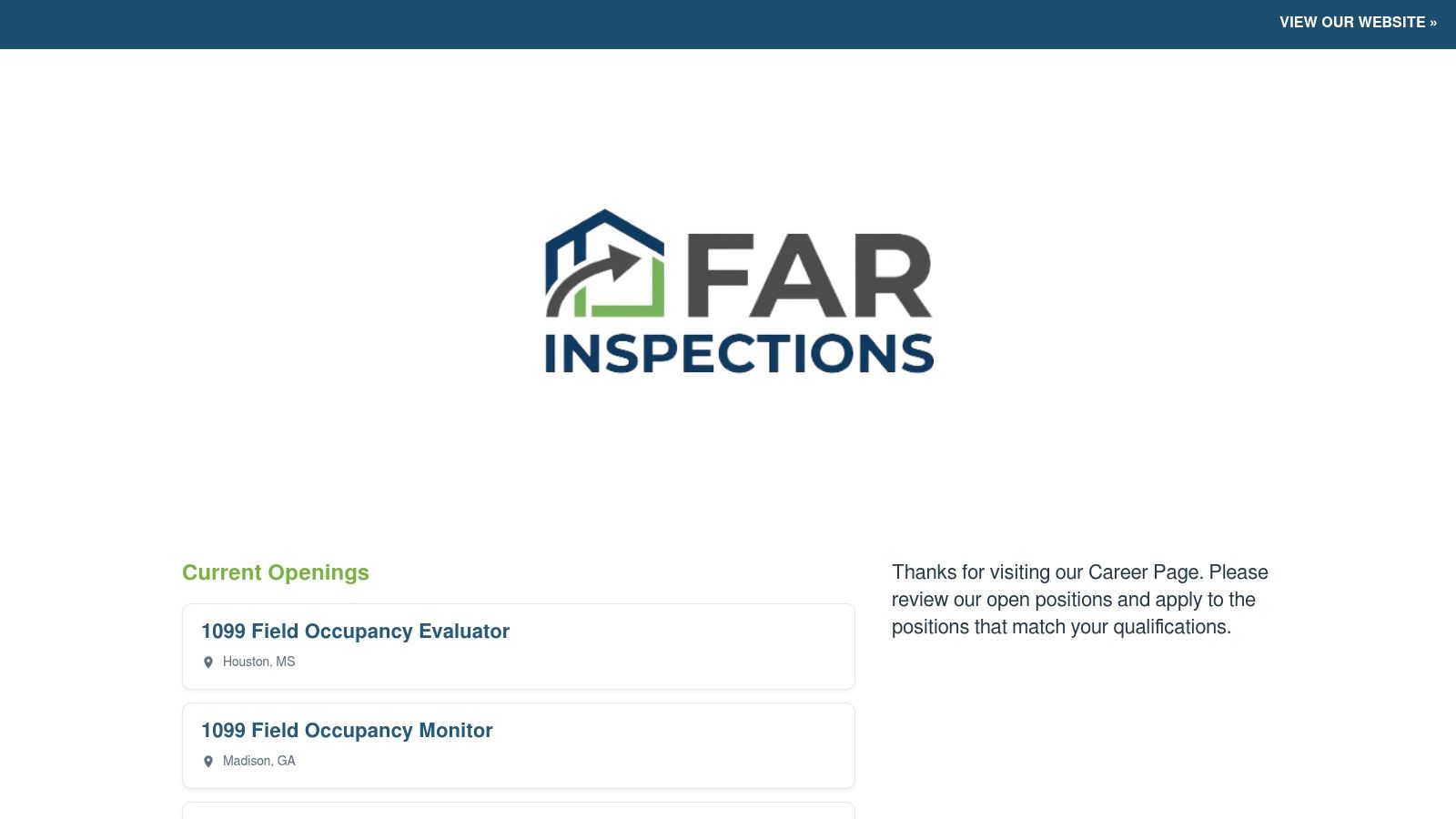
Reviewed regional career listings have shown active FAR postings across several of these Southeast states alongside GIS contract openings in Virginia and North Carolina. Checking both employer-controlled systems lets you compare real county demand across the Carolinas, Tennessee, and Virginia before investing time in onboarding.
Steady regional turnover keeps these openings reappearing even in mature construction and housing markets. According to Bureau of Labor Statistics occupational profile data, construction and building inspectors held 153,900 jobs in 2025. Retirements, transfers, and regular field turnover keep creating fresh seats for dependable local inspectors, so a territory that shows no openings this month may have a live posting the next.
Filtering by County and Role Title
- State and County Verification: Always filter down to your exact county or named territory, since statewide growth in markets like North Carolina or Tennessee doesn't mean every rural ZIP code has daily order volume.
- Employment Classification: Confirm whether a specific Southeast listing is classified as 1099 independent-contractor, part-time, or employee work before applying.
- Role Title Variations: Search across related terms (occupancy inspector, mortgage field inspector, property verifier) because similar field-inspection routes appear under different job titles.
- Workload Reality: A live local posting signals current recruiting interest without promising a guaranteed weekly paycheck, so verify average monthly order counts for your territory directly with the coordinator.
How the seven occupancy inspection employers compare
The seven entry points differ less in the basic task than in how work is assigned and how you get into the system. Each one can lead to occupancy-related field work, but the practical fit depends on whether you want company-controlled assignments, local postings, territory-based contractor work, or a direct vendor relationship. Treat each employer as its own route and confirm the work model before spending time onboarding.
| Item | Work Model | Application Route |
|---|---|---|
| FAR Inspections | Field inspection contract work; some listings identify 1099 status | Apply through the company careers portal and check local openings |
| GIS Field Services | Contract field inspections in territory-based locations | Check the openings page or submit a general application |
| Mortgage Bankers Field Services | Independent-contractor, task-based work with flexible scheduling | Apply through the company website and provide your coverage area |
| Safeguard Properties | Territory-based vendor or independent-contractor field work | Check the company's vendor or recruiting channels |
| National Mortgage Field Services (NMFS) | Mortgage field inspection work, potentially in a local territory | Contact the company through its website |
| Mortgage Bankers Field Services Local Inspection Postings | Territory-based contractor work with flexible scheduling | Apply through the specific local posting |
| FAR and GIS Southeast Territory Openings | Local field-inspection contract roles; status varies by listing | Apply through FAR or GIS employer-controlled career systems |
Pay is generally per order, so confirm rates and payment timing with each employer before accepting work. FAR and GIS are the clearest employer-controlled routes, with applications flowing through their own career systems. Mortgage Bankers Field Services gives you two doors: the company website for general contractor work and local postings when you want a specific territory. Safeguard Properties and NMFS require more patience because the route depends on vendor intake or direct contact.
For North Carolina, South Carolina, Tennessee, and Virginia, the Southeast territory entries deserve separate attention. Local openings can differ from general applications because coverage needs are tied to named territories. I would prioritize the route that matches the county you can cover reliably, then ask how assignments are released, how revisions are handled, and what approval impact your reports support.
Choosing the Right Occupancy Inspection Job
Picking the right entry point comes down to matching your geography, vehicle costs, and schedule against how each company assigns orders. Before submitting applications, read every line of a local posting carefully using a structured job description analysis guide so you don't overlook hidden vehicle, insurance, or turnaround requirements.
Run through four quick verification checks with any hiring coordinator before onboarding. First, confirm whether the role is 1099 contractor or W-2 employee status. Second, ask for exact per-inspection rates, photo-rejection policies, and payout schedules. Third, clarify whether assignments are strictly exterior occupancy checks or broader property-preservation orders. Fourth, calculate real route math by comparing expected stops per week against local fuel prices and county drive times across your target area.
How Field Inspections Connect to Occupancy Approval Readiness
Whether an inspector is verifying a financed home for a mortgage servicer or evaluating a finished building for a local authority having jurisdiction, inspection timing controls when a property can move forward. A newly built home or commercial facility can look physically complete and still sit unable to open, receive occupants, or pass final approval until required utilities and life-safety systems are operating properly.
For construction companies, residential builders, commercial property owners, and gas utilities across North Carolina, South Carolina, Tennessee, and Virginia, delayed permanent natural gas lines often create that exact bottleneck right before final sign-off. Blue Gas Express addresses that gap with temporary mobile compressed natural gas (CNG) and liquefied natural gas (LNG) delivery, keeping building heat, hot water, and other required systems live for occupancy permits and inspections. Our mobile gas units arrive in 16 ft by 8 ft trailers, plug into standard natural gas meters or regulators in 30 minutes or less, and use remote monitoring to schedule hot-swap refills so inspection schedules stay intact.
Treat every live local posting as your starting line, not the final word. Verify county coverage, pay structure, and scope directly with the employer so your first month on the road builds reliable, repeatable income.
If a delayed permanent gas line is holding up your occupancy permit, generator commissioning, or construction schedule in North Carolina, South Carolina, Tennessee, or Virginia, Blue Gas Express delivers rapid temporary mobile CNG and LNG units straight to your site. Our team handles connection equipment, remote monitoring, and uninterrupted fuel delivery so essential heating and hot water systems stay operational through final inspection. Visit Blue Gas Express to request temporary natural gas support and keep your project moving on schedule.