

Natural gas can be liquefied at about -260°F into LNG, but it does not freeze solid in ordinary winter weather. Water ice and hydrates are what usually stop flow.
So if methane itself stays gaseous on the coldest morning your site will ever see, why does a heater surge, a generator test fail, or a whole building lose gas during a cold snap? That gap between the fuel freezing and the system freezing up is where most winter trouble lives, and it's the difference a builder or facility manager needs to understand before blaming the tank.
What Happens When Gas Gets Very Cold
Say a construction heater runs fine at noon, then sputters at dawn. Or a generator starts for a commissioning test, loses fuel pressure, and shuts down while frost is still on the enclosure. The first fear is often that the gas froze solid inside the tank.
That almost never describes natural gas. Natural gas is mostly methane, and methane can be cooled on purpose into a liquid called LNG at about -260°F, or about -162°C. A true solid only becomes possible at even colder cryogenic temperatures that outdoor winter doesn't reach. A kitchen freezer, a parked compressed-gas trailer, and a building line on a bitter night all leave methane as a gas.
The word freeze usually points elsewhere
In field language, frozen gas usually means something else turned solid. It can be water ice inside a regulator, meter, or valve. It can also be a hydrate, a solid made from water plus gas under pressure.
That distinction is familiar in other building systems. Just as Erica's Plumbing, Air Conditioning & Restoration explains how an air conditioner can ice up for reasons other than the weather outside, a gas system can lose flow because moisture and pressure conditions create a blockage, not because methane became a block of ice.
Don't ask only how cold the air is. Ask which component formed a solid, and where it formed.
Keep the temperature table in the next section as your reference. It separates liquefying, solidifying, icing, and hydrate formation, which are four different events with four different fixes.
Temperatures That Liquefy or Solidify Gas
Read each row as a phase change, not as a trivia list. The substance, temperature, and pressure together decide whether you get a gas, a liquid, or a solid.
| Substance or event | Temperature | Pressure note | What forms |
|---|---|---|---|
| Methane boiling, LNG region | about -161.5°C to -162°C, near -260°F, or 111.6 K | about atmospheric | Liquid occupying roughly 1/600 of gas volume |
| Methane triple point | about -182.47°C or 90.68 K | about 0.117 bar absolute | Solid possible; no stable liquid below this |
| Nitrogen boiling | -195.8°C | 1 atmosphere | Liquid nitrogen |
| Nitrogen freezing | about -210°C | 1 atmosphere | Solid nitrogen |
| Water freezing in equipment | 0°C, or 32°F | ambient lines and regulator outlets | Ice that can block flow |
| Methane hydrates | can form near or above 0°C; dissociation studied from about -2.7°C to 4.9°C | needs water plus pressure | Solid hydrate, not solid methane |
The LNG row is a liquid, not a frozen block
The U.S. Energy Information Administration guide to liquefied natural gas defines LNG as natural gas cooled to approximately -260°F, or about -162°C, at which point it changes from a gas into a liquid. That's close to methane's atmospheric-pressure boiling point because methane is the principal component of pipeline-quality natural gas.
Calling that liquid frozen gas misleads crews. It's an extremely cold liquid that boils back into gas when it absorbs heat. It doesn't thaw like ice from a freezer, and it doesn't stay put if insulation fails. Tanks, pressure controls, and vaporizers exist to manage that constant tendency to boil.
The reason anyone bothers is volume. The liquid occupies roughly 1/600 of the volume of the gas in its gaseous pipeline form. That 600-to-1 reduction lets an insulated tank or specialized truck carry a large energy load to a site that doesn't yet have a permanent line. Without that shrinkage, moving the same amount of gas by road would take far more space.
The solid row sits far below LNG storage
Below methane's triple point, methane can't remain a stable liquid and may form a solid instead. LNG systems aren't designed to go there. They're built to hold methane in the liquid region, limit heat leaking in, and vaporize liquid in a controlled way when a building or process needs gas.
That's why asking can you freeze gas needs a precise answer. Yes, in a laboratory or specialized cryogenic system, methane can reach a solid phase. No, ordinary commercial natural gas doesn't typically become a solid under practical conditions.
Nitrogen shows why there's no universal freeze point
Nitrogen boils colder than methane and freezes colder still. Two gases in the same plant can therefore behave differently at the same temperature. Composition matters, and so does pressure, but pressure alone doesn't freeze a gas at room temperature. The fluid still has to cross the relevant temperature boundary.
Practical rule: Name the substance before you name a freezing temperature. Methane, nitrogen, water, and a hydrate don't share one number.
For daily decisions, sort the rows into three groups. A CNG trailer lives far above methane's boiling region, so your concern is pressure equipment and moisture. An LNG tank lives at the boiling row, so your concern is insulation and boil-off. The solid methane row is mainly a boundary that tells you ordinary cold isn't turning pipeline gas into a solid. The water and hydrate rows are the ones that explain most winter shutdowns.
Where Gas Flow Stops and Why
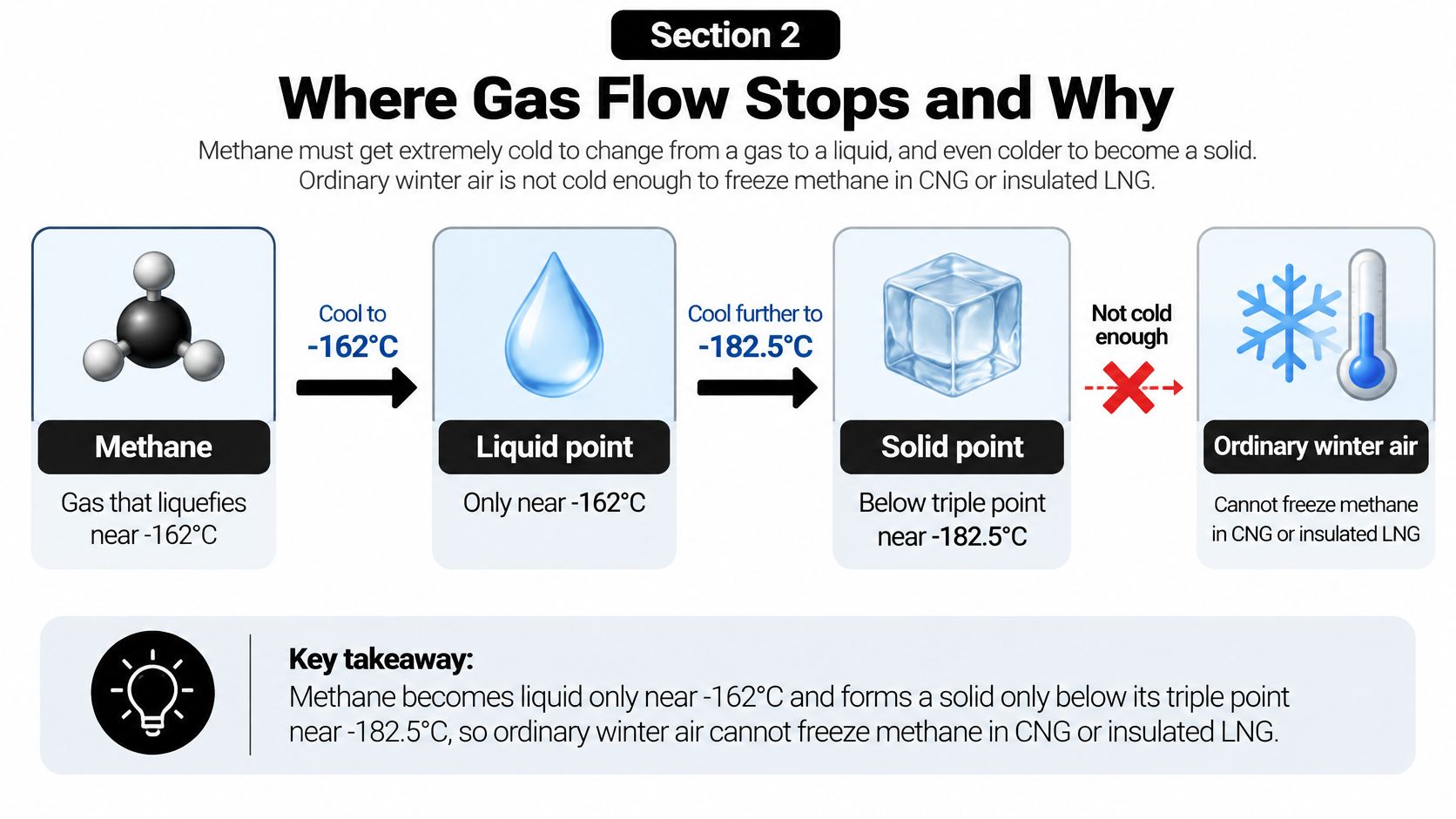
Start with what can't happen in normal winter service. The NIST WebBook entry for methane puts methane's triple point at approximately 90.68 K, or -182.47°C, at about 0.117 bar absolute, and its normal boiling point at about 111.6 K, or -161.5°C. Below the triple point methane can't exist as a stable liquid and may form a solid. Above it, in every outdoor condition a jobsite faces, methane in CNG stays gaseous and methane in insulated LNG stays in its intended liquid region.
Water behaves on a completely different scale. Liquid water freezes near 32°F and narrows a passage the way ice narrows a garden hose left outside overnight. A thin ring of ice inside a small regulator port doesn't need to fill a large pipe to stop a heater. It only needs to restrict the narrowest point.
Hydrates add a third mechanism. Water plus natural gas under pressure can form a solid that looks like ice but isn't frozen water, and it can appear at temperatures well above methane's cryogenic range. A 2023 Energy study indexed by RePEc examined methane-hydrate dissociation across an initial temperature range of 270.5 to 278 K, equivalent to approximately -2.7°C to 4.9°C. Heavier hydrocarbons and carbon dioxide in an unconditioned stream can also drop out or freeze long before pure methane solidifies, restricting valves, regulators, and metering equipment.
How a regulator creates its own cold
Trace one common chain from start to finish. Wet gas enters a pressure-reduction device. As it expands, its temperature falls. Water at the outlet freezes, or water and gas form a hydrate. Flow drops, downstream pressure falls, and the burner or engine starves even though the air outside is above freezing.
That chain explains three familiar calls. A construction heater surges because the restriction keeps changing at the regulator. A generator passes a no-load start, then dies during commissioning when higher flow creates a bigger pressure cut at a valve. A utility customer reports dead appliances, but the appliances are fine and production upstream has fallen because wellheads and gathering equipment froze off.
A system can lose flow on a mild day if expansion makes one small outlet much colder than the surrounding air.
Match the symptom to the component that failed
| What you see | What actually failed | What to check or do |
|---|---|---|
| Flow drops at a regulator while air is above freezing | wet gas cooled by expansion, then ice or hydrate | confirm dry gas, stage the pressure cut, insulate and watch outlet temperature |
| Valve or meter plugs in mild cold | water or heavier hydrocarbons, not solid methane | moisture removal and dew-point margin before the restriction |
| Whole region loses supply in a polar outbreak | wellhead freeze-off, frozen mechanical parts, or delayed repairs | treat as upstream supply risk and arrange backup fuel |
| LNG pressure rises as the tank warms | liquid boiling back to gas | insulation, pressure management, and controlled vaporization |
Use the rows in order. First confirm the gas is dry enough for the coldest point it will meet, which is often a regulator outlet, not the tank. Then check whether the pressure cut is staged, whether exposed parts have insulation or heat tracing where appropriate, and whether outlet temperatures are being watched during high flow. Controlled depressurization matters too, because a sudden large drop can create the cold spot that starts the plug.
Don't stop at the building wall. The NERC Reliability Insights report from March 2025 notes that during Winter Storm Elliott, Appalachian natural-gas production fell by more than 6 Bcf per day because of wellhead freeze-offs, mechanical freezing, and weather-related repair delays. That kind of loss can reach a customer whose own piping never iced at all.
So the useful diagnostic question isn't what temperature freezes gas. It's which component froze or formed hydrates, and where in the supply path that happened. A local plug calls for moisture control and regulator protection. A regional freeze-off calls for backup supply planning. Treating both as frozen methane sends crews to warm a tank while the restriction sits in a valve, or miles upstream at a wellhead.
How CNG LNG and Pipeline Gas Handle Cold
Think about how the fuel is packed. Pipeline gas, CNG, and LNG aren't three kinds of frozen gas. They're the same basic fuel stored and moved in three different ways, and cold attacks each method at a different point.
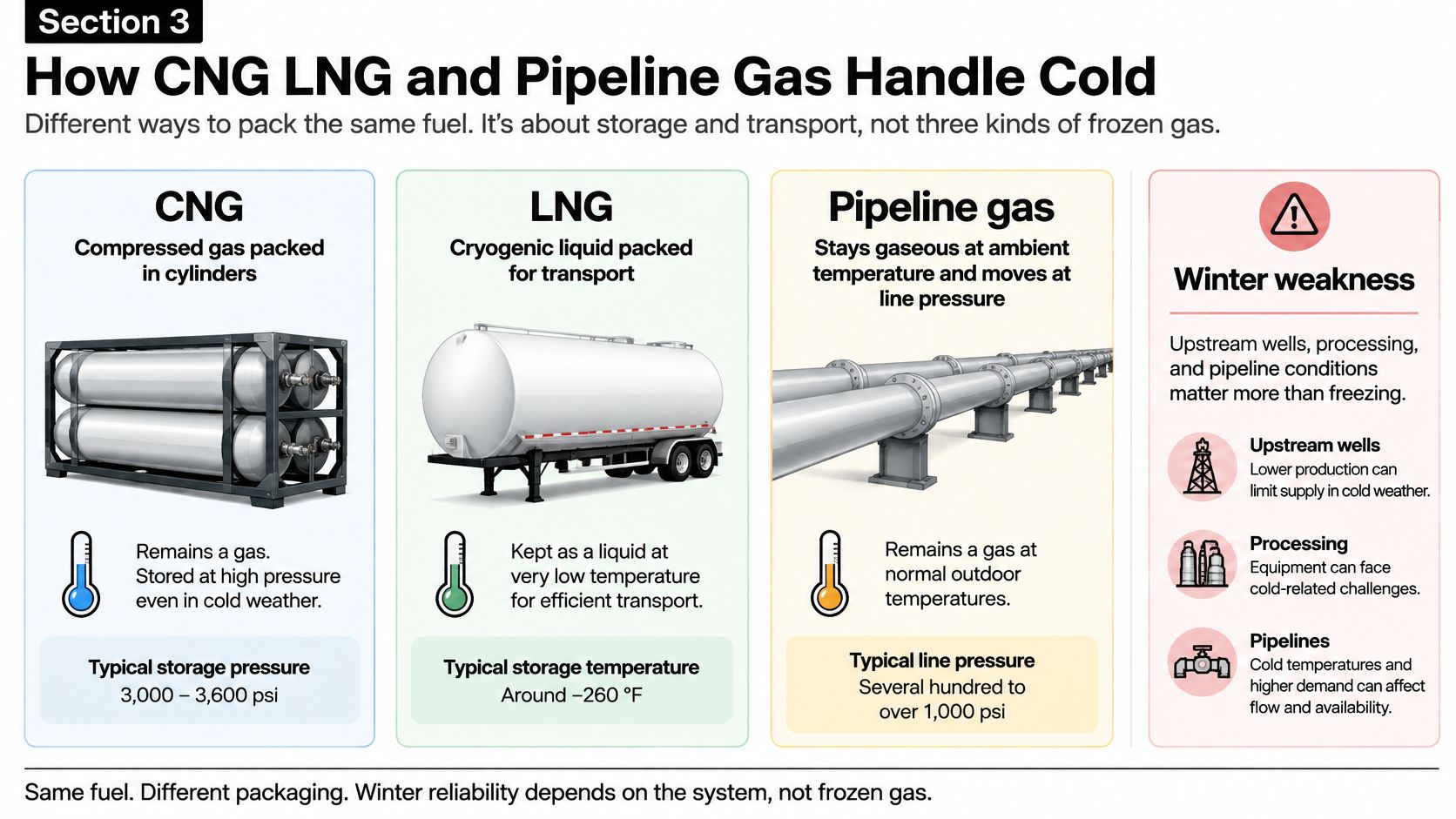
| Supply form | Typical temperature | How it is stored | Cold-weather exposure | Fits when |
|---|---|---|---|---|
| Pipeline gas | ambient | utility line at operating pressure | upstream freeze-offs and weather repair delays | permanent service is already reliable |
| CNG | gaseous, not cryogenic | high pressure in cylinders or a mobile unit | regulator outlets can ice if gas is wet | temporary or smaller loads with dry gas and protected regulators |
| LNG | about -260°F or -162°C | insulated cryogenic tank, then a vaporizer | boil-off if heat enters; cold injury and brittle ordinary steel | a large volume or a longer gap before a pipeline is ready |
Pipeline gas stays warm, but its supply path may not
Pipeline gas remains gaseous at ambient temperature and moves at line pressure. Inside a heated building, solid methane isn't a realistic concern. The exposure sits upstream at wells, gathering lines, processing equipment, and compressors, where water, mechanical parts, and repair access can all fail in severe weather. A reliable permanent line is still the simplest supply when it's installed and the upstream system is performing.
CNG packs by pressure, and the regulator is the cold spot
CNG remains a gas and gains density by raising pressure rather than dropping temperature. That makes it practical for temporary loads without cryogenic tanks, but it puts attention on the pressure-reduction step. The Air Products gaseous nitrogen safetygram gives a useful comparison for substance-specific behavior, listing nitrogen's normal boiling point at -195.8°C and its freezing point at approximately -210°C at 1 atmosphere. Different gases cross phase boundaries at different temperatures, and increasing pressure alone doesn't make a gas solid at ordinary temperatures.
For CNG equipment, the immediate hazard is expansion cooling. As compressed gas expands through a regulator, the Joule-Thomson effect can lower its temperature enough to form ice or hydrates from water contamination. Gas dehydration, verified dew-point margins, staged pressure reduction, insulation, and temperature checks at regulator and valve outlets address that risk directly.
LNG packs by cold, and heat leaking in is the issue
LNG takes the opposite route. Holding gas as a cryogenic liquid gives a compact load, but heat entering the tank makes liquid boil back to gas. Insulation, pressure management, and a vaporizer aren't accessories. They're the system that turns stored liquid into usable gas at the rate a building, heater, or generator demands.
That trade can bridge a delayed permanent line, a short outage, or a large temporary load. It also moves risk toward cryogenic handling, transport logistics, and vaporization capacity. If the vaporizer can't keep up, having liquid in the tank doesn't guarantee enough gas at the burner.
Choose the packing method whose weak point you can actually protect on your site.
The verdict is situational. Choose CNG when the load fits gaseous storage and you can keep the gas dry and the regulators protected. Choose LNG when volume or duration justifies cryogenic equipment and trained handling. Stay with pipeline gas when permanent service is already reliable and upstream conditions aren't interrupting supply.
What Cryogenic Liquid Does to Equipment
Once you deliberately cool gas into LNG, the question changes. It isn't whether the fuel will freeze in winter. It's what a liquid held near -260°F can do to skin, metal, hoses, and supports that weren't built for cryogenic service.
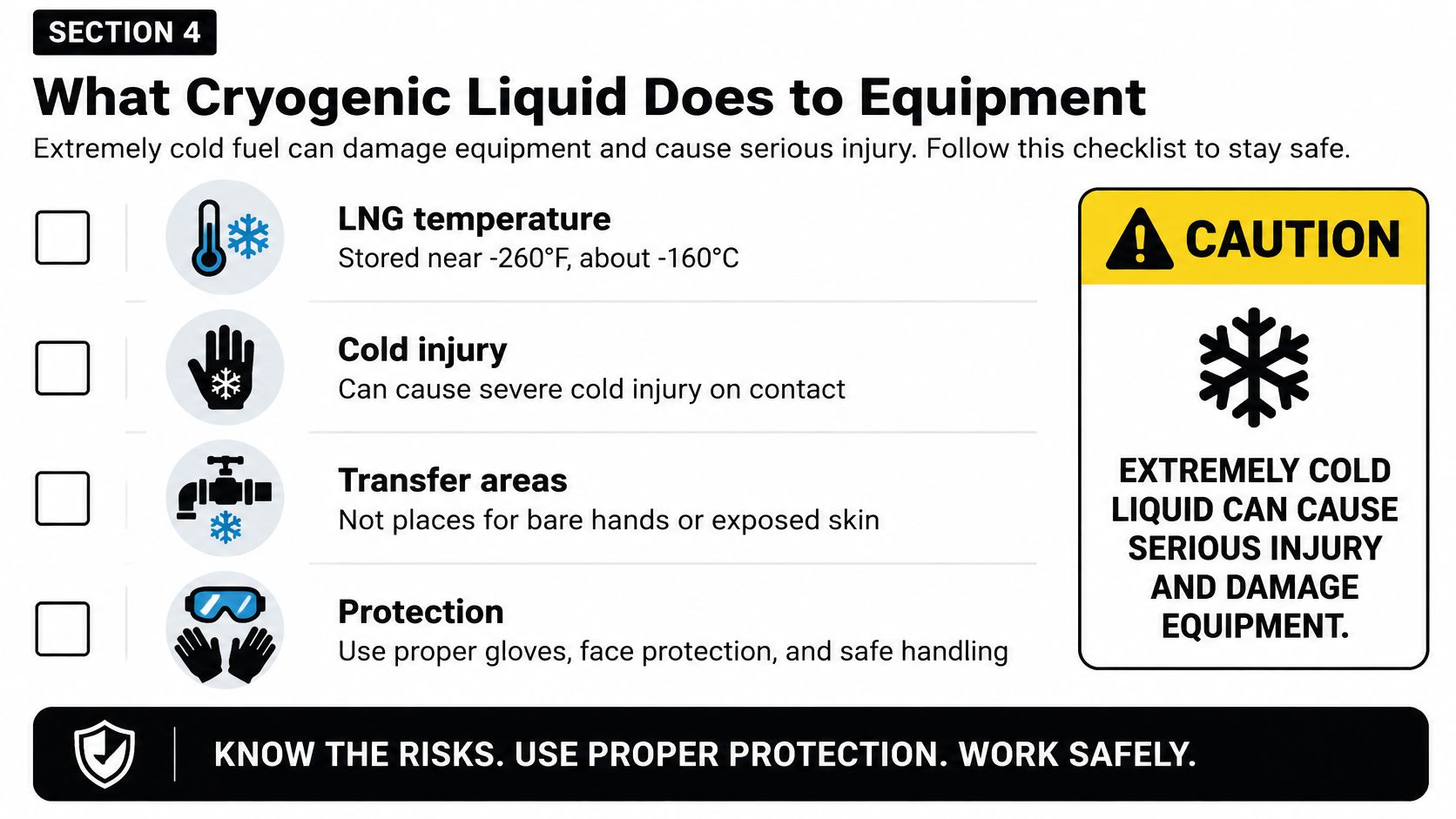
The PHMSA LNG rail rulemaking document describes LNG stored around -260°F (-160°C), where contact can cause severe cold injury and ordinary carbon steel can become brittle and fracture at cryogenic temperatures. Materials exposed to LNG may also experience thermal contraction and loss of structural integrity, including piping and supporting infrastructure.
Cold changes how metal behaves
Metal shrinks as it gets colder. At ordinary winter temperatures that movement is small and expected. At cryogenic temperatures, contraction can stress joints and supports, and unsuitable steel can lose toughness. Instead of bending under a load or impact, brittle material can crack.
That's why transfer areas aren't places for bare hands, ordinary hoses, or improvised fittings. Crews need compatible valves, connections, and personal protection selected for the temperature and pressure involved. When you're reviewing small gas connections and control hardware for a setup, Material Handling USA lab gas fittings illustrates the kind of purpose-built fitting category to evaluate rather than substituting general hardware. The key check is always the manufacturer's rating for your actual service, not whether a part merely threads together.
- Materials rated for cryogenic service: Confirm tanks, piping, valves, hoses, and supports are specified for LNG temperatures.
- A planned vapor path: Size the vaporizer for peak gas demand, not just average demand.
- Pressure controls that expect boil-off: Treat boiling as normal when heat enters, and manage it rather than sealing liquid in and forgetting it.
- Separation and shutdown: Provide required clearances, controlled transfer areas, and an emergency shutdown crews can reach and operate.
A complete LNG setup is a chain, not a tank
A working installation needs an insulated container, compatible transfer hoses, pressure controls, regulators, and a vaporizer that turns liquid back into gas. Odorant is added to the vaporized gas so leaks can be smelled, not to the liquid in the tank. If any link is undersized or made from the wrong material, the chain limits the whole supply.
Think through the sequence before delivery day. Liquid leaves storage, enters the vaporizer, becomes gas, receives odorant, passes through regulation, and enters the building or pipeline connection. Each step needs a pressure and temperature range the equipment can handle. Each step also needs a way to stop flow if a hose, fitting, or control fails.
Boiling inside an LNG tank isn't automatically a malfunction. Unmanaged pressure from that boiling is the problem.
LNG can supply a site that doesn't yet have a working pipeline, cover peak demand, or support a disrupted feed. It doesn't erase winter risk. It moves that risk onto transport schedules, vaporization, material choice, and upstream availability. Before accepting a cryogenic delivery, confirm four things in plain language: the materials are rated for the temperature, the vaporizer path is planned, trained people will handle transfer, and everyone knows the shutdown steps. If one answer is vague, the setup isn't ready.
Keep Temporary Gas Flowing in a Cold Snap
If methane is still a gas, waiting for the fuel to thaw won't fix an ice plug, a hydrate, or an upstream freeze-off. Work through the decision in three steps, starting at the restriction and ending with supply.
Three checks before the next cold morning
Confirm dry gas and protected regulators. Check dew-point margin, staged pressure reduction, insulation, heat tracing where appropriate, and outlet temperatures during real flow, not just at idle.
Separate a local plug from a regional loss. A single heater starving at its regulator points to local moisture and expansion cooling. Many buildings losing pressure together points upstream to production, gathering, compression, or delayed repairs.
Arrange temporary supply before the date slips. If a permanent line will miss its hookup date, match the load and outage length to CNG or LNG while crews can still place equipment, verify connections, and test under load.
That third step is where we at Blue Gas Express fit for construction, industrial, residential, and utility users. We routinely solve natural gas line install delays and natural gas line maintenance and associated outages during residential, commercial, and industrial construction. We also serve property needs such as occupancy permits, generator commissioning, freeze prevention, and general heat while a permanent line is delayed or maintenance is underway.
In plain terms, temporary supply can range from small gas boxes to 16-foot trailers and larger trailer loads. Those units can bridge a missed hookup date, keep a model home supplied, or cover a utility disruption, then come off when the permanent line is ready. The form matters: delivered LNG is a cryogenic liquid near -260°F that needs vaporizers and compatible equipment, while CNG remains high-pressure gas that needs dry gas and protected pressure regulation.
Book the backup around the install date and the load, not after the first failed start proves you needed it.
Your next check is specific. Write down the peak load, the expected gap in permanent service, and the equipment that must run for heat, occupancy, or commissioning. Then choose CNG when gaseous storage and regulator protection fit that load, or LNG when volume and duration justify cryogenic gear. Require compatible materials, a tested vaporizer or regulator path, and a clear shutdown plan either way. That preparation answers can you freeze gas in the way that matters on site: methane won't freeze in your winter, but water, hydrates, and missed supply dates can still stop your project if you don't plan for them.
If a delayed permanent line, maintenance outage, or cold snap threatens heat, occupancy, or generator commissioning, Blue Gas Express offers temporary mobile CNG and LNG supply sized from small gas boxes to larger trailer loads. Tell us your peak load and hookup date, and we'll help you match the right temporary system so your project keeps moving until permanent service is ready.