

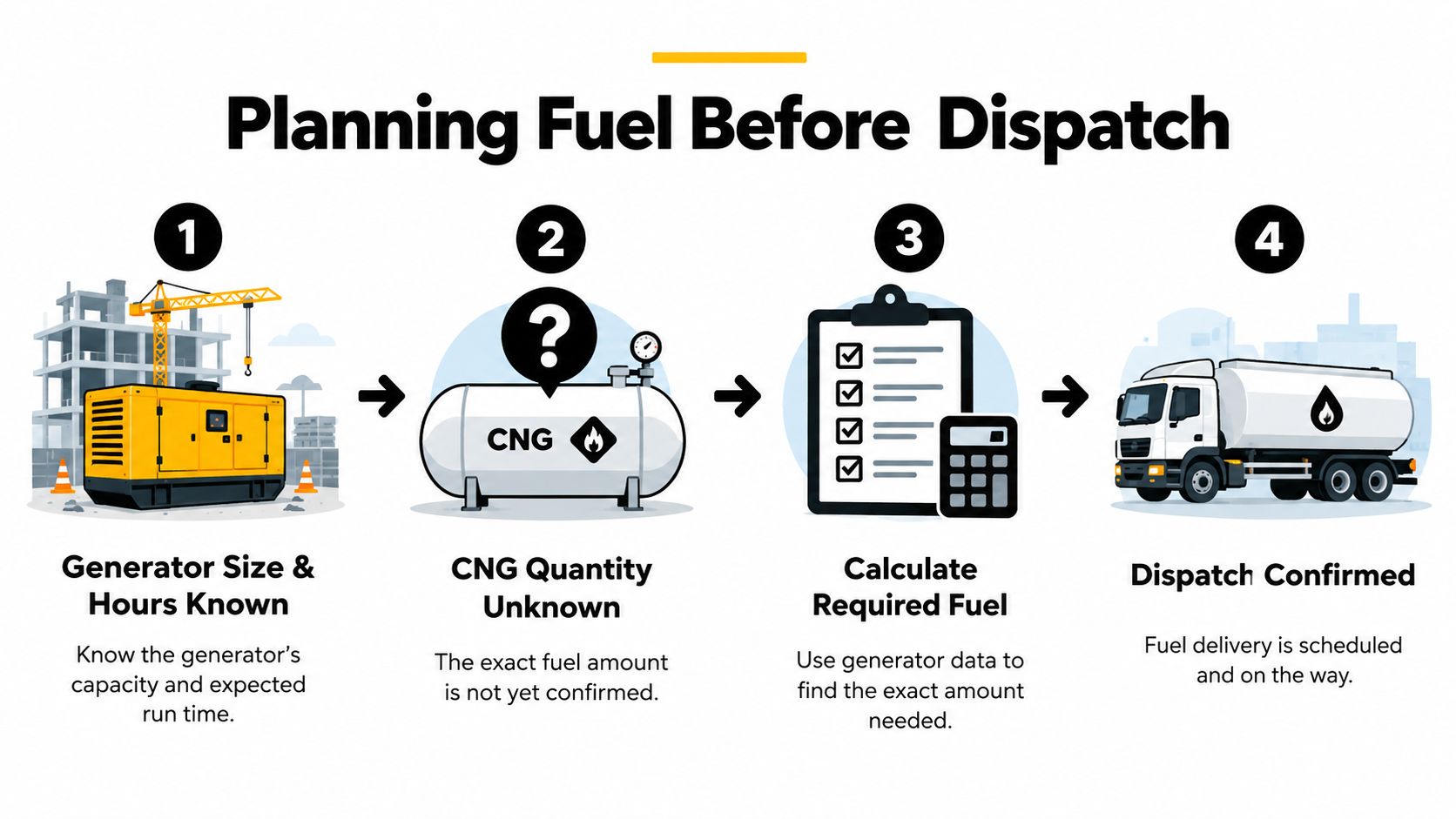
The generator is selected, the construction schedule is set, and the crew expects power when they arrive. But the fuel order still isn't ready: daytime equipment, overnight standby, and brief demand peaks don't add up to a reliable CNG quantity just because you know the generator's size. Before dispatch, you need a fuel estimate that follows the work schedule and translates into a delivery plan the supplier can support.
Planning Fuel Before Dispatch
A temporary-power plan can look complete until someone asks when the first trailer will need replacing. The electrical contractor knows which equipment will run, the superintendent knows the working hours, and procurement has a full-load fuel figure. What's missing is the connection between those inputs.
Consider a construction site that needs production power during the day and a smaller overnight load for essential equipment. Ordering against the generator's maximum consumption for the entire schedule ignores how the site will operate. Ordering against an assumed average can be equally misleading if it hides extended operation or unexpected commissioning work.
CNG generator fuel consumption should become a dispatch quantity, not remain a specification-sheet number. Start by collecting the information needed to make that translation.
Assemble the dispatch inputs
- Electrical demand: Expected generator output in kW for each operating period, including overnight requirements.
- Equipment fuel data: The manufacturer's consumption curve for the actual generator configuration, not merely its rated capacity.
- Operating schedule: Planned runtime, shutdown periods, commissioning activities, and possible extensions.
- Gas specification: Supplier heating value and the measurement conditions attached to the fuel data.
- Procurement units: Whether the delivery will be recorded and billed by mass, standard volume, or energy.
Ask the rental company to identify any assumptions behind its consumption figures. A rating without the associated load, gas specification, and operating conditions is an incomplete purchasing input.
Then separate expected consumption from contingency. A reserve should address a named risk, such as a delayed delivery or extended test, rather than compensating for missing data.
Dispatch rule: Don't approve a fuel order until the electrical demand, consumption assumptions, and delivery units can be traced through the same worksheet.
The equipment needs electrical energy. The supplier delivers fuel mass, volume, or energy. Those are different quantities, and converting between them transparently is the practical purpose of the calculation.
Understanding Load and Heat Rate
Heat rate expresses the fuel energy required to produce a net kilowatt-hour of electricity. A lower heat rate means less fuel energy is needed for the same electrical output. The U.S. Energy Information Administration's generator-efficiency comparison also explains that fuel use varies with prime mover, fuel heat content, emissions controls, and operating conditions, so nameplate capacity isn't a universal consumption rate.
That distinction matters when a rental specification gives you rated kW but no usable fuel curve. Capacity describes what the machine can supply under its specified conditions. It doesn't tell you what the connected equipment will demand throughout the project.
Separate electrical work from fuel input
The basic relationship is straightforward:
Electrical energy, kWh = operating output, kW × runtime, hours
If an appropriate heat rate is available:
Fuel energy, Btu = electrical energy, kWh × heat rate, Btu/kWh
The word appropriate carries the uncertainty. A heat rate for a different generator technology, loading condition, or measurement basis should be treated as a screening reference, not a delivery commitment.
For context, EIA reported consumption-weighted natural-gas averages of 9,788 Btu/kWh for simple-cycle generation and 7,340 Btu/kWh for combined-cycle generation in 2015, in its comparison linked above. Simple-cycle equipment in that comparison included gas turbines, internal-combustion engines, and steam turbines. Those historical fleet averages don't define a particular mobile CNG generator's performance.
Choose the strongest available evidence
| Available information | Practical use | Main limitation |
|---|---|---|
| Measured fuel and output from the actual installation | Update the operating forecast | Must represent the upcoming work |
| Manufacturer consumption curve | Estimate fuel at planned loads | Requires matching equipment and gas assumptions |
| Broad heat-rate reference | Check the order of magnitude | Isn't a model-specific guarantee |
Request fuel rates at loads that resemble the project's actual operating periods. Don't assume fuel consumption falls in direct proportion to electrical output when the generator unloads.
Measured data becomes especially useful after commissioning, provided fuel use and electrical output cover the same interval. A delivery receipt alone can't establish generator efficiency if the associated runtime and output weren't recorded.
Use heat rate to test whether a forecast is plausible, then replace broad assumptions with equipment-specific information. Climate, equipment condition, and the operating profile can all shift the result from the initial estimate.
Converting Between CNG Units
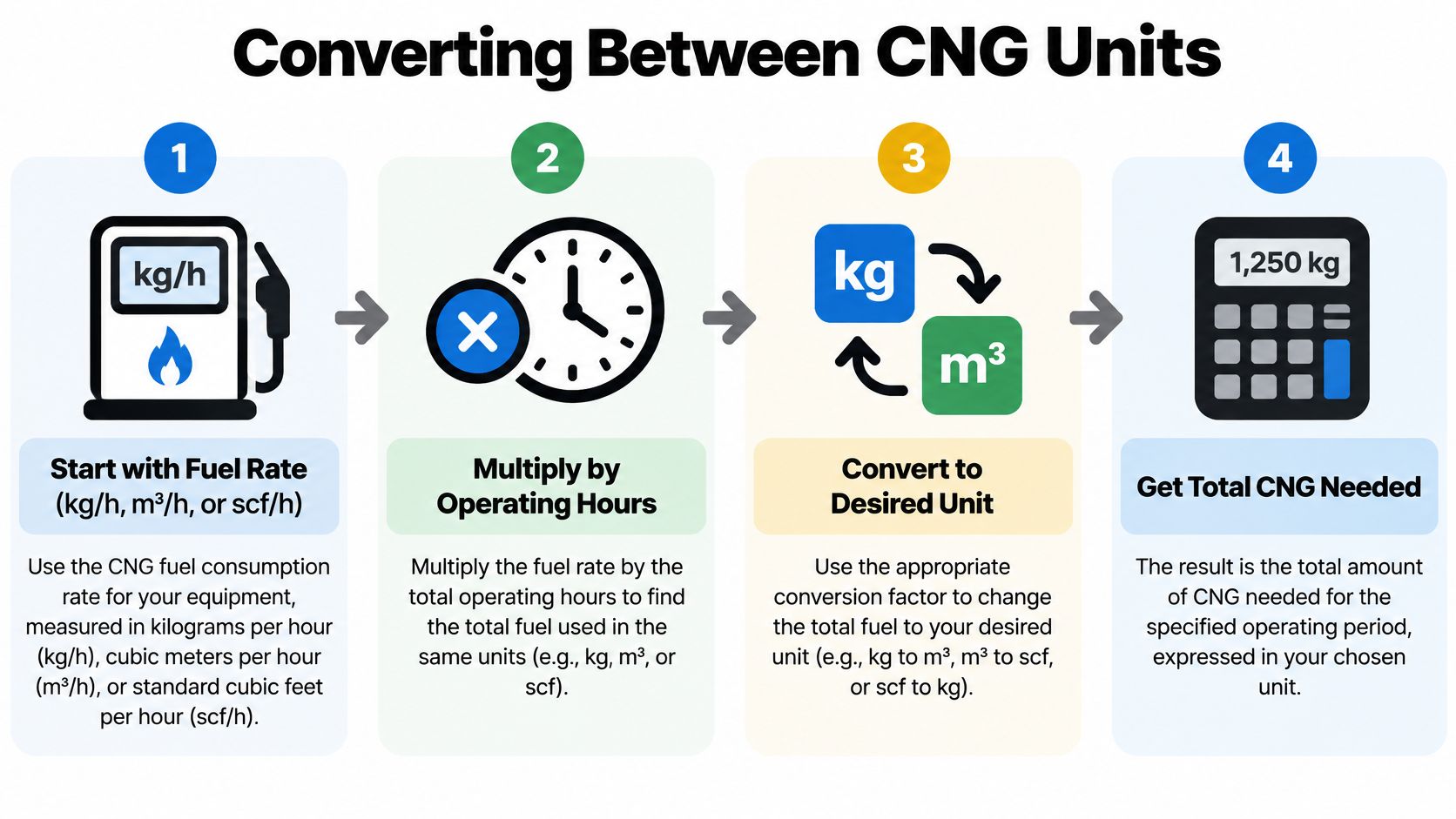
A consumption calculation can be internally correct and still produce the wrong order if the generator supplier and fuel supplier use different units. Keep the original fuel-rate units visible until each operating period has been calculated. Convert the total only after confirming the procurement basis.
Never treat a unit label as a complete gas specification. A cubic metre reported at stated reference conditions isn't interchangeable with an unspecified volume reading.
Build the calculation in consistent units
Use a worksheet with columns for operating period, expected kW, runtime, applicable fuel rate, and calculated fuel quantity. For each row, select the rate corresponding to that load.
| Starting rate | Period calculation | Result |
|---|---|---|
| kg/h | Fuel rate × operating hours | kg |
| Standard m³/h | Fuel rate × operating hours | Standard m³ |
| scf/h | Fuel rate × operating hours | scf |
Here, scf means standard cubic feet. Obtain the temperature and absolute-pressure reference used by the manufacturer and supplier rather than assuming their definitions match.
The dimensional arithmetic should remain visible: kg/h × h = kg. Apply the same cancellation check to every row before adding quantities.
Convert using supplier-confirmed properties
Use these templates with compatible units:
- Volume to mass: Gas mass = reference-condition volume × gas density at those same conditions.
- Mass to volume: Reference-condition volume = gas mass ÷ matching gas density.
- Volume to energy: Fuel energy = reference-condition volume × heating value per reference-condition volume.
- Energy to therms: Therms = fuel energy ÷ supplier-confirmed energy per therm.
- Delivery quantity: Procurement-unit consumption + separately documented reserve.
Therms describe energy, not a physical gas volume. Converting scf or standard cubic metres into therms therefore requires the gas heating value, not just a volume-conversion factor.
For kilogram conversions, ask for density or composition data suitable for the stated reference conditions. Also confirm whether the manufacturer and supplier use compatible heating-value bases. Don't combine a heat rate on one basis with a gas heating value on another without an agreed correction.
A compact arithmetic pattern is:
Daytime fuel + overnight fuel + additional event fuel = forecast consumption
Forecast consumption × verified procurement conversion factor = order-basis consumption
Order-basis consumption + stated reserve = planned supply
Keep all terms in the first expression in the same unit, such as kilograms. If daytime consumption is recorded in standard cubic metres and overnight consumption in kilograms, convert before summing.
The same discipline applies to scf and therms. A spreadsheet won't flag an incompatible reference condition or energy basis unless someone builds that check into it. Have the gas supplier confirm the conversion inputs before the worksheet becomes a purchase order.
Calculating Consumption Across Load Scenarios
The most useful operating model reflects how the crew will use power, not how long the generator will be available. Technical research documents load-related changes in engine behavior, including exhaust temperature, reinforcing why generator operating conditions need to be evaluated across load. For delivery planning, model fuel in kilograms or standard cubic metres per hour through the schedule, including overnight operation and peak events.
The following scenarios are calculation templates, not measured case studies or universal performance curves. Every rate must come from the selected manufacturer's data or suitable site measurements.
Steady overnight operation
Suppose the site has a stable overnight electrical requirement. Identify the corresponding low-load fuel rate and multiply it by the actual overnight operating duration.
Overnight consumption, kg = verified low-load rate, kg/h × overnight runtime, h
This is a reasonable use of a constant hourly rate because the modeled load is steady. It isn't permission to use the full-load rate or reduce that rate proportionally without supporting data.
Check whether “standby” means running under a small load or shut down and available to start. Those operating states shouldn't share an assumed consumption entry.
A workday with changing demand
For daytime construction, divide the schedule according to actual activities. Mobilization, normal production, testing, and cleanup may require different operating entries.
| Work period | Rate to obtain | Calculation output |
|---|---|---|
| Light activity | Matching low-load kg/h | Rate × duration, in kg |
| Normal production | Matching working-load kg/h | Rate × duration, in kg |
| Peak activity | Matching peak-load kg/h | Rate × duration, in kg |
| Overnight operation | Matching overnight kg/h | Rate × duration, in kg |
Add the calculated kilograms, then apply the verified delivery-unit conversion. Don't average the electrical loads first unless the resulting consumption estimate has been checked against the manufacturer's curve.
This approach also identifies when fuel will be consumed. A high-demand commissioning period may require a trailer change earlier than a daily average would suggest, even if the total project quantity remains unchanged.
Starting and brief peak events
Treat a short event according to its duration, not as a complete operating hour. If it occurs inside an already modeled operating period, avoid counting the baseline fuel twice.
Additional event fuel, kg = incremental event rate, kg/h × event duration, h
The incremental rate is the event rate minus the baseline rate already included for that interval. If transient fuel information isn't available, obtain manufacturer guidance and identify the allowance as uncertain rather than presenting an invented precise value.
Starting capability also needs a separate equipment check. Adding fuel reserve doesn't establish that the generator can support the electrical transient.
The most useful estimate follows the expected load profile hour by hour rather than assuming every hour occurs at rated output.
Maintain a base schedule and a clearly described contingency schedule. That lets the delivery coordinator distinguish expected demand from a possible extension and arrange replacement cylinders or trailers against the appropriate operating window.
Comparing CNG With Diesel
A fair CNG-versus-diesel comparison starts with the same useful electrical output and work schedule. Comparing gas volume with diesel gallons directly doesn't establish which generator uses energy more efficiently or which temporary-power arrangement will be easier to support.
Obtain equipment-specific fuel data for both options. Convert their consumption to a compatible energy basis using verified fuel properties, then evaluate the electrical output associated with that input.
Compare the complete operating arrangement
| Decision area | CNG information needed | Diesel information needed |
|---|---|---|
| Fuel efficiency | Gas consumption across planned loads | Diesel consumption across the same loads |
| Energy conversion | Matching gas heating value and units | Matching liquid-fuel heating value and units |
| Site supply | Usable delivered gas and supply configuration | Usable tank inventory and refill arrangement |
| Access | Trailer placement and exchange requirements | Refueling access and operating restrictions |
| Continuity | Supply-change procedure | Refill procedure |
The simple-cycle and combined-cycle references discussed earlier illustrate why equipment efficiency matters. They aren't a CNG-versus-diesel test, and a combined-cycle plant average shouldn't be assigned to a portable gas genset.
A nominally attractive fuel price may become less useful if the proposed supply arrangement doesn't fit the site. Conversely, a delivery plan that looks convenient can still be poorly matched to sustained low-load operation. Evaluate the generator and its fuel logistics together.
Include delivery effort without confusing the metrics
If your company operates support vehicles or manages its own fuel transport, Routelink's guide to find your fleet's cost per mile can help organize the transport-cost side of the comparison. Keep that fleet metric separate from generator fuel efficiency, then include the relevant delivery costs in the project evaluation.
Before selecting a fuel arrangement, confirm:
- Equipment availability: Can the proposed machine support the operating and starting requirements?
- Expected efficiency: Are the fuel curves representative of the planned work?
- Delivery interval: Can replenishment occur within the available access windows?
- Runtime and refueling: What happens if the schedule extends or access is interrupted?
The defensible outcome isn't a universal winner. It's a documented choice based on comparable output, verified consumption data, and a workable refueling arrangement.
Accounting for Operating Conditions
When actual consumption differs from the forecast, investigate the assumptions before adding a permanent contingency. Start with load factor and part-load behavior: compare recorded output with the operating periods used in the worksheet. A generator running lightly for longer than planned may use fuel differently from a machine following the expected production schedule.
Next, check equipment efficiency and condition. Confirm that the consumption curve applies to the installed configuration and that the rental provider has reviewed maintenance status. Don't assume a discrepancy proves a mechanical fault, but don't dismiss it as normal variation without checking.
Match each discrepancy to useful evidence
- Altitude and temperature: Obtain the manufacturer's site-condition guidance. The planning risk is using a rating or curve that doesn't represent the installation.
- Gas quality and heating value: Compare the supplier's gas specification with the worksheet assumption. A mismatch can alter the volume needed to provide the modeled fuel energy.
- Pressure regulation: Have the supplier verify delivery conditions, regulation performance, and any applicable losses or allowances. Don't hide these inside the generator's combustion rate.
- Starting demand: Compare actual event frequency and duration with the schedule. Repeated tests can make an occasional-event assumption unsuitable.
- Storage and trailer conditions: Confirm usable supply under the agreed operating limits rather than treating the nominal inventory as fully available.
Billing units and generator reference conditions also need reconciliation. If delivered quantities appear inconsistent with the operating record, check the measurement basis before concluding that the generator consumed excess fuel.
Separate combustion emissions from total climate impact
Using the EPA stationary-combustion factor of 53.06 kilograms CO2 per million Btu, the EIA simple-cycle reference gives an indicative direct intensity of approximately 0.519 kilograms CO2 per kWh; moving between the previously stated simple-cycle and combined-cycle heat rates would reduce fuel energy and associated CO2 by about 25%. These are reference calculations, not site-specific emissions measurements.
Lower consumption doesn't automatically establish lower total greenhouse-gas impact. The International Energy Agency's methane documentation identifies methane releases from incomplete combustion and fugitive emissions, including stationary generators.
Keep separate records: Fuel burned for useful electricity and gas released through leakage or venting aren't interchangeable measures of performance.
Document abnormal releases and have qualified personnel investigate connection integrity, pressure-control condition, and shutdown practices. A credible operating review addresses both fuel efficiency and methane management.
Finalizing Mobile CNG Delivery Plans
Turn the completed worksheet into a supply schedule with named responsibilities. The initial delivery should cover the planned operating window and its documented reserve, using the supplier's confirmed usable quantity. Decide who monitors remaining supply, who authorizes replenishment, and who communicates schedule changes.
For construction companies, industrial facilities, builders, utilities, and commercial owners, the next delivery matters as much as the first. Set the replenishment trigger against expected consumption before the next available delivery window. If the next work period includes commissioning or extended operation, reassess the trigger before that activity starts.
Document the operating handover
- Supply timing: Agree on delivery access, placement, exchange arrangements, and any interruption associated with changing supply.
- Reserve purpose: State whether the reserve covers delivery delay, additional runtime, uncertain testing, or another identifiable risk.
- Measurement record: Capture hourly kW, runtime, delivered mass or volume, supplier heating value, and reference conditions.
- Daily reconciliation: Compare actual and planned usage, then update the remaining schedule instead of carrying an outdated estimate forward.
- Equipment checks: Assign qualified personnel to connection integrity, leak checks, pressure-control maintenance, and shutdown procedures.
Keep the operating log with the delivery records. The next forecast will be more useful if the team can distinguish longer runtime from changed load, a conversion mismatch, or an abnormal release.
Blue Gas Express is a relevant temporary-supply option when construction, generator commissioning, or freeze-prevention work must proceed while pipeline service is delayed or unavailable. Before arranging mobile supply, give the supplier the generator information, operating schedule, site constraints, and calculation assumptions.
The correct fuel calculation is a transparent load-profile estimate verified against manufacturer and supplier data. It should tell the project team not only how much gas is expected, but when usable supply must be on site.
Blue Gas Express provides temporary CNG and LNG delivery across North Carolina, South Carolina, Tennessee, and Virginia for construction, generator commissioning, and freeze prevention during natural-gas installation delays or maintenance outages. Visit Blue Gas Express with your generator specifications, hourly load schedule, and site-access requirements to discuss a temporary fuel-delivery plan.