

A fleet manager staring at a renewal list knows the feeling. Diesel tractors are due, emissions rules are tightening, and the route sheet isn't changing just because the budget got awkward. That's when liquefied natural gas vehicles stop being a theory and become a practical question, especially if the work is long-haul, high-mileage, or tied to a corridor where fuel access matters as much as horsepower.
LNG has come back into fleet conversations for one reason: it can make sense where duty cycle, fuel economics, and infrastructure line up. It is not a passenger-car story, and it isn't a magic substitute for diesel. It's a heavy-duty tool, built for operators who can live with cryogenic fuel systems and want to trade some familiar diesel assumptions for a different operating model.
For fleets also thinking about risk, it helps to look beyond the truck itself. Insurance, uptime, fuel continuity, and route discipline all sit in the same decision, which is why resources like how to insure a business fleet can be part of the same planning conversation.
Why Fleets Are Looking at LNG
A regional hauler choosing its next fuel starts with route sheets, fuel invoices, maintenance records, and customer pressure to reduce emissions without delaying deliveries. LNG enters that discussion because it offers a different balance of onboard energy storage and range from compressed gas. It also requires a defined operating pattern, dependable refueling, and acceptance of cryogenic equipment.
Its strongest case is heavy-duty work with regular, high-mileage routes. China illustrates how far the technology has progressed in one major market. In 2024, approximately 178,200 heavy-duty LNG vehicles were sold there, up 17% from 2023 and 383% from a decade earlier. LNG trucks held about 13.6% of the heavy-duty market, according to the IEEFA report. That scale matters because it shows LNG trucks have moved beyond pilot projects in at least one major market.
Practical rule: if trucks do not run predictable, high-mileage routes, LNG is usually harder to justify.
For a construction or utility fleet, the decision turns on the actual work pattern, refueling footprint, and tolerable downtime. A short, dispersed job schedule can expose the limits of fixed LNG supply, while a repeat corridor can make fuel planning easier. Fleet managers should also include insurance, uptime, and fuel continuity in the same review. Guidance such as how to insure a business fleet belongs in that operational assessment. LNG is therefore a route-and-risk choice, not a cleaner-sounding replacement for diesel.
How LNG Fuel Systems Actually Work
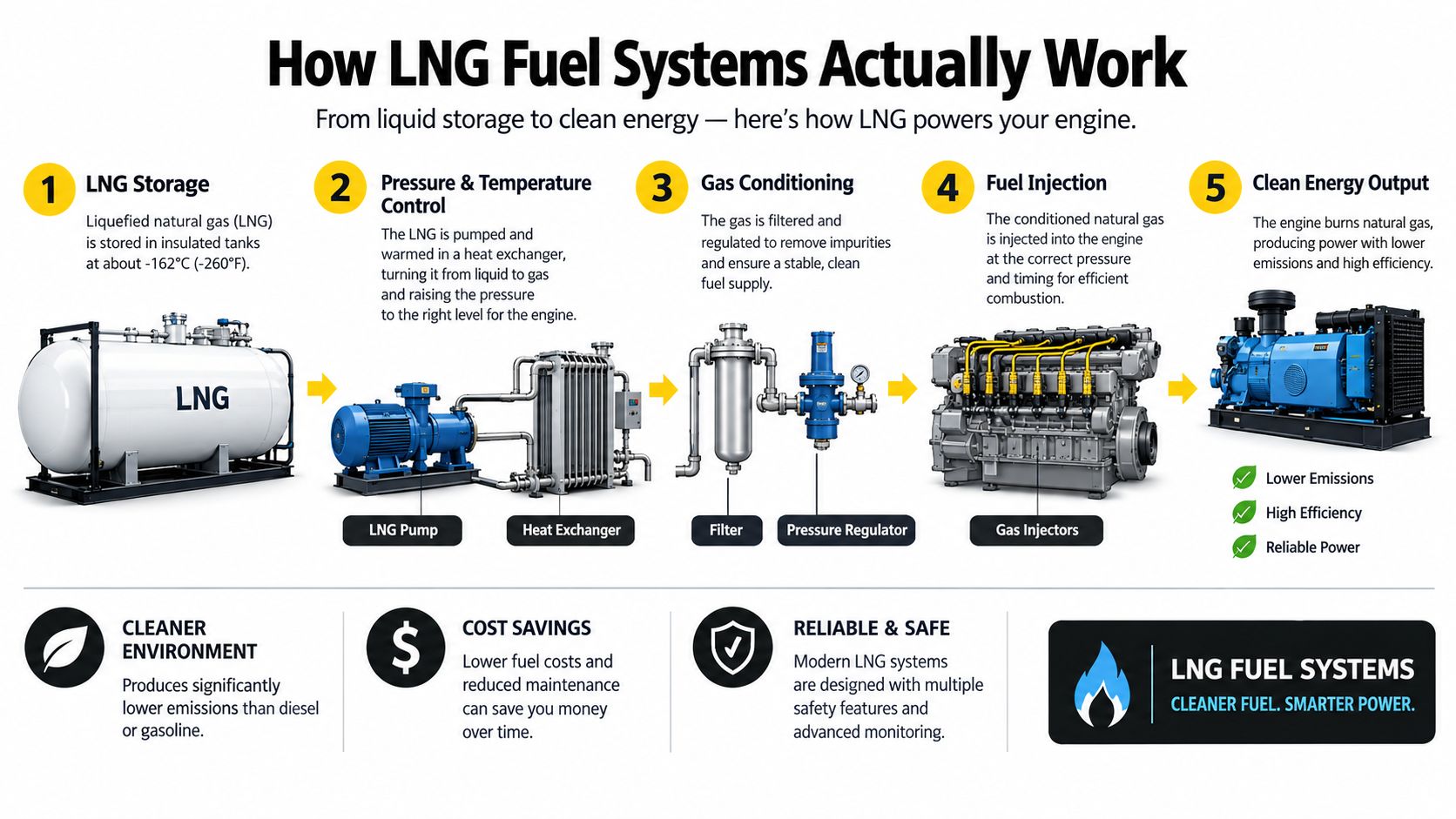
Think of an LNG truck's fuel setup as a heavy-duty thermos, not a gas can. The fuel has to stay extremely cold so it stays liquid, and the liquid form is what gives the truck enough onboard energy for heavy-duty duty cycles. LNG is maintained near minus 260 degrees Fahrenheit, and liquefaction reduces natural gas volume to about 1/600 of its atmospheric volume National Renewable Energy Laboratory technical paper. That's the core reason LNG can carry more usable energy on the vehicle than comparable compressed natural gas storage.
The tank is only the beginning
An LNG system starts with an insulated cryogenic tank. The tank isn't just a container, it's a controlled environment with multilayer insulation and pressure-management hardware to slow heat ingress and manage boil-off. That matters because the fuel can warm up during parking or staging, which increases pressure and can reduce usable range if the truck sits too long.
From there, the fuel moves through pressure-control components and vaporizers before it reaches the engine. The truck isn't burning liquid at the injector, it's using system hardware to turn stored cryogenic fuel into something the engine can use reliably. That means the engineering job is keeping fuel conditions stable from depot to road.
Field rule: range on paper is not the same thing as range after a hot weekend parked at a jobsite.
Engine type changes the whole story
LNG trucks don't all behave the same way. Spark-ignition systems and compression-ignition systems can deliver different fuel-economy and operating outcomes, even when they share the same fuel. That's why a fleet can't treat every LNG tractor as interchangeable just because the badge looks similar.
The storage system also creates a planning mindset that diesel fleets aren't used to. With LNG, you're managing cryogenic behavior, not just refilling a tank. If your operation has unpredictable dwell time or vehicles that sit between jobs, that storage reality becomes part of the route plan, not a footnote.
LNG Versus CNG and Diesel at a Glance
| Fuel | Onboard Energy Density | Typical Range | Refueling Time | Best-Fit Duty Cycle |
|---|---|---|---|---|
| LNG | High, because the fuel is stored as a cryogenic liquid | Suited to longer heavy-duty routes | Slower and more specialized than diesel | High-mileage regional or long-haul work |
| CNG | Lower than LNG in the same packaging space | Better for shorter or moderate routes | Straightforward when station access is good | Urban, regional, and depot-based work |
| Diesel | High practical energy density with familiar packaging | Broad, with strong flexibility | Fast and familiar | Mixed routes, variable duty, broad network access |
A 500-mile regional haul is where LNG starts to make sense if the fueling corridor is reliable. A 60-mile urban delivery loop usually doesn't need that much onboard energy, which is why CNG or diesel may be easier to live with. The right answer depends less on the fuel label and more on the route pattern.
LNG's advantage is onboard energy storage. CNG's advantage is often simpler handling and a more forgiving fit for shorter or depot-centered work. Diesel still wins where fleets need flexibility, dense refueling access, and no special cryogenic handling.
For a fleet manager, the useful question is not “Which fuel is cleanest?” It's “Which fuel keeps the trucks available, fueled, and on route without forcing the operation to bend around the fuel?” LNG can answer that well in the right corridor, but it asks for discipline in return.
Where LNG Trucks Have Actually Scaled
A fleet can buy the truck, but it still needs the route to fit the fuel. That helps explain why LNG adoption has clustered in a few places instead of spreading evenly across every heavy-duty market.
In the European Union, a 2021 European Parliament briefing reported more than 6,000 LNG trucks in operation in 2020, alongside more than 20,000 CNG trucks. About 85% of the EU's natural-gas truck fleet was concentrated in Spain, Italy, France, Germany, and the Netherlands European Parliament briefing. That concentration matters. It shows LNG scaling where freight density, station access, and operating routines line up, not where buyers prefer a different badge on the tank.
China shows the same corridor pattern in a larger, faster-moving market. Adoption picked up where long-haul freight volumes were high, diesel and LNG economics favored the switch, and refueling corridors gave operators confidence that trucks could stay on schedule. The point is practical. LNG grows when the whole operating system supports it.
Corridor logic beats broad-market logic
LNG works best when a fleet runs repeatable miles between known stops. In that setting, cryogenic fuel behaves like a managed asset, not a daily surprise. Dispatch knows where the truck will fuel. Drivers know the procedure. Maintenance teams can plan around the equipment's handling requirements.
The limits show up just as clearly outside that pattern. If routes change often, station coverage is thin, or trucks may sit long enough for fuel management to become a concern, LNG becomes harder to live with. Fossil LNG or bio-LNG may change the emissions story, but neither changes the basic operating discipline the fuel demands.
That is where LNG has scaled. In corridors, not everywhere.
The Climate Math Most Comparisons Skip
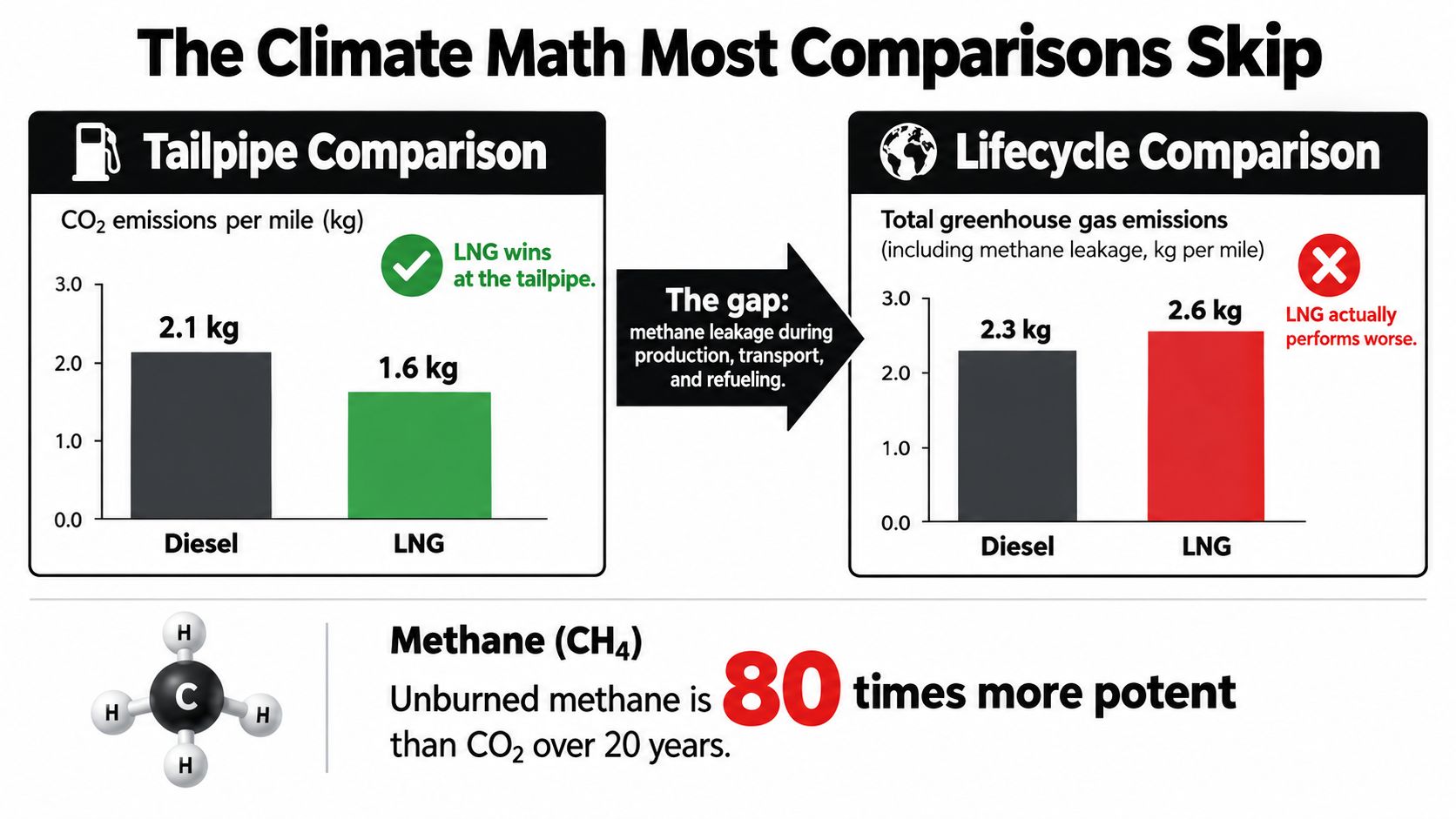
A tailpipe-only comparison makes LNG look better than diesel more often than it deserves. That's because the carbon story doesn't stop at combustion. Methane leakage during production, liquefaction, distribution, and fueling can erode the climate advantage, and that effect is especially important when people compare a fossil LNG truck to a diesel truck as if fuel pathway didn't matter.
The fuel pathway has changed fast enough to complicate old assumptions. IEA Bioenergy reported that renewable sources supplied 75% of the liquefied gas used in heavy transport in 2024, up from 17% the year before IEA Bioenergy newsletter. That means a claim about “LNG emissions” can be misleading unless it says whether the truck is running fossil LNG or bio-LNG.
Ask what fuel pathway the fleet is actually buying
A good buyer should ask three questions before accepting a climate claim. What fuel is being used, how was it produced, and what methane assumptions are being made upstream? Without those answers, “lower emissions” is just a slogan.
The same truck can sit in two very different emissions stories depending on its fuel source. Fossil LNG and biomethane-derived LNG are not interchangeable from a lifecycle perspective. If you're comparing options for a fleet under carbon scrutiny, the comparison should include the full pathway, not just the exhaust pipe.
LNG isn't automatically low-carbon. The emissions result depends on the fuel source, the leakage rate, and the duty cycle.
That's the honest frame. It protects fleets from buying a fuel system on a claim that won't hold up once procurement, compliance, or customer reporting gets stricter.
Operational Realities Outside the Main Corridor
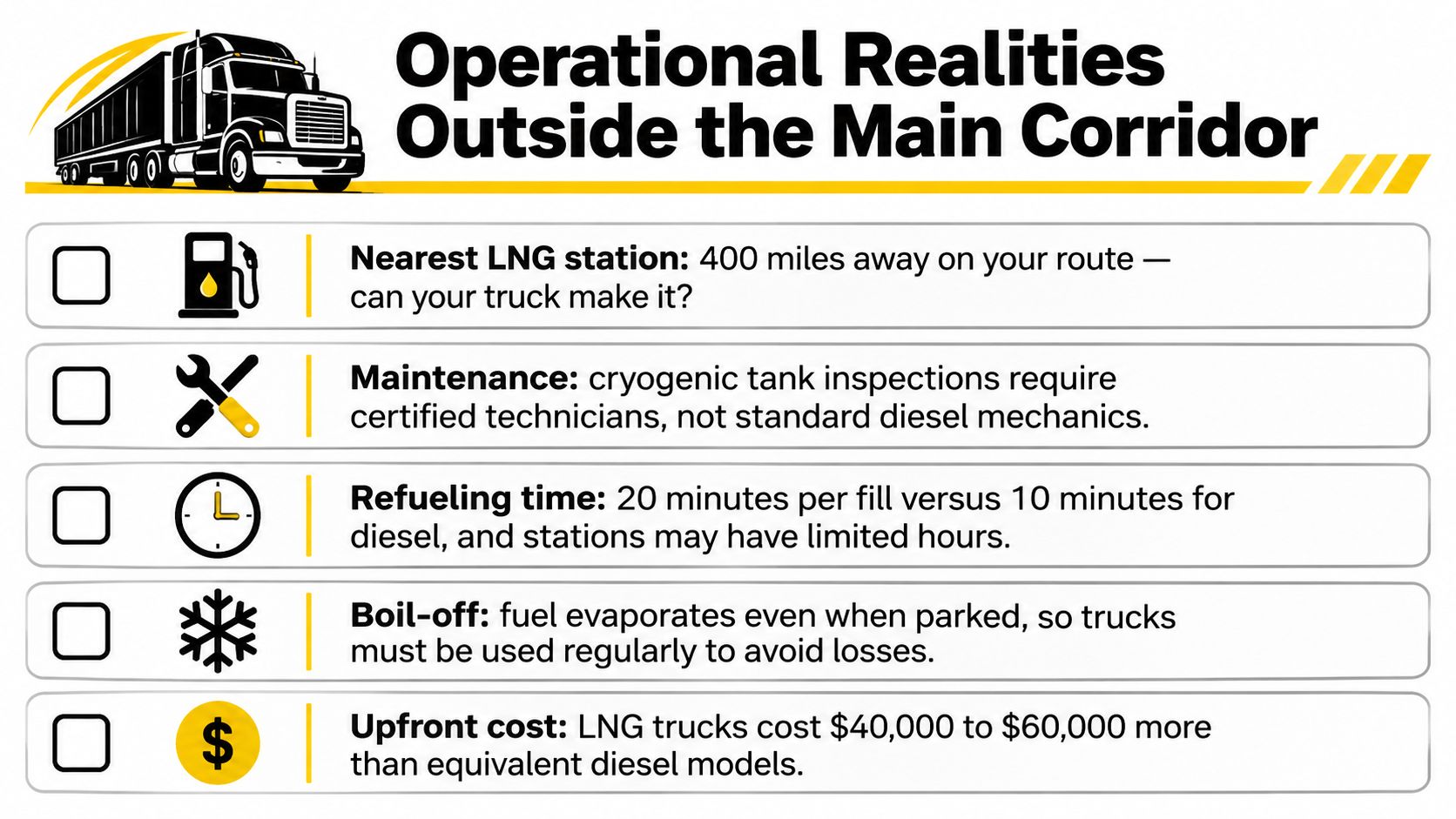
A truck only earns its keep if it can get fueled when it needs fuel. That's why station geography matters so much more for LNG than many buyers expect. A late-2025 market source estimated about 81 U.S. LNG stations versus 1,385 CNG stations, which points to a serious infrastructure imbalance outside the strongest freight corridors Washington State JLARC review.
For a construction or utility fleet, that imbalance changes the risk profile. If the nearest compatible station is too far away, or if a station is down, the truck doesn't have a backup plan unless the fleet has already built one. That's why contingency fueling matters as much as vehicle spec.
What can go wrong in the field
LNG can be vulnerable to dwell time, heat ingress, and boil-off when vehicles sit parked. It can also be awkward when station hours don't match dispatch needs or when refueling access depends on a single site. Those are operational issues, not engineering trivia.
The right planning question is simple. Can the truck stay on schedule if the station is unavailable for a day? If the answer is no, the fleet needs a contingency path. That might mean temporary mobile gas delivery, on-site storage, or a different fuel choice for the segment of the fleet that can't tolerate downtime.
For fleet managers who deal with permits, outages, or project mobilization, the legal and operational chain matters too. A plain-language overview like chain of responsibility explained can help frame who owns what when fuel continuity, vehicle readiness, and jobsite compliance all intersect.
Matching LNG to the Right Duty Cycle
Start with the route, not the brochure. If the daily work is predictable, mileage is high, and fueling access is stable, LNG can fit well. If the route changes constantly, the truck may sit for long periods, or the operating area has weak station coverage, LNG becomes much harder to defend.
A simple route-by-route filter
Use these questions in order:
- Daily distance: Is the truck doing enough miles to justify LNG's storage advantage?
- Route predictability: Does it return to a known corridor and fuel pattern?
- Refueling access: Is there reliable station coverage where the truck works?
- Payload sensitivity: Does the vehicle spec leave enough room for cryogenic hardware?
- Emissions policy: Does the local rule favor lifecycle performance or just alternate fuel adoption?
That framework usually separates the options cleanly. Diesel still fits variable operations, sparse infrastructure, and fleets that need maximum flexibility. CNG makes more sense when the route is shorter and depot access is easier. Battery-electric can be a strong answer for urban or return-to-base work, while hydrogen stays more situational and infrastructure-dependent.
LNG sits in the middle only when the route is long, the corridor is stable, and the fleet can manage cryogenic storage responsibly. It's not the default clean-fleet answer. It's a specialized tool for a specialized job.
A Decision Checklist for Fleet Planners
Before you spec LNG tractors, run five checks. First, confirm the route is predictable enough for cryogenic storage and station access. Second, verify that your fueling corridor has redundancy, not just a single point of failure. Third, define whether your emissions target assumes fossil LNG or bio-LNG.
Then look at total cost of ownership sensitivity, because fuel price and truck utilization can change the result fast. Finally, write down the contingency plan for outages, delays, and temporary worksites. A truck choice and a fuel-supply choice are two halves of the same decision.
Blue Gas Express helps fleets and job sites keep moving when permanent gas infrastructure isn't ready or a supply interruption would shut work down. If you're comparing LNG, CNG, and temporary fuel support for a project or fleet plan, visit Blue Gas Express to see how mobile natural gas delivery can bridge the gap while your longer-term setup takes shape.