

The generator arrives before the utility connection, the boiler loop is needed before the permanent meter set is ready, and the gas supply has to work now. A mobile CNG trailer or LNG vaporizer can solve the supply gap, but only if the downstream equipment sees stable pressure through startup, peak demand, and low-load holds. That makes the gas pressure regulator more than a connection fitting. It's the control point that protects equipment, manages changing inlet conditions, and determines whether a temporary installation behaves like a reliable fuel system or a recurring emergency call.
Temporary service exposes weaknesses that permanent installations can hide. Trailer pressure changes as storage conditions and demand change, vaporizer output can become cold during rapid letdown, and a generator or boiler may move quickly between low fire and full load. A regulator sized only from the appliance nameplate can look acceptable during a quiet test and still fail when the first major load starts.
A Temporary Gas Job That Starts Before the Pipeline
A 1.5 MW generator package arrives on site weeks before the utility tie-in. The mobile CNG trailer is parked near the location where the permanent meter set will eventually live, and the commissioning team is ready to run the engine. Between the trailer and the generator sits a pressure-reduction train. Its job is to turn a variable, high-pressure supply into the pressure the engine controls expect.
If the engine requires 7 inches water column, the regulator has to hold that outlet under changing flow. A weakly matched unit can allow the pressure to sag when the generator loads, or let the downstream pressure rise when the demand suddenly falls. Either condition can create nuisance trips, unstable combustion, or a shutdown that looks like an engine problem even though the root cause sits upstream.
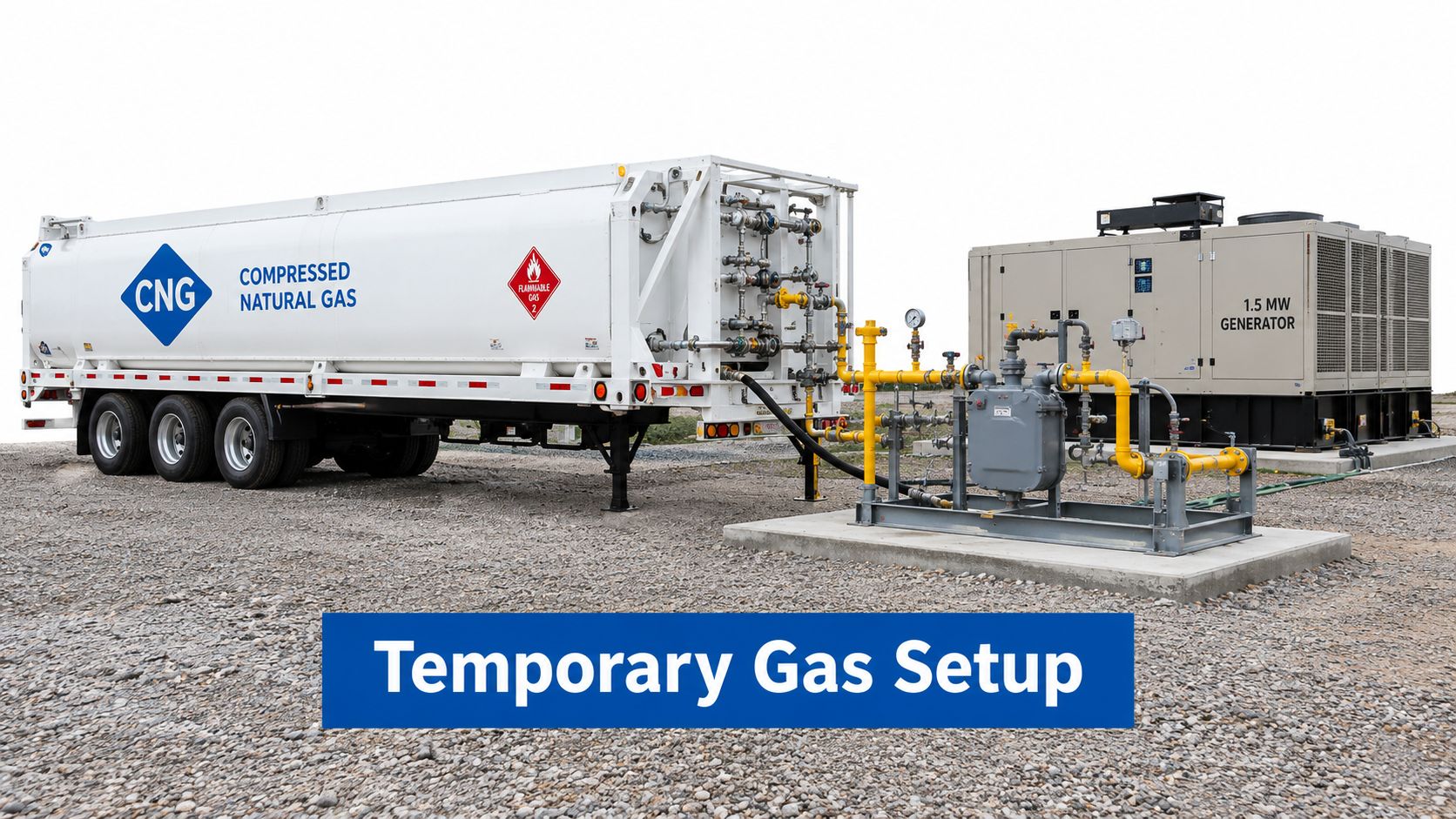
The same issue appears during a cold-weather freeze-prevention job. LNG vapor feeds a temporary boiler loop while the permanent gas line is unavailable. The vaporizer and regulator must handle rapid flow changes without allowing cold gas, ice, or capacity loss to interrupt the boiler. An undersized regulator may pass a steady commissioning flow but fail when several burners open together.
Field rule: Temporary service isn't simply a smaller permanent service. It usually has a wider operating range, less upstream certainty, and less time to recover from a poor selection.
Natural gas systems use regulators at multiple pressure-reduction points. Transmission systems can operate above 1,000 psi, or 69 bar, while distribution pressure is commonly reduced below 60 psig, or 4.13 barg, before gas reaches customers, as described by Emerson's overview of natural gas pressure regulators. End-use regulators may receive inlet pressure from 14 inches water column, or 3.4 kPa, to 5 psig, or 34 kPa, then deliver the lower pressure required by appliances.
The temporary project needs a regulator selected around the actual pressure swing, peak flow, low-flow behavior, temperature, venting, and equipment tolerance. The line size matters, but it isn't the whole decision.
What a Gas Pressure Regulator Actually Does
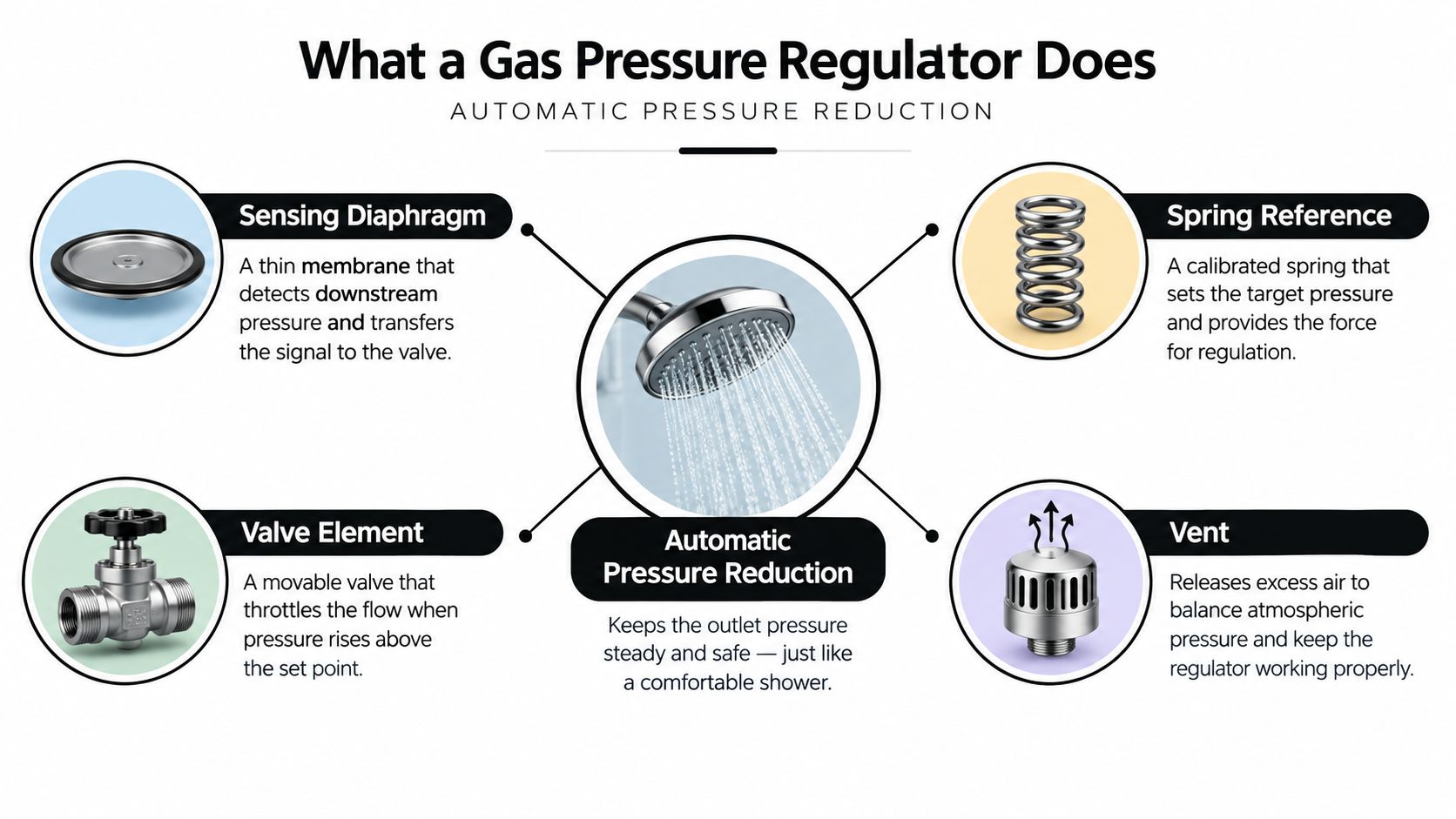
Think about a shower supplied by a variable building pressure. You want a comfortable, repeatable flow at the showerhead, not the full pressure available in the building pipe. A gas regulator performs a similar pressure-reduction function, but it reacts continuously to downstream pressure and gas demand.
Inside the body, four parts work together:
- Sensing diaphragm: Detects outlet pressure and moves as that pressure changes.
- Spring reference: Applies the force that represents the desired setpoint.
- Valve element: Opens or closes the gas passage to balance supply with demand.
- Vent: Allows the sensing chamber to reference atmospheric pressure, where the installation design permits venting.
When downstream pressure falls, the diaphragm moves against the spring force and the valve opens farther. When downstream pressure rises, the valve moves toward its seat. The regulator isn't measuring flow directly. Safety guidance from UNSW makes this distinction clear: regulators control pressure, not flow, and they must reduce cylinder pressure to a safe working level before use. For a separate explanation of how filtration and pressure reduction can be combined, this filter pressure regulator explained guide is a useful reference.
Four behaviors that matter on site
Outlet set pressure is the target pressure under a defined operating condition. It isn't a guarantee that the outlet will remain perfectly unchanged at every flow.
Droop is the outlet pressure decrease as flow rises. On a 0 to 10 psig appliance line, excessive droop can leave a generator short of fuel pressure at full load even though the regulator held the setpoint during a low-flow test.
Lock-up is the pressure behavior after flow stops. A regulator must close without allowing outlet pressure to creep high enough to lift a relief device or trip downstream equipment. Overnight low-load operation can expose lock-up problems that daytime testing misses.
Accuracy class describes how closely the regulator maintains its intended pressure within its rated operating range. One industrial regulator family covers inlet pressures up to 100 bar, nominal diameters up to DN 400, operating temperatures from -20 °C to +60 °C, outlet set ranges of roughly 0.5 to 70 bar, and accuracy classes as tight as ±1%, according to the Fisher, Francel, and Tartarini regulator bulletin.
The practical question isn't whether a catalog lists impressive performance. It's whether the selected spring range, trim, and body can control the actual temporary load from minimum demand through peak demand.
The Main Regulator Types and Where Each Fits
The right regulator family depends on how much the inlet varies, how sensitive the equipment is, and whether the system must hold pressure for days rather than minutes. A low-cost unit can work well when its limitations match the job. The same unit can be a poor choice when the load cycles sharply or the downstream equipment has little pressure tolerance.
| Regulator Type | Best Temporary Service Fit | Watch-Out |
|---|---|---|
| Single-stage | Short-duration generator work with a relatively manageable inlet and acceptable droop | Outlet pressure can vary more as inlet pressure and flow change |
| Two-stage | Sensitive generators, boilers, and longer temporary holds requiring steadier delivery | More components mean more installation, inspection, and stored-pressure considerations |
| Pilot-operated | Large-flow generator or boiler service, especially where pressure stability matters | Needs correct pilot sensing, filtration, commissioning, and maintenance |
| Self-contained, relief-style | Compact trailer assemblies and smaller, defined loads | Can be misapplied after a vaporizer or where changing inlet conditions exceed its control range |
| Back-pressure | Temporary manifolds, return paths, or closed sections that must maintain upstream pressure | It controls upstream pressure, not the downstream appliance supply |
Single-stage for speed and simplicity
A single-stage regulator is often the fast-deployment option for a short generator run. It reduces pressure in one control step and can be practical when the inlet remains within a known range and the generator tolerates modest outlet movement.
It isn't automatically a bad choice. It becomes a bad choice when a project manager treats its nominal capacity as proof of stable full-load performance. Confirm the expected droop and lock-up behavior instead of relying on the body size.
Two-stage for sensitive loads
Two-stage regulation divides the pressure reduction into separate steps. That arrangement generally gives the downstream equipment a more stable operating environment when the source pressure changes or the load remains in service for an extended period.
The trade-off is physical and procedural. A two-stage unit needs proper venting, isolation, inspection, and safe depressurization. Safety guidance warns that the first stage can trap high-pressure gas after a two-stage regulator is removed or adjusted under pressure, creating a gas-release or projectile hazard.
Pilot-operated for larger temporary demand
Pilot-operated designs make sense when the main valve must handle substantial flow while maintaining close pressure control. They're candidates for large generator packages, temporary boiler plants, and other loads where outlet stability matters more than minimum footprint.
They also demand better commissioning. Pilot sensing lines, filters, impulse connections, and setpoints must match the installation. A pilot-operated regulator that isn't commissioned correctly can be less predictable than a simpler unit.
Self-contained and back-pressure designs
Self-contained regulators are common on mobile gas equipment because they package sensing and control in one compact assembly. They can work well for a defined, moderate load, but a unit that performs properly on the trailer may not be suitable downstream of a vaporizer with cold, rapidly changing flow.
Back-pressure regulators solve a different problem. They maintain pressure upstream by opening as that pressure rises. A temporary manifold may need one to prevent unstable behavior in a return or bypass arrangement, but it shouldn't be substituted for the pressure-reducing regulator feeding the generator or boiler.
Reading the Spec Sheet Before You Buy
A supplier's data sheet becomes useful only when its values are compared with the site conditions. Start with the inlet pressure range. Ask whether the regulator covers the full swing from a CNG tube trailer, the outlet of an LNG vaporizer, and any low-pressure condition that occurs near the end of supply.
Next, examine the outlet set range and its tolerance. The target isn't just the pressure written on the appliance schedule. It's the pressure the appliance needs while starting, running at peak demand, and returning to low fire. A regulator that reaches the setpoint at no flow may still fall below the equipment requirement when burners or an engine governor demand gas.
Capacity has to match the peak event
Check the regulator's Cv or flow-capacity data against the worst expected demand, not the generator nameplate alone. Include simultaneous burner operation, startup demand, vaporizer limitations, hose losses, filters, isolation valves, and the pressure available at the regulator inlet.
A unit that looks adequate at steady state can fail when a 1,000 cfh heater starts. The symptom may be a pressure dip, flame failure, or generator trip. That isn't solved by turning the adjustment screw higher. The regulator needs enough control authority and upstream margin for the event.
Ask what the accuracy figures mean
Accuracy class tells you how closely the regulator controls pressure under specified conditions. Droop tells you how far pressure falls as flow increases. Lock-up tells you what happens when demand stops. These terms should appear in the supplier's selection basis, not just in a catalog table.
One technical example reports hysteresis and repeatability below 10% and average droop of 10% at 20:1 turndown for a low-pressure regulator family, with lock-up limits defined by ANSI Z21.80/CSA 6.22 and EN 88-1, as shown in the DUNGS technical document. Treat such figures as application data, not universal promises for every regulator.
Also confirm gas compatibility, odorization compatibility, NPT or flange connections, hose ratings, vent routing, and a documented overpressure-protection path. Refuse a unit with no clear vent arrangement or no written explanation of what protects the downstream system if the regulator fails open.
Installing and Commissioning Under Real-World Pressure
A regulator can pass a shop test and still behave differently on site. Consider an LNG vaporizer feeding a 500 kW generator set in cold ambient conditions with an intermittent electrical load. During a steady test, the outlet gauge looks correct. When the generator starts and the vaporizer responds, the pressure drops, the regulator chills, and the engine control begins reacting to a fuel condition that the commissioning team didn't see at no load.
The sequence matters. First, the installer leak-tests the upstream train and confirms all joints, valves, and hose connections. Then the team verifies the set pressure with a calibrated gauge before opening the downstream appliance fully.
Commission from low demand to peak demand
The installer should stroke the load gradually rather than opening every demand point at once. At each step, watch the outlet gauge for pressure drop, recovery speed, and oscillation. A regulator that recovers slowly may be undersized, poorly sensed, restricted by a filter, or operating with too little inlet pressure margin.
The cold side needs equal attention. High-pressure LNG letdown can produce Joule-Thomson cooling, and moisture or contaminants can freeze around the diaphragm cavity, seat, or vent path. If the vaporizer doesn't provide enough pre-warming, the project may need line heaters or a different regulator location. Placing the regulator too close to a cold vaporizer can expose it to conditions the data sheet doesn't represent.
Commissioning check: Don't sign off after confirming only the set pressure. Confirm peak-flow stability, zero-flow lock-up, downstream pressure recovery, and a clear vent discharge path.
Inspect the vent line for ice, blockage, poor termination, or an orientation that allows water to collect. A vent problem can make a sound regulator appear defective. For additional practical context on documenting field checks, DUCHENG commissioning insights can help project teams build a more disciplined handover record.
The handover should include gauge readings, setpoint results, leak-test records, protection-device status, and observed behavior during load changes. Operations staff need to know what normal pressure looks like before the trailer is left unattended.
Maintenance and Field Troubleshooting
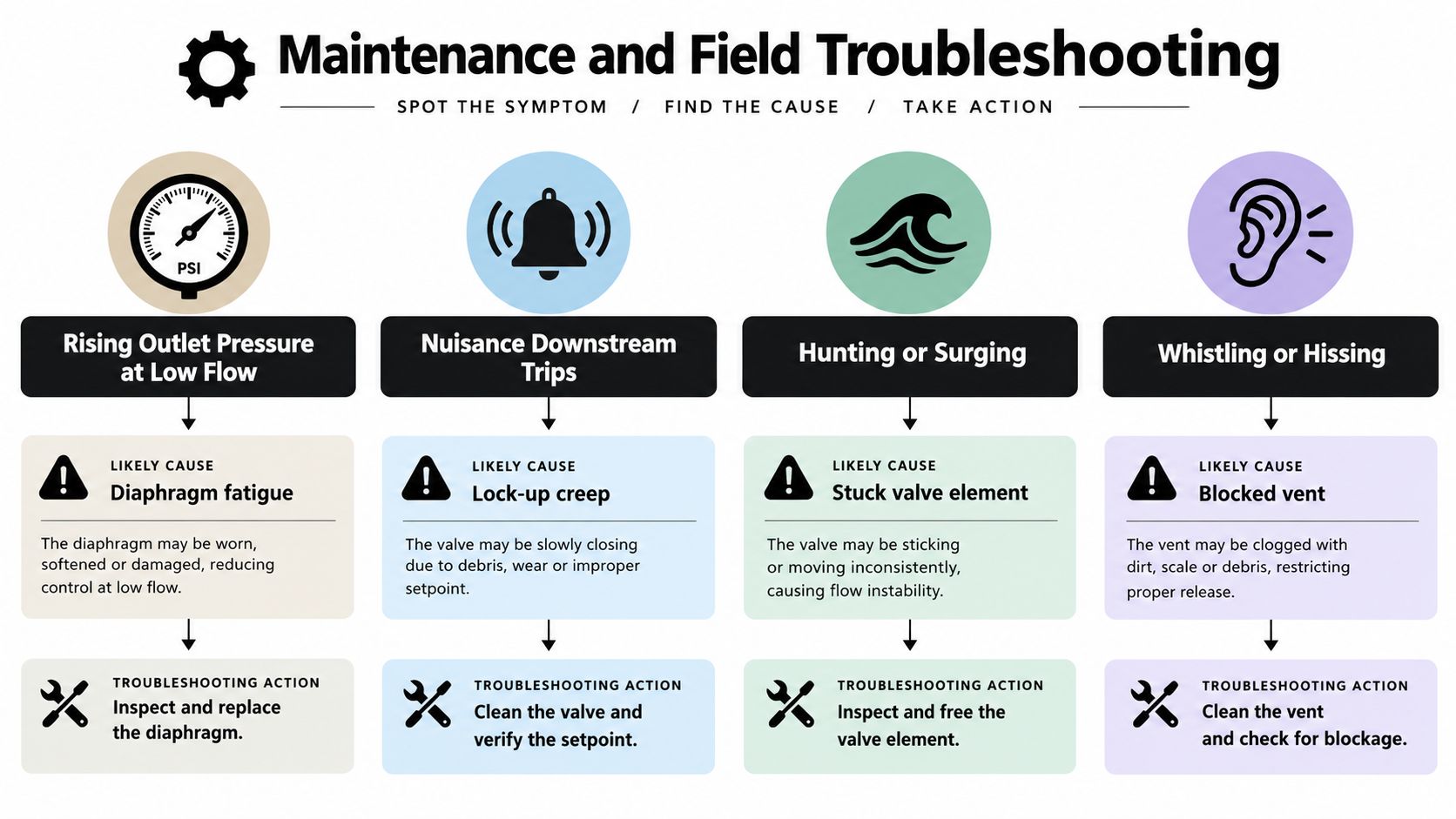
Troubleshooting starts with the symptom on the gauge, not the part number on the nameplate. A pressure regulator that appears to be failing may instead have a blocked vent, an iced passage, a contaminated seat, or a downstream demand that exceeds the selected capacity.
Match the symptom to the likely cause
- Rising outlet pressure at low flow: Diaphragm fatigue, seat damage, or a sensing problem can stop the regulator from closing cleanly. Isolate the upstream supply, confirm the gauge condition, and observe lock-up at zero flow. A trained technician may need to inspect the diaphragm and seat.
- Nuisance downstream trips: Lock-up creep can push outlet pressure high when demand falls. Check the downstream relief device, verify the regulator setpoint, and compare zero-flow pressure with the equipment limit.
- Sudden capacity loss in cold weather: Ice around the diaphragm cavity, seat, or vent can restrict movement or flow during LNG service. Isolate safely, inspect for ice or moisture, correct the thermal condition, and don't just increase the spring setting.
- Whistling or hissing: A blocked or damaged vent screen, leaking connection, or abnormal valve movement may be responsible. Inspect the vent termination and screen after making the system safe, then repeat a leak test.
- Hunting or surging: A stuck valve element, poor sensing-line arrangement, oversized regulator, or unstable inlet condition can create cycling. Compare the actual load range with the regulator's turndown and review the installation geometry.
Depressurization deserves its own procedure. Isolate upstream and downstream, release stored pressure through an approved path, verify zero pressure, and keep personnel clear of vent outlets. Never loosen a regulator connection just because the downstream gauge reads low.
Routine records prevent avoidable callouts. Verify setpoint periodically, inspect the vent stack, look at the seat and diaphragm during planned outages, and log outlet pressure at known operating conditions. Drift is easier to identify in a trend than after an appliance trips during a night shift.
Codes, Standards, and Safety Boundaries
A project manager doesn't need to memorize every clause, but the installer must identify which rules govern the equipment, piping, fuel source, and location. For line pressure regulators, ANSI Z21.80 and CSA 6.22 are key references. Process piping may bring ASME B31.3 into scope, while appliance connections and fuel-gas arrangements may involve NFPA 54. Canadian projects may also require CSA B149.1, and mobile gas delivery brings relevant DOT 49 CFR requirements into the review.
The exact compliance path depends on jurisdiction, pressure, equipment, and whether the installation is temporary or permanent. Ask the qualified designer or authority having jurisdiction to confirm the applicable edition and scope before equipment ships.
Overpressure protection is a system decision
A regulator reduces pressure, but it isn't the only protective layer. The design may require a relief valve, slam-shut device, monitor regulator, excess-flow protection, or another secondary device. A single regulator is rarely an adequate answer for an outlet above 5 psig, particularly where downstream piping or appliances can't tolerate the full upstream pressure after a failure.
The installer should leave documentation that identifies the regulator model, setpoint, inlet and outlet limits, protection devices, vent destination, test results, and inspection status. If the regulator is part of a skid or trailer train, the records should show how the complete assembly was evaluated rather than treating each component as isolated.
What you can see during a walkdown
A non-engineer can still catch warning signs before startup:
- Vent orientation: The vent should discharge to a safe location and remain protected from water, ice, dirt, and accidental obstruction.
- Accessibility: Operators need room to read gauges, isolate the train, and reach service points without unsafe improvisation.
- Labeling: Flow direction, set pressure, gas service, isolation points, and emergency actions should be clear.
- Records: Leak-test results, calibration information, relief-device details, and commissioning readings should be available.
- Condition: Hoses, fittings, supports, and regulator bodies should show no visible damage or unapproved field modification.
Stop the startup if the protection path is unclear, the vent is blocked, the gauge is missing or unverified, or the installer can't explain what happens when the regulator fails open.
Practical Recommendations for Mobile Gas Projects
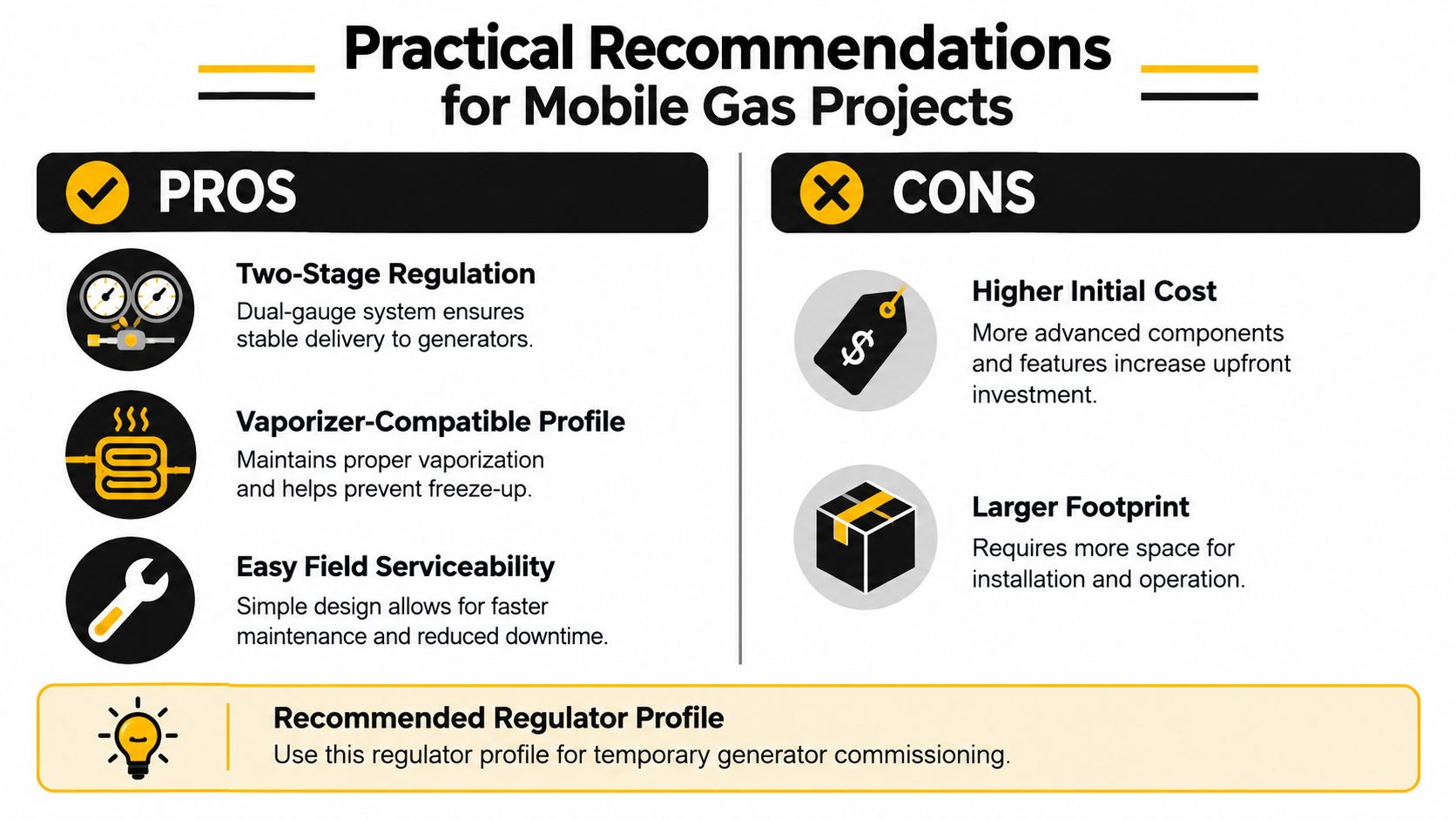
For a temporary generator or freeze-prevention vaporizer, I'd ask suppliers to evaluate a two-stage or pilot-operated regulator before defaulting to a compact single-stage unit. Trailer-mounted service also favors corrosion-resistant construction, such as stainless steel or aluminum bodies where compatible with the gas and environment, along with a documented lock-up tolerance below 5% of setpoint.
Don't compromise on the protective details:
- Overpressure protection: Specify the secondary protection device and its set relationship to the regulator.
- Vent screens and routing: Keep the sensing chamber protected without restricting safe discharge.
- Cryogenic inlet margin: Confirm the regulator can handle the temperature and pressure conditions created by the vaporizer and rapid letdown.
- Peak-flow capacity: Size the Cv for the actual maximum appliance demand, with a 1.25 safety factor in the selection basis.
- Service access: Make sure technicians can isolate, inspect, and replace the unit without rebuilding the entire hose train.
Bring the supplier into pre-mobilization planning early. Trailer hookups, hose ratings, end connections, vent arrangements, regulator footprint, vaporizer location, and downstream equipment limits should be resolved before the unit ships. A late discovery that the flange pattern or vent route doesn't fit can turn a fast deployment into a field redesign.
The decision pattern is straightforward. Small flow plus stable inlet conditions points toward a self-contained regulator. Large flow plus cryogenic feed points toward a pilot-operated unit, provided the team can support proper sensing, filtration, and commissioning.
Blue Gas Express provides temporary CNG and LNG delivery, mobile gas units, and pressure-reduction equipment for projects waiting on a gas connection, managing an outage, commissioning a generator, or protecting equipment from freezing. If your temporary gas job needs a documented regulator selection and a delivery plan that fits the site, visit Blue Gas Express to discuss the required pressure, flow, connection, and deployment conditions.