

The superintendent has drywall up, finishes moving room by room, and an owner asking whether turnover is still real. Then the permanent gas service date moves out by three weeks. Boilers can't be commissioned, gas appliances can't be tested, winter freeze protection becomes a concern, and every conversation on site starts with the same question: what can we work around?
That situation is common across commercial, multifamily, industrial, and residential work in the Carolinas and Mid-Atlantic. Construction schedule delays rarely come from one isolated event. They build when labor, approvals, material deliveries, inspections, and utility energization interact without enough float or a credible recovery option.
A 2024 analysis of 180 construction project schedules found that approximately 75% of projects experience delays, with a median delay of 20% to 40% of total project duration. The study also found that activity delays follow a log-normal distribution after controlling for delay-risk factors, giving planners a statistical baseline for understanding how delays cluster rather than appear randomly. Construction Owners provides the underlying analysis and context.
What Construction Schedule Delays Cost You
It's punchlist week. Drywall is complete, finish carpenters are working through the units, and the permanent gas meter remains three weeks beyond planned turnover. The superintendent spends the morning with the utility, project manager, and owner, then uses the afternoon to resequence crews that should be testing, commissioning, and closing out. A utility hold-up can strand finished work just as quickly as a late material package.
Every extra week extends supervision, trailers, equipment rentals, insurance, and security. That burn can turn a three-week slip into a four-figure problem. Cleaning, temporary facilities, coordination, and temporary utilities add to it, while demobilized trades may need to return, crews may wait for access, and compressed work windows can create rework.
Calculate exposure against the contract, project size, labor plan, and local conditions. On a mid-size commercial or multifamily job, review these categories:
- Extended general conditions: Add the actual monthly burn for supervision, site facilities, temporary utilities, security, rentals, and administrative support.
- Trade resequencing: Price remobilization, overtime, reduced productivity, and conflicts created when one subcontractor returns while another trade is still working.
- Revenue delay: Apartment lease-up, retail opening, owner occupancy, and operating income may move with the certificate of occupancy.
- Contract exposure: Check negotiated completion dates, liquidated damages provisions, owner notices, and incentive or penalty terms before selecting a recovery tactic.
The broader pattern shows why a field delay deserves financial review. One performance study reported that 72% of projects were delayed on average, with delays averaging 38% beyond the original contracted duration. It also reported that 63% experienced cost overruns averaging 24% above original contracted cost. For North American projects, the same source reported 98% were delayed, with an average delay amount of 37%. The Journal of Civil Engineering documents those findings and a separate infrastructure dataset spanning three continents.
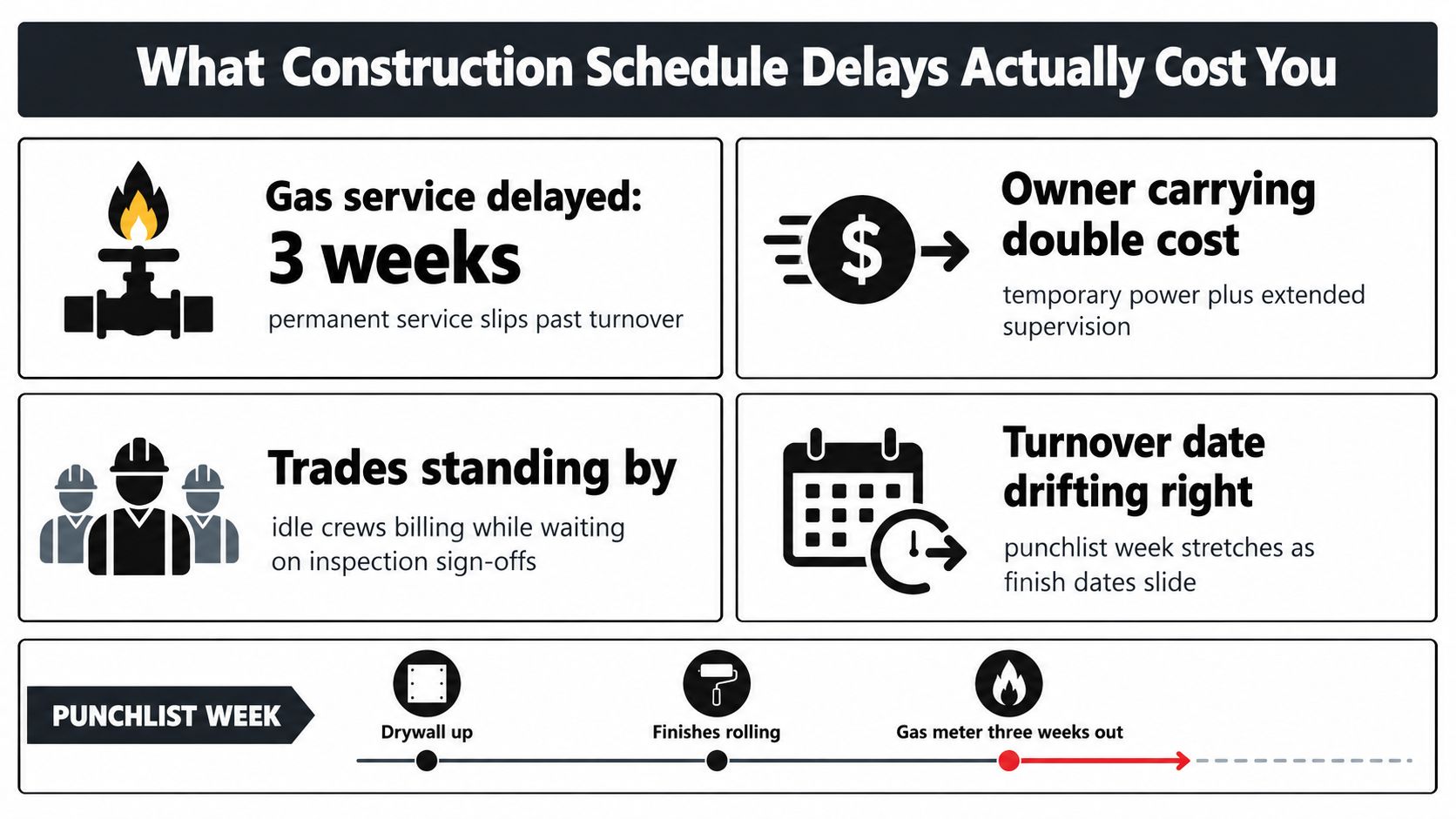
Field reality: A delay becomes expensive before the revised completion date appears in the schedule. Crews lose productive sequence, decisions age in inboxes, and the owner stops trusting the forecast.
Confidence affects the recovery effort. Repeated date changes without a documented mitigation path can slow approvals, harden negotiations, and make each subsequent recovery measure more expensive. Give the owner a dated plan, named responsibilities, and a clear decision point for temporary utility service before the stalled sequence spreads.
The Most Common Causes of Construction Schedule Delays
A late project rarely has one controlling cause. The superintendent's job is to identify which constraint can consume float, interrupt a planned sequence, or prevent the next trade from starting.
Labor remains the clearest current signal. A 2025 AGC workforce survey found that 45% of firms reported project delays caused by shortages among their own workers or subcontractors. The survey also recorded materials lead times at 35%, government approvals or inspectors at 34%, and owner-directed halts or redesigns at 32%. The Associated General Contractors of America provides the underlying survey analysis.
| Cause Category | Approx. Share of Delays | Recent Trend | Typical Duration Impact |
|---|---|---|---|
| Labor and skilled-trade availability | 45% cited delays | Subcontractor staffing remains a leading field constraint | Reduces production across several connected activities |
| Materials and lead times | 35% cited delays | Procurement uncertainty affects equipment and long-lead packages | Can consume float or move a critical-path activity |
| Approvals, inspections, and decisions | 34% cited delays from approvals or inspectors | Review latency narrows installation windows | May force resequencing, rework, or a missed turnover milestone |
| Owner-directed changes | 32% cited delays from halts or redesigns | Late decisions disrupt field work and procurement | Often affects several trades at once |
| Utility coordination and energization | Often buried inside other categories | Service dates and commissioning steps are tracked too loosely | A missed utility milestone can hold testing and turnover for multiple working days |
Earlier delay research points to the same operational weaknesses. One review cited labor delays at 37% and also identified material shortages, equipment downtime, and management or communication bottlenecks. A separate delay-forensics source assigned 38% of delays to owner responsibility and 24% to design issues, including change orders and submittal approvals. Assessing the Delay Analysis explains why production tracking should be reviewed alongside decision-cycle performance.
Critical path causes versus nuisance causes
A delivery affecting a room with available float is a field problem. The same delivery blocking commissioning can become a turnover problem. Track those conditions separately so the recovery plan targets the work that controls completion.
The practical test is simple: identify the blocked successor, confirm whether another crew can work, and record the earliest date the constraint can be removed. For utility-dependent work, that may require a temporary gas bridge rather than waiting for permanent service. Temporary CNG or LNG can keep equipment testing and site operations progressing while the permanent connection is resolved, subject to site safety, permitting, supply, and equipment requirements.
A project exposed to a site shutdown also needs a risk-transfer review. A resource such as site shutdown insurance for builders can help examine business-interruption exposure. Insurance does not replace a dated recovery plan, accountable owners, or an accurate schedule.
How Critical Path and Float Drive Real Delays
A schedule can contain hundreds of activities, but only a connected chain controls the earliest finish. The critical path changes as work progresses, so a path identified during baseline planning can't be treated as permanent.
Start with the dependency chain that leads to turnover:
- Foundation and structure.
- Framing and enclosure.
- Rough-in MEP work.
- Inspections and sign-offs.
- Insulation, drywall, and finishes.
- Permanent utility energization.
- Equipment commissioning.
- Certificate of occupancy and turnover.
Mark the relationships that can't be bypassed. Then identify total float, the amount of time an activity can move before it affects the planned project finish, and free float, the amount of time it can move before it delays its immediate successor. Near-critical activities deserve daily attention when they have less than two weeks of float, even though the data-driven risk model referenced in the research treats tasks with free float under three days as critical. UBC Open Collections discusses how float along the critical path can mitigate delay risk.
A five-day slip can mean two different things
Suppose a drywall activity has five days of free float. A five-day slip may consume the float without moving turnover. The superintendent still needs to correct it, but it isn't yet a completion-date event.
Now place the same five-day slip on a gas-line tie-in scheduled for day 220, where the final inspection depends on service. If the utility can't energize, the pressure test, equipment startup, appliance checks, and occupancy sequence may all move. The activity duration matters less than the dependency chain behind it.
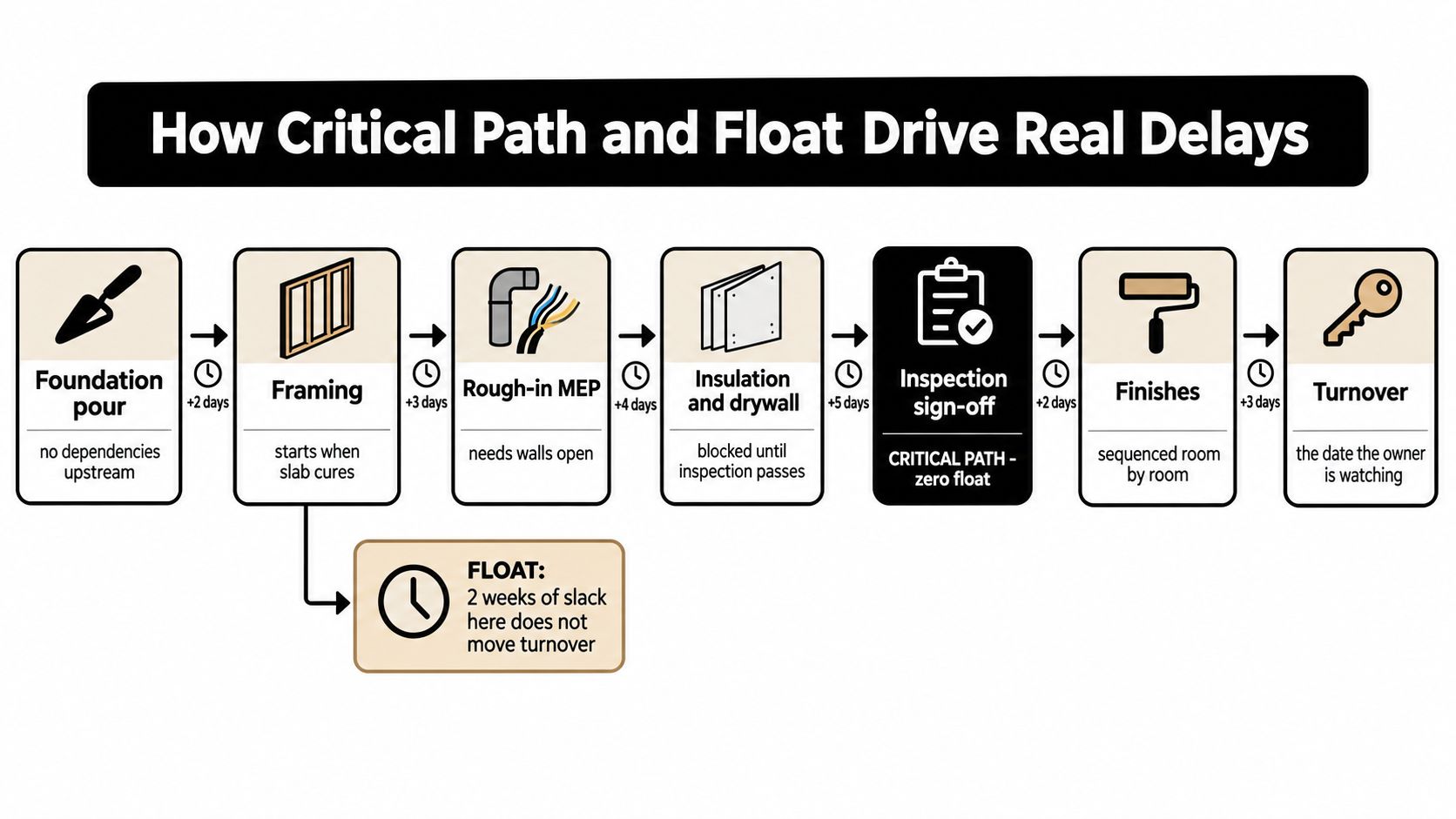
Run a weekly path check
Each week, compare planned and actual dates for every activity tied to turnover. Ask the foreman or trade partner what is physically complete, not merely what the update says. Check whether the predecessor logic still reflects the way work is being built.
Then record three items:
- Float consumed: Note which activities lost total or free float.
- Path movement: Identify whether a former non-critical chain has become the path controlling completion.
- Recovery choice: Decide whether to resequence, add resources, split a handoff, or protect the date with temporary service.
A schedule buffer is a quantitative risk absorber. Once critical-path activities lose float through late approvals, resequencing, or supply disruption, further slippage translates directly into completion delay.
A Simple Risk Assessment Framework for Your Schedule
A useful risk meeting doesn't produce a long register that nobody opens. It produces a short list of threats tied to named activities, owners, actions, and dates.
Use a two-axis heat map. Score probability from 1 to 5 and cost-and-time impact from 1 to 5. The multiplication isn't the important part. The discipline is. A risk with a high impact needs attention even when the probability looks moderate.
Hold the review weekly with the superintendent, PM, and lead MEP coordinator. Keep it to 15 minutes and require each red-quadrant risk to have:
- A schedule activity: Name the exact predecessor, successor, or milestone at risk.
- An accountable owner: Assign a person, not a department.
- A mitigation action: State what will happen before the next review.
- A recheck date: Put the decision back on the calendar.
- A recovery trigger: Define when the team stops monitoring and starts executing the alternate plan.
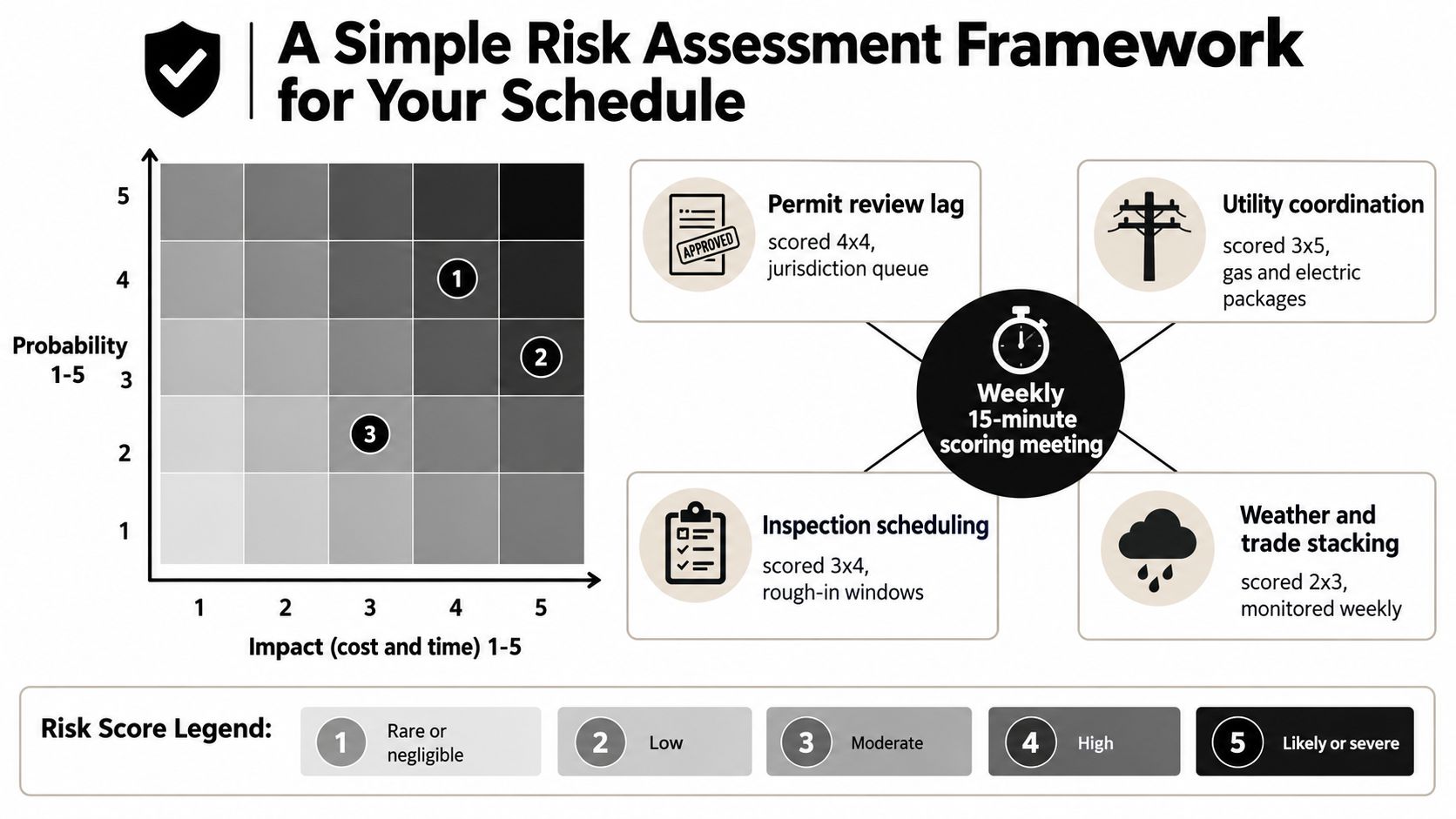
Three risks scored in the same meeting
A late gas utility tie-in might score 3 for probability and 5 for impact. The mitigation could be a temporary CNG or LNG assessment, a written utility date, and an inspection sequence that keeps non-gas work moving.
A roofing weather window might score 2 for probability and 3 for impact. The team can protect materials, move interior work forward, and reserve labor for the next viable installation window.
A long-lead rooftop unit might score 4 for probability and 4 for impact. The response may include an approved substitute, early submittal review, partial procurement, or a revised lift plan.
The scoring method exposes a common mistake. Teams often give the same attention to a high-probability nuisance as they give to a low-probability event that would stop turnover. The map forces a practical distinction.
Escalation rule: If a risk could consume more than the available contingency budget, require a written recovery option within 48 hours.
Don't hide an unresolved utility date inside meeting minutes. Put the threat beside the activity it can move, and force the decision while options still exist.
Permitting, Inspections, and Utility Coordination Without the Runaround
Permitting and inspections should operate as one workstream. On too many jobs, the gas package sits in one queue, the mechanical package in another, and electrical coordination happens after the field has already closed walls. Each queue creates its own comment cycle and its own opportunity for dates to drift.
Where the jurisdiction allows it, submit gas, mechanical, and electrical packages together. At 60% design, start the permanent utility conversation instead of waiting for a nearly complete design. Ask the utility for a written service-date range, required prerequisites, meter conditions, and escalation contacts. A verbal promise isn't a schedule control.
Maintain one permit and utility log with these fields:
- Submission date
- Reviewer comments
- Responsible responder
- Resubmittal date
- Number of review cycles
- Actual approval date
- Inspection request date
- Inspection result
- Utility prerequisite status
- Confirmed service window
Prepare the inspection before requesting it
Many re-inspections come from small, preventable misses. Label disconnects and equipment. Have pressure-test records available. Keep gas shutoffs accessible. Confirm that inspectors can reach the work without moving stored materials, cutting finished surfaces, or waiting for a trade to return.
Book rough-in inspections during the same week walls are scheduled to close. If the inspector's window slips, the drywall crew should have a documented alternate area rather than a full stop.
The same coordination principle applies to adjacent building systems. For projects modifying older access infrastructure, teams may need to coordinate controls, power, safety devices, and site access before work reaches commissioning. Technical resources on retrofitting legacy gate operators can help frame that type of legacy-system coordination without treating the gate package as an isolated field task.
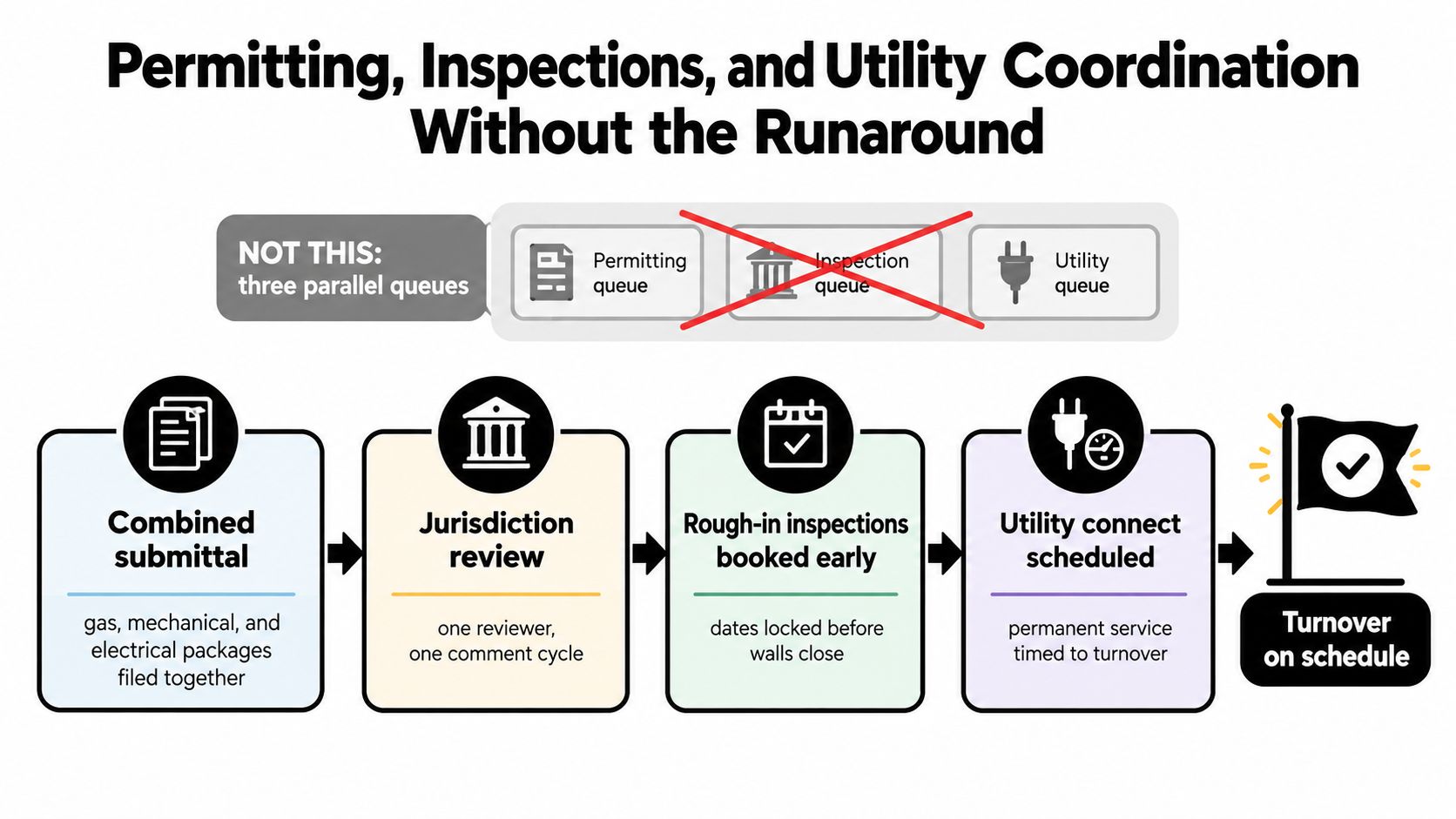
Keep utility dates evidence-based
Record every utility commitment and every prerequisite in writing. If a date depends on trench acceptance, pressure testing, a meter set, or an inspection release, show those conditions beside the date. That lets the superintendent distinguish a true service constraint from an internal coordination failure.
The objective isn't to pressure an inspector into a favorable result. It's to present complete work, reserve the correct inspection window, and prevent an avoidable second visit from becoming the event that pushes turnover.
Comparing Temporary CNG, Temporary LNG, and Waiting on Permanent Gas
A utility date can sit on the schedule as a single line item while holding up boilers, appliances, inspections, and occupancy. The practical choices are temporary CNG, temporary LNG, or waiting for permanent gas. Each option carries different requirements for speed, capacity, access, safety, and cost.
| Factor | Temporary CNG | Temporary LNG | Wait for Permanent Gas |
|---|---|---|---|
| Deployment speed | Fast mobilization for a short bridge, subject to site review and equipment availability | Requires tanker, vaporization equipment, and a more involved setup | No temporary mobilization, but the schedule remains exposed |
| Capacity and fit | Suits lower-demand commercial loads and temporary operation | Better suited to heavier loads, hospitals, and large kitchens | Ultimately matches the permanent design |
| Site requirements | Tube trailer, regulators, connections, access, and safety controls | Cryogenic storage or delivery equipment, vaporizers, setbacks, access, and operating controls | Utility prerequisites, inspection release, and final connection |
| Best use | Short commissioning or occupancy bridge | Higher-demand temporary service or a longer, heavier operating requirement | Only when the utility date is credible and the project has enough float |
| Main trade-off | Capacity may limit the equipment that can run simultaneously | More planning, equipment, and site-control requirements | General conditions and lost revenue continue while the team waits |
Temporary CNG generally suits a short bridge for boiler startup, appliance testing, occupancy inspections, or freeze prevention. It can keep a controlled commissioning sequence active while the utility completes line work. Before committing, the superintendent needs a load study, connection plan, trailer access plan, gas detection procedures, emergency procedures, and approvals from the relevant utility and authorities.
Temporary LNG serves a different operating range. Cryogenic delivery and vaporization can support heavier demand, but the site must accommodate setbacks, equipment placement, vaporizer operation, deliveries, traffic control, and trained personnel. That setup may fit a hospital, large kitchen, or facility whose required load exceeds practical CNG capacity. The added capacity comes with more coordination and tighter site controls.
Waiting for permanent gas has the simplest operating arrangement when the utility date is reliable and the schedule contains real float. If that date remains uncertain, supervision and temporary power costs continue. Boiler and appliance commissioning may slip, generators may be needed for testing, winter freeze exposure may increase, and occupancy or lease-up can move later.
The correct comparison is temporary bridge cost against the full cost of a utility slip, including daily general conditions, lost rent, liquidated damages, remobilization, and owner credibility. A three-to-six-week delay can make a temporary solution financially rational even when equipment rental looks expensive by itself. The decision should follow a written load review, site check, delivery plan, and recovery schedule, rather than the rental price alone.
Case Example – How a Mobile Gas Unit Saved a Stalled Project
A multifamily project in the Carolinas reached the final inspection sequence with interior work substantially complete. The permanent gas installation still required utility work before the boilers and appliances could be commissioned. The owner had a turnover date tied to leasing activity, and the superintendent had already run out of useful interior resequencing.
The recovery team treated the utility issue as a critical-path event rather than a procurement note. The PM verified the connected load, reviewed the regulator and connection requirements with the utility, confirmed delivery access, and asked for a written temporary-service plan. The team then evaluated a mobile CNG unit for the bridge, with the operating sequence limited to the equipment needed for commissioning and occupancy readiness.
The mobile unit was deployed after the site and safety requirements were cleared. That allowed the mechanical contractor to complete controlled boiler startup, support gas-appliance testing, and keep the inspection sequence moving while the permanent line installation continued. The superintendent maintained a daily log of pressure checks, equipment status, deliveries, and utility prerequisites.
The important lesson isn't that temporary gas removes every delay. It doesn't. The team still had to coordinate inspections, protect the site, and avoid exceeding the temporary system's capacity. The value came from preserving the dependent activities that would otherwise have waited behind the utility date.
The cost decision should be documented using actual project exposure. Compare the temporary unit, delivery, setup, supervision, and operating costs with the extended general conditions, remobilization, lost occupancy revenue, and contractual exposure created by the alternative. The right option is the one that protects the finish date safely and transparently, not the one with the lowest standalone equipment price.
Your Construction Schedule Delay Response Checklist
Use this checklist when a delay first threatens a milestone. The superintendent should be able to review it with the PM and lead trade without opening a dozen disconnected logs.
Detect and document
- Confirm the physical condition: Walk the affected area and record what is complete, blocked, inspected, delivered, or unavailable.
- Name the dependency: Identify the predecessor, successor, and turnover milestone affected.
- Update the schedule truthfully: Don't move dates merely to make the update look healthier.
- Capture the cause: Save utility notices, inspection results, delivery records, meeting minutes, photos, and daily reports.
A 2026 construction scheduling report says only 24% of general contractors and 2% of owners are very confident that schedule updates reflect project reality, while 44% of updates contain risky changes to actual dates. SmartPM Technologies presents those findings. The practical response is simple: treat each update as a decision record, not a cosmetic report.
Recover deliberately
- Protect the critical path: Recalculate float and identify the activity that now controls completion.
- Open parallel work: Move crews to areas that don't depend on the blocked activity.
- Shorten decision cycles: Assign one owner for each approval, submittal, inspection, and utility action.
- Price the bridge: Compare temporary service, overtime, resequencing, and remobilization against continued delay exposure.
- Set a trigger date: Decide when monitoring ends and the recovery option starts.
- Reforecast with the owner: Present the cause, critical-path effect, mitigation, cost, and decision deadline together.
For gas-related holds, ask whether temporary CNG or LNG can support the actual load and commissioning sequence. Blue Gas Express provides mobile CNG and LNG units for temporary natural gas service when line installation or utility work threatens construction, occupancy, generator commissioning, or freeze-prevention milestones.
A late job rarely recovers through optimism. It recovers when the team identifies the controlling dependency, protects the next handoff, and commits to a safe alternative before the remaining float disappears.
If a delayed gas installation is putting turnover, commissioning, or freeze protection at risk, Blue Gas Express can help evaluate temporary CNG or LNG service for the site's required load and schedule. Contact the team with your location, equipment needs, target date, and utility status so you can compare a mobile gas bridge with the full cost of waiting.