

Think of a virtual pipeline for CNG as an 'energy highway on wheels.' It's a clever way to move compressed natural gas (CNG) using trucks, trains, or even ships. This system is a lifeline for customers who aren't hooked up to a traditional, physical pipeline, ensuring they get the energy they need without the massive infrastructure.
How Mobile Natural Gas Delivery Actually Works
Imagine you're running a factory or a large construction site far from any existing gas mains. How do you power your operations? This is precisely the challenge a virtual pipeline solves. Instead of being tethered to a fixed, underground network, this system creates a flexible, mobile supply chain that brings the energy right to your doorstep.
It's a logistics game-changer that basically erases geography from the energy access equation, creating new opportunities for all kinds of industries and communities.
The whole process boils down to three key stages:
- Compression Stations: First, natural gas is pulled from a primary source and put under immense pressure. This step is crucial because it shrinks the gas's volume, making it possible to transport large amounts efficiently.
- Specialized Transport: The compressed gas is then loaded into ultra-strong containers, often called cascades or tube trailers, which are mounted on trucks or railcars for safe transit.
- Decompression Units: Once the CNG arrives at its destination, this equipment steps the pressure back down to a safe, usable level, ready for whatever the customer needs it for.
A Growing Need for Flexible Energy
The appetite for this kind of adaptable energy solution is booming. The global virtual pipeline market was valued at around USD 2.32 billion in 2023 and is expected to climb to USD 3.65 billion by 2032.
CNG is the clear leader in this space, holding a massive 64% market share back in 2022. That really underscores just how important it has become in modern energy logistics. You can dive deeper into these figures by exploring the latest virtual pipeline market trends from this research.
This 'pipeline-on-wheels' isn't just a temporary fix; it's a strategic tool. It keeps businesses running during pipeline maintenance, serves as the main fuel source for off-grid operations, and helps regions adopt cleaner fuels where permanent infrastructure just isn't there yet.
By creating this mobile energy highway, the virtual pipeline CNG system offers an immediate and often more affordable way to get natural gas where it needs to go. It's powering industries and communities that might otherwise be left in the dark, making it a critical piece of the future of energy distribution.
The Journey of Natural Gas: From Source to Site
Getting natural gas from its origin to a customer's location via a virtual pipeline is a surprisingly straightforward, yet finely-tuned process. Think of it as a mobile energy solution, bridging the gap where physical pipelines don't exist. It's how we get clean, reliable energy to industries, construction sites, and entire communities on demand.
The whole operation boils down to a clear, four-step journey. Each stage plays a critical role, from preparing the gas for its road trip to making it usable at the final stop.
Stage 1: Sourcing the Natural Gas
It all starts at the source. We tap into a main transmission or distribution pipeline, which acts as our "mother station." This is the entry point for the entire virtual pipeline CNG system, where we draw the raw natural gas that's about to be put on the move.
Stage 2: Compression and Loading
Next, the gas is sent to a powerful compression facility. Here's where the magic happens. Specialized compressors crank up the pressure of the natural gas to around 3,600 psi (pounds per square inch). This is a crucial step because compressing the gas shrinks its volume dramatically, allowing us to pack an enormous amount of energy into a transportable container.
Once it's compressed, the CNG is loaded into high-tech mobile storage units, often called cascades or tube trailers. These aren't your average trailers; they're essentially a bundle of super-strong cylinders built to hold the highly pressurized gas safely on its journey.
This compression stage is the heart of the virtual pipeline. It’s what makes it possible to package a massive volume of energy into a compact, mobile form, turning a standard truck into a rolling energy supply.
This infographic gives you a great visual of how these stages all link up.
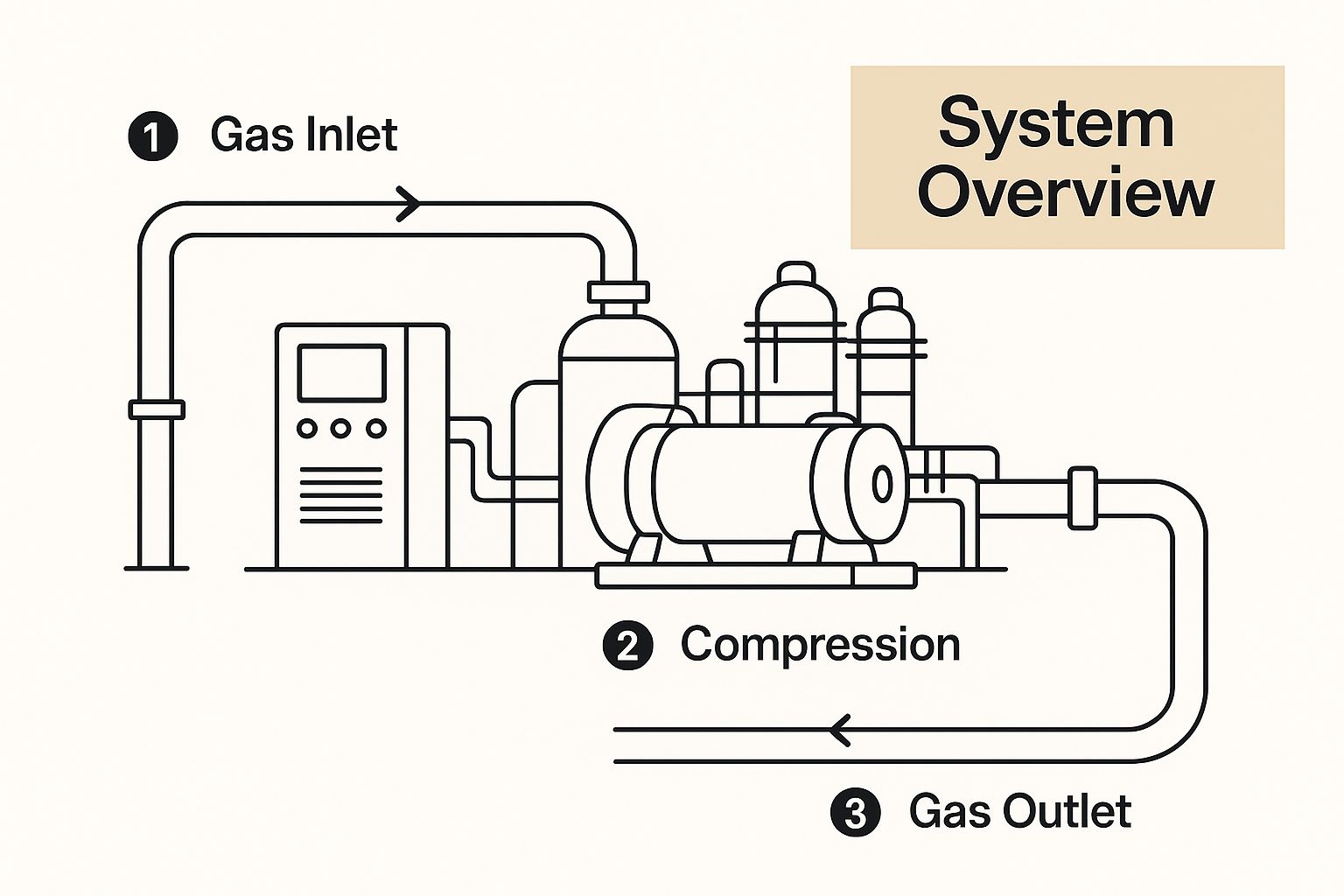
You can see the flow from the compression station all the way to the final delivery, highlighting the key pieces of equipment that make it all work.
Stage 3: Hitting the Road
With the cascades full, it's time to roll. Trucks haul the tube trailers over the highways to their final destination. This is the most visible part of the virtual pipeline—the physical link connecting the gas source to the end-user. The logistics here are managed carefully to maintain a constant, dependable supply, often using a rotation of trailers to ensure service is never interrupted.
Stage 4: Decompression and Delivery
Once the truck arrives, the trailer hooks up to a pressure reduction station (PRS) on-site. This is the final, critical step. The PRS safely brings the gas pressure down from its high-pressure transport state to a level that's usable for the customer's equipment. Whether it's firing up industrial boilers, heating a new housing development, or commissioning a power generator, this station is the final gatekeeper, delivering a steady flow of natural gas right where it's needed.
A Look Inside the Core System Components
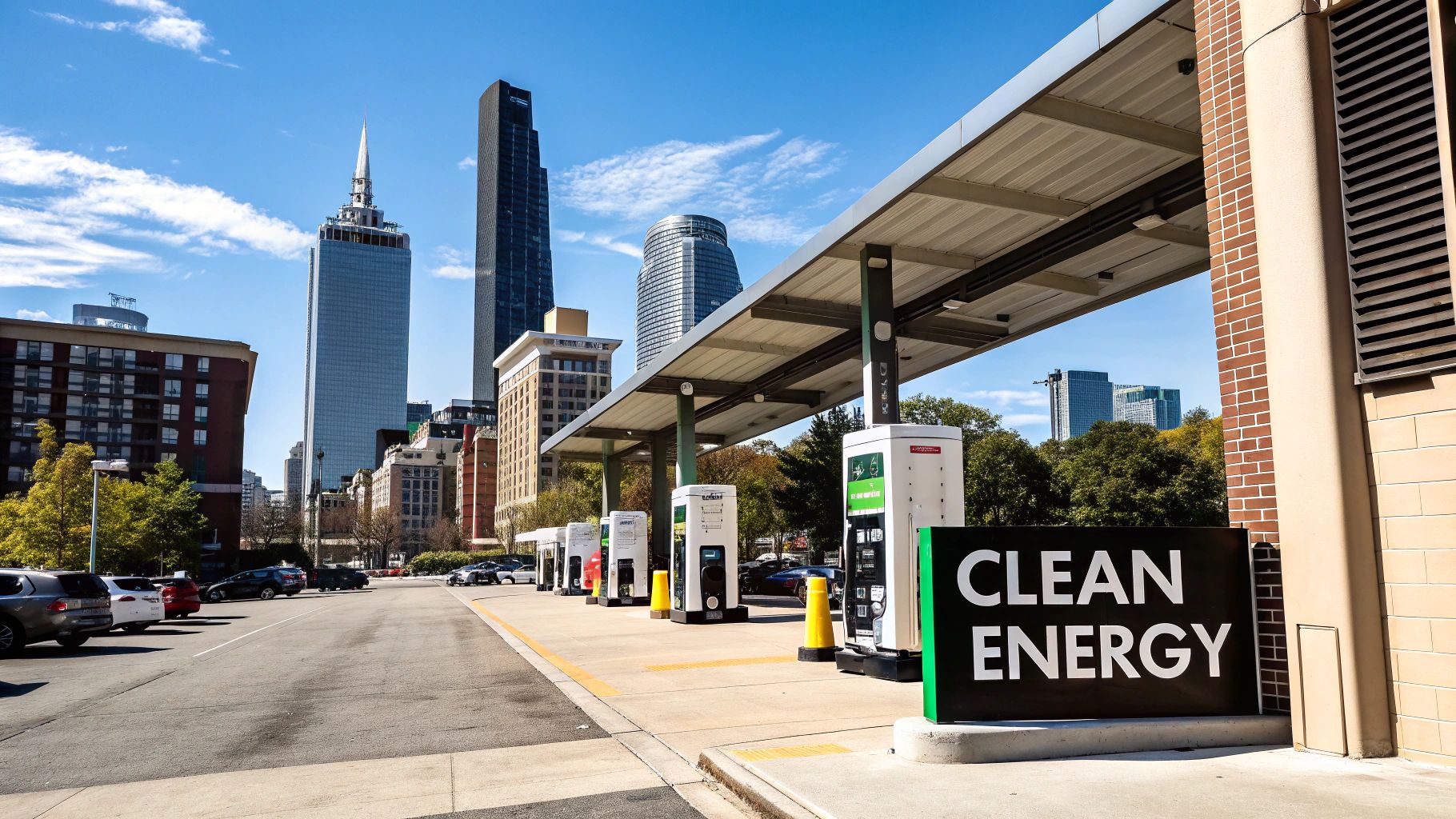
A virtual pipeline CNG system isn't just one piece of equipment; it's a series of specialized components working together seamlessly. Each part has a crucial job, from compressing the gas at the source to delivering it in a usable form at its final destination.
Think of it as a four-part journey. It all starts with the powerhouse that gets the gas ready, moves to the containers that hold it, then to the vehicles that carry it, and finally, to the equipment that hands it off to the end user.
The Compression Station
The whole process kicks off at the compression station. This is the heart of the operation, where natural gas is pulled directly from a major pipeline.
Here, powerful compressors get to work, pressurizing the gas to around 3,600 psi. This step is non-negotiable—it shrinks the gas's volume dramatically, packing a huge amount of energy into a transportable format. Without this, you'd be moving more air than energy.
Storage Cascades and Prime Movers
Once compressed, the CNG is channeled into specialized storage modules called cascades or tube trailers. These aren't your average tanks. They're a series of interconnected, high-strength cylinders built to handle the intense pressure safely.
These cascades are then loaded onto prime movers—usually semi-trucks—which become the mobile link in our virtual pipeline. They are the physical bridge between the gas source and the customer. The safety and reliability of this transport depend on strict protocols, including rigorous pre-trip inspections that ensure every component is road-ready.
The real magic of the virtual pipeline is the teamwork between the cascades and the trucks. A trailer can be dispatched at a moment's notice, change its route if needed, or join a fleet to meet a sudden spike in demand. This is the kind of agility a fixed pipeline just can't offer.
The Pressure Reduction Station
The final stop on the journey is the Pressure Reduction Station (PRS), installed right at the customer’s site. When a CNG trailer pulls up, it hooks into this unit, which acts as the final gatekeeper.
The PRS does the exact opposite of the compression station. It carefully steps the gas pressure down from 3,600 psi to a lower, usable level that the customer’s equipment needs. Whether it's feeding an industrial furnace, a power generator, or a hospital's boiler system, the PRS ensures a smooth and steady flow, completing the virtual pipeline's journey.
Comparing Virtual and Traditional Pipelines
Think of it this way: when you need to get natural gas from point A to point B, do you build a permanent, multi-lane highway or deploy a flexible fleet of trucks? That's the core difference between a traditional pipeline and a virtual pipeline CNG system. One is a massive, permanent fixture, while the other is all about agility and speed for specific situations.
They both deliver the same product, but how they do it—and why you’d choose one over the other—couldn't be more different. The traditional pipeline is the bedrock of our energy infrastructure, built for massive, continuous supply. The virtual pipeline, on the other hand, is the nimble special operations team, called in to handle jobs the big infrastructure can't.
Speed and Flexibility
Here's where the virtual pipeline really shines: speed. You can get a mobile CNG solution up and running in just a few days or weeks. Compare that to the years of planning, securing permits, and heavy construction needed to lay a traditional pipeline. For any project with a tight deadline, this rapid deployment is a massive advantage.
It's also incredibly flexible. Need more gas? Just add more trailers to the route. Need less? Scale it back. If your project moves, the pipeline moves with you. This makes it perfect for temporary needs, like providing a critical gas supply during a planned shutdown or maintenance of a primary pipeline. It's energy on demand.
Investment and Infrastructure
Laying a traditional pipeline is a monumental undertaking with a staggering price tag. We're talking about huge upfront capital for land rights, materials, and a massive labor force. These projects easily run into the millions, sometimes billions, of dollars, which only makes sense for long-term, high-volume demand.
A virtual pipeline completely sidesteps this. The initial investment is dramatically lower because you're not building anything permanent. Instead of a massive capital expenditure (CapEx), the cost shifts to a more predictable operational expenditure (OpEx). This model is a financial lifeline for businesses that can't justify the cost of a permanent pipeline but still need reliable access to natural gas.
A virtual pipeline flips the traditional energy model on its head. Instead of bringing the customer to the pipeline, it brings the pipeline directly to the customer, wherever they are.
To put it all into perspective, let's look at a direct comparison. This table breaks down the key differences and shows where each system excels.
Virtual Pipeline CNG vs. Traditional Pipeline Comparison
| Attribute | Virtual Pipeline (CNG) | Traditional Pipeline |
|---|---|---|
| Installation Speed | Fast (Days to Weeks) | Slow (Months to Years) |
| Upfront Investment | Low to Moderate | Extremely High |
| Geographic Reach | Flexible, reaches remote areas | Fixed, limited by terrain |
| Operational Flexibility | Highly adaptable and scalable | Rigid and permanent |
| Ideal Volume | Low to medium, intermittent | High, continuous supply |
| Best Use Cases | Temporary supply, remote sites, backup | Permanent supply for cities, large plants |
As you can see, the choice isn't about which one is "better" overall, but which one is right for the job at hand.
Ultimately, these two systems are not competitors; they're complementary. Traditional pipelines are the arteries of our national energy grid, providing a constant flow to major hubs. The virtual pipeline CNG model acts as the capillaries, extending that reach to ensure clean, reliable energy can get to any point on the map, quickly and efficiently.
Why Businesses Choose Virtual Pipeline Solutions
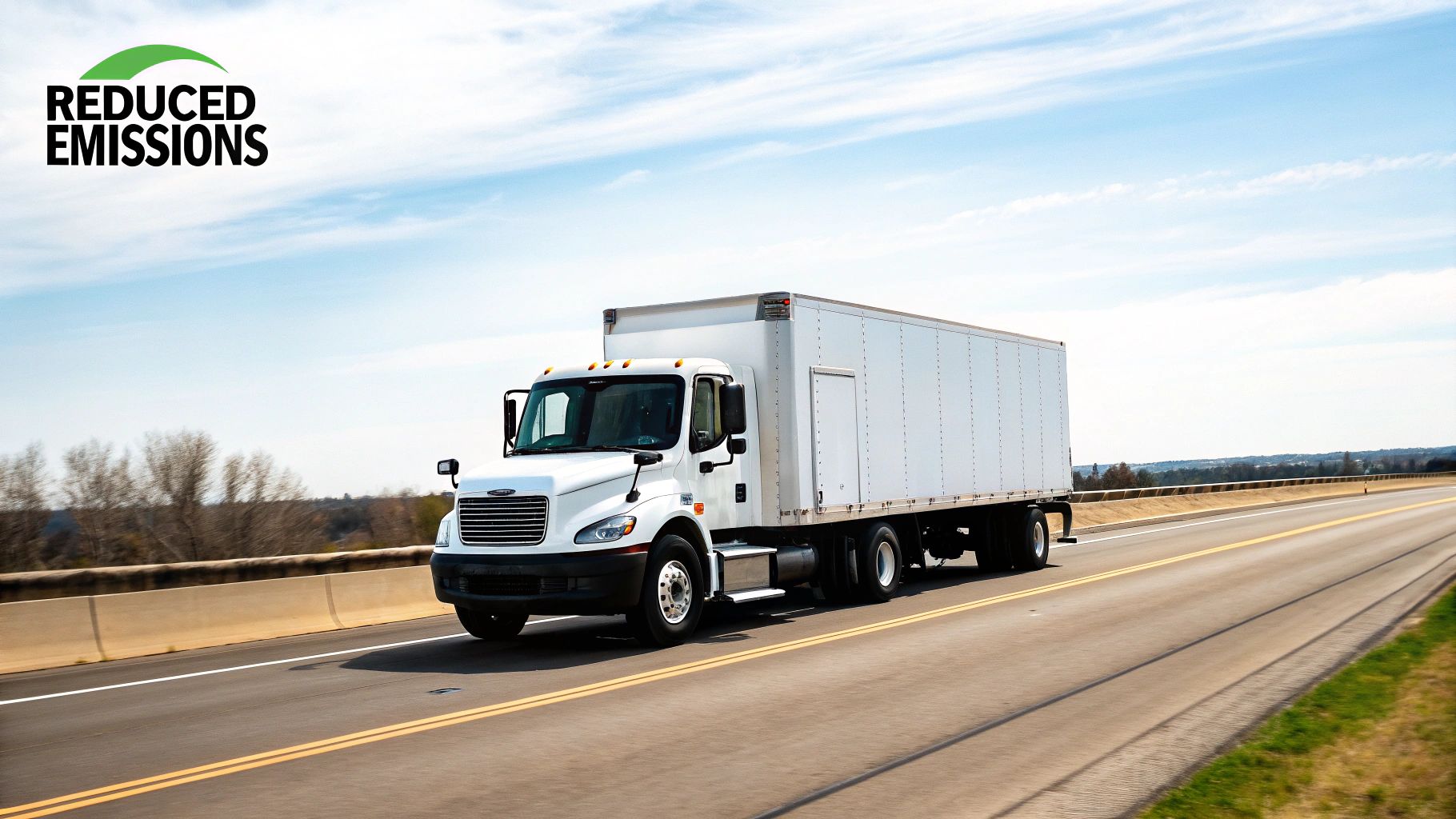
When you get past the technical side of things, the decision to go with a virtual pipeline CNG system is really about solving practical, everyday business problems. Companies are turning to this mobile energy strategy because it delivers a potent mix of economic, operational, and environmental wins that traditional pipelines just can't match.
The most obvious benefit is the cost. Laying a conventional pipeline is a massive undertaking. You're looking at staggering upfront capital for materials, land rights, and labor, not to mention a permitting maze that can drag on for years. A virtual pipeline sidesteps all of that, turning a huge capital expense into a manageable, predictable operating cost.
Unlocking Operational Agility
Flexibility is another huge reason businesses are embracing mobile natural gas. You aren't permanently tied to a fixed piece of infrastructure. Instead, your energy supply can be started, stopped, scaled up, or even moved to an entirely new site with surprising ease. It’s a level of agility that a buried pipeline simply can't offer.
This kind of adaptability is a game-changer in a few common situations:
- Temporary Projects: Powering a construction site or a seasonal business without sinking money into permanent infrastructure.
- Emergency Supply: Acting as a crucial lifeline when the main gas line is down for maintenance or an unexpected outage.
- Phased Development: Fueling the initial phase of a new facility while the permanent infrastructure is still in the planning and building stages.
This capability delivers true energy security and redundancy, keeping the lights on and the machines running, no matter what happens.
Achieving Environmental Goals
Finally, there’s the environmental angle, which is becoming more important every day. Many industries still rely on diesel, propane, or heating oil—all of which come with higher emissions and a bigger carbon footprint. A virtual pipeline creates a straightforward path to switch to cleaner-burning natural gas, even for locations completely off the grid.
By making it easy to switch from high-emission fuels to natural gas, a virtual pipeline becomes a strategic tool for businesses looking to hit sustainability targets, stay compliant with regulations, and shrink their carbon footprint.
Picture a remote manufacturing plant that swaps its diesel generators for CNG delivered via virtual pipeline. Right away, it cuts fuel costs and dramatically lowers its emissions of greenhouse gases and harmful particulates. It’s a single move that improves the bottom line, bolsters its green credentials, and secures a more reliable energy source.
This powerful combination—making economic sense, offering operational freedom, and promoting environmental stewardship—is exactly why more and more businesses see virtual pipeline CNG as the fuel for their future success.
How Industries Use Virtual Pipeline CNG
The real magic of virtual pipeline CNG isn't just in the technology itself, but in how it solves tangible, real-world problems. You can see its impact everywhere, from isolated industrial sites to the heart of busy cities. It's essentially a lifeline for anyone needing reliable energy where traditional pipelines just can't reach.
Think about a remote mining operation or a manufacturing plant far from the nearest gas main. They need a constant energy source for process heat and power. Historically, their only option was often expensive and less clean fuels like diesel. A virtual pipeline completely flips that script, delivering a steady, on-demand supply of natural gas right to their doorstep.
This isn't just about convenience. It’s a strategic move that keeps operations humming, slashes fuel costs, and helps these businesses seriously shrink their carbon footprint.
Powering Industrial Growth and Transportation
The industrial sector has been a primary driver behind this technology. The global industrial virtual pipeline market was already valued at USD 1.21 billion in 2023 and is only expected to climb. This growth is all about the need for dependable gas without being physically tethered to a pipeline. You can dive deeper into this industrial market growth on gminsights.com.
Transportation is another arena where virtual pipeline CNG is making a huge difference. Picture a city wanting to switch its entire bus fleet to cleaner CNG but lacking a network of fueling stations. Mobile CNG trailers can be brought in to create pop-up or even permanent fueling points at depots, making the green transition practical and affordable. The same principle works for logistics companies looking to fuel their long-haul trucks.
Virtual pipelines aren't just a backup plan; they are an enabling technology. They give communities and industries access to cleaner energy today, bridging the gap while permanent infrastructure is planned or built.
Ensuring Community and Emergency Resilience
Beyond the factory floor and the open road, virtual pipelines play a critical community role. When a natural disaster hits or a pipeline unexpectedly fails, these mobile units can be dispatched in a hurry to power hospitals, emergency shelters, and other vital facilities. They become the energy backbone that keeps a community running when the main grid is down.
Making sure these operations run smoothly requires sharp, data-driven decisions. This is where tools like oil and gas data analytics come into play, helping optimize logistics and ensure reliability.
This same flexibility is a game-changer for new housing developments. Instead of waiting months—or even years—for a utility hookup, builders can use temporary CNG to heat homes and pass inspections. This avoids costly delays and lets families move in on schedule. In every one of these scenarios, the virtual pipeline proves its worth by delivering energy with precision, speed, and incredible adaptability.
Answering Your Key Questions
Whenever you're looking at a new way of getting energy, a few practical questions always come to mind. When it comes to a virtual pipeline CNG system, most people want to know about three things: safety, how far it can realistically go, and how it compares to other mobile options like Liquefied Natural Gas (LNG).
How Safe Is Hauling CNG?
Moving compressed natural gas by truck is incredibly safe, and that's by design. It's not just a matter of luck; it's the result of tough regulations and some serious engineering.
CNG is stored in incredibly robust, thick-walled cylinders specifically built to take a beating. These tanks go through brutal testing protocols that simulate conditions far worse than anything they'd ever encounter on the road.
On top of that, the drivers aren't just any truckers. They have specialized HAZMAT training and are experts in safe handling and emergency procedures. Every single delivery is held to the highest safety standards set by agencies like the Department of Transportation.
What’s the Real-World Service Range?
So, how far can you actually send these trucks? The sweet spot for a CNG virtual pipeline is typically within a 200-250 mile radius of the compression station.
Once you start going much further than that, the cost of transportation can begin to cancel out the savings. But within that range, you can cover a huge service area, making it a perfect fit for regional energy distribution to facilities that are off the main grid.
CNG vs. LNG for Virtual Pipelines
This is a big one. The choice between CNG and LNG really boils down to your specific needs, especially the distance involved.
For shorter distances and situations that need faster, more frequent top-offs, CNG is almost always the better choice. The process is simpler—you just compress the gas—which means the equipment costs less and you can get up and running much faster.
LNG, on the other hand, is natural gas that’s been chilled into a liquid. This makes it much denser, so you can pack more energy into a single truck. It’s the go-to for long-haul routes over 250 miles or for users who need a massive amount of gas delivered all at once. The trade-off? The liquefaction and regasification equipment at both ends is far more complex and expensive.
When pipeline delays put your project on hold, you can't afford to wait. Blue Gas Express delivers reliable, temporary CNG and LNG solutions to keep your operations moving. Get your project back on track by visiting the Blue Gas Express website to secure your mobile gas supply today.