

Natural gas in its raw form is like a massive, uncontained cloud—pretty tough to move from point A to point B. The solution? We compress it. Think of how a scuba diver’s tank holds a huge amount of breathable air in a small space. That's essentially what we do with Compressed Natural Gas (CNG), turning an unwieldy resource into a portable, high-pressure energy source.
Why CNG Transportation Matters
Getting a handle on how to move CNG is absolutely essential for meeting the world's energy needs, especially as we shift toward cleaner fuels. It’s all about getting energy to the industries, power plants, and vehicle fleets that aren't connected to a physical pipeline. This logistical magic turns a fixed resource into a mobile one, building what you might call a "virtual pipeline" to just about anywhere.
You really can't overstate how important this is. As the world uses more energy, getting it where it needs to go becomes the name of the game. In fact, global natural gas demand hit a record 4,122 billion cubic meters (bcm) and is expected to keep climbing to around 4,193 bcm. You can dive deeper into these global energy trends to see just how logistics plays a role.
Bridging the Energy Gap
CNG really shines in places where building permanent pipelines just doesn't make sense from a cost or practical standpoint.
Here are a few classic examples:
- Remote Industrial Sites: Think of a factory or a mine way off the beaten path. Instead of spending a fortune on a dedicated pipeline, they can get a steady stream of CNG delivered.
- Emergency Power Generation: When the power goes out during a storm or other disaster, mobile CNG units can be rolled in quickly to keep hospitals, data centers, and other critical services running.
- Vehicle Fleets: City buses, garbage trucks, and even long-haul semis can fill up at stations that are supplied by CNG trucks, cutting down on diesel use.
By making natural gas portable, CNG transportation blows past geographical barriers. It delivers a flexible energy solution that can scale up or down as needed, supporting both economic growth and environmental objectives by replacing dirtier fuels.
This infographic breaks down the primary ways we move CNG from one place to another.

As you can see, each method has its own job to do. From the continuous flow of pipelines to the flexible, on-demand nature of trucking and the virtual pipeline, they all fit together to build a robust energy supply chain.
To make this even clearer, here’s a quick breakdown of the main transportation methods and where they fit in.
Overview of CNG Transportation Methods
| Method | Primary Use Case | Key Characteristic |
|---|---|---|
| Pipeline Network | Long-distance, high-volume bulk transport | Continuous, high-capacity flow |
| Road Transport (Trucks) | "Last mile" delivery to off-grid users | Highly flexible and scalable |
| Virtual Pipeline | Supplying remote areas or creating a temporary supply | A system combining road, rail, or sea transport |
Ultimately, the method chosen depends entirely on the distance, the volume of gas needed, and the existing infrastructure (or lack thereof).
The Core Methods for Moving Natural Gas

When you flip a switch or turn a dial, you expect the power to be there. But what happens when the energy source, like compressed natural gas, isn't right next door? The logistics behind the transportation of cng are all about bridging that gap, using a few key methods to move gas from where it's plentiful to where it's needed.
These systems are the backbone of CNG delivery, ensuring that vehicle fleets, industrial plants, and remote construction sites have the fuel they need to operate. It’s a smart mix of massive, fixed infrastructure and incredibly nimble mobile solutions. Let's dig into the three primary ways CNG gets from point A to point B.
Traditional Pipelines: The Superhighways of Gas
Think of the traditional pipeline network as the interstate highway system for natural gas. It’s a sprawling, interconnected web built to shuttle staggering volumes of gas across the country. For feeding major cities and industrial hubs with a continuous, high-volume supply, nothing beats a pipeline.
But just like a highway, a pipeline only goes where it's been built. Extending that fixed infrastructure is a monumental task, often costing millions of dollars per mile. This makes it impossible to run a dedicated pipeline to every single customer, especially those in rural or newly developed areas. That's where the other methods come into play.
Over-the-Road Trucking: Flexible Last-Mile Delivery
When a pipeline isn't an option, trucking is the answer. Specialized vehicles called tube trailers are, quite simply, high-pressure gas tanks on wheels. These rigs are filled with CNG at a compression station—which is hooked up to a pipeline—and then driven directly to the customer.
This approach offers incredible flexibility. It's the ideal solution for:
- Pinpoint Delivery: Supplying a specific manufacturing plant, a new housing development, or a temporary construction project.
- Scalable Fueling: A customer can easily ramp their supply up or down just by changing the number of trailer deliveries.
- Speed to Market: Building a pipeline can take years. A truck-based supply can be set up in just days or weeks.
These tube trailers are the real workhorses of the CNG industry, handling the critical "last-mile" delivery that pipelines can't. For businesses like Blue Gas Express, this mobile-first model is their bread and butter, allowing them to deliver temporary natural gas solutions exactly when needed. This ensures projects can start on time, even if the permanent gas lines are still months away from being active.
The real power of over-the-road trucking is its ability to separate energy access from fixed infrastructure. It turns CNG from a location-bound utility into a mobile commodity that can be delivered precisely where it's needed, when it's needed.
This isn’t just about convenience; it’s a crucial enabler for economic activity. It allows new factories to open in rural areas and provides an essential energy backup during pipeline maintenance or unexpected outages.
The Virtual Pipeline Concept: Connecting the Dots
Now, let’s combine those two methods into a more sophisticated logistics system: the virtual pipeline. Don't let the name fool you—there's no physical pipe. Instead, it’s a complete, end-to-end supply chain on wheels that uses trucks and tube trailers to mimic the constant, reliable flow of a traditional pipeline.
Here’s how a virtual pipeline system works seamlessly:
- Sourcing: Natural gas is pulled from a major transmission pipeline at a dedicated facility.
- Compression: The gas is compressed and pumped into mobile storage modules or tube trailers.
- Transportation: Trucks deliver the full trailers to the customer's site.
- Decanting: On-site, a pressure reduction unit (PRU) safely lowers the gas pressure to a usable level for the customer’s equipment.
This system is perfect for users who have a steady, consistent demand for energy but no direct pipeline access. Imagine an asphalt plant miles from the nearest gas main. With a virtual pipeline, trucks can swap empty trailers for full ones on a regular schedule, ensuring their operations never skip a beat.
The virtual pipeline is the modern evolution in the transportation of cng, blending the steadfast reliability of a pipeline with the unmatched flexibility of mobile delivery.
Decoding the Technology Behind CNG Transport
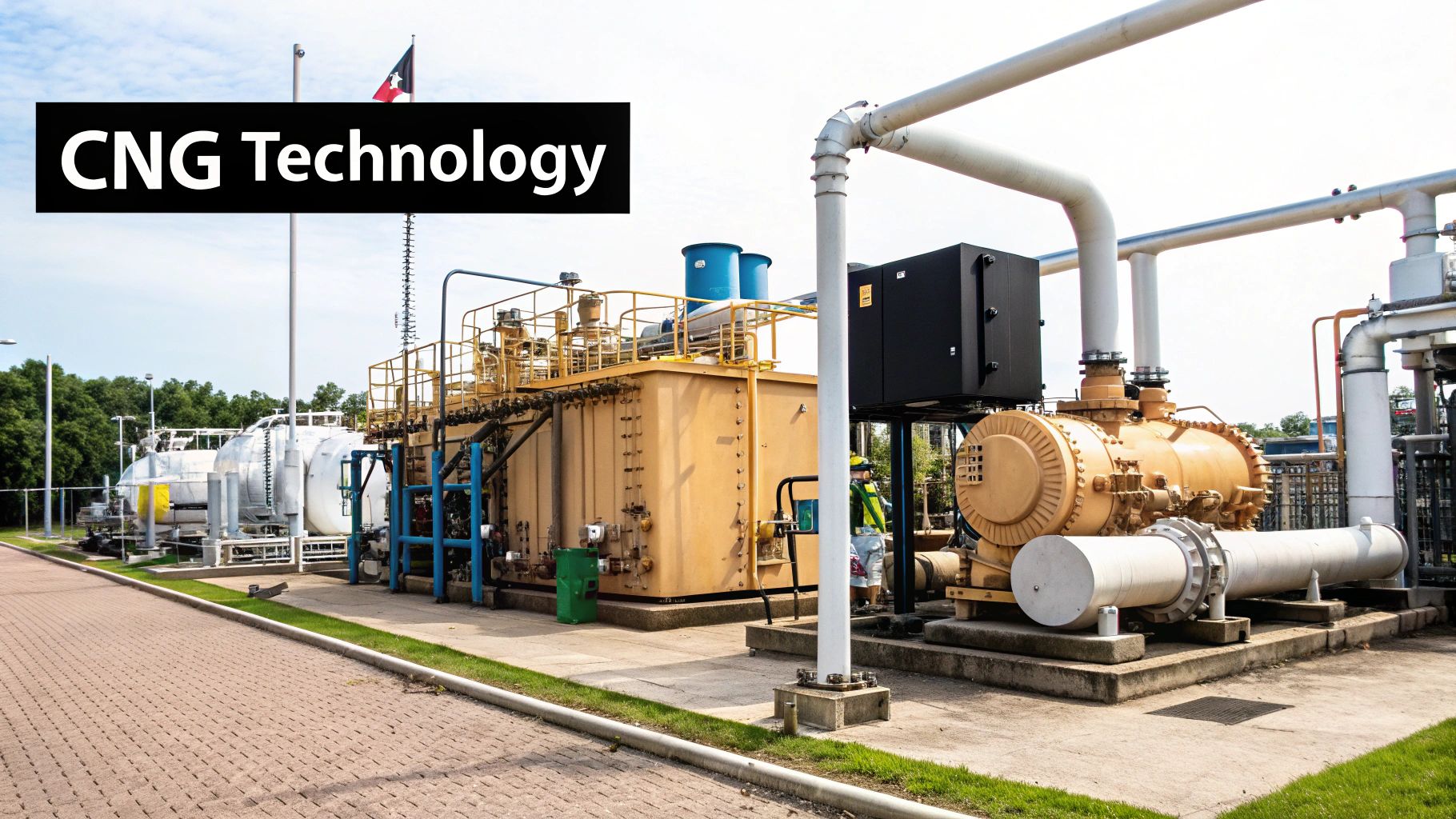
Moving CNG from point A to point B isn't as simple as just filling up a tank. It’s a sophisticated process where a whole chain of specialized technologies has to work together seamlessly. To really get a feel for how a "virtual pipeline" works, you need to understand the role each piece of equipment plays, from the moment the gas is prepped to the second it's delivered.
This technological backbone is what transforms natural gas from a stationary resource, locked into physical pipelines, into a flexible energy source that can go anywhere. Every single component is built for extreme pressure and safety, creating a rock-solid system for on-demand energy.
Getting the Gas Ready for the Road
The journey starts by getting the natural gas ready to leave the pipeline. This is the job of a compression station, which is the gateway to the entire mobile supply chain. Think of it like a powerful pump that takes low-pressure gas from a pipeline and squeezes it down into a much smaller, more concentrated volume for trucking.
Inside the station, massive industrial compressors crank up the pressure, usually to between 3,000 and 3,600 pounds per square inch (psi). This extreme pressure is what lets us pack a huge amount of energy into the transport cylinders. It's a precise, highly controlled process.
The Right Containers for the Job
Once compressed, the CNG is pumped into high-pressure cylinders. These are far from your everyday tanks; they're meticulously engineered vessels built to handle immense forces safely. The choice of cylinder often comes down to a balancing act between weight, capacity, and cost for a given operation.
Here are the four main types you’ll see in the field:
- Type 1: These are the old-school workhorses—all-metal cylinders made from heavy-duty steel. They're tough and affordable, but their weight is a major drawback, limiting how much gas a truck can legally haul.
- Type 2: A step up from Type 1, these have a metal liner (steel or aluminum) wrapped with a composite material around the middle. This "hoop wrap" shaves off a bit of weight.
- Type 3: Things get much lighter here. These feature a full composite wrap over a metal liner, which means a truck can carry significantly more gas per load.
- Type 4: This is the top-of-the-line option. Made entirely of composite materials with a polymer liner, they are the lightest cylinders available, maximizing both payload and the truck's fuel efficiency.
The type of cylinder used has a direct impact on the entire operation's efficiency. Lighter composite cylinders (Type 3 and 4) mean more gas per trip, fewer deliveries, and ultimately, lower costs.
A Closer Look at a CNG Tube Trailer
The backbone of over-the-road CNG delivery is the tube trailer. This specialized semi-trailer is basically a mobile storage bank, made up of a series of large, interconnected cylinders mounted onto a chassis.
These trailers are much more than just tanks on wheels. They're complex systems loaded with manifolds, valves, and safety equipment that give operators precise control over filling and dispensing. As we unpack the equipment, it's also worth thinking about how technology impacts trucking insurance, since advanced monitoring and safety features can make a real difference in risk assessment.
Making the Gas Usable at Its Destination
When a tube trailer arrives, the high-pressure gas isn't ready to be used just yet. The final piece of the puzzle is the Pressure Reduction Unit (PRU).
A PRU is a sophisticated skid that safely "steps down" the gas pressure from as high as 3,600 psi to a usable level for the customer, which could be as low as 2 psi. This is a carefully managed process that ensures a smooth, steady flow of energy, finally completing the CNG's journey from pipeline to end-user.
Navigating Critical Safety and Regulatory Standards
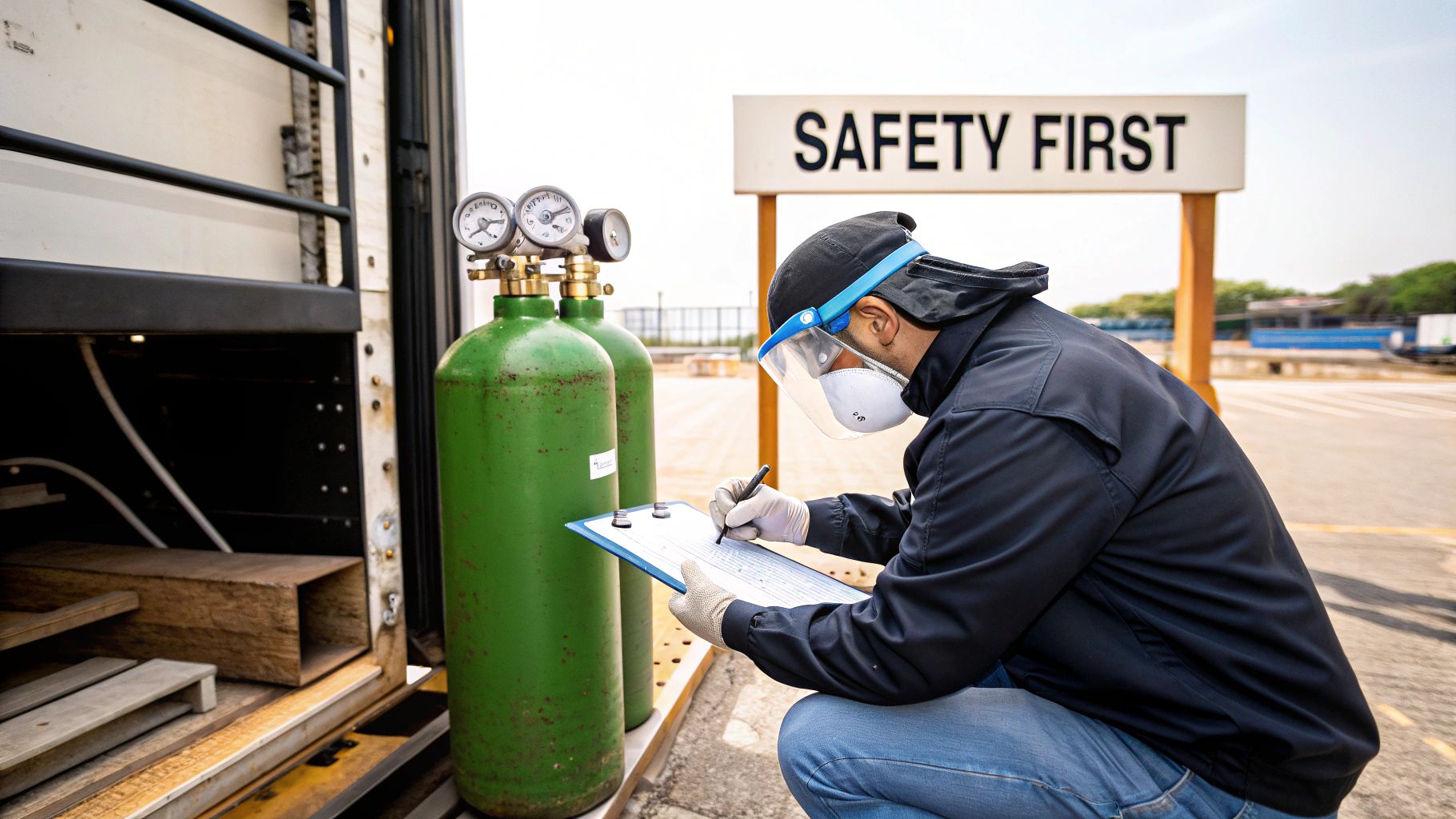
Moving any kind of fuel requires a serious commitment to safety, but the high-pressure nature of compressed natural gas takes that commitment to a whole new level. The entire system built around the transportation of CNG is wrapped in layers of strict regulations and time-tested safety protocols. These aren't just bureaucratic hurdles; they are essential safeguards for drivers, the public, and the communities we serve.
Interestingly, CNG has a few built-in safety advantages over liquid fuels. If gasoline spills, it pools on the ground, creating a lingering fire hazard. CNG, being lighter than air, behaves differently. In the unlikely event of a leak, it rises and dissipates into the atmosphere, which dramatically lowers the risk of ignition.
The real challenge, of course, is managing the immense pressure. That’s where top-notch engineering and strict operational standards create a robust, multi-layered defense system.
Key Regulatory Bodies and Their Roles
In the U.S., the Department of Transportation (DOT) is the primary authority overseeing the movement of hazardous materials, and that includes CNG. The DOT essentially writes the safety playbook that everyone in the industry must follow, ensuring a consistent, high standard of safety nationwide.
Their regulations are incredibly detailed, covering everything from how equipment is built to the qualifications a driver must have.
These aren't just guidelines; they are the law. Key mandates include:
- Cylinder Manufacturing: Every single CNG cylinder has to pass rigorous design, testing, and certification protocols to prove it can handle high pressure and potential impacts.
- Vehicle Specifications: Trucks and trailers carrying CNG must be outfitted with specific safety gear, like emergency shut-off systems and pressure relief devices.
- Operational Procedures: There are precise, regulated procedures for every step—loading, unloading, and securing the CNG for transit.
The Pillars of CNG Transport Safety
Beyond the government rulebook, the industry itself operates on a foundation of core safety pillars. These are the daily practices that responsible providers like Blue Gas Express live by, making safety the absolute priority.
A truly effective safety program really comes down to three critical components.
- Rigorous Equipment Inspections: Before a tube trailer ever leaves the yard, it gets a meticulous top-to-bottom inspection. We’re talking about checking every valve, gauge, and safety device to make sure it's functioning perfectly.
- Specialized Driver Training: Our drivers are much more than just drivers; they're highly trained professionals who know how to handle high-pressure gas. They go through extensive training on emergency procedures and the specific mechanics of their vehicles.
- Emergency Response Planning: Every transport company must have a detailed, well-rehearsed emergency response plan. This plan lays out the exact steps to take in the event of an accident or equipment failure, ensuring a fast, coordinated response.
The commitment to safety in CNG transportation isn't just about checking boxes for compliance; it's about building trust. By layering advanced engineering, strict regulatory oversight, and continuous training, the industry ensures this clean energy source is delivered securely and reliably, every time.
This powerful safety framework is what allows the market to grow with confidence. Here in the United States, the compressed natural gas market was valued at over USD 13.4 billion and is forecast to hit USD 26.6 billion by 2030. This growth is fueled by vast domestic supply and policies pushing for lower emissions. For a deeper dive into these numbers, check out this U.S. market analysis.
Comparing the Economics of CNG Transportation
When you need to move compressed natural gas, you’re essentially looking at two completely different playbooks. The first is building a traditional pipeline—a massive, permanent piece of infrastructure. The second is what we call a "virtual pipeline," which relies on a fleet of trucks.
Choosing between them isn't about which one is better overall, but which one makes sense for your specific situation. It really boils down to a classic financial trade-off: a huge upfront investment for low running costs versus a much smaller initial outlay with higher, ongoing expenses. Getting this decision right is everything.
The Upfront Investment: Capital Expenditure
The first and most glaring difference is the initial cash required to get started, known as Capital Expenditure (CapEx).
Pipelines: Let's be clear: building a physical pipeline is a monumental project. You're looking at costs that can easily run into the millions of dollars per mile. This figure accounts for everything from acquiring the land and navigating the permitting maze to the actual steel and construction crews. This is why pipelines only make financial sense for serving enormous, long-term customers like a whole city or a sprawling industrial complex.
Virtual Pipelines: This is where trucking shines. The initial investment is a world away from building a pipeline. Your main costs are the specialized tube trailers that hold the CNG and the Pressure Reduction Unit (PRU) at the delivery site. You get to sidestep the astronomical expense and lengthy timelines of permanent construction, making this a far more practical entry point for many businesses.
Ongoing Operational Costs
Once you're up and running, the financial picture starts to flip. This is where Operational Expenditure (OpEx), or the day-to-day running costs, comes into play.
With a pipeline, the ongoing costs are incredibly low. Once it's in the ground, your expenses are mostly for routine maintenance, inspections, and monitoring. The gas just flows, 24/7, without much human involvement. For sheer high-volume efficiency, it’s tough to beat.
Trucking, on the other hand, comes with higher variable costs. Your OpEx is tied directly to things like diesel for the trucks, driver pay, vehicle maintenance, and insurance. These costs go up with every mile driven and every delivery made, which means the cost-per-unit of gas is naturally higher than a pipeline's, especially over long hauls.
The core economic principle is simple: Pipelines trade a massive upfront investment for unbeatable long-term efficiency, while trucking offers immediate access with predictable, consumption-based operational costs.
A Head-to-Head Comparison
To really see the trade-offs in action, it helps to put the two methods side-by-side. The table below breaks down how factors like distance, volume, and flexibility influence which approach is the most cost-effective for a given job.
Cost and Efficiency Comparison of CNG Transport Methods
This comparison highlights the fundamental economic and operational differences between laying permanent pipe and using a flexible trucking solution for the transportation of cng.
| Factor | Pipelines | Virtual Pipeline (Trucking) |
|---|---|---|
| Initial Investment (CapEx) | Extremely high (millions per mile) | Low to moderate (cost of trailers and PRU) |
| Operational Costs (OpEx) | Very low (maintenance and monitoring) | Moderate to high (fuel, labor, vehicle upkeep) |
| Ideal Distance | Long-distance, cross-country transport | Short to medium distances ("last-mile" delivery) |
| Best Use Case | Continuous, high-volume supply to fixed locations | Supplying remote sites, variable demand, temporary needs |
| Scalability | Fixed capacity, difficult to scale | Highly flexible, can scale up or down easily |
Ultimately, a pipeline is like owning your own superhighway—it costs a fortune to build, but once it's done, traffic flows cheaply. A virtual pipeline is more like having a fleet of delivery vans on call. You don't have to build the road, but you pay for every single trip.
What's Next for CNG Transport and Logistics?
The world of CNG transportation isn't just evolving; it's accelerating. Driven by smarter tech and a serious push for sustainability, the ways we move compressed natural gas are becoming safer, more efficient, and more plugged-in than ever before. These shifts are cementing CNG's place as a critical player in the clean energy landscape.
Breakthroughs in materials science are leading the way. Think advanced composite cylinders, especially Type 4 designs, which are making transport vehicles both lighter and stronger. This is a huge deal. It means a single tube trailer can haul more gas per trip without getting flagged for being overweight. The result? Fewer trips, less diesel burned by the truck itself, and lower costs across the board.
The Shift to Smart Logistics
At the same time, the day-to-day business of delivering CNG is getting a massive digital overhaul. By weaving in Internet of Things (IoT) sensors and sophisticated software, fleet management is being completely transformed.
- Real-Time Monitoring: Imagine IoT devices on every trailer constantly tracking cylinder pressure and temperature. This isn't science fiction—it's happening now. Operators get instant alerts, allowing them to catch potential issues long before they escalate.
- Predictive Maintenance: Instead of waiting for a breakdown, logistics software can now analyze performance data to predict when equipment needs a tune-up. This proactive approach keeps trucks on the road and avoids costly, unexpected downtime.
- Smarter Routes: Clever algorithms crunch data on traffic, weather, and delivery schedules to map out the most efficient routes possible, saving even more on fuel and cutting emissions.
The backbone of this connected future is powerful communication. To get a sense of what's coming, it’s worth exploring the transformative potential of 5G technology and how it will enable the next generation of logistics tracking and automation.
CNG's Renewable Counterpart: RNG
Perhaps the most exciting development is the growing partnership between conventional CNG and Renewable Natural Gas (RNG). RNG is chemically the same as the natural gas pulled from the ground, but its origin story is completely different. It's produced from organic waste—think landfills, farms, and wastewater treatment plants.
When we use RNG in the CNG supply chain, we create a powerful, low-carbon energy cycle.
By capturing methane that would otherwise just vent into the atmosphere and turning it into a usable vehicle fuel, RNG can become a net-zero or even carbon-negative energy source. This elevates CNG from simply being a "cleaner" fuel to a truly renewable one.
This trend is a massive force behind the industry's growth. It clicks perfectly with corporate sustainability initiatives and government programs designed to decarbonize our economy. The numbers tell the story: the global automotive natural gas vehicle market was valued at around USD 13.52 billion and is projected to nearly double to about USD 25.88 billion by 2035. For a deeper dive into these figures, check out this comprehensive market report.
These aren't just ideas on a whiteboard. They are real-world innovations making the transportation of CNG smarter, safer, and more sustainable every day.
Frequently Asked Questions About CNG Transportation
Even after getting familiar with the technology, you probably still have some practical questions about what it’s like to move compressed natural gas on a daily basis. Let’s tackle some of the most common things people ask about the safety, real-world uses, and environmental impact of CNG transport.
Is Transporting CNG by Truck Safe?
Yes, it's remarkably safe. The safety record for moving CNG is top-notch, and that’s no accident—it's the result of tough engineering standards and very strict government oversight. The cylinders used to hold CNG are built like tanks, far tougher than the gas tank in your car.
These cylinders go through hellish testing to make sure they can handle extreme pressure, hard impacts, and even fire. On top of that, the trailers themselves are loaded with safety features, like pressure relief valves and emergency shut-offs. CNG also has a natural safety advantage: it’s lighter than air. In the unlikely event of a leak, the gas just rises and dissipates, which is a world away from liquid fuels that pool on the ground and create a serious fire hazard.
What Is a Virtual Pipeline and When Is It Used?
A "virtual pipeline" sounds high-tech, but it's really a smart and flexible logistics system. Instead of a physical pipe, it's a fleet of trucks carrying CNG in specialized tube trailers. They pick up gas from a source, like a major pipeline access point, and deliver it directly to customers who aren't connected to the grid.
Think of it as the perfect solution for a few key scenarios:
- Remote Locations: It’s a lifeline for industrial plants, power stations, or vehicle fueling depots located where it just doesn’t make financial sense to build a permanent pipeline.
- Temporary Needs: It’s ideal for supplying gas to a construction site or keeping the lights on during planned pipeline maintenance.
- Rapid Deployment: Need an energy supply fast? A virtual pipeline can be up and running in a fraction of the time it takes to plan and build traditional infrastructure.
This "pipeline on wheels" brings modern energy to places that would otherwise go without.
How Does CNG Transport Impact the Environment?
You have to look at the big picture here. While the delivery trucks do burn fuel, the net environmental gain is huge when CNG is used to replace dirtier fuels like diesel or coal. The real win happens at the final destination.
When used to power vehicles, CNG slashes emissions, cutting CO2 by up to 25%, particulate matter by 95%, and nitrogen oxide by 50% compared to gasoline or diesel.
So, when a virtual pipeline supplies CNG to a factory or a fleet of city buses, it leads to a major drop in air pollution. The benefit gets even bigger if the source is Renewable Natural Gas (RNG), which is captured from organic waste and can even be a carbon-negative fuel. This makes the transportation of cng a key piece of the puzzle for achieving wider decarbonization goals.
Facing a delay in your natural gas line installation? Don't let it halt your project. Blue Gas Express provides reliable, on-demand temporary CNG solutions to keep your operations running smoothly. Get your project back on track by visiting us at https://bluegasexpress.com.