

Ever wonder how the natural gas that heats your home or powers your local factory gets there? It's a journey that spans hundreds, sometimes thousands, of miles, moving from deep underground wells to your doorstep. This process, known as natural gas transportation, is the invisible backbone of our energy system.
At its core, the goal is to move gas from where it's found to where it's needed. But since gas is, well, a gas, you can't just load it into a standard container. It has to be compressed or even turned into a liquid to make the trip efficiently and safely.
The Unseen Network Powering Our World
Think of the natural gas grid as the circulatory system for our economy. It’s a complex web of pipelines, ships, and trucks working 24/7 to deliver energy, much like arteries deliver oxygen. It’s an out-of-sight, out-of-mind system that allows a resource pulled from the earth to power a light switch in a city far, far away.
This journey from the wellhead to the end-user is a marvel of engineering. Different methods are used for different situations, each one designed to handle the specific challenges of distance, volume, and terrain.
How Gas Travels From Point A to Point B
While the specifics can get complicated, the primary ways we move natural gas are surprisingly straightforward. The three main workhorses of the industry are:
- Pipelines: These are the superhighways of the gas world. A massive, continent-spanning network of underground pipes carries the bulk of natural gas over land.
- Liquefied Natural Gas (LNG) Carriers: To cross oceans, you can't just build a pipeline. Instead, the gas is super-cooled to -260°F (-162°C), turning it into a liquid that takes up 600 times less space. This liquid is then loaded onto enormous, specialized ships for transport.
- Compressed Natural Gas (CNG) Trucks: For shorter hauls or to supply areas not connected to the main grid, gas is compressed into high-pressure tanks and delivered by truck. This creates a flexible "virtual pipeline" on wheels.
The constant demand for energy means we're always investing in and expanding this infrastructure. It’s a clear sign of just how critical a reliable gas supply is to the global economy.
Keeping Up with Global Demand
As the world's appetite for energy grows, so does the need for robust transportation networks. The global market for natural gas pipeline transport was valued at around $18.85 billion in 2024 and is expected to climb to $24.84 billion by 2029.
This growth is all about connecting new gas discoveries to hungry markets. You can dive deeper into these trends with research on the global gas transport market. In this guide, we'll break down each of these transportation methods to give you a clear picture of how this essential resource keeps our world running.
Exploring the Main Arteries: Pipelines and Compressor Stations
When you think about how natural gas gets from point A to point B, pipelines are the first thing that comes to mind. They are the undisputed workhorses of the industry, a vast and mostly hidden network that acts as the country's energy circulatory system. It's simply the most efficient way to move gas across land, guaranteeing a steady flow from the wellhead to the end user.
Think of this pipeline network like our road system. Each part has a specific job.
The journey starts on the gathering pipelines. These are like the small country roads of the gas world. They're smaller pipes that collect raw natural gas from a cluster of wellheads and funnel it toward a central processing facility where it gets cleaned up.
From there, the processed gas hops onto the transmission pipelines. These are the interstate highways. Built from high-strength steel and sometimes several feet wide, these high-pressure lines can transport enormous volumes of gas over hundreds or even thousands of miles, crossing state lines to connect supply hubs with major markets.
Finally, the gas arrives at its destination and moves into the distribution pipelines. Consider these the local streets and driveways. This web of smaller, lower-pressure pipes is managed by local utilities, branching off the main transmission lines to deliver gas directly into homes, businesses, and industrial sites.
This infographic lays out the entire journey, from extraction and transport all the way to its final use.
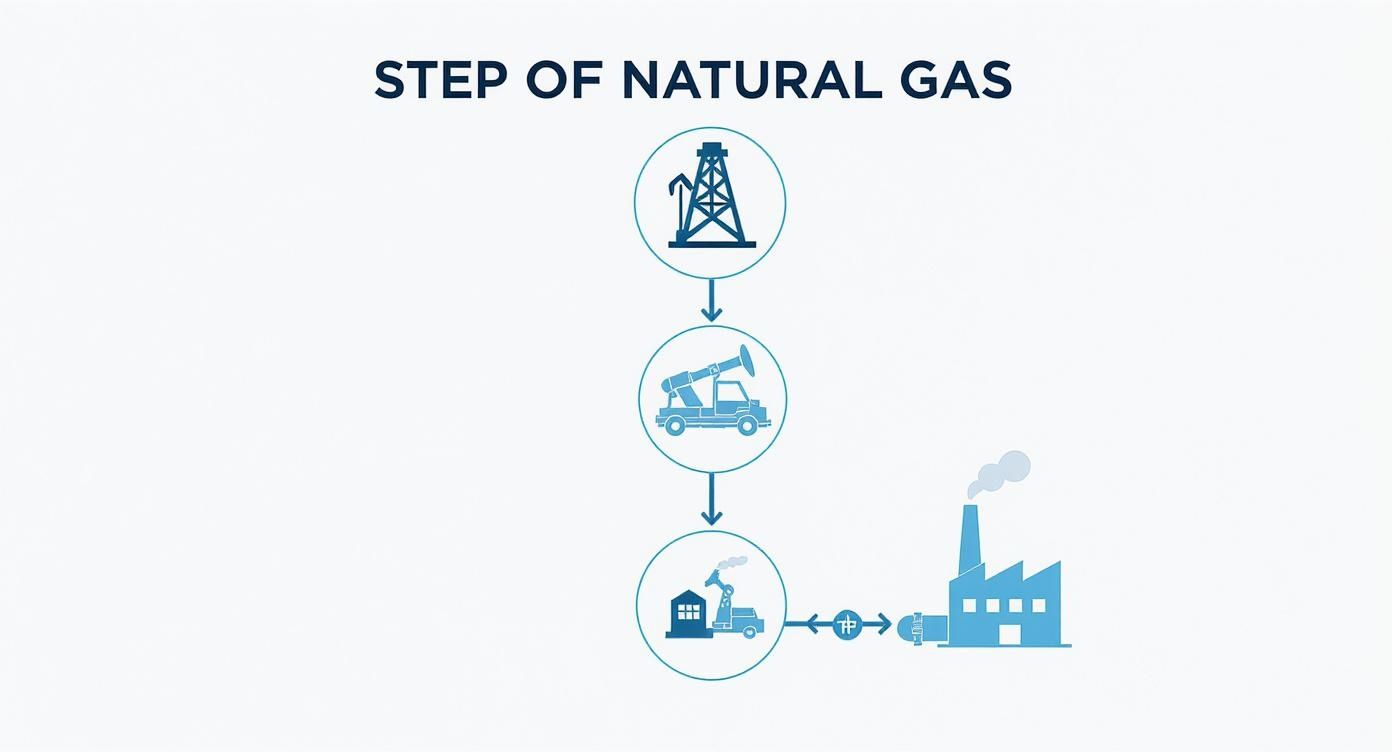
As you can see, the pipeline is the critical link that transforms a raw resource from the ground into usable energy for everyone.
Keeping the Pressure On: Compressor Stations
Gas doesn't just flow through thousands of miles of pipe on its own. Just like water pressure drops in a very long garden hose, the gas loses momentum over long distances due to friction and changes in elevation. To keep it moving, the network depends on a series of crucial installations: compressor stations.
These stations are the heart of the pipeline system, giving the gas a much-needed push. Placed every 40 to 100 miles along a transmission line, they use powerful turbines or engines to re-pressurize the gas, sending it on its way to the next station. Without them, long-distance gas transport would grind to a halt.
A compressor station essentially re-energizes the gas stream, ensuring a powerful and consistent flow from one end of the country to the other. It’s a constant cycle of push, flow, and repeat.
The scale of this infrastructure is enormous and still expanding. The U.S. natural gas pipeline industry's revenue is on track to hit $42.4 billion in 2025, a number that speaks volumes about its importance. A lot of this growth is driven by shale gas production, which demands modern pipelines to bring new reserves to the market.
Building and Maintaining the Network
Keeping this massive network safe and reliable is a huge undertaking that blends precise engineering with round-the-clock monitoring.
- The Right Materials: Transmission pipelines are typically made from tough carbon steel to handle high pressure. In contrast, smaller distribution lines often use flexible, corrosion-resistant plastic.
- High-Tech Monitoring: Companies use sophisticated inspection tools to keep an eye on pipeline integrity from the inside. A common practice is sending "smart pigs"—robotic devices packed with sensors—through the pipeline. They crawl along the interior, detecting tiny cracks, dents, or signs of corrosion long before they can become serious problems.
Modern sensor technology in the oil and gas sector is key to making these systems reliable. It's this continuous cycle of maintenance and technological oversight that makes pipelines such a dependable way to transport natural gas.
Going Global: Liquefied Natural Gas (LNG) Transportation
Pipelines are the undisputed champions for moving natural gas across land, but they hit a hard stop at the ocean's edge. So, how does gas from a field in Texas end up powering a factory in Japan or heating a home in Germany?
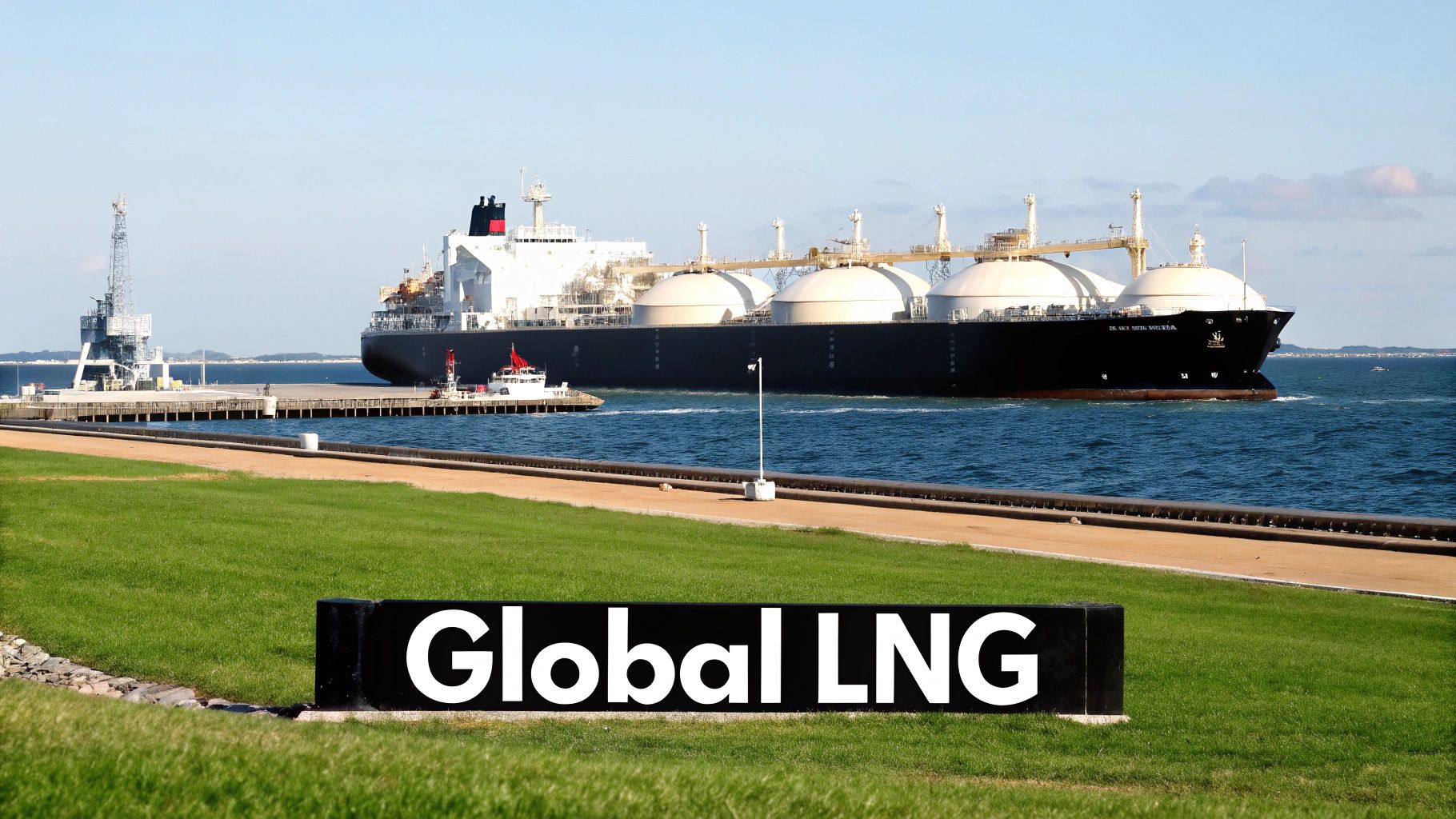
The answer lies in a remarkable process that turns gas into a liquid, making it possible to ship worldwide. This is the world of Liquefied Natural Gas, or LNG. It’s the innovation that unlocked global gas trading, allowing energy to move between continents with surprising efficiency. The whole idea is built on a basic principle of physics: when you make a gas extremely cold, it becomes a liquid.
The Science of Shrinking Gas
Think of it like this: imagine capturing a massive cloud of steam and chilling it until it becomes a single, tiny ice cube. That’s basically what happens with LNG, just on an industrial scale.
At a special liquefaction facility, natural gas is first purified and then cooled to a staggering -260°F (-162°C). At this incredibly frigid temperature, it condenses into a clear, colorless liquid. The most important part of this transformation is the dramatic reduction in volume.
The liquefaction process shrinks the gas by a factor of more than 600. This means a volume of natural gas that would fill a massive concert hall can be condensed to fit inside a single, standard shipping container. This incredible density is what makes it economical to transport natural gas across vast oceans.
And the need for this technology is only growing. As global energy demand climbs, the LNG trade has become more critical than ever. In 2024, total global gas demand hit a record 4,122 billion cubic meters (bcm), with LNG trade surging to a new high of 555 bcm. A significant part of this was driven by Europe's increased LNG imports, which jumped by 23.6% to make up for reduced pipeline supplies. You can discover insights into rising global gas demand on boereport.com to see the full picture of these trends.
The LNG Supply Chain Explained
Moving LNG is a carefully orchestrated dance with three main stages, each requiring highly specialized infrastructure.
- Liquefaction Plants: These are huge industrial complexes, usually built on coastlines with easy access to both gas reserves and deep-water ports. This is where the raw gas undergoes its deep-freeze transformation into LNG.
- LNG Carriers: Once liquefied, the LNG is loaded onto highly specialized, double-hulled ships. These carriers are essentially giant, ocean-going thermoses, engineered to keep the LNG at its cryogenically cold temperature for voyages that can last for weeks.
- Regasification Terminals: When a carrier arrives at its destination, the LNG is offloaded into a regasification terminal. Here, it’s carefully warmed up, allowing it to turn back into a gas before being sent into the local pipeline network for distribution to homes and businesses.
This entire supply chain—from liquefaction to regasification—acts as a virtual floating pipeline. It connects energy producers and consumers across the globe, ensuring a steady supply for nations that don't have their own gas reserves.
Pipelines Versus LNG Transportation
While pipelines and LNG are both essential for moving natural gas, they serve very different roles. Each method has its own set of advantages depending on the distance, geography, and market dynamics of a particular situation. Knowing their differences makes it clear why one is chosen over the other.
Comparison of Natural Gas Transportation Methods
To put it simply, pipelines are like fixed highways, while LNG is like a flexible shipping network. This table breaks down the key distinctions between the two.
| Factor | Pipeline Transportation | LNG (Liquefied Natural Gas) Transportation |
|---|---|---|
| Best Use Case | Overland transport across continents | Overseas and intercontinental transport |
| Flexibility | Low; fixed point-to-point route | High; ships can be redirected to different markets |
| Infrastructure | Requires continuous land access | Requires coastal liquefaction & regasification plants |
| Initial Cost | High upfront cost for long-distance lines | Very high cost for plants and specialized carriers |
| Distance | Most economical for distances under 2,000 miles | More economical than pipelines for long distances |
Ultimately, LNG offers a level of market flexibility that pipelines simply can't match. If demand suddenly shifts or prices become more attractive in another part of the world, an LNG cargo ship can be rerouted mid-voyage. This adaptability makes LNG a cornerstone of the global energy trade, allowing suppliers to respond quickly to market needs and giving buyers the freedom to diversify their energy sources beyond fixed pipeline connections.
Don't Have a Pipeline? No Problem: On-Demand Natural Gas Delivery
Pipelines are the arteries of the natural gas industry, and massive LNG carriers are the workhorses of global trade. But what happens when you need gas somewhere those systems can't reach? Not every construction site, remote factory, or new development has a pipeline connection ready to go.
That's where the incredible flexibility of mobile delivery and Compressed Natural Gas (CNG) steps in. This is energy on demand, delivered right where you need it, when you need it.
The concept is straightforward: we take standard natural gas and compress it to an immense pressure—around 3,600 pounds per square inch (psi). This process squeezes the gas down to less than 1% of its original volume, making it dense enough to transport efficiently.
Once compressed, the gas is loaded into super-strong, cylindrical tanks mounted on trucks or trailers. These mobile units can hit the road and deliver natural gas to virtually any location with road access, bridging the last-mile gap for customers far from the main grid.
The Virtual Pipeline: A Lifeline for Off-Grid Operations
For businesses that need a constant, uninterrupted supply of gas without a physical connection, we can create what’s called a "virtual pipeline." This isn’t a single piece of hardware but a seamless logistical ballet. It’s a continuous, perfectly timed rotation of CNG trucks moving between a compression station and the customer's site.
One truck will pull up, hook into the on-site equipment, and start supplying gas. Just before it runs empty, a fresh truck arrives to take its place. This constant handoff ensures the gas never stops flowing, perfectly mimicking the reliability of a permanent pipeline.
The virtual pipeline concept is a game-changer for energy logistics. It gives you the rock-solid dependability of traditional infrastructure with the agility of a modern, on-demand service. It’s how projects stay on schedule and businesses stay running.
This innovative approach is an indispensable solution in countless situations where digging trenches and laying pipe just isn't an option.
Where Mobile Gas Delivery Makes a Difference
Mobile gas delivery isn't some niche service; it’s a critical tool that solves real-world problems across a surprising number of industries. Its adaptability makes it the go-to choice for temporary, emergency, or remote energy needs.
Here are a few of the most common applications we see:
- Construction and Development: Imagine trying to build a new housing community in the middle of winter. The permanent utility lines won't be active for months, but you need heat now. Mobile CNG keeps crews working and helps builders meet deadlines for occupancy permits.
- Industrial Operations: An asphalt plant or a large-scale agricultural facility might be miles from the nearest pipeline. Instead of sinking millions into a dedicated pipeline extension, mobile delivery provides a dependable primary fuel source.
- Emergency Fuel Supply: When a pipeline needs maintenance or a natural disaster causes an outage, mobile units can be deployed in a hurry. This is how critical facilities like hospitals and power stations keep their lights on.
- Pipeline "Pigging" Support: During routine pipeline cleaning with tools called "pigs," the flow of gas often has to be temporarily shut off. Mobile CNG units can be brought in to bypass the section being worked on, so customers downstream never even notice the interruption.
CNG vs. Small-Scale LNG: Choosing the Right Mobile Fuel
While CNG is the champion of most mobile delivery jobs, small-scale LNG can also be trucked in for certain high-volume situations. Both get the job done, but they have key differences in energy density and on-site logistics.
| Feature | Mobile CNG Delivery | Small-Scale Mobile LNG Delivery |
|---|---|---|
| State of Gas | Gaseous (highly compressed) | Liquid (cryogenically cooled) |
| Energy Density | Lower | Higher (packs more energy per truck) |
| Best Use Case | Shorter distances, temporary needs | Longer distances, higher volume demands |
| On-Site Setup | Simpler decompression equipment | Requires regasification (warming) units |
| Deployment Speed | Very fast, ideal for emergencies | Fast, but requires specialized cryo-handling |
Ultimately, mobile solutions, like those provided by operators such as Blue Gas Express, are the vital connective tissue in the natural gas supply chain. They bring energy directly to the point of need, erasing geographical barriers and infrastructure delays to keep progress moving forward.
Keeping Gas Transport Safe and By the Book
Moving any kind of energy carries risks, and natural gas is no different. That’s why the entire industry is built on a foundation of strict safety rules and serious government oversight. These aren't just suggestions on a clipboard; they are mandatory, overlapping systems designed to protect workers, communities, and the environment every step of the way.
Think about it: from the specific grade of steel used for a pipeline to the intensive training required for an LNG tanker crew, every single detail is regulated. This commitment to safety is what allows a massive, complex infrastructure to deliver energy reliably, day in and day out. The goal is always to stay ahead of the curve—to spot and fix potential issues before they ever have a chance to become real problems.
The Regulatory Gatekeepers
In the U.S., the main federal agency keeping watch is the Pipeline and Hazardous Materials Safety Administration (PHMSA). PHMSA is the one setting and enforcing the rules for how our country's enormous pipeline network is designed, built, operated, and maintained. Their authority is sweeping, covering everything from the specs for pipeline materials to the drills for emergency response.
On the global stage, similar agencies and international bodies work in concert to create a unified set of safety standards, which is especially critical for the massive ships carrying LNG across oceans. This web of regulations ensures that whether a pipeline is crossing a state line or a tanker is crossing the Atlantic, it's all held to the highest safety benchmarks.
Staying Proactive on Pipeline Integrity
Keeping millions of miles of pipelines in top condition is a huge job that demands constant vigilance and some pretty cool technology. Operators don't just sit around waiting for a problem to pop up; they are actively searching for any potential weak spots.
Here’s how they stay on top of it:
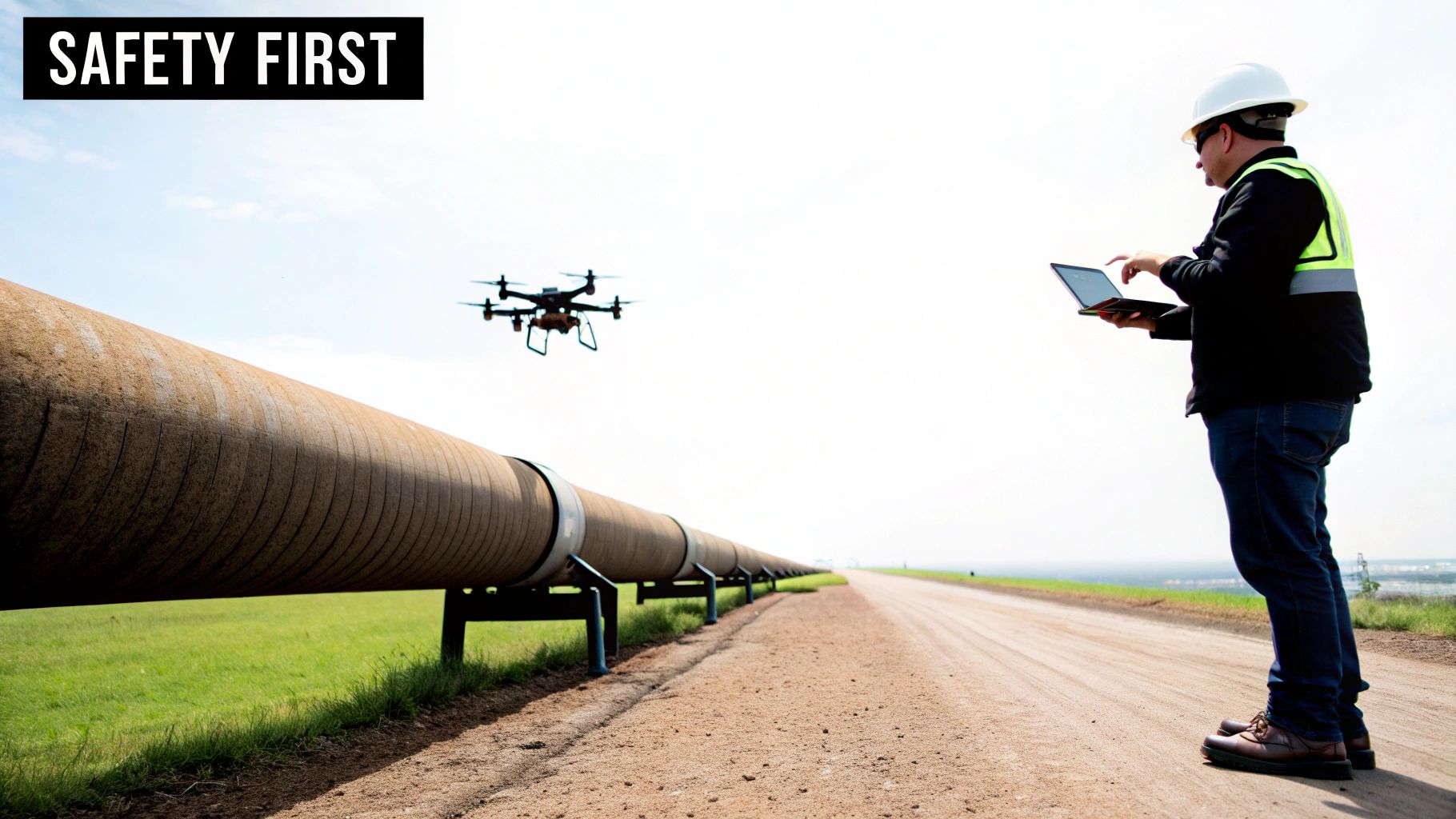
- Constant Inspections: This can be as high-tech as helicopters and drones with special sensors flying over the right-of-way or as boots-on-the-ground as crews walking the pipeline route.
- "Smart Pig" Tech: As we touched on earlier, these are sophisticated robotic tools that travel inside the pipe. They use advanced sensors to spot tiny signs of corrosion, cracks, or dents with incredible accuracy.
- Advanced Leak Detection: Modern setups might use fiber optic cables that run alongside the pipeline or even acoustic sensors that can actually "hear" the distinct sound of a gas leak, triggering an immediate alert.
Of course, when gas is transported by truck, rigorous safety measures like strict pre-trip inspection protocols for every vehicle are absolutely essential for managing risk on the road.
The whole philosophy behind modern pipeline safety is prevention. By constantly checking and maintaining the system, operators can handle minor issues long before they could ever escalate.
Emergency Plans and Public Awareness
Even with the best preventative work, you have to be ready for anything. That's why every pipeline operator must have a detailed and well-rehearsed emergency response plan. These aren't developed in a vacuum; they're created hand-in-hand with local first responders like fire and police departments. The plans spell out exactly who does what in an emergency to ensure the response is fast and coordinated.
Public awareness is another crucial piece of the safety puzzle. Ever see those small, colorful markers in a field or along a road? They're there to show you where a pipeline is buried. This is part of a much larger effort to educate the public, highlighted by programs like the national "Call 811 Before You Dig" campaign. It’s a simple but effective way to prevent accidental pipeline damage from construction or landscaping work, which remains a primary cause of incidents.
A Focus on Environmental Responsibility
Today, safety isn't just about preventing accidents; it's also about protecting the environment. The natural gas industry is putting more and more focus on shrinking its environmental footprint, especially when it comes to reducing methane emissions. Since methane is the main ingredient in natural gas and a potent greenhouse gas, keeping it in the pipe is a top priority.
This involves using advanced monitoring tech to find and fix leaks fast, as well as upgrading equipment at facilities like compressor stations to run cleaner and more efficiently. This deep commitment to environmental compliance is now woven directly into the safety and regulatory fabric of the entire industry.
Your Questions About Natural Gas Transportation, Answered
After digging into the massive world of pipelines, LNG carriers, and mobile gas units, it's normal to have a few questions bubble up. This is a complex business where giant infrastructure meets pinpoint logistics. Let's tackle some of the most common questions to give you a clearer picture of how this vital energy source gets from point A to point B.
Getting a handle on these details really fills in the gaps, showing you the real-world challenges and clever solutions behind natural gas transportation.
What’s the Main Way Natural Gas Gets Around?
Pipelines. Hands down, they are the most common and cost-effective way to move natural gas across land. In the United States alone, we're talking about a staggering network of over 2.5 million miles of pipelines—the true backbone of our energy grid. This isn't just one giant pipe, though. The system is split into three distinct parts, each with a specific job.
- Gathering Systems: Think of these as the local side streets. They’re smaller pipelines that collect raw gas straight from the wells and shuttle it over to processing plants.
- Transmission Systems: These are the interstate highways of the gas world. They are huge, high-pressure pipelines that carry enormous amounts of cleaned gas over hundreds or thousands of miles, linking supply regions to the big city markets.
- Distribution Systems: Finally, these are the neighborhood streets and driveways. Local utilities run these smaller, low-pressure lines, which branch off the main transmission system to deliver gas right to your home or business.
While LNG is a game-changer for overseas shipping and CNG gives us incredible on-demand flexibility, pipelines are the bedrock of the whole domestic system.
How Do We Know Natural Gas Pipelines Are Safe?
Pipeline safety isn't an accident; it's the result of a multi-layered strategy that combines strict government rules, constant high-tech monitoring, and proactive maintenance. The goal isn't just to react to problems—it's to stop them from happening in the first place.
Regulators like the Pipeline and Hazardous Materials Safety Administration (PHMSA) in the U.S. set and enforce tough standards for everything from the steel used in the pipes to how they’re operated day-to-day. But it doesn't stop there. Pipeline operators use some seriously advanced tech to keep things secure.
They run sophisticated tools called "smart pigs" through the lines, which use sensors to hunt for any hint of corrosion, cracks, or other potential weak spots. They also use aerial patrols and ground-based sensors to sniff out leaks. On top of that, every operator has a detailed emergency response plan worked out with local first responders. Public awareness campaigns, like the "Call 811 Before You Dig" initiative, are also a huge part of preventing accidental damage from construction.
Can You Really Truck Natural Gas?
You bet. Natural gas is frequently transported by truck in two forms: Compressed Natural Gas (CNG) and Liquefied Natural Gas (LNG). Trucking is the key to getting gas to places that the pipelines just can't reach.
With CNG, the gas is squeezed to a high pressure and loaded into special cylinders on a trailer. This "virtual pipeline" is the perfect solution for supplying industrial plants, bringing temporary heat to construction sites, or acting as an emergency fuel backup. For bigger jobs, small-scale LNG can be delivered in specialized cryogenic tanker trucks. Trucking is absolutely essential for that last-mile delivery and for serving areas where building a new pipeline just doesn't make sense.
This on-demand delivery model bridges the infrastructure gap, ensuring that even off-grid projects have access to a reliable and consistent energy supply, preventing costly delays and operational shutdowns.
What's the Real Difference Between CNG and LNG?
The main difference between CNG and LNG all comes down to how the gas is condensed for transport. It’s a classic case of pressure versus temperature.
CNG, or Compressed Natural Gas, is still a gas, but it's been squeezed under immense pressure (around 3,600 psi). This compression shrinks its volume to less than 1% of what it would be otherwise, allowing it to be packed into tough, durable tanks.
LNG, or Liquefied Natural Gas, is made using a totally different technique. The gas is chilled to a mind-bogglingly cold -260°F (-162°C), which turns it into a liquid. This deep freeze shrinks the gas's volume by a factor of more than 600.
Because LNG is so much denser, a single tanker can carry way more energy than a CNG tanker of the same size. This density makes LNG the perfect choice for long-haul shipping across oceans, while CNG is better suited for shorter trips by truck and as a clean-burning vehicle fuel.
Facing a construction delay because your natural gas line isn't ready? Blue Gas Express provides on-demand, mobile natural gas solutions to keep your project on track. We offer fast deployment of CNG and LNG units across the Southeast, ensuring you get the energy you need, exactly when you need it. Don't let utility delays stop your progress—learn how we can help at https://bluegasexpress.com.