

Think of a natural gas safety data sheet (SDS) as the go-to instruction manual for anyone working with this fuel. It’s the single most important document for handling, storing, and responding to emergencies involving natural gas. Far from being just another piece of compliance paperwork, this is a practical, life-saving guide that translates complex chemical information into clear, actionable advice.
What Is a Natural Gas Safety Data Sheet
At its core, a Natural Gas Safety Data Sheet (SDS) is your single source of truth for the properties and risks of natural gas. It’s designed to be a critical safety tool that helps prevent accidents, gives clear instructions during an emergency, and ultimately protects people and the environment.
The document is organized into a globally standardized 16-section format, which means no matter who creates the SDS, the information is always in the same place. Need to know what to do in case of a leak? There's a section for that. Unsure what kind of protective gear to wear? The SDS has you covered.
The Bedrock of Workplace Chemical Safety
The whole point of an SDS is to give workers the knowledge they need to stay safe. By laying out the potential hazards, spelling out safe handling procedures, and providing emergency protocols, it removes the guesswork from a potentially dangerous situation. It turns uncertainty into confident, correct action.
Inside a natural gas SDS, you’ll find crucial details like:
- Hazard Identification: This section gives you the lowdown on flammability, explosion risks, and potential health effects like asphyxiation.
- Protective Measures: You'll get specific recommendations for ventilation, proper storage, and the exact personal protective equipment (PPE) you need.
- Emergency Response: It provides step-by-step instructions for what to do in case of a leak, fire, or accidental exposure.
- Chemical Properties: For the more technically curious, this includes data on the composition and physical characteristics of the gas.
A Standardized Format for Universal Understanding
Because an SDS is a formal, living document, its reliability hinges on a solid document control process to keep it accurate and up-to-date. The 16-section structure isn’t optional—it’s mandated by the Occupational Safety and Health Administration (OSHA) and is consistent with the Globally Harmonized System (GHS).
This image from an OSHA guide shows just how standardized the format is.
As you can see, the layout flows logically, starting with basic identification and hazard warnings before moving into first aid, fire-fighting, and handling procedures. It’s built to give you information progressively.
To help you get familiar with this layout, here’s a quick reference table highlighting the sections you’ll likely turn to most often.
Quick Guide to Key SDS Sections
| Section & Topic | What You Will Find |
|---|---|
| Section 2 Hazards Identification | A quick summary of all potential risks, including GHS pictograms and signal words. |
| Section 4 First-Aid Measures | Immediate steps to take in case of skin contact, inhalation, or other exposure. |
| Section 5 Fire-Fighting Measures | Guidance on extinguishing agents and specific hazards associated with a fire. |
| Section 7 Handling and Storage | Best practices for safely moving and storing natural gas containers. |
| Section 8 Exposure Controls/PPE | Details on exposure limits and the necessary personal protective equipment. |
Knowing where to look for this information is the first step toward building a strong safety culture and ensuring everyone goes home safe at the end of the day.
Decoding Hazards and Chemical Composition
Now we get to the heart of a natural gas safety data sheet: the sections that serve as the document's early warning system. Sections 2 (Hazard Identification) and 3 (Composition/Information on Ingredients) are where the abstract idea of "danger" gets specific and actionable. Think of this part of the SDS as a translator, turning dense chemical data into a universal language of safety that anyone can understand at a glance.
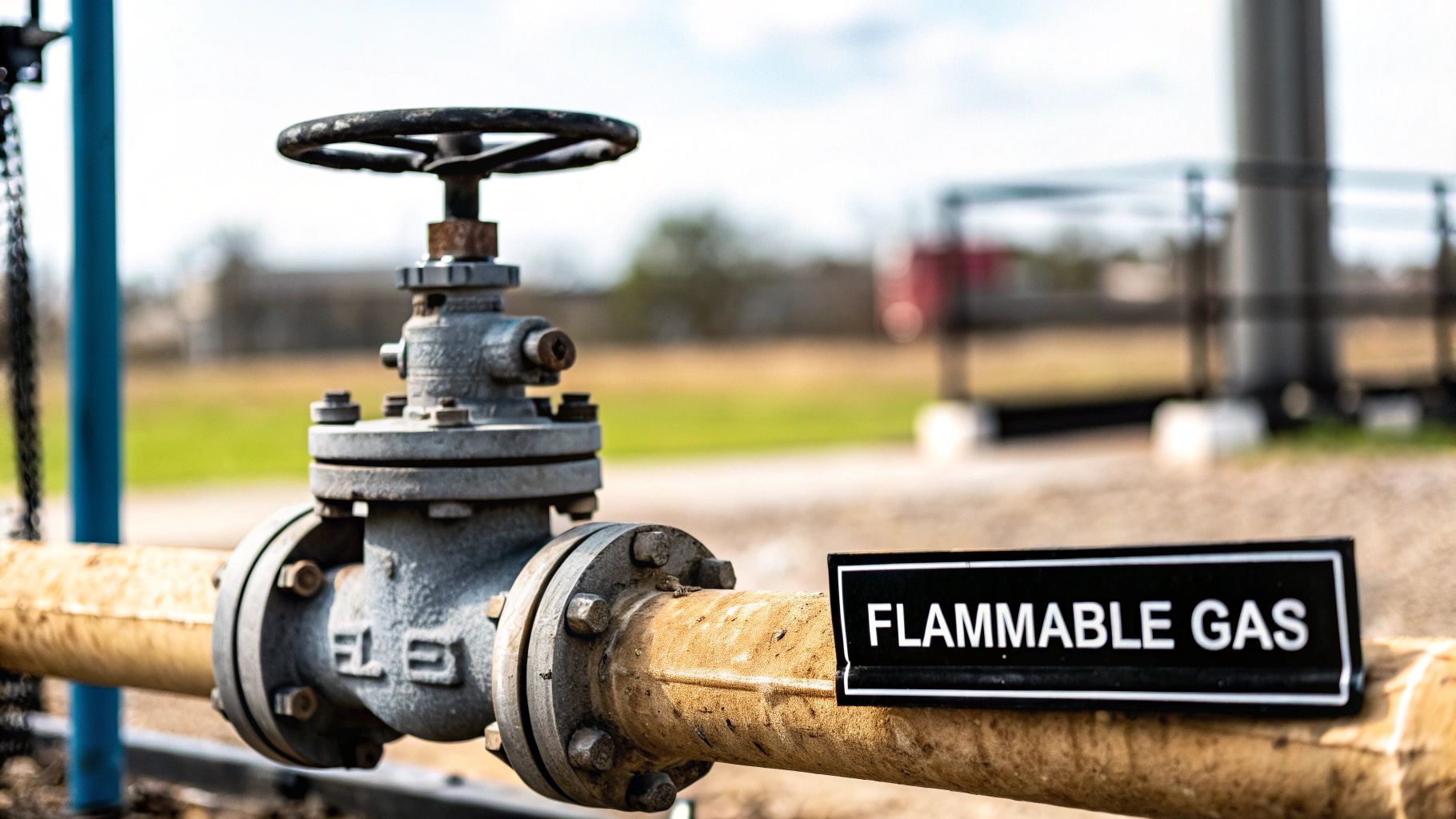
This is where you’ll see the Globally Harmonized System (GHS) pictograms. These are simple, bold symbols that act like international road signs for chemical hazards. A flame symbol screams flammability. A gas cylinder icon warns you it's under pressure. These visuals work hand-in-hand with signal words like 'Danger' or 'Warning' to give you an immediate feel for how serious the risk is.
Reading the Language of Risk
The terms you see here—like "flammable gas" or "simple asphyxiant"—aren't just technical jargon. Each one tells a specific story about how to stay safe. A "flammable gas" warning is your cue to be relentless about removing ignition sources, everything from an open flame to a spark of static electricity. The "simple asphyxiant" classification is a critical reminder that a gas leak in an enclosed room can silently push out the oxygen, creating a life-threatening situation before you even realize it.
Getting these classifications isn't just about checking a box. It's the difference between knowing natural gas is dangerous and truly understanding why it's dangerous—and, more importantly, how to stop those specific dangers from ever becoming a reality.
A natural gas safety data sheet is more than a list of warnings; it’s a narrative that explains the character of the substance. Learning to read it is like learning the language of the material itself, allowing you to anticipate its behavior and respect its power.
Understanding the Chemical Makeup
Section 3 builds on this by laying out the "recipe" for natural gas. While it’s mostly methane (often 85-95%), it’s never completely pure. Natural gas is actually a cocktail of different components, and each one brings its own set of properties and potential risks to the table.
- Ethane, Propane, and Butane: These heavier hydrocarbons are also flammable and boost the overall energy content of the gas.
- Nitrogen and Carbon Dioxide: As non-flammable ingredients, these can affect how the gas burns and its overall efficiency.
- Mercaptans: These are the key players for safety. They're sulfur-based compounds added in tiny amounts to give natural gas its classic "rotten egg" smell so you can detect a leak.
This infographic breaks down some of the key first aid steps, which are directly informed by the hazards spelled out in the SDS.
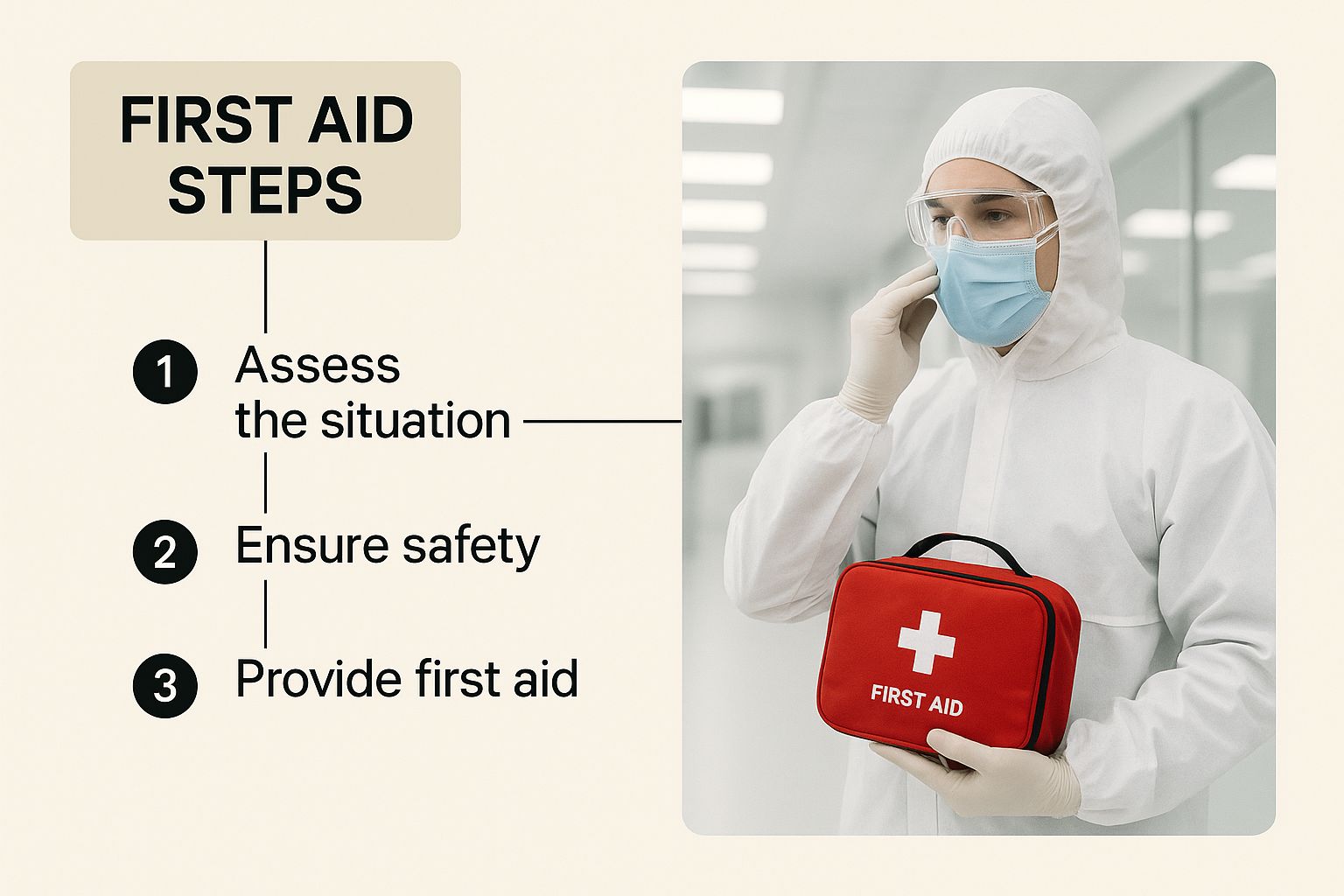
The graphic really drives home how vital it is to have immediate access to safety protocols—a core job of the SDS. Knowing the full composition is crucial because it influences everything from specific health risks to which type of fire extinguisher you should grab in an emergency.
Setting Safe Exposure Limits
This blend of chemicals also determines the specific occupational exposure limits you'll see in the SDS. These numbers aren't pulled out of thin air; they are scientifically backed thresholds designed to protect workers from harmful health effects over time.
For instance, natural gas is always classified as a highly flammable compressed gas with a serious explosion hazard. That's why you will always see the GHS signal word 'Danger' right upfront—it’s a direct consequence of its extreme flammability and potential to go boom. Occupational exposure limits can vary by region. In the U.S., the ACGIH has set the short-term exposure limit (STEL) for butane isomers at 1000 ppm, while concentrations over 1600 ppm are considered immediately dangerous to life or health (IDLH). You can dive deeper into these specific hazard classifications in Enbridge's detailed safety data sheet.
By putting the hazard identification from Section 2 together with the ingredient list in Section 3, you get a complete, three-dimensional picture of what you’re dealing with. This knowledge empowers you to go beyond basic compliance and build a genuinely safe work environment.
Your Playbook for Emergencies and First Aid
When a natural gas incident kicks off, there's no time to second-guess your next move. The information in Sections 4 (First-Aid Measures), 5 (Fire-Fighting Measures), and 6 (Accidental Release Measures) of a natural gas safety data sheet is your emergency playbook. It’s a step-by-step guide designed for clear, confident action when every single second counts.
Think of this part of the SDS as your pre-written crisis plan. It cuts through the theory and gives you the "what to do now" instructions you need to protect people and property.
Immediate First-Aid Steps for Exposure
Natural gas is a simple asphyxiant, meaning it displaces oxygen. This makes inhalation the most common and dangerous route of exposure. If someone starts showing signs of oxygen deprivation—like dizziness, headaches, nausea, or even passing out—the SDS gives you a clear and immediate response protocol.
The absolute first priority is getting the person to fresh air. But don't become a second victim. Make sure the area is safe to enter before you attempt a rescue. If the person isn't breathing, trained personnel need to start rescue breathing or CPR immediately and call for emergency medical help.
With compressed or liquefied natural gas (LNG), direct skin contact is a different beast—it can cause severe frostbite.
- Don't rub the area. You'll just cause more tissue damage.
- Warm the area gently using lukewarm water, never hot.
- Get medical attention immediately. Frostbite isn't something to treat lightly; it needs professional care.
Responding to a Natural Gas Fire
A fire fed by natural gas is uniquely dangerous. The primary instruction you'll find in Section 5 of the SDS often feels counterintuitive: do not extinguish the flame unless the gas flow can be stopped safely. Putting out the fire while gas is still leaking creates an invisible, explosive cloud that can re-ignite with devastating force.
Your first job is to shut off the gas supply at the source. Once—and only once—the flow is stopped can you move on to extinguishing any secondary fires. The SDS will specify exactly which extinguishing agents are appropriate.
A burning gas leak is a visible, contained hazard. An un-ignited gas cloud is an invisible, ticking time bomb. That's why the SDS prioritizes stopping the fuel source over just putting out the flame.
For fighting natural gas fires, these are the typical go-to tools:
- Dry Chemical Extinguishers: Great for smothering the fire.
- Carbon Dioxide (CO2): Works by displacing oxygen to kill the flame.
- Water Spray or Fog: This is mainly for cooling down surrounding equipment and structures to keep the fire from spreading. It's not for putting out the gas fire itself.
Managing an Accidental Gas Leak
Section 6 lays out the game plan for an accidental release or leak, built on three core principles: evacuation, ignition source control, and ventilation. The moment you detect a leak, this plan needs to snap into action.
First, get everyone out of the immediate area. Move upwind to stay clear of the traveling gas cloud. That distinct "rotten egg" smell from the added mercaptans is your first and best warning. Next, and this is critical, eliminate every potential source of ignition.
This means shutting down absolutely everything:
- Open flames
- Sparks from electrical equipment or even static electricity
- Hot surfaces and any running engines
Only after the area is secure and all ignition sources are controlled should you try to ventilate the space. Open doors and windows to help disperse the gas. For a major incident, emergency responders will bring in specialized equipment to handle the situation safely.
Beyond the immediate crisis, a natural gas SDS also helps you create an effective fuel spill response plan to minimize environmental impact and keep everyone safe. This structured approach ensures a coordinated, effective response to any incident, big or small.
Getting a Handle on Safe Practices and Exposure Controls
True safety isn't about knowing what to do after something goes wrong—it's about setting up your workspace so it never has a chance to happen in the first place. That’s exactly what Sections 7 (Handling and Storage) and 8 (Exposure Controls/Personal Protection) of a natural gas safety data sheet are for.
Think of these sections as your proactive game plan. They lay out the specific engineering controls, work habits, and personal protective equipment (PPE) you need to make safety a routine part of the job, not just an emergency checklist.
Best Practices for Safe Handling
Working with natural gas, especially in its compressed or liquefied forms, is a job that demands focus. Your number one goal is simple: keep the gas contained and keep ignition sources far, far away. It only takes one stray spark.
To make that happen, the SDS lays out some critical handling procedures:
- Use Non-Sparking Tools: Your standard steel wrench or hammer can create a spark if it hits another metal surface. In a gas-rich environment, that’s a recipe for disaster. This is why you’ll see requirements for tools made of brass, bronze, or other non-ferrous alloys.
- Ground All Equipment: Static electricity is an invisible but very real threat. It can build up on containers, hoses, and other equipment and discharge as a spark. Grounding everything is a non-negotiable step to safely channel that static away.
- Ensure Proper Ventilation: You always want to work in a well-ventilated space. Good airflow prevents gas from building up to flammable or dangerous concentrations, which is especially critical when you're indoors or in a confined area.
How to Properly Store Natural Gas Cylinders
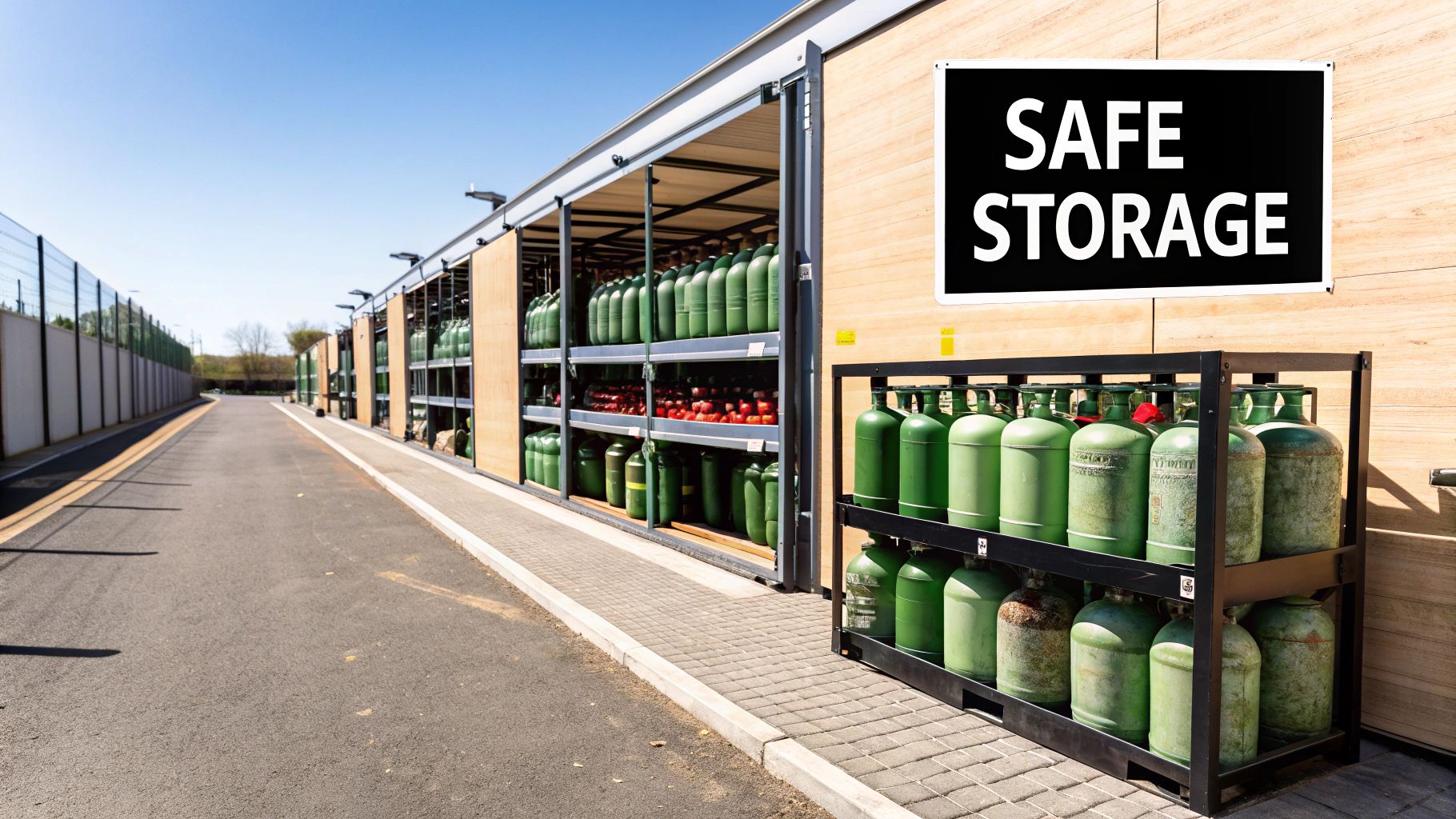
Where and how you store natural gas is just as crucial as how you handle it. Section 7 gives you clear, direct rules for storing compressed gas cylinders to prevent leaks, physical damage, or exposure to dangerous conditions. A poorly stored cylinder is a major liability.
Here are the core storage rules you'll find:
- Store it upright and secure: Cylinders need to be chained or strapped firmly to a wall or another fixed structure. If one tips over, the valve could be damaged or sheared off completely.
- Keep it cool and clear: Cylinders should be stored in a cool, well-ventilated spot away from direct sun, open flames, welding arcs, and even busy walkways where they could get knocked over.
- Separate it from incompatible materials: Natural gas and strong oxidizers like oxygen or chlorine do not mix. Storing them near each other is asking for trouble, as a leak could trigger a powerful, dangerous reaction.
The rules in a natural gas safety data sheet aren't just arbitrary suggestions. They are proven engineering and administrative controls. Each one, from using non-sparking tools to chaining up a cylinder, adds another critical layer of defense against an accident.
Understanding Exposure Limits and PPE
While good handling and storage practices are your first line of defense, Section 8 prepares you for what to do if you are exposed to the gas. This section defines the Occupational Exposure Limits (OELs)—the maximum concentration a worker can be around without risking their health. It also gets very specific about the Personal Protective Equipment (PPE) needed for different tasks.
This isn't a one-size-fits-all list. The gear you need depends entirely on the job you're doing and the potential for exposure.
- Flame-Retardant Clothing (FRC): This is essential protection against the risk of a flash fire.
- Safety Glasses or Goggles: Your eyes need protection from splashes of liquefied gas, which is cold enough to cause immediate frostbite.
- Thermal Gloves: Anyone handling the super-chilled equipment associated with LNG will need these to prevent severe cold burns.
- Respiratory Protection: If you're working in a confined space or responding to a leak where gas levels might exceed the OELs, you'll likely need a self-contained breathing apparatus (SCBA).
The importance of following these protocols is mirrored in large-scale industrial practices like gas flaring. All over the world, producers use controlled flaring to safely burn off excess gas and prevent dangerous pressure buildups. This process is governed by meticulous safety measures designed to protect both people and the environment—the very same principles found in a safety data sheet. You can learn more about how this is monitored by checking out the global flaring data on worldbank.org.
By mastering these controls, you're not just following rules; you're actively building safety into every task, from the ground up.
Getting to Grips with the Technical and Reactivity Data
Now we get to the parts of a natural gas safety data sheet that can make your eyes glaze over. Sections 9, 10, and 11—Physical and Chemical Properties, Stability and Reactivity, and Toxicological Information—are packed with technical jargon. But don't skip them. This is where you find the why behind all the safety warnings.
Think of it this way: the first half of the SDS tells you what to do. This second half explains why you're doing it. It’s the science that backs up the rules, and understanding it can make the difference in a critical situation.
Decoding Physical and Chemical Properties (Section 9)
Section 9 is basically the substance's spec sheet. It lists all the inherent characteristics of natural gas that dictate how it behaves in the real world. Some of this is pretty technical, but a few key points have immediate, practical value on the job.
You'll see its appearance listed as a "colorless gas" and its odor described by that classic "rotten egg" smell—which, of course, is the added mercaptan, not the gas itself. You'll also find its density. Because natural gas is lighter than air, it will rise and disperse in a well-ventilated space. But in an enclosed room, it can pool near the ceiling, creating a hidden hazard.
The most critical numbers in this whole section are the Lower and Upper Explosive Limits (LEL/UEL).
Think of it like trying to get an old gas grill to light. If you have too little propane or too much, it just won't ignite. The LEL and UEL are the same principle for natural gas mixing with air.
- LEL (Lower Explosive Limit): This is the smallest amount of gas in the air—typically around 5%—that can catch fire. Any less than that, and the mix is too "lean" to burn.
- UEL (Upper Explosive Limit): This is the highest concentration, usually about 15%. Anything more, and the mix is too "rich" and doesn't have enough oxygen to ignite.
That window between 5% and 15% is the explosive range. Every single safety protocol, especially those for ventilation, is designed to keep gas concentrations well outside of this dangerous zone.
Stability and Reactivity Explained (Section 10)
Section 10 of the natural gas safety data sheet tells you how the gas plays with others. It answers two simple but vital questions: "What makes it unstable?" and "What should I keep it away from?"
For the most part, natural gas is pretty stable under normal conditions. The real takeaway here is the list of incompatible materials. For a fuel like natural gas, the number one enemy is a strong oxidizer.
- Common Oxidizers: Think of things like chlorine, pure oxygen, and nitrates.
- Why It's a Problem: Oxidizers are chemical cheerleaders for fire. Mixing them with natural gas can cause a fire to start more easily or even trigger a violent, explosive reaction.
This is exactly why there are such strict rules about storing gas cylinders away from other chemicals. A leaky oxygen tank next to a leaking natural gas line is a recipe for disaster.
Understanding the Health Hazards (Section 11)
Finally, Section 11 gets specific about what natural gas does to the human body. The key phrase you'll see here is "simple asphyxiant."
This is an important distinction. Natural gas isn't a poison that attacks your cells. Instead, it displaces oxygen. In a confined space, a leak can quietly reduce the breathable oxygen from its normal 21% down to a dangerously low level.
The early warning signs—headaches, dizziness, confusion—are actually symptoms of oxygen deprivation. This section hammers home why you never, ever enter an area with a suspected leak without the right air-monitoring equipment and respiratory protection. The danger isn't what you're breathing in; it's what you aren't.
Navigating Transport and Regulatory Compliance
A natural gas safety data sheet does more than just keep people safe on-site; it’s a critical passport for the substance once it hits the road. Think of Sections 14 (Transport Information) and 15 (Regulatory Information) as the bridge connecting your internal safety protocols to the broader legal world of hazardous materials.
These sections ensure that every single person involved—from the team loading the truck to the driver and emergency responders along the route—is speaking the same language. It's about creating a seamless, legally sound chain of custody for a potentially dangerous substance.
The Logistics of Transport Information
Section 14 is all about the practical details of shipping natural gas safely. This isn't just bureaucratic paperwork. It's a universal code that tells shippers, carriers, and first responders exactly what they're dealing with. For natural gas, you’ll always find a few key identifiers:
- UN Number: Natural gas is typically assigned UN1971. This is its international ID, instantly recognized by transportation authorities everywhere.
- Proper Shipping Name: The official designation is "Natural gas, compressed."
- Hazard Class: Natural gas falls under Class 2.1, which flags it as a flammable gas.
This simple set of data dictates everything—from the specific placards slapped on the side of the vehicle to the handling procedures required during transit. It's what ensures a tanker of compressed natural gas is treated with the necessary caution for every mile it travels.
A UN number is more than a label; it's a summary of the hazard. When a first responder sees UN1971, they immediately know they are dealing with a flammable, compressed gas and can initiate the correct emergency protocol without delay.
Your Compliance Checklist
If Section 14 is about the how of moving natural gas, Section 15 answers the question, "Which rules do we have to follow?" This part of the natural gas safety data sheet is your regulatory checklist, pinpointing the specific national and international laws that apply.
It references rules from agencies like OSHA, the EPA, and the Department of Transportation (DOT), confirming that the product complies with various chemical inventories and legal frameworks. For any company operating across state lines or internationally, this section is absolutely essential for staying out of hot water.
The importance of this documentation is reflected in the strict standards set by government bodies. For instance, the U.S. Department of Transportation's PHMSA division keeps incredibly detailed safety data on natural gas pipelines, using incident reports to shape risk management strategies. This public data shows just how valuable the information in an SDS is for protecting workers and communities. You can dig into these safety initiatives by exploring PHMSA's data and statistics overview.
Frequently Asked Questions
Got questions about Natural Gas Safety Data Sheets? You're not alone. When it comes to workplace safety, it's crucial to have clear, straightforward answers. Let's tackle some of the most common questions people have about these vital documents.
Where Can I Find the Safety Data Sheet for Natural Gas?
Your employer is legally required by OSHA to make the SDS for natural gas—and any other hazardous substance on-site—readily accessible to you. No hoops to jump through, no waiting for a supervisor. You need to be able to get your hands on it, fast.
So, where should you look?
- The "Big Binder": A classic for a reason. Many job sites keep a physical binder, usually bright yellow or clearly labeled "SDS," in a central spot like a break room or a foreman's office.
- Digital Systems: More and more, companies are using online databases. This lets you pull up an SDS on a computer, tablet, or even your phone in seconds.
- Straight from the Source: The gas utility or supplier who provides the natural gas creates the SDS. You can almost always find it on their website, usually in a "Safety" or "Resources" section.
The bottom line is you need access during your work shift. If you can't find it easily, ask your supervisor immediately.
How Often Does a Natural Gas SDS Need to Be Updated?
A natural gas safety data sheet doesn’t have a rigid expiration date. Think of it less like a carton of milk and more like a living document that has to reflect the latest safety knowledge.
The rule is this: if the manufacturer discovers any significant new information about the hazards of natural gas or new ways to protect against them, they must update the SDS within three months.
While there's no mandatory "renew by" date for employers, a common best practice is to review all SDSs on file at least every three years. This is a good way to check in with suppliers and make sure you have the most current versions on hand. Always work from the latest edition to ensure your safety info is on the money.
What Is the Difference Between an SDS and an MSDS?
This is a simple one: the SDS (Safety Data Sheet) is the new, improved, and globally standardized version of the old MSDS (Material Safety Data Sheet). The key word here is standardized.
The whole point of moving from MSDS to SDS was to create a single, predictable format for chemical safety. With the 16-section SDS, you know exactly where to look for first-aid measures or fire-fighting instructions, no matter who made the chemical.
The old MSDS formats were a bit of a free-for-all. One manufacturer's sheet could look completely different from another's, making it a nightmare to find what you needed in a hurry. The strict 16-section structure of the SDS fixes that, bringing much-needed consistency and clarity to chemical safety worldwide.
When your project can't wait for a permanent gas line, you need a reliable temporary solution. Blue Gas Express provides mobile CNG and LNG delivery to keep your construction, industrial, or commercial operations running without interruption. Ensure your project stays on schedule with our fast, safe, and dependable service. Learn more about our temporary natural gas solutions.