

Ever wonder how the natural gas that heats your home or cooks your food gets there? It often travels hundreds, if not thousands, of miles from a remote well, all through a hidden network of pipelines. This journey isn't a passive one; it relies on a powerful process to keep the gas moving.
This process is often called natural gas pumping, but that's a bit of a misnomer. You don't "pump" a gas in the same way you pump water. Instead, you compress it.
Think of it like blowing up a very, very long balloon. To get air to the far end, you have to keep pushing more air in at the start. In the natural gas grid, compressor stations act as the "hearts" of the system, giving the gas a powerful boost of pressure every 40 to 100 miles to keep it flowing.
The Hidden Journey of Natural Gas
The entire system is a sophisticated, multi-stage operation that functions like our economy's circulatory system. It’s a delicate balancing act of physics and engineering. By compressing the gas, operators reduce its volume and give it the energy needed to overcome friction inside the pipeline.
This journey has three main phases:
- Extraction and Processing: It all starts at the wellhead. Raw gas is pulled from the ground and sent to a processing plant where impurities like water, oil, and other gases are scrubbed out.
- Transmission: Once cleaned, the gas enters massive, high-pressure transmission pipelines. These are the superhighways of the gas grid, operating at pressures that can exceed 1,000 psi to move huge volumes over long distances.
- Distribution: Finally, the gas is stepped down to lower-pressure distribution lines. These smaller pipes are the local roads that branch out into neighborhoods and deliver gas directly to homes, businesses, and factories.
The entire system is a delicate balancing act. Continuous pressure management is the engine that reliably moves this invisible fuel, ensuring that when you turn on your stove, the gas is there waiting for you.
Understanding this journey is key to appreciating the complexity of our energy infrastructure. It’s a story that touches everything from economic stability and energy security to the environmental challenges we face today.
This guide will pull back the curtain on each step of this process. We'll look at the key equipment, the sophisticated control systems, and the critical safety protocols that make it all work—from the massive turbines that power compressor stations to the digital tools that monitor every cubic foot of gas in real time.
How Gas Compression Moves Fuel Across Miles
When we talk about natural gas pumping, it's easy to picture a liquid being pushed through a pipe. But that's not quite right. We're actually dealing with a gas, and the entire process of moving it relies on one core principle: compression.
Think of it like filling a bicycle tire. You're squeezing a large volume of air into a small, fixed space. As you pump, the air molecules get packed tighter and tighter, and the pressure inside the tire skyrockets. This is the same fundamental idea behind moving natural gas. We mechanically squeeze the gas, which dramatically increases its internal pressure.
That built-up pressure is pure potential energy. It's the "push" that forces the gas to travel through thousands of miles of steel pipeline, overcoming the constant friction it encounters along the way. Without this constant re-pressurizing, the flow would just fizzle out.
The Physics of Flow
At its heart, natural gas movement is governed by a basic law of physics you probably learned in high school: gas always wants to move from a high-pressure area to a low-pressure one. The entire pipeline network is engineered to take advantage of this simple rule.
It's a carefully managed cascade of pressure drops and boosts. Gas leaves a compressor station at high pressure and starts its journey. As it travels, friction with the pipe walls causes the pressure to slowly decrease. Before it drops too low, another station gives it a powerful boost, and the cycle continues.
The pipeline network isn't just a conduit; it's an active system where pressure is the 'engine' of transportation. Each compressor station acts as a powerful heart, re-pressurizing the gas to sustain its long-distance journey.
The infographic below gives you a bird's-eye view of this journey, from the wellhead all the way to your home.

As you can see, managing pressure is critical at every stage to keep the gas moving safely and efficiently from the source to the final customer.
Why Compression Is Non-Negotiable
As natural gas flows, it’s constantly rubbing against the inside of the pipeline. This friction causes it to lose pressure and slow down, a completely unavoidable effect. If you left it alone, the gas would eventually grind to a halt.
To fight this, the industry strategically places compressor stations every 40 to 100 miles along major transmission lines. These stations are the real workhorses of the system. They act like powerful relay runners, pulling in the slowing gas, re-compressing it, and sending it back into the pipeline with renewed force.
The pressure inside these massive, long-haul pipelines is kept incredibly high—typically between 200 and 1,500 pounds per square inch (psi). This high pressure is essential for two reasons:
- Efficiency: It packs an immense amount of gas into the pipeline, maximizing how much energy can be transported at once.
- Momentum: It provides the raw force needed to keep the gas moving over hundreds of miles, pushing it over hills and through valleys.
At the end of the day, compression is the only feasible method for transporting the vast quantities of natural gas that power our country. It’s the invisible engine that turns a resource sitting in the ground into a reliable stream of energy for millions. This foundational process is what makes everything else—the equipment, the controls, the delivery—possible.
Inside a Natural Gas Compressor Station
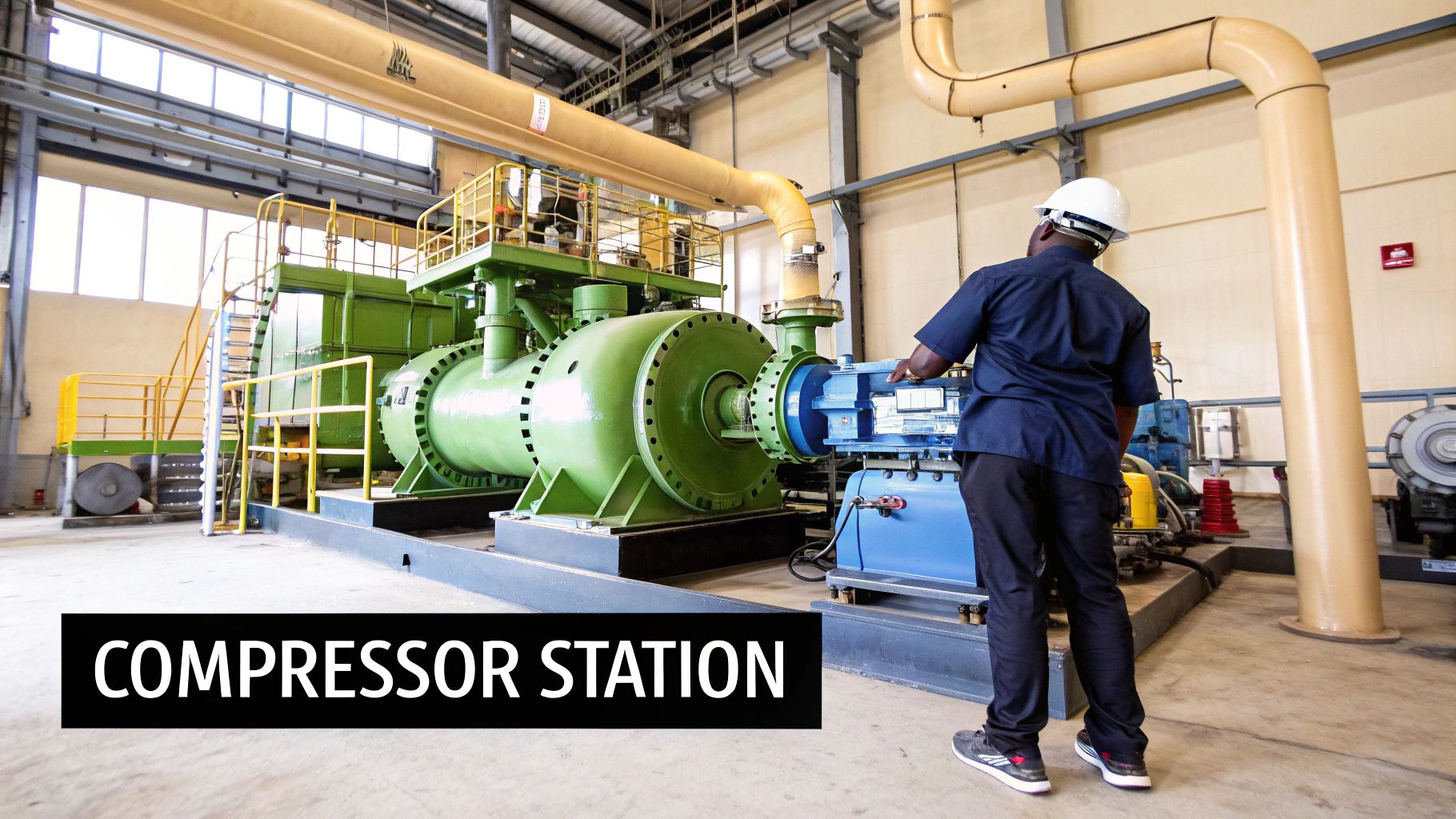
If you think of the natural gas pipeline network as the country's circulatory system, then compressor stations are the powerful hearts that keep everything flowing. They're strategically placed along thousands of miles of pipeline, each one acting as a high-tech relay station. Their job is simple but crucial: take in gas that has lost pressure over its journey, give it a massive boost, and send it on its way.
These aren't just single buildings with one big machine. A compressor station is a complex, engineered site where several key components work in perfect concert to maintain the momentum needed for natural gas pumping.
The Two Primary Types of Compressors
While the goal is always the same—increase pressure—the industry uses two main types of compressors to get it done. The choice isn't random; it comes down to specific operational needs, like how much pressure is required and the volume of gas being moved.
The two workhorses of the natural gas grid are:
- Reciprocating Compressors
- Centrifugal Compressors
Getting to know how each one works pulls back the curtain on the incredible engineering that keeps our energy supply moving.
Reciprocating Compressors: The Piston Powerhouse
A reciprocating compressor operates on a principle most of us are already familiar with—it’s very similar to the engine in a car or even a simple bicycle pump. It uses a piston that moves back and forth within a sealed cylinder to physically squeeze the gas.
It’s a straightforward, three-step dance:
- Intake: The piston pulls back, creating a low-pressure void that sucks natural gas into the cylinder through an intake valve.
- Compression: The piston then reverses course, pushing forward to shrink the available space. With the valves sealed, the gas has nowhere to go, and its pressure skyrockets.
- Discharge: Once the target pressure is hit, a discharge valve pops open, and the piston shoves the now high-pressure gas out into the pipeline.
This design is a beast when it comes to generating extremely high pressures. That makes it perfect for applications like injecting gas into underground storage caverns or giving the gas its first big push at the start of a pipeline.
Centrifugal Compressors: The High-Speed Spinner
Centrifugal compressors play a completely different game. Forget pistons; these machines use a fast-spinning wheel called an impeller, which looks a bit like a highly engineered fan, to accelerate the gas molecules.
Think of a merry-go-round spinning at full speed. Anyone on the edge is pushed outward by centrifugal force. A centrifugal compressor does the exact same thing to natural gas. Gas is pulled into the impeller's center and then flung outwards at incredible velocity.
This high-speed exit gives the gas a ton of kinetic energy. The gas then flows into a diffuser, a specially shaped chamber that slows it down. As the gas decelerates, all that kinetic energy is converted directly into pressure. These units are built to move massive volumes of gas, making them the standard choice for major transmission pipelines.
Centrifugal compressors are prized for their reliability and ability to handle continuous, high-volume flows. Their smooth, steady operation makes them the backbone of long-haul natural gas pumping operations where consistency is key.
The decision between these two types often boils down to a classic engineering trade-off: pressure versus volume.
Comparison of Natural Gas Compressor Types
To really understand the difference, it helps to see their strengths and weaknesses side-by-side. The following table breaks down the core characteristics of these two essential machines.
| Feature | Reciprocating Compressor | Centrifugal Compressor |
|---|---|---|
| Operating Principle | Positive displacement (piston) | Dynamic (impeller) |
| Best For | High-pressure, lower-volume applications | High-volume, moderate-pressure applications |
| Flow Type | Pulsating flow | Continuous, smooth flow |
| Efficiency | Highly efficient across various speeds | Most efficient at a specific design speed |
| Common Uses | Gas gathering, storage, processing plants | Mainline transmission pipelines |
Ultimately, having both types of technology available gives pipeline operators the flexibility to design a system that's both powerful and efficient for any situation.
Powering the Process: Prime Movers
A compressor is only as good as the engine that drives it. In the industry, this engine is called a prime mover, and these things are immensely powerful, often generating tens of thousands of horsepower.
There are two primary ways to power these machines:
- Natural Gas-Fired Turbines: Essentially a jet engine bolted to the ground, these turbines use a small amount of the pipeline gas as fuel. They are completely self-sufficient, which makes them ideal for remote station locations.
- Large Electric Motors: Where a reliable connection to the electrical grid is available, massive electric motors are a great alternative. They produce lower on-site emissions and are often more efficient, a trend that's becoming more common across the industry.
Essential Supporting Equipment
A compressor station is much more than just the compressor and its prime mover. Several other pieces of equipment are absolutely vital for keeping the operation safe and smooth.
Before the gas can even get to the compressor, it must pass through scrubbers and filters. These are designed to pull out any liquids, dirt, or other impurities that could cause serious damage to the high-precision machinery inside the compressor.
After being compressed, the gas is incredibly hot, often reaching temperatures over 250°F. Sending gas that hot down the line would damage the pipeline's protective coating. To prevent this, the gas is routed through large cooling units—basically giant radiators with powerful fans—that bring the temperature down to a safe level before it re-enters the main pipeline.
Managing the Invisible Flow of the Gas Grid
Controlling the natural gas that flows beneath our feet is a high-stakes balancing act. Think of it less like opening a tap and more like managing a vast, invisible, high-pressure river of energy that snakes across continents. The main job for pipeline operators is to keep this river flowing smoothly, maintaining a perfect equilibrium. Pressure has to be high enough for the gas to travel efficiently, but well below the maximum safety limits that could stress the pipeline itself.
This is a 24/7 challenge because our demand for natural gas is constantly in flux. It can swing wildly throughout the day and change dramatically with the seasons. A cold winter morning triggers a massive surge as millions of furnaces kick on, while demand plummets on a mild spring afternoon. The grid has to respond to these peaks and valleys in real time, without ever missing a beat.
Using Line Pack as a Strategic Buffer
So, how do operators handle those sudden spikes in demand? They use a clever technique called line pack. Instead of building massive, expensive storage tanks everywhere, they use the pipeline itself as a flexible, temporary storage vessel.
Imagine it's like slightly over-inflating a very, very long balloon. By carefully increasing the pressure in a segment of the pipeline, operators can literally "pack" more gas into the existing space. This creates an immediate buffer that can be drawn down the moment demand jumps. When things quiet down, they can rebuild the line pack, getting ready for the next peak.
This approach is indispensable for a few key reasons:
- Responsiveness: It lets the grid meet a sudden cold snap's demand almost instantly, long before a compressor station hundreds of miles away could even react.
- Efficiency: It gets the most out of existing infrastructure, which is far cheaper than building new physical storage facilities.
- Stability: It helps smooth out the operational peaks and troughs, ensuring a more consistent and reliable flow across the entire network.
Line pack essentially transforms the pipeline from a simple transportation tube into a dynamic, active part of the energy storage system. It's a beautiful example of the sophisticated physics and engineering that keep our gas supply reliable.
Of course, managing line pack isn't guesswork. It requires a constant firehose of data from every corner of the network. That's where the grid's digital nerve center comes into play.
The Role of SCADA in Modern Gas Control
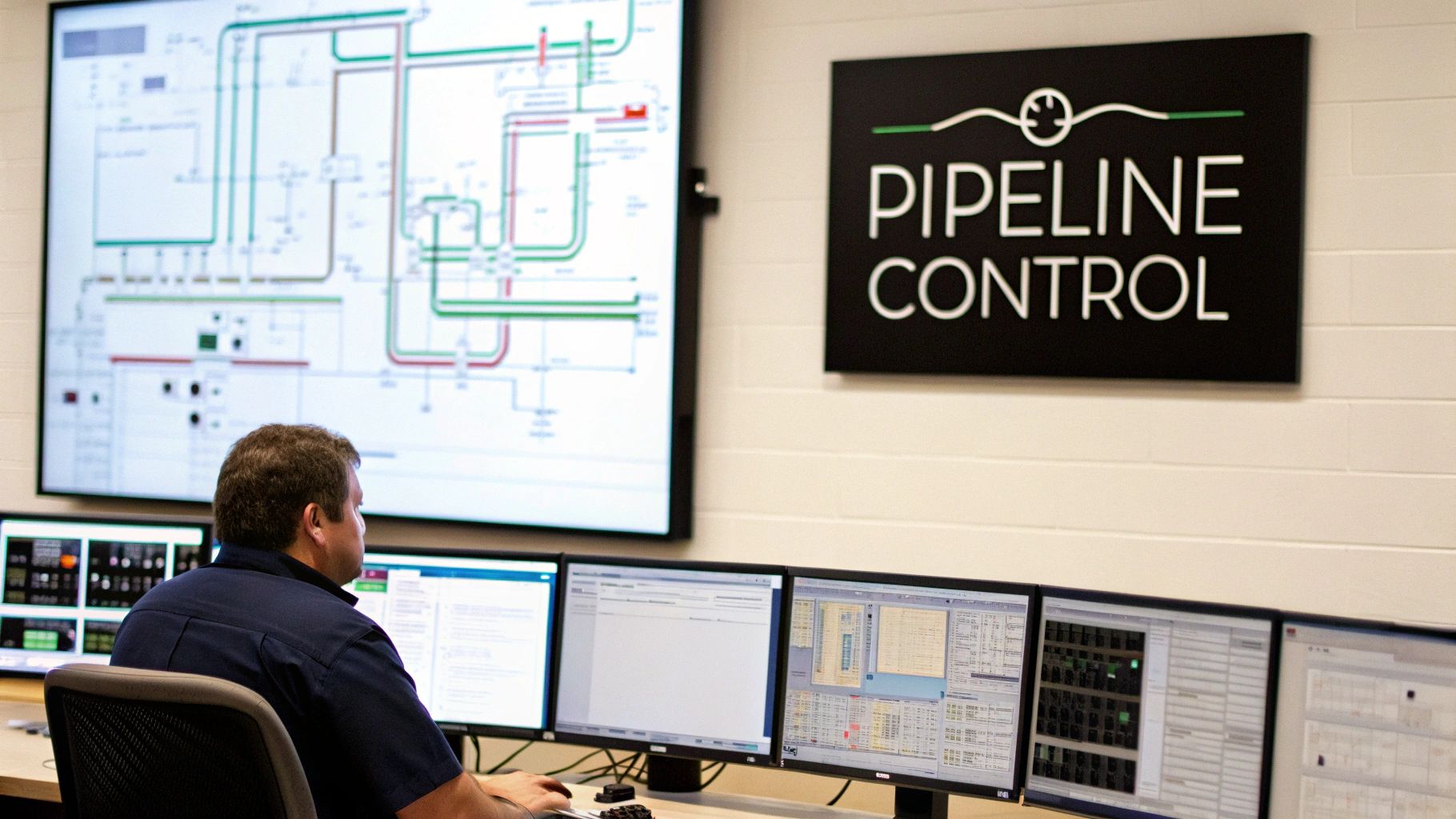
The entire natural gas grid is monitored and controlled through a system known as SCADA, which stands for Supervisory Control and Data Acquisition. Think of it as the brain and nervous system of the whole pipeline network. It connects thousands of sensors out in the field to a central control room, giving operators a complete, real-time picture of everything that's happening.
These sensors are constantly measuring critical data points, including:
- Pressure levels all along the pipeline.
- Flow rates to track exactly how much gas is moving.
- Gas temperature, which can affect pressure and safety.
- Compressor status, like engine speed and performance.
This flood of information streams back to a handful of highly secure control centers, often located hundreds of miles away from the actual pipes. Inside, operators sit in front of a wall of screens that display a digital twin of the gas grid. With a click of a mouse, they can open or close a valve in another state, adjust compressor speeds, and make the tiny, constant adjustments needed to keep the system perfectly balanced.
Meeting Unprecedented Demand
The precision of these control systems has never been more important. The U.S. natural gas market has seen incredible activity, with demand, production, and LNG deliveries setting new records in the first quarter of 2025. This surge was partly fueled by the coldest January in over 30 years, a stark reminder of how quickly the grid must adapt to extreme weather.
During that period, both domestic consumption and production in the Lower 48 states hit all-time monthly highs. This really drives home the critical role that sophisticated management plays in ensuring the U.S. can meet its energy needs. You can explore more about these market trends and what they mean for the U.S. role in global energy.
Ultimately, the seamless delivery of natural gas to our homes and businesses relies on this intricate dance between massive physical infrastructure and meticulous digital oversight. From the strategic use of line pack to the all-seeing eye of SCADA, every piece works together to manage an invisible force with pinpoint precision.
Safety and Environmental Stewardship in Pumping
Moving natural gas across huge distances under high pressure is a marvel of modern engineering, but it's a job that comes with serious responsibilities. The whole process of natural gas pumping hinges on a deep, unwavering commitment to keeping the public safe and protecting the environment. Since the fuel is invisible, naturally odorless, and highly pressurized, operators build in multiple layers of protection to handle the risks and keep the system's impact to a minimum.
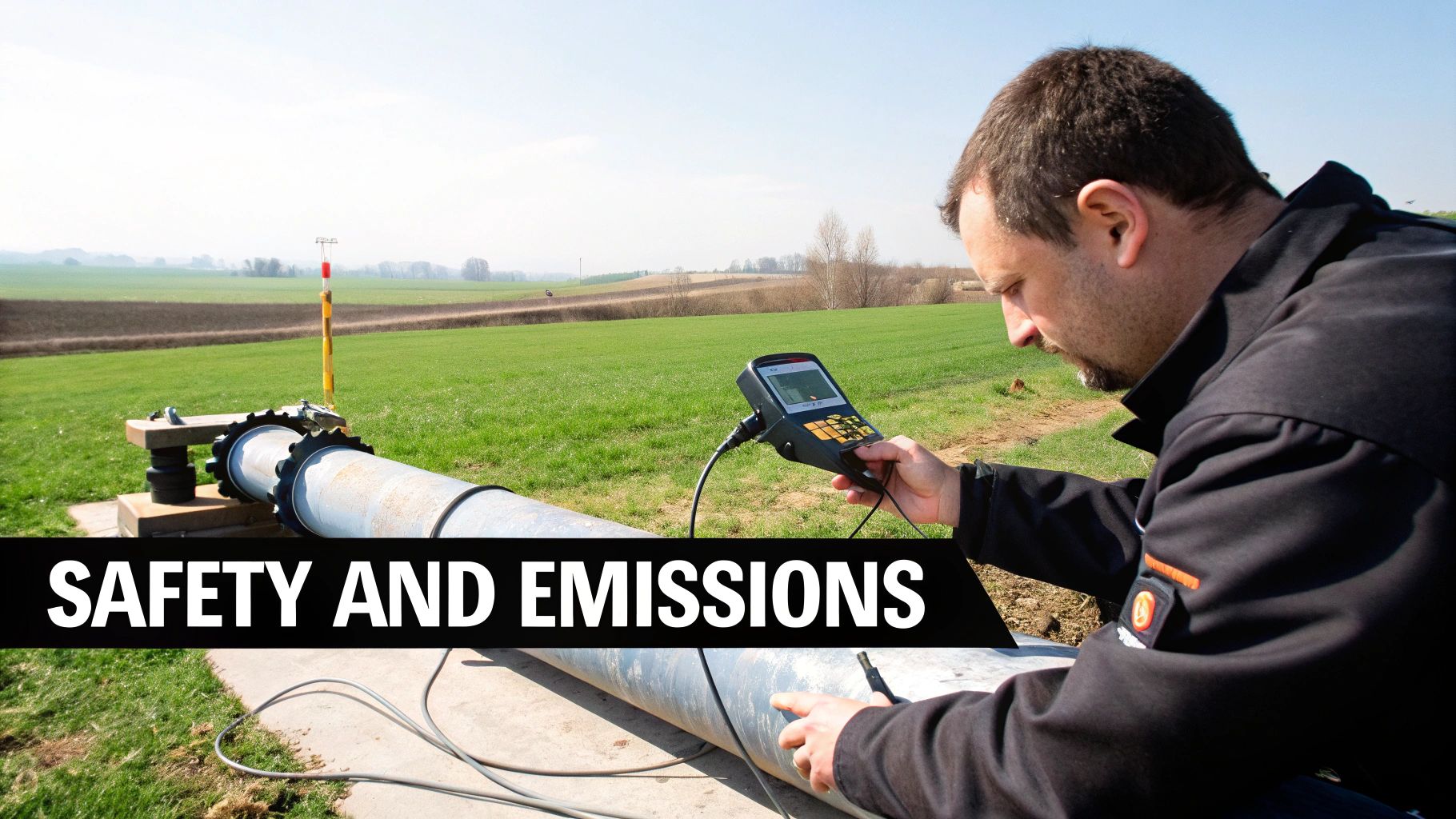
This commitment isn't just a policy; it's built right into the system. Robust pipeline integrity programs and advanced safety features are designed from day one to ensure that the invisible river of energy stays safely contained within the pipeline's steel walls.
Preventing and Detecting Leaks
The best defense is a good offense, and in the pipeline world, that means proactive maintenance and constant inspection. You can't just bury a pipeline and forget about it. Its health has to be monitored continuously. One of the most incredible tools for this is a clever device called a pipeline inspection gauge, or more commonly, a "pig."
These are sophisticated, torpedo-shaped robots that are put inside the pipeline to travel along with the flow of gas. As they move, they give the pipe a full internal health check-up, using technologies like magnetic fields and ultrasonic waves to spot potential trouble long before it starts.
- Corrosion: They can find tiny spots of rust or wear that could eventually compromise the pipe.
- Deformations: Dents or buckles that might weaken the pipe's structure are flagged immediately.
- Microscopic Cracks: They can even detect minuscule stress fractures that are completely invisible from the outside.
On top of these internal checks, automated systems are standing by for immediate response. Pipelines are fitted with automated shut-off valves that can isolate a section of the line in seconds if a sudden pressure drop signals a problem. This drastically limits the amount of gas that could escape during an incident.
Tackling the Challenge of Methane Emissions
While safety is always the top priority, the industry’s biggest environmental focus is on managing methane emissions. Methane is the main ingredient in natural gas, and it's also a potent greenhouse gas. Stopping it from leaking into the atmosphere is a critical part of pumping natural gas responsibly.
Most of these emissions are small, unintentional releases called fugitive emissions, which often happen at connection points, valves, or equipment seals at compressor stations. The primary weapon against them is a comprehensive Leak Detection and Repair (LDAR) program.
An effective LDAR program is a continuous cycle of find-and-fix. It combines advanced technology with on-the-ground diligence to systematically reduce the environmental footprint of natural gas transportation.
Crews use highly sensitive infrared cameras and laser-based detectors to hunt down even the tiniest leaks that you can't see with the naked eye. Once a leak is found, it's logged and scheduled for repair, turning environmental stewardship into a core part of day-to-day operations.
Shifting Toward Cleaner Pumping Technologies
Beyond just plugging leaks, the industry is also making big strides in adopting cleaner technologies right at the heart of the pumping process—the compressor station. This means upgrading the massive prime movers that power the compressors themselves.
Older natural gas-fired turbines are steadily being replaced with low-emission turbines that burn fuel more cleanly and completely, which cuts down on emissions of nitrogen oxides and unburned methane. An even bigger move is the trend toward electrifying compressor stations. By swapping out gas turbines for large electric motors, operators can eliminate all combustion emissions on-site.
This shift doesn't just improve local air quality; it also shrinks the operation's carbon footprint, especially when the electricity comes from renewable sources. It’s a trend that directly connects the natural gas grid to the broader transition to cleaner energy.
Global gas production dynamics make this push for efficiency and environmental care all the more important. After a 4.3% jump in 2021, global output held steady in 2022. North America's production, however, grew by 4.8% in 2022, with the U.S. up 4.3% and Canada up 7.3%, making up for declines in other parts of the world. As these key regions continue to produce, implementing these safety and environmental measures is absolutely crucial for maintaining a responsible energy supply. You can explore more about these global production trends and regional impacts.
The Future of Natural Gas Infrastructure
The world of natural gas pumping isn't standing still. It's constantly changing, pushed by the twin goals of becoming more efficient and more environmentally friendly. These pressures are sparking some fascinating innovations that are getting the industry ready for a new era in energy.
One of the biggest game-changers is the move toward automation and artificial intelligence. Think of it as shifting from a reactive mindset—fixing things after they break—to a predictive one. AI algorithms are now smart enough to comb through massive amounts of sensor data, spot early warning signs of equipment failure, and flag it for maintenance before a catastrophic breakdown happens. This not only keeps the gas flowing but also saves a ton of energy and money.
Decarbonization and Electrification
A huge part of this future is decarbonization. You're seeing a real push to power compressor stations with renewable energy instead of burning natural gas on-site. By swapping out gas-fired turbines for clean electric-drive compressors, a station’s direct emissions can drop to virtually zero. That’s a massive win for the industry's carbon footprint.
As AI leaders invest billions in new data centers, they’re looking for clean, reliable power. This massive spike in electricity demand creates a parallel need for dependable power generation, which positions natural gas as a critical partner to back up intermittent renewables during the energy transition.
This shift toward electrification is creating a more interconnected and resilient energy system. It’s a world where wind and solar power can literally push natural gas through the pipelines.
Global Trade and Infrastructure Growth
The booming global trade in Liquefied Natural Gas (LNG) is another major force shaping what comes next. As more countries rely on LNG, there's a growing need for the pipelines that get the gas from the production fields to the coastal terminals where it's liquefied and loaded onto ships.
Building this kind of infrastructure is a colossal undertaking that requires specialized skills. To really appreciate the gas network, you have to understand the companies that build its physical backbone. For example, firms focused on pipeline infrastructure development are the ones laying the groundwork for this global trade.
Right now, a handful of countries dominate the scene. The United States is the top producer, while Russia sits on the largest reserves. But watch out for Qatar—they’ve announced plans to increase their LNG production by a staggering 85% by 2030. This kind of global ambition is what's driving huge investments in pipelines and showing how the industry is adapting to a cleaner and more connected energy future.
Your Questions About Natural Gas Pumping, Answered
Even after covering the basics, a few specific questions always pop up about the day-to-day realities of moving natural gas. Let's tackle some of the most common ones to clear things up.
Is It Pumping or Compressing?
You'll hear people use both terms, but if we're getting technical, there's a difference. Pumping is for liquids, while compressing is for gases.
Since natural gas is, well, a gas, the process is technically compression. We're squeezing the gas to increase its pressure, which is what forces it to travel through the pipeline. That said, "natural gas pumping" has become a very common way to describe the whole operation, so you'll hear it used all the time.
The bottom line is this: no matter what you call it, the goal is to apply force (compression) to create the pressure needed to push the gas hundreds of miles and overcome friction along the way.
How Far Apart Are the Compressor Stations?
Think of compressor stations as the pulse of the pipeline network. They're the power-ups that keep the gas moving smoothly over vast distances.
As a rule of thumb, you'll find a compressor station spaced every 40 to 100 miles along a long-haul pipeline.
But that spacing isn't just a guess. It’s a calculated decision based on a few key variables:
- The Pipe's Size: Wider pipes mean less friction, so the gas can travel further before it needs another push.
- The Lay of the Land: Pushing gas uphill through mountains takes a lot more energy than moving it across flat plains, so stations need to be closer together in hilly terrain.
- How Much Gas is Flowing: Moving a massive volume of gas creates more pressure drop, which means you need more frequent boosts to keep it going.
Engineers meticulously plan each station's location to make sure the pressure stays in that sweet spot for safe and efficient transport.
Are Electric Compressors Better Than Gas-Powered Ones?
This is a classic "it depends" situation. Choosing between a traditional gas-powered turbine and a modern electric motor comes down to location, cost, and environmental priorities.
Gas-powered turbines have one huge advantage: they run on the very fuel they're moving. This self-sufficiency makes them the go-to choice for remote areas where you can't just plug into a reliable power grid.
On the other hand, electric-drive compressors are the cleaner option. They produce zero emissions on-site, which is a big win for local air quality and helps companies hit their decarbonization targets. They're incredibly efficient and are quickly becoming the standard wherever a stable electrical supply is available. It’s really a balancing act between operational freedom and environmental responsibility.
At Blue Gas Express, we know that a steady gas supply is non-negotiable, especially when you're off the main pipeline grid. If pipeline access is causing delays or interruptions for your project, our temporary CNG and LNG solutions are designed to bridge the gap. Find out how we can deliver immediate mobile gas units to your site and keep your operations running without a hitch.