

Ever wondered how the natural gas that heats your home or powers your business makes its way from deep underground to your doorstep? It's a fascinating journey that relies on two distinct but complementary methods: a massive, hidden network of pipelines and highly flexible mobile solutions like Compressed Natural Gas (CNG) and Liquefied Natural Gas (LNG).
These systems work together to deliver a steady, reliable stream of energy for everything from cooking dinner to running heavy industrial machinery.
The Incredible Journey of Natural Gas to You
Think of the natural gas delivery network like the nation's circulatory system. It starts at a central source—underground reservoirs—and travels through a complex web of arteries and capillaries to reach every end user. This intricate process ensures that whether you're firing up a furnace or fueling a power plant, the energy is there right when you need it.
The two primary methods, pipelines and mobile gas, work in concert to meet the country's diverse energy demands.
Two Core Delivery Methods
The backbone of the whole system is an enormous network of pipelines, an unseen interstate highway system buried just beneath our feet. These pipelines are the workhorses, transporting staggering volumes of gas over vast distances to cities, towns, and industrial hubs connected to the main grid.
But what about locations that are off the beaten path? That’s where mobile solutions step in.
- Compressed Natural Gas (CNG): This is natural gas put under high pressure and stored in specialized containers, which are then transported by truck. It's a fantastic option for temporary needs or for sites that are close to a pipeline but aren't directly connected.
- Liquefied Natural Gas (LNG): By super-chilling natural gas to a frigid -260°F, it condenses into a liquid that takes up 600 times less space. This incredible density allows huge quantities to be moved efficiently by truck or ship, even across oceans.
This dual-pronged approach creates an incredibly resilient and adaptable energy delivery system. The infographic below gives you a bird's-eye view of this entire journey.
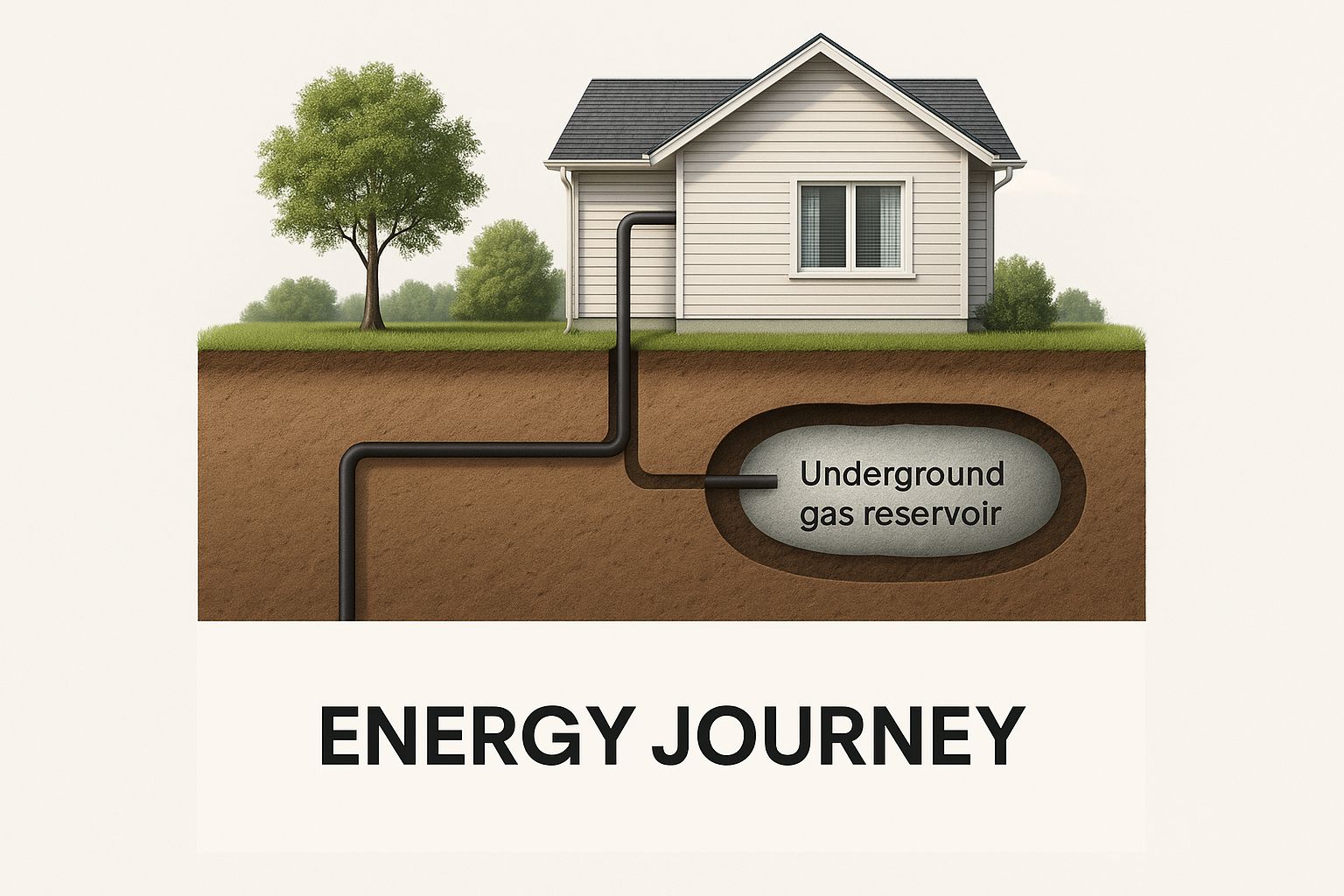
As the visual shows, natural gas is extracted, processed, and then fed into major transmission pipelines before branching out into smaller distribution lines that serve our communities and homes.
Before we dive deeper, here's a quick summary of how these delivery methods compare.
Natural Gas Delivery Methods at a Glance
| Delivery Method | Core Principle | Best For |
|---|---|---|
| Pipelines | Transporting gas through a fixed, underground network of pipes. | High-volume, continuous supply to grid-connected areas like cities and industrial zones. |
| CNG (Mobile) | Pressurizing gas for truck transport in specialized containers. | Temporary or remote sites relatively close to a pipeline connection. |
| LNG (Mobile) | Chilling gas into a liquid for high-density transport by truck or ship. | Long-distance transport, serving off-grid locations, and supplying massive volumes. |
This table neatly captures the different roles each method plays in ensuring gas gets where it needs to go.
Why This Journey Matters
Understanding this delivery process is more important than ever, as the global appetite for natural gas is on the rise. In fact, total demand is expected to climb to approximately 4,193 billion cubic meters (bcm) by 2025. This growing demand highlights just how critical a robust and reliable delivery infrastructure is for powering economies.
Once it reaches your property, natural gas is the go-to fuel for a wide range of household needs. To see how it fits into the bigger picture of home comfort, it's worth exploring the efficiency of various home heating systems.
A sophisticated and reliable delivery network is the key to energy security. By combining the vast reach of pipelines with the flexibility of mobile LNG and CNG, the system can adapt to virtually any demand, anywhere, ensuring that power is always there when you need it.
Now, let's take a closer look at each of these delivery methods to explore the technology and real-world applications that make this incredible energy journey possible.
The Unseen Pipeline Highway Under Our Feet
It’s easy to forget, but crisscrossing the country just a few feet beneath us is a massive, invisible highway. This isn't for cars, though. It's a sprawling network of pipelines that serves as the absolute backbone for how natural gas delivered to millions of homes and businesses. It's the primary, most efficient way we move fuel from where it's found to where it's needed.
Think of it just like our road system. The journey starts on small country roads, merges onto huge interstate freeways, and finally exits onto the local streets that lead right to your neighborhood. This analogy is a perfect way to visualize the three distinct stages of the natural gas pipeline system.
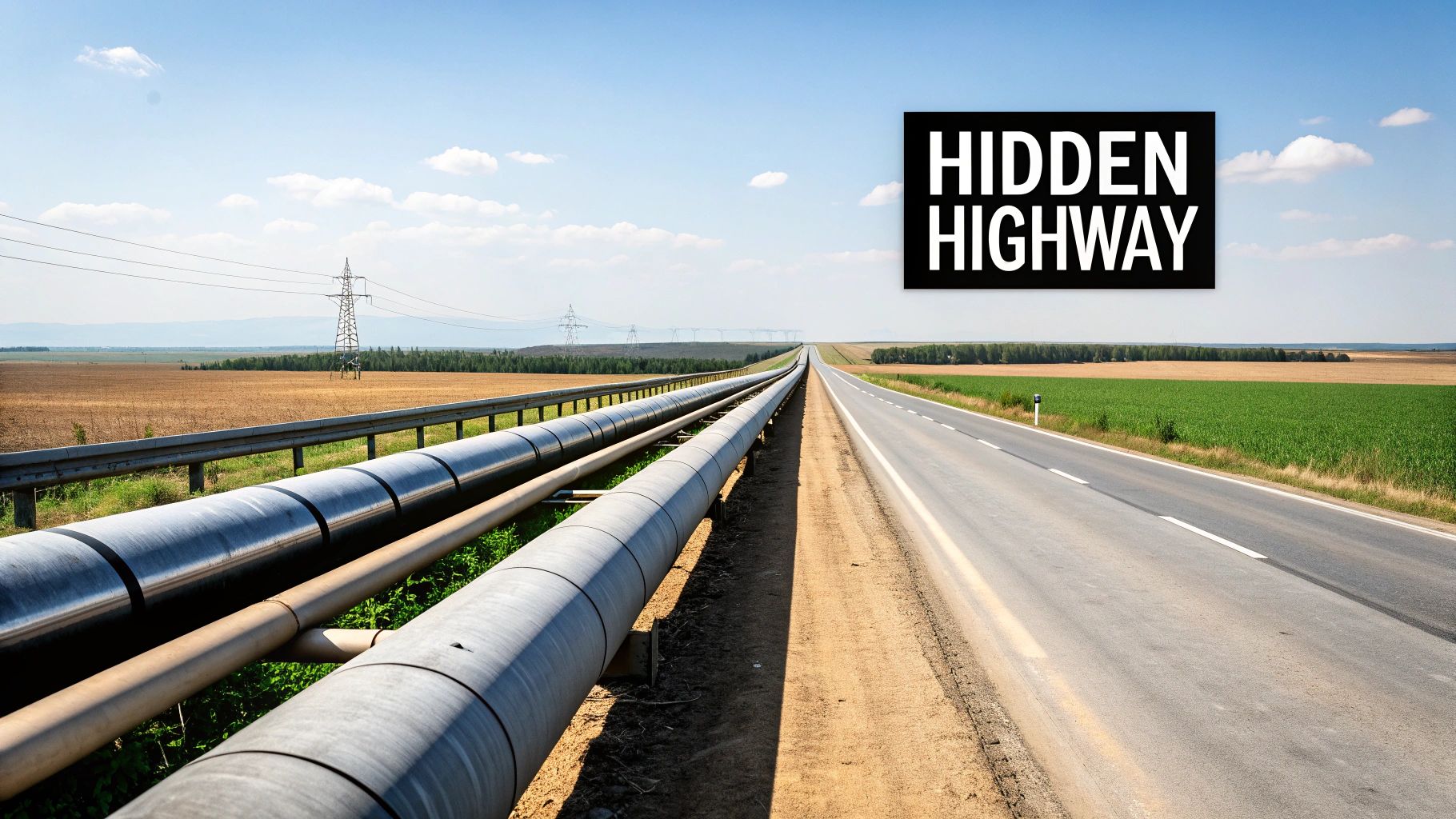
This whole network is a feat of engineering, designed to keep a constant, reliable flow of energy moving 24/7. It’s precisely this reliability that makes it the go-to method for supplying natural gas to populated areas.
The Three Tiers of the Pipeline Network
This "highway" isn't just one long pipe. It's a sophisticated, tiered system built to manage pressure and volume safely as the gas travels from remote wells to bustling city centers.
Gathering Lines (The Local Roads): The journey begins here. These are smaller pipelines that "gather" raw gas straight from production wells. Picture them as the driveways and rural routes collecting traffic before it hits the main road. They operate at lower pressures, moving the gas to a processing plant for refinement.
Transmission Lines (The Interstate Highways): After processing, the gas enters the big leagues. These are the enormous steel arteries of the system, some several feet in diameter. They're built to transport incredible volumes of natural gas under very high pressure across entire states, functioning as the interstate highway system for fuel.
Distribution Lines (The City Streets): As the gas nears its destination, it’s handed off to the local distribution network. These are the smaller lines, often made of plastic or steel, that run right under our streets. They’re the final step, branching off like city roads to deliver gas directly to homes, offices, and factories.
Keeping the Gas Flowing Smoothly
Pushing gas across thousands of miles is a serious challenge. It takes more than just pipes; the system depends on crucial facilities to keep the pressure up and the flow steady.
That’s where Compressor Stations come in. Think of them as the rest stops and refueling stations for the gas. Placed every 40 to 100 miles along the major transmission lines, these stations use powerful turbines to re-pressurize the gas, giving it the boost it needs to keep moving forward. Without these stations, friction would eventually bring the flow to a standstill.
When the high-pressure gas arrives at the edge of a community, it passes through a "city gate" station. This is a critical checkpoint where the immense pressure from the transmission line is safely reduced to a much lower level, making it suitable for the smaller pipes in the local distribution network.
Safety Is Built-In, From Start to Finish
You can’t see it, but the safety of this underground highway is paramount. Natural gas itself is actually odorless, which would make leaks impossible to detect. That's why utility companies add a distinct, foul-smelling chemical called mercaptan to the gas before it enters the local distribution lines.
That unmistakable "rotten egg" smell is a deliberately added safety feature. It’s a simple but incredibly effective way to ensure that even the tiniest leak is immediately noticeable. This measure, combined with constant monitoring and routine inspections, makes the pipeline network an exceptionally safe and reliable way to get natural gas delivered where it needs to go.
Mobile Energy: LNG and CNG Solutions
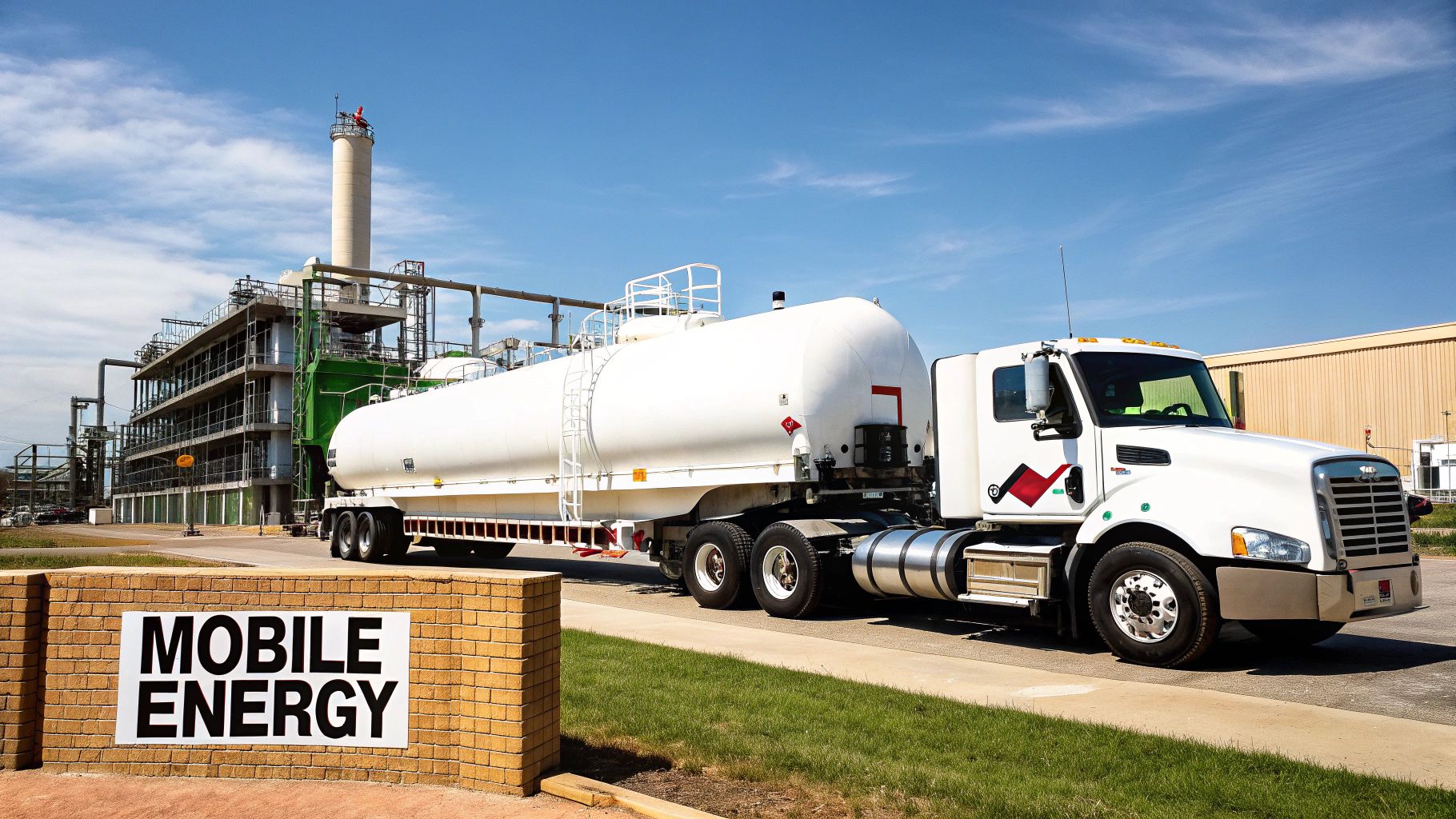
The vast, unseen pipeline network is an engineering marvel, but what happens when you’re building or operating somewhere the pipeline doesn’t reach? For countless construction sites, remote industrial plants, or even new communities, a physical connection to the grid just isn't feasible. This is where the flexibility of mobile energy shines, making sure natural gas is delivered reliably, no matter how far off the beaten path you are.
Two main players make this happen: Liquefied Natural Gas (LNG) and Compressed Natural Gas (CNG). While they both deliver the same clean-burning fuel, they get it there in very different ways. Understanding how they work is the key to seeing how they solve unique energy challenges on the ground.
LNG: The Super-Cooled Concentrate
Think of LNG as natural gas concentrate. To make it, the gas is chilled to a bone-chilling -260°F (-162°C). This deep freeze transforms it from a gas into a clear, non-toxic liquid.
The real magic here is the incredible space savings. In its liquid state, natural gas takes up 600 times less space than it does as a gas. That kind of density is a complete game-changer for transportation.
This process makes it possible to move massive amounts of energy in cryogenic tanker trucks or across oceans in specialized vessels. It's the go-to solution for getting gas across continents or for supplying large-scale operations that need a big, steady fuel source but don't have a pipeline.
CNG: The Pressurized Powerhouse
If LNG is a concentrate, then CNG is more like a highly pressurized can of soda. Instead of being super-cooled, natural gas is compressed to less than 1% of its original volume and stored in high-strength cylinders at pressures hitting 3,600 psi.
This approach skips the energy-intensive cooling process needed for LNG, making it a simpler, more direct option for regional delivery. You'll typically see CNG moved by truck in what's called a "tube trailer"—basically, a rolling rack of interconnected cylinders.
Because it’s not as dense as LNG, CNG is the perfect fit for customers who are relatively close to a pipeline hookup and have more moderate energy demands. It's a fantastic solution for providing temporary service during pipeline repairs or for fueling a fleet of vehicles from a central station.
The Core Difference: LNG uses extreme cold to shrink the gas for maximum density, making it perfect for hauling large volumes over long distances. CNG uses high pressure to compact the gas, making it ideal for smaller volumes and regional transport.
Real-World Mobile Energy Applications
The true value of LNG and CNG comes from just how versatile they are. They are the energy lifeline in all sorts of situations where laying a pipeline just doesn't make sense.
- Remote Industrial Operations: A mine or manufacturing plant miles from the nearest town can use an on-site LNG storage tank and vaporizer to power its entire operation.
- Emergency Fuel Supply: When a natural disaster hits or the power grid goes down, mobile CNG or LNG units can be trucked in quickly to power hospitals, shelters, and other critical infrastructure.
- Construction and Development: New housing developments often need gas for inspections long before the permanent pipeline is live. A temporary CNG hookup can provide the fuel to keep the project on schedule.
- Pipeline Interruptions: If a section of pipeline needs to be taken offline for maintenance, utilities can bring in mobile gas solutions to keep the gas flowing to homes and businesses without anyone noticing.
This adaptability is a big reason why demand keeps growing. In fact, global natural gas consumption grew by 2.8% in 2024, partly because LNG and CNG make it so easy to get energy where it's needed for both transport and power generation. The world's biggest consumers—like the US, Russia, and China—are relying more and more on these methods to expand energy access. You can dive deeper into these trends by exploring the latest global energy data.
Choosing the Right Natural Gas Delivery Method
Picking the right way to get natural gas delivered to your site isn't a simple choice—it's a critical decision that boils down to your specific needs, location, and budget. There's no single "best" answer. What works perfectly for a developer building a new suburban neighborhood will be completely wrong for a remote factory or a temporary construction project.
Think of it this way: a new housing development right next to a city will almost always tie into the existing underground pipeline. It’s the most direct, reliable, and affordable long-term solution. But what if you're managing a massive manufacturing plant miles from the nearest gas main? Or what if you just need temporary heat on a job site to keep work moving through the winter? That’s when the decision gets interesting.
First, Take Stock of Your Project's Needs
Before you can even begin to compare pipelines, CNG, and LNG, you have to get crystal clear on your own requirements. Getting this part wrong can lead to serious headaches, from budget overruns to an energy supply that just can't keep up with your demand.
Start by asking yourself four key questions:
- How much gas will you actually use? There's a world of difference between powering a backup generator for a single building and fueling an entire industrial furnace. Heavy, non-stop demand usually points you toward a pipeline or a large on-site LNG setup.
- Where is your project located? This is often the biggest deciding factor. If you're close to existing infrastructure, connecting to a pipeline is usually a no-brainer. If you're out in the middle of nowhere, mobile solutions are your only real options.
- What's your budget for the initial setup? Tying into a pipeline can mean significant upfront costs for construction and trenching. LNG requires a specialized, and expensive, cryogenic storage tank, while CNG uses more straightforward cylinder storage.
- How vital is a constant, uninterrupted supply? For critical operations like a hospital or a 24/7 manufacturing line, you can't afford any downtime. This makes supply reliability a non-negotiable priority.
Answering these questions honestly will quickly filter your options and point you in the right direction.
Scenario One: A New Housing Development
Let's picture a developer breaking ground on a 150-home community just outside a growing city. The main goal is to provide every home with dependable, low-cost fuel for heating, hot water, and cooking. Here, tapping into the existing utility pipeline is the clear winner.
Sure, there’s an initial investment to lay the new distribution lines throughout the neighborhood. But the long-term payoff is massive. Once it's done, every single home has a constant, on-demand supply of natural gas. No one has to worry about scheduling deliveries or maintaining a big storage tank on their property. For permanent, high-density residential areas, this is the most seamless and economical way to go.
Scenario Two: An Off-Grid Industrial Plant
Now, imagine a large food processing plant that operates around the clock, located 50 miles from the closest gas main. It needs a huge, unwavering supply of energy to run its industrial dryers and heavy machinery. Trying to extend a pipeline that far would be astronomically expensive—we're talking millions of dollars.
So the real choice here is between LNG and CNG. Because the factory’s demand is both massive and constant, Liquefied Natural Gas (LNG) is the way to go. A large cryogenic storage tank can be installed on-site, holding enough fuel to run the plant for weeks at a time. This drastically cuts down on the number of truck deliveries needed and guarantees the stable supply that's absolutely essential for keeping the production line moving.
The real magic of LNG is its energy density. When you cool natural gas to -260°F, it shrinks to 1/600th of its original volume. This incredible density makes it the perfect solution for high-demand, off-grid users who need maximum energy security with a minimal storage footprint.
Scenario Three: A Temporary Construction Site
Finally, let’s look at a common scenario: a new commercial building is going up, but the permanent gas line won't be connected for another three months. The contractor needs to run powerful heaters to cure concrete and keep the crew working through the winter. The energy demand is moderate, but more importantly, it's temporary.
This is a textbook case for Compressed Natural Gas (CNG). A mobile "tube trailer"—basically a truck carrying a rack of high-pressure gas cylinders—can be brought right to the job site. It hooks directly into the heating equipment, and when a cylinder runs low, it's simply swapped out for a full one. Once the building's permanent gas line is up and running, the CNG trailer is just driven away. The flexibility and lower upfront cost make CNG the ideal plug-and-play solution for any short-term or intermittent energy need.
To help you visualize these differences, we've put together a simple comparison of the three main delivery methods.
Comparison of Natural Gas Delivery Solutions
This table breaks down the key factors for each solution, offering an at-a-glance guide to help you weigh your options based on what matters most for your project.
| Factor | Pipeline Network | Compressed Natural Gas (CNG) | Liquefied Natural Gas (LNG) |
|---|---|---|---|
| Ideal Use Case | Permanent, high-density areas (cities, suburbs) | Temporary or moderate, regional off-grid needs | High-volume, long-term off-grid operations |
| Upfront Cost | High (for new connections) | Moderate | High (requires cryogenic storage) |
| Ongoing Cost | Lowest per unit of gas | Higher due to transport | High, but cost-effective for large volumes |
| Infrastructure | Permanent underground pipes | Mobile trailers and storage cylinders | On-site cryogenic tank and vaporizer |
| Supply Type | Continuous and on-demand | Intermittent (requires scheduled refills) | Intermittent (requires scheduled refills) |
Ultimately, whether you choose a permanent pipeline connection or a mobile "virtual pipeline" solution like CNG or LNG, the decision comes back to those core needs: volume, location, budget, and reliability.
Why Reliable Natural Gas Delivery Matters
Think about your morning coffee or the furnace that keeps your house warm. Behind the scenes of our daily routines is a silent engine: a consistent, dependable energy supply. When natural gas is delivered without a hitch, it creates a ripple effect of benefits—economic, environmental, and even national security—that touch every part of our society. It’s not just a utility; it’s a cornerstone of modern life.
For any business, predictable costs are king. A reliable stream of natural gas gives manufacturers, restaurants, and commercial operations just that. It lets them manage budgets, keep a lid on overhead, and stay competitive. Instead of reacting to volatile energy bills, they can focus on what they do best—growing and innovating.
Cleaner Air and a More Secure Energy Future
The benefits go far beyond the balance sheet. Natural gas is a much cleaner-burning fuel than coal or oil. It releases significantly fewer harmful pollutants, like sulfur dioxide and particulate matter, which directly translates to better air quality for our communities and a healthier environment.
Even more critical is how a robust delivery system strengthens our national energy security. A diverse network of pipelines, backed by mobile LNG and CNG solutions, creates a resilient grid that isn't dependent on a single point of failure. If a pipeline needs maintenance or a storm causes a disruption, gas can be rerouted or trucked in, ensuring essential services never skip a beat.
Think of a diversified natural gas delivery system as an insurance policy against supply shocks. By combining the massive capacity of pipelines with the nimble flexibility of mobile gas, the network guarantees that homes, hospitals, and industries always have the power they need, right when they need it.
Keeping Up with America's Growing Appetite for Gas
The need for this kind of reliable infrastructure has never been greater. U.S. natural gas consumption is projected to climb to a record 91.4 billion cubic feet per day (Bcf/d) in 2025. This demand is largely driven by homes and businesses—in fact, 45% of U.S. homes rely on natural gas to stay warm, especially when winter hits.
To see the real-world impact, just look at how many people depend on natural gas heating systems. This reliance makes a dependable supply chain more than an industrial issue; it's a matter of public comfort and safety.
Ultimately, getting natural gas delivered where it needs to go, efficiently and without interruption, is what supports our economic stability, promotes cleaner air, and strengthens our energy independence. It's what keeps the lights on, businesses running, and homes warm—making it one of the most vital parts of our national infrastructure.
Got Questions About Natural Gas Delivery? We've Got Answers.
As natural gas becomes a go-to fuel, more and more questions pop up about how it actually gets from the source to your site. Getting a handle on the logistics, safety, and costs involved is key to making a smart energy decision. Let's clear the air and answer some of the most common questions we hear.
Whether you're already hooked up to a pipeline or you're looking at mobile options for a project off the beaten path, this should give you the confidence you need.
How Do You Ensure Natural Gas Delivery Is Safe?
Safety isn't just a priority; it's the foundation of the entire natural gas delivery system. From the wellhead to the end-user, every step is governed by strict protocols and built with multiple layers of protection. It’s a system designed from the ground up for public safety.
For the massive underground pipeline network, safety starts with constant vigilance. Control centers are staffed 24/7, using sophisticated tech to monitor pressure, flow, and the overall health of the lines. Pipelines also get regular check-ups using advanced "smart pig" tools that can spot tiny issues long before they could ever become a problem.
And of course, there's that smell. Natural gas is odorless on its own, so a chemical with a distinct "rotten egg" aroma called mercaptan is added. It's a simple but incredibly effective safety measure that makes even the smallest leak immediately obvious.
Mobile delivery is just as buttoned-up.
- Tough-as-Nails Containers: Both CNG and LNG are moved in specially engineered, double-walled tanks built to handle extreme pressures and temperatures. These things are designed to keep the fuel contained, even in an accident.
- Highly Trained Pros: The drivers and technicians handling mobile gas aren't just truck drivers. They go through intensive, specialized training on safe handling, emergency response, and equipment operation.
- Smart Vehicle Safety: The trucks themselves are loaded with safety gear, like GPS tracking, remote monitoring systems, and automatic shut-offs that can prevent or contain any potential issues on the road.
Which is Cheaper: A Pipeline, CNG, or LNG?
This is the million-dollar question, and the answer really comes down to your specific situation—where you are, how much gas you use, and how close you are to a pipeline. There’s no single "cheapest" choice; it's all about what makes the most sense for your needs.
Generally, if you can get access to a pipeline, it will almost always be your most affordable option per unit of gas. Why? Because you cut out all the extra costs of transportation, compression, and liquefaction. Once that initial connection is paid for, you're tapped into a direct, continuous, and cost-effective supply.
Mobile solutions are naturally going to cost more because of the complex processes involved. It takes a lot of energy to compress or liquefy natural gas, and specialized transport adds to the final bill. But what you're paying for is incredible flexibility.
When you're comparing the mobile options:
- CNG is usually the more economical choice for shorter hauls and smaller-to-medium-sized projects. The compression process is simpler than liquefaction, making it a great fit for temporary construction sites or businesses that are relatively close to a pipeline tap.
- LNG starts to make more financial sense when you need to move huge volumes of gas over long distances. Because it’s so dense, a single truck can carry a massive amount of energy. This reduces the number of trips needed, making it the go-to for high-demand industrial plants far from any pipelines.
Can I Get Natural Gas Without a Pipeline Nearby?
Yes, absolutely. This is the exact problem that mobile energy solutions like CNG and LNG were designed to solve. Think of them as a "virtual pipeline"—they give you all the clean-burning benefits of natural gas without needing a physical pipe in the ground.
If your business, construction site, or industrial facility is beyond the reach of a utility pipeline, a mobile gas supplier can set up a complete, self-contained fuel solution right on your property. The process is surprisingly straightforward.
A supplier will first figure out your energy demands and then install the right kind of storage. For high-volume needs, that might be a large cryogenic tank for LNG. For more moderate use, it could be a series of interconnected CNG cylinders. Once you're set up, they'll schedule regular truck deliveries to keep you topped off, ensuring you never run out.
What Happens if the Natural Gas Supply Gets Disrupted?
Energy suppliers and utilities have extensive backup plans to keep the gas flowing, even when things go wrong. The entire system is built with redundancy in mind to prevent a single point of failure from causing a widespread outage.
On the pipeline network, operators can often reroute gas around a problem area, kind of like a traffic detour on the interstate. This ensures that customers downstream from the issue can continue operating without a hiccup.
For businesses that absolutely cannot afford any downtime, the best strategy is to have a backup fuel supply ready to go. Many facilities with a pipeline connection also keep an on-site LNG or propane tank. This dual-fuel capability is a cornerstone of energy security, guaranteeing that critical operations at places like hospitals, data centers, and manufacturing plants can continue no matter what.
At Blue Gas Express, we specialize in providing these flexible, reliable mobile natural gas solutions when a pipeline isn't an option. If you're facing delays in getting your gas line installed or need a temporary energy source for your project in the Carolinas, Tennessee, or Virginia, we can help. Learn more about our rapid-deployment CNG and LNG services by visiting https://bluegasexpress.com.