

Think of a mobile energy solution as a power grid on wheels. It's a self-contained unit packed with high-capacity batteries, smart inverters, and sophisticated control systems, all ready to be deployed wherever power is needed, fast. This design essentially frees electricity from the constraints of fixed power lines, making it a game-changer for everything from disaster relief to remote industrial projects.
What Are Mobile Energy Solutions?
Imagine you’re running a remote construction site, a huge music festival, or a community shelter after a hurricane has wiped out the local grid. Not long ago, your only real option would have been a loud, fume-belching diesel generator. Today, mobile energy solutions provide a much cleaner, quieter, and more flexible answer.
At their heart, these systems are advanced, portable power stations that can be transported and set up in a matter of hours. They’re far more than just giant portable chargers; they are complete power hubs. They store massive amounts of electricity—often captured from renewable sources—and deliver it as stable, reliable power right where you need it. This capability is fundamentally changing how entire industries think about temporary power.
The Core Components
So, what makes these mobile powerhouses tick? To really get it, you have to look at the key parts working together inside. Each piece has a critical job to do in delivering on-demand electricity safely and efficiently.
- High-Density Batteries: This is the core of the system. Most units rely on Lithium-ion technology to store a huge amount of energy in a surprisingly compact space.
- Smart Inverters: If the batteries are the heart, the inverter is the brain. It converts the direct current (DC) stored in the batteries into the alternating current (AC) that runs our everyday equipment.
- Battery Management System (BMS): This is the unsung hero. The BMS is a vital safety and performance system that constantly monitors battery health, temperature, and charge levels to keep everything running smoothly and reliably for the long haul.
- Robust Enclosure: All this sophisticated tech is housed in a tough, weather-resistant container or mounted on a trailer. It’s built to handle the bumps and bruises of transport and the harsh conditions of outdoor deployment.
This all-in-one design is what allows a mobile energy solution to work as a true plug-and-play power source, turning a once-complex logistical nightmare into a straightforward task.
The real magic of this technology is its ability to bridge the gap between energy supply and demand, delivering resilience exactly where traditional infrastructure can't. Whether it's stabilizing a strained city grid during a brutal heatwave or powering critical medical equipment in an emergency, these systems provide energy security on demand.
It’s no surprise the market for these solutions is taking off. The Mobile Energy Storage System market was valued at USD 51.12 billion in 2024 and is projected to skyrocket to USD 156.16 billion by 2032. This incredible growth is being driven by rising electricity demand and the global push to cut greenhouse gas emissions. You can learn more about the mobile energy market growth and what's fueling its expansion.
How Mobile Energy Systems Deliver Power
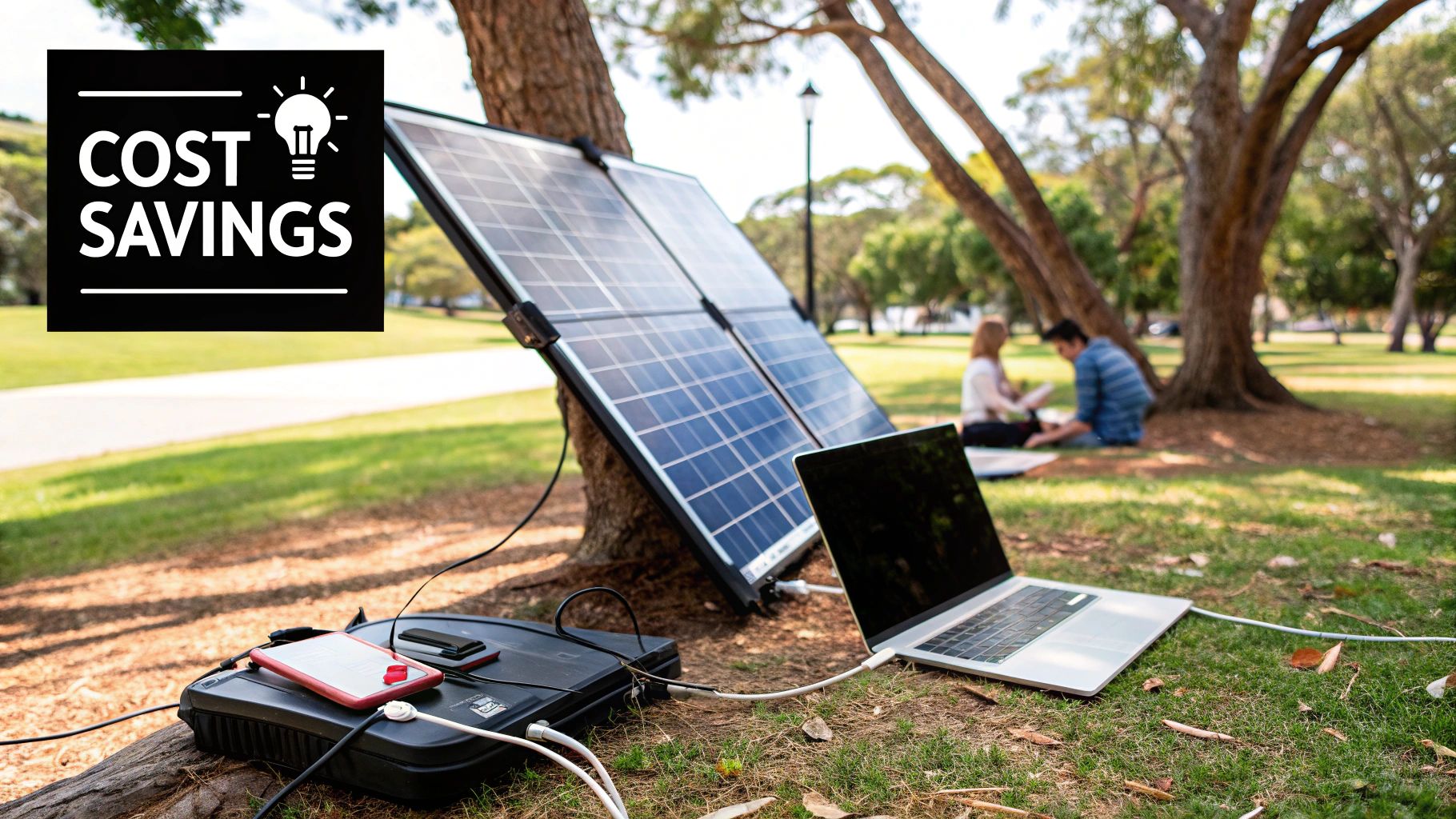
To really get a feel for what mobile energy solutions can do, it helps to understand how they get from a power source to your job site. I like to think of it as a simple three-act play: charging the unit, getting it where it needs to go, and putting it to work. Each step is engineered for efficiency and speed.
This entire workflow is what sets these systems apart from fixed power installations or even old-school generators. You're not just getting a product; you're getting a complete, on-demand energy service. Let's walk through the journey to see how it all comes together.
Stage 1: Charging the System
Before a mobile unit can deliver even a single watt, it needs to be juiced up. This "charging" phase is surprisingly flexible. You can draw power from all sorts of sources, depending on what’s available and what makes the most economic sense. Think of it like filling up a gas tank, but with far cleaner and more versatile fuel options.
The most common method is plugging directly into the electrical grid, usually during off-peak hours when electricity is dirt cheap. This strategy, known as peak shaving, is a game-changer. You store low-cost energy and deploy it later to avoid getting hammered with expensive peak demand charges from the utility company. That alone can translate into serious savings.
Better yet, these units are tailor-made for renewables. They can be charged using:
- Large-Scale Solar Farms: Soaking up clean solar energy all day to provide power anytime, day or night.
- Wind Turbines: Capturing energy when it's gusty, guaranteeing a steady supply even when the air is still.
- Other Green Sources: Hooking up to hydro or other renewable facilities to build a completely carbon-free power reserve.
This ability to play nice with renewables is a massive advantage, helping companies hit their sustainability targets without sacrificing reliability.
Stage 2: Transporting to the Site
Once the batteries are full, the mobile energy solution is ready to hit the road. This is where the "mobile" part of the name really proves its worth. Unlike stationary power systems that are bolted to a concrete slab, these units are built from the ground up for quick and easy relocation.
How it gets there depends on the size and shape of the system. The most common setups include:
- Trailer-Mounted Units: Smaller to mid-sized systems are often built right onto a towable trailer. These are perfect for getting power to a construction site or an outdoor festival in a hurry.
- Truck-Mounted Systems: For a bit more oomph, larger units can be integrated directly onto a truck chassis, making long-haul delivery a breeze.
- Containerized Solutions: The real heavy hitters are housed in standard shipping containers. This design means they can be moved by truck, rail, or even ship for deployment practically anywhere in the world.
This logistical nimbleness is key. It means reliable power can be delivered to just about any location you can imagine, from a tight urban worksite to a remote mining operation.
Stage 3: Deployment and Power Delivery
The final act is deployment. This is where the unit gets connected and starts doing its job. The whole process is designed to be incredibly fast and painless, often taking just a few hours from arrival to being fully operational.
Once on-site, a technician simply connects the unit’s output to the facility’s main electrical panel, a temporary power distribution board, or even directly to heavy equipment.
The unsung hero of this whole operation is the inverter. The batteries store energy as direct current (DC), but almost everything we use—from power tools to computers—runs on alternating current (AC). The inverter’s job is to seamlessly convert that stored DC power into clean, stable AC power that’s safe for even the most sensitive electronics.
This plug-and-play approach keeps downtime to an absolute minimum and lets projects power up almost instantly. Whether it's for temporary site power, running equipment, or keeping an entire building online, the system is ready when you are.
Inside the Technology Powering Mobile Energy
When you look at a mobile energy unit, it's easy to just see a box that provides power. But under the hood, there’s a sophisticated ecosystem of hardware working together to store and deliver that energy safely and reliably. It's not just a big battery; it's a complete, integrated power system.
Think of it like a high-performance car engine. Every component—from the battery cells themselves to the cooling system and the onboard computer—has a specific job. Each one is critical to the unit's overall performance, safety, and lifespan. Let’s pop the hood and see what makes these things tick.
This infographic gives a great overview of where battery storage units fit into the bigger picture of mobile energy.
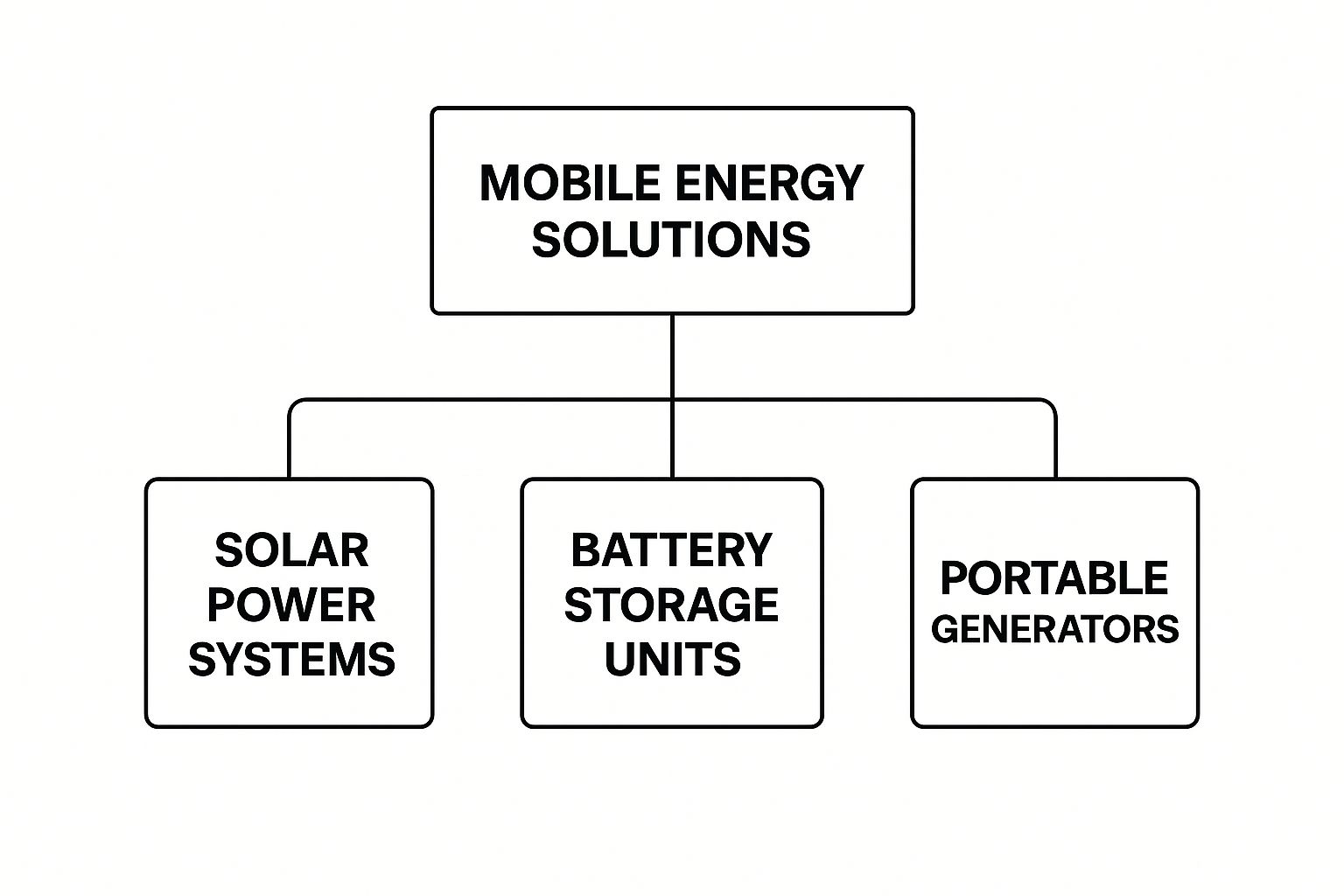
As you can see, battery storage has become a cornerstone technology, offering a quiet, emission-free alternative to old-school generators and a perfect partner for mobile solar setups.
The Dominance of Lithium-Ion Batteries
The heart of any modern mobile energy solution is, without a doubt, the battery. And in the world of batteries, lithium-ion (Li-ion) chemistry is king. There’s a very good reason for this: energy density.
Energy density is simply a measure of how much power you can cram into a certain amount of space or weight. For a mobile unit that needs to be moved around, this is everything. You need the most bang for your buck in the smallest, lightest package possible, and that's where Li-ion shines.
The numbers don't lie. The market for Mobile Energy Storage Systems is expected to explode, hitting USD 102.8 billion by 2033, up from USD 25.2 billion in 2023. Lithium-ion batteries owned about 64.5% of the market share in 2023, driven by that fantastic energy density and the fact that their costs keep coming down.
Of course, Li-ion isn't the only game in town. A few other technologies have found their niche:
- Sodium-ion (Na-ion): This is the up-and-comer. It uses sodium, which is cheap and abundant. Its energy density isn't quite at Li-ion levels yet, but its low cost makes it a compelling option for certain applications where size isn't the absolute top priority.
- Advanced Lead-Acid: Forget the clunky battery in your dad's old truck. Today’s lead-acid designs are much better performers and are incredibly recyclable. They’re a solid choice when the upfront cost is the main concern and a little extra weight isn’t a dealbreaker.
Comparing Key Battery Technologies for Mobile Energy Storage
To really understand the trade-offs, it helps to see the dominant battery technologies side-by-side. This table breaks down their key characteristics, from performance to cost.
| Technology | Energy Density | Lifecycle | Cost | Common Use Case |
|---|---|---|---|---|
| Lithium-ion (Li-ion) | High | 2,000-5,000 cycles | Medium-High | Most mobile applications, EVs, consumer electronics |
| Sodium-ion (Na-ion) | Medium | 1,000-4,000 cycles | Low | Grid storage, some emerging mobile uses |
| Advanced Lead-Acid | Low | 500-1,500 cycles | Very Low | Backup power, forklifts, off-grid systems |
As you can see, the choice of battery really depends on the specific job it needs to do. For most mobile power needs today, lithium-ion offers the best all-around package.
Essential Hardware for Peak Performance
A world-class battery is only as good as the system that supports it. Three pieces of hardware are absolutely non-negotiable for ensuring a mobile energy solution is safe, efficient, and built to last.
1. The Battery Management System (BMS)
The BMS is the brain of the operation. It’s an electronic board that acts as a combination of a bodyguard and a health monitor for the battery pack. It’s constantly watching everything.
What does it do?
- Stops the battery from overcharging or draining too low.
- Keeps the charge level even across all the individual cells.
- Monitors temperature to make sure things don't get too hot.
- Calculates exactly how much juice is left and the overall health of the battery.
A mobile energy unit without a quality BMS would be unreliable, inefficient, and frankly, dangerous. It is the single most important safety feature in the entire system.
2. High-Efficiency Inverters
Batteries store power in direct current (DC), but almost everything we use—from power tools to laptops—runs on alternating current (AC). The inverter is the component that makes that switch. A top-notch, pure sine wave inverter is critical because it creates clean, stable AC power. This protects sensitive electronics from getting fried by "dirty" power, which is a common problem with cheaper, lower-quality inverters.
3. Thermal Management Systems
Batteries get warm when they’re working hard, both when charging and discharging. Too much heat is the enemy of battery life and can even create a safety hazard. That’s where thermal management comes in. These systems use fans, liquid cooling, or even advanced phase-change materials to pull heat away and keep the battery in its happy place—its optimal operating temperature.
To truly get a handle on how these systems work in the real world, it helps to understand the fundamentals of battery and charging technologies. It’s this thermal control that allows the unit to perform like a champ, whether it’s sitting in the desert sun or on a frozen job site.
Where Mobile Power Makes a Real-World Impact
It’s one thing to talk about the tech, but it's another to see it in action. These mobile energy solutions aren’t just a concept on a whiteboard; they're out in the field solving tough, practical problems across all sorts of industries. They deliver clean, dependable power in places where it used to be a massive headache—or flat-out impossible.
The real magic of mobile energy is its flexibility. Whether it's a chaotic disaster zone or a carefully planned grid maintenance project, these units show up and get the job done. Let's look at a few mini case studies to see how they're making a difference.
Emergency Response and Disaster Relief
When a hurricane, flood, or wildfire hits, the power grid is often the first thing to go. Suddenly, whole communities are plunged into darkness, sometimes for weeks. In those first critical hours and days, getting power back isn't a convenience; it's a lifeline.
This is exactly where mobile energy solutions shine. Stationary generators might be flooded or cut off, but these units can be trucked right into the heart of an affected area. They immediately get to work powering critical infrastructure:
- Medical Facilities: Keeping the lights on in field hospitals, running life-saving diagnostic equipment, and making sure vital medicines stay refrigerated.
- Communication Hubs: Firing up cell towers and emergency command centers so first responders can coordinate and families can connect.
- Community Shelters: Providing light, heat, or air conditioning and offering charging stations for people who have lost everything.
A huge bonus is their quiet, emission-free operation. In a crowded shelter or a dense neighborhood, you're not adding the constant noise and toxic fumes of a diesel generator to an already stressful situation.
Powering Remote Construction and Mining
Big construction and mining projects are often way out in the middle of nowhere, miles from the nearest power line. For decades, the only answer was to haul in diesel generators to run everything from heavy machinery and power tools to the site office.
Mobile energy systems are completely flipping that script. A single trailer-mounted unit can be dropped on-site, providing instant, reliable power for welders, compressors, lights, and crew facilities. This brings some serious advantages over the old diesel habit.
Think about it from a site manager's perspective: no more scheduling fuel deliveries to a remote location, fewer maintenance calls for finicky generators, and a much quieter, safer work environment. It cuts through the logistical and environmental knots that have always been a part of remote industrial work.
Plus, you can charge these units with portable solar arrays right on site or juice them up during off-peak hours back at the grid. This can seriously cut operating costs and shrink the project's carbon footprint, making the whole operation more profitable and sustainable.
Supporting Large-Scale Events
Putting on a music festival, an outdoor concert, or a major sporting event is like building a small city overnight. It needs a massive amount of temporary power for stage lighting, sound systems, food vendors, and all the behind-the-scenes production gear.
Event organizers are increasingly swapping out noisy diesel generators for mobile energy solutions. A few containerized systems can create a clean, quiet, and reliable microgrid for the entire event. The near-silent operation is a game-changer, especially for concerts or film shoots where unwanted background noise is a deal-breaker.
Aiding Utility Grid Stabilization
Even the most robust power grids get pushed to their limits. Think about a blistering summer heatwave when everyone cranks up their air conditioning at the same time. That massive surge in demand can strain the system to its breaking point, leading to brownouts or even widespread blackouts.
Utilities are now using mobile energy systems as a strategic ace up their sleeve. They can deploy these units to a struggling substation and inject a boost of power right where it's needed most. This practice, known as peak shaving, helps them ride out the demand surge without having to fire up expensive and dirty "peaker" plants. It's a smart, flexible way to keep the grid stable and the lights on for everyone.
The Strategic Advantages of Going Mobile
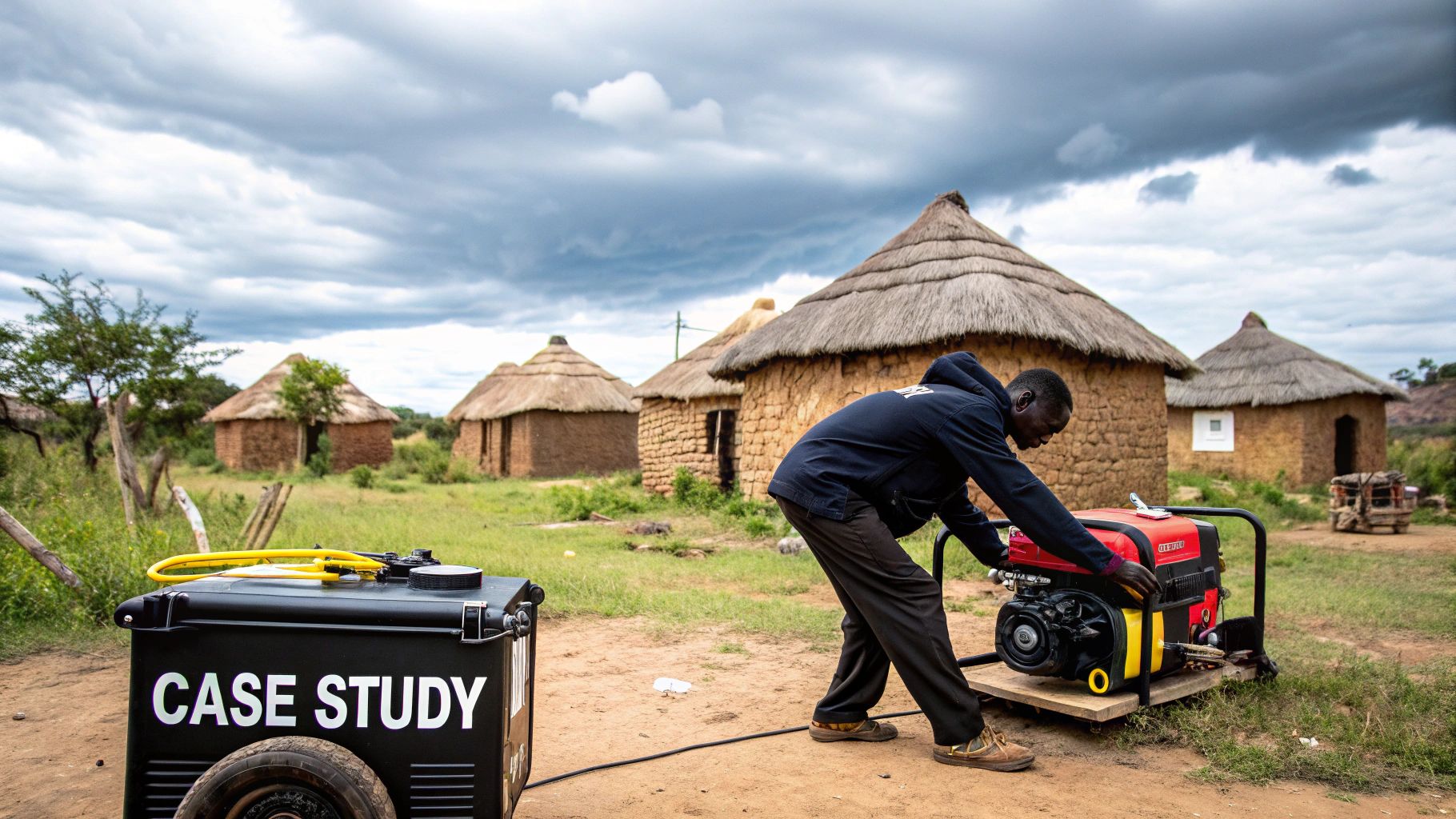
When we talk about mobile energy, we're looking at something much bigger than just a temporary power source. This is a fundamental change in how businesses approach their energy needs, bringing serious advantages that touch everything from the budget to your ability to stay online during an outage.
Let's break down the benefits into three key areas: financial, environmental, and operational. When you see them all together, the true value really clicks.
These systems aren't just a quiet replacement for old diesel generators; they open up new ways to be efficient and dependable. The market is exploding for a reason—the global Mobile Energy Storage System (MESS) market is on track to hit an incredible USD 68.88 billion by 2035, with a 26% annual growth rate. A huge part of this is driven by renewables, where roughly 55% of solar and 45% of wind projects now use mobile storage to keep the grid stable. You can read the full research on mobile energy storage growth for a deeper dive into this rapid expansion.
Financial Gains and Cost Reductions
One of the most persuasive reasons to go mobile is the immediate impact on your finances. We all know diesel generators are fuel-hungry and need constant attention, leaving businesses exposed to unpredictable fuel prices and high labor costs. Mobile energy systems, especially battery-based ones, take a big bite out of those expenses.
Think about it: you can charge the unit using cheap, off-peak grid power or even free solar energy. Right there, your "fuel" costs plummet. Plus, with far fewer moving parts, the maintenance is a breeze compared to the constant oil changes and filter swaps that diesel engines demand. That one-two punch of lower fuel and upkeep costs adds up to major long-term savings.
But it’s not just about saving money. These systems can actually make you money. Utilities often deploy them for grid support services, like managing frequency or shaving peak demand, earning revenue while also making the grid more reliable for everyone.
Environmental and Community Benefits
The positive environmental impact is just as compelling. Mobile energy storage produces zero on-site emissions. That means no more spewing out harmful pollutants like carbon monoxide and nitrogen oxides, which is essential when you're working in populated areas, near fragile ecosystems, or on a job with tough environmental regulations.
And then there's the noise—or lack thereof. These systems are whisper-quiet. Unlike the constant drone of a diesel generator, their silent operation makes them perfect for:
- Events and Film Sets: Where background noise is a deal-breaker.
- Residential Areas: You can power a construction site or handle an outage without disrupting the entire neighborhood.
- Disaster Relief: In a chaotic situation, the last thing anyone needs is more noise and stress.
By pairing so well with renewables, these systems are also helping us move toward cleaner energy. They solve the classic "intermittency" problem by storing solar or wind power when it’s plentiful and dishing it out when it's not, making green energy a much more practical and reliable option.
Enhanced Operational Performance
From a day-to-day operational standpoint, mobile energy solutions give you a level of agility you just can't get anywhere else. Their plug-and-play design means you can get them up and running incredibly fast—often in just a few hours. That kind of rapid deployment is a game-changer for emergency response, planned maintenance, or any project on a tight schedule.
This flexibility also means you can scale your power up or down on the fly, without sinking money into permanent infrastructure. A construction project can bring in more units as it expands, or a festival can rent the exact amount of power it needs for the weekend.
Most importantly, these systems are a powerful tool for energy resilience. For any business that loses money or productivity during an outage, having a mobile unit ready to go is a lifeline. It's the reliable backup that keeps the lights—and your business—on when the grid lets you down.
How to Choose the Right Mobile Energy System
Choosing the right mobile energy system isn't a one-size-fits-all decision. A setup that’s perfect for a weekend food truck festival would be totally inadequate for a remote construction project. The key is to get a really clear picture of your specific power demands before you start shopping.
The goal here is simple: match the system's capabilities to your operational needs. This helps you sidestep the two most common and costly pitfalls—oversizing your unit and paying for power you don't need, or undersizing it and dealing with constant shutdowns and delays.
Assess Your Power and Energy Needs
First things first, you need to nail down your power capacity and total energy requirements. They sound similar, but they tell you two very different things about what your operation needs to run smoothly.
- Power Capacity (kW): Think of this as the maximum electrical muscle you need at any given moment. How many tools, lights, or machines will you be running all at once? Just add up the wattage of all your equipment to figure out your peak power draw.
- Energy Storage (kWh): This is all about endurance—how long you can keep everything running. It’s the size of your system's "gas tank." An eight-hour construction shift requires a much bigger tank (more kWh) than a short, four-hour event.
You have to look at your load profile. Are you powering a few lights and a command trailer with a steady, low draw? Or do you need massive, short bursts of power to kickstart heavy-duty equipment like welders or air compressors? Answering that question is crucial for finding a system with the right balance of power and storage.
Consider Portability and Charging Sources
Next up, let's talk logistics. How are you getting this thing to your site, and how are you going to keep it juiced up?
Portability is a huge factor. A project squeezed into a tight urban lot might only have room for a smaller, trailer-mounted unit. A sprawling industrial site, on the other hand, could easily handle a full containerized system. The more remote and rugged the location, the more critical portability becomes.
Your charging strategy is just as important. Do you have access to the grid to top off the battery during cheap, off-peak hours? Or are you completely off-grid and relying on solar panels or a backup generator to recharge?
Your choice of mobile energy system should align perfectly with your available charging infrastructure. Planning this from the start ensures you have a sustainable power source for the entire duration of your project.
Ultimately, understanding all your options, including the best portable generators, is essential for keeping your project powered. By clearly defining your needs for power, portability, and charging, you can confidently pick a system that’s sized and configured to get the job done right.
Common Questions About Mobile Energy Solutions
When you start digging into mobile energy, the big-picture benefits are clear, but the practical, on-the-ground questions always follow. How fast can I get one running? Is it really safer than my old diesel generator? What happens if my power needs grow?
Let's clear up some of those common questions with straightforward answers.
How Quickly Can a System Be Deployed?
Speed is where these systems truly shine. Forget the weeks or months of planning and construction that permanent power infrastructure requires. We’re talking about getting power online in a matter of hours, not days.
A standard trailer-mounted unit can often be delivered, hooked up, and running in under an hour. For the larger, container-sized systems, you're still typically looking at just a few hours from arrival to full operation. That rapid response is a game-changer for emergency situations or any project where downtime is a budget-killer.
Are Mobile Energy Solutions Safer Than Diesel Generators?
Yes, and the difference is significant. Because these are battery-powered systems, they get rid of some of the biggest hazards associated with traditional generators. There are no toxic fumes, which completely removes the danger of carbon monoxide in confined spaces.
They also run virtually silent. That’s a huge plus for worker safety on a noisy job site, and it keeps things quiet for nearby homes or during public events.
The safety features go beyond just eliminating fumes and noise. Every modern mobile energy unit is equipped with a sophisticated Battery Management System (BMS). This is the onboard brain that continuously monitors everything—temperature, voltage, current—to stop problems like overheating before they can start.
Can Multiple Units Be Combined for More Power?
Absolutely. Scalability is baked right into their design. Most mobile energy systems are built to be modular, meaning you can easily link multiple units together to increase your power capacity.
This feature is incredibly practical in a few common situations:
- Growing Projects: As a construction site moves through different phases, you can add another unit to meet increasing power demands.
- Large-Scale Events: Planners can rent the precise number of units they need to handle peak loads without paying for excess capacity.
- Redundancy: For critical operations, running multiple units in parallel ensures that if one goes down for maintenance, the power stays on.
What Is the Typical Lifespan?
The lifespan really comes down to the batteries inside. The high-quality lithium-ion batteries found in today's systems are built for the long haul and are usually rated for thousands of charge cycles.
In the real world, this translates to a service life of 10 to 15 years—sometimes even longer. Of course, this depends on how it’s used, the operating environment, and whether it's maintained properly.
For temporary natural gas needs during construction or maintenance, Blue Gas Express delivers reliable mobile CNG and LNG solutions to keep your project on schedule. Discover our rapid deployment services at https://bluegasexpress.com.