

At its core, a methane gas compressor is a machine built to do one thing really well: increase the pressure of methane gas by reducing its volume. Think of it like packing a suitcase for a long trip. You have to squeeze everything in to make it fit, and in doing so, you can carry a lot more in the same space. These machines are the quiet workhorses of the entire natural gas supply chain.
The Role of Compression in Our Energy System

The fundamental challenge with methane—the main ingredient in natural gas—is that it’s abundant but not very dense. In its natural state, it takes up a huge amount of space. This makes it incredibly inefficient to move from a production well to the homes and businesses that rely on it. This is exactly where a methane gas compressor becomes essential.
By boosting the pressure, compressors force methane molecules much closer together. This simple physical change is what makes our modern natural gas infrastructure possible. Without compression, the massive network of pipelines crisscrossing the country simply couldn't transport enough gas to meet demand.
Why Is Reducing Volume So Important?
Imagine trying to move a mountain of feathers using nothing but small buckets. You wouldn't get very far, very fast. Compressing methane is the equivalent of bundling those feathers into tight, dense, and manageable bales.
This densification achieves several critical goals:
- Pipeline Transportation: Gas needs a push to travel long distances. Compressors act like booster stations along the pipeline, keeping the pressure up and ensuring the gas keeps flowing from remote fields to cities.
- Efficient Storage: Creating compressed natural gas (CNG) or liquefied natural gas (LNG) allows us to store immense amounts of energy in a tiny fraction of the original volume. This is crucial for fueling vehicles and meeting energy demands during peak times.
- Industrial Applications: Countless industrial processes, from generating electricity to manufacturing goods, require natural gas to be delivered at specific high pressures. Only compressors can meet these requirements.
To see how these jobs fit together, this table breaks down the core functions of methane compression.
Core Functions of Methane Compression at a Glance
| Function | Primary Purpose | Key Benefit |
|---|---|---|
| Pipeline Transport | Overcome friction and maintain flow over long distances. | Enables the efficient and large-scale delivery of natural gas from source to market. |
| Gas Storage | Significantly reduce the volume of methane for storage. | Allows for stockpiling energy in the form of CNG or LNG for peak demand or vehicle use. |
| Gas Gathering | Collect low-pressure gas from multiple wellheads and boost its pressure. | Consolidates raw natural gas for entry into processing plants or main transmission lines. |
| Gas Injection | Force gas back into underground reservoirs. | Enhances oil recovery from aging wells or provides a long-term storage solution. |
| Vapor Recovery | Capture and compress low-pressure gas vapors that would otherwise be vented. | Prevents waste, increases saleable product, and reduces harmful emissions. |
This table highlights just how versatile and indispensable these machines are at every step of the natural gas journey.
Capturing a Valuable Resource
Beyond simply moving energy, methane gas compressors play a huge role in environmental stewardship. Methane is a potent greenhouse gas, so capturing it from sources like landfills or agricultural operations is critical to prevent it from escaping into the atmosphere. To truly grasp the scale of the issue, it’s worth understanding how waste management and climate change are intrinsically linked.
A recent study revealed that smaller, dispersed sources are responsible for a staggering 70% of total methane emissions from U.S. oil and gas activities.
Capturing and compressing this fugitive gas isn't just an economic opportunity—it's an environmental imperative. By using compressors to capture this "biogas," we can transform a potential climate liability into a valuable asset known as renewable natural gas (RNG), which can then be used to power communities and significantly lower our carbon footprint.
Decoding the Three Main Compressor Types
When you're dealing with methane gas, not all compressors are created equal. The right tool for the job depends entirely on what you're trying to accomplish, and in the world of gas compression, there are three main designs that do most of the heavy lifting.
Getting a handle on these core types—reciprocating, centrifugal, and rotary screw—is the first real step in matching the right machine to your project. Let's break down how each one works, using some simple analogies to get past the complex engineering jargon.
The Reciprocating Compressor: A Powerful Piston
Think of a reciprocating compressor as a bicycle pump, but built for an industrial-scale job. It works on a simple principle called positive displacement. A piston moves back and forth inside a cylinder, pulling in methane, trapping it, and then squeezing it down.
Every stroke of that piston forces the methane into a smaller space, which cranks up the pressure—just like each push on a bike pump handle crams more air into the tire. This design is fantastic at hitting extremely high pressures, making it the go-to choice when you need brute force more than massive volume.
Here's what makes them stand out:
- High-Pressure Capability: These are the champions of high-pressure work, often pushing well past 1,000 psi (pounds per square inch).
- Variable Flow Rates: You can precisely control the output by adjusting the piston speed, giving you a lot of flexibility on the fly.
- Efficiency at High Ratios: They work very efficiently when there's a huge difference between the starting pressure and the final pressure.
That's why you’ll find them doing tough jobs like injecting gas deep into underground storage wells or pushing it into high-pressure transmission pipelines that stretch for hundreds of miles.
The Centrifugal Compressor: A High-Speed Fan
Now, switch gears and picture a powerful fan spinning at incredible speeds inside a sealed case. That's the basic idea behind a centrifugal compressor. It uses a rapidly rotating impeller to literally sling methane gas outward, converting raw speed into pressure.
As the gas gets thrown to the outer edge of the casing, it naturally slows down and its pressure builds. This method is perfect for moving enormous quantities of gas at more moderate pressure levels. It's less about force and more about achieving a high-volume, continuous flow.
Key Takeaway: Centrifugal compressors are the workhorses for huge operations. They're prized for their ability to handle massive flow rates, which is why they dominate at LNG (liquefied natural gas) plants, large processing facilities, and major pipeline booster stations.
Because they operate so smoothly and continuously, they don't create the "pulsing" effect in the gas line that a reciprocating unit does. This makes them a much more stable choice for systems that can't handle a lot of vibration.
The demand for these machines is exploding right alongside our use of natural gas. The global natural gas compressor market, which is the heart of methane handling, was valued at around USD 5.2 billion and is expected to hit USD 7.8 billion, growing at a rate of 4.1% each year. A big driver is the boom in shale gas production, especially in North America, where upstream operations alone accounted for a USD 2.2 billion market share. These compressors are essential for moving methane from the wellhead, through the pipeline network, and into storage. You can dive deeper into these market trends and what’s driving them in the full report.
The Rotary Screw Compressor: An Interlocking Squeeze
Our third major type is the rotary screw compressor. Imagine two big, interlocking corkscrews—engineers call them rotors—spinning toward each other inside a very tight housing. As they turn, they pull methane gas into the spaces between their helical lobes.
As the rotors keep spinning, the pockets of trapped gas are forced down the length of the screws into progressively smaller spaces. This compresses the gas before it exits at the outlet. It’s another form of positive displacement, but one that provides a steady, non-pulsating flow, combining some of the best features of the other two types.
What people love about rotary screw compressors:
- Continuous Flow: Just like a centrifugal unit, they deliver a smooth, pulse-free stream of gas.
- Compact Design: They often take up less space than a reciprocating compressor with a similar output.
- Lower Maintenance: With fewer moving parts than their piston-driven cousins, they generally mean less downtime and fewer repairs.
This blend of features makes them incredibly versatile. You'll see them all over the place, from gas gathering systems at the wellsite to vapor recovery units and as fuel gas boosters for power turbines.
Comparing Reciprocating Centrifugal and Rotary Screw Compressors
To make the choice clearer, it helps to see these three technologies side-by-side. Each one has a distinct personality and is cut out for different kinds of work.
| Compressor Type | Operating Principle | Best For | Pros | Cons |
|---|---|---|---|---|
| Reciprocating | Positive displacement via piston | High-pressure, low-to-medium flow | Achieves very high pressures; highly efficient; flexible flow control | Pulsating flow; higher maintenance needs; larger footprint |
| Centrifugal | Dynamic displacement via impeller | High-volume, low-to-medium pressure | Handles massive flow rates; continuous, smooth flow; high reliability | Less efficient at low flows; limited pressure ratio per stage |
| Rotary Screw | Positive displacement via rotors | Medium pressure and flow | Smooth, pulse-free flow; compact and reliable; lower maintenance | Lower maximum pressure than reciprocating; efficiency can drop at part-load |
Ultimately, choosing the right compressor isn't just about picking one off a list. It’s about understanding the specific demands of your operation—the pressure you need, the volume you have to move, and even the makeup of the gas itself. A reciprocating compressor excels at creating intense pressure, a centrifugal model is a master of high volume, and a rotary screw offers a fantastic, balanced performance for a huge range of tasks.
Anatomy of a Methane Gas Compressor
To really get a feel for how a methane gas compressor works, you have to look under the hood. These machines can look intimidating, but they’re built from a handful of core parts working together in perfect sync. The easiest way to think about it is like a living organism, where every part has a specific, vital job to do.
The Heart of the Machine: The Prime Mover
Everything starts with the prime mover. This is the power source, the heart of the entire operation. It supplies the raw mechanical energy needed to drive the compression process. Without a strong heart, the system is dead in the water.
You'll typically find one of two types powering a compressor:
- Electric Motor: These are the clean, quiet, and reliable workhorses. You’ll see them in stationary setups like processing plants or pipeline stations where there's a steady supply of electricity.
- Natural Gas Engine: Out in the field, like at a remote wellhead or on a mobile compression unit, a natural gas engine is the go-to. It siphons off a tiny fraction of the gas it's compressing for fuel, making the whole unit self-sufficient.
This power source is the first link in a chain of carefully engineered components, each one critical for handling methane safely and effectively.
The Lungs: The Compression Powerhouse
Once the prime mover generates the power, that energy has to be transferred to the components that do the actual squeezing. These are the lungs of the operation, breathing in low-pressure methane and exhaling it at a much higher pressure. The exact parts doing the heavy lifting depend on the compressor type.
In a reciprocating compressor, the work is done by a crankshaft, connecting rods, and pistons—just like in your car's engine. The prime mover turns the crankshaft, which pushes the pistons back and forth inside cylinders, methodically drawing in and compressing the gas with each stroke.
For a centrifugal compressor, the power spins a finely balanced impeller at mind-boggling speeds. This impeller acts like a high-tech slingshot, flinging gas molecules outward to convert their speed into pressure.
And in a rotary screw compressor, the prime mover turns a pair of tightly meshed, spiral rotors. As they spin, they trap pockets of methane between their grooves, forcing the gas into a smaller and smaller space until it reaches the target pressure in a smooth, continuous flow.
No matter the specific design, the objective is always the same: to mechanically shrink the volume that methane occupies. This simple action is what increases its pressure and energy density, making it possible to store and transport natural gas efficiently.
The Brains and Nerves: The Control System
A powerful machine like this can't just run wild. It needs a sophisticated control system to operate safely and efficiently—this is the compressor's brain and central nervous system. It's constantly monitoring what's happening and making adjustments on the fly.
This "brain" is really a network of sensors, valves, and controllers that keep an eye on every part of the operation.
Its key jobs include:
- Monitoring Pressures and Temperatures: Sensors are placed at the inlet and outlet to make sure the machine is operating within its designed limits. No surprises.
- Regulating Flow Rate: The control system can tweak the prime mover's speed or adjust valves to perfectly match the compressor's output with what the pipeline or storage tank needs.
- Automated Shutdowns: This is the most critical function. If a sensor detects a dangerous condition—like pressure spiking, temperatures getting too high, or a gas leak—the system immediately triggers an emergency shutdown (ESD) to prevent a disaster.
This intelligent oversight is what turns a piece of powerful, brute-force machinery into a safe and reliable industrial tool, especially when you're dealing with a flammable gas like methane.
Essential Support Systems
Finally, a few other systems work in the background to keep the core components safe and running for the long haul. Think of them as the circulatory and skeletal systems that prevent breakdowns.
First up is the lubrication system. This is non-negotiable. It constantly pumps oil to critical moving parts like bearings, pistons, and gears to cut down on friction, heat, and wear. Without it, the incredible forces and speeds would cause the machine to grind to a halt in minutes.
Just as important are the sealing systems. These are specialized gaskets, packings, and mechanical seals designed with one purpose: to keep the methane inside the compressor. Since methane is both a valuable product and a potent greenhouse gas, keeping it from leaking is crucial for efficiency, safety, and environmental responsibility.
Lastly, you have the cooling system. The act of compressing gas generates a massive amount of heat. If you've ever felt a bike pump get hot, you've experienced this firsthand. Coolers, which often use fans or liquid coolant, pull this heat away to protect the equipment and keep the gas at a manageable temperature for its journey downstream.
Choosing the Right Methane Compressor for Your Needs
Picking the right methane gas compressor isn't just a simple purchase—it's a critical investment that directly impacts your project's efficiency, long-term costs, and safety. Get it wrong, and you're stuck with an oversized unit guzzling energy or an undersized one that can't keep up, leading to expensive downtime. It's a decision with real consequences.
To sidestep these pitfalls, you need a solid framework. This isn't about passing a technical exam; it's about methodically matching a compressor’s strengths to the specific demands of your operation. It all comes down to asking the right questions before you commit.
The stakes are high, and the market shows just how much precision matters. The global gas compressors market, which includes methane compressors, was valued at around USD 6.3 billion and is expected to climb to nearly USD 9.5 billion, growing at a 4.3% CAGR. This isn't surprising, given the rising demand for natural gas and massive infrastructure projects like LNG terminals and pipelines. You can get more insights on this expanding market from PR Newswire.
Key Performance Metrics to Define
Before you even start looking at different models, you have to define your operational goalposts. These are the non-negotiable performance numbers that will immediately narrow down your options. Nailing these metrics is the single most important step in the entire process.
Start with two fundamentals:
Required Flow Rate (Capacity): How much gas do you need to move, and how fast? This is usually measured in standard cubic feet per minute (SCFM) or million standard cubic feet per day (MMSCFD). This number dictates the raw size and throughput of the compressor you'll need.
Pressure Requirements (Inlet and Discharge): What’s the gas pressure coming in (suction), and what does it need to be going out (discharge)? The gap between these two figures—the compression ratio—is a huge clue as to whether you should be looking at a reciprocating, centrifugal, or rotary screw compressor.
For example, a really high compression ratio often screams for a reciprocating compressor, as they are champs at creating big pressure jumps. On the other hand, if you need to move a massive volume of gas with just a moderate pressure boost, a centrifugal compressor is probably your best bet.
Analyzing Your Methane Gas Stream
Here’s a reality check: not all methane is the same. The specific makeup of your gas stream can dramatically affect a compressor's performance and how long it lasts. Overlooking these details is a recipe for premature equipment failure and serious safety risks.
You need to know what you’re working with:
- Presence of Corrosive Compounds: Does the gas contain "sour" elements like hydrogen sulfide (H2S) or high levels of carbon dioxide (CO2)? When mixed with moisture, these can form acids that eat away at internal parts. If so, you'll need a unit built with special materials or coatings.
- Moisture Content: Dealing with "wet" gas that has water vapor or hydrocarbon liquids? You’ll need a compressor designed to handle that, plus upstream equipment like scrubbers or knockout drums to separate the liquids first.
- Particulate Matter: Is there any chance of sand, scale, or other gunk in the gas stream? Proper filtration is non-negotiable to protect sensitive components like pistons, cylinders, and impellers from abrasive damage.
This infographic gives you a great visual breakdown of a methane compressor’s core systems, showing how the power, compression, and control elements all have to sync up.
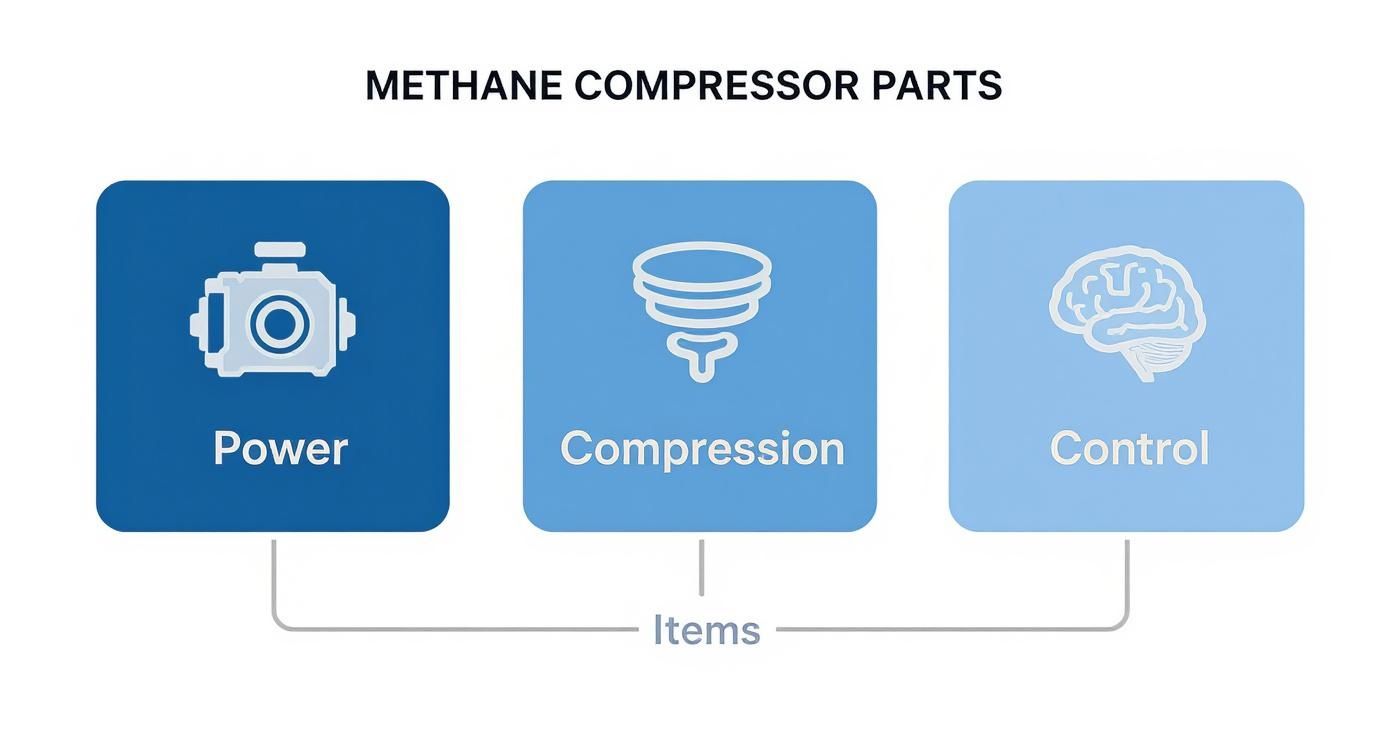
As the visual shows, every component—from the engine providing the muscle to the control unit acting as the brain—has to be perfectly matched to the job at hand for everything to run smoothly.
Matching Compressor to Environment and Application
Finally, where and how the compressor will operate are just as important as the gas it’s pushing. The environment and application add a final, crucial layer to your decision-making.
A compressor destined for an offshore platform has vastly different design requirements than one used for a temporary pipeline outage. The former needs extreme corrosion resistance and a compact footprint, while the latter prioritizes mobility and rapid deployment.
Think through these practical factors:
- Location and Footprint: Is space tight? A rotary screw or centrifugal compressor can often pack more punch into a smaller package than a big reciprocating unit.
- Power Source Availability: Do you have a reliable electrical grid for an electric motor, or do you need a self-contained natural gas engine that can run anywhere?
- Duty Cycle: Is this compressor going to be running 24/7, or will it be used intermittently? The answer impacts the design needed for long-term durability and maintenance scheduling.
- Regulatory Requirements: Are there local noise ordinances or strict emissions standards (like fugitive methane limits) you have to comply with?
By working through these questions—from performance specs and gas quality to the operating environment—you build a detailed profile of the exact compressor you need. This structured approach takes the guesswork out of the equation and puts you on a path to a smart, informed decision that ensures safety, efficiency, and reliability for years to come.
Mastering Compressor Safety and Maintenance
When you're dealing with a volatile substance like methane, safety isn't just a best practice—it's the absolute bedrock of your operation. A methane gas compressor is a serious piece of industrial machinery. The difference between a reliable, long-lasting asset and a catastrophic failure often comes down to a disciplined approach to its care. Getting safety and maintenance right protects your crew, your equipment, and your entire project.
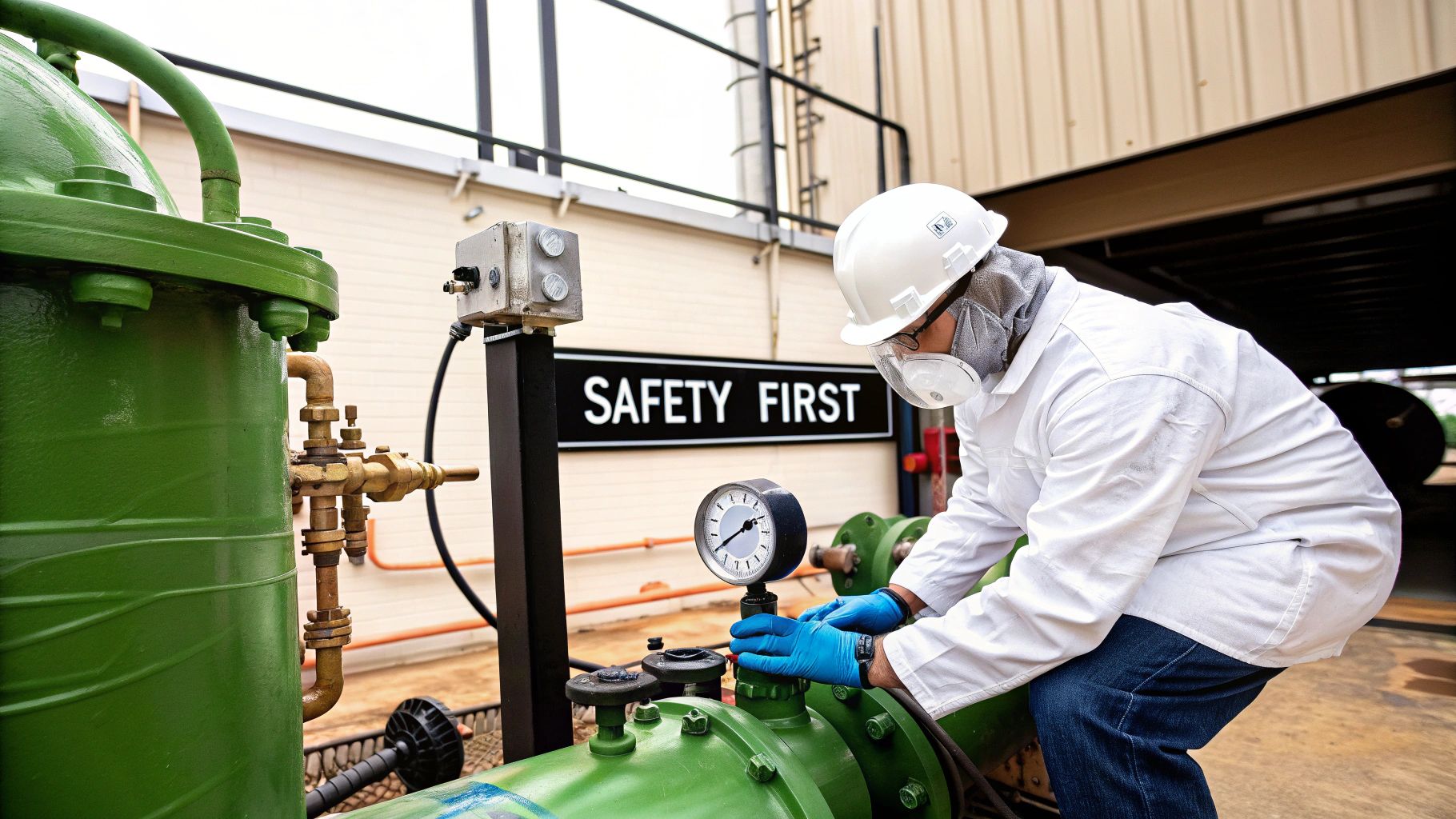
This all starts with a deep respect for the non-negotiable safety systems built into every modern compressor. These aren't just fancy add-ons; they're essential guardrails. Think of them as the machine's own reflexes, designed to react instantly to trouble long before a human operator could even notice something is wrong.
Core Safety Systems You Must Know
Three key systems form the foundation of compressor safety. Each one tackles a different potential hazard, and together, they create a multi-layered defense.
- Emergency Shutdown (ESD) Devices: This is the big red button, in both a literal and figurative sense. The ESD system is a smart network of sensors that keeps a constant watch on vital signs like pressure, temperature, and vibration. If any of those readings spike into the danger zone, the system slams the brakes, shutting the entire unit down instantly to prevent damage or a dangerous gas leak.
- Pressure Relief Valves (PRVs): Think of these as the simple, bulletproof fail-safes. If pressure inside a pipe or vessel builds up beyond a pre-set limit, the PRV automatically pops open to vent the excess gas to a safe location. It's the ultimate line of defense against over-pressurization, a condition that could otherwise cause a rupture.
- Gas Detection Sensors: Methane is naturally colorless and odorless, which makes a leak totally invisible to human senses. Gas detectors act like a tireless electronic nose, constantly sniffing the air. If they detect even a trace amount of methane, they'll sound alarms and can even trigger an automatic shutdown, ensuring a rapid response to a potentially explosive hazard.
Safety is paramount, and it guides everything we do. This is a core principle echoed by industry leaders like the Interstate Natural Gas Association of America (INGAA), who emphasize that safety underpins the secure and reliable transportation of natural gas across the nation.
Building a Preventative Maintenance Schedule
The single best way to extend the life of your equipment is with a proactive maintenance plan. Instead of reacting to breakdowns, a preventative schedule lets you catch and fix small issues before they snowball into major downtime. A simple checklist, broken down by how often you do it, makes sure nothing ever falls through the cracks.
Daily Checks (Pre-Startup):
- Fluid Levels: First thing's first. Check that the engine oil, compressor lubricant, and coolant are all topped off and within their recommended ranges.
- Visual Inspection: Do a quick walk-around. Look for any drips, loose connections, frayed wires, or other obvious signs of wear and tear.
- Control Panel: Glance at the gauges. Make sure everything is reading normally and that there are no active fault codes on the screen.
Weekly Inspections:
- Cleanliness: A clean compressor skid isn't just for looks. It makes spotting fresh leaks much easier and helps prevent fire hazards from building up.
- Filter Checks: Take a look at the intake air filters and their differential pressure gauges. Clogged filters make the machine work harder than it has to.
- Belt Tension: For any belt-driven components, check the belts for proper tension and look for any cracking or fraying.
Monthly and Quarterly Routines:
- Vibration Analysis: This is a bit more advanced, but using monitoring tools to track vibration patterns can give you an early warning about failing bearings or misalignment.
- Seal Checks: Carefully inspect all seals and gaskets for the slightest sign of leakage, paying special attention to any high-pressure connections.
- Safety System Tests: This is crucial. You have to periodically function-test all shutdown sensors and alarms to verify they're working correctly. It’s not just good for peace of mind; it's often a regulatory requirement.
By committing to a disciplined maintenance routine, you turn upkeep from a chore into a strategic advantage. You ensure your methane gas compressor runs safely, reliably, and efficiently for years to come.
Where Methane Gas Compression is Headed
The world of gas compression is changing fast. For years, the game was all about more power and higher pressure. Now, the next generation of methane compressors is focused on something different: becoming smarter, more efficient, and a whole lot better for the environment. These machines are evolving from simple, standalone workhorses into intelligent, connected systems that are absolutely vital to the global shift in energy.
This evolution is really being pushed by a marriage of digital technology and some seriously advanced engineering. Think of Internet of Things (IoT) sensors as the new eyes and ears for modern compressors. They provide a constant, real-time feed of data on everything—vibration, temperature, pressure swings, you name it. This firehose of information makes predictive maintenance a reality, letting us spot potential problems long before they cause expensive shutdowns.
Smarter Guts and Greener Designs
Artificial intelligence (AI) and machine learning are taking that data and putting it to work. AI algorithms can dig through performance trends to fine-tune fuel consumption and flow rates, essentially squeezing every last drop of efficiency out of each cubic foot of gas.
At the same time, we're seeing the rise of the digital twin. This is a perfect virtual copy of a physical compressor. Engineers can use this digital model to run endless simulations, test out new operating settings, and even train technicians—all without any real-world risk.
This wave of innovation is bringing real, measurable benefits:
- Slashing Emissions: New materials and dramatically improved seal designs are making a huge dent in fugitive methane emissions, which has been a major goal for the industry.
- Ready for Hydrogen: Forward-thinking designs are already being built to handle blends of hydrogen and natural gas. This is about future-proofing these critical machines for the energy mix of tomorrow.
To get a feel for how methane compression fits into the bigger picture of sustainability, it’s worth checking out resources on the future of renewable energy farming, where capturing and compressing biogas is becoming a critical process.
The market is definitely feeling this momentum. The global process gas compressor market, which is where methane compressors live, was valued at USD 6.30 billion and is expected to climb to USD 10.3 billion, growing at a 5.7% CAGR. That growth is being driven by the global push for cleaner energy and the adoption of tech like AI and IoT to make these machines safer and more reliable. You can find more details about this market growth on custommarketinsights.com.
Ultimately, these advancements mean methane compressors aren't just tools for today—they're becoming foundational pieces of a cleaner energy future.
Answering Your Questions About Methane Compressors
We've covered a lot of ground, from how these machines work to what makes them tick. Naturally, that brings up some practical questions. Let's dive into some of the most common things people ask, clearing up the details to help you connect the theory to what happens out in the field.
How Is Compressing Methane Different From Compressing Air?
You might think gas is gas, but compressing methane is a whole different ballgame than compressing the air we breathe. It really boils down to two things: safety and what the gas itself does to the equipment.
Methane is flammable, so there's zero room for error. Every single part of the compressor, especially the electrical components and seals, has to be explosion-proof or intrinsically safe. This isn’t a nice-to-have; it's a fundamental design requirement to prevent a stray spark from causing a disaster.
Then there's the gas itself. Methane pulled from the ground is rarely pure. It often carries corrosive hitchhikers like hydrogen sulfide (H2S), which will eat away at the standard metals you'd find in a typical air compressor. A purpose-built methane gas compressor uses special corrosion-resistant alloys and heavy-duty seals to handle these impurities and stop dangerous leaks before they start.
Does the Gas Mix Really Matter When Choosing a Compressor?
Absolutely. In fact, it's one of the most critical factors. You can't just look at pressure and flow rate specs and call it a day; you have to know exactly what's in the gas. If you're dealing with a "sour" gas stream loaded with H2S, you'll need a machine built with stainless steel or other tough alloys to keep it from corroding from the inside out.
Key Takeaway: Turning a blind eye to your methane's composition is a recipe for expensive problems. Things like moisture, CO2, or heavier hydrocarbons will dictate everything from the materials and filtration needed to the right kind of lubricant for the job.
The specific mix of gases also changes the overall density and heat properties of the stream. Engineers have to run the numbers on this to size the compressor correctly and make sure it will perform as expected. Get it wrong, and you'll end up with a machine that constantly struggles to keep up.
What Are the First Red Flags of Compressor Failure?
Knowing what to look for can be the difference between a simple repair and a complete shutdown. An experienced operator develops a feel for their machine and can spot trouble long before it becomes catastrophic. You just have to know what to listen and look for.
Here are the classic early warning signs that a compressor is asking for help:
- Strange Noises: You know what your machine sounds like day-to-day. If you suddenly hear knocking, grinding, or a new high-pitched whine, that’s an immediate red flag. It could be anything from a failing bearing to a piston issue.
- More Shaking: All compressors vibrate, but a sudden increase or change in that vibration is a bad sign. It often points to a problem with alignment or an imbalance in the rotating parts.
- Getting Hotter: Keep an eye on the gauges. If the gas, oil, or coolant temperatures start creeping up and staying high, it’s a classic symptom of poor lubrication or excessive internal friction.
- Tripping Off: If the compressor’s safety systems are suddenly shutting it down more often, don't just reset it and walk away. The machine is telling you that something is consistently pushing past safe limits, and you need to find out why.
When a new gas line is delayed or a planned utility outage is on the calendar, you can't just put your operation on pause. Blue Gas Express is here to bridge the gap with mobile, temporary CNG and LNG solutions that keep you running. We specialize in rapid deployment across the Carolinas, Tennessee, and Virginia, making sure you get the energy you need, right when you need it. Don't let a gas interruption derail your project. Learn how we deliver a seamless energy supply.