

A hot tapping split tee is a specialized, two-part fitting engineered to clamp around a live, pressurized pipeline. Its purpose is to create a secure branch connection without ever shutting down the flow of gas or liquid inside. This fitting is the heart of the hot tapping process—think of it as keyhole surgery for active pipes. It allows for modifications, repairs, or tie-ins while the system stays completely online.
The Critical Role of Hot Tapping in Modern Infrastructure
Imagine needing to add a new gas line to a power plant or a water connection to a hospital. The old way meant shutting everything down. This would bring critical services to a halt, stop production, and rack up massive downtime costs. Hot tapping completely changes the game, letting crews work on live systems safely and efficiently.
Central to this whole operation is the hot tapping split tee. This isn't your standard, off-the-shelf plumbing part. It’s a custom-fabricated fitting built to the exact specifications of the host pipe. It arrives in two precisely engineered halves that are bolted and then welded directly onto the active pipeline, creating a new, permanently sealed branch outlet.
Process Versus Component
It’s easy to confuse the terms, but it helps to think of it as the method versus the hardware.
- Hot Tapping: This is the process of drilling or cutting into a live pipeline, vessel, or tank. The entire procedure is done under full operating pressure, without interrupting the flow of product.
- Split Tee: This is the component that makes hot tapping possible. It acts as a pressure-containing housing and provides a flanged outlet where a new valve and the tapping machine are mounted.
Here’s a simple analogy: if hot tapping is the surgery, the split tee is the sterile, sealed entry port. It allows the surgeon (the tapping machine) to safely access the patient (the pipeline) without any leaks or system failure. This approach creates a fully controlled environment, ensuring no gas or fluid escapes.
By eliminating the need for system shutdowns, hot tapping not only saves immense amounts of time and money but also prevents the environmental impact associated with venting or draining pipelines, particularly in the natural gas industry.
Why Choose Hot Tapping Over a Shutdown?
So, why go through the trouble of hot tapping instead of just shutting the line down? It really comes down to a clear-headed assessment of cost, risk, and operational continuity. While the specialized equipment and expertise for hot tapping require an upfront investment, the long-term benefits are undeniable, especially for industries where uptime is everything.
Let's break down the real-world differences.
Pipeline Modification Methods Compared
This table gives a quick snapshot of how the two approaches stack up.
| Factor | Traditional Shutdown | Hot Tapping with Split Tee |
|---|---|---|
| Service Interruption | Complete shutdown required | Zero interruption to service |
| Downtime | Hours, days, or even weeks | Minimal to none |
| Product Loss | Significant loss from draining/venting | No product loss |
| Operational Cost | High (lost revenue, labor) | Reduced operational cost |
| Environmental Impact | Potential for emissions/spills | Minimal environmental impact |
| Safety | Risks associated with depressurizing | Contained and highly controlled |
Ultimately, the ability to perform maintenance, add new connections, or install equipment without interrupting service is invaluable. Hot tapping isn’t just a clever technique; it’s a smarter, safer, and more efficient way to manage our most vital infrastructure.
How Split Tees Make Live Pipeline Connections Possible
A hot tapping split tee is the key that unlocks a high-stakes procedure, turning it into a controlled, predictable engineering task. It's what allows a crew to add a brand-new branch to a live pipeline—all without shutting down service, losing product, or risking the integrity of the system.
Think of it like building a secure, sealed antechamber around the pipe before you even think about making a cut. The whole process is methodical, with each step building on the last. When it's done, you have a new, fully operational connection point that's just as strong as the original pipeline. Let's walk through how it works.
Step 1: Installing the Split Tee Fitting
It all starts with the hot tapping split tee itself. This fitting is custom-made to the exact specs of the host pipe and arrives in two halves. First, technicians get to work meticulously cleaning and prepping the surface of the live pipe right where the new connection will go.
The two halves of the tee are then carefully positioned to clamp perfectly around the pipe. Once everything is aligned, they’re bolted together and then welded directly to the pipeline. This welding is one of the most critical parts of the job; it creates a rock-solid, pressure-containing seal that essentially becomes part of the pipe's structure. What you're left with is a secure housing with a flanged outlet, all set for the next phase.
Step 2: Mounting the Valve and Tapping Machine
With the split tee welded firmly in place, it's time to add the full-bore valve. This valve gets bolted straight onto the flange of the tee's branch outlet. It’s the gatekeeper, giving the team a crucial layer of control for the rest of the operation. For now, it stays closed.
Next up is the hot tapping machine, which is mounted right onto that closed valve. This specialized rig is basically a high-powered, completely sealed drill press. It has a long boring bar equipped with a pilot drill and a circular cutter designed to chew through the pipe wall. The whole setup—split tee, valve, and tapping machine—now forms a single, pressure-tight unit.
This infographic gives you a great visual of the fundamental workflow.
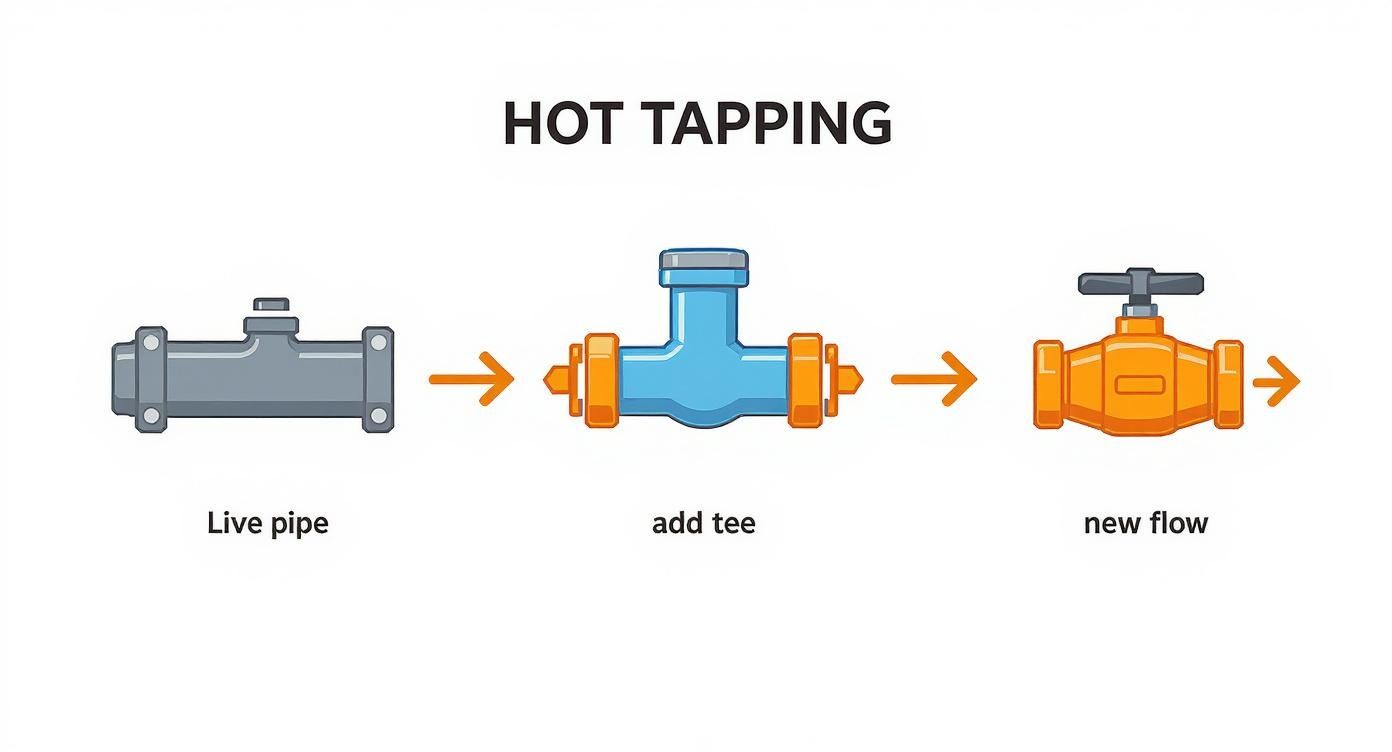
You can clearly see how the process flows from the existing live pipe to the final installation of a new, functional branch.
Step 3: Executing the Live Cut
This is where the "hot tap" really happens. The space between the valve and the tapping machine is bled of air and brought up to the same pressure as the pipeline. With the pressures equalized, the operator opens the gate valve, giving the tapping machine a clear path to the pipe wall.
The operator then advances the boring bar until the pilot drill makes contact. This little drill does a big job: it secures the piece of pipe that's about to be cut out (called the coupon), making sure it doesn’t fall into the pipeline and cause havoc. Once the pilot is through, the main cutter engages and smoothly slices a perfect circle through the pipe wall, all within the sealed enclosure.
The entire cutting process is done with zero pressure drop in the main line and without a single drop of product leaking. It’s this level of precision that makes hot tapping so essential for industries that can’t afford downtime.
Step 4: Completing the Connection
Once the cut is finished, the operator retracts the boring bar. The coupon, held securely by the pilot drill, is pulled back through the open valve and into the tapping machine's housing.
With the cutter and coupon safely out of the way, the operator closes the full-bore valve, once again sealing off the pipeline's contents. The pressure in the tapping machine is then safely bled off, and the machine is removed. Just like that, the new branch connection is live up to the closed valve, ready for the new pipeline to be tied in. This seamless procedure is a perfect example of why the hot tapping split tee is a game-changer for infrastructure work.
Choosing the Right Split Tee for the Job
Picking the right hot tapping split tee isn’t just about ordering a part from a catalog. It’s a critical engineering decision that directly impacts the safety and success of your live pipeline connection.
Think of it like this: you're performing surgery on a live, pressurized system. The split tee is your primary tool, and choosing the wrong one won't just cause a minor hiccup—it could lead to a catastrophic failure. The decision boils down to getting three things absolutely right: the material, the pressure rating, and the dimensions.
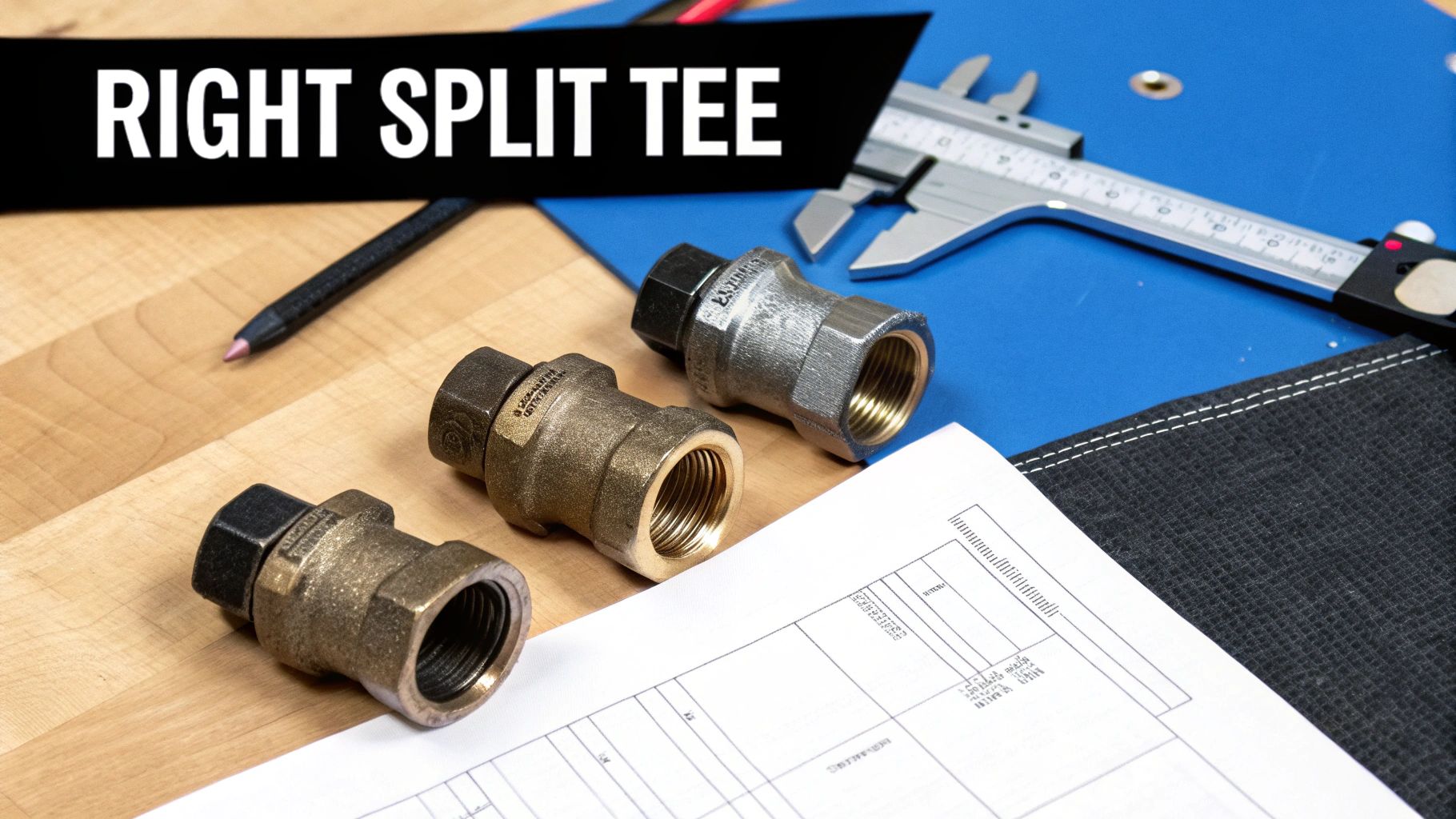
Matching Materials to Service Conditions
First things first: what is the split tee made of? This is crucial because the material must be fully compatible with the existing pipe and whatever is flowing through it. A mismatch here is a ticking clock for corrosion and failure.
- Carbon Steel (e.g., ASTM A234 WPB): This is your go-to for most natural gas and oil pipelines. It’s the industry workhorse, known for its strength and reliability in standard conditions.
- Stainless Steel (e.g., ASTM A403 WP316): If you're working with corrosive materials or in harsh environments like coastal or offshore sites, stainless steel is a must. Its resistance to rust and chemical damage is non-negotiable.
- Alloy Steel (e.g., ASTM A182 F11): When the heat is on—literally—you need an alloy steel. These are engineered specifically for high-temperature and high-pressure applications where other materials would warp or fail.
The goal is simple: the new connection should be just as strong, if not stronger, than the original pipe. At a bare minimum, the split tee’s material grade and strength must match the host pipe to create a truly permanent and reliable bond.
Verifying Pressure and Temperature Ratings
Every pipeline has its limits—a specific pressure and temperature range it’s designed to handle. Your split tee must be rated to comfortably exceed the pipeline's maximums, with a healthy safety margin built in. A fitting that can't take the pressure is an accident waiting to happen.
Before you do anything else, check the pipeline’s design documents for its Maximum Allowable Operating Pressure (MAOP) and temperature specs. The split tee manufacturer will provide its own ratings, and you have to ensure they’re higher. There's no room for assumptions here; this requires absolute verification.
The global market for split tee fittings hit around $1.2 billion in 2022, which tells you just how vital these components are. That demand has driven manufacturers to implement incredibly strict quality control. Today, most fittings undergo hydrostatic testing at 1.5 times their maximum operating pressure to leave no doubt about their safety and performance.
Confirming Pipe and Branch Dimensions
Finally, the fit has to be exact. A fundamental step in choosing the right hot tapping split tee for the job is consulting an ultimate pipe size chart and reference guide to ensure perfect fit and operational integrity. You need two critical measurements:
- Run Size: The outside diameter (OD) of the main pipe you're clamping onto.
- Outlet Size: The diameter of the new branch connection you're adding.
These numbers dictate the size and curvature of the fitting. A split tee made for a 12-inch pipe won't work on a 12.5-inch one. Even a tiny mismatch will prevent a proper seal, leading to leaks or a failed weld. Accurate field measurements are an absolute must before you place an order.
Understanding Key Safety and Compliance Standards
When you're working with high-pressure pipelines, there's absolutely zero room for error. A successful hot tapping split tee installation isn't just about getting the job done; it's a meticulously engineered operation that lives and dies by strict safety and compliance standards. This isn't some quick field fix—it's a procedure where every single detail is planned, double-checked, and executed by the book.
Following these standards isn't just a suggestion. It’s the very framework that guarantees the pipeline's integrity, protects the crew, and keeps the gas flowing. Think of these regulations as the operational blueprint that transforms a high-stakes task into a controlled, predictable, and safe job. Cutting corners isn't just a bad idea; it introduces risks you can't afford to take.
The Governing Bodies of Pipeline Safety
So, who writes the rulebook? A few key organizations set the standards that define safe hot tapping. Their guidelines are built on decades of real-world engineering, hard data, and a deep understanding of what can go wrong with a pipeline.
- American Petroleum Institute (API): For anyone in oil and gas, API is the starting point. They provide the foundational guidance for the entire industry.
- American Society of Mechanical Engineers (ASME): ASME is the authority on the hardware. They create the essential codes for piping systems and pressure vessels, ensuring everything is built to last.
- Occupational Safety and Health Administration (OSHA): OSHA’s focus is on people. They ensure every job, including hot tapping, is done in a way that protects workers from harm.
These groups work together to create a unified safety culture. It means a hot tap in Texas follows the same rigorous protocols as one in Pennsylvania.
A critical aspect of hot tapping safety and compliance involves thoroughly understanding the potential causes of pipe failures and implementing robust preventive measures. For more detailed insights on this topic, exploring resources on preventing pipe bursts can provide valuable context for mitigating risks during live pipeline operations.
Core Standards You Must Know
While a project might fall under various codes, a few are non-negotiable for almost every hot tapping job. These aren't just recommendations; they are mandatory reading for a safe, compliant installation.
The big one is API RP 2201, "Safe Hot Tapping Practices in the Petroleum & Petrochemical Industries." This is the bible for hot tapping. It walks you through the entire process, from planning and picking equipment to the final cut. It’s a detailed roadmap for managing the unique dangers that come with working on a live, pressurized line.
You also have the ASME B31 codes—like B31.3 for process piping and B31.8 for gas transmission. These codes govern the design, construction, and structural integrity of the pipeline itself. When you perform a hot tap, you’re modifying that system, and ASME ensures your new connection is just as strong and reliable as the original pipe.
Essential Safety Protocols in Practice
Beyond the written standards, a successful hot tap depends on what happens on the ground. These on-site protocols are where the regulations come to life.
Here’s what every professional crew does, every time:
- Meticulous Pre-Job Planning: Nothing is left to chance. The job is mapped out from start to finish, including a full risk assessment, procedure review, and a plan B (and C) for anything that could go wrong.
- Material and Welder Verification: Every component, especially the hot tapping split tee, must come with certified material test reports (MTRs). Just as important, only welders qualified under codes like ASME Section IX are allowed to lay a bead on that pipe.
- Pressure Testing: Before the coupon is cut, the entire assembly—the fitting, the valve, and the tapping machine—is pressure-tested to a level higher than the line's operating pressure. You have to be 100% sure there are no leaks.
- Robust Emergency Response Plan: Everyone on site knows what to do if something goes wrong. A clear, practiced plan ensures a swift and effective response to any incident.
These steps aren't just a checklist. They're a discipline that confirms a safe hot tap is no accident; it’s the direct result of methodical engineering and certified expertise.
Where Hot Tapping Really Shines: Real-World Scenarios
The engineering behind a hot tapping split tee is clever, but its real value is in what it lets you do in the field. This isn't just some abstract procedure; it's a practical, problem-solving tool that keeps businesses running, buildings powered, and critical infrastructure growing without skipping a beat. From massive industrial parks to the final hookup for a new restaurant, hot tapping is the go-to method for making connections on live, pressurized pipes.
Let's break down a few common situations where this technology proves its worth, turning potential logistical nightmares into straightforward projects.
Adding New Service Lines Without Shutting Down
Picture a sprawling manufacturing plant that's expanding with a new production wing. That new section needs a connection to the facility's main natural gas line. The old-school way would mean shutting down the entire plant—stopping production for days, costing a fortune in lost revenue, and causing a massive headache for everyone in the supply chain.
This is exactly where a hot tapping split tee comes in. A skilled crew welds the fitting onto the live gas main, attaches a valve, and performs the tap. Just like that, they’ve created a brand-new, fully functional branch line.
The benefits are huge:
- Zero Downtime: The main plant keeps humming along at full capacity, completely unaffected by the major work happening on its primary gas supply.
- Serious Cost Savings: The staggering financial hit from a full shutdown is completely sidestepped.
- Unbroken Operations: Critical processes are never put at risk, making the transition to bring the new wing online totally seamless.
Commissioning New Buildings and Equipment
Hot tapping is also a game-changer for getting new equipment into service or supplying gas to brand-new buildings. Think about a new commercial development with a huge backup generator, or a new apartment complex with a large boiler system. Both need to be tied into the local gas utility's main line.
Rather than shutting off gas for an entire neighborhood—a surefire way to upset existing customers—the utility can use hot tapping. A split tee creates the perfect connection point for the new service, allowing them to commission the equipment safely and efficiently. It’s the kind of move that keeps current customers happy and gets new facilities up and running much faster.
This isn't a niche trick; it's become standard practice worldwide. For over 70% of major pipeline operators in North America and Europe, hot tapping with split tees is the preferred method for making new connections. It's a key strategy that also helps prevent methane emissions, according to the EPA.
Building Bypass Lines for Critical Maintenance
Sometimes, a section of pipeline just has to be taken out of service for inspection, repair, or replacement. The catch? The gas or liquid flowing through it can't stop. A hot tapping split tee is the solution for creating a temporary detour, often called a bypass line.
The process is surprisingly logical:
- A hot tap connection is made just upstream of the section that needs work.
- A second hot tap is made just downstream of that same section.
- A temporary pipe is run between these two new connection points.
Once that bypass is in place, the flow is rerouted through it. The isolated section in the middle can now be safely depressurized and worked on without disrupting service to anyone downstream.
Keeping the Gas Flowing with Temporary Service
For really complex jobs, like major pipeline relocations or system-wide upgrades, even a bypass might not be enough. Entire sections of a gas main might need to be offline for weeks, but the customers—hospitals, businesses, residential areas—can't go without gas. This is where temporary natural gas providers like Blue Gas Express become essential partners.
A hot tapping split tee can be installed to create a temporary injection point into the distribution system. This lets a provider feed compressed natural gas (CNG) or liquefied natural gas (LNG) directly into the local lines, keeping everything running like clockwork while the heavy-duty pipeline work is underway. It’s a beautifully coordinated dance between hot tapping crews and temporary gas suppliers that guarantees uninterrupted service.
Bringing It All Together: Why a Split Tee is Just the Beginning
A successful hot tapping split tee installation is a critical step, but it’s often just one piece of a much larger operational puzzle. Think of it this way: the fitting gets you the physical connection, but major pipeline projects demand a full-scale strategy to keep the gas flowing and customers happy. It’s never just about the hardware; it’s about a seamless, integrated plan.
When you need to take a main line out of service for significant repairs, upgrades, or even a relocation, you can't just shut things down. This is where specialized partners become your most valuable asset, working right alongside hot tapping contractors to bridge the gap between the technical work and the absolute need for uninterrupted service.
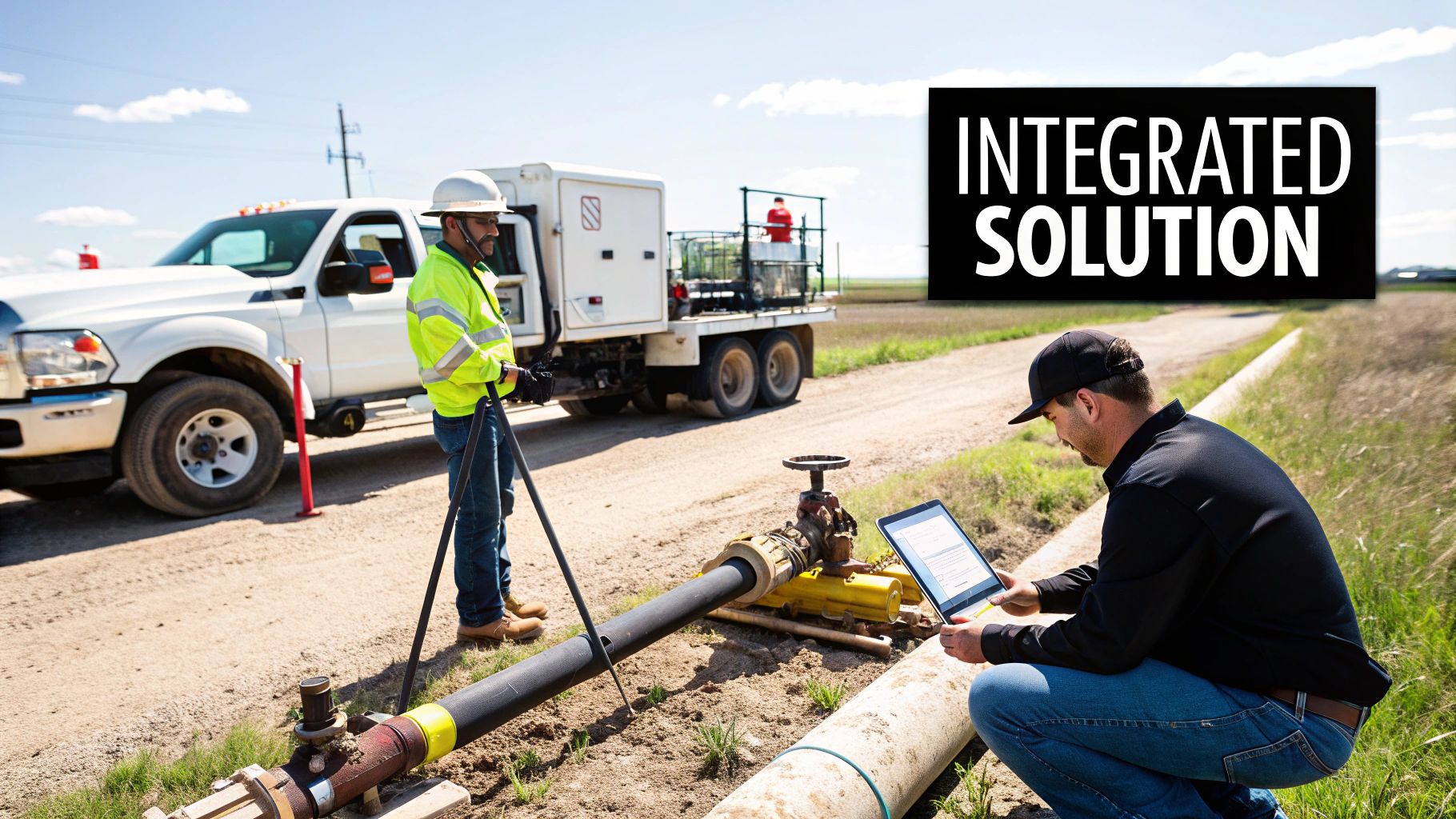
The Critical Role of Temporary Natural Gas
Picture a hospital, a major manufacturing plant, or a dense residential area—they can't afford a single minute without natural gas. This is where a temporary natural gas provider like Blue Gas Express steps in, delivering compressed natural gas (CNG) or liquefied natural gas (LNG) right to your job site. This mobile supply gets injected downstream of your work area, keeping everyone's service online while the main pipeline is safely shut down.
This coordinated effort brings two expert services together:
- Precision Hot Tapping: The crew creates the necessary connection and isolation points on the live system.
- Reliable Temporary Supply: A mobile gas source provides a continuous flow to bypass the section being worked on.
This integration is the secret sauce for achieving zero downtime. It turns what could be a highly disruptive project into a smooth background operation that customers never even know is happening. The result is a project that nails safety, efficiency, and customer satisfaction from start to finish.
A Coordinated Strategy for Zero Downtime
This partnership model is absolutely essential for complex jobs. Let’s say a gas utility needs to replace a long, aging section of a critical transmission line. First, hot tapping crews would install split tee fittings to create tie-in points for a temporary gas feed from a mobile LNG or CNG unit.
Once that temporary supply is active and feeding the downstream network, the main line section can be safely isolated, purged, and replaced. This synergy ensures that homes, businesses, and critical facilities stay fully operational for the entire duration of the project. It’s a powerful strategy for modernizing our infrastructure without disrupting the lives that depend on it.
Common Questions About Hot Tapping Split Tees
Even when you know the process inside and out, the idea of cutting into a live pipeline naturally raises a few questions. A hot tapping split tee operation is a serious piece of engineering, so it’s wise to get into the nitty-gritty. Let's tackle some of the most common things people ask.
What Is the Maximum Pressure for a Hot Tap?
This is the big one, and the honest answer is: it depends. There's no single magic number for maximum pressure. The real limit is always determined by the weakest link in the chain—the component with the lowest pressure rating, whether that's the split tee fitting, the valve, or the tapping machine itself.
Think about it this way: high-pressure natural gas transmission lines can run at over 1,000 PSI. To safely tap a line like that, you need a split tee and valve specifically built and rated for pressures significantly higher than that, usually with a safety margin of 1.5x or more. The first rule is to always confirm the pipeline's Maximum Allowable Operating Pressure (MAOP) and then double-check that every single piece of your hot tapping gear is rated to exceed it.
Can Hot Tapping Be Done on Any Pipe Material?
Hot tapping works on a lot of things, but not everything. It's a go-to procedure for carbon steel pipes, which are the backbone of most oil and gas infrastructure. But you can absolutely perform a hot tap on other materials, too, such as:
- Stainless steel
- Alloy steels
- Ductile iron
- Cast iron
The trick is making sure the materials play nice together. Your hot tapping split tee has to be weld-compatible with the host pipe. This is why you can't just hot tap a PVC or concrete pipe; the welding process and the material’s structure just aren't a fit for this kind of work.
The success of any hot tap hinges on a perfect weld between the fitting and the pipe. This weld creates the permanent, pressure-containing seal that makes the entire operation safe and reliable.
What Happens to the Cut-Out Pipe Piece?
That little piece of pipe cut out during the tap is called the coupon. And no, it doesn’t just get dropped into the pipeline to cause a massive blockage later. The tapping machine is designed with a special pilot drill that acts like a hook, catching and holding the coupon firmly.
Once the cutter has made its way through the pipe wall, the operator simply retracts the whole assembly. The coupon is pulled back up through the valve and safely into the tapping machine's body. After the valve is shut and the machine is detached, the coupon is removed. It's actually a useful piece of evidence—crews often inspect it to get a real-world look at the pipe's wall thickness and condition.
How Long Does a Typical Hot Tapping Installation Take?
The timeline really depends on the job. A straightforward tap on a small, easy-to-reach pipe could be done in a day. On the flip side, tapping a large-diameter transmission line in a tricky spot could stretch over several days when you account for site prep, welding, weld inspection (non-destructive testing), and finally, the tap itself.
For complex projects where you can't afford a service interruption, a Blue Gas Express temporary natural gas solution is the perfect partner. We keep your customers online so your crews can complete critical pipeline work without the pressure. Learn more about how we can support your next project.