

When you need to create a new connection to a pressurized gas line that's already in service, you can't just shut it down. That’s where hot tapping comes in. Think of it as performing surgery on a critical artery without ever stopping the blood flow—it’s a highly specialized technique that prevents service interruptions and costly downtime. For any industry that relies on a steady stream of natural gas, this method is absolutely essential.
What Exactly Is Hot Tapping on Gas Lines?
Let's use an analogy. Imagine a major city is fed by one massive water main, and a new hospital needs to be connected. The old way would mean shutting off the water for everyone, causing a city-wide headache. Hot tapping is the modern, elegant solution to that problem. It lets technicians create that new connection while the water—or in our case, natural gas—keeps flowing without a single hiccup.
At its heart, hot tapping gas lines is all about creating a completely sealed and controlled environment right on the surface of a live pipe. First, a specialized fitting is welded to the pipeline, and a permanent valve is attached to it. Then, a high-tech drilling machine is mounted onto the valve, creating a pressure-tight chamber. This setup allows a hole to be cut into the pipe wall with absolute precision and safety. No gas escapes, and the system's pressure remains perfectly stable from start to finish.
This capability is a game-changer for all sorts of sectors. For instance:
- Industrial Manufacturing: A factory running around the clock can't just stop production for a pipeline upgrade.
- Hospitals and Healthcare: These facilities need a constant gas supply for everything from heating and sterilization to backup power.
- Power Generation Plants: Keeping the fuel flowing is non-negotiable for generating electricity without interruption.
- Expanding Communities: New neighborhoods or commercial developments can be tied into the existing gas grid seamlessly.
The infographic below walks you through this careful, three-step process.
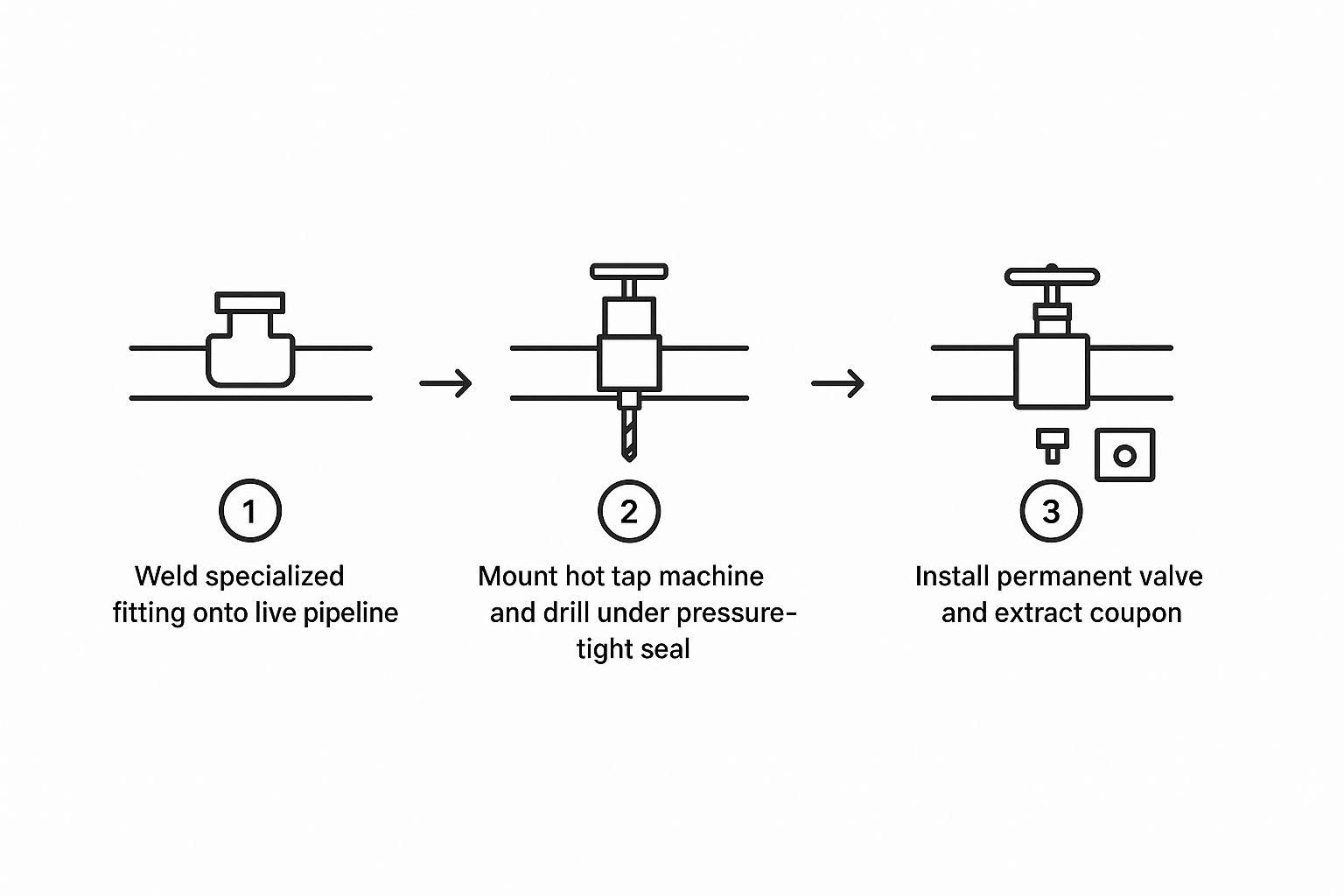
As you can see, the combination of a secure fitting, a specialized valve, and a controlled drilling machine all work together to create a safe, permanent, and leak-proof connection.
A Cornerstone of the Energy Sector
The precision required for hot tapping makes it a foundational practice in modern energy infrastructure. It’s all about maintaining operational efficiency and avoiding expensive disruptions. Just look at the United States, where 2021 crude oil production hit roughly 11 million barrels per day. Keeping pipelines intact and flowing is a massive economic priority. This method allows for crucial expansions, repairs, and tie-ins without affecting that output. If you want to dig deeper, you can read more about the hot tapping market to see just how significant its impact is.
By eliminating the need to shut down, drain, and purge entire sections of a pipeline, hot tapping doesn't just save millions in operational costs. It also has a huge environmental benefit by preventing the release of methane gas into the atmosphere.
A Step-by-Step Look at the Hot Tapping Process
It’s one thing to talk about hot tapping gas lines in theory, but it’s another thing entirely to see the process unfold in the real world. It’s not about brute force; it’s more like a carefully choreographed industrial ballet. Every single movement is meticulously planned and executed with absolute precision to ensure a safe, permanent, and leak-proof connection—all without ever shutting down the gas flow.
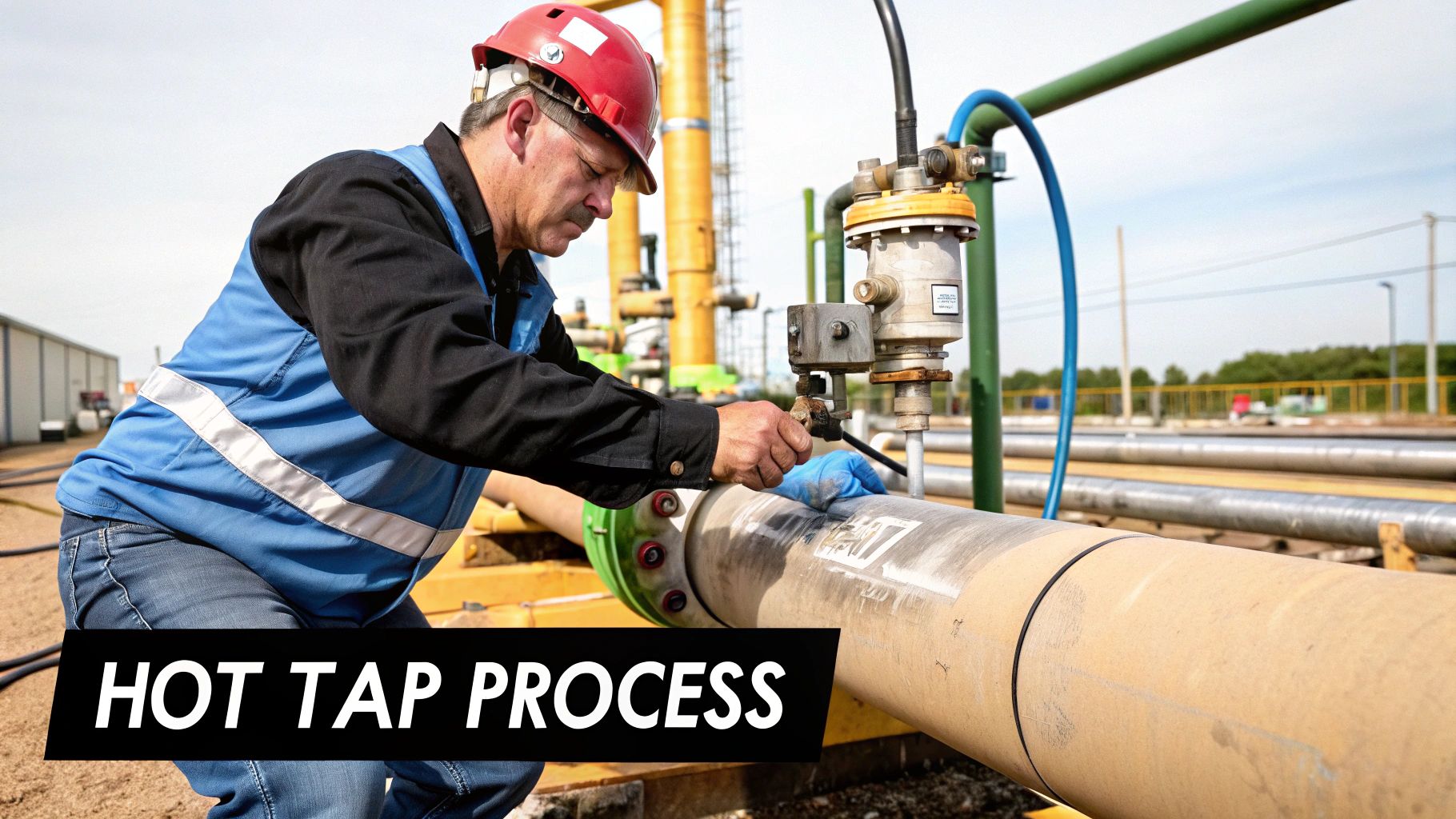
This methodical approach is what transforms a potentially high-stakes job into a controlled, routine procedure. Let's walk through the key stages of a typical hot tapping operation.
Stage 1: Preparation and Fitting Installation
Long before any tools are switched on, the real work begins with painstaking preparation. This goes far beyond just gathering equipment; it's about gaining an intimate understanding of the pipeline and its environment.
- Site Inspection and Safety Briefing: A team of certified technicians starts by inspecting the precise location for the tap. They’ll verify the pipe’s material, its diameter, and the thickness of its wall. From there, they hold a comprehensive safety meeting to review the entire procedure, flag potential hazards, and run through emergency response plans. Everybody on site has to be on the same page.
- Welding the Fitting: The first piece of hardware to go on is a specialized hot tap fitting, which is often a full-encirclement split tee. This component is carefully positioned and then welded directly onto the live pipeline. The welding itself is a highly controlled process designed to maintain the pipe's structural integrity.
This fitting is the foundation for the whole operation. It’s the gateway for the new connection, and its installation has to be perfect.
Stage 2: Mounting the Valve and Tapping Machine
With the fitting securely welded in place, it's time to build the sealed, pressurized chamber where the drilling will happen. This is where the core hot tapping equipment comes into play.
First, a permanent, full-port valve is bolted onto the flange of the fitting. This valve is critical because it will eventually control the gas flowing into the new branch line. After being attached and tested, it stays in the open position for now.
Next, the hot tapping machine is mounted directly onto the valve's outlet. This machine is a serious piece of engineering, with a boring bar, a specialized cutter, and a sealed housing. When it's bolted to the valve, it creates a completely pressure-tight system, isolating the work area from the outside world.
The connection between the valve and the hot tapping machine is the most critical seal in the entire setup. Before moving forward, technicians will pressure test this assembly—often with nitrogen—to be 100% certain there are no leaks.
Stage 3: The Cut and Coupon Retrieval
This is the moment of truth. Once the setup is fully secured and pressure-tested, the actual "tap" can begin. It's a surprisingly controlled and quiet process.
- Drilling the Pipe: The operator advances the boring bar through the open valve until the cutter touches the pipe wall. The machine is turned on, and the cutter begins to drill slowly and smoothly through the pipeline. The machine’s design ensures the pipe's internal pressure stays perfectly balanced the entire time.
- Retrieving the Coupon: As soon as the cutter makes it all the way through the pipe wall, a special pilot bit catches the piece of pipe that was just cut out. This piece is called the "coupon." The operator then retracts the boring bar, pulling the coupon back through the valve and into the machine's housing.
- Closing the Valve: With the coupon safely out of the way, the operator closes the full-port valve. This single action immediately separates the live pipeline from the hot tapping machine. The tap is complete, and the new branch is officially live.
Finally, with the main valve closed, the pressure inside the hot tapping machine is safely vented. The machine is then unbolted and removed, leaving behind the new valve, ready for the branch line to be connected. The whole sequence creates a seamless tie-in with zero disruption to service.
The Uncompromising Safety Protocols of Hot Tapping
When you're working with a live, pressurized gas line, there is zero margin for error. A successful hot tap isn't just about having the right tools; it’s about a relentless, step-by-step commitment to safety from the first plan to the final inspection. This is precisely why hot tapping gas lines is a specialized field, reserved only for highly trained and certified professionals who live and breathe these procedures. One tiny oversight can lead to catastrophic failure, making safety the absolute cornerstone of every single job.
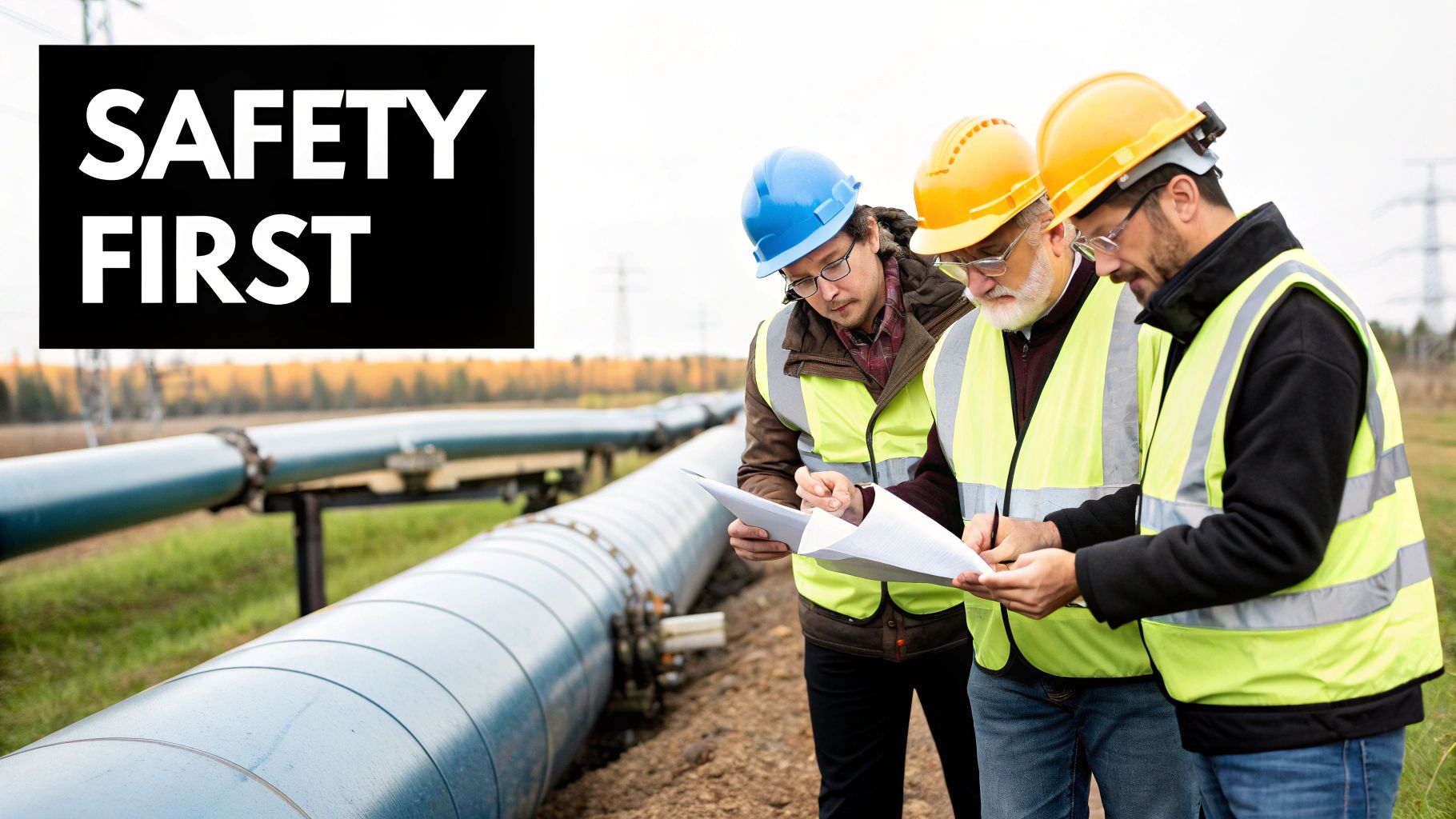
The whole operation is wrapped in layers of safety protocols designed to protect the crew, the integrity of the pipeline, and the surrounding area. It all starts long before anyone even thinks about touching the pipe, with meticulous planning and a thorough risk assessment.
Every hot tap is executed according to strict industry standards. Following these specific hot tapping safety rules is non-negotiable, and they must always align with broader regulations, like those detailed in this UK workplace safety compliance guide, to ensure everything is done by the book.
Pre-Job Risk Assessment and Planning
Before a single weld is laid, a comprehensive risk assessment is an absolute must. This is far more than a simple checklist; it's a deep dive into every possible variable that could affect the job.
First, technicians have to verify the condition of the pipe with 100% certainty. This usually means running non-destructive tests, like ultrasonic scans, to make sure the pipe wall is thick and strong enough to handle the weld and the tapping pressure. Any hint of corrosion or weakness is an immediate showstopper.
Just as critical is knowing exactly what's inside that pipeline. The team needs precise data on the gas pressure, its temperature, and flow rate. This information dictates everything—from the equipment selection to the speed of the drill cutter—because controlling these variables is how you prevent disaster.
Every hot tap begins with a pre-job safety meeting, often called a "toolbox talk." This is where the entire team walks through the procedure step-by-step, identifies potential hazards, confirms emergency protocols, and ensures every crew member understands their specific role.
On-Site Safety Measures During the Operation
Once the work kicks off, a whole new set of protocols comes into play to manage the live environment. These on-site measures are every bit as important as the planning phase.
One of the most fundamental safety rules is proper equipment grounding. You’re dealing with metal grinding against metal, and the last thing you want is a spark anywhere near a flammable gas line. All hot tapping machines and related gear must be securely grounded to eliminate any static electricity before it can build up.
Controlling the immediate work area is also vital. Key on-site measures include:
- Atmospheric Monitoring: The air around the worksite is continuously monitored for any trace of flammable gas.
- Fire Suppression: The right fire suppression equipment, like extinguishers or a charged fire hose, must be on standby and within arm's reach.
- Controlled Access: The work zone is cordoned off and restricted to essential personnel only. This minimises distractions and ensures everyone on site is fully aware of the risks involved.
The checklist below outlines some of the critical checks that must be passed before the cutter makes its first turn. This really highlights the layers of verification needed to ensure a safe operation.
Key Safety Checks Before Starting a Hot Tap
| Verification Area | Checklist Item | Purpose |
|---|---|---|
| Pipe Integrity | Ultrasonic Wall Thickness Test | Confirms the pipe can safely handle welding and drilling pressure without failing. |
| System Vitals | Pressure and Flow Rate Verification | Ensures operational conditions are within the safe limits of the equipment and procedure. |
| Equipment Setup | Pressure Test of Tapping Assembly | Guarantees a leak-proof seal between the valve and the hot tapping machine before drilling. |
| Electrical Safety | Equipment Grounding Confirmation | Prevents static discharge and potential sparks in a flammable gas environment. |
Passing every one of these checks isn't just a recommendation—it's a requirement. Only when every box is ticked can the team proceed with confidence.
Inside the Toolkit for Professional Gas Line Tapping
When you're working on a live, pressurized gas line, you can't just grab any old tools from the truck. Hot tapping gas lines demands a highly specialized kit where every single piece is engineered for precision and safety under extreme conditions. It's less like a standard toolbox and more like a mobile surgical suite designed for industrial arteries.
Each component is built to be incredibly strong and reliable because, in this line of work, there's zero room for error.
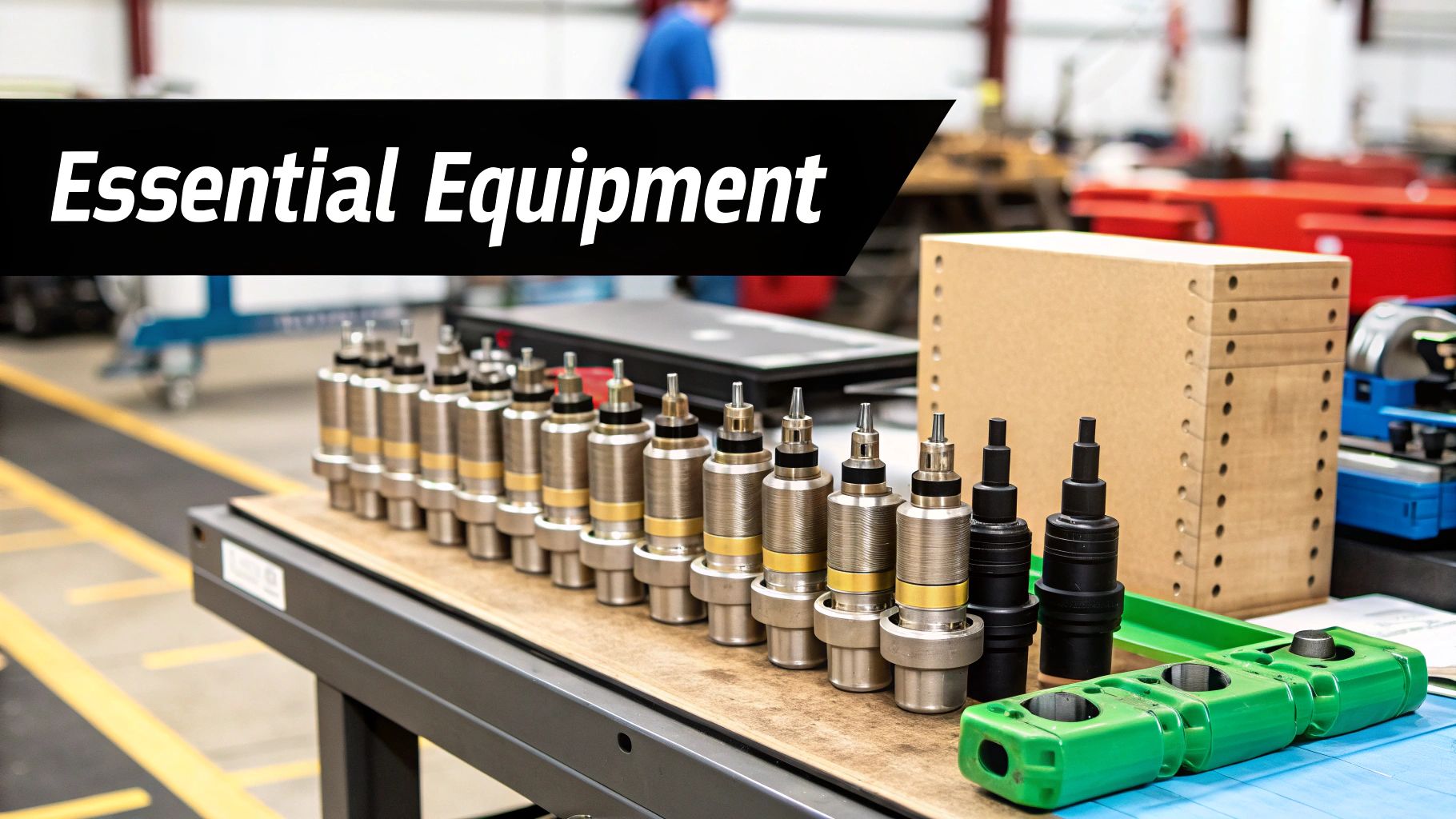
The star of the show is, without a doubt, the hot tapping machine. This powerful piece of equipment is the heart of the whole procedure. Its one job is to drill into the pressurized pipe without letting so much as a whisper of gas escape. It’s a beautifully complex assembly of pressure-rated parts all working together seamlessly.
The Core Hot Tapping Machine Components
Think of the machine as a high-torque drill sealed inside a pressure-proof chamber. It’s designed to push a cutter through a valve and into the pipe wall while keeping everything safely contained.
Here’s a look at its main parts:
- The Boring Bar: This is the long, rotating shaft that does the actual work of turning the cutter. It has to be perfectly straight and tough enough to handle the immense force required to drill through steel without bending.
- The Cutter and Pilot Drill: At the business end of the boring bar, you’ll find a circular cutter, precisely sized for the new branch connection. Inside it sits a pilot drill that features a clever little device called a coupon retainer. This is designed to catch and hold onto the piece of pipe that gets cut out so it can be safely removed.
- The Pressurized Housing: The entire drive mechanism is locked inside a heavy-duty housing that bolts directly onto the new valve. Once the cut is made, this chamber contains the full pipeline pressure, making sure nothing gets out.
This setup allows a technician to make a perfect cut from a safe distance, typically using a hydraulic power unit to fine-tune the drilling speed and pressure.
The design of the hot tapping machine is a marvel of industrial engineering. It must simultaneously drill through hardened steel, contain thousands of pounds of pressure, and retrieve the cut section of pipe, all through a valve opening just a few inches wide.
Essential Fittings and Valves
Long before the tapping machine even shows up, the foundation for the new connection has to be permanently installed. This hardware isn’t temporary; it becomes a lasting part of the gas infrastructure.
The two most important pieces are the fitting and the valve. First, a hot tap fitting—often a full-encirclement split tee—is welded directly onto the live pipe. This design is brilliant because it wraps completely around the pipe, evenly distributing stress and reinforcing the connection point. This fitting is what provides the flanged outlet for the new valve.
With the fitting in place, a full-port gate valve or ball valve is bolted on. The "full-port" part is key. It means the opening through the valve is the same diameter as the pipe itself, which is essential for letting the cutter and the cut-out "coupon" pass through without getting stuck. After the job is done, this valve gives operators permanent control over the new branch line.
Supporting Gear for a Safe Operation
Of course, the main machine and fittings don't work in a vacuum. A whole range of supporting equipment is needed to monitor and manage the process. For example, pressure gauges are attached to the machine's housing to give technicians a real-time reading of the internal pressure, confirming the seal is holding perfectly.
Hydraulic power units are also standard, giving the operator precise control over the cutter’s rotation and feed rate. That level of control is what ensures a smooth, clean cut that doesn’t compromise the integrity of the pipe. From the biggest machine to the smallest gauge, every piece in the toolkit is absolutely vital for a successful hot tap.
When you're running any operation that depends on a steady flow of gas—whether it's a power plant or a manufacturing facility—the word "shutdown" is one you never want to hear. It's expensive and disruptive.
Traditionally, if you needed to add a new connection to a pipeline, you had no choice. You had to stop operations, drain the entire line, do the work, and then go through the whole slow process of purging and refilling it. This old-school method doesn't just stop production; it kicks off a whole chain of logistical and financial problems.
This is where hot tapping gas lines changes the game entirely. Instead of shutting everything down, you can make a new connection while the system is live and under pressure. Imagine adding a new on-ramp to a highway without ever stopping traffic—that’s the essence of hot tapping. This single capability is why it's become the go-to method for pipeline modifications.
Unlocking Massive Economic Savings
Let's talk money. The financial upside of avoiding a shutdown is huge and immediate. When a pipeline stays in service, the revenue keeps flowing. For a large industrial site or a utility, we're talking about saving tens, or even hundreds, of thousands of dollars for every day you stay online.
But it's not just about the lost revenue. Think about all the other costs that come with a traditional shutdown:
- Labor Costs: Draining and refilling a pipeline is a major job that takes a lot of hands and a lot of hours.
- Product Loss: All the gas that gets vented or flared during a shutdown is product you can't sell. It's literally money going up in smoke.
- Restart Headaches: Getting a complex system back up to full operational pressure isn't like flipping a switch. It can be slow, complicated, and sometimes things just don't want to start back up smoothly.
Hot tapping sidesteps all of these issues. The entire job gets done while your system runs just like any other day, making it an incredibly efficient and smart financial move.
The core value here is simple but powerful: Hot tapping protects your bottom line by ensuring 100% operational continuity. It turns a project that could have been a massive disruption into a routine, controlled procedure.
A Critical Advantage for Environmental Protection
The benefits don't stop at the bank. At a time when everyone is focused on environmental responsibility, hot tapping offers a major win by preventing the release of methane—a potent greenhouse gas—into the atmosphere. When you shut down a pipeline the old way, you often have to vent its contents, releasing huge volumes of natural gas.
By keeping the pipeline completely sealed and pressurized, hot tapping gas lines makes sure that gas stays right where it's supposed to be. In fact, this is now seen as a key strategy for cutting emissions in the natural gas industry. According to the Natural Gas STAR Program, performing an average of 320 hot taps a year can prevent around 24,400 Mcf of natural gas from being vented. You can dig deeper into these numbers by reading the findings on methane mitigation.
This makes hot tapping not just a smart business decision, but a responsible environmental one, too. It allows companies to maintain and expand critical infrastructure while actively shrinking their carbon footprint. Whether you're keeping the lights on at a hospital during an upgrade or expanding a factory's capacity, hot tapping is a safe, efficient, and clean way to get the job done.
Guaranteeing Zero Downtime with Temporary Gas Solutions
Hot tapping is designed to prevent service interruptions, but some jobs are just too important to leave anything to chance. For places like hospitals, data centers, or massive manufacturing plants, even a moment without gas can lead to serious problems. This is where an extra layer of security isn't just a good idea—it's a critical part of the plan.
This ultimate fail-safe is a temporary gas solution. By hooking up a portable natural gas or propane supply, we can build in a redundant system that guarantees 100% operational continuity, no matter what happens during the hot tap. It’s like having a backup generator for your power; you get a solid safety net and complete peace of mind.
How a Temporary Gas Bypass Works
The idea is simple but incredibly effective. Before we even start the hot tap, a mobile gas delivery system is connected to the facility’s piping, downstream from where we'll be working. This setup, often a compressed natural gas (CNG) or liquefied natural gas (LNG) unit, essentially becomes a temporary, self-contained gas main.
If any unexpected issue pops up during the hot tap that might threaten the main supply, this temporary system is already online and ready to take over instantly. The switch is completely seamless, so the facility never experiences a single moment of disruption. This proactive step turns a high-stakes procedure into a controlled, risk-free operation.
This strategy is all about total risk mitigation. For a hospital, it ensures life-support systems and sterilization equipment never go down. For a data center, it keeps cooling systems running to prevent a catastrophic server meltdown.
Meticulous Planning is Key to a Flawless Operation
Pulling this off requires more than just showing up with a truck. It’s the result of careful, detailed coordination. Integrating a temporary gas supply means we need to know the facility’s exact consumption needs, the best connection points, and the precise timeline for the hot tap. Achieving zero downtime relies on meticulous planning and effective project scheduling to make sure every resource is in place for a perfect transition if needed.
Here’s what our integrated approach looks like:
- Load Assessment: First, we calculate the facility's peak gas demand. This tells us exactly how to size the temporary supply unit so it can handle the load.
- Site Logistics: We figure out the safest, most efficient spot to place the mobile gas unit and map out the connection route.
- Coordination: We work hand-in-hand with the hot tapping crew and the facility managers to sync up every step of the timeline.
For those projects where the cost of failure is sky-high, pairing hot tapping with a ready-to-go temporary gas supply is the ultimate guarantee. It's the only way to be absolutely certain the gas flows, uninterrupted, from start to finish.
Common Questions About Hot Tapping Gas Lines
Even after seeing how it's done, it's totally normal to have questions about a process as precise as hot tapping. We're talking about a procedure that's part heavy construction, part surgical operation, so it naturally sparks a lot of curiosity. Let's tackle some of the most common questions to clear things up and maybe bust a myth or two.
Think of this as a quick Q&A with an expert who’s been in the trenches.
Is Hot Tapping Safe for Every Type of Gas Line?
Not exactly. While hot tapping is an incredibly useful technique, it’s not a magic bullet for every situation. The safety and success of the whole operation hinge on the pipeline's material and, more importantly, its current condition. Before any work starts, technicians perform a thorough check-up using non-destructive tests, like ultrasonic scans, to make sure the pipe wall is thick and sound enough to withstand the process.
You absolutely can't perform a hot tap on a pipe with heavy corrosion, existing cracks, or other structural flaws. It's just too risky. Certain materials, like old cast iron or some types of lined pipe, also pose challenges and might not be suitable. At the end of the day, safety dictates everything, and that initial assessment is non-negotiable.
How Long Does a Typical Operation Take?
That’s a classic "it depends" question. A small, simple tap on a 4-inch line could be wrapped up in a day, from setting up the gear to closing the final valve. It's pretty straightforward.
On the other hand, a large-diameter tap on a major transmission pipeline is a different beast altogether. That could easily stretch over several days. The extra time is needed for more involved prep work, complex welding on the fitting, and the slow, careful pace required to drill through a much thicker pipe wall. Of course, site logistics and planning also play a big part in the final timeline.
It's a common misconception that the drilling is the longest part. In reality, the actual cutting might only take a few hours. The bulk of the job is spent on meticulous prep, equipment setup, and double-checking every safety protocol.
What Happens to the Cut-Out Piece of Pipe?
I get this question all the time. People picture a chunk of metal falling into the pipeline and causing chaos, but that's not how it works. That cut-out piece, which we call a "coupon," is captured before it can go anywhere.
The hot tapping machine is cleverly designed with a pilot drill that has a retention wire or latch system. As the cutter finishes slicing through the pipe wall, this device snags the coupon. The operator then retracts the entire cutting assembly, pulling the coupon cleanly back through the valve. Once the valve is shut, the machine is removed, coupon and all. It leaves a perfect opening with zero debris left in the line.
Can Hot Tapping Be Performed in Bad Weather?
Safety is always the number one priority on site, and bad weather can introduce risks we just aren't willing to take. While a crew might be able to work through a light drizzle with the right shelter, some conditions are an immediate stop-work order.
Typically, operations are shut down for:
- Heavy Rain or Snow: It creates dangerously slick surfaces and poor visibility.
- High Winds: Trying to maneuver heavy, suspended equipment in strong winds is a recipe for disaster.
- Lightning Storms: This one’s a no-brainer. You don’t want to be anywhere near a massive metal pipeline and equipment during a thunderstorm.
The final decision always comes down to the on-site safety supervisor, who will put the job on hold until conditions are safe for everyone.
When a project demands a failsafe to ensure uninterrupted service, Blue Gas Express can step in with temporary and portable natural gas solutions that fit right into your workflow. To learn how our mobile gas services can give your critical facility a zero-risk backup during essential pipeline maintenance, give us a call.