

Imagine trying to add a new water spigot to your house, but you can't turn off the main water supply. That’s the challenge that hot tapping a pipe solves on an industrial scale. It's a highly skilled technique for creating a new connection to a pipeline that's live and under pressure—whether it's full of natural gas, steam, or water—all without shutting anything down.
The Foundation of Uninterrupted Operations
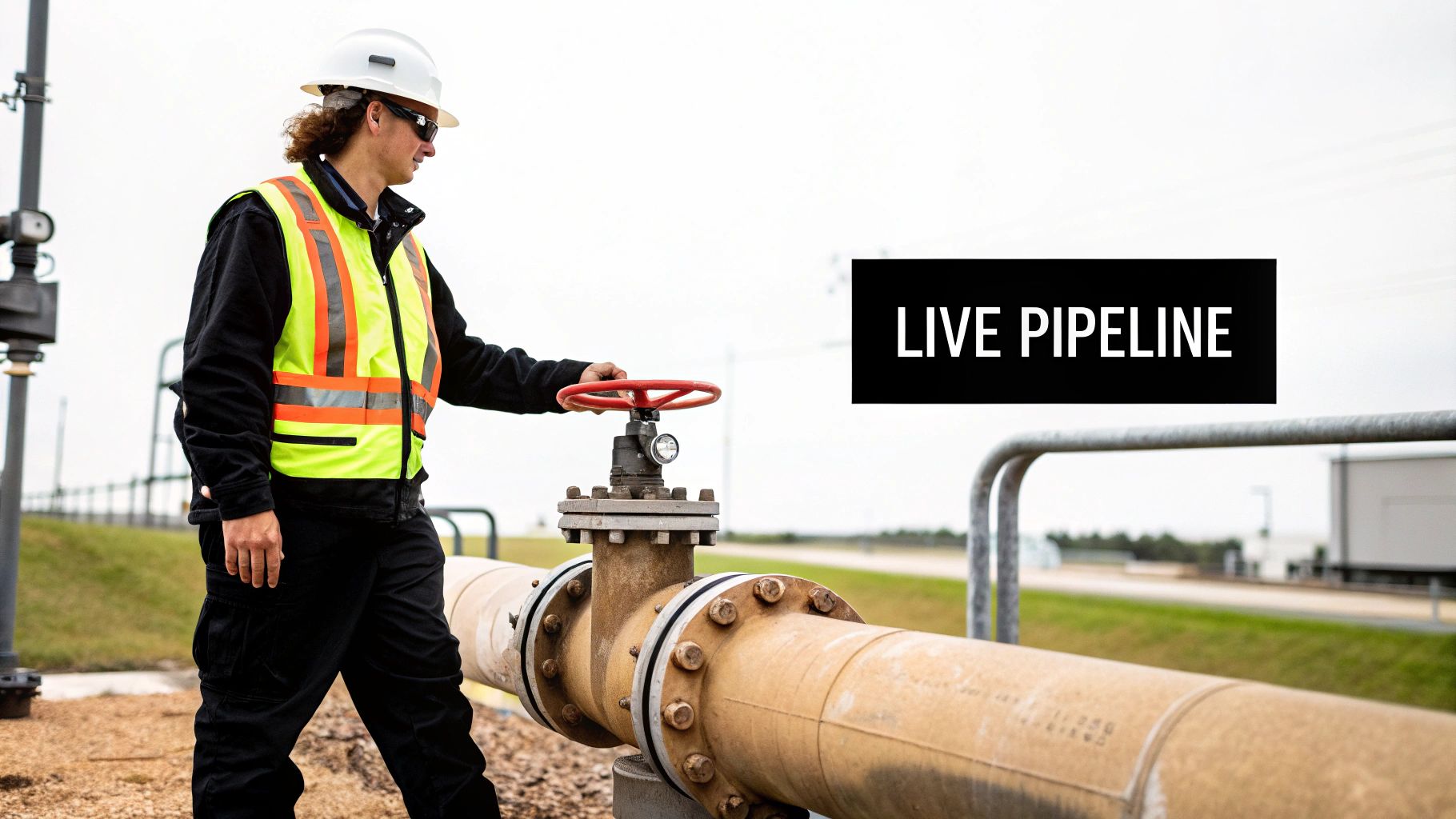
At its heart, hot tapping is all about avoiding the massive costs and logistical headaches of a full system shutdown. For a hospital, factory, or an entire community relying on a constant flow of gas or water, turning off the supply isn't just an inconvenience—it's a major operational and financial disruption. This is where hot tapping really shines.
By letting technicians safely tie in a new branch or install a valve on a live line, operations continue without a hitch. Think of it like a highway crew adding a new on-ramp to a busy interstate without ever closing a single lane. This capability is absolutely essential for things like:
- Expanding utility networks to serve new housing developments or industrial parks.
- Adding instruments like pressure gauges and temperature sensors for better system monitoring.
- Creating a bypass around a damaged section of pipe to allow for critical repairs.
- Integrating new equipment into an existing manufacturing process loop.
Why Avoiding a Shutdown Is a Big Deal
The old-school alternative is a planned shutdown. It’s often a much bigger, more expensive, and more complicated ordeal. Taking a major pipeline offline means depressurizing the system, purging all the product inside, doing the work, and then going through the entire process of refilling and re-pressurizing. This racks up costs from lost product, crew time, and operational downtime.
Hot tapping has been a game-changer for pipeline maintenance, especially for live natural gas lines. It’s a key reason companies like Blue Gas Express can effectively support their industrial and construction clients during system modifications.
The savings are real. According to an EPA analysis, performing just 320 hot taps a year on gas pipelines can generate over $184,760 in direct economic benefits simply by preventing the loss of gas that would otherwise be vented during a shutdown. You can dig into the numbers yourself in the EPA's analysis of hot tapping savings.
Hot Tapping vs Traditional Shutdown At a Glance
To really get a feel for the advantages, it helps to see a direct comparison between hot tapping and the traditional shutdown method.
| Aspect | Hot Tapping | Traditional Shutdown |
|---|---|---|
| Service Interruption | None. The system remains fully operational. | Complete service interruption is required. |
| Operational Downtime | Minimal to zero, preserving revenue and productivity. | Significant downtime, leading to lost production and sales. |
| Product Loss | Virtually none, as the product is never drained. | The entire section must be purged, resulting in wasted product. |
| Environmental Impact | Lower, as it avoids venting or flaring of gas. | Higher, due to the release or flaring of purged product. |
| Project Timeline | Faster, since it avoids lengthy shutdown procedures. | Slower and more complex due to depressurizing and purging steps. |
As you can see, the choice often comes down to balancing cost, safety, and the absolute need for operational continuity. For many critical infrastructure projects, hot tapping isn't just a preference—it's a necessity.
A Look at the Hot Tapping Process Step-by-Step
To really get a feel for what hot tapping is, it helps to walk through the process. While it's a job for highly trained specialists, the core idea is surprisingly simple. Think of it like performing keyhole surgery on a live pipeline—a precise, carefully planned operation designed to add a new connection without interrupting service or causing a leak.
The whole thing hinges on three key pieces of equipment working together: the fitting (the new permanent branch), the valve (the gatekeeper), and the hot tapping machine (the specialized drill). Let's break down how they come together.
This diagram shows the basic setup and gives a great visual of how all the parts connect.
You can see the hot tapping machine mounted on an isolation valve, which is bolted to a fitting welded onto the main pipeline. This entire stack creates a sealed, pressurized system, making sure the gas or liquid inside the pipe stays exactly where it should be.
Phase 1: Creating the Foundation
First things first, a permanent fitting has to be installed on the pipeline. This isn't just a random piece of hardware; it’s an engineered component, usually a split-tee fitting, that perfectly matches the pipe’s material, size, and pressure rating. For steel pipes, certified welders attach this fitting, creating a bond as strong as the pipe itself.
Of course, before any welding starts, the pipe's surface is thoroughly cleaned and inspected. Technicians use non-destructive testing (NDT), like ultrasonic scans, to confirm the pipe wall is thick and sound enough for the procedure.
Key Takeaway: That initial fitting isn't temporary. It becomes a permanent part of the pipeline, so the quality of the installation is absolutely critical for long-term safety and performance.
Phase 2: Installing the Gatekeeper
With the fitting welded on and inspected, a permanent isolation valve is bolted to its flange. This valve is the crucial control point for the new branch line.
During the actual hot tap, the valve stays wide open so the drill can pass through. Once the job is done, it can be closed to shut off the new branch, allowing for future work or maintenance without ever disrupting the main line.
Phase 3: Mounting the Tapping Machine
Now it's time for the main piece of equipment. The hot tapping machine is mounted directly onto the open valve. This machine is the real workhorse of the operation, consisting of a motor, a boring bar, and a custom cutter built to cleanly remove a section of the pipe wall (called a coupon).
The full assembly—machine, valve, and fitting—now forms a self-contained, pressurized system. Before any drilling begins, a pressure test is performed on this setup to guarantee it’s completely leak-proof. It's a final, critical safety check.
Phase 4: Making the Cut
With everything secure, the main event begins. The operator starts the machine and slowly advances the cutter through the open valve until it touches the pipe wall. The drill then cuts through the pipe, removing the coupon cleanly.
A clever pilot bit at the center of the cutter is designed to catch the coupon the moment it's free. The operator then carefully retracts the cutter, pulling the coupon back out through the valve. As soon as the cutter is clear, the valve is closed, and the new connection is officially live. The hot tapping machine can then be depressurized and removed, and the job is done.
When Is Hot Tapping the Right Call for Your Project?
Deciding to use hot tapping isn't really a question of if it can be done, but why it should be done. You’re not just asking, "Can we tap into this live pipe?" The real question is, "What’s the fallout if we don't?" Hot tapping becomes the clear answer when the cost of a full shutdown—whether measured in lost revenue, project delays, or pure logistical chaos—is a price you just can't afford to pay.
Think of it like performing surgery. You wouldn't put a patient under general anesthesia for a minor procedure if a local anesthetic would do the job with less risk and disruption. A full shutdown is like general anesthesia for your pipeline system; hot tapping a pipe is the precision, localized approach that keeps everything flowing without missing a beat.
Scenarios Where a Shutdown Is Off the Table
Some situations don’t just make a shutdown inconvenient; they make it practically impossible. These aren't obscure, once-in-a-lifetime problems. They're common hurdles that project managers and facility operators navigate all the time.
- Expanding Infrastructure: Imagine a construction crew needs to connect a new retail complex to the city's main gas line. Shutting down that main would cut off service for thousands of homes and businesses. That’s not an option. Hot tapping allows them to make that new connection without anyone losing their heat or ability to cook dinner.
- Upgrading an Active Process: An industrial plant needs to install a new sensor on a high-pressure steam line to get better efficiency data. Taking that line down, even for a few hours, could mean tens of thousands of dollars in lost production. With hot tapping, the sensor gets installed while the plant continues to run at full steam—literally.
- Emergency Repairs and Maintenance: A slow leak is discovered in a critical section of a water main. Instead of forcing a massive water outage on an entire neighborhood, technicians can hot tap the pipe on either side of the leak. They install a temporary bypass, keeping water flowing to every customer while they safely repair the damaged section.
This is where the meticulous, step-by-step process of hot tapping really shines, moving from careful prep to the final cut without ever compromising the active line.

As you can see, every stage is deliberately planned to maintain the integrity and pressure of the live pipeline.
A Strategic Business Decision
At the end of the day, opting to hot tap a pipe is a business decision rooted in continuity, efficiency, and smart risk management. It's about protecting your revenue, hitting tough deadlines, and making sure the community or facility that relies on that pipeline never even knows work is being done.
By looking at hot tapping as a tool for operational continuity, project managers can easily justify the cost. It’s not an expense; it’s an investment that prevents much larger financial losses from downtime.
The industry's growing reliance on this method is clear from market trends. The global market for pipeline-specific hot tapping machines was valued at a staggering $1.42 billion in 2024. This boom is largely fueled by demand in natural gas-heavy regions like North America and Europe, where providers like Blue Gas Express operate.
For construction firms in states like Virginia or South Carolina, hot tapping offers a fast, dependable way to add branch connections, which can actually reduce the need for temporary gas from mobile units during line installation delays. You can dig deeper into the data by exploring the pipeline hot tapping machine market to see the growth for yourself.
This widespread adoption shows just how valuable the technique is for major infrastructure projects where every single hour of uptime has a dollar amount attached to it. By understanding the specific scenarios where hot tapping excels, you can make smarter, more strategic decisions that keep your projects on track and your operations online.
The Risks and Safety Protocols Behind Hot Tapping

Let's be clear: drilling into a live, pressurized pipeline is serious business. It's a highly specialized skill, and while it boasts an excellent safety record, you can't ignore the inherent risks. The potential for leaks, equipment failure, or metallurgical problems with the host pipe is always there if the job isn't managed with absolute precision. This is why you don't hand this work over to a general contractor—it demands a team that lives and breathes pipeline integrity.
Success in hot tapping a pipe comes down to identifying and eliminating those risks long before a single tool is picked up. The entire procedure is built on a foundation of proactive safety measures, not reactive fixes. It's all about engineering problems out of the equation from the very start.
Turning High Stakes into a Controlled Process
For every potential hazard in a hot tapping operation, there’s a proven safety protocol to counter it. This systematic approach is what transforms a high-stakes task into a controlled, predictable, and safe procedure. These aren't just suggestions; they are the bedrock of a successful project.
Here’s how a professional team mitigates the risks:
- Non-Destructive Testing (NDT): Before any cutting begins, technicians use methods like ultrasonic testing to get a complete picture of the pipe's health. This confirms the wall has sufficient thickness and that there are no hidden weak spots from corrosion or other defects.
- Meticulous Calculations: Engineers run detailed calculations that account for the pipe’s pressure, temperature, flow, and material properties. This ensures every piece of equipment and every fitting is perfectly suited for the job's specific conditions.
- Strict Adherence to Standards: The entire operation is governed by rigorous standards from organizations like the American Petroleum Institute (API) and the American Society of Mechanical Engineers (ASME). Following these guidelines isn't optional—it's essential for safety and reliability.
A well-executed hot tap is a masterclass in careful engineering and procedural discipline. The goal is to make a critical modification feel like a routine event by leaving absolutely nothing to chance.
The Human Factor and Regulatory Oversight
Beyond the technical side, the human element is what truly ensures a safe outcome. A successful hot tap requires certified professionals operating specialized equipment. Technicians need the training and experience to manage every variable, from the forces exerted by the cutter to the precise operation of the pressure-containment machinery.
For high-risk jobs like hot tapping, robust permit to work systems are critical. These formal procedures are in place to guarantee that every risk has been assessed and that every person on site knows their exact role in keeping the operation safe.
This relentless focus on safety is why hot tapping, when done right, is such a valuable tool. It drastically reduces the risks and costs associated with pipeline incidents. In fact, historical data shows that many unintentional gas releases from high-pressure lines were linked to invasive repairs that required a full shutdown—a scenario hot tapping completely avoids. EPA economic models even show that 320 annual hot taps can produce net savings of $184,760 per year, highlighting its economic and safety benefits.
Ultimately, the success of hot tapping a pipe comes down to the experience of the team holding the tools. Partnering with a proven specialist is the most important decision you can make.
What Are the Alternatives to Hot Tapping?
While hot tapping is an incredibly effective way to keep operations running, it isn't always the right or only answer. Sometimes, the old-fashioned approach of a planned shutdown is the only safe path forward. Knowing when to choose which method comes down to understanding the trade-offs between downtime, cost, and safety.
Every project is different. The right decision hinges on a careful assessment of the pipeline's condition, the nature of the work, and just how much service interruption you can tolerate.
The Traditional Method: Planned Shutdowns
A planned shutdown is exactly what it sounds like: you bring a section of the pipeline completely offline. Think of it like a major plumbing repair in a hospital. You wouldn't risk cutting into a critical water line; instead, you’d schedule a time to shut off the water to that entire wing, make the fix, and then turn it back on.
This is a major undertaking. Before a single cut is made, a whole sequence of events has to happen:
- Isolate: First, you have to seal off the work area by closing valves both upstream and downstream.
- Depressurize: The pressure inside that isolated section is slowly and safely bled off until it reaches normal atmospheric pressure.
- Purge and Vent: Finally, whatever product is left in the line—be it natural gas, steam, or water—has to be completely removed. For something flammable like natural gas, this involves pumping in an inert gas like nitrogen to push the product out safely before venting.
Only when the line is isolated, empty, and at zero pressure can technicians safely start their work.
When a Shutdown Is the Only Choice
For all its downsides—namely lost revenue and service disruption—a planned shutdown is sometimes unavoidable. Hot tapping is a precision technique that depends on the pipeline being in good structural health. If there's any doubt about the pipe's integrity, a shutdown becomes the only responsible option.
A shutdown is pretty much non-negotiable in a few key situations:
- The pipe’s integrity is in question due to severe corrosion, cracks, or other known structural flaws.
- The project involves a massive overhaul, like replacing an entire section of the pipeline, which is far too complex for a simple tie-in.
- The pipe is made of a material that can't be safely welded on, such as brittle cast iron or certain composites.
In these cases, the risk of working on a live, compromised line is just too high. The cost of a temporary shutdown is a small price to pay for safety.
Other Key Terms: Cold Tapping and Line Stopping
You’ll often hear two other terms in these discussions: cold tapping and line stopping. They’re related but serve very different purposes.
Cold tapping follows the exact same mechanical process as hot tapping, but it’s done on a pipeline that’s already been shut down and depressurized. It’s a way to add a new connection while the line is already offline for other maintenance.
Line stopping, on the other hand, is a clever technique for creating a temporary blockage in a live pipeline. It involves inserting a special plugging head to stop the flow, allowing for repairs to be made downstream without shutting down the whole system. It's often used alongside hot tapping to isolate a very specific section.
The Bottom Line: Hot tapping is for working on live, pressurized lines to completely avoid a shutdown. Cold tapping and planned shutdowns are for depressurized lines, where service interruption is part of the plan.
Comparing Pipeline Intervention Methods
To make the right call, you need to weigh the pros and cons of each approach. This table breaks down the key factors to consider.
| Method | Downtime | Cost Impact | Environmental Impact | Best Use Case |
|---|---|---|---|---|
| Hot Tapping | None | Low (avoids lost revenue) | Low (prevents product venting) | Adding connections to a critical, live pipeline without interrupting service. |
| Cold Tapping | Required | Medium (downtime costs apply) | High (requires product purge) | Making a new connection during a pre-planned shutdown for other maintenance. |
| Planned Shutdown | Required | High (significant lost revenue) | High (requires product purge) | Performing major repairs or working on a pipe with compromised structural integrity. |
Ultimately, the choice comes down to balancing the urgent need for continuous operation against the pipeline's physical condition and the scale of the job. For most new connections and modifications on healthy, critical infrastructure, hot tapping is simply the best way to protect your uptime and your bottom line.
Using Temporary Gas During Pipeline Projects
So, hot tapping is brilliant for avoiding most shutdowns. But what about those rare times when things don't go perfectly to plan? Even the best-laid plans can hit a snag, creating a gap between the new infrastructure being ready and the final connection being made. This is where a temporary mobile gas solution becomes your project's best friend, ensuring operations never skip a beat.
Think of temporary gas not as an alternative to hot tapping, but as a strategic partner. It's there to bridge logistical gaps and provide total energy security when the timeline for that permanent tie-in gets a little fuzzy. It keeps the project moving and saves everyone from the headache of costly delays.
A Safety Net for Unavoidable Delays
Let's paint a picture. A new commercial building is finished and ready for tenants. The only problem? The final hot tap connection to the main gas line is held up for a week because of a permitting issue. Without gas, the developer can't fire up the HVAC systems, test the kitchen equipment, or get that all-important certificate of occupancy. Every single day of delay means lost rent and ballooning costs.
This is a perfect job for a mobile gas provider like Blue Gas Express. A temporary compressed natural gas (CNG) or liquefied natural gas (LNG) unit can be on-site within hours. This mobile supply delivers the fuel needed to get the building's systems fully commissioned, secure the occupancy permit, and let the business open right on schedule.
Bridging the Gap in Planned Maintenance
Temporary gas is also a lifesaver during planned maintenance windows where even hot tapping can't solve the whole problem. Imagine a manufacturing plant has to shut down a specific section for an internal equipment upgrade. The main pipeline is still live, but this one isolated part of the facility has to go offline.
Instead of grinding all production to a halt, a temporary gas supply can be brought in to power the critical machinery that would otherwise be down. This approach really gives you the best of both worlds:
- Minimized Disruption: You only take down the essential section, while the rest of the facility keeps humming along.
- Operational Continuity: Key production lines stay active, preventing a complete—and very expensive—shutdown.
- Flexibility: The temporary supply can be scaled up or down to match the exact energy needs for the duration of the maintenance.
Key Insight: Temporary gas turns an "either/or" problem into a "both/and" solution. You can perform the necessary maintenance and keep essential operations running, so you never have to choose between progress and productivity.
By building temporary mobile gas solutions into the project plan from the start, facility managers and developers can create a truly resilient energy strategy. This ensures that whether you're facing an unexpected delay in hot tapping a pipe or navigating a planned maintenance event, 100% operational uptime is always within reach.
A Few Common Questions About Hot Tapping
Let's tackle some of the practical, real-world questions that always come up when people first consider hot tapping a pipe. These are the things you're probably wondering about, and getting clear answers can help you understand the process better.
Is It Really Safe to Hot Tap a High-Pressure Natural Gas Line?
Yes, it is. When done correctly by certified professionals who live and breathe industry standards like API 2201, hot tapping is a remarkably safe and routine procedure, even on high-pressure gas mains.
Think of it as a carefully choreographed operation. Before a single cut is made, the pipe undergoes extensive testing to confirm it can handle the job. Every calculation is double-checked, and the specialized equipment is designed to contain the pressure at every stage, virtually eliminating the risk of leaks.
What Kinds of Pipes Can You Hot Tap?
Hot tapping is incredibly versatile. It's most commonly performed on carbon steel and stainless steel pipes—the workhorses of the natural gas and industrial worlds.
But the list doesn't stop there. Skilled technicians can also successfully tap into other materials like ductile iron and even some high-density plastics (HDPE). The key is always a thorough pre-job analysis to check the pipe's condition, wall thickness, and material to ensure it's compatible with the welding and equipment involved.
A Quick Word of Caution: You can't hot tap everything. Brittle materials like cast iron or PVC just aren't candidates. The localized stress from the procedure is more than they can safely handle, making a planned shutdown the only viable path forward.
How Long Does a Hot Tap Usually Take?
The timeline really depends on the specifics of the job. A number of factors come into play, including the pipe's diameter, the pressure inside, the material it's made of, and how easy it is to access the work site.
A simple tap on a small, accessible pipe could be wrapped up in a day. On the other hand, a large-diameter, high-pressure tap in a tight, congested area might take several days to account for setup, safety checks, and the procedure itself.
But here’s the most important takeaway: no matter how long the job takes, your main line never stops flowing. Your operations continue at full capacity, completely uninterrupted.
When you hit a snag or a planned maintenance window gets complicated, a gap in your gas supply can bring everything to a halt. That’s where Blue Gas Express comes in. Our temporary mobile gas solutions are designed to keep your project on track and your facility online, giving you total peace of mind. Learn how we can keep your project moving forward without interruption by visiting https://bluegasexpress.com.