

So, what exactly is a home fueling station for CNG? It’s a private, on-site system that takes natural gas straight from a standard utility line, compresses it, and lets you refuel vehicles or power equipment right on your property.
Think of it as your own personal gas station—only instead of gasoline or diesel, you're using cleaner, more affordable natural gas.
Understanding Your On-Site CNG Fueling Options
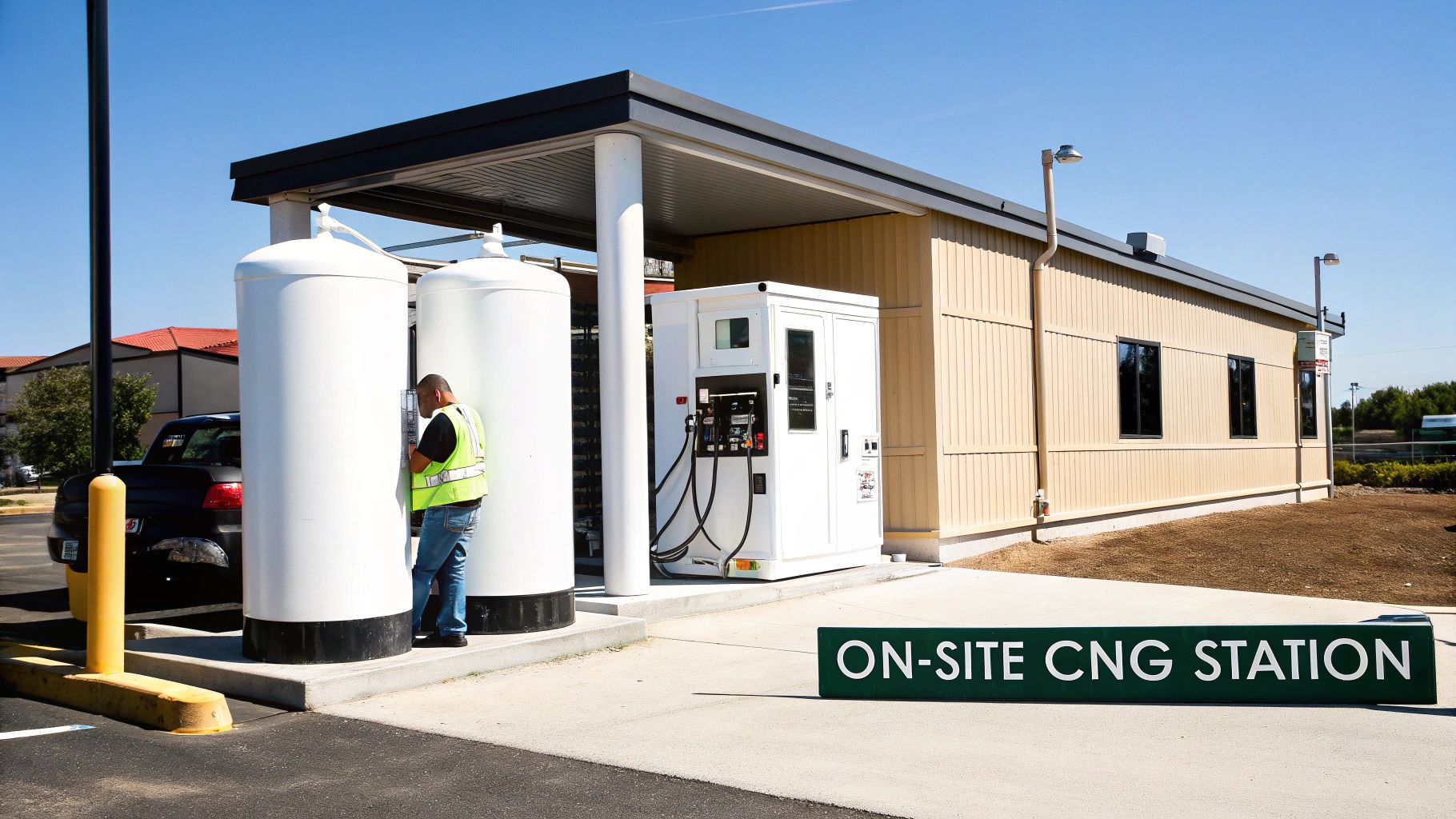
Imagine having a direct line of fuel for your construction equipment, backup generators, or vehicle fleet right where you need it, whenever you need it. That’s the core promise of a home fueling station for CNG (Compressed Natural Gas). It completely cuts out time-wasting trips to off-site fueling depots and gives you much greater control over your operations and energy costs.
This idea is catching on fast as more industries look for reliable and cleaner energy. The global compressed natural gas market, valued at USD 92.21 billion, is on track to hit USD 121.42 billion by 2032, which signals a major move toward energy independence. For builders and industrial managers, this trend makes it clear: on-site CNG is becoming a key strategic asset. You can dig into more data on the global CNG market growth to see what it means for businesses.
The Core Components of a CNG Station
The technology behind it is advanced, but the basic idea is pretty simple. Any on-site CNG system, whether it’s for a single home or a massive commercial project, relies on three key parts working together. Knowing what they do makes the whole process much less mysterious.
- The Compressor: This is the heart of the operation. It pulls low-pressure natural gas from your utility line and pressurizes it—a lot. Think of it as a super-powered air compressor built specifically for natural gas.
- The Storage Tanks: After the gas is compressed, it needs a safe place to stay until you’re ready to use it. These high-pressure tanks, often set up in a "cascade" system, hold the CNG so it’s ready for a quick fill.
- The Dispenser: This is the part you actually interact with. It's the pump and nozzle used to get the CNG into your vehicle or equipment, complete with meters and safety shut-offs to ensure every fill-up is safe and accurate.
A home CNG fueling station essentially brings the utility's pipeline directly to your equipment. It's about closing the last-mile gap in energy delivery, giving you complete control over your fuel supply and operational timelines.
This guide will walk you through everything you need to know to put this technology to work. We’ll cover how these systems operate, weigh the pros and cons of permanent installations versus flexible mobile solutions, and break down the costs and safety rules. By the time you're done, you'll have a clear roadmap for deciding if an on-site home fueling station cng is the right move for your project.
How a Home CNG Fueling System Works
Turning the natural gas from your utility line into a high-pressure vehicle fuel sounds pretty technical, but it’s actually a very logical process. A home fueling station cng is essentially a small, self-contained refinery that takes the gas you already have and gets it ready for your equipment. Each step is designed to make sure the fuel is clean, safe, and compressed enough to get the job done.
You can really break the whole thing down into four main stages. It starts by pulling from your existing gas line, then it purifies the gas, cranks up the pressure, and finally, safely pumps it into your vehicle or machinery. Seeing it this way makes it much less mysterious.
Step 1: Tapping Into the Utility Line
Everything begins with your property's existing natural gas pipeline—the same one that might run to your building's furnace or water heater. The gas in this line is at a very low pressure, usually less than 1 psi (pounds per square inch). That's fine for a stove, but it won't do much for heavy equipment.
The home fueling station cng connects right to this low-pressure source. This is what makes it so convenient; you're using a resource you already have on-site to create your own fuel supply. Think of it like hooking up a hose to a tap before a pressure washer boosts the power.
Step 2: Filtering and Drying the Gas
Before we can boost the pressure, the gas needs a good cleaning. The natural gas from the utility line isn't 100% pure—it contains tiny amounts of water vapor, oils from pipeline compressors, and other small particles. If these impurities get into the system, they can wreak havoc on the sensitive parts of both the fueling station and your equipment.
To stop that from happening, the gas is pushed through a series of filters and dryers. This is a critical purification step that strips out moisture and other gunk. It guarantees that only clean, dry natural gas makes it to the compression stage, which is vital for protecting your investment and keeping everything running smoothly for years.
The filtering and drying stage is non-negotiable for the health of the system. Pushing untreated gas into a high-pressure compressor is a surefire way to cause corrosion and breakdowns, just like putting dirty water into a high-performance engine.
Step 3: Compressing the Gas to High Pressure
This is where the magic really happens. After being cleaned, the low-pressure gas flows into the compressor, which is the heart of the system. The compressor’s job is to dramatically ramp up the pressure, essentially squeezing the gas molecules tightly together so you can pack more energy into a smaller space.
The pressure is jacked up from less than 1 psi to as high as 3,600 psi or even more. This massive increase is what transforms ordinary natural gas into powerful Compressed Natural Gas (CNG).
When it comes to compression, you generally have two options:
- Slow-Fill: This approach uses a smaller compressor that chugs along for several hours—often overnight—to fill a vehicle directly. It’s perfect for fleets that sit idle for long stretches.
- Fast-Fill: This method uses a much bigger, more powerful compressor to first fill a series of high-pressure storage tanks, often called a cascade. When a vehicle pulls up, the gas is rapidly transferred from these tanks, making the fill-up time feel just like a regular gas station pump—only a few minutes.
Step 4: Dispensing the CNG Safely
The last step is getting the high-pressure CNG from the station into your equipment's tank safely and efficiently. This is handled by a special dispenser hose and nozzle built to withstand intense pressures.
The dispenser is loaded with safety features, like breakaway hoses and automatic shut-offs, to prevent any leaks or accidents. The nozzle locks onto the vehicle’s fuel port to create a perfect seal for a secure transfer. Once you’re connected, the high-pressure gas flows from the storage cascade into your equipment’s tank, and you’re ready to roll with clean, dependable power.
Choosing Between Permanent and Mobile CNG Stations
When it comes to setting up a CNG fueling station, project managers and builders face a critical decision. This isn't just about picking equipment; it's a strategic choice that dictates your budget, timeline, and how nimble you can be. You can go one of two ways: build a permanent, fixed station or bring in a temporary, mobile solution.
Think of it this way. A permanent station is like building a house—a long-term investment designed for consistent, heavy use. A mobile unit, on the other hand, is like renting a fully-furnished apartment—it gives you everything you need right away, without the long-term commitment and massive upfront cost.
The Case for a Permanent CNG Station
A permanent CNG fueling station is the traditional route, and it makes perfect sense for organizations with a predictable, long-term need for on-site fuel. We're talking about commercial fleets with dozens of CNG vehicles returning to the same depot every night or industrial plants with steady fuel demands for their machinery.
These stations are built to last and handle high volumes. They connect directly to the main utility gas line and can be scaled up to meet enormous fuel requirements. But this permanence comes with some serious trade-offs.
- Major Capital Investment: You’re buying the compressor, storage tanks, and dispensers outright.
- Lengthy Timelines: The journey from initial design to a fully operational station can easily stretch over many months, bogged down by site prep, construction, and a mountain of permits.
- Fixed Location: Once it's built, it’s not going anywhere. This lack of flexibility is a major downside if your operational needs change or your project relocates.
The Flexibility of Mobile CNG Solutions
Mobile CNG stations offer a totally different value proposition centered on speed and adaptability. These are self-contained, trailer-mounted systems that can be delivered and operational in a matter of hours or days, not months. For builders and utility managers staring down a tight deadline, that kind of speed is a real game-changer.
Let's say you're working on a new commercial building. The permanent gas line is delayed, but you absolutely have to commission the HVAC systems to get your certificate of occupancy. A mobile CNG unit from a provider like Blue Gas Express can step in and bridge that gap, keeping the project on track and helping you avoid costly penalties. These units are also perfect for temporary needs like generator testing, job site heating, or providing emergency fuel during a utility outage.
Mobile CNG solutions are the rapid-deployment force of the natural gas world. They aren't meant to replace permanent infrastructure but to provide a critical stopgap, ensuring operational continuity when time is your most valuable resource.
The real beauty of this model is its service-based approach. You sidestep the huge upfront cost and long-term maintenance headaches, paying only for the fuel you need, exactly when you need it.
This process flow shows how natural gas is taken from the utility, filtered, compressed, and dispensed for use.
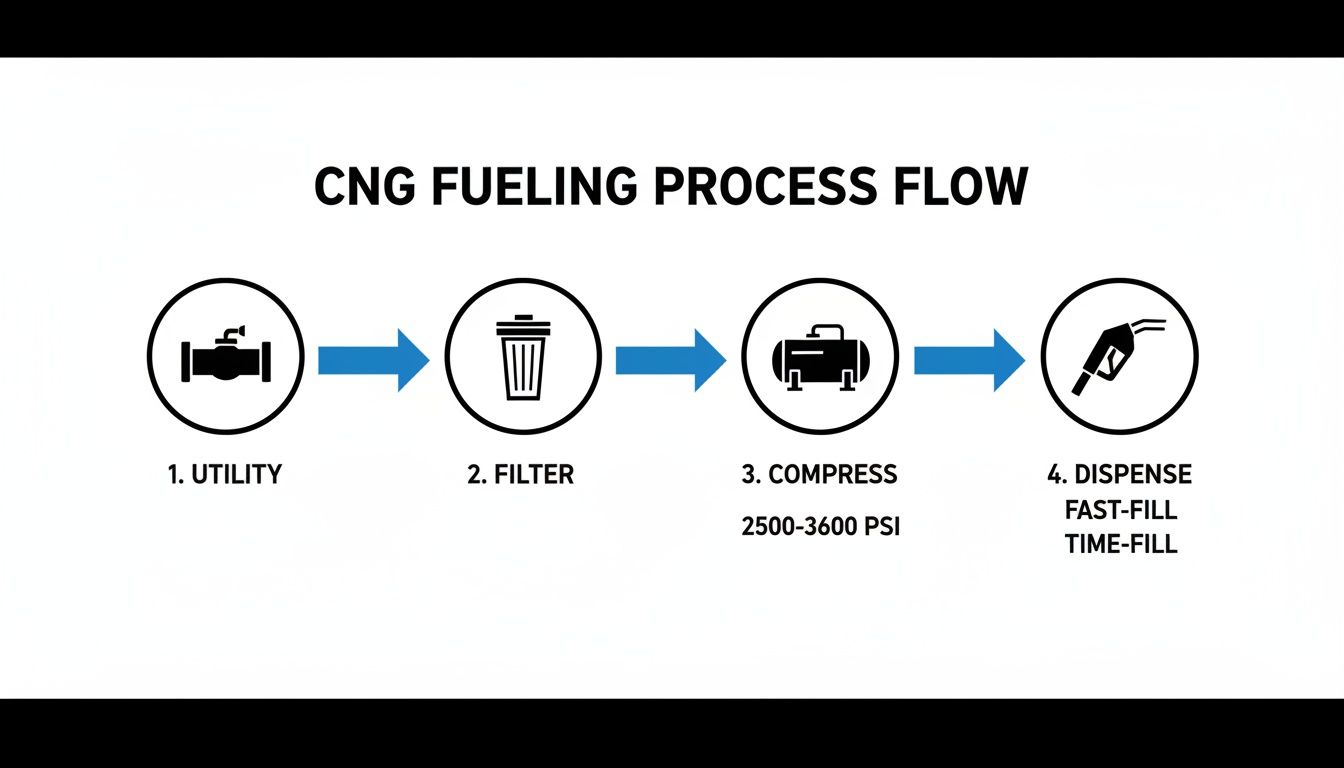
While this simple four-step process is the backbone of both station types, mobile providers have perfected its on-demand delivery.
Permanent vs Mobile CNG Solutions At A Glance
To really get a handle on the best choice for your project, it helps to see how these two options stack up side-by-side. While the national CNG refueling infrastructure is growing, there are still only around 700 to 1,385 public and private stations in the U.S., compared to over 125,000 gasoline stations. This gap makes mobile solutions an essential tool for filling in where permanent stations aren't feasible or available yet. You can find more insights on the expansion of the clean transport industry.
This table breaks down the key differences between building a permanent station and using a mobile service.
| Feature | Permanent CNG Station | Mobile CNG Solution |
|---|---|---|
| Deployment Speed | Months to over a year | Hours to a few days |
| Upfront Cost | High capital expenditure | Low to none (service-based) |
| Flexibility | Fixed in one location | Highly mobile, can be moved |
| Permitting | Complex and lengthy process | Handled by the service provider |
| Maintenance | Owner's responsibility | Managed by the service provider |
| Best Use Case | Long-term, high-volume fleet fueling | Temporary, urgent, or stopgap needs |
In the end, the right call comes down to your project's specific needs. If you’re setting up a fleet that will operate for the next decade, investing in a fixed station is a solid long-term play. But if your project is temporary, urgent, or you're just not sure what the future holds, the agility of a mobile CNG solution is tough to beat.
Getting Real About the Costs and ROI of Your CNG Station
Let's cut to the chase—what’s a home fueling station cng actually going to cost? Before you make any decisions, you need a clear picture of the investment and the potential returns. The financial story is completely different depending on whether you're building a permanent station from the ground up or bringing in a flexible mobile solution.
For builders and property managers, this isn't just about buying equipment. It's about keeping projects on schedule, sidestepping expensive delays, and getting the best possible return on investment (ROI). Each path has its own price tag and its own unique financial upside.
Breaking Down Permanent Station Costs
Think of a permanent CNG station as a major infrastructure project, because that's exactly what it is. It's a significant capital investment, and the total cost is a mix of hardware, labor, and all the "soft costs" that come with any serious construction job.
Here’s what you’ll need to budget for:
- Core Equipment: Your biggest line items will be the compressor, storage tanks, and dispenser. The price tag is directly tied to the size and capacity you need, easily running from tens of thousands to well over a hundred thousand dollars.
- Installation and Site Prep: This is far from a plug-and-play operation. You're looking at costs for pouring a concrete pad, running high-voltage electrical service to power the compressor, and trenching for the utility gas line hookup.
- Soft Costs: These are the expenses that can sneak up on you. They include everything from engineering and design fees to the costs of navigating a tricky permitting process, plus fees for final inspections and commissioning.
A permanent station is a valuable long-term asset, but the upfront cash required is substantial, and it can take a while to start seeing a return.
The Service-Based Model of Mobile CNG
Mobile CNG completely flips the financial script. Instead of a massive upfront purchase, you're paying for a service. This model is all about speed and flexibility, taking the burden of owning and maintaining the equipment off your shoulders.
With a mobile provider, you sidestep all the big-ticket costs of a permanent station. You’re simply paying for the service of getting CNG delivered right where you need it, when you need it. This fee typically wraps equipment rental, the fuel itself, and all the necessary maintenance and compliance into one predictable cost. It turns a huge capital expense into a manageable operational expense, which is a lifesaver for budgeting on temporary or time-sensitive projects.
The real financial win with a mobile CNG solution often comes from the disasters it helps you avoid. By getting you immediate fuel to commission generators or heat a new building, it can save you from thousands of dollars in project delay penalties and help you secure that all-important certificate of occupancy right on schedule.
Calculating Your Return on Investment
The ROI for a home fueling station cng is about much more than just the price at the pump. While CNG is almost always cheaper than diesel or propane, the biggest financial gains for many projects come from simply keeping the operation running smoothly.
With a permanent station, you calculate ROI over years of steady use, factoring in lower fuel prices and less wear-and-tear on your equipment. Because CNG burns so much cleaner, you can expect 20-30% reduced maintenance costs, which is a huge deal for vehicle fleets or industrial machinery. It’s no surprise the global market for these stations is projected to hit USD 45 billion by 2033, driven by these clear economic and environmental benefits. You can find more details in this natural gas fueling station market report.
For mobile solutions, the ROI is often immediate and dramatic. Picture a commercial construction project where a utility hookup delay is threatening to push your grand opening back by a month. The cost of bringing in a mobile CNG unit for a few weeks is a tiny fraction of the financial hit you’d take from penalties, lost lease revenue, and damage to your reputation. In those moments, the return on investment isn't just good—it's game-changing.
Navigating Safety Codes and Permitting
When you're dealing with compressed natural gas, "good enough" simply doesn't cut it. Getting the safety codes and permitting right isn't just a bureaucratic step—it’s the absolute bedrock of a successful project, protecting your people, property, and investment.
Think of this process less as a hurdle and more as a proven blueprint for a safe and reliable installation. Every single home fueling station cng project, whether it's a permanent fixture or a temporary mobile unit, is subject to strict oversight. These rules exist for one reason: to prevent accidents. Getting this right from day one saves you from a world of headaches, from costly fines and project delays to, most importantly, serious safety hazards.
Understanding the Key Regulations
The world of gas safety regulations can seem like alphabet soup at first, but it really boils down to a few key authorities. The big one is the National Fire Protection Association (NFPA). Their NFPA 52 code is essentially the bible for CNG systems, laying out the core safety standards for how stations are designed, built, and operated.
But the NFPA is just where the conversation starts. You also have to satisfy a few other key players:
- Local Fire Marshals: At the end of the day, your local fire department has the final authority on what's considered safe in their jurisdiction.
- Municipal Building Codes: These local rules govern everything from the specifications for the concrete pad to the fine print on electrical wiring.
- Utility Company Standards: Your natural gas provider has its own strict set of requirements for anything connecting to their supply lines.
As you work through these codes, developing a risk management plan is a crucial step. It forces you to think through potential hazards and plan for them before a shovel ever hits the ground.
Safety isn't just a chapter in the manual; it's the entire foundation of a successful CNG fueling project. Adhering to codes isn't about checking boxes—it's about building a system that is fundamentally safe by design.
Your Essential Safety Checklist
While the specific rules can change from one town to the next, a handful of core safety principles are universal. These are the non-negotiables that inspectors will be laser-focused on.
- Proper Site Selection: The station needs space. It has to be located a safe distance from buildings, property lines, and any potential source of ignition. Good ventilation is also critical to ensure natural gas can't accumulate.
- Mandatory Safety Equipment: Every setup must have key safety gear. This means clearly marked and easily accessible emergency shut-off switches (E-stops) and sensitive methane detectors that will trigger an alarm and automatically cut off the gas flow if a leak is ever detected.
- Correct Installation Protocols: This is no place for DIY. All electrical components in the area must be rated as explosion-proof, and every pipe and fitting has to be certified to handle the intense pressures of CNG. This work demands certified technicians who know exactly what they're doing.
The Permitting Workflow Simplified
Getting the right permits can feel like a marathon, but the path is pretty straightforward. It starts with submitting detailed engineering plans to your local building department and fire marshal. After they've reviewed and approved everything, construction can begin. But you’re not done yet. Before the station can go live, it has to pass a final, thorough inspection.
This is exactly where bringing in an experienced mobile provider can be a game-changer. A company like Blue Gas Express takes the entire compliance burden off your shoulders. Their equipment arrives on-site already vetted, code-compliant, and ready to go, which can dramatically accelerate your project timeline.
Real-World Applications of Mobile CNG Solutions
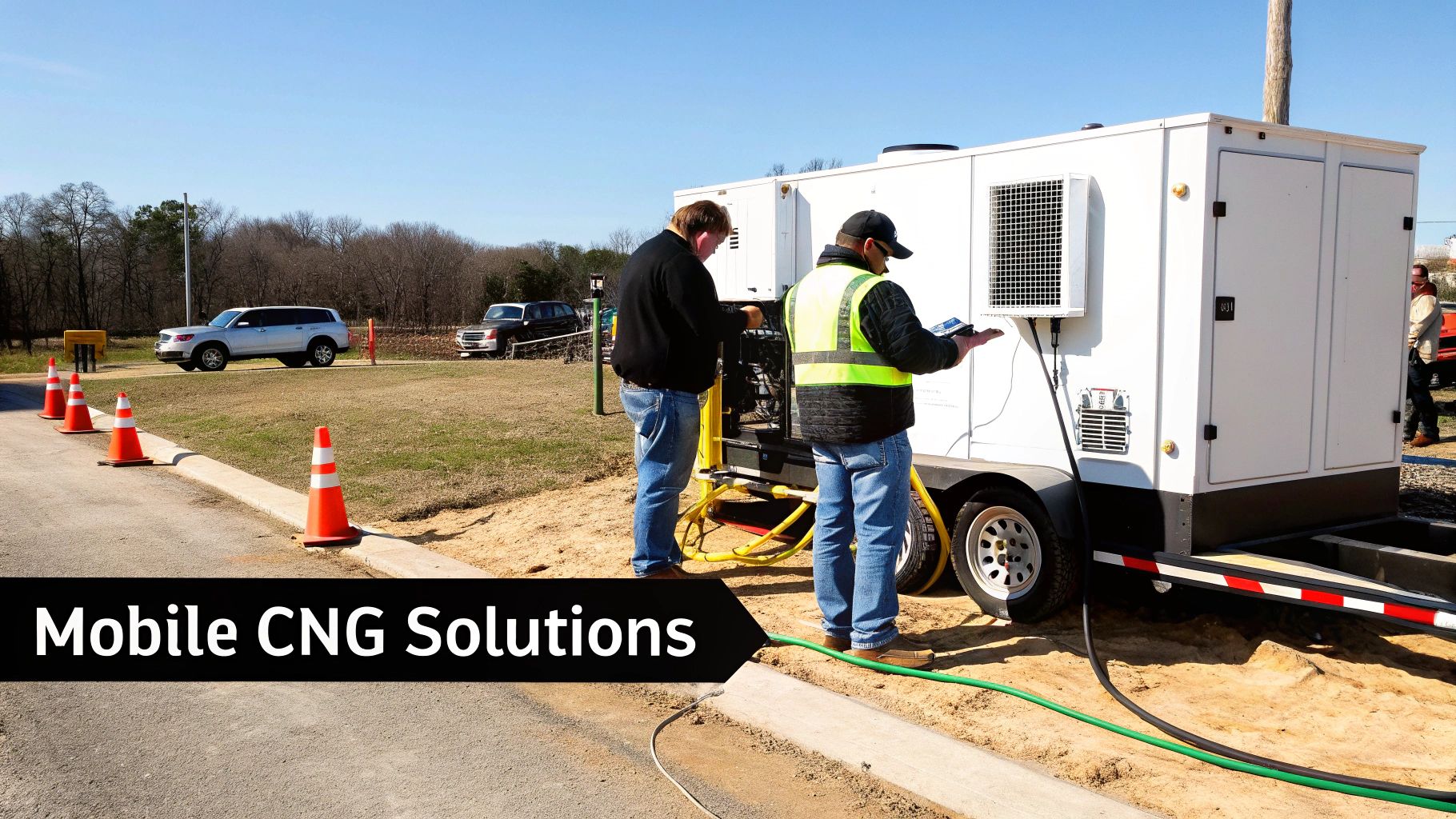
The real value of a mobile CNG solution clicks into place when you see it solve a problem that would otherwise bring a project to a grinding halt. We're not just talking about theoretical benefits here. These are practical, boots-on-the-ground fixes that save serious time, money, and headaches.
Think of a mobile home fueling station cng setup as an energy bridge. It’s a flexible solution that keeps the lights on—and the heat running—when permanent infrastructure just isn't ready. Let's look at a couple of common scenarios where this technology becomes a project-saver.
Securing a Certificate of Occupancy on a Tight Deadline
Picture this: a commercial developer is in the final stretch of building a new office tower. The grand opening is just two weeks away, but there's a show-stopping problem. The local utility is running six weeks behind schedule on connecting the permanent natural gas line.
No gas means no way to fire up the HVAC systems for final testing. And without a fully commissioned HVAC system, there's no way to pass the final inspections and get the Certificate of Occupancy. The entire project is on the verge of a costly delay, threatening financial penalties and pushing back tenant move-in dates.
Instead of accepting defeat, the developer brings in a mobile CNG provider.
- Timeline: A mobile CNG trailer, like those from Blue Gas Express, is on-site and connected to the building's main gas inlet in under 48 hours.
- Outcome: The HVAC systems are fully tested and commissioned. The building sails through its final inspection, secures the permit, and opens for business right on schedule.
What could have been a multi-week, multi-million-dollar disaster becomes a simple logistical step. The problem is solved in days, not months.
Ensuring Uptime with Backup Generator Testing
Now, let's consider a mission-critical data center. Its last line of defense against a blackout is a massive natural gas backup generator. To meet compliance standards and guarantee it will work when needed, this generator has to be tested under a full load for several hours every year.
Here’s the catch: that test consumes a huge volume of natural gas, which could easily disrupt the main supply for the rest of the facility. You can't just take other critical systems offline, and building a separate, dedicated high-pressure gas line just for annual testing is far too expensive.
For mission-critical facilities, "hope" is not a strategy. A mobile CNG unit provides a dedicated, isolated fuel source, allowing for rigorous generator testing without impacting daily operations or compromising the main gas supply.
A mobile CNG unit is the perfect solution. A high-capacity trailer is brought to the site just for the test and connected directly to the generator. This creates an independent, high-volume fuel source that completely bypasses the facility's main gas line.
The data center can run its vital diagnostics safely without any interruption to live operations, proving they’re ready for a real emergency.
Got Questions About CNG Fueling Stations? We've Got Answers.
Even after getting the rundown on the technology, it's natural to have some real-world questions about putting a CNG fueling solution to work. Here are some of the most common things we hear from builders, project managers, and property owners.
How Much Space Does a Home CNG Fueling Station Need?
The footprint really depends on what you're trying to do. A small, permanent slow-fill station for a single truck might only need a spot the size of a large outdoor AC unit, as long as it has plenty of ventilation. On the other hand, a commercial-grade fast-fill station needs a dedicated concrete pad—we're talking several hundred square feet to safely house the compressor, storage tanks, and dispenser.
Mobile solutions are a different story. They come self-contained on a trailer. All you need is a safe, accessible parking spot near where you'll be using the gas. This makes them incredibly flexible for tight job sites or temporary projects where you can't spare the real estate.
Can I Use a CNG Station for More Than Just Vehicles?
Absolutely. While filling up trucks is a common use, CNG is a workhorse fuel for all sorts of commercial and industrial jobs.
- Generator Commissioning: Fire up large-scale generators for testing without touching the main utility supply.
- Temporary Building Heat: Fuel industrial heaters to keep construction going through the winter and stop pipes from freezing.
- Securing Occupancy Permits: Run commercial kitchen appliances or HVAC systems to pass those final inspections before the permanent gas line is live.
What Kind of Maintenance Does a CNG Fueling System Require?
If you own a permanent station, maintenance is on you. It's an ongoing operational cost. The compressor, filters, and safety gear need regular check-ups and service from certified technicians to keep everything running safely and efficiently.
This is where temporary mobile solutions really shine. When you work with a service provider like Blue Gas Express, they handle 100% of the equipment maintenance, monitoring, and safety compliance. It takes a huge operational headache off your plate so you can focus on the actual project.
One of the biggest perks of the mobile CNG model is that all the responsibility shifts to the provider. All the maintenance, safety checks, and compliance tasks are managed for you, turning a complex job into a simple, hands-off service.
How Long Does It Take to Fuel Equipment with CNG?
Fueling time is all about the application. For a vehicle at a fast-fill home fueling station cng, it feels just like a regular gas station pump—you're done in a few minutes.
But for bigger jobs that need a constant fuel source, like running a generator or a boiler, it's a different process. The mobile unit connects directly to your equipment's gas inlet, feeding it an uninterrupted supply for hours or even days. When one trailer gets low, another full one is swapped in seamlessly, so you experience zero downtime.
Ready to stop letting natural gas interruptions delay your projects? Blue Gas Express delivers reliable, on-demand mobile CNG solutions right to your site, keeping your operations on schedule and on budget. Visit Blue Gas Express to learn how we can bridge your energy gap today.