

Think of a gas transport company as a mobile pipeline. It’s a straightforward but powerful concept: they bring compressed natural gas (CNG) or liquefied natural gas (LNG) directly to any site that can’t get it through a traditional pipeline.
These companies are your energy lifeline when permanent infrastructure is down for repairs, not yet built, or simply unavailable. They keep the lights on and the heat running when you’d otherwise be stuck.
What Does a Gas Transport Company Really Do?
Let’s get practical. Imagine you're on the final stretch of a major construction project, but the utility's permanent gas line installation is suddenly delayed by weeks. What happens next? The HVAC systems can't be commissioned, the backup generators can't be tested, and you can’t get your occupancy permit. Every day of delay costs a fortune.
This is exactly where a gas transport company steps in. They’re not just a delivery service; they’re energy logistics experts who specialize in keeping businesses running. Their job is to create a seamless bridge between a natural gas source and your site, guaranteeing you have the power you need, right when you need it.
The "Pipeline on Wheels" Concept
The "pipeline on wheels" analogy is the best way to grasp what they do. When a physical pipeline isn’t an option, these companies create a virtual one using a fleet of specially designed trailers. You get the same reliable, clean-burning natural gas, just delivered in a different way.
So, when does this become essential? Here are a few common scenarios:
- Planned Maintenance & Upgrades: Utilities often need to take sections of pipeline offline for integrity tests or repairs. A mobile gas supply can be set up to bypass that section, meaning homes and businesses downstream never even notice a service interruption.
- Emergency Response: If a pipeline ruptures or a natural disaster strikes, a mobile gas unit can be dispatched quickly to restore service to critical facilities like hospitals and shelters, preventing a bad situation from getting worse.
- New Construction: Mobile gas is a game-changer for new developments—whether it’s a residential subdivision, a commercial park, or an industrial plant. It provides the energy needed to power operations months before permanent utilities are connected.
- Peak Demand Support: Some facilities have peak usage times where they need more gas than their pipeline can deliver. A temporary mobile solution can supplement their supply, helping them avoid hefty high-demand charges from the utility.
A gas transport company delivers more than just fuel; it delivers operational resilience. It's the insurance policy that protects you from the massive financial and logistical headache of downtime.
This is a huge and growing industry. The global oil and gas transportation market was valued at USD 330.06 billion and is expected to climb, which tells you just how much businesses rely on these critical logistics. You can read more about these market trends at Market Research Future.
Understanding Your Mobile Gas Options: CNG vs. LNG
When you bring in a gas transport company, you're essentially choosing between two ways to get natural gas to your site: as a compressed gas (CNG) or as a super-cooled liquid (LNG). While both deliver the same energy, how they get from the source to your doorstep is completely different.
Knowing the distinction is the key to picking the right tool for the job.
You can think of CNG as squeezing air into a scuba tank. We take natural gas straight from a pipeline and compress it to less than 1% of its original volume, but it stays in its gaseous form. It’s a pretty straightforward process, making it a flexible, quick-to-deploy option for many temporary energy needs.
LNG, on the other hand, is a bit more like turning steam back into a puddle of water, only much colder. The gas is chilled to an incredibly cold -260°F (-162°C), which transforms it into a dense, clear liquid. This liquefaction process shrinks the gas to about 1/600th of its original volume, packing an enormous amount of energy into a surprisingly small space.
Compressed Natural Gas: The Agile Solution
Since it doesn’t require a complex, deep-freeze process, CNG is usually the first choice for shorter-term projects or those with more moderate energy demands. The equipment is generally more mobile and can be set up much faster.
A perfect example is a utility company needing to perform a one-day repair on a local gas line. A gas transport company can roll a CNG tube trailer right up to the site, create a temporary bypass, and keep homes and businesses fully supplied. For these kinds of nimble, short-duration jobs, CNG hits the sweet spot between speed and efficiency.
This flowchart lays out the basic decision-making process.
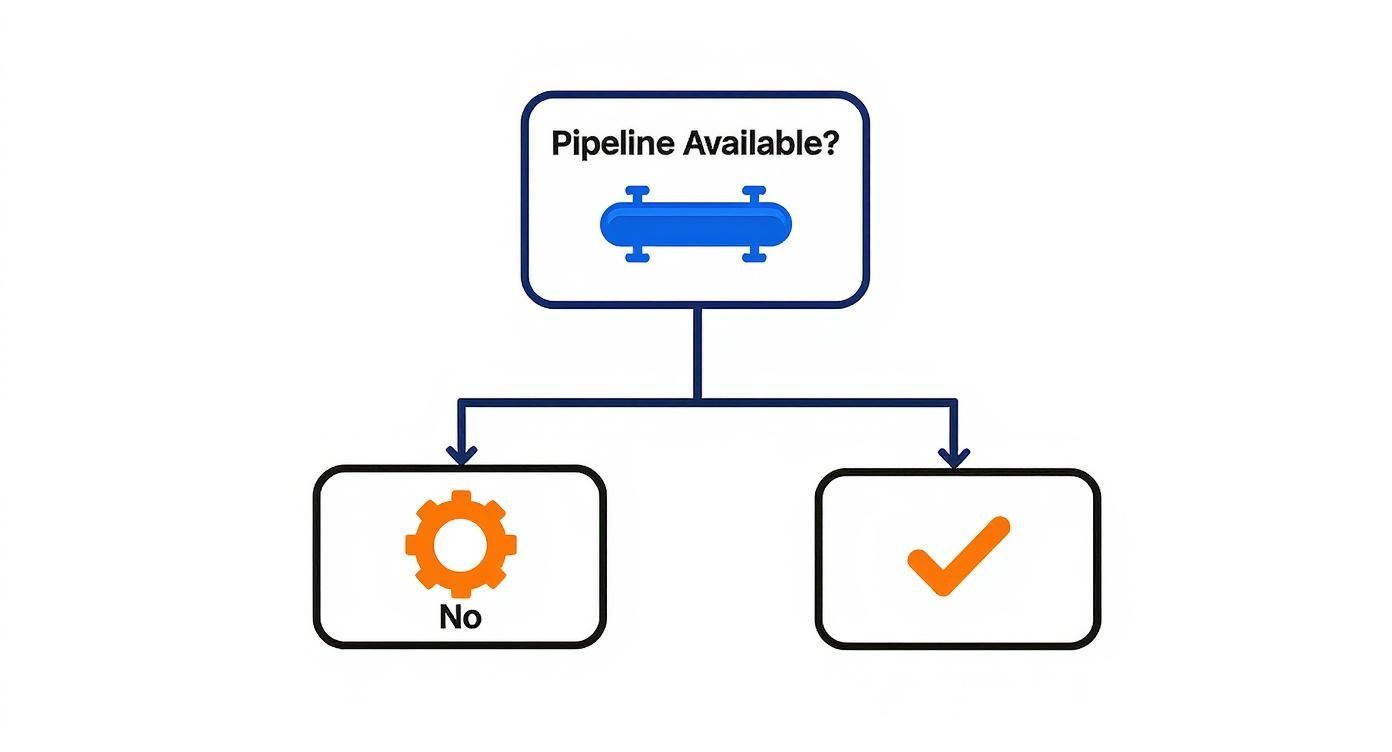
As you can see, when a pipeline isn't an option—whether for a few hours or for the foreseeable future—a mobile gas solution from a provider like Blue Gas Express becomes the logical next step.
Liquefied Natural Gas: The High-Capacity Workhorse
LNG’s incredible energy density makes it the undisputed workhorse for big, long-haul projects. Because a single trailer of LNG holds so much more energy than a CNG trailer, you need far fewer truck swaps to maintain a continuous supply. That’s a massive logistical advantage that cuts down on site traffic and simplifies your operations.
Picture a large industrial plant or a new hospital being built miles from the nearest pipeline. These projects need a massive, uninterrupted flow of gas for months to power heavy equipment, run generators, or provide heat.
In these energy-hungry scenarios, LNG is the clear winner. A single tanker can deliver the same amount of gas as several CNG trailers, making it the only practical choice for sustaining long-term operations without a constant parade of deliveries.
This efficiency is a game-changer for any project where a consistent, high-volume energy supply is absolutely non-negotiable.
Comparing CNG and LNG Mobile Solutions
So, how do you decide? The choice really boils down to your project's specific needs—how long it will last, how much gas you'll need, and the logistics of your site. To make it easier, here's a side-by-side look at how they stack up.
| Feature | Compressed Natural Gas (CNG) | Liquefied Natural Gas (LNG) |
|---|---|---|
| State | Gaseous (compressed) | Liquid (cryogenic) |
| Energy Density | Lower | Very high (approx. 3x that of CNG) |
| Storage Pressure | High pressure (2,400-3,600 psi) | Low pressure (under 150 psi) |
| Transport Volume | Requires more trailers for the same energy amount | Delivers more energy per truckload |
| Processing | Simpler; involves compression and dehydration | More complex; requires cryogenic cooling |
| Ideal Duration | Short-term (hours to a few weeks) | Long-term (weeks to months or years) |
| Best For | Pipeline repairs, emergencies, smaller projects | Large construction, industrial plants, remote sites |
Ultimately, both are powerful tools, but they solve very different problems. A good gas transport company will help you weigh these factors to find the right fit.
Key Differences at a Glance
Let's break it down into simple terms.
An experienced provider will analyze your requirements and recommend the best fit, but here’s a quick cheat sheet:
CNG is ideal for:
- Short-term pipeline maintenance that might last a few hours to a few days.
- Emergency response situations where getting gas flowing again fast is the top priority.
- Smaller commercial sites that just need temporary heat or power.
LNG is the better choice for:
- Long-duration construction projects that will run for weeks or even months.
- Large industrial facilities with high, round-the-clock energy demands.
- Remote locations where you want to minimize the number of fuel deliveries for cost and logistical reasons.
The end goal is always the same: a seamless, reliable energy supply that feels just like you're connected to a pipeline. By understanding the real-world differences between CNG and LNG, you can have a much more productive conversation with your provider and land on the solution that keeps your operations running without a single hiccup.
When You Need a Mobile Gas Delivery Solution
Mobile natural gas isn't just a niche service for obscure situations. Think of it as an essential tool for keeping the lights on and the heat running. A reliable gas transport company becomes a critical partner in more scenarios than you might think, turning potential disasters into minor hiccups.
These situations generally fall into two buckets: projects you plan for and emergencies that pop up out of nowhere.
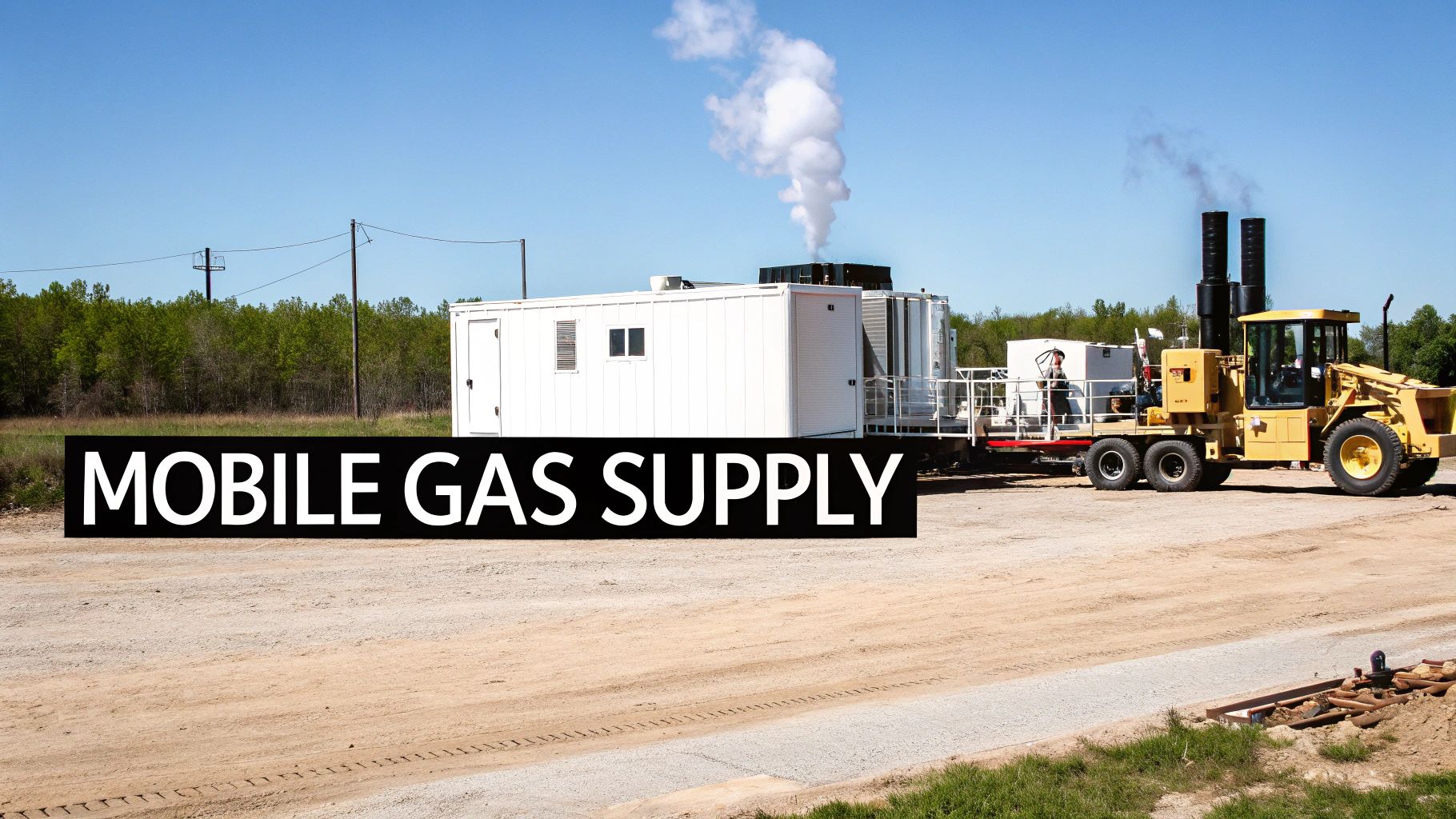
Understanding when to call in these "pipelines on wheels" helps you see them as a strategic tool, not just a last-ditch effort. Whether you’re managing a utility, a construction site, or a manufacturing plant, mobile gas is the answer to filling critical energy gaps.
Planned Pipeline Maintenance And Upgrades
Gas utilities are in a constant state of upkeep, ensuring their vast pipeline networks are safe and reliable. This work—inspections, repairs, system upgrades—often means taking a section of the pipeline offline. In the past, that automatically meant service interruptions for potentially thousands of customers.
Now, a mobile gas solution can create a seamless workaround. Say a utility needs to run a week-long integrity test on a major distribution line. Before shutting anything down, a gas transport company like Blue Gas Express can set up a temporary injection point past the isolated section. The result? Uninterrupted gas flow to every home and business.
This forward-thinking approach turns what would be a massive disruption into a simple background task. Customers stay online, and the utility gets its critical work done without the headache of public complaints or logistical chaos.
Emergency Response And Outage Prevention
Emergencies are where a mobile gas provider really shows its worth. A pipeline break from a third-party digging accident, a natural disaster, or a sudden equipment failure can kill service to an entire community in an instant. The fallout from an outage like that, especially during a cold snap, can be huge.
When the stakes are this high, every second counts. A prepared gas transport company can have trailers and technicians on the road within hours. They can quickly set up a temporary supply to keep critical facilities—hospitals, emergency shelters, data centers—running while the main lines are being fixed.
This rapid deployment isn't just a convenience; it's a core part of modern disaster recovery. It stops a local infrastructure problem from snowballing into a full-blown public safety crisis.
By having a mobile gas partner on retainer, utilities and large businesses can dramatically shorten downtime and soften the financial blow of an unexpected outage. The cost of bringing in a temporary supply is a drop in the bucket compared to the losses from a prolonged shutdown.
Powering New Construction And Remote Sites
One of the most practical uses for mobile gas is bridging the energy gap at new construction sites. It solves a classic chicken-and-egg problem: a new housing development or commercial building needs natural gas to test the HVAC systems and get its certificate of occupancy, but the permanent utility hookup is still months away.
A mobile CNG or LNG solution delivers the energy needed to keep the project on track. This lets builders finish crucial system tests, stop pipes from freezing in the winter, and sidestep expensive delays. It's the perfect temporary energy bridge to keep things moving.
The same idea works for industrial sites in the middle of nowhere. A new manufacturing plant might be built miles from existing pipelines. A long-term LNG supply can power the entire facility for months or even years while the permanent infrastructure is built, letting the business start making money far sooner than it otherwise could.
Navigating the Maze of Safety and Regulatory Compliance
When you're dealing with natural gas, safety isn't just a box to check—it's the bedrock of the entire industry. Bringing in a gas transport company means you're handing over the keys to a potent energy source, and that's a responsibility governed by a thicket of federal, state, and local rules.
The good news? A top-notch provider handles all of this for you. They don't just drop off gas; they deliver the confidence that comes from knowing every "i" is dotted and every "t" is crossed. Think of them as your compliance department on wheels, making sure your project is buttoned up and secure.
The Alphabet Soup of Gas Regulations
The minute a trailer loaded with CNG or LNG hits the road, it comes under the watchful eye of some serious regulatory bodies. The two big players you'll hear about most are:
- The Department of Transportation (DOT): These are the folks who own the rules of the road. They dictate everything from the structural integrity of the transport trailers to the specialized training and certifications required for every driver hauling hazardous materials.
- The Pipeline and Hazardous Materials Safety Administration (PHMSA): As a division within the DOT, PHMSA gets into the nitty-gritty. They write the playbook for safely handling, loading, and unloading compressed and liquefied gases.
An experienced gas transport provider doesn't just know these rules—they live by them. Their entire operation is built on a foundation of obsessive record-keeping, constant training, and routine equipment checks. It's just part of their daily rhythm.
This commitment is non-negotiable, especially in an industry with massive financial implications. The global oil and gas logistics market, which includes this type of transport, was recently valued at $169.781 billion and is only getting bigger. That growth highlights why you can't afford to partner with anyone who cuts corners on safety.
What a Professional Provider Takes Off Your Plate
Beyond the federal level, a great partner manages all the on-the-ground safety details so you can stay focused on your own job site. This is where their expertise really shines.
Key Compliance and Safety Responsibilities:
- Specialized Driver Training: These drivers are more than just people with a CDL. They're highly skilled technicians with hazmat endorsements who undergo continuous, specific training on the unique properties and handling procedures for CNG and LNG.
- Equipment Certification and Maintenance: Every single component—from the cryogenic tanks holding LNG to the high-pressure valves on a CNG trailer—is subject to a strict schedule of documented inspections and certifications. Nothing is left to chance.
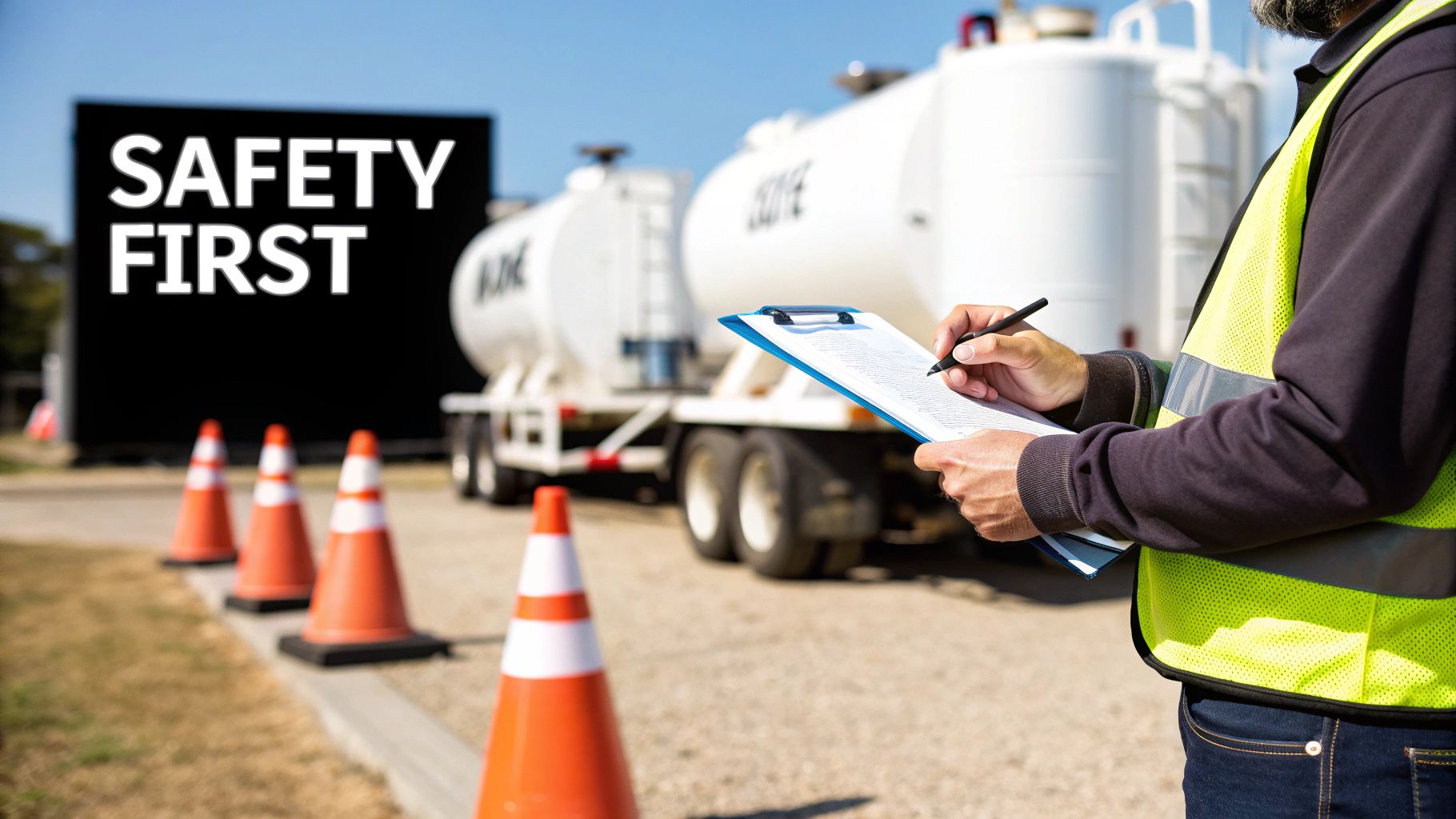
- On-Site Safety Protocols: Before a single molecule of gas is delivered, their team will be on your site. They’ll perform a full safety assessment, set up a secure perimeter, and walk through the exact procedures for connecting and disconnecting from your system.
- Local Permitting and Coordination: Your provider will take the lead on securing all the necessary permits from local authorities, fire marshals, and city regulators. They’ll also coordinate directly with first responders, giving them site plans and safety data sheets so everyone is on the same page.
Of course, alongside regulatory compliance, physical security is also a huge piece of the puzzle. Protecting these valuable assets during transit is critical, which is why providers often implement robust container security measures adapted for their specific equipment. It's this proactive, hands-on approach with local officials that really separates the pros from the amateurs.
Breaking Down Project Costs and Timelines
When you hire a gas transport company, you're not just buying gas. It’s easy to get sticker shock if you're only thinking about the fuel itself, but it's much more than that. The real value is in the entire temporary infrastructure—the logistics, the specialized equipment, and the human expertise needed to get that fuel to your site safely and reliably.
Think of it less as a simple purchase and more as crucial operational insurance. A professional provider will give you a transparent quote that breaks everything down, so you see exactly what you're paying for. No surprises, just a clear picture of the "pipeline on wheels" being built specifically for you.
Key Factors Shaping Your Project Budget
A good quote will detail every part of the service, moving way beyond a simple per-unit price for the gas. Each piece of the puzzle is critical to a successful operation.
- Equipment Mobilization and Demobilization: This is the cost of getting all the heavy-duty gear—like CNG tube trailers or LNG tankers and vaporizers—to your location and then taking it away when the job is done. It’s the setup and teardown of your temporary gas supply.
- Specialized Equipment Rental: You're essentially renting a sophisticated, mobile gas plant. This line item covers the daily or monthly fees for the high-pressure CNG trailers or cryogenic LNG storage units that will be on your site for the duration of the project.
- Transportation and Logistics: This covers the actual "wheels on the ground" part of the service. For a short-term CNG project, this might just be a few trailer swaps. For a longer-term LNG supply, it accounts for all the scheduled tanker deliveries needed to keep the gas flowing without a single interruption.
- Engineering and On-Site Labor: You need brains to go with the brawn. This fee covers the technical experts who perform the initial site assessment, design the system, and manage the hands-on commissioning and safe operation of the equipment.
The Typical Project Lifecycle From Start to Finish
Mobile gas projects follow a well-defined path to ensure everything runs safely and on schedule. While every site has its quirks, the process generally moves through a few predictable phases, from the first handshake to full-scale operation.
Keeping this process on track is everything. In fact, many of the same strategies for managing project scope creep in construction apply here to prevent budget overruns and delays.
Here’s what you can expect:
- Initial Consultation and Site Walk-Down: It all starts with a conversation about what you need, followed by a visit to your site. The provider’s engineers will get eyes on your connection points, measure out the available space, and check site access to figure out the safest, most effective setup.
- Engineering and Solution Design: Back at the office, the engineering team uses the data from the walk-down to create a custom blueprint. This is where they'll select the right equipment (CNG vs. LNG), map out the optimal placement, and detail all the safety protocols.
- Deployment and Commissioning: Once you sign off on the plan, the trucks roll in. Technicians will install everything, run a battery of safety checks, and commission the system to make sure the gas flows seamlessly into your existing infrastructure.
- Ongoing Operation and Support: The job isn't over once the gas is on. Throughout the project, the gas transport company manages every fuel delivery and provides 24/7 technical support. They’re on call to make sure your operation continues without a hitch until your permanent gas supply is back online.
Your Checklist for Choosing the Right Partner
Picking a gas transport company is one of the most important calls you’ll make for your project. This isn't just about hiring a fuel supplier. It’s about finding a true energy partner whose reliability, safety, and know-how will make or break your operation's success. The right choice means your energy flows without a hitch. The wrong one can bring on costly delays, serious safety risks, and a whole lot of logistical headaches.
To get past the sales pitch and find a partner who can really deliver, you need a solid way to evaluate them. This checklist gives you a practical framework to vet potential companies, focusing on what actually matters for a high-stakes energy project.
Assess Their Documented Safety Record
Safety isn’t just a priority; it's everything. Before you even think about price or timelines, your very first questions should be about their safety performance. A good provider will be open, honest, and proud of their record.
Don't settle for vague promises. Ask for hard numbers and documentation. Key things to request include:
- DOT Safety Rating: This is a federal score card that shows how well they follow transportation safety rules.
- Experience Modification Rate (EMR): An EMR under 1.0 is a great sign, showing they have a better-than-average safety record in the industry.
- Incident and Accident Reports: Get a look at their history of recordable incidents. A low number speaks volumes about their safety culture.
If a company is cagey about sharing this info, that’s a major red flag. A proven commitment to safety is the bedrock of any trustworthy partnership.
Evaluate Fleet Size and Technical Sophistication
The company's fleet is the heart of their operation, and its size and condition directly impact their ability to serve you. An old or small fleet can mean equipment breakdowns and an inability to adapt if your energy needs suddenly spike.
You need to know if they have the right tools for your specific job. For example, a handful of CNG tube trailers just won’t cut it for a large, long-term industrial project that needs the high energy density of LNG. A modern, diverse fleet shows the gas transport company has invested in its own capabilities and is ready for anything, from a quick emergency job to a sustained, high-volume supply contract.
The right partner doesn’t just have equipment; they have the right equipment for your project, with backup units ready to go to guarantee uptime. This depth is a crucial indicator of their operational readiness and reliability.
Confirm In-House Engineering Capabilities
A mobile gas project is a lot more complicated than just dropping off a trailer. It takes real engineering to design a safe, efficient, and compliant connection to your system. A company with its own dedicated engineering team can build a solution that fits your site’s specific needs perfectly.
They should be able to handle it all, from the initial site walk-down to designing the tie-in points and making sure the flow rates are correct. This level of expertise is critical in the broader energy logistics world. While a mobile solution is temporary, it’s part of a massive industry. The pipeline transportation market alone was valued at USD 26.58 billion and is expected to keep growing, with the U.S. pipeline network stretching over 885,233 miles. This context really drives home the scale and technical precision needed in energy transport, a topic you can dive deeper into with these pipeline transportation market insights.
Finally, make sure to check on their operational support. Your energy needs don't clock out at 5 PM. Any partner you consider must offer 24/7 monitoring and technical support, with a clear plan for how they'll respond to issues, day or night. That round-the-clock availability is your ultimate safety net.
Common Questions We Hear About Gas Transport Services
When you're looking into a mobile energy solution, a lot of practical questions come to mind. It’s one thing to understand the concept, but it's another to see how it works in the real world. Getting straight answers is crucial, especially when your operations hang in the balance.
Here are some of the most common questions we get from businesses considering a partnership with a gas transport company. We'll tackle everything from emergency response times to cost, giving you the clear picture you need to decide if this is the right move for you.
How Fast Can You Get Here in an Emergency?
When a pipeline goes down, every second counts. In a true emergency, a professional gas transport provider with a ready fleet and solid response plans can usually be on-site within a few hours to a day.
Of course, the exact timing depends on a few things, like how far you are from our staging areas, how easy it is to access your site, and the specific gear we need to bring. A company with equipment strategically placed across a region can move a lot faster than one scrambling from a single location. That readiness is what really separates the pros, especially when downtime is costing you money by the minute.
What’s a Typical Project Duration?
One of the best things about mobile natural gas is its flexibility. There really is no "typical" project length because we tailor the service to exactly what you need, for exactly as long as you need it.
- Short-Term Needs: We might be on-site for just a single day to support a planned pipeline integrity test or cover a quick emergency repair.
- Medium-Term Projects: For something like a new construction build-out or handling seasonal peak demand, you might see our trailers on-site for several weeks or a few months.
- Long-Term Solutions: In some cases, a remote facility might be waiting years for a permanent pipeline. We can act as their primary energy source for as long as it takes.
This adaptability means you only pay for the service when you need it, whether that’s for a few hours or a few years.
Is Mobile Natural Gas More Expensive Than Pipeline Gas?
Let's be direct: on a per-unit basis, yes. Mobile natural gas costs more than gas delivered through a traditional pipeline. That difference comes from the logistics—the compression or liquefaction, the specialized trucks, and the on-site equipment needed to turn the fuel back into usable gas for your system.
But here’s the thing: you can't compare the cost of mobile gas to pipeline gas. You have to compare it to the astronomical cost of an operational shutdown.
When your facility goes dark, the financial bleeding starts immediately. You’re looking at lost production, project delays, and potentially huge contractual penalties. Seen from that perspective, a temporary supply from a reliable gas transport company isn't an expense—it's an incredibly cost-effective insurance policy that keeps your business running.
When downtime is not an option, you need a partner who can deliver. Blue Gas Express provides fast, reliable mobile CNG and LNG solutions to keep your project on track. Contact us today to secure your temporary energy supply.