

Gas metering stations are, without a doubt, the ‘cash registers’ of the natural gas industry. They're the critical checkpoints where every cubic foot of gas is precisely measured, ensuring fair billing and operational safety. This is where the ownership of gas officially changes hands, and getting it right is non-negotiable.
The Critical Role of Gas Metering Stations
Picture the vast network of natural gas pipelines crisscrossing the country as a massive highway system. In this analogy, gas metering stations are the indispensable toll booths, customs checkpoints, and quality control labs all rolled into one. Without them, the entire system would be chaotic—there'd be no reliable way to track, bill for, or verify the gas moving from point A to point B.
At their core, these stations provide an indisputable record of gas volume and quality every time it's sold or transported. This is the bedrock of fiscal and operational integrity for the whole energy sector.
When a producer sells gas to a pipeline operator, for instance, a metering station measures the exact volume transferred. This measurement becomes the basis for the entire financial transaction, a process we call custody transfer. Accuracy here is everything. Even a minuscule error of just 0.1% on a high-volume pipeline can snowball into millions of dollars in billing discrepancies over the course of a year.
Three Pillars of Operation
Every single gas metering station, regardless of its size or location, is built on three core functions. These tasks work together in a logical sequence to measure, verify, and condition the gas before it moves on to its next destination, whether that’s a local utility or a large factory.
The infographic below breaks down this simple but essential process flow.
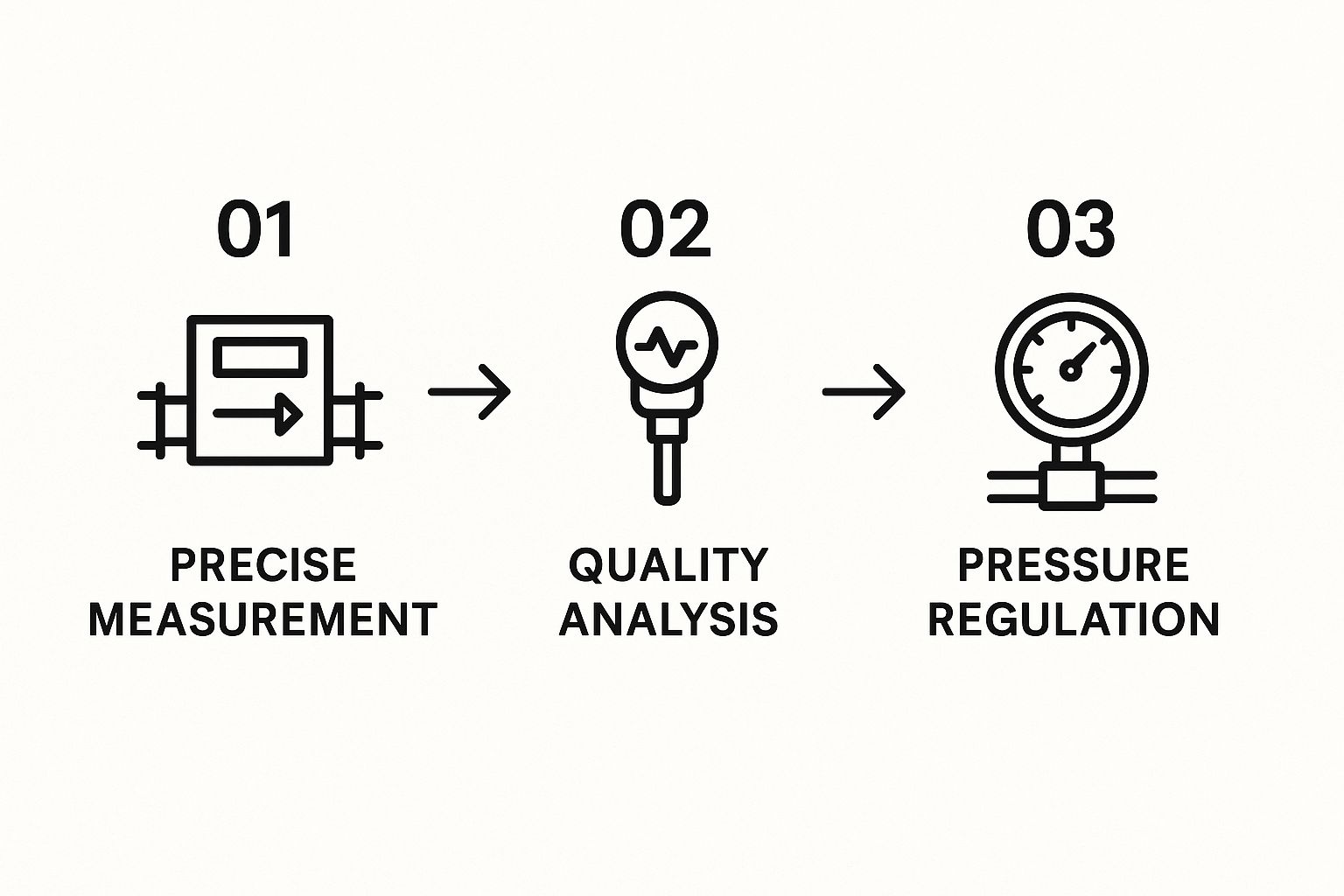
As you can see, measurement, analysis, and regulation aren't separate jobs; they’re sequential steps that build on one another to guarantee the gas is a reliable and marketable product.
To get a clearer picture, let's look at what each function truly accomplishes.
Core Functions of a Gas Metering Station
| Function | Description | Primary Importance |
|---|---|---|
| Measurement (Metering) | Accurately calculates the volume of gas passing through the station, correcting for variables like temperature and pressure. | Fiscal Accuracy: This is the basis for all billing and custody transfer. It ensures sellers are paid correctly and buyers receive what they paid for. |
| Analysis (Gas Quality) | Uses a gas chromatograph to determine the precise chemical makeup and energy content (BTU value) of the gas. | Product Value & Safety: Determines the gas's heating value, which dictates its price. It also flags harmful impurities that could damage equipment. |
| Regulation (Pressure Control) | Reduces the gas pressure from high-pressure transmission levels to lower, safer levels suitable for the downstream network. | Grid Safety & Integrity: Protects local distribution pipes and end-user equipment from dangerous over-pressurization, preventing system failures. |
These three pillars work in concert to ensure every transaction is fair, every piece of equipment is protected, and the gas delivered is safe for everyone.
Safeguarding the Entire Energy Grid
These stations do far more than just measure gas for billing. They are fundamental to the safety and reliability of the entire energy grid. The analysis function spots impurities like water or sulfur, which can corrode multi-billion dollar pipeline infrastructure if they aren't caught and managed.
At the same time, they regulate pressure, stepping it down from the high-pressure transmission lines to much safer levels required for local distribution networks.
By performing these functions, gas metering stations protect downstream equipment, prevent dangerous over-pressurization events, and ensure the gas delivered to homes and businesses is safe for use.
The importance of this infrastructure can't be overstated. When you're planning a new station or upgrading an old one, you have to nail the industrial design considerations, such as greenfield vs. retrofit approaches. This isn't a small niche; it's part of a massive global market. The gas pipeline infrastructure market itself was valued at about USD 3.23 trillion in 2025 and is forecast to more than double to roughly USD 7.18 trillion by 2034.
Inside a Modern Gas Metering Station
To really get a feel for what a gas metering station does, you have to follow the journey of the natural gas itself. Picture a high-tech assembly line, but instead of putting something together, it's meticulously refining, measuring, and double-checking a product. Every single component has a specific job, and they all work in perfect harmony to guarantee accuracy and safety from the moment gas comes in until it goes out.
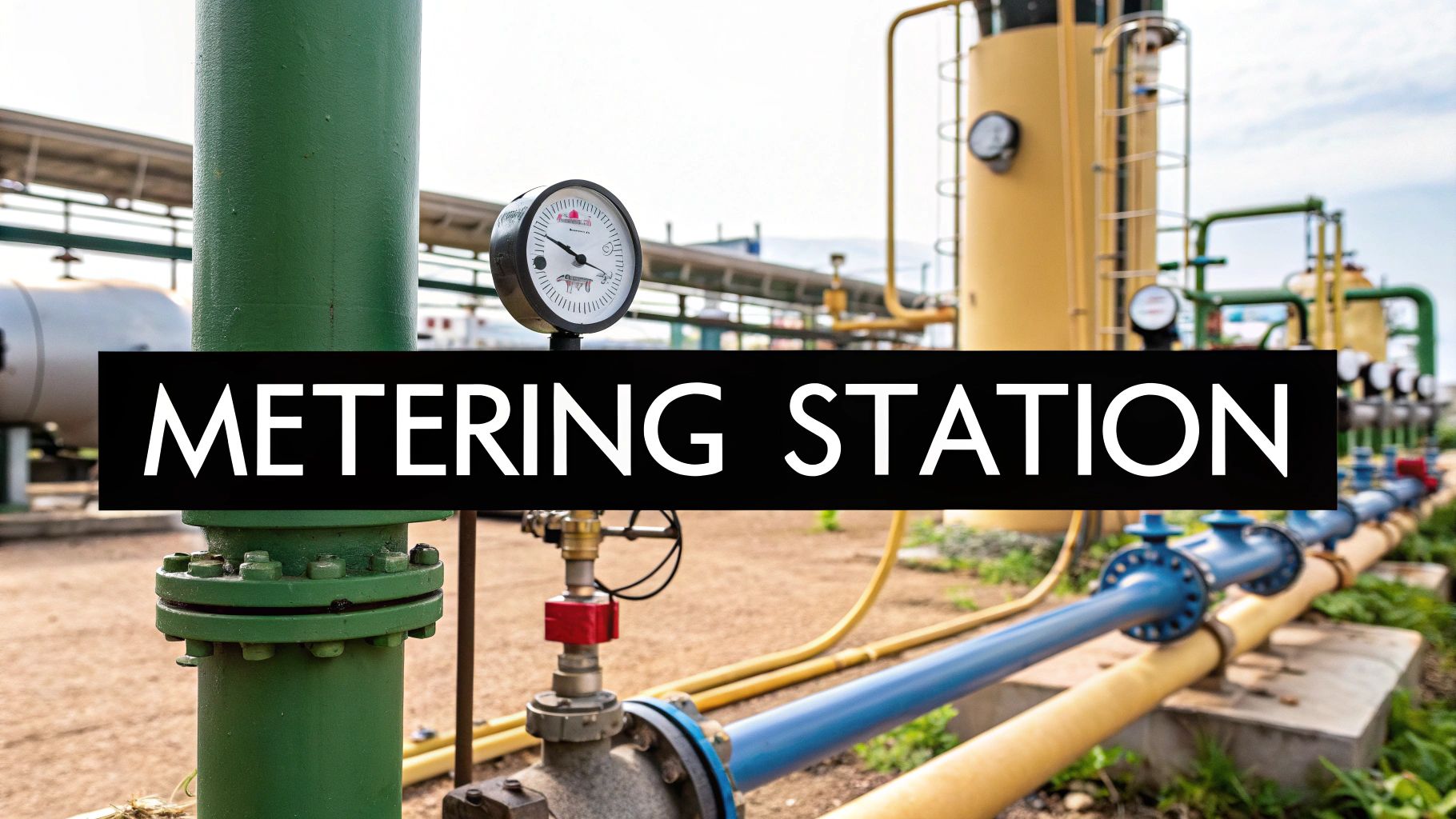
This whole process is a smooth, continuous flow. It starts with raw, unverified gas and ends with a precisely measured and conditioned product, ready for the next leg of its journey. Let's walk through that path, piece by piece, to see how it all comes together.
The Entry Point: Filtration and Separation
Before any measurement can even begin, the natural gas has to be cleaned up. The gas coming in from a big transmission pipeline isn't pure; it often carries moisture, bits of debris, or other liquid hydrocarbons. If left unchecked, that gunk can wreck sensitive equipment and throw off the measurements. That's why the very first stop is the inlet separator and filtration system.
Think of this system as the station's bouncer. Its sole purpose is to get rid of any unwanted elements before they can cause problems further down the line.
- Separators: These are typically large vessels that use gravity and some clever internal engineering to separate liquids—like water or condensates—from the main gas stream.
- Filters: Next, a series of high-efficiency filters acts like a fine-mesh screen, catching tiny solid particles like rust or dirt. This ensures the gas flowing to the delicate instruments downstream is squeaky clean.
Without this crucial first step, the accuracy of the entire station would be shot from the very beginning.
The Heart of the Station: The Flow Meter
Once the gas is clean, it hits the most important component in the entire facility: the flow meter. This is the official ‘cash register’ we talked about earlier. Its job is to quantify the exact volume of gas that passes through. There’s no single, one-size-fits-all solution here; the type of meter used depends on the specific job, the flow rates, and the level of precision required.
A flow meter doesn't just clock volume; it generates the raw data that becomes the basis for multi-million dollar financial transactions. Its accuracy is everything. Even a tiny error, repeated over time, can snowball into a massive financial dispute.
You'll often see ultrasonic, turbine, or Coriolis meters in the field, each using a different physical principle to get the job done. This single piece of equipment is the linchpin of the station's entire purpose.
The Quality Control Check: The Gas Chromatograph
Just measuring the volume isn’t the whole story. Natural gas is bought and sold based on its energy content, or heating value, which changes based on its chemical makeup. This is where the gas chromatograph steps in, acting as a kind of molecular "purity scanner."
This sophisticated device pulls a tiny sample of the gas and breaks it down completely. It identifies and measures the exact percentage of every component—methane, ethane, propane, nitrogen, you name it. This analysis is critical for two main reasons:
- Financial Accuracy: It determines the gas's calorific value (its energy content), which is used to calculate the final price.
- Safety and Integrity: It sniffs out harmful contaminants like hydrogen sulfide or too much water vapor, which could corrode pipelines or create safety hazards.
In short, the chromatograph is the quality assurance expert, making sure the product meets every single contractual specification.
The Brain of the Operation: The Flow Computer
All the raw data from the meters and sensors would be meaningless without a central processor to crunch the numbers. That's the job of the flow computer, which is truly the brain of the gas metering station. It’s a powerful, highly specialized computer that’s constantly collecting real-time data from every key point.
It pulls in a continuous stream of inputs from:
- The Flow Meter (the raw gas volume)
- Pressure Transmitters (the current line pressure)
- Temperature Transmitters (the current gas temperature)
- The Gas Chromatograph (the gas composition and physical properties)
The flow computer takes all this live information and runs it through complex calculations based on industry standards, like those from the American Gas Association. It converts the raw measured volume into a standardized, billable volume—the official record for the custody transfer. This final, corrected number is the one that really counts, ensuring that every transaction is fair and accurate, no matter how much the physical conditions in the pipeline change. It's the final judge of exactly how much gas was delivered.
The Technology of Accurate Gas Measurement
In the world of natural gas, accuracy isn't just a nice-to-have; it's the bedrock of every single financial transaction. When we talk about a gas metering station, its ability to measure with pinpoint precision is what determines whether millions of dollars in energy are being accounted for correctly. This isn't magic—it's the result of advanced hardware and sophisticated software working in perfect sync.
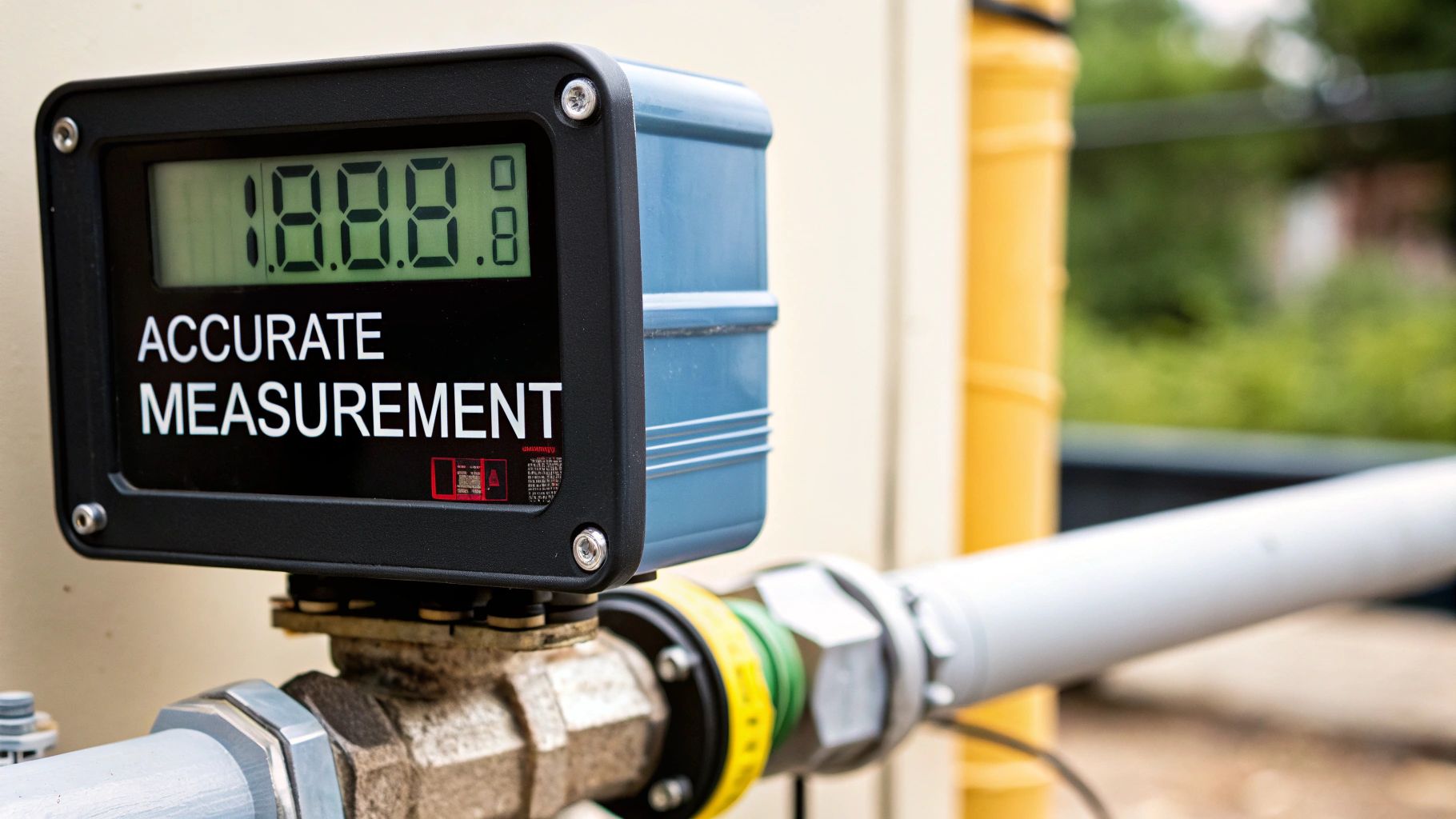
This drive for precision is fueling massive growth in the global gas metering market. The industry, valued at around USD 5.74 billion in 2025, is on track to soar past USD 9.8 billion by 2035. That's a significant jump, reflecting a major global investment in modernizing our gas infrastructure. You can dig deeper into these trends by checking out the gas meters market growth projections on futuremarketinsights.com.
This growth really highlights just how critical the underlying technology has become. So, let’s pull back the curtain and look at the workhorses that make this accuracy possible.
Choosing the Right Flow Meter Technology
At the heart of any metering station is the flow meter, but there’s no "one-size-fits-all" solution. Different meters operate on entirely different principles, each with its own set of strengths and ideal use cases.
An ultrasonic flow meter, for instance, works a bit like a ship's sonar. It sends high-frequency sound pulses across the pipe—one traveling with the gas flow and another against it. By measuring the incredibly small time difference between when the signals arrive, it can calculate the gas velocity with extreme precision, all without ever getting in the way of the flow.
Then you have the turbine meter, which functions more like a high-tech windmill. As gas flows through, it spins a rotor with blades. The speed of that spin is directly proportional to the rate of the gas flow. They're a proven, highly reliable technology that has been trusted for decades.
Finally, the Coriolis meter offers the most direct measurement possible. It works by vibrating a set of tubes and detecting the subtle twisting forces created by the mass of the gas flowing through them. This allows it to measure mass flow directly, which is a huge advantage for certain applications.
The choice of a flow meter is a foundational design decision. It hinges on practical factors like expected flow rates, the cleanliness of the gas, how much pressure drop is acceptable, and the level of accuracy demanded for custody transfer.
The right meter for a massive transmission pipeline is likely different from one needed for a small industrial user. Let's break down how these common technologies stack up.
Comparing Common Gas Flow Meter Technologies
The table below offers a quick comparison of the most common flow meter technologies, showing what makes them tick and where they fit best in the real world.
| Meter Type | Operating Principle | Key Advantages | Common Applications |
|---|---|---|---|
| Ultrasonic | Measures the transit time difference of sound pulses traveling with and against the gas flow. | No moving parts, minimal pressure drop, high accuracy across wide flow ranges. | High-volume custody transfer stations and large transmission pipelines. |
| Turbine | Measures the rotational speed of a rotor turned by the gas flow. | Proven reliability, high accuracy under stable conditions, cost-effective. | City gate stations and industrial measurement where flow is consistent. |
| Coriolis | Measures the mass flow directly by detecting the twisting force (Coriolis effect) in vibrating tubes. | Extremely high accuracy, measures mass directly, unaffected by gas properties. | Applications requiring the highest precision, such as specialty gas blending or LNG. |
Each of these meters excels in its own lane, providing engineers with a toolkit to build a station perfectly suited to its environment.
Why Volume Alone Is Not Enough
Just measuring how much gas has passed through the meter is only half the story. Natural gas is a compressible fluid, which means its volume can change dramatically depending on its pressure and temperature. Think of it like a sponge: a cubic foot of gas squeezed under high pressure holds a lot more energy than a cubic foot at low pressure.
To make sure every transaction is fair, the raw volume reading has to be corrected and converted into a standardized volume. This is the job of the flow computer, which acts as the station's brain.
The flow computer takes the raw volume data from the meter and instantly applies correction factors based on real-time readings from other instruments:
- Pressure Transmitters
- Temperature Transmitters
- Gas Composition Data (often from an onboard gas chromatograph)
By normalizing the volume to a set of standard conditions (for example, a specific pressure and temperature), the flow computer guarantees that a cubic foot of gas in one place has the exact same energy value as a cubic foot anywhere else. This process is what transforms a simple volume reading into a legally and financially sound transaction. Without it, the entire natural gas market simply couldn't function.
Maintaining Gas Quality and Pipeline Safety
A gas metering station does a lot more than just measure volume for billing. Think of it as the guardian at the gate for multi-billion dollar pipeline networks. It's a vigilant quality control checkpoint, making sure the natural gas flowing through is not just valuable, but also safe for the entire system downstream.
This role is absolutely critical. It’s about more than just ticking boxes on a spec sheet; it's about actively preventing catastrophic failures. The gas stream can carry hidden threats—corrosive elements that silently eat away at steel pipelines from the inside. A modern metering station stands as the first and most important line of defense against these invisible dangers.
Uncovering the Molecular Fingerprint
The main tool for this job is the gas chromatograph, a highly sophisticated piece of equipment that works like a molecular detective. It takes a continuous sample of the gas and runs a detailed chemical analysis, breaking it down to reveal its exact composition. This isn't just for scientific curiosity; it provides two critical pieces of information.
First, it tells us the gas's heating value (also called calorific value). Natural gas isn't sold by volume alone—it's sold based on its energy content. Gas with a higher concentration of energy-rich molecules like ethane and propane is worth more. The chromatograph gives us this data, making sure the billing is accurate and fair for both buyer and seller.
Second, and arguably more vital for safety, it flags potentially harmful contaminants.
A gas chromatograph doesn't just see what's valuable in the gas; it also sees what's dangerous. By flagging impurities before they can cause widespread damage, it serves as an early warning system for the entire pipeline network.
This dual job—financial verification and safety monitoring—is what makes the chromatograph an absolutely essential part of any modern gas metering station.
The Most Unwanted Contaminants
The analysis run by the gas chromatograph is programmed to hunt for specific, undesirable elements that can wreak havoc on a pipeline system. Even tiny amounts of these substances can cause major operational and safety problems over time. The main culprits are always on the watch list.
- Water Vapor (H₂O): When water mixes with other compounds in the gas stream under high pressure, it can form corrosive acids. It can also form solid, ice-like structures called hydrates, which can clog or even damage pipes and equipment.
- Hydrogen Sulfide (H₂S): Often called "sour gas," this compound is extremely corrosive to steel, especially when water is present. It can make pipes brittle, leading to catastrophic failures.
- Carbon Dioxide (CO₂): While not as aggressive as H₂S, carbon dioxide also forms a corrosive acid when it mixes with water, slowly eating away at the pipeline's integrity.
Catching these contaminants early is everything. The industry has very strict limits on their allowable concentrations, and it's the metering station's job to ensure those lines are never crossed.
Protecting Billions in Infrastructure
The financial stakes here are massive. A single major pipeline is a multi-billion dollar asset. A failure due to corrosion isn't just a service outage; it can cause devastating environmental damage and pose a serious threat to public safety.
By constantly monitoring gas quality, metering stations play a direct role in protecting these massive investments. If the chromatograph detects contaminant levels creeping above acceptable limits, it can trigger alarms or even automatically shut off the gas flow. This immediate response prevents "off-spec" gas from ever entering the broader network and causing damage.
This kind of proactive quality control extends the life of pipelines, cuts down on the need for expensive repairs, and ensures natural gas gets delivered safely and reliably. It elevates the station from a simple cash register to a critical infrastructure protection system.
Fuel on the Move: How Metering Stations Support Mobile CNG and LNG
For decades, we’ve thought of natural gas as something that flows through a fixed, underground network. But that picture is changing. A more agile approach to energy is taking hold, one where gas can be delivered directly where it's needed, whenever it's needed. This is the world of mobile energy, and it’s made possible by highly specialized gas metering stations built for Compressed Natural Gas (CNG) and Liquefied Natural Gas (LNG).
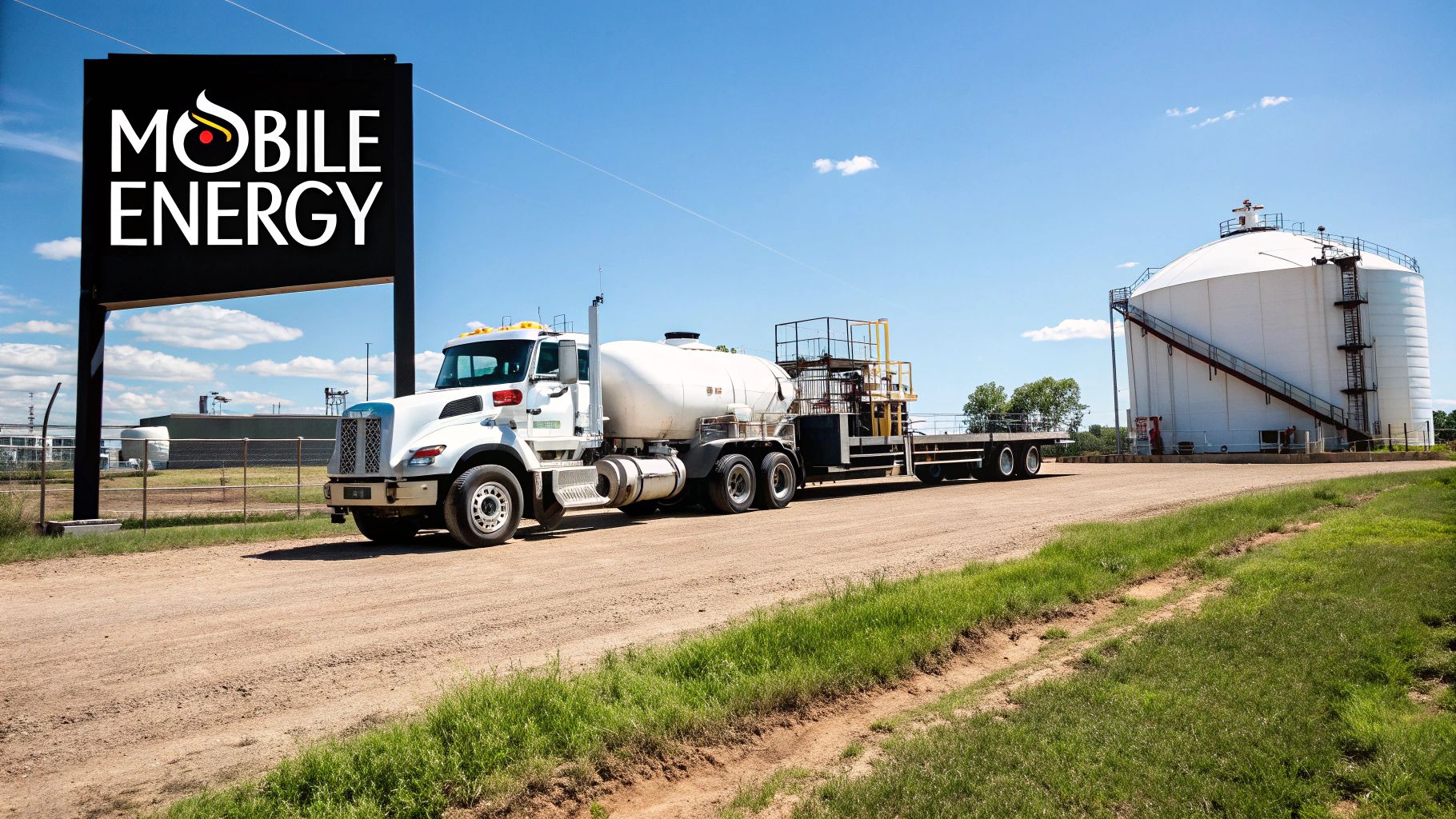
Think of it as creating a "virtual pipeline." Instead of waiting months or even years for a utility to lay new pipe, companies can now truck in CNG or LNG. This is a game-changer for industrial sites, remote communities, and power plants, giving them incredible flexibility. It’s the perfect solution for getting energy to off-grid locations or serving as a critical backup during pipeline maintenance.
Metering in the Extremes
Let's be clear: handling CNG and LNG is nothing like metering standard pipeline gas. These fuels exist in extreme physical states, and the equipment has to be engineered to match. Standard metering skids just can't cut it.
The challenge with CNG is all about pressure. To transport it efficiently, natural gas is compressed to less than 1% of its original volume, pushing pressures up to a staggering 3,600 psi. A CNG metering station has to be built like a fortress, with heavy-duty components and specialized seals to prevent leaks and still get a precise reading.
LNG flips the script to temperature. The gas is chilled to a cryogenic -260°F (-162°C) to keep it in a liquid state. Any equipment touching it must be made from materials that won't turn brittle and shatter in the cold. The metering system also has to precisely account for the massive expansion that happens when the liquid turns back into a gas for use.
This isn't just about tweaking old designs for new fuels. It's about engineering an entirely new class of resilient, mobile energy infrastructure that can be dropped into place to meet urgent demand, anywhere in the world.
What Makes a Mobile Metering Skid Tick?
To pull this off, mobile metering skids are designed as tough, self-contained units that can be deployed quickly. They’re a complete package, integrating several key systems to measure and deliver gas safely and accurately.
- Pressure and Temperature Regulation: For LNG, this starts with vaporizers that gently warm the liquid back into a gas. For both CNG and LNG, a series of sophisticated regulators then steps the intense pressure down to a level the customer’s equipment can actually use.
- High-Performance Flow Meters: You'll often find Coriolis meters on these skids. They are incredibly accurate because they measure mass flow directly, which is essential when you're dealing with gases whose density swings wildly with temperature and pressure changes.
- Advanced Flow Computers: The flow computer is the brain, just like in a traditional station. It takes the raw data from the meters and instantly corrects it for the extreme conditions, making sure every last cubic foot is billed correctly.
The push for Advanced Metering Infrastructure (AMI) is a major force behind this technology. The global trend is toward smarter, more automated systems. In fact, the Asia Pacific region already holds a 42% share of the AMI gas meter market and is expected to grow at a 16% CAGR through 2030, largely thanks to smart city projects. If you're curious about what's driving this, you can learn more about the smart gas meter market drivers.
Expanding Access and Keeping the Lights On
The real-world impact here is huge. Imagine a new hospital is finished months ahead of schedule, but the local utility is still weeks away from connecting the gas line. In the old days, that meant costly delays waiting for heat and hot water.
Now, a company like Blue Gas Express can simply roll up a mobile LNG unit. The metering skid connects right into the building’s plumbing, providing the gas needed to fire up the HVAC systems, pass inspections, and get the doors open on time.
This technology is also a powerful backup. When a pipeline needs emergency repairs, mobile units can be dispatched to keep critical facilities—like manufacturing plants or power generators—online. It prevents millions in downtime and helps maintain grid stability. It's a perfect example of how modern gas metering has moved far beyond the pipeline to build a more flexible and reliable energy future.
Frequently Asked Questions
When you're dealing with something as vital as natural gas infrastructure, questions are bound to come up. How do different systems fit together? Why are certain steps so important? What's on the horizon for the industry? Here are some straightforward answers to the most common questions we hear, clearing up the role these facilities play in our energy network.
What’s the Difference Between a City Gate and a Custody Transfer Station?
While both are types of gas metering stations, they have very different jobs in the natural gas delivery chain. The easiest way to think about it is to see them as specialized checkpoints, each with a unique purpose.
A custody transfer station is a catch-all term for any point where natural gas officially changes hands—where the ownership, or "custody," is transferred. This could be from a producer to a pipeline company or between two different pipeline operators. The absolute, number-one priority here is dead-on, highly accurate measurement. It's the official "cash register" for the gas being bought and sold.
A city gate station, on the other hand, is a specific and much more complex kind of custody transfer station. It's the critical link where a high-pressure, long-haul transmission pipeline connects to the local, low-pressure distribution grid that feeds homes and businesses in a town or city.
On top of just metering the gas, a city gate has several other critical jobs:
- Pressure Reduction: It has to dramatically slash the gas pressure down to a safe level for the smaller, local pipes.
- Gas Heating: When you drop the pressure that much (a phenomenon called the Joule-Thomson effect), the gas gets incredibly cold. Heaters are used to warm it back up and prevent pipes from freezing over.
- Odorization: This is where natural gas gets its tell-tale "rotten egg" smell. A potent odorant is injected so that even the smallest leak can be detected by smell, which is a massive public safety feature.
So, to put it simply: every city gate is a custody transfer station, but not every custody transfer station is a city gate.
How Do Smart Technologies Improve Gas Metering Stations?
Smart technologies and Advanced Metering Infrastructure (AMI) are completely overhauling how gas metering stations work. They're shifting these sites from places that need manual check-ins to automated, data-rich nerve centers, bringing a whole new level of efficiency and safety to the table.
Instead of waiting for a technician to show up and physically read a meter, smart systems beam back critical operational data in real-time. This constant stream of information lets operators keep a close eye on flow rates, pressure, temperature, and gas quality from a central control room, miles away.
The real game-changer with smart technology is its power to turn reactive maintenance into predictive action. By constantly analyzing live data, these systems can spot potential trouble long before it leads to a catastrophic failure, which means less downtime and a much safer network.
This constant connectivity unlocks some major improvements:
- Instant Leak and Anomaly Detection: Any weird drop in pressure or an unusual flow reading can trigger an instant alarm, letting crews respond to a potential leak or equipment issue in minutes, not hours.
- Smarter Data Analytics: The incredibly detailed, high-frequency data helps utilities forecast demand more accurately, optimize their entire network, and ensure billing is spot-on.
- Predictive Maintenance: Smart sensors can listen to the "health" of the equipment, sending alerts when a part starts showing signs of wear. Taking this proactive approach can cut maintenance costs by an estimated 15% and slash unplanned downtime by 20%.
Why Is Gas Quality Analysis So Important?
Analyzing the quality of natural gas is absolutely critical for two reasons that are completely intertwined: financial accuracy and operational safety. At its core, it's about making sure the product is both valuable and safe to transport.
First, the money side. Natural gas isn't sold by volume alone; it's sold based on its energy content, often called its heating or calorific value. A device called a gas chromatograph breaks down the gas to its molecular level to figure out that exact energy value, which sets its price. Gas with more energy-rich components like propane is worth more. Without this analysis, buyers and sellers would just be guessing, leading to huge financial errors over time.
Second, there’s safety and integrity. The analysis acts as a gatekeeper, screening the gas for harmful impurities that can eat away at the pipeline from the inside out. It’s specifically looking for troublemakers like:
- Water Vapor (H₂O): Can mix with other elements to form corrosive acids or even ice-like plugs called hydrates that can block a pipeline solid.
- Hydrogen Sulfide (H₂S): Incredibly corrosive to steel and can make pipeline walls brittle and weak.
- Carbon Dioxide (CO₂): Can form carbonic acid when mixed with water, which also leads to corrosion.
By confirming the gas meets strict quality standards, the station protects billions of dollars of downstream infrastructure from getting slowly destroyed.
What Are Key Design Considerations for a Metering Station?
Putting together a gas metering station is a serious engineering challenge that involves a delicate balance of performance, safety, and a whole lot of rules and regulations. Getting these key factors right from the start is what ensures a station will run reliably for decades.
Capacity and Flow Range
The station has to be designed to accurately measure everything from the lowest trickle of gas on a slow day (its "turndown") to the absolute maximum flow during peak demand. If it's not sized right, you lose accuracy at the high or low end, which costs money.
Metering Technology Selection
Choosing the right kind of meter—whether it's ultrasonic, turbine, or Coriolis—is a pivotal decision. The best choice depends on how much accuracy you need, how clean the gas is, how much pressure drop is acceptable, and, of course, the budget.
Safety and Hazard Management
Safety isn't just a priority; it's the priority. The design has to include a meticulous hazardous area classification, proper ventilation to prevent gas buildup, fire and gas detection systems, and a rock-solid emergency shutdown (ESD) system that can isolate the station in a split second if something goes wrong.
Regulatory Compliance
You can't just build these things however you want. Every station must be engineered and constructed in strict alignment with national and international standards (like those from AGA, API, and ASME). This isn't just about following the law; it's about embedding proven best practices into the design.
Future-Proofing
A smart design doesn't just solve today's problems—it anticipates tomorrow's. This could mean leaving physical space to add another meter run if demand grows, or selecting equipment that's already compatible with new energy sources like hydrogen blends, which are quickly becoming a reality.
Facing delays with your natural gas connection? Don't let it bring your project to a halt. Blue Gas Express provides reliable, on-demand mobile CNG and LNG solutions to keep your operations running smoothly. Learn how we deliver temporary natural gas right where you need it, when you need it.