

At its most basic, a gas compression package is an all-in-one system designed to boost the pressure of natural gas. But it's much more than just a single piece of equipment. Think of it as a fully engineered, self-contained powerhouse, built onto a single transportable base, that does the heavy lifting of moving gas from the wellhead to the end-user.
The Heart of the Gas Pipeline
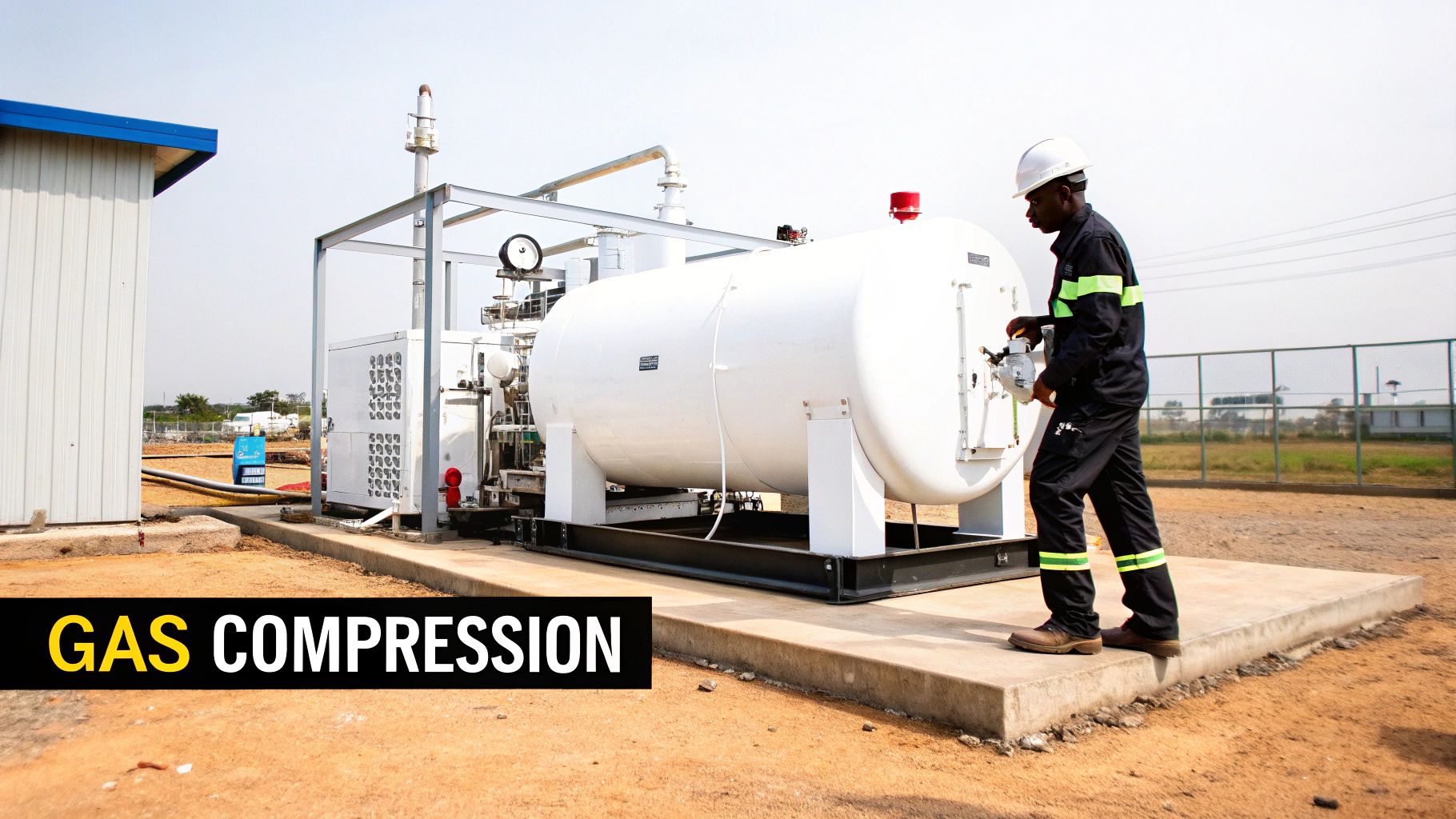
A great way to understand a gas compression package is to think of it as the heart of the entire natural gas pipeline network. Just like a human heart pumps blood through the body, these units provide the essential "push" to move gas through thousands of miles of infrastructure. Without that constant pressure, the gas would simply lose momentum and never reach our homes, businesses, and power plants.
What makes these packages so practical is their integrated design. Instead of piecing together dozens of individual components on-site—a logistical nightmare—everything is pre-assembled on a heavy-duty steel frame called a skid. This "plug-and-play" approach makes it much easier to transport, install, and get a unit up and running, which is why they've become a cornerstone of modern energy infrastructure.
What Does It Actually Do?
When you get right down to it, the job of every gas compression package is to take gas at a low pressure and squeeze it into a higher, more usable pressure. This simple-sounding task is fundamental to a surprising number of industrial processes.
You’ll find them at work in applications like:
- Pipeline Transport: This is the big one. They're the engines that move massive volumes of natural gas from production fields to the cities and towns that need it.
- Gas Storage: When surplus gas needs to be saved for later, it’s injected deep underground into reservoirs. This requires immense pressure, which these packages provide.
- Gas Processing: Before natural gas can be used, it has to be cleaned and separated. Compression packages feed the raw gas into processing plants at the precise pressure needed for treatment.
- Enhanced Oil Recovery: In a technique called "gas lift," operators pump gas back into aging oil wells to force more oil to the surface, and it’s these packages that handle the job.
The entire system is a carefully balanced orchestra of mechanical and electrical components. The compressor provides the muscle, the driver supplies the power, and the control systems act as the brain, ensuring everything operates safely and efficiently.
This all-in-one functionality shows just how critical these units are to the global energy supply chain. As the world's appetite for natural gas grows, so does the demand for these workhorses. Recent industry analysis found the global gas compressors market hit USD 5.1 billion in a single year and is on track to reach USD 6.9 billion within a decade. This growth isn't just a number; it reflects the indispensable role gas compression plays across energy, manufacturing, and transportation. You can dig into more of the numbers by checking out the gas compressor market size on imarcgroup.com.
Inside the Gas Compression Package: The Core Components
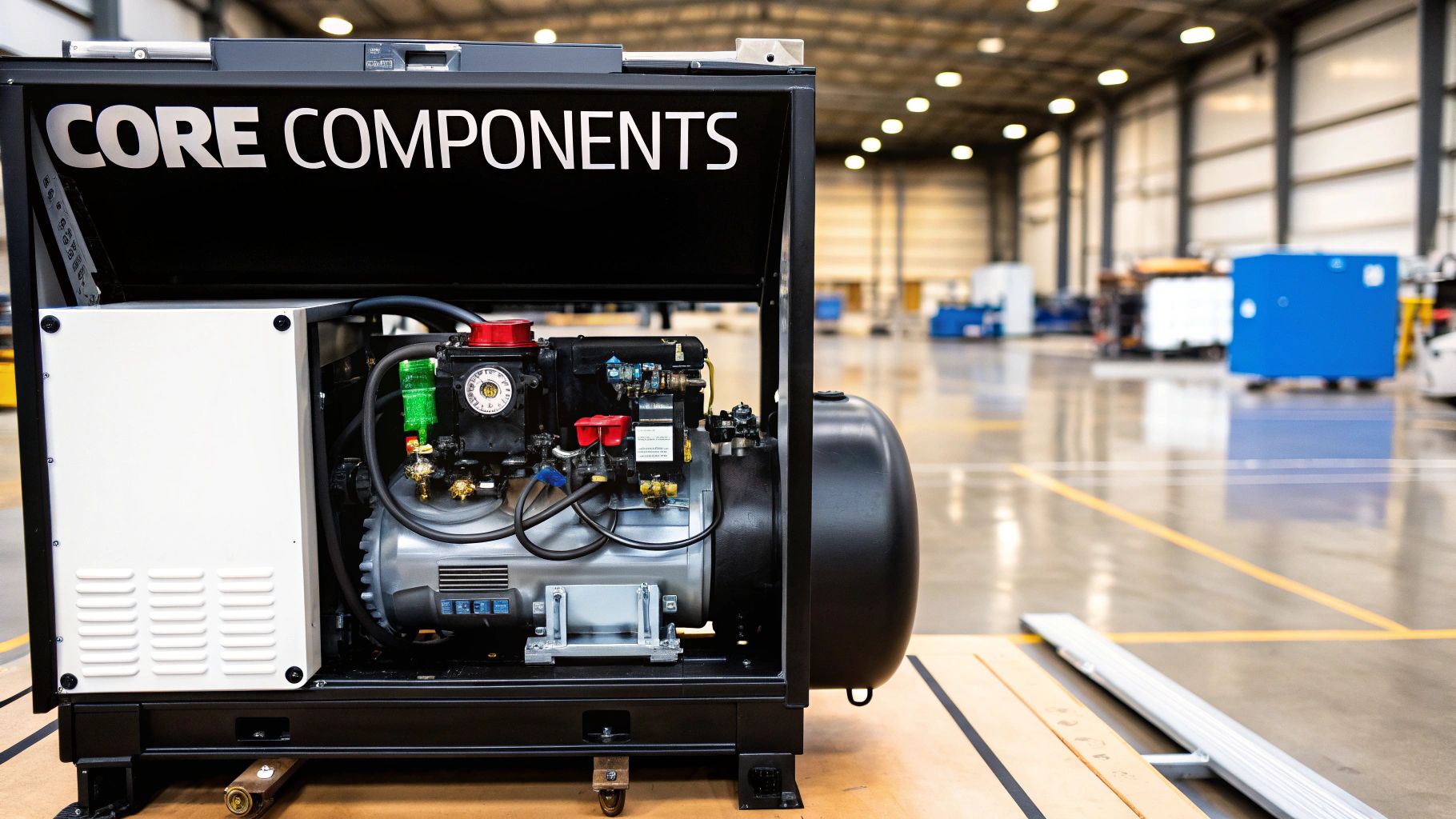
To really get what a gas compression package is all about, you have to look past the steel skid and see the individual parts working in harmony. Think of it like a high-performance car engine—every component has a specific job, and the overall performance hinges on how well they all play together.
At the very heart of the system is the compressor itself. This is the workhorse, the component that physically does the job of pressurizing the gas.
Compressors generally come in two main flavors, and each is built for different kinds of work. The first is positive displacement, which works by trapping a set amount of gas in a chamber and then shrinking that chamber's volume to build pressure. The classic example is a reciprocating compressor, which uses pistons moving back and forth, not unlike the engine in your truck.
The second type is the dynamic compressor. Machines like centrifugal compressors use spinning blades or impellers to get the gas moving at incredibly high speeds. This kinetic energy is then converted into pressure as the gas slows down. It’s a bit like how a spinning fan creates a powerful, steady breeze.
To help you see the difference, here’s a quick breakdown of how these two types stack up.
Comparing Compressor Types in Gas Compression Packages
This table compares the two primary types of compressors—positive displacement and dynamic—based on their operating principles, ideal applications, pressure capabilities, and efficiency ranges to help readers understand which type is suited for different industrial needs.
| Feature | Positive Displacement (e.g., Reciprocating) | Dynamic (e.g., Centrifugal) |
|---|---|---|
| Operating Principle | Traps a fixed volume of gas and mechanically reduces it. | Uses rotating impellers to accelerate gas, converting velocity into pressure. |
| Ideal Applications | High-pressure, low-flow scenarios like gas lift, gas injection, and pipeline transmission. | High-volume, low-to-moderate pressure applications like natural gas processing and LNG production. |
| Pressure Capability | Very high pressure ratios per stage. Can reach thousands of PSI. | Lower pressure ratios per stage. Best for large volumes at moderate pressures. |
| Efficiency Range | Generally more efficient across a wide range of operating conditions, especially with variable loads. | Highly efficient but within a narrower operating range. Efficiency drops off outside this sweet spot. |
Ultimately, the choice between positive displacement and dynamic comes down to the specific job requirements—how much gas you need to move and how much pressure you need to build.
The Power Behind the Pressure: The Driver
Of course, a compressor can't do its job alone; it needs a power source. That’s where the driver comes in. It’s essentially the engine of the whole package, providing the muscle needed to run the compressor. What you choose for a driver usually depends on where the unit is located and what utilities are available.
The two main options are:
- Natural Gas Engines: You'll see these everywhere in remote field locations. Why? Because the gas being compressed can often double as fuel. They're powerful, self-sufficient, and perfect for upstream or midstream work.
- Electric Motors: If you have access to reliable and affordable power, an electric motor is a fantastic choice. They run quieter, have lower emissions, and typically need less maintenance than a gas engine, making them a great fit for facilities closer to towns or cities.
Each component on the skid is more than just a piece of metal; it’s a solution to a specific operational challenge, from managing temperature to ensuring gas purity.
Pairing the right driver with the right compressor is a critical piece of engineering. You have to make sure the power output, speed, and torque of the driver are a perfect match for what the compressor needs. Get it right, and you get an efficient, long-lasting machine.
The Essential Support Systems
Beyond the compressor and driver, a whole team of unsung heroes keeps the package running safely and efficiently. These auxiliary systems are absolutely vital.
One of the most important is the cooling system. When you compress gas, you generate a ton of heat. That heat has to go somewhere, or you risk damaging the equipment and losing efficiency. Coolers, which often look like giant radiators, are responsible for keeping operating temperatures in check.
Just as critical are the scrubbers and separators. These vessels are the package's filter, pulling out unwanted liquids, debris, and other gunk from the gas before it hits the compressor. This is a non-negotiable step for protecting the sensitive guts of the machine.
Finally, the whole show is run by the control panel—the electronic brain of the operation. It constantly monitors pressures, temperatures, and flow rates, making tiny adjustments on the fly and triggering a safety shutdown if anything strays outside its limits.
How a Gas Compression Package Works Step by Step
To really get a feel for how these packages work, let's follow the natural gas as it makes its way through the system. It’s not a single event, but a carefully choreographed sequence of cleaning, compressing, and cooling. This whole process is what turns low-pressure gas from the wellhead into something valuable and ready for transport.
The journey starts the second the raw gas flows in from a pipeline. But it doesn't just get squeezed right away—the first stop is all about protecting the expensive machinery downstream.
Step 1: Gas Cleaning at the Inlet Scrubber
Before we can even think about compression, the gas has to be cleaned up. Raw natural gas is rarely pure. It’s usually full of liquids like water and other hydrocarbons, and can even carry solid debris like sand and rust. If that junk made its way into the compressor, you’d be looking at catastrophic damage to its precision parts.
That's why the inlet scrubber is the first stop. This vessel is essentially a high-tech filter. It uses gravity and specially designed internal components to knock out the liquids and solids, letting only the gas pass through. Think of it like wringing out a sponge before you use it—you get rid of the stuff you don't want so you can get the job done right. Once clean and dry, the gas is ready for the main event.
Step 2: The Compression Stage
With the impurities gone, the gas now enters the heart of the package: the compressor itself. Whether it’s a reciprocating or a centrifugal model, the goal is the same—to dramatically increase the gas pressure by squeezing it into a much smaller space.
The physics here are straightforward. When you force a gas into a smaller container, you push all its molecules closer together. This raises both its pressure and its temperature. It’s the exact same thing that happens when you use a bicycle pump; each stroke crams more air into the tire, boosting the pressure inside.
Trying to hit a very high target pressure all at once would create an incredible amount of heat, which is both inefficient and dangerous. That’s why most packages use multi-stage compression. The gas gets a partial pressure boost in one cylinder or stage, then gets cooled off before moving to the next one for another squeeze. This step-by-step approach is much safer and more efficient.
Step 3: Cooling and Final Discharge
That heat I mentioned has to go somewhere. Between each compression stage, the now-hot gas is routed through a cooler (often called an intercooler). These units function a lot like the radiator in your car, using fans to blow air over a series of tubes to pull heat away from the gas. Cooling the gas down makes it denser, which means the next compression stage doesn’t have to work as hard. This saves a ton of energy and reduces wear and tear on the equipment.
After passing through the very last compression stage and a final cooler (the aftercooler), the gas is finally ready. Now at high pressure, it leaves the gas compression package through a discharge outlet and flows into a pipeline, a storage tank, or another processing facility.
Where Gas Compression Packages Are Used
You might think of a gas compression package as just another piece of heavy industrial machinery, but it’s really the unsung hero of our modern energy system. These units are hard at work in more places than you'd expect, playing a crucial role from the moment natural gas is pulled from the ground until it gets to where it’s needed.
Simply put, they are the muscle that moves gas from point A to point B.
The Upstream and Midstream Backbone
In the world of oil and gas, operations are split into stages. During the initial production phase, known as upstream, compression packages are absolutely essential. They tackle a few key jobs right at the source:
- Wellhead Compression: When a gas well gets older, its natural pressure drops. A compressor package is brought in to give it a boost, keeping the gas flowing steadily into the gathering pipelines and making the well economically viable for longer.
- Gas Gathering: Think of this like a network of small country roads leading to a highway. Compressors act as the on-ramps, pulling gas from multiple individual wells and pushing it into a central processing plant.
- Gas Lift Operations: In older oil wells that are struggling to produce, compressors are used for a clever trick. They inject gas down into the well, which mixes with the crude oil and lightens the load, making it much easier to lift to the surface. It’s a game-changer for maximizing oil recovery.
Once the gas is collected, the midstream sector takes over. This is where gas compression packages are the heart of the whole transportation network. You'll find them set up as booster stations along thousands of miles of pipelines, maintaining the pressure needed to push the gas efficiently across the country.
The infographic below shows the basic idea in action—taking gas in at low pressure and sending it out at a much higher, more useful pressure.
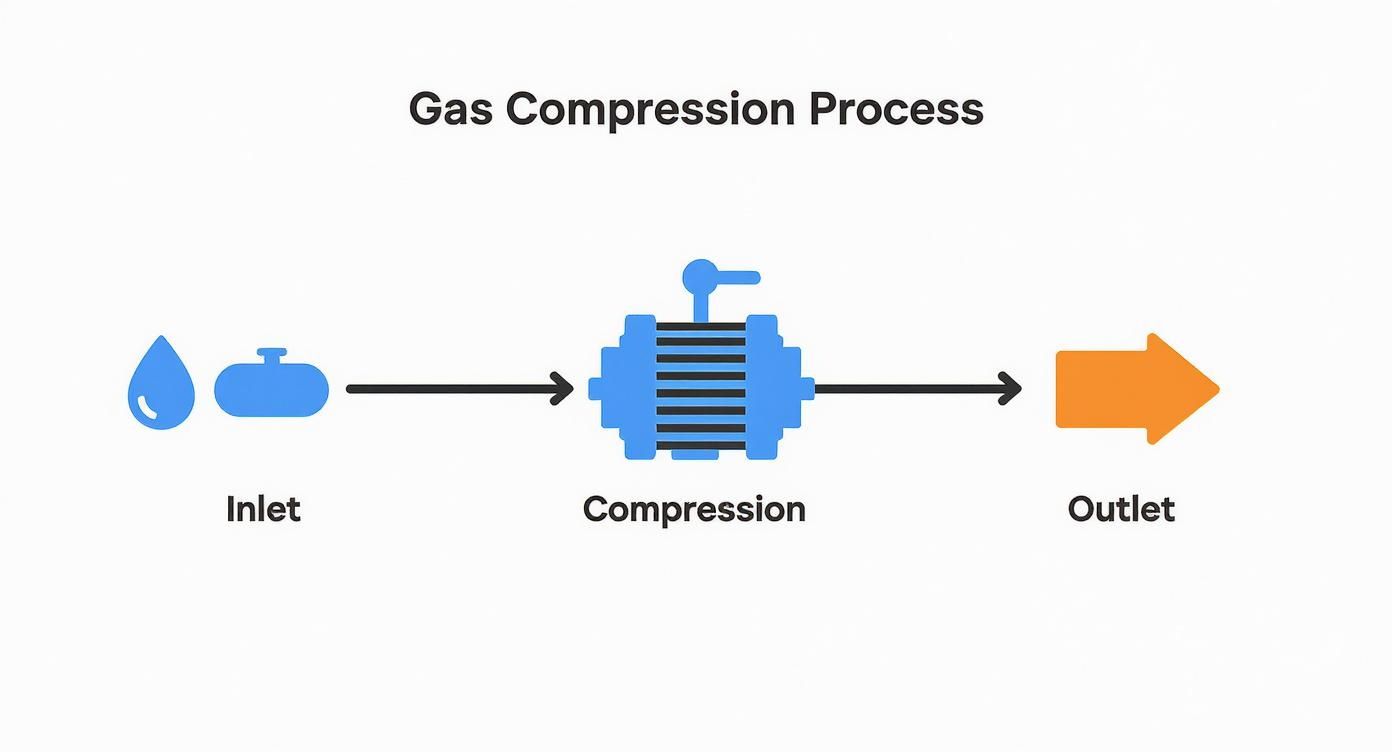
This simple cycle—inlet, compression, outlet—is the engine that powers the entire natural gas supply chain.
Downstream and Specialized Roles
The journey doesn't stop at the pipeline. In downstream facilities like refineries and petrochemical plants, a gas compression package is vital for all sorts of complex chemical processes that require gases to be held at very specific, high pressures. In these potentially hazardous environments, safety is everything, which is why things like intrinsically safe radio standards are so critical for ensuring communication devices don't create a spark.
A specialized and fast-growing job for these compressors is in the Liquefied Natural Gas (LNG) industry, where controlling gas vapor is a major safety and financial priority.
This is where boil-off gas compressors have a unique role. As LNG sits in storage or is moved in tankers, a small amount naturally warms up and evaporates back into a gas. Instead of letting this valuable methane escape, these specialized packages capture the "boil-off" and re-compress it.
This not only prevents waste but also cuts down on emissions. It's a big deal, and the market reflects that—the North America boil-off gas compressors market was recently valued at USD 1,660.48 million and is expected to keep growing.
How to Select the Right Gas Compression Package
Picking the right gas compression package is a huge decision, one that sits right at the crossroads of precise engineering and serious financial planning. Get it right, and you're set up for years of efficient, reliable operations. Get it wrong, and you're looking at frustrating downtime, poor performance, and a big hit to your capital budget. The whole process really boils down to one thing first: defining what you actually need.
Before you even start looking at different models or talking to manufacturers, you have to create a clear operational baseline for your project. Think of it like writing a detailed job description for a new hire—the more specific you are, the better the final fit will be.
Define Your Core Operational Parameters
First things first, you have to get your technical specs locked in. These aren't just suggestions; they are the hard numbers that will form the foundation of your entire search.
You need to have solid answers to these questions:
- What is the required flow rate? How much gas are you trying to move? This is usually measured in standard cubic feet per minute (SCFM) or million standard cubic feet per day (MMSCFD).
- What are the suction and discharge pressures? You have to know the pressure of the gas as it comes into the unit (suction) and what the target pressure needs to be on the way out (discharge).
- What is the gas composition? Are you dealing with pure methane, or is it a mix with other things like CO2 or H2S? The exact makeup of the gas dramatically influences your choice of materials and even the type of compressor you'll need.
Honestly, those three data points are the absolute bare minimum. You can't even have a productive conversation with a supplier without them.
Consider Environmental and Site Conditions
A compressor package that runs like a dream in a mild, sea-level climate could easily fall on its face in a high-altitude desert. Where the equipment will live has a massive impact on its performance and how long it will last.
You absolutely have to factor in:
- Altitude and Climate: Higher altitudes mean thinner air, which can choke the power output of a natural gas engine. Likewise, extreme hot or cold temperatures will mess with everything from the coolers to the lubricants.
- Regulatory Requirements: Does the local jurisdiction have strict rules about noise or emissions? This could easily push you toward an electric motor instead of a gas engine, for example.
Skipping over these site-specific details is a classic mistake. It's an easy way to end up with a unit that's either undersized for the job or non-compliant from day one.
The right gas compression package isn't just about meeting today's needs; it’s about anticipating future demands and operational realities. A thorough evaluation process ensures your investment delivers long-term value and performance.
New Purchase Versus Rental Strategy
Finally, you've got to tackle the big question: buy new or rent? For a long time, buying was the go-to choice for any long-term project, but the market has changed that calculation. The single biggest factor right now is lead time. Industry experts are seeing the average time to build and deliver a new gas compression package stretch to around 60 weeks. That’s a huge jump from the six to eight weeks we used to see before the recent boom in demand from LNG export terminals and other big energy projects. You can read more about the factors driving rising demand in the compression industry on aogr.com.
Those long waits have made rental fleets a much more popular option, especially for projects on a tight schedule. Renting can be the perfect stop-gap while your new unit is being built, or it can serve as a flexible solution for shorter-term needs. Your decision here has to balance your project timeline, capital budget, and your long-term operational strategy to figure out the smartest path forward.
Common Questions About Gas Compression
Even with a solid grasp of the basics, it's natural to have a few more questions about how a gas compression package really performs out in the field. Let's dive into some of the most common questions people ask to clear up any lingering confusion and tackle some practical details.
We'll cover everything from simple definitions to critical safety measures, giving you a complete picture of this technology.
What’s the Difference Between a Compressor and a Gas Compression Package?
This is a great question, and it gets right to the heart of what these systems are. Think of it like a car. The compressor is just the engine—the single component doing the heavy lifting of physically squeezing the gas to increase its pressure.
A gas compression package, on the other hand, is the entire car. It's a complete, ready-to-go system mounted on a single steel skid. This package includes the compressor, its driver (like a natural gas engine or an electric motor), a control panel, coolers, scrubbers to clean the gas, all the piping, and a suite of safety valves. It’s a turnkey solution built for a specific job.
Why Is Multi-Stage Compression Necessary?
Compressing gas creates a lot of heat. If you tried to crank up the pressure all at once in a single step (or 'stage'), the heat generated could easily damage sensitive equipment. Not only is it dangerous, but it's also incredibly inefficient and wastes a ton of energy.
Multi-stage compression is the smart solution to this heat problem. By breaking the process into smaller, more manageable steps, the system can operate safely and much more efficiently.
Here’s how it works: the gas is compressed a little bit in the first stage, then piped through an 'intercooler' to strip away the heat. Once cooled, it moves on to the next stage for another pressure boost. This step-by-step method allows the package to reach incredibly high pressures without overheating, which extends the life of the machinery and cuts down on fuel costs. It's a much safer and more effective way to manage the intense physics involved.
What Are the Main Safety Features on a Gas Compression Package?
Safety is non-negotiable when you're dealing with high-pressure, flammable gas. That’s why gas compression packages are built with multiple layers of protection to prevent accidents and keep things running smoothly.
Here are a few of the key safety systems you'll find:
- Automated Shutdown Systems: The control panel is always on watch, monitoring for high pressure, high temperatures, or excessive vibration. If any of these readings stray outside of safe limits, the system automatically shuts itself down to prevent a bigger problem.
- Pressure Relief Valves: These are the mechanical failsafes. If the pressure inside a pipe or vessel gets too high, these valves automatically open to vent the excess gas, preventing a potential rupture.
- Gas Detection and Ventilation: Good airflow is critical to stop flammable gas from building up. Many sites also have gas detectors that will sound an alarm or trigger a shutdown the moment a leak is detected.
Consistent maintenance and keeping a close eye on these features are fundamental to ensuring a gas compression package operates safely for years to come.
When unexpected project delays or maintenance outages put your natural gas supply at risk, you need a solution that’s fast and dependable. Blue Gas Express specializes in providing temporary mobile CNG and LNG units to keep your operations running without a hitch. If you're facing a gas line interruption in the Carolinas, Tennessee, or Virginia, learn how we can deliver an on-site solution by visiting https://bluegasexpress.com.