

At its heart, an energy data management system (EDMS) is the brain behind your energy strategy. Think of it less like a piece of software and more like a dedicated financial advisor for your energy consumption. Instead of tracking income and expenses, it meticulously monitors, analyzes, and reports on every kilowatt-hour of electricity or cubic foot of natural gas your facility uses.
Making the Invisible, Visible
Trying to manage your facility's energy costs by only looking at a monthly utility bill is like trying to navigate a ship in the fog. You know you're moving, but you have no idea where you're going or what obstacles are in your path. This is the reality for many industrial plants, commercial buildings, and large-scale project sites, where hidden energy waste quietly drives up operating costs.
An EDMS cuts through that fog. Its primary job is to take the confusing jumble of raw data from meters and bills and turn it into clear, actionable information. It gives you a granular view of how, when, and where energy is being used across your entire operation, moving far beyond a simple monthly total.
Turning Numbers into Strategy
An EDMS doesn't just collect data; it gives that data meaning. By pulling all your energy information into one place, you can finally get answers to the tough questions that were impossible to tackle before:
- Which machine on the factory floor is the real energy hog?
- Why are we seeing energy spikes at 2 a.m. when no one is here?
- How does a heatwave affect our cooling costs versus our production output?
- Where are the low-hanging fruit for real savings and efficiency gains?
This is a fundamental shift from just paying the bills to actively managing your energy. The market shows just how critical this control has become. The global Energy Management Systems (EMS) market was valued at USD 57.31 billion and is projected to expand at a 14.3% CAGR through 2031, a trend driven by smart grid adoption and the urgent need to control operational costs. You can find more details on this growth at Cognitive Market Research.
An EDMS gives you the visibility to turn an uncontrollable expense into a managed asset. It’s the difference between guessing where your money is going and knowing exactly where to invest to improve your bottom line.
A Must-Have for Temporary Energy Solutions
This kind of detailed insight is absolutely critical when you’re dealing with temporary energy sources, like mobile compressed natural gas (CNG) for a pipeline project or a remote construction site. In these scenarios, visibility isn't just about saving a few dollars—it's about preventing a complete operational shutdown that could cost you thousands.
A solid energy data management system lets project managers watch fuel levels in real time, accurately forecast when the next delivery is needed, and coordinate with suppliers to ensure the gas never runs out. It turns a logistical headache into a well-oiled machine, keeping projects on time and on budget. Without it, you're just flying blind and hoping for the best.
What Are the Core Components of an EDMS?
Think of an energy data management system less like a single piece of software and more like a skilled team working together. Raw data comes in one end—messy and full of potential—and comes out the other as clear, actionable intelligence you can use to make smarter decisions. Each part of the system has a specific job to do, transforming a flood of numbers into a coherent story about your energy performance.
The whole process boils down to a simple, powerful loop: you monitor what's happening, analyze why it's happening, and then report on it to drive savings and improve performance.
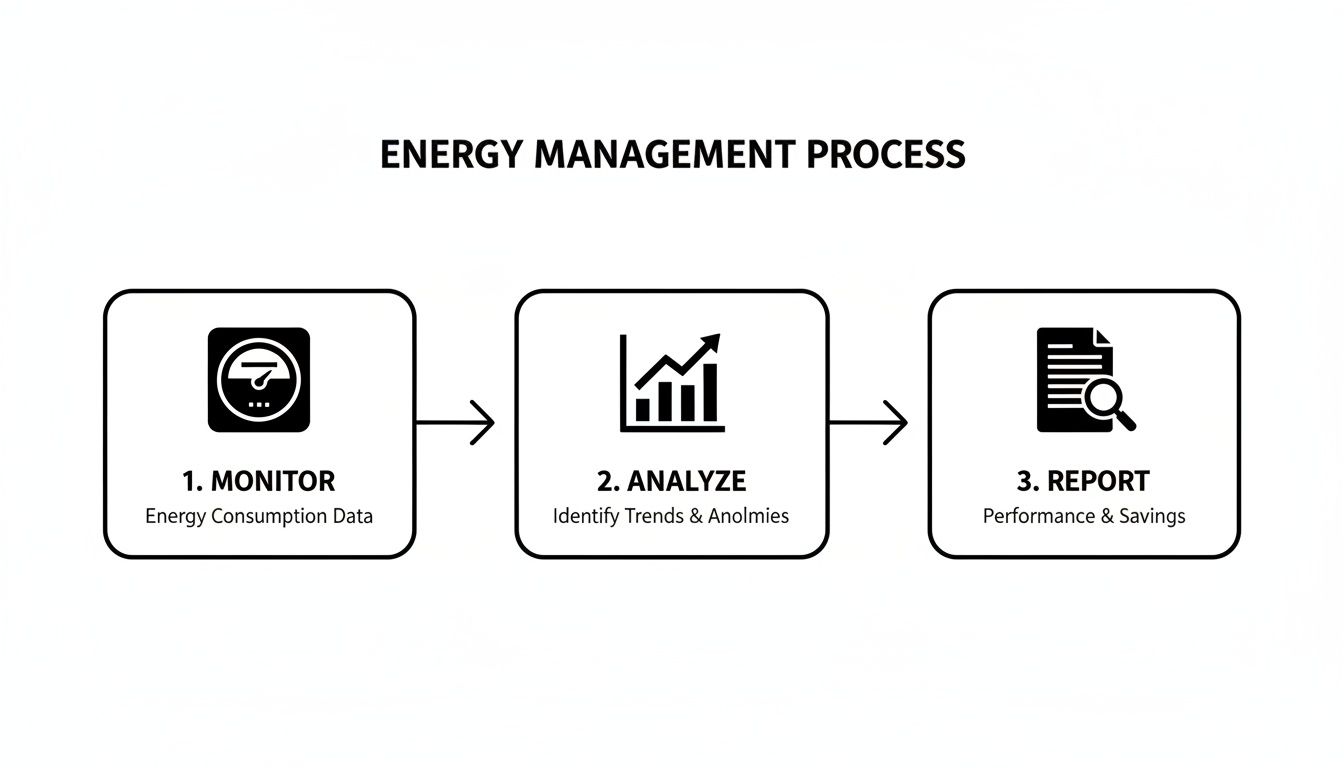
This flow is the engine of any good EDMS, turning data collection into a strategic advantage. Let's pull back the curtain on the five core components that make it all work, looking at what each one does and why it matters.
The Five Pillars of an Energy Data Management System
To truly understand how an EDMS functions, it helps to see how its core components work together. Each one plays a critical role, from gathering the initial data points to presenting the final, polished insights. For a user relying on temporary gas, these components are not just abstract features; they are practical tools for ensuring operational continuity and cost control.
The table below breaks down these five pillars, explaining what each one does and offering a concrete example of how it helps a temporary gas user in the real world.
| Component | Function | Example for a Temporary Gas User |
|---|---|---|
| Data Collection | Gathers raw energy information from various sources. | Pulls real-time fuel levels from telemetry on mobile CNG/LNG tanks. |
| Data Validation | Cleans and verifies incoming data to ensure accuracy. | Flags a sudden, illogical drop in a tank's pressure sensor as a potential error. |
| Centralized Storage | Organizes and stores all cleaned data in one accessible place. | Keeps a historical record of daily gas consumption across all project sites. |
| Analytics Engine | Processes the data to uncover patterns and identify opportunities. | Predicts when a tank will run low based on past usage trends, automating reorder alerts. |
| Reporting & Visualization | Presents insights through dashboards, alerts, and reports. | Creates a daily dashboard showing fuel usage vs. project progress for the site manager. |
By working in concert, these components provide a complete, 360-degree view of your energy landscape, making it possible to manage temporary resources with the same precision as a permanent utility connection.
1. Data Collection: The Foundation
You can't manage what you don't measure. This is where it all begins. A solid EDMS acts as a universal data hub, pulling information from a wide range of sources to build a complete picture of your operation.
- Smart Meters and Submeters: These are your eyes on the ground, giving you granular, real-time consumption data for your whole facility or even down to a single piece of heavy machinery.
- Utility Bills: Looking at past invoices helps establish a baseline, track seasonal trends, and spot long-term changes in your energy profile.
- Sensors and IoT Devices: Modern systems go beyond just energy meters. They integrate with sensors tracking occupancy, ambient temperature, and equipment runtime, adding critical context to why you're using energy.
- Telemetry from Mobile Gas Units: For anyone using temporary CNG or LNG, this is non-negotiable. Telemetry devices on your mobile units send live fuel level data directly to the EDMS, so you're never caught off guard by an empty tank.
2. Data Validation and Cleansing: Quality Control
Raw data is almost never perfect. It’s often full of errors, gaps, and weird inconsistencies that can throw your entire analysis off track. The validation component is your quality control checkpoint, automatically finding and flagging these problems before they can cause trouble.
Imagine a facility manager gets a utility bill that's suddenly 50% higher than last month, even though operations were the same. A good EDMS would automatically compare that bill against the facility's own meter data, instantly flagging it as a likely billing error that could have cost the company thousands.
3. Centralized Data Storage: Your Single Source of Truth
Once the data is collected and cleaned, it needs a safe, organized home. The EDMS provides a central repository—a single source of truth—for every piece of energy information. This is huge. It breaks down the data silos that form when different departments (like accounting and operations) keep their own separate, and often conflicting, records.
This unified approach is particularly critical in industrial settings. In fact, Industrial Energy Management Systems (IEMS) dominate with 71% of the market share, largely because they excel at managing complex operational data from multiple sources. The hardware and sensors that feed these systems make up a massive 62% of that segment, underscoring just how vital that foundational data collection is. You can explore more on these market dynamics in a report from Grand View Research.
4. Analytics: The Engine of Insight
This is where the data comes to life. The analytics engine is the brain of the operation, taking all that stored information and using powerful algorithms to uncover patterns, spot anomalies, and generate insights you can actually act on. It’s what answers the all-important "so what?" and "what now?" questions.
An analytics engine can do things that are simply impossible with manual tracking. It can pinpoint a single, faulty HVAC unit that’s wasting energy every weekend—an issue that would be completely buried in a monthly utility bill.
Some of the key jobs the analytics engine performs include:
- Load Profiling: Figuring out when and where your peak energy demand hits.
- Benchmarking: Comparing the energy performance of different buildings, production lines, or even shifts.
- Predictive Forecasting: Using your historical data to create surprisingly accurate forecasts of future energy use and costs.
5. Reporting and Visualization: Making Data Understandable
Finally, all those brilliant insights are useless if no one can understand them. The reporting component translates complex analytics into intuitive, easy-to-digest formats. We’re talking about custom dashboards, automated email reports, and real-time alerts that get the right information to the right person at the right time.
For a construction site manager using temporary CNG, this might be a simple dashboard on their tablet showing daily fuel consumption. This one visual tool helps them optimize delivery schedules, prevent work stoppages, and keep the project moving forward without costly surprises. It turns data from something you just have into something you actively use, every single day.
How an EDMS Integrates with Your Operations
A top-tier Energy Data Management System (EDMS) isn’t a standalone tool that just sits in a corner. It's the central hub for your entire facility's operational data, connecting systems that, on their own, don't know how to talk to each other. Think of it as breaking down the walls between departments to create one unified, powerful view of performance.
Imagine your facility is an orchestra. Your production line, HVAC systems, and even the accounting software are all world-class musicians. The problem is, they’re all playing from different sheet music. The EDMS steps in as the conductor, making sure every instrument is in sync and playing the same tune: peak efficiency.
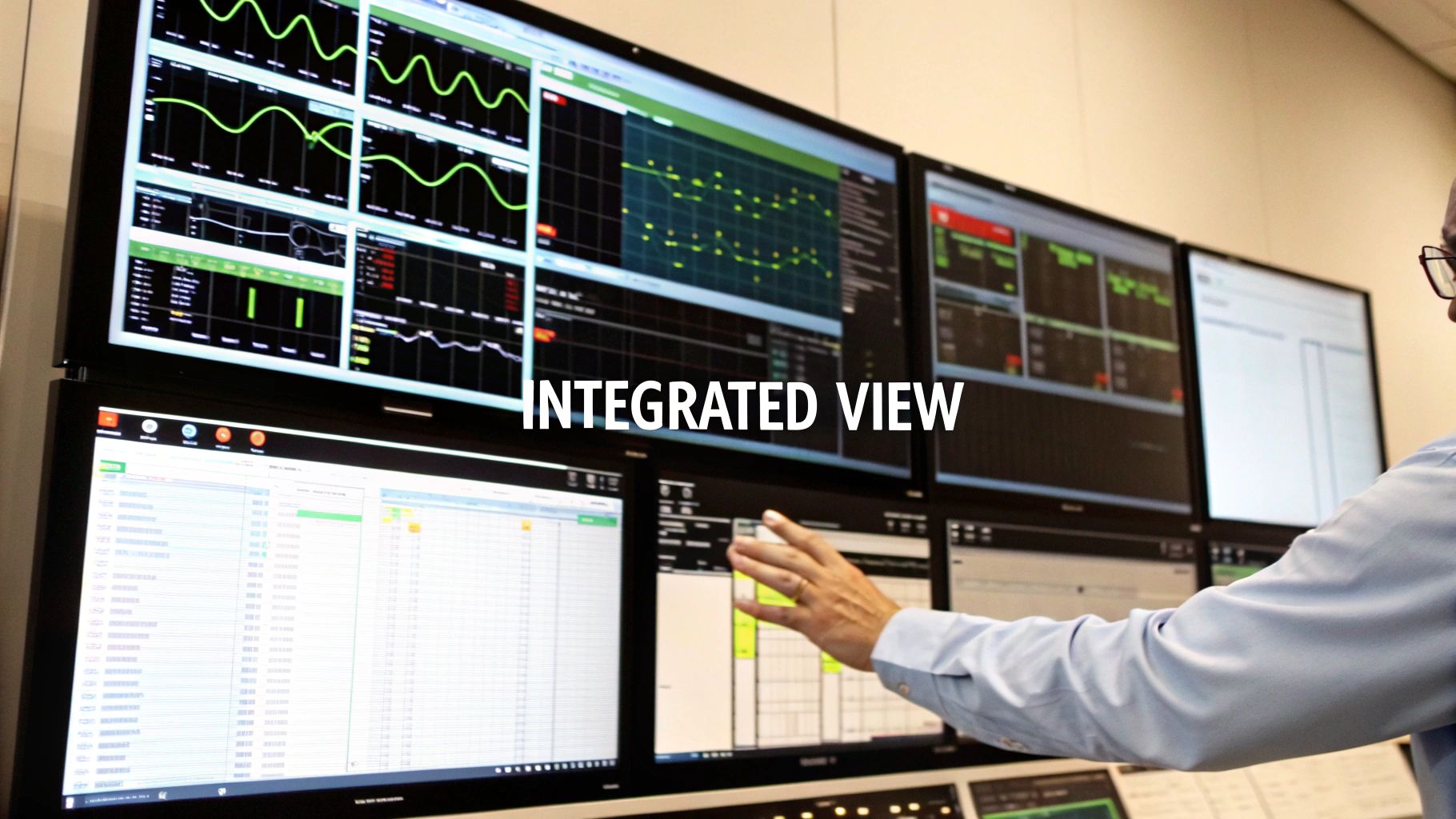
This synergy all comes down to smart data integration, which is the technical term for pulling all these different data sources together. By linking everything up, you can finally move past just tracking energy use and start connecting it directly to your operational output.
Connecting Key Operational Systems
An EDMS truly shines when it’s plugged into the tools you’re already using every day. This creates a powerful feedback loop where energy data gives you context for your operations, and operational data explains why your energy consumption looks the way it does.
Key integrations usually fall into three main categories:
- SCADA Systems: Your Supervisory Control and Data Acquisition (SCADA) system is the lifeblood of most industrial sites. When you integrate it with an EDMS, you can overlay energy data directly onto your production metrics. Suddenly, you can see the precise energy cost to make one product, identify which assembly line runs leanest, and spot a machine that’s chewing up power before it breaks down completely.
- Automated Meter Reading (AMR): Tying into your AMR system means consumption data from utility meters flows straight into your EDMS automatically. This gets rid of tedious manual data entry, cuts out human error, and gives you a near real-time stream of information to work with.
- Accounting and Billing Software: When your EDMS is linked to your accounting platforms, validating utility bills becomes a breeze. The system can automatically flag any strange discrepancies between what your meters say you used and what the utility billed you for, potentially saving thousands in billing mistakes.
With this level of connectivity, an EDMS stops being just a monitoring tool and becomes a core part of your business intelligence strategy.
Seamless Integration for Temporary Energy Supplies
For projects that depend on a temporary natural gas supply, this integration isn't just a bonus—it's absolutely critical for keeping the lights on. Managing mobile CNG or LNG units demands precise coordination to avoid running out of fuel and causing expensive downtime.
An integrated EDMS makes sure a temporary fuel supply is managed with the same level of precision as a permanent utility hookup. It takes the guesswork out of logistics and turns a potential headache into a reliable, well-oiled machine.
When you integrate your EDMS with your temporary gas provider's systems, you create a seamless flow of information that gives you a few major advantages:
- Real-Time Telemetry Syncing: The EDMS gets live data fed directly from the telemetry units on the mobile CNG skids. This gives you an accurate, up-to-the-minute view of your fuel levels without anyone having to go out and check them manually.
- Automated Refill Scheduling: The EDMS analytics engine can look at your current consumption rates and historical data to predict when you'll run low. It can then automatically trigger an alert to both your project manager and the gas provider, ensuring a new unit is on its way long before you’re at risk of running dry.
- Utility and Provider Coordination: The system acts as a single source of truth for everyone involved. It guarantees that the project site, the temporary gas provider, and the local utility are all looking at the same data. This avoids the kind of miscommunication that can delay project timelines or even hold up occupancy permits.
By plugging these vital systems together, an EDMS ensures your temporary energy solution is perfectly aligned with your real-time needs, keeping your project on track and on budget.
Measuring Success and Calculating Your ROI
So, you're considering an energy data management system. It's a smart move, but let's be honest—the real question is, what's the payback? Beyond all the technical bells and whistles, the true value of an EDMS shows up in real dollars saved and smoother operations. The trick is to track the right metrics, build a solid business case, and see exactly how that data translates to your bottom line.
Think of an EDMS as hiring a financial analyst dedicated solely to your energy spending. You stop just passively paying utility bills and start actively investing in a tool designed to hunt down and eliminate waste. Its success isn't measured by how much data it collects, but by how quickly it pays for itself.
Key Performance Indicators That Matter
To prove your EDMS is working, you need to watch the Key Performance Indicators (KPIs) that connect energy use directly to business results. These aren't just numbers on a screen; they're the vital signs of your operational health.
- Energy Use Intensity (EUI): This is a straightforward one—how much energy are you using per square foot? Watching your EUI drop over time is clear proof that your efficiency efforts are actually making a difference.
- Peak Demand Charges: Utilities often hit commercial and industrial users with hefty fees based on their single highest point of energy use. An EDMS spots these peaks, allowing you to shift equipment schedules and potentially knock 10-30% off your electricity bills.
- Carbon Footprint Reduction: If your company has sustainability goals, an EDMS gives you the hard data you need for accurate ESG reporting. It turns your green initiatives from fuzzy promises into concrete, measurable wins.
- Cost Per Unit Produced: For any manufacturer, this is the holy grail. By overlaying energy data on top of production data, you can see the exact energy cost baked into every single item you make. That’s how you find the sweet spot for maximum profitability.
The best way to sell an EDMS to leadership isn't by talking about saving energy—it's by talking about saving money. When you focus on metrics like peak demand and cost per unit, you're speaking their language.
Building a Strong Business Case
Figuring out the ROI for an EDMS is about more than just subtracting your energy savings from the system's cost. You have to look at the full picture, including both direct and indirect financial wins.
The U.S. market for energy management is already worth USD 18.19 billion, and with energy costs on the rise and a big push for decarbonization, it's only growing. As detailed in market analysis from Precedence Research, businesses are increasingly turning to these systems to stay competitive.
To build a compelling case, focus on these three pillars:
- Direct Cost Savings: This is the low-hanging fruit. It includes a smaller energy bill, lower peak demand fees, and catching those inevitable utility billing mistakes.
- Operational Efficiency Gains: Think about the time saved. This includes getting predictive maintenance alerts before a critical machine fails and automating the tedious, manual work of compiling data for reports.
- Risk Mitigation and Cost Avoidance: This is absolutely critical, especially for anyone on a temporary energy supply. For a factory running on mobile CNG, avoiding just one production shutdown because you unexpectedly ran out of fuel can pay for the entire EDMS in a single afternoon.
ROI in Action: A Temporary Gas Scenario
Let's make this real. Imagine a manufacturing plant is waiting on a natural gas pipeline upgrade. To keep the lines running for two months, they've brought in temporary CNG from a provider like Blue Gas Express.
Without an EDMS, the plant manager is flying blind. They're relying on gut feelings and manual tank checks to schedule fuel deliveries. To be safe, they schedule frequent refills, which means paying for more deliveries than they need and wasting fuel.
Now, let's say they implement an energy data management system with telemetry. Suddenly, the manager has a real-time dashboard showing exactly how much gas is being used and when. The system's analytics quickly spot a trend: fuel consumption drops by 20% on weekends.
Armed with this insight, the manager reschedules deliveries, cutting out two expensive weekend trips per month. A few days later, the system sends an alert about an inefficient heating unit running all night in an empty warehouse. They fix it immediately, stopping the waste.
The ROI calculation here is simple. The money saved from fewer deliveries and catching that energy leak easily covers the monthly cost of the EDMS. They're seeing a positive return long before the new pipeline is even finished.
Your Checklist for Implementing an EDMS
Getting a handle on your energy data is one of the smartest moves you can make for your budget and your operations. But turning that idea into a working energy data management system isn’t something you can just wing. You need a solid plan. This checklist is built to walk you through the process, step by step, taking the guesswork out of it and setting you up for success.
Think of it like building a house. You wouldn’t just start pouring concrete without a detailed blueprint. This checklist is that blueprint, making sure the system you build actually fits your needs, plugs into your existing operations, and gives you a real return.
Phase 1: Define Your Goals and Scope
Before you start looking at software demos, you have to figure out what winning looks like for your organization. If your goals are fuzzy, your system will be too. You need to get specific and, whenever possible, attach numbers to your objectives so you know exactly what you're aiming for.
Start by getting clear answers to these questions:
- What’s our main goal here? Are we trying to cut overall energy costs by 15%? Is the mission to prevent downtime by keeping a close eye on our temporary CNG supply? Or do we just need to automate sustainability reports to keep regulators happy?
- Which facilities are we covering? Are we focusing on one industrial plant, a dozen scattered construction sites, or a whole portfolio of commercial buildings?
- Who needs to use this? Make a list of every key stakeholder, from the facility manager and site foreman to the CFO and sustainability officer. Knowing what they need from the system is absolutely critical.
Key Insight: A clearly defined goal turns an EDMS from a simple tracking tool into a powerful strategic asset. You’re no longer just "monitoring energy"—you’re "slashing temporary fuel waste by 20% to keep this project on budget."
Phase 2: Audit Your Existing Infrastructure
Once you know where you're going, you need a map of where you're starting from. An infrastructure audit sounds technical, but it’s really just about taking stock of what you already have. This step prevents nasty surprises down the road and helps vendors give you a much more realistic quote and timeline.
Your audit should be a simple inventory of all your data sources:
- Metering Hardware: What do you have on site? Smart meters, basic submeters, or just the main utility meter? Critically, can they send data remotely, or does someone have to walk out and read them?
- Operational Systems: Jot down any software you’ll need to connect with. This could be a SCADA system, a building management system (BMS), or even your accounting platform.
- Temporary Energy Sources: If you rely on mobile gas units, note the provider—for instance, Blue Gas Express—and find out what kind of telemetry data is available from their CNG or LNG skids.
This audit gives you a solid, realistic starting point. It helps you spot gaps—like realizing you need to install new submeters on a key production line—long before it becomes a problem during implementation.
Phase 3: Evaluate Vendors and Plan Integration
With your goals defined and your audit complete, you're finally ready to start talking to EDMS providers. Here's the thing: not all systems are the same, especially when you're dealing with the unique challenges of mobile energy solutions.
When you’re vetting vendors, dig into these key areas:
- Specialized Experience: Don't be shy. Ask for case studies that are directly relevant to your industry or your specific use of temporary energy. A vendor who gets the logistics of mobile CNG telemetry is going to serve you far better than one who’s only ever dealt with traditional utilities.
- Integration Capabilities: Show them your audit list and confirm they can connect seamlessly with your systems. Ask for a technical demo of how they integrate with platforms like SCADA or specific telemetry protocols.
- Scalability and Support: Pick a system that can grow with your business. Cloud-based platforms usually offer the most flexibility. And don't forget to ask about their customer support. What happens when you need an answer at 3 a.m. from a remote project site?
Phase 4: Execute Implementation and Training
This is where the plan comes to life. A smooth rollout hinges on clear communication, a phased approach, and making sure your team actually knows how to use the new tool. You can’t just flip a switch and expect everyone to jump on board.
Your execution plan should have three main parts:
- Phased Rollout: Don't try to do everything at once. Start with a pilot project at a single site or on one specific piece of equipment. This lets you work out the kinks in a controlled environment before going company-wide.
- Team Training: Offer hands-on training that's tailored to different roles. A project manager needs to know how to read the fuel supply dashboard, while an analyst needs to learn how to build custom reports from scratch.
- Establish Baselines: As soon as the system is live, just let it run and collect data for about a month. This gives you a clear performance baseline—the "before" picture that you'll measure all your future savings and improvements against.
By following this checklist, you can move forward with confidence, knowing you’re putting in place an energy data management system that will deliver real, measurable value from the get-go.
Common Questions About Energy Data Management
Diving into energy data management can definitely bring up a lot of questions. You might be wondering how a new system will play with your current tools, or if it’s even right for a business of your size. This section tackles the most common questions we hear about an energy data management system, giving you clear, straightforward answers to help you move forward with confidence.
What Is the Difference Between an EDMS and a BMS?
It’s easy to get an Energy Data Management System (EDMS) and a Building Management System (BMS) mixed up, but they play very different roles.
Think of your BMS as the hands-on operator of your facility. It’s the system that physically turns the HVAC on, adjusts the lighting, and manages security systems based on direct commands and schedules.
The EDMS, on the other hand, is the strategic brain that analyzes the results of those actions. It doesn't flip the switches itself. Instead, it meticulously tracks the energy impact of every move the BMS makes, providing the deep insights you need to make those commands smarter and more efficient.
For instance, a BMS might be programmed to run the air conditioning from 8 AM to 6 PM. An EDMS would analyze that data alongside occupancy trends and reveal that the building is mostly empty by 5 PM, identifying a clear opportunity to save an hour of cooling costs every single day. The best approach is to have them work together, using the EDMS to inform the BMS on how to operate for maximum savings.
How Does an EDMS Help Manage Temporary Energy Supplies?
For any project relying on temporary energy like CNG or LNG, an energy data management system isn't just a nice-to-have—it's essential. It turns fuel management from a high-stakes guessing game into a precise, data-driven science.
The biggest benefit is real-time visibility into your fuel consumption, which completely removes the constant worry of an unexpected run-out. This allows project managers to accurately forecast refill needs and prevent the kind of costly downtime that can bring a construction site or industrial process to a grinding halt. The system can, for example, analyze usage trends and automatically ping both you and your provider when a CNG tank hits a 25% threshold.
An EDMS is also exceptional at sniffing out waste. It might flag temporary heaters running at full blast overnight in an unoccupied area or an inefficient generator burning through fuel faster than its specs suggest. These insights give you the power to optimize usage on the fly, keep project costs in check, and get the most value from every drop of fuel.
Is an EDMS Only for Large Industrial Companies?
Absolutely not. This is a common myth that stops smaller organizations from tapping into some powerful cost-saving opportunities. While it’s true that massive industrial facilities see enormous benefits, the technology has come a long way.
Modern, cloud-based EDMS solutions are built to scale and are surprisingly affordable for businesses of all sizes, from multi-site commercial buildings and retail chains to smaller manufacturing plants. The need for an energy data management system isn't determined by the sheer volume of energy you use; it's driven by the desire to control costs and run a more efficient operation.
Any organization, regardless of its size, that wants to gain actionable insights from its utility bills can benefit significantly from an EDMS. It's about working smarter, not just being bigger.
Bottom line: if you pay utility bills, you have energy data. An EDMS simply gives you the tools to understand that data and use it to your advantage, whether you're managing a single warehouse or a sprawling industrial campus.
What Is the Typical Implementation Timeline?
The timeline for getting an EDMS up and running can vary quite a bit depending on the complexity of your setup. There's no single answer, but we can look at a couple of common scenarios.
- For a straightforward, cloud-based system in a commercial building with smart meters already in place, implementation can be surprisingly fast. You could be looking at your first dashboards in just a matter of weeks.
- For a comprehensive, on-premise system in a large industrial plant with numerous custom data sources and complex reporting needs, the process is naturally more involved. This kind of project could take several months to fully integrate and roll out.
The key factors that really influence the timeline are:
- Your Current Infrastructure: The quality and accessibility of your existing metering hardware play a huge role.
- Number of Integrations: The more systems you need to connect (like SCADA, BMS, or accounting software), the more time it will take.
- Level of Customization: How much you need to tailor dashboards, alerts, and reports to your specific operational needs will also affect the schedule.
How Does an EDMS Support ESG and Sustainability Goals?
An energy data management system is the bedrock of any credible Environmental, Social, and Governance (ESG) strategy. It gives you the accurate, verifiable, and auditable data required to measure your carbon footprint and track progress toward sustainability targets. This is more critical than ever, with over 23,000 companies disclosing environmental data through the Carbon Disclosure Project (CDP) in 2023 alone.
Instead of relying on tedious and error-prone manual data entry from stacks of utility bills, an EDMS automates the entire process. This ensures that the data you use for annual sustainability reports, green building certifications, or regulatory filings is both precise and defensible.
When stakeholders or investors ask you to prove the impact of your efficiency initiatives, an EDMS lets you answer with hard numbers. It can automatically calculate Scope 2 emissions from purchased electricity and generate the exact reports needed for frameworks like CDP. In essence, it transforms your sustainability goals from ambitious statements into measurable, data-backed achievements.
Managing a temporary fuel supply shouldn't be a source of stress. Blue Gas Express provides reliable, on-demand CNG and LNG solutions to keep your projects running without interruption. Our telemetry-ready units integrate seamlessly with your energy data management system, giving you the control and visibility you need.