

When you look at hydrogen strictly by weight, it's an absolute powerhouse. A single kilogram packs an incredible punch, delivering around 120 megajoules of energy (MJ/kg). To put that in perspective, it’s nearly three times the energy you'd get from the same weight of gasoline or diesel. This exceptional energy-to-mass ratio, or gravimetric density, is precisely why it’s at the center of so many conversations about decarbonizing heavy transport and industry.
But that’s only half the story.
What Is the True Energy Content of Hydrogen?
To really understand how hydrogen works as a fuel, we need to look at it from two different angles: its energy content by weight (gravimetric density) and by volume (volumetric density). These two measurements reveal both hydrogen's greatest strength and its most significant practical challenge.
By Weight (Gravimetric Density)
This is where hydrogen truly shines. As the lightest element in the universe, a kilogram of hydrogen contains a staggering number of energy-carrying molecules. This makes it one of the most energy-rich fuels we know of on a per-mass basis. If you could fuel a car with a 1 kg tank of hydrogen, you'd go much farther than on 1 kg of petrol.
By Volume (Volumetric Density)
Here’s the catch. In its natural state as a gas at normal atmospheric pressure, hydrogen molecules are incredibly spread out. This means it takes up a massive amount of space to store even a small amount of energy. It's like trying to carry a day's worth of feathers in a small backpack—it’s not heavy, but it's incredibly bulky.
The fundamental challenge with hydrogen isn't its energy potential, but the engineering required to pack enough of it into a practical, manageable volume. This is why compression and liquefaction are non-negotiable for almost all real-world applications.
To solve this low-density problem, we have to force the molecules closer together, either by compressing the gas to very high pressures or by cooling it to a cryogenic liquid.
For instance, hydrogen's Lower Heating Value (LHV) of 120 MJ/kg dwarfs gasoline's 44 MJ/kg. But at standard pressure, its volumetric energy is a mere 0.01079 MJ/L, which is practically useless compared to gasoline’s 34.2 MJ/L. This disparity is what drives the innovation in storage tanks and transportation systems. For a deeper look into this topic, the International Renewable Energy Agency (IRENA) offers excellent resources on hydrogen's role in the global energy shift.
Hydrogen Energy Content Quick Reference
For engineers, project managers, and technicians on the ground, having quick-reference numbers is essential for planning and calculations. The table below summarizes the key energy values for hydrogen in different states. (We'll break down the difference between LHV and HHV in the next section).
| Metric | Gaseous Hydrogen (at STP) | Liquid Hydrogen (LH2) | Compressed Hydrogen (700 bar) |
|---|---|---|---|
| LHV (MJ/kg) | 120.0 | 120.0 | 120.0 |
| HHV (MJ/kg) | 141.8 | 141.8 | 141.8 |
| LHV (MJ/L) | 0.01079 | 8.49 | 4.74 |
| HHV (MJ/L) | 0.0127 | 10.03 | 5.60 |
As you can see, both liquefaction and compression dramatically increase the amount of energy stored per litre, making hydrogen a viable fuel for vehicles, power generation, and industrial use.
HHV vs. LHV: Getting Your Hydrogen Energy Numbers Right
When you start working with hydrogen's energy content, you'll immediately run into two key terms: Higher Heating Value (HHV) and Lower Heating Value (LHV). It's not just jargon—the difference between them is massive, and using the wrong one can throw off your efficiency calculations, leading to undersized equipment or unexpected fuel shortages.
Think of it like gross vs. net income. HHV is the "gross" energy—the absolute maximum potential in a perfect, theoretical scenario. LHV, on the other hand, is the "net" energy—what you can actually expect to get out of your equipment in the real world. For anyone planning a project, the net value is what really matters.
The science behind it is pretty straightforward. When you burn hydrogen or run it through a fuel cell, the main byproduct is good old H₂O. But whether that water ends up as a liquid or as steam makes all the difference in how much energy you can actually capture and use.
What Is Higher Heating Value (HHV)?
The Higher Heating Value (HHV) is the total amount of energy released when hydrogen combusts and the resulting water vapor is condensed back into liquid. This condensation process releases its own packet of energy, called the latent heat of vaporization.
For hydrogen, the HHV is a hefty 141.8 MJ/kg. This number includes the energy from the main reaction plus that extra bonus energy you get from turning the steam back into water.
You can think of HHV as a lab measurement. It's the full, unabridged story of hydrogen's energy potential, accounting for every last joule you could possibly squeeze out of it.
But here's the catch: in most real-world equipment, that steam just vents out of an exhaust pipe along with other hot gases, and that extra energy is lost to the atmosphere. That’s why HHV, while technically correct, isn't the most practical number for day-to-day engineering.
What Is Lower Heating Value (LHV)?
This is where the Lower Heating Value (LHV) comes in. It's the far more realistic metric for most applications. LHV represents the net energy you get when the water byproduct stays as a vapor (steam) and is vented out with the exhaust.
For hydrogen, the LHV is around 120 MJ/kg. This is the practical, usable energy you can count on getting from standard industrial equipment like engines, turbines, and most boilers. It's the HHV minus the energy you can't capture from the escaping steam.
When to Use Each Value
So, which one should you use? It’s not a matter of choice; it's dictated by the hardware. Using the wrong value will give you a dangerously optimistic view of your system's performance.
Getting this right is fundamental for accurate project planning, fuel purchasing, and designing a system that actually delivers what you expect.
Here’s a quick guide:
Use LHV for almost everything:
- Internal Combustion Engines: The exhaust is scorching hot, and water blows out as steam. LHV is the only number that makes sense here.
- Gas Turbines: Just like engines, they run hot and fast, and that water vapor is long gone.
- Standard Boilers & Furnaces: Unless you have a special condensing unit, heat and steam go right up the stack.
- Most Fuel Cells: Water often exits as vapor, so LHV gives you a more honest measure of the net electrical output.
Use HHV only for special high-efficiency gear:
- Condensing Boilers: These are the exception to the rule. They are specifically built with a second heat exchanger to cool the exhaust, force the water vapor to condense, and reclaim that latent heat. For these systems, HHV is the correct value.
For engineers and project managers setting up temporary gas supplies with providers like Blue Gas Express, always default to LHV. It ensures your calculations for fuel consumption, run times, and operational costs are based in reality.
If you mistakenly use HHV to calculate the efficiency of a standard generator, you'll overstate its performance by nearly 15-18%. In an industrial setting, an error that large is the difference between a successful project and a costly failure.
How Hydrogen Stacks Up Against Other Fuels
Knowing hydrogen's energy content is one thing, but the real "aha!" moment comes when you put it side-by-side with the fuels we rely on every day. On a kilogram-for-kilogram basis, hydrogen is in a league of its own. By volume, however, it tells a completely different story—one that explains both its incredible potential and its biggest challenges.
This comparison is crucial for anyone planning a project. For a wider view of how hydrogen fits into the bigger picture, this renewable energy sources comparison offers excellent context.
The Tale of Two Densities: Gravimetric vs. Volumetric
Hydrogen’s most incredible feature is its gravimetric energy density. Simply put, it packs more punch per kilogram than any other common fuel. This is its superpower, making it a fantastic choice for any application where weight is a critical factor.
The flip side of this coin is its extremely low volumetric energy density. As the lightest element in the universe, its molecules are naturally spread out. To store enough hydrogen to do any real work, you have to either compress it to very high pressures or chill it down into a liquid—both of which demand energy and specialized equipment.
This visual helps clarify the difference between the total energy potential (HHV) and the actual usable energy (LHV) we get in most real-world scenarios.
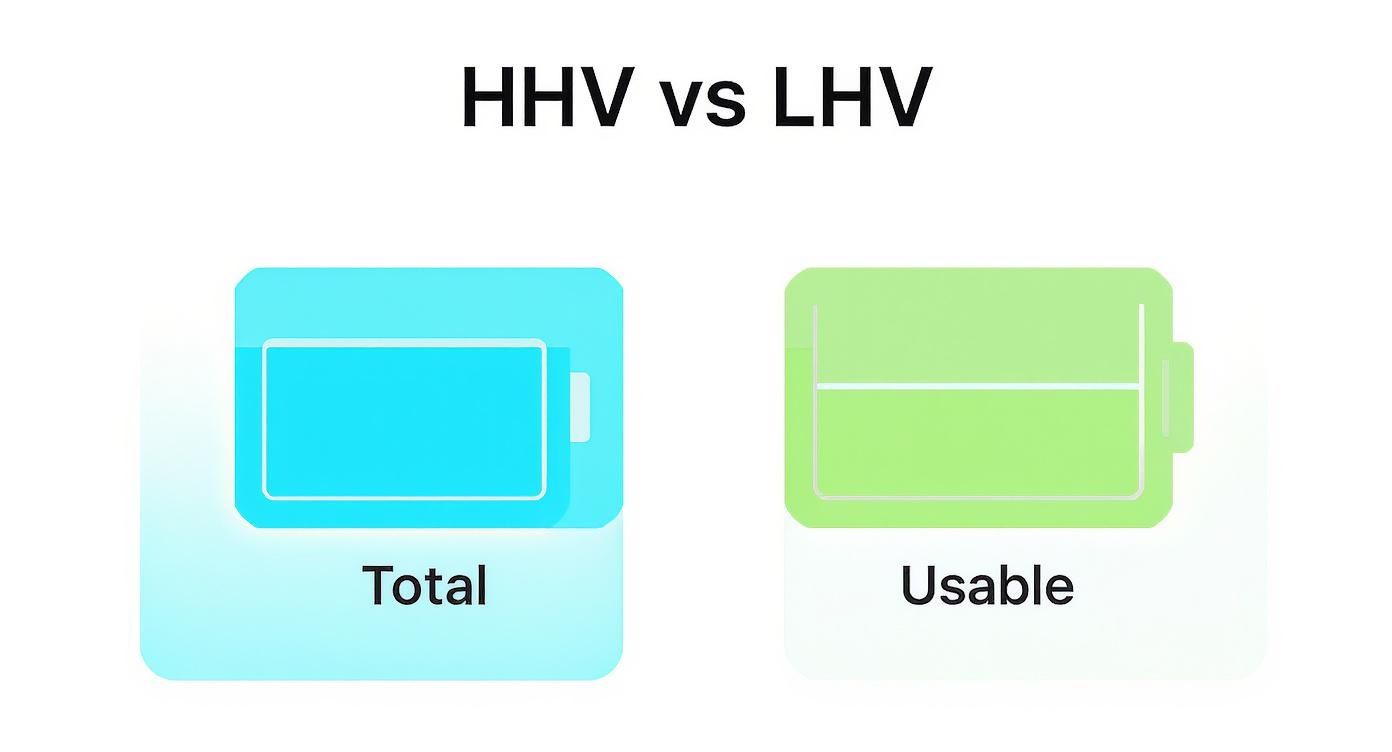
As you can see, HHV represents the full tank, but LHV is what you can actually expect to get out of most engines and turbines where the water vapor just goes out the exhaust.
Energy Density Comparison Hydrogen vs Conventional Fuels (LHV)
Let's look at the hard numbers. This table puts hydrogen's LHV right next to several conventional fuels, and the results are pretty stark. It highlights the massive gap in energy-per-kilogram and the equally big challenge of energy-per-liter.
| Fuel | Gravimetric Energy Density (MJ/kg) | Volumetric Energy Density (MJ/L) |
|---|---|---|
| Hydrogen (Liquid) | 120.0 | 8.5 |
| Hydrogen (Compressed Gas, 700 bar) | 120.0 | 4.7 |
| Natural Gas (LNG) | ~45.0 | 22.2 |
| Propane (Liquid) | 46.4 | 25.3 |
| Diesel Fuel | 45.6 | 38.6 |
| Gasoline | 44.4 | 34.2 |
The data doesn't lie. Hydrogen delivers nearly three times the energy per kilogram compared to gasoline or diesel. This is a game-changer for weight-sensitive industries:
- Aviation: Less weight means more payload or longer range.
- Long-Haul Trucking: Lighter fuel allows for heavier cargo without breaking road limits.
- Maritime Shipping: A high energy-to-weight ratio can significantly extend a vessel's operational range.
Hydrogen's greatest advantage is that it lightens the load. In transportation, weight is a constant penalty, and hydrogen offers the most effective way to carry immense energy with minimal mass.
But then you look at the volumetric numbers, and you see the engineering hurdle. Even as a cryogenic liquid, hydrogen provides less than a quarter of the energy per liter that diesel does. This is exactly why you can't just swap a diesel tank for a hydrogen tank of the same size and get anywhere near the same range.
It also explains the intense focus on developing advanced storage—like carbon-fiber composite tanks for compressed gas and super-insulated cryogenic vessels for liquid hydrogen. These solutions are absolutely essential to make hydrogen a practical fuel for things that move.
This fundamental trade-off is the central story of the hydrogen economy. Its incredible lightness is undeniable, but overcoming the storage challenge is the key to unlocking its true potential across our industries.
The Impact on Hydrogen Storage and Transport

We've established that hydrogen packs a serious punch when measured by weight. But here's the catch: in its natural gaseous state, it's incredibly light and diffuse. This creates a massive logistical puzzle. You can't just pump it into a regular tank and call it a day; its low volumetric density means we have to get clever with how we store and move it.
The engineering behind hydrogen transport is a direct response to this physical reality. Every project, whether it's for temporary site power or a permanent industrial supply, has to choose a strategy. There are really three main ways to tackle this, each with its own trade-offs.
Strategy 1: Compressed Gaseous Hydrogen (CGH2)
The most straightforward and common method is to simply squeeze it. By compressing hydrogen gas to incredibly high pressures, we can pack far more molecules into the same amount of space. Standard industrial pressures for this range from 200 to 700 bar (that's roughly 3,000 to 10,000 psi).
This is a well-understood and reliable approach, making it the go-to for many applications.
- The Upside: The technology is mature. High-pressure compressors and tanks, typically made from steel or advanced carbon-fiber composites, are readily available. It’s a flexible solution for everything from stationary storage banks to fueling heavy-duty trucks and buses.
- The Downside: Compressing gas takes a lot of energy—usually around 10-15% of the hydrogen's own LHV. Plus, the tanks needed to safely contain these immense pressures are thick, heavy, and expensive, which adds significant weight and cost to any setup.
Strategy 2: Cryogenic Liquid Hydrogen (LH2)
If you need to maximize density, the next step is to get it incredibly cold. By chilling hydrogen down to a frigid -253°C (-423°F), it condenses into a liquid. This process, known as liquefaction, makes hydrogen about 800 times denser than it is as a gas at sea level. This is how you can move massive quantities in a single tanker.
For long-haul transport by road, rail, or sea, liquefaction is often the only practical option. The problem is, this density comes at a steep price.
The energy penalty for liquefaction is no small thing. It can consume as much as 30-40% of the hydrogen's original energy content. This efficiency hit has to be factored into the overall cost and carbon footprint of your supply chain.
On top of that, you need highly specialized, super-insulated cryogenic tanks (think of a high-tech thermos) to stop the liquid from warming up and boiling away. This "boil-off" is a constant, slow loss of fuel, which can be a real headache for long-term storage unless you have a way to capture and use the escaping gas.
Strategy 3: Chemical Carriers
A third, and very clever, strategy is to bond hydrogen molecules to a more stable "carrier" compound. This makes it far easier to handle and transport at normal temperatures and pressures. The front-runner in this space right now is ammonia (NH3).
By converting hydrogen into liquid ammonia, we can use the vast, existing global infrastructure for ammonia—pipelines, ships, and storage facilities. Once it reaches its destination, the hydrogen is "cracked" back out of the ammonia.
Here’s a quick look at how these methods stack up in terms of how much energy you can fit in a litre:
| Storage Method | Achieved Volumetric Density (LHV) | Key Consideration |
|---|---|---|
| Gaseous H2 (Atmospheric) | ~0.01 MJ/L | Impractical for most uses |
| Compressed Gas (700 bar) | ~4.7 MJ/L | Mature technology but heavy tanks |
| Liquid H2 (Cryogenic) | ~8.5 MJ/L | High density but large energy penalty |
| Ammonia (as carrier) | ~12.7 MJ/L (for NH3) | Uses existing infrastructure but requires cracking |
Ultimately, each of these solutions is a workaround for hydrogen's fundamental paradox. It offers incredible energy per kilogram, but its feather-light nature forces a choice: contain it with immense pressure, chill it with massive energy input, or convert it into something else entirely to make it practical for the real world.
Why Hydrogen Energy Is Gaining Momentum
So, we've broken down the numbers behind hydrogen's energy content. But why does any of this matter right now? The answer is simple: hydrogen is stepping out of the shadows as a niche industrial gas and becoming a major player in the global energy transition.
This shift is happening out of necessity. We're facing the urgent challenge of decarbonizing sectors where simply plugging things in isn't an option. Think about heavy industries like steel manufacturing, long-haul trucking, or chemical production—these operations are responsible for a huge chunk of global emissions and need massive, reliable power that batteries can't deliver. This is precisely where hydrogen, with its incredible energy packed into every kilogram, offers a real, scalable path forward.
A Market Responding to Global Pressures
This strategic role is fueling a massive wave of investment. The global hydrogen market is exploding, largely because it offers a way to clean up those hard-to-abate industries. In 2024, the market was already valued at around USD 262 billion, and it's on track to more than double to an estimated USD 556.56 billion by 2034. That kind of growth shows serious confidence in hydrogen's future. For a deeper dive into the numbers, check out the market analysis from Precedence Research.
This isn't just market hype; it's backed by serious policy. Governments around the world are putting frameworks in place to create transparent and reliable supply chains. The goal is to ensure green hydrogen can be produced, certified, and traded with confidence. It's this combination of practical energy properties and strong political will that is cementing hydrogen's place in our future energy mix.
Technology and Innovation Driving Costs Down
Of course, for hydrogen to truly compete with fossil fuels, it has to be affordable. That’s where the real game-changer comes in: massive improvements in electrolyzer technology.
Electrolyzers are the machines that split water into hydrogen and oxygen using electricity. Their efficiency is getting better every single year, which is steadily chipping away at the cost of producing green hydrogen and making it a genuine competitor to natural gas and other traditional fuels.
As production costs drop, the potential uses for hydrogen just keep growing. Three key things are happening right now:
- Better Electrolyzer Efficiency: New designs and advanced materials mean we need less electricity to produce each kilogram of hydrogen.
- Scaling Up Production: We’re seeing a global push for green hydrogen, with projections hitting 150 GW of capacity by 2030. This massive scale-up will naturally lower costs.
- Building Out Infrastructure: Serious money is finally being invested in the pipelines, storage tanks, and fueling stations needed to create a functioning hydrogen economy.
In the end, hydrogen's momentum comes from a perfect storm. The powerful energy content of hydrogen makes it the right tool for the toughest jobs, strong policy is creating a stable market, and rapid innovation is making it cheaper by the day.
Answering Your Top Questions About Hydrogen's Energy
We've covered the core concepts of hydrogen's energy content, but how does this all play out in the real world? Let's tackle some of the most common questions that come up when planning projects involving hydrogen.
Which Value Should I Use for My Project: LHV or HHV?
This is a critical question, and the answer almost always comes down to your equipment. For nearly every practical application, you should use the Lower Heating Value (LHV).
The LHV is the right metric for any system where the water vapor created during combustion (or in a fuel cell) escapes as steam. That energy used to turn water into vapor isn't captured, so you can't count it. This applies to:
- Internal combustion engines
- Gas turbines
- Most industrial boilers and furnaces
- The vast majority of fuel cell systems
Only use the Higher Heating Value (HHV) if you're working with a high-efficiency condensing system. These specialized units are designed to cool the exhaust and condense that water vapor back into a liquid, capturing the extra energy in the process. Using HHV for any other system will lead to dangerously optimistic and inaccurate efficiency numbers.
Why Is Hydrogen So Energy-Rich by Weight but So Poor by Volume?
This is the central paradox of hydrogen. It all boils down to its basic physics. Hydrogen is the lightest element in the universe, so a single kilogram of H₂ contains an incredible number of energy-carrying molecules. This gives it a phenomenal energy-to-mass ratio, or gravimetric density, of 120 MJ/kg.
But as a gas, those super-light molecules are naturally spread far apart. They take up a massive amount of space, which results in a very low energy-per-volume, or volumetric density. This is the core challenge in hydrogen logistics—not the energy itself, but the difficulty of cramming enough of it into a practical container.
How Do Pressure and Temperature Affect Its Energy Content?
The energy packed into a single kilogram of hydrogen (120 MJ/kg) never changes. What does change, and dramatically so, is how much of that gas you can fit into a given space. This is where pressure and temperature become game-changers for storage.
Think of it like packing a suitcase. The clothes (the energy) are what they are. How you pack them (pressure and temperature) determines how many outfits you can fit inside.
By compressing hydrogen gas to 700 bar, we force far more molecules into a tank, boosting the energy stored per liter. Taking it a step further, cooling it to a cryogenic liquid at -253°C makes it incredibly dense, multiplying its volumetric energy and making it feasible for long-haul transport.
Is Handling High-Energy Hydrogen Dangerous?
Like any fuel, hydrogen demands respect and proper handling, but its properties are well-understood. In fact, one of its key safety advantages is its extreme lightness. If a leak happens in an open area, hydrogen gas shoots upward and disperses almost instantly. This is a stark contrast to heavier fuels like propane that can pool near the ground, creating a lingering explosion risk.
Decades of industrial use have led to mature safety standards for handling hydrogen. These protocols involve robust tank designs, sensitive leak detection systems, and strict ventilation requirements. These measures ensure hydrogen can be managed safely in any setting, from temporary industrial gas supply to vehicle fueling stations.
For reliable temporary natural gas solutions that keep your project on schedule, Blue Gas Express offers fast deployment of CNG and LNG units across the Southeast. Learn more about our mobile gas services.