

A trustworthy density of natural gas calculator is an essential piece of kit for anyone in the industry. Why? Because natural gas is anything but a uniform substance. Its density is constantly in flux, shifting with its specific chemical makeup, the ambient temperature, and the pressure it's under.
Getting this number right is critical for just about everything, from ensuring fair billing in custody transfers to managing pipeline efficiency and safety.
Why Accurate Gas Density Is Crucial
Calculating the density of natural gas isn't some abstract, academic problem—it's a daily requirement with very real financial and operational consequences.
Think about it like this: when you buy a gallon of gasoline, you pay for a standard volume. But natural gas is usually sold based on its energy content (measured in BTUs), a value that's directly linked to its density. Even a fractional error in that density calculation can ripple outward, creating significant financial discrepancies.
In custody transfer, where huge volumes of gas are bought and sold, inaccurate density readings can spark billing disputes worth thousands of dollars. An incorrect density figure means the energy content is wrong, and one party is either overpaying or getting short-changed. It’s like using a broken scale at the grocery store, but the stakes are exponentially higher.
The Impact on Operations and Safety
The financial side is just one part of the story. Density also dictates how efficiently gas moves through a pipeline. Operators rely on this data to model flow dynamics and manage compressor stations. If the gas is denser than they think, it takes a lot more energy to push it through the system, driving up operational costs and slowing down throughput.
Safety is another huge factor, especially for storing and transporting compressed natural gas (CNG) and liquefied natural gas (LNG). Protocols for these operations are built on precise density figures. Knowing the exact mass of gas packed into a specific volume is non-negotiable for preventing over-pressurization and maintaining the structural integrity of tanks and vessels.
The specific composition, especially the mix of hydrocarbons, plays a massive role. The difference in density and energy content is vital when choosing the right fuel for marine LPG installations, such as propane versus butane.
More Than Just Methane
It's a common mistake to think of natural gas as pure methane. In the real world, it's a complex cocktail of hydrocarbons and inert gases that varies from one source to another. This unique composition, along with temperature and pressure, is what determines its density.
At standard conditions, natural gas density typically falls somewhere between 0.7 and 0.9 kilograms per cubic meter. You can learn more about the global reliance on these metrics and see just how foundational this measurement is.
To get an accurate density reading, any calculator must account for the primary variables at play.
Key Factors Influencing Natural Gas Density
| Factor | Impact on Density | Why It Matters |
|---|---|---|
| Composition | Higher concentrations of heavier hydrocarbons (like ethane, propane) increase density. | Every gas stream has a unique "fingerprint." A generic methane value will lead to significant errors in energy and volume calculations. |
| Temperature | As temperature increases, gas expands, and density decreases. | Temperature fluctuations in pipelines and storage tanks directly affect the mass of gas in a given volume. Hotter gas is less dense. |
| Pressure | As pressure increases, gas molecules are forced closer together, increasing density. | High-pressure transmission systems (pipelines, CNG tanks) contain much denser gas than low-pressure distribution lines. |
Ultimately, these factors make it clear why you can't just use a single, fixed value for density.
Because every gas stream is unique, relying on a generic, fixed value for density is a recipe for error. A precise density of natural gas calculator becomes the essential tool for converting raw data into actionable, accurate results.
Getting Your Inputs Lined Up for an Accurate Calculation
Any density of natural gas calculator lives by a simple rule: garbage in, garbage out. Think of it like a high-performance engine—you can't expect premium results if you're feeding it low-grade fuel. Getting your inputs right isn't just a preliminary step; it's the most critical part of the whole process.
To get a density value you can actually trust, you absolutely need three key pieces of information:
- The precise composition of your natural gas.
- The operating temperature of the gas.
- The absolute pressure it's under.
Locking these down isn't just about getting a number. It has real-world consequences for billing, operational efficiency, and even safety.
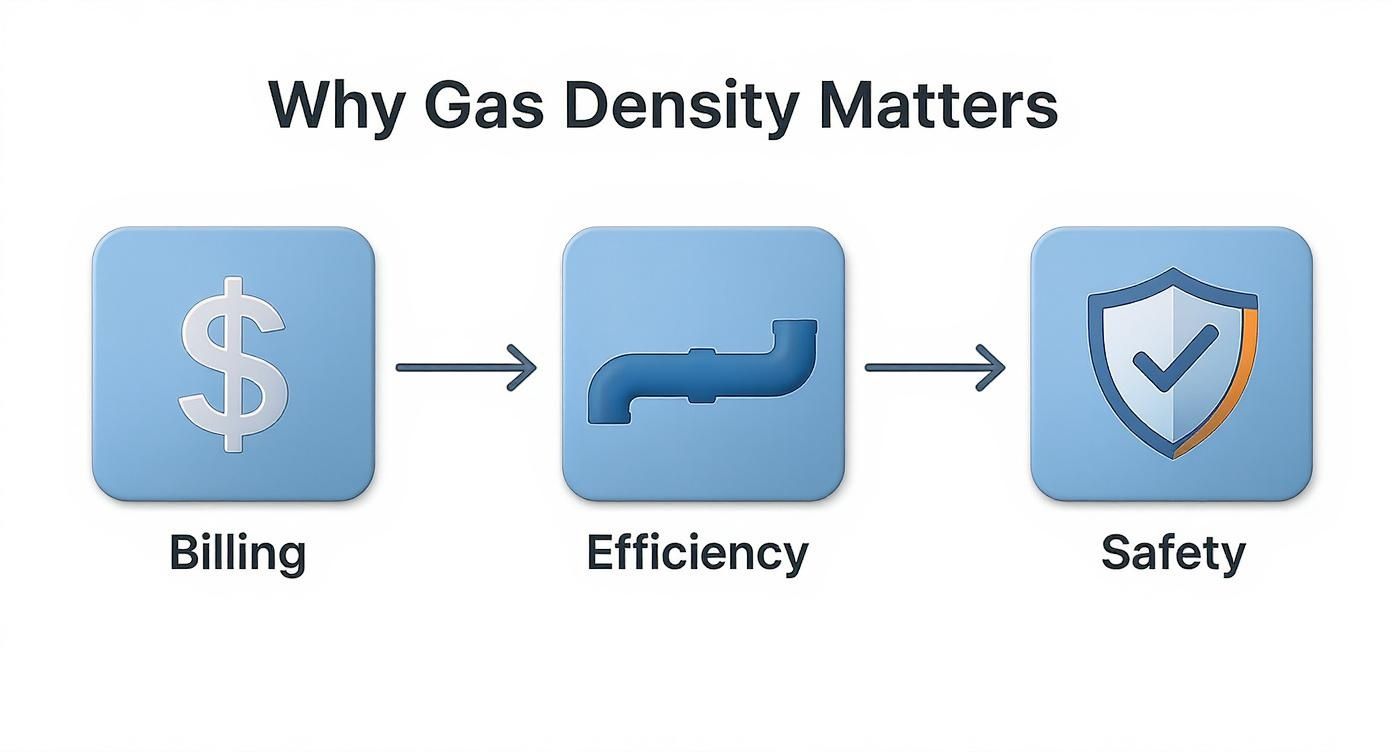
As you can see, every part of the gas handling chain—from the financial side to pipeline logistics and safety procedures—relies on an accurate density value. It's the foundation for so much of what we do in the field.
Sourcing Your Gas Composition Data
The gold standard for gas composition is a recent gas chromatograph (GC) report. This detailed analysis is essentially a chemical fingerprint of your gas stream, breaking it down into its individual components by mole percent.
When you get a GC report, you'll see a list of components. The ones that have the biggest impact are usually:
- Methane (CH₄)
- Ethane (C₂H₆)
- Propane (C₃H₈)
- Butanes (C₄H₁₀)
- Nitrogen (N₂)
- Carbon Dioxide (CO₂)
These gases form the bulk of the mixture, and their specific percentages are what we'll use to figure out the overall molecular weight. Resist the temptation to use a generic or old analysis; gas composition can change dramatically over time and from different sources, and using bad data is a surefire way to get an inaccurate result.
From the Field: Always check the date on your gas analysis. I've seen gas from the same well change composition over its production life. Using a report that's even a few months old can throw off your calculations enough to matter.
Temperature and Pressure: The Two Game-Changers
With the composition in hand, you next need to nail down the current operating conditions. These aren't just ballpark numbers—they must reflect the exact moment and location where you're measuring density.
For temperature, the calculations demand an absolute scale, like Kelvin (K) or Rankine (°R). While most online tools handle the conversion automatically, it's a classic spot for manual error. Remember, 20°C isn't 20—it's 293.15 K, and that difference is huge.
Pressure is probably the most common stumbling block. You absolutely must use absolute pressure, not gauge pressure. Gauge pressure is what's shown on a standard dial, measuring pressure above the surrounding atmosphere. Absolute pressure is the total pressure—gauge plus atmospheric. It's a critical distinction. If you use gauge pressure, your density result will always be wrong, and always too low. If your reading is in psig (pounds per square inch gauge), you have to add the local atmospheric pressure to convert it to psia (pounds per square inch absolute).
Calculating the Molecular Weight of Your Gas Mix
Before you can calculate the density of natural gas, you have to nail down one critical input: the average molecular weight of your specific gas mixture. This isn't just a preliminary step; it's the foundation for the entire calculation. Getting this right is everything.
Natural gas is never just one thing—it’s a cocktail of different gases. That means its molecular weight isn't a single number but a weighted average of all its components. The process is pretty straightforward: you take the percentage (mole fraction) of each gas in the mix, multiply it by its own molecular weight, and then add everything up. This gives you one representative value for the entire stream.
Breaking Down the Calculation
Let's run through a real-world example with a gas composition you'd likely see in the field. Imagine your latest gas analysis report comes back with this breakdown:
- Methane (CH₄): 95.0%
- Ethane (C₂H₆): 3.5%
- Propane (C₃H₈): 0.5%
- Nitrogen (N₂): 0.8%
- Carbon Dioxide (CO₂): 0.2%
Each of these gases has a fixed, known molecular weight, which you can pull from any standard engineering handbook or a reliable reference table like the one below.
Molecular Weights of Common Natural Gas Components
Here’s a quick-reference table for the molecular weights of the usual suspects you'll find in a natural gas analysis. Having these handy is a huge time-saver.
| Component Gas | Chemical Formula | Molecular Weight (g/mol) |
|---|---|---|
| Methane | CH₄ | 16.04 |
| Ethane | C₂H₆ | 30.07 |
| Propane | C₃H₈ | 44.10 |
| Nitrogen | N₂ | 28.01 |
| Carbon Dioxide | CO₂ | 44.01 |
Once you have your gas composition percentages and these standard molecular weights, the rest is just simple multiplication and addition. This table covers the most common components, but for more complex streams with heavier hydrocarbons or inerts, you'll need to expand your reference list.
The key takeaway here is that heavier molecules like propane and ethane pack a bigger punch, contributing more to the overall weight even when they're present in tiny amounts. This is precisely why assuming your gas is pure methane will almost always steer you wrong.
Putting It All Together
Now, let's crunch the numbers for our sample gas mix to get its weighted average molecular weight (M). The math for each component is simply: (Mole Fraction) x (Molecular Weight).
- Methane: 0.950 x 16.04 g/mol = 15.238
- Ethane: 0.035 x 30.07 g/mol = 1.052
- Propane: 0.005 x 44.10 g/mol = 0.221
- Nitrogen: 0.008 x 28.01 g/mol = 0.224
- Carbon Dioxide: 0.002 x 44.01 g/mol = 0.088
The final step is to sum up these individual values to get the molecular weight for the whole mixture.
So, adding them all up: 15.238 + 1.052 + 0.221 + 0.224 + 0.088 = 16.823 g/mol.
That final number, 16.823 g/mol, is the average molecular weight (M) for this particular gas stream. This is the value you’ll plug into the real gas law equation to solve for density.
This process really drives home why an accurate gas analysis is non-negotiable. Even a small shift in composition can throw off this crucial input and skew your final density result. A good density of natural gas calculator does all this heavy lifting for you, but understanding how it works under the hood gives you confidence that the numbers you're getting are reliable.
Moving Beyond Theory: Why Real Gas Laws Are Non-Negotiable

If you remember anything from a basic physics or chemistry class, it's probably the Ideal Gas Law (PV=nRT). It’s a foundational concept, but in the field—where conditions are far from ideal—it just doesn't cut it. The truth is, ideal gases are a theoretical construct. Real natural gas, especially when crammed into pipelines or CNG tanks under immense pressure, behaves in ways the simple formula can't predict.
The Ideal Gas Law assumes gas molecules are just dimensionless points that don't interact. But we know they have volume, and they exert attractive forces on each other. Ignoring these facts leads to significant errors in density calculations—errors that can have serious financial and operational consequences. We need to upgrade our toolkit to match what’s actually happening out there.
The Key to Accuracy: The Compressibility Factor (Z-Factor)
To close the gap between classroom theory and real-world application, we introduce a correction known as the compressibility factor, or Z-factor. Think of it as a "fudge factor" rooted in rigorous thermodynamics. It’s a dimensionless value that adjusts the ideal gas equation to account for the very real effects of molecular volume and intermolecular forces at a given pressure and temperature.
For a purely theoretical ideal gas, Z is always 1.0. But for the natural gas in your pipeline, it's a different story.
- At low pressures, the gas behaves more "ideally," and the Z-factor hovers close to 1.0.
- At high pressures, like those found in CNG storage, the Z-factor can drop well below 1.0. This tells you the gas is more compressible than the ideal model suggests.
Skipping the Z-factor is like trying to navigate a mountain range with a flat map. You're going to be wrong, and the consequences could be costly.
The Z-factor isn't just a minor tweak; it's the critical variable that makes a density of natural gas calculator a reliable tool for custody transfer, engineering design, and safety compliance. Without it, your numbers are just a rough guess.
The Real Gas Law in Action
By plugging the Z-factor into the equation, we arrive at the real gas law, which is what any professional-grade density calculation relies on:
Density = (P * M) / (Z * R * T)
Let’s quickly run through the components again:
- P: Absolute pressure
- M: The molecular weight we determined from the gas composition
- Z: The all-important compressibility factor
- R: The universal gas constant
- T: Absolute temperature
This relationship shows that density climbs with pressure (P) but drops as temperature (T) or the Z-factor (Z) increases. Finding the right Z-factor isn't a simple lookup; it's typically calculated using complex equations of state, like AGA8, or found on standardized charts based on the gas’s specific gravity, temperature, and pressure.
This level of precision is fundamental to the energy market. The intricate balance of supply and demand in the natural gas sector hinges on accurate measurements of physical properties. With global natural gas demand seeing a 1.9% rise in early 2025—largely from power sectors that demand high combustion efficiency—the density value becomes more critical than ever. You can explore more on these natural gas market indicators to see the bigger picture.
Ultimately, this refined formula ensures the density value you're working with is a true reflection of the gas’s physical state, whether you're managing pipeline integrity or commissioning a new gas-fired turbine.
Putting Density Calculations to Work in the Field

This is where the theory hits the pavement. In the field, a density calculation isn't just an abstract number—it's a critical operational parameter that directly impacts safety, logistics, and your bottom line. Every day, technicians and engineers lean on these calculations to make the informed decisions that keep the energy supply chain moving.
Two of the most common places a reliable density of natural gas calculator becomes non-negotiable are at pipeline custody transfer points and in specialized operations with compressed or liquefied natural gas. In both cases, density is the crucial link between volume and energy, ensuring everyone gets what they paid for.
Custody Transfer and Energy Billing
When natural gas changes hands, the financial stakes are huge. Gas is sold based on its energy content (measured in BTUs), not just its volume. To figure this out, flow meters measure the volume passing through a specific point, and that volume has to be converted to mass and then to energy.
Here’s a quick look at how it works on the ground:
- A flow computer constantly logs the volume, temperature, and pressure of the gas.
- It pulls a pre-programmed gas composition from the latest lab analysis.
- The system then calculates density in real-time to convert the measured volume into a standard mass flow rate.
If that density value is off, the entire energy calculation goes with it. For a major pipeline, a seemingly tiny 1% error in density could snowball into millions of dollars in billing mistakes over a year.
Safety and Logistics in CNG and LNG Operations
In the world of Compressed Natural Gas (CNG) and Liquefied Natural Gas (LNG), density is everything for safety and logistics. For companies like Blue Gas Express that deliver mobile gas solutions, knowing the exact mass of gas in a container is vital for safe transport and efficient delivery.
Accurate density calculations are also foundational for complying with safety regulations, like the German transport regulations for gas cylinders.
Practical Field Tip: When you're using a digital calculator for CNG fueling, always double-check that your input pressure is absolute, not gauge. This is easily the most common mistake I see, and it can seriously skew your mass calculation. Get it wrong, and you could under-fill a tank or, much worse, over-pressurize it.
LNG density is just as critical. Stored at cryogenic temperatures around -162°C (-260°F), its density dictates storage volume and energy content. Even small shifts in composition can cause significant density changes, affecting everything from tanker capacity calculations to the efficiency of the regasification process.
Whether you're managing massive pipelines or mobile CNG trailers, accurate density data is the bedrock of safe, fair, and efficient operations.
Common Questions We Hear in the Field
Even with a great calculator, you're bound to run into questions out in the field. Calculating gas density isn't just plugging in numbers; it’s about understanding the variables that can throw off your results. Let's tackle a few of the most common issues that technicians and engineers run into.
How Often Should I Re-test My Gas Composition?
This is a big one, and the answer really comes down to your gas source. If you're pulling from a major transmission pipeline, the gas is usually pretty consistent. A quarterly or even semi-annual gas analysis from a lab will likely be enough to keep you in the ballpark.
But if your gas is coming straight from a wellhead or a field gathering system, that’s a different story. The composition can fluctuate significantly. In those situations, you should be looking at monthly or even weekly testing to stay accurate.
Any time you suspect a change in the gas stream—maybe the BTU value suddenly shifts or a new well is tied in—get a new analysis done. Never assume the gas composition is a fixed number. It's a live variable you have to keep tabs on.
Can I Just Use Standard Temperature and Pressure?
Absolutely not, at least not for the actual density calculation. Standard conditions, like 60°F and 14.73 psia, are for normalizing volumes for custody transfer and reporting. They're a baseline for comparing apples to apples, but they aren't the real-world conditions inside your pipe.
To get an accurate density, you have to use the actual temperature and pressure of the gas at that moment. Plugging in standard values for gas flowing at 800 psig and 80°F will give you a number that is fundamentally wrong and useless for any real application.
What if My Gauge Only Reads in PSIG?
This is probably the single most common trip-up I see. Your instruments might give you gauge pressure (psig), but any reputable density calculation requires absolute pressure (psia). The fix is simple: you just add the local atmospheric pressure to your gauge reading.
- At sea level, this is roughly 14.7 psi.
- Up in a place like Denver, it's closer to 12.2 psi because of the altitude.
Forgetting this step will always make your density calculation come out too low. In custody transfer, that seemingly small error can add up to huge financial discrepancies over time. It's a tiny detail that makes a massive difference, so always know your site's elevation or have a barometer handy.
When you need reliable, temporary natural gas solutions on-site, trust the experts. Blue Gas Express provides mobile CNG and LNG delivery across the Southeast, ensuring your projects stay on track without interruption. Learn more about our rapid deployment services.