

When we talk about natural gas conversion, we're really talking about transforming raw gas into something far more useful and movable, like Compressed Natural Gas (CNG) or Liquefied Natural Gas (LNG). This step is crucial for getting this energy source from the ground to the power plants, vehicles, and factories that depend on it.
Why We Can't Just Use Raw Natural Gas
In its natural state, straight from the well, gas is a bit like a powerful engine without any wheels—it has incredible potential but can't really go anywhere. It’s a low-density gas, which means it takes up a massive amount of space, making it a logistical nightmare to transport over long distances without a dedicated pipeline. The conversion process is what truly unlocks its value for the rest of the world.
Let me put it another way. Imagine trying to ship a giant, fluffy cloud. That's raw natural gas. Converting it is like compressing that cloud into a dense, manageable bale (think CNG) or chilling it into a small, potent liquid droplet (that's LNG). It's all about shrinking the volume to make it practical for global transport and storage.
Tapping into a Global Energy Source
If we couldn't convert natural gas, its use would be stuck in regions lucky enough to be sitting on top of a gas field or connected by a pipeline. That would cut off countless countries and industries from a cleaner, more efficient fuel. The whole point of the process is to solve a few key problems:
- Boost Energy Density: By compressing or liquefying the gas, we pack way more energy into a much smaller space. LNG, for instance, is an incredible 600 times denser than natural gas in its gaseous form.
- Make Global Shipping Possible: LNG can be loaded onto enormous, specially designed tankers and shipped across oceans. This creates a "virtual pipeline," connecting energy suppliers and consumers thousands of miles apart.
- Fuel a Wide Range of Uses: Converted natural gas is incredibly versatile. It powers everything from city buses (CNG) to massive power plants and industrial heaters that run on a steady stream of regasified LNG.
The ability to turn natural gas into a dense liquid or a compressed gas isn't just a matter of convenience. It's the core technology that makes the entire global gas market work and plays a huge role in the ongoing shift in our energy systems.
This guide will break down exactly how this all happens, from the basic science to the real-world applications. We’ll explore why converting natural gas is so vital for powering our cities, fueling our trucks, and keeping our energy grids stable. By the end, you'll have a solid grasp of the technologies and their place in the modern energy mix.
The Science Behind Liquefaction and Compression
At its core, natural gas conversion comes down to solving one fundamental problem: in its natural state, it takes up way too much space. To make it a practical, transportable fuel, we have to shrink it. The two main ways we do this are by making it incredibly cold or by putting it under immense pressure.
Each method gives us a distinct form of natural gas with its own set of pros and cons.
Think of it like packing for a trip. Creating Liquefied Natural Gas (LNG) is the equivalent of using a vacuum-seal bag for a long international flight. By sucking all the air out, a huge pile of clothes becomes a tiny, dense brick—perfect for maximizing space in your luggage. Liquefaction does the same for natural gas, shrinking it so much that we can economically ship it across oceans.
On the other hand, making Compressed Natural Gas (CNG) is more like tightly rolling your clothes for a weekend road trip. It's an effective way to fit more into your bag, but it’s not nearly as compact as the vacuum-sealed option. This approach works great for fueling vehicles or supplying local customers where you don't need the absolute maximum density.
The infographic below shows how raw gas is transformed into these more practical fuels.
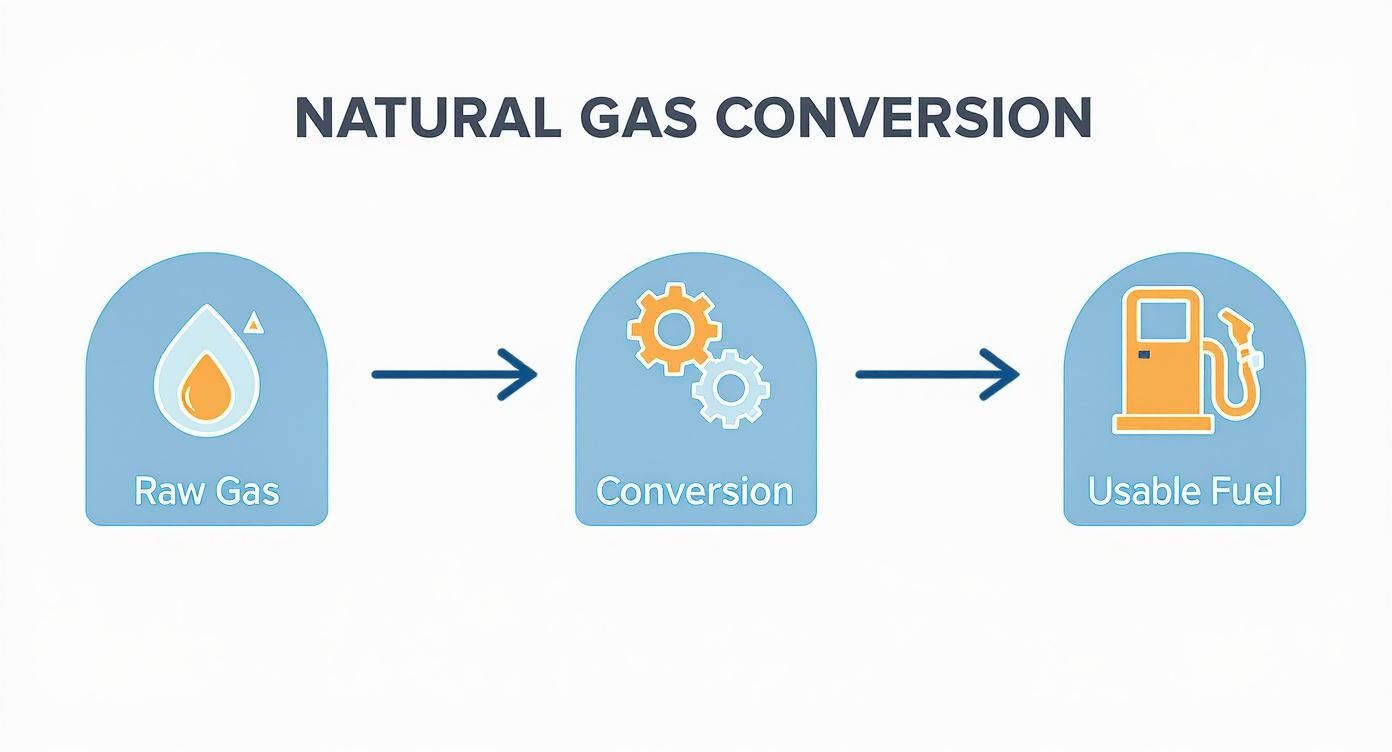
As you can see, no matter the path, the goal is always to process the raw resource into a denser, more usable form of energy.
The Physics of Liquefied Natural Gas
To create LNG, we chill natural gas down to a mind-bogglingly cold -162°C (-260°F). At this extreme temperature, the gas literally changes its state, turning from a vapor into a liquid. The science here is all about molecular motion.
In its gaseous form, natural gas molecules are zipping around chaotically. As we cool the gas, we're robbing those molecules of their kinetic energy, forcing them to slow down. Eventually, they slow down so much that the weak attractive forces between them (called van der Waals forces) take over, pulling them together into a liquid.
The result is a truly massive reduction in volume. LNG takes up just 1/600th of the space that the same amount of natural gas would at normal atmospheric pressure. This incredible energy density is what turns natural gas into a global commodity.
This isn't something you can do with a standard freezer. It requires a highly complex, multi-stage cooling process inside a massive facility known as an LNG train. The amount of energy needed to reach and maintain these cryogenic temperatures is immense, which is why liquefaction is a capital-intensive process geared toward large-scale production.
The Power of Compressed Natural Gas
Turning natural gas into CNG works on a completely different principle: raw pressure. It all comes down to a classic physics concept known as Boyle's Law, which basically says that if you squeeze a gas, its volume shrinks.
CNG facilities use powerful compressors to squeeze natural gas to pressures between 200 and 250 bar (about 3,000 to 3,600 psi). That's more than 200 times the atmospheric pressure we experience every day. This immense force shoves the gas molecules much closer together, drastically reducing the total volume.
But unlike LNG, the gas never changes its state—it just becomes an extremely dense gas. Because this process avoids the complex and energy-hungry refrigeration cycle, setting up a CNG station is a far less expensive and complicated affair than building an LNG plant.
Comparing LNG and CNG Conversion Methods
Putting these two methods side-by-side really clarifies their differences and where each one shines. The choice between LNG and CNG often comes down to the specific application, distance, and infrastructure available.
| Attribute | Liquefied Natural Gas (LNG) | Compressed Natural Gas (CNG) |
|---|---|---|
| Primary Method | Cryogenic Cooling | High-Pressure Compression |
| Storage Temperature | -162°C (-260°F) | Ambient Temperature |
| Storage Pressure | Near Atmospheric | 200-250 bar (3,000-3,600 psi) |
| Volume Reduction | Approx. 600 times | Approx. 200-250 times |
| Energy Density | Very High | Moderate |
| Ideal Application | Long-haul transport (ships, trucks) | Regional transport (buses, fleet vehicles) |
In the end, both liquefaction and compression are incredible engineering feats that unlock the potential of natural gas. They make it a versatile energy source that can be moved and used just about anywhere, with each method tailored to solve different logistical puzzles.
The Machinery That Makes It Happen
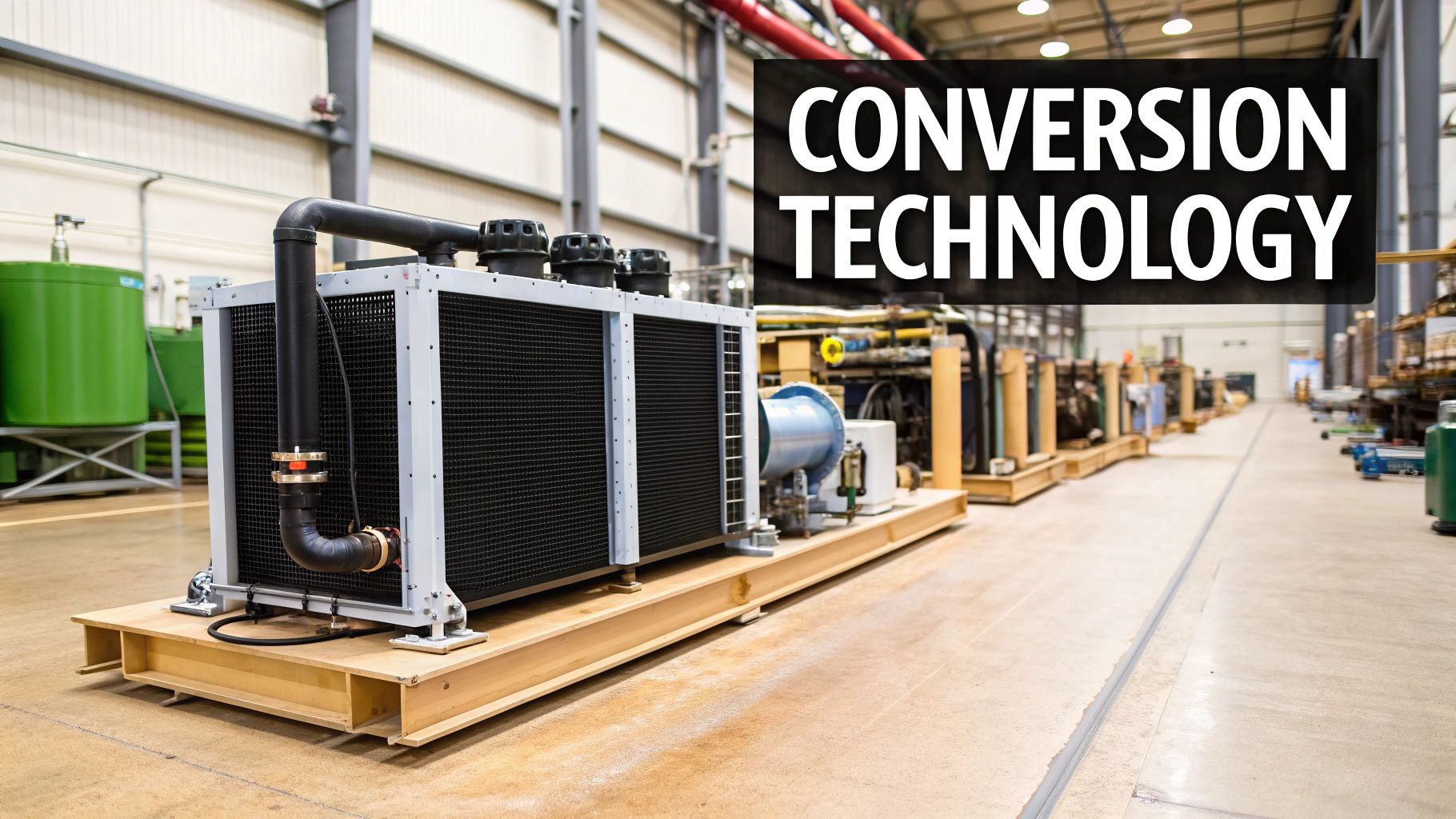
Turning raw natural gas into a dense, transportable fuel isn't magic; it's a feat of incredible engineering. The process relies on highly specialized equipment, where each component has a critical job to do. Think of it as an industrial-scale symphony, with every piece of machinery perfectly timed to either chill gas into a liquid or squeeze it into a high-pressure state.
For LNG, this all happens in what's known as an "LNG train"—not a railway train, but a long, sequential series of processing units that purify and liquefy the gas. The technology for CNG, on the other hand, is all about raw power, using massive compressors to cram the gas into a fraction of its original volume.
Let's look at the core hardware for both paths.
The LNG Train: A Journey to Deep Freeze
Making LNG is a delicate, multi-stage process. You can't just throw natural gas into a freezer. First, it has to be meticulously cleaned, because even tiny amounts of impurities could freeze solid and clog up the multi-million dollar equipment.
The first major stop is the acid gas removal unit. This system acts like a chemical sponge, using solvents to scrub out compounds like carbon dioxide (CO₂) and hydrogen sulfide (H₂S). If left in, they'd turn into dry ice and solids, creating blockages that could bring the entire plant to a grinding halt.
Next, the gas passes through dehydration systems. These units typically use materials called molecular sieves to pull out nearly every last drop of water vapor—another substance that would freeze and cause major headaches downstream.
Once the gas is pure, it's ready for the main event: the cryogenic heat exchangers. These are the heart and soul of any LNG plant.
Think of a cryogenic heat exchanger as a super-refrigerator on a colossal scale. It uses a cascading cycle of refrigerants—like propane, ethylene, and even some of the methane itself—to systematically pull heat out of the natural gas stream until it finally hits the magic number: -162°C (-260°F).
This chilling happens gradually. The gas flows through a series of increasingly colder exchanger modules until it condenses into a liquid. From there, the freshly made LNG is sent to massive, double-walled, vacuum-insulated tanks, ready for transport.
CNG’s Power Players: Compressors and Storage
The tech behind CNG is less about thermodynamics and more about pure mechanical muscle. At the center of it all is the compressor. These are the workhorses that take natural gas from pipeline pressure and crank it up to the 3,000–3,600 psi needed for vehicle storage tanks.
While there are a few different designs, two types dominate the industry:
- Reciprocating Compressors: These work like the pistons in a car engine, using a back-and-forth motion to compress the gas in stages. They are incredibly reliable and efficient for reaching those ultra-high pressures.
- Rotary Screw Compressors: These use a pair of massive, intermeshing screws to trap and squeeze the gas. They offer a smooth, continuous flow and are a popular choice for many CNG fueling stations.
After compression, the gas needs to be stored before it’s pumped into a truck or trailer. This is done using a storage cascade system. Instead of one giant tank, it’s a series of high-pressure cylinders linked together. The cascade is set up in banks—low, medium, and high pressure—which makes fueling much faster and more efficient by always drawing from the highest-pressure bank first.
Finally, specialized dispensing equipment handles the job of safely moving the high-pressure gas from the storage cascade into a vehicle. These dispensers might look like regular gas pumps, but they are built to manage extreme pressures, featuring breakaway safety hoses and precise meters to ensure every fill is safe and accurate.
Global Applications of Converted Natural Gas
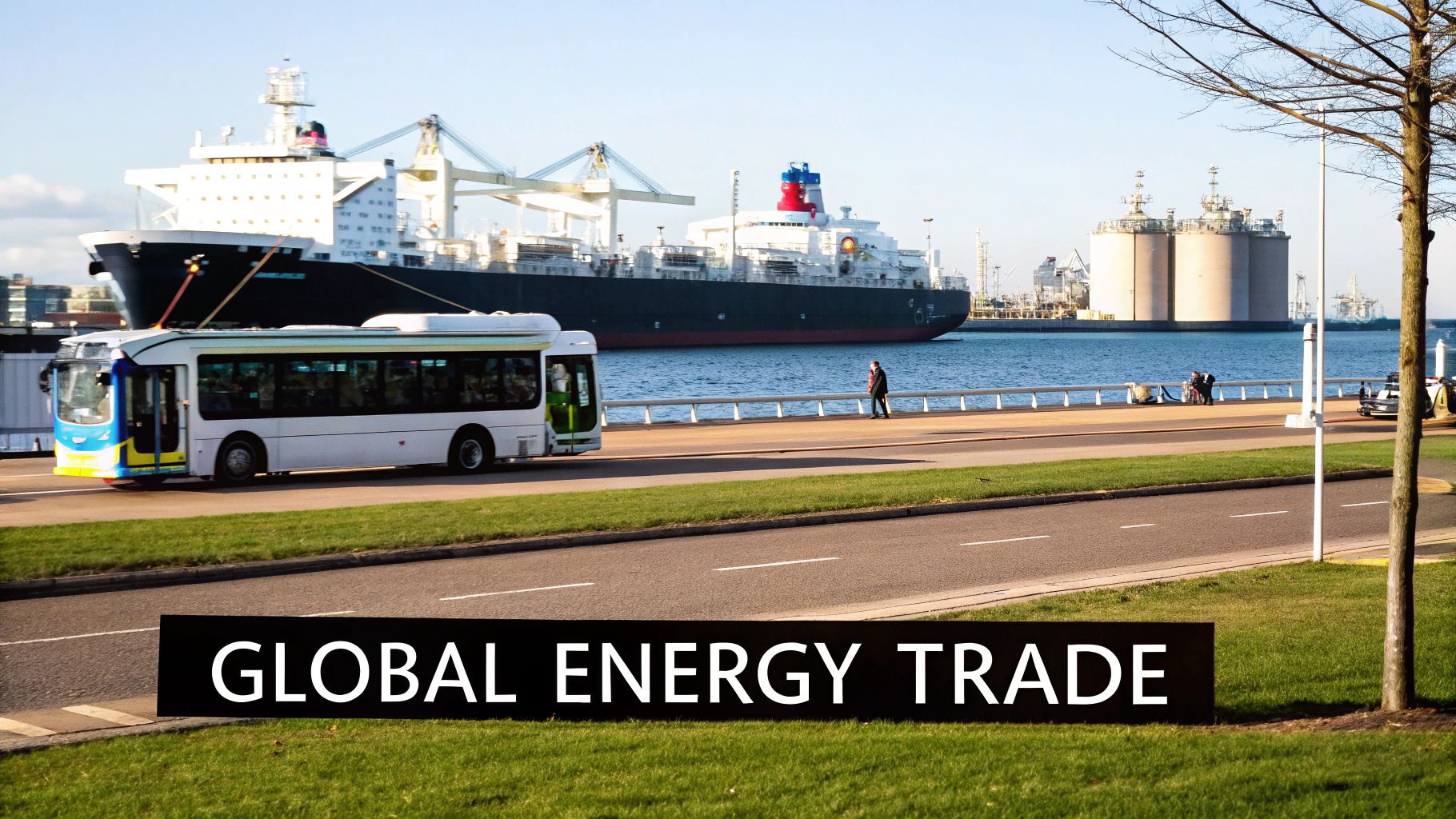
Natural gas used to be a strictly local resource. If you weren't connected to a pipeline, you were out of luck. But today, thanks to conversion technologies, it’s a global commodity that can be shipped across oceans or trucked down the highway.
This shift has completely redrawn the world’s energy map. Now, natural gas can reach practically any corner of the globe, making it a critical player in international trade, ground transportation, and industrial power.
For decades, countries without their own gas reserves had few options. The development of Liquefied Natural Gas (LNG) changed the game entirely. By super-cooling natural gas until it becomes a liquid, we can load it onto massive tankers and ship it anywhere, just like oil. This single innovation unlocked a truly global marketplace for gas.
LNG: The Global Energy Connector
At its core, LNG connects parts of the world with abundant energy to those that need it. Nations like the United States, Australia, and Qatar can liquefy their vast gas supplies and export them to hungry markets in Europe and Asia. For the receiving countries, it’s a much cleaner alternative to coal for generating electricity and powering industry.
This seaborne trade is now fundamental to global energy security, and recent events have put that in sharp focus. The global gas trade, propelled by LNG, recently hit a record volume of 555 billion cubic meters (bcm). LNG imports into Europe, for instance, jumped by 23.6% in the first half of one year as nations scrambled to fill storage and stabilize their energy supply.
This really highlights LNG's role as a global balancing act. It’s also making huge waves as a cleaner fuel for the very ships that transport it. The maritime industry is under immense pressure to clean up its act, and LNG-powered vessels produce almost no sulfur emissions and far less nitrogen oxide than traditional bunker fuel.
The conversion of natural gas into LNG effectively created a "virtual pipeline" that spans the globe. This allows energy to flow where it's needed most, fostering economic growth and enhancing energy security for entire continents.
Of course, shipping a flammable substance across the world requires airtight safety protocols. Understanding the regulations, like the flammable liquids placard guidelines, is non-negotiable for keeping the entire supply chain safe.
CNG: Powering Fleets on the Ground
While LNG rules the seas, Compressed Natural Gas (CNG) is the quiet workhorse of ground transportation. Its reach is more local, but its impact on commercial fleets is just as significant, offering a cleaner and often more affordable fuel than diesel.
Think about your city's public transit. There's a good chance many of those buses run on CNG. They're noticeably quieter and produce far fewer tailpipe emissions, which is a massive win for air quality in crowded urban centers. Buses are a perfect use case because they follow predictable routes and return to a central depot every night to refuel.
This "return-to-base" model works brilliantly for other heavy-duty fleets, too:
- Waste Disposal Trucks: Their stop-and-go routes and high fuel consumption make them ideal candidates for CNG conversion.
- Delivery and Logistics Fleets: Companies running delivery vans and short-haul trucks are switching to CNG to cut fuel costs and hit sustainability targets.
- Airport and Seaport Vehicles: The shuttles, baggage carts, and other ground equipment in these contained areas are often CNG-powered to keep local emissions down.
Unlike personal cars, which need a widespread public refueling network, these commercial fleets solve the infrastructure puzzle themselves. A company can build a single compression and fueling station at its home base to service its entire fleet, making the economics of natural gas conversion work. It’s a practical, powerful approach that's helping to clean up our cities.
Ensuring Grid Stability in a Renewable World
The global push for renewable energy is picking up serious steam. We’re seeing more solar panels and wind turbines than ever before, which is fantastic news for the planet. But this shift brings a big challenge to the table: intermittency. The sun isn't always shining, and the wind isn't always blowing, which can create huge, unpredictable gaps in power generation.
Those gaps are a real problem for grid stability. That’s where natural gas conversion steps in, acting as a crucial safety net. Power plants fired by natural gas, whether from a pipeline or from regasified LNG, can fire up in minutes—not hours—to fill the void left by renewables and keep the lights on.
The Perfect Partner for Renewables
Think of the power grid as a massive, constantly moving balancing act. On one side, you have the electricity demand from homes and businesses, which fluctuates all day. On the other, you have the supply from every power source feeding the grid. If supply suddenly dips below demand, you're looking at brownouts or even widespread blackouts.
Solar and wind are brilliant when they're producing, but their output can be all over the place. A big cloud bank rolling in or a sudden drop in wind speed can cause generation to plummet. This is precisely the scenario gas-fired "peaker" plants are built for. They sit quietly on standby and then roar to life at a moment's notice to pump power back into the system, rebalancing the scales.
This on-demand flexibility is what makes natural gas such a vital 'bridge fuel.' It provides the rock-solid reliability needed to support a grid that’s becoming more dependent on intermittent renewables, smoothing out the bumps on the road to a cleaner energy future.
This balancing act is becoming more critical every year. As we integrate more renewables, other innovative solutions are also emerging. It’s worth exploring different approaches, like learning how household virtual power plants strengthen the grid to see how decentralized systems also contribute to a reliable power supply.
A Global Balancing Act
This isn't just a theory; we're seeing it play out across the globe. As countries add more renewables, they increasingly rely on natural gas to keep their power systems stable.
Take Europe, for example. In the first half of a recent year, natural gas use in the electricity sector jumped by 6.5%. Why? Because wind and hydropower generation came in lower than expected, and gas was needed to pick up the slack.
It was a similar story in North America, where a 2.5% year-on-year increase in gas consumption was needed to handle heating demand during a cold snap. This shows just how essential gas is for meeting critical energy needs when they spike. The International Energy Agency's Gas Market Report digs into these trends, highlighting how this flexible backup is indispensable for keeping grids reliable.
Without this on-demand power from natural gas, grid operators would have to cap the amount of renewable energy they could safely add to the system. That would seriously slow down the transition to clean energy. By providing this essential backup, the conversion of natural gas into an accessible fuel source is directly paving the way for a more renewable-powered world.
Where Natural Gas Conversion Is Headed Next
The journey of natural gas from a raw resource to a usable fuel all comes down to conversion. Looking ahead, the world of natural gas technology isn't just growing; it's getting smarter and more flexible, pushed by a global appetite for cleaner energy. Both LNG and CNG have carved out their niches—LNG is the heavyweight champ of international trade, while CNG is the go-to clean fuel for vehicles—but the next chapter is already being written.
This push forward is really about meeting rising energy demands. We just saw global natural gas demand climb to 4,122 billion cubic meters, a 1.9% jump driven largely by economies in Asia and North America looking to switch away from coal. That kind of growth shows just how critical natural gas remains in the global energy puzzle. For a deeper dive into these numbers, the CEDIGAZ First Estimates report lays out the full story.
Next-Generation Conversion Technologies
The future of natural gas conversion is less about massive, centralized plants and more about nimble, adaptable solutions. We're seeing a wave of new thinking designed to tackle very specific challenges, both in the market and for the environment.
Here are a few of the most exciting developments:
- Floating LNG (FLNG): Picture an entire liquefaction plant built on a massive ship. These facilities can park directly over offshore gas fields, completely sidestepping the need for long, expensive undersea pipelines and onshore construction.
- Small-Scale LNG: Think of these as "micro-refineries." Smaller, modular LNG plants are popping up to power industrial sites, remote towns, or even fuel ships at port, all without needing a connection to a major pipeline.
- Renewable Natural Gas (RNG): This is a real game-changer. RNG, also called biomethane, is captured from organic waste sources like farms and landfills. This carbon-neutral gas can be dropped right into the existing system and converted to bio-LNG or bio-CNG, using the infrastructure we already have to deliver a genuinely green fuel.
These advancements paint a clear picture of an industry adapting on the fly. While experts continue to debate the long-term place of natural gas in a zero-carbon world, its role in the near future is undeniable. The conversion of natural gas remains an essential tool, giving us the flexibility to back up renewable power, cut transportation emissions, and keep the lights on for a growing world.
Common Questions About Natural Gas Conversion
When you start digging into natural gas conversion, a few key questions always pop up. Let's break down the most common ones to give you a clearer picture of how it all works and where it fits in the energy landscape.
What's the Real Difference Between LNG and CNG?
It really boils down to how much energy you can pack into a tank and what you need that energy for. Think of it like this: LNG is for the marathon, and CNG is for the daily commute.
LNG is the heavy hitter for long-haul applications. By chilling natural gas into a liquid, it becomes incredibly dense—about 600 times denser than in its gaseous state. That phenomenal density is why it's the fuel of choice for massive cargo ships crossing oceans or for supplying entire power grids via import terminals.
CNG, on the other hand, is compressed, not liquefied, making it about 200-250 times denser than standard natural gas. While that's still a big improvement, it's better suited for vehicles that operate on a local or regional scale. You'll see it fueling fleets of city buses, garbage trucks, and delivery vans that can easily return to a central station to refuel.
Does Converting Natural Gas Use a Lot of Energy?
Yes, there's no getting around it—these processes are energy-intensive, especially when you're making LNG. Liquefaction is a massive refrigeration job, requiring the gas to be chilled all the way down to a frigid -162°C.
That cooling process is a significant energy cost. In fact, it typically consumes between 8% to 12% of the energy content of the gas it's processing. Industry folks call this a "parasitic load" because it's energy that gets used up just to create the final product.
Compressing gas for CNG takes less energy but still requires powerful equipment. The good news is that engineers are constantly improving the efficiency of compressors and heat exchangers to chip away at that energy cost and make the whole operation more sustainable.
Can You Convert Renewable Natural Gas, Too?
Absolutely, and this is where things get really interesting for the future of clean energy. Renewable Natural Gas (RNG), also known as biomethane, is a fantastic alternative produced from organic waste sources like farms, landfills, and water treatment facilities.
After the raw biogas is captured and cleaned up to pipeline-quality standards, it’s virtually identical to fossil-based natural gas. That means it can drop right into the existing conversion infrastructure to create bio-LNG and bio-CNG. This gives us a direct pathway to a carbon-neutral fuel using the same trucks, ships, and equipment we have today.
When pipeline interruptions or installation delays threaten your project's timeline, a dependable temporary fuel source is essential. Blue Gas Express provides mobile CNG and LNG delivery to keep your operations running without a hitch. Ensure your project stays on schedule with our rapid-deployment natural gas solutions.