

Think of a pipeline, but on wheels. That's the simplest way to understand a compressed natural gas (CNG) tanker. These specialized trucks are designed to transport natural gas under incredible pressure, making them a lifeline for any location cut off from traditional pipeline infrastructure.
Your Mobile Pipeline Bridging the Energy Gap
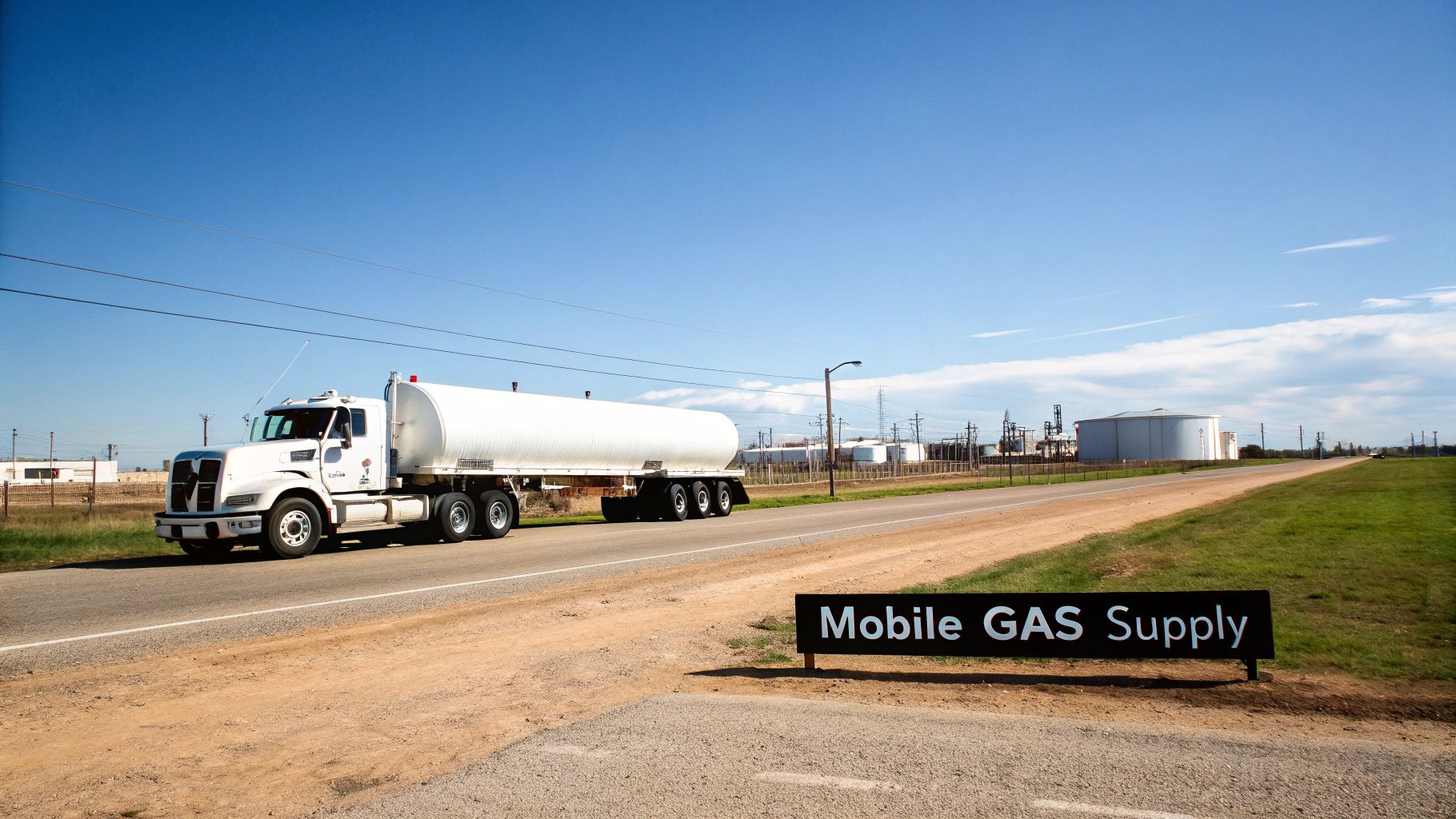
Imagine a compressed natural gas tanker as a giant, portable power bank, but instead of charging a phone, it can power an entire industrial site, a massive construction project, or even a small community. When a permanent energy connection isn't an option—whether due to remote geography, planned maintenance, or unexpected construction delays—these tankers roll in to fill the void, ensuring operations continue without skipping a beat.
This whole system is often called a "virtual pipeline." It's a clever logistics network that moves natural gas over the road instead of through the ground. But it’s more than just a convenience; it’s a critical tool for energy resilience and keeping businesses running. For many operations, an abrupt loss of gas supply can translate to millions in lost revenue and productivity. CNG tankers provide the essential safeguard against that kind of disruption.
The Fundamental Purpose of Mobile Gas
At its core, a CNG tanker’s job is to deliver a reliable, on-demand supply of natural gas anywhere it's needed. This is only possible because the gas is compressed to less than 1% of its standard volume. Squeezing it down so much allows a massive amount of energy to be stored and transported efficiently, opening the door to serving a huge range of needs that fixed pipes just can't handle.
A few key roles they play include:
- Temporary Service: Getting a new construction site or commercial building powered up with natural gas long before the permanent utility line is active.
- Emergency Supply: Serving as a crucial backup energy source for essential facilities like hospitals or data centers if a pipeline goes down.
- Remote Operations: Fueling industrial work, like mining or manufacturing, in plants situated far from any established gas grid.
- Pipeline Maintenance Support: Keeping gas flowing to customers while a utility takes a section of the main pipeline offline for repairs or inspections.
By acting as a flexible and rapidly deployable energy source, compressed natural gas tankers give businesses and communities the power to overcome logistical roadblocks and maintain uninterrupted access to heat and power.
These tankers are essential for keeping the energy flowing, no matter the obstacle. The table below breaks down their primary roles in the energy delivery landscape.
Key Roles of CNG Tankers in Energy Delivery
| Function | Description | Primary Beneficiaries |
|---|---|---|
| Bridging Service Gaps | Provides natural gas before permanent utility infrastructure is installed or activated. | Construction companies, real estate developers, new industrial facilities. |
| Emergency Response | Acts as a backup fuel source during pipeline outages or natural disasters. | Hospitals, data centers, utilities, critical public services. |
| Remote Fueling | Delivers energy to operations located far from the established gas grid. | Mining operations, agricultural facilities, remote manufacturing plants. |
| Infrastructure Support | Ensures uninterrupted service to customers during planned pipeline maintenance or upgrades. | Gas utility companies and their residential/commercial customers. |
As you can see, their versatility makes them an indispensable part of a modern energy strategy.
Why This Technology Is Critical
The real value of CNG tankers goes way beyond just delivering fuel. They are a strategic tool for economic growth, allowing projects to get off the ground in areas that would otherwise be deemed too remote or expensive to connect to the grid. For a construction manager, that means no more costly delays spent just waiting for the utility company to show up.
For gas utilities themselves, partnering with a mobile gas provider like Blue Gas Express is a smart way to keep customers happy and meet service obligations during infrastructure work. At the end of the day, these mobile pipelines on wheels offer a pragmatic answer to today's energy challenges, bringing the flexibility needed to power progress, wherever it’s happening. This guide will walk you through the technology, common applications, and key things to consider when deploying this vital energy solution.
The Technology That Makes CNG Transport Possible
To really get a handle on what compressed natural gas tankers do, you have to appreciate the engineering that goes into them. At the end of the day, it’s all about one thing: shrinking the volume of natural gas so you can actually move it around efficiently. This isn't as simple as just pumping gas into a tank; it's a carefully controlled process of intense compression and rock-solid containment.
Natural gas, in its natural state, is incredibly bulky. Trying to haul it over the road in its raw form would be like trying to transport a cloud—completely impractical. The solution is to squeeze it. Hard. Specialized compressors crank up the pressure to over 3,000 pounds per square inch (psi), forcing the gas molecules to pack tightly together. This single step shrinks the gas's volume down to less than 1% of what it would be at normal atmospheric pressure.
A good way to picture it is to think of a scuba tank. A diver's tank packs a huge amount of breathable air into a small, portable cylinder by compressing it. A compressed natural gas tanker works on the exact same principle, just on a massive scale, carrying enough energy to power a factory or keep a large construction site running.
The Science of Keeping It Contained
Holding gas at these kinds of pressures demands some seriously strong materials. The tanks themselves, often called cylinders or tubes, are the heart of the system, and their design is absolutely critical for safety and efficiency. In the early days, these cylinders were made from thick, heavy steel. It’s strong, no doubt, but it also adds a ton of weight to the truck.
Thankfully, materials science has come a long way. Many of today's high-capacity tankers use advanced composite materials. These tanks typically start with a thin inner liner made of plastic or aluminum, which is then wrapped in layers of super-strong carbon fiber and resin. The result is a container that’s just as tough as steel but significantly lighter, which means the tanker can haul more gas and less dead weight.
This shift in materials is a huge deal for the economics of mobile gas delivery. Every pound you can shave off the tank itself is another pound of natural gas you can deliver to a customer.
The Energy Density Puzzle
While compression is a game-changer, it also shines a light on the central challenge of CNG: the constant trade-off between how much energy you can pack in (energy density) and how much the whole setup weighs. Because CNG is still a gas, even when compressed, it simply holds less energy in the same amount of space compared to liquid fuels.
This physical reality has real-world consequences. Transporting and storing CNG comes with unique hurdles. Unlike liquefied natural gas (LNG), which is chilled into a super-dense liquid, CNG stays in a gaseous state. At its typical storage pressure of around 200 bar, CNG has about 35% of the energy-per-volume of LNG. This means you need bigger, heavier tanks to carry the same amount of energy.
For instance, a truck carrying a bundle of high-pressure steel tubes might hold between 4,000 to 7,500 cubic meters of methane. But the weight of all that steel is so massive that the actual gas payload accounts for less than 5% of the total truck weight. For a deeper dive into this energy-to-weight ratio, you can check out this detailed technical paper.
The core engineering problem is a constant balancing act: how do you pack in the most gas possible while keeping the truck's total weight within legal road limits and ensuring everything stays completely safe under immense pressure?
This challenge is what fuels the constant innovation in tank design and materials. The technology behind compressed natural gas tankers is a fantastic example of clever engineering, designed to work around the physical limits of natural gas to get energy where it needs to go, safely and reliably.
Comparing Natural Gas Delivery Methods
Picking the right way to get natural gas to your site isn't a one-size-fits-all decision. The best method really hinges on your project's timeline, budget, energy demand, and long-term goals. Your three main options—pipelines, compressed natural gas tankers, and liquefied natural gas (LNG) trailers—each come with their own distinct set of pros and cons.
Think of a permanent pipeline like building a new highway. It's a massive, long-term infrastructure project that demands huge upfront capital, extensive permitting, and a long construction timeline. Once it’s in the ground, it offers a nearly limitless and cheap supply of gas, but it's completely inflexible. It only goes where it's built.
This is where mobile gas solutions shine. They act as flexible, temporary roads that can bring energy exactly where you need it, right when you need it, skipping the headaches of permanent construction.
CNG Tankers: The Rapid Deployment Specialists
Compressed natural gas tankers are the go-to solution when you need speed and agility. They really excel in situations that call for immediate or temporary gas service with minimal upfront investment.
Imagine a construction project that needs to power temporary heaters to cure concrete, but the permanent utility connection is still months away. A CNG tanker can be on-site within hours, bridging that critical energy gap and keeping the project on schedule.
This rapid-response capability makes them perfect for:
- Pipeline Maintenance: Utilities often bring in a fleet of CNG tankers to keep gas flowing to an entire neighborhood while they perform essential repairs on the main line.
- Emergency Fueling: During an unexpected outage, CNG tankers can be dispatched to power critical facilities like hospitals or data centers.
- Short-Term Projects: They provide on-demand energy for special events, temporary industrial setups, or job sites with a clear, limited duration.
The main constraint with CNG is its energy density. Since the gas stays in a gaseous state (even under high pressure), a single tanker holds less total energy than an LNG trailer of a similar size. This makes CNG most economical for projects located closer to a compression source, typically within a 150-200 mile radius.
CNG tankers are the ultimate problem-solvers for immediate, flexible energy needs. They eliminate the waiting game associated with permanent infrastructure, allowing projects to stay on schedule and operations to continue without interruption.
This diagram breaks down the key factors—pressure, material, and weight—that are constantly being measured and managed to make CNG delivery possible.
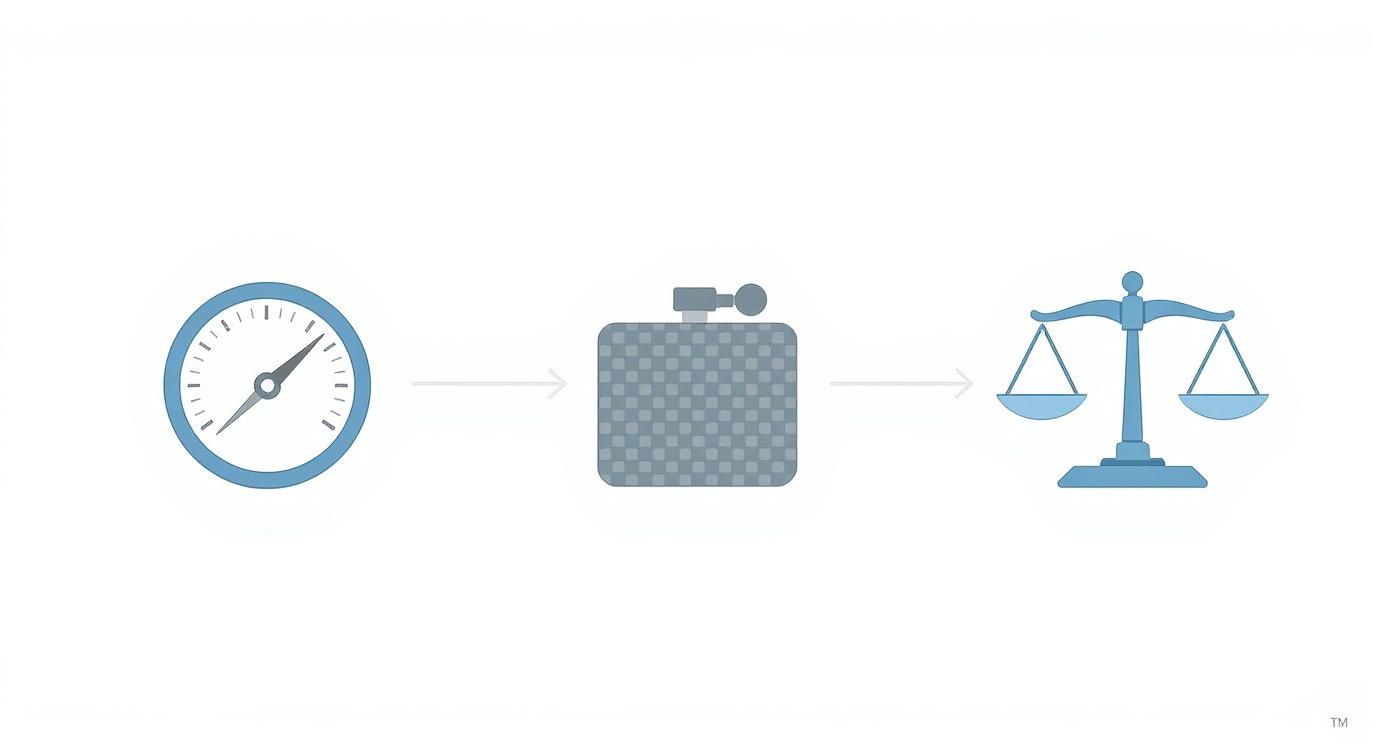
It highlights the intense pressure, advanced lightweight materials, and careful weight management required to make mobile CNG delivery both safe and efficient.
LNG Trailers: High-Volume, Long-Distance Haulers
If CNG tankers are the nimble delivery vans of the mobile gas world, then LNG trailers are the long-haul freight trucks. LNG, or liquefied natural gas, is simply natural gas that has been cooled to a frigid -260°F (-162°C). This process turns it into a super-dense liquid, reducing its volume by about 600 times. That’s how a single trailer can carry significantly more energy than a CNG tanker.
This incredible energy density makes LNG the preferred choice for:
- Large Industrial Users: Think factories or power plants with high, continuous energy demands that are located far from a pipeline.
- Long-Distance Transport: It's more cost-effective to haul LNG over long distances because you can move more energy with fewer trips.
- Marine and Rail Fueling: It’s becoming a primary fuel source for ships and locomotives transitioning to cleaner energy.
But there's a trade-off. The liquefaction process is energy-intensive and requires specialized cryogenic storage tanks, which drives up the upfront cost of LNG production and handling compared to CNG. Also, if the LNG isn't used, it will gradually warm up and "boil off," meaning it can't be stored indefinitely without some loss. CNG, on the other hand, can be stored under pressure forever without any fuel loss.
Natural Gas Delivery Options Compared
To make the choice clearer, here’s a side-by-side look at how these three options stack up against each other across the most important factors.
| Attribute | CNG Tankers | LNG Trailers | Pipelines |
|---|---|---|---|
| Speed | Very Fast (hours/days) | Fast (days/weeks) | Very Slow (months/years) |
| Flexibility | High (fully mobile) | High (fully mobile) | None (fixed location) |
| Upfront Cost | Low (rental/service model) | Moderate (specialized equipment) | Extremely High (construction) |
| Energy Density | Lower | Very High | N/A (continuous supply) |
| Best Use Case | Temporary, emergency, short-haul | High-volume, long-haul, remote | Permanent, high-demand, long-term |
| Storage Loss | None | Low ("boil-off") | None |
As you can see, the "best" option is entirely dependent on the job at hand. For immediate, flexible, and lower-volume needs, a compressed natural gas tanker from a provider like Blue Gas Express is often the most practical and cost-effective solution.
Real-World Applications and Use Cases
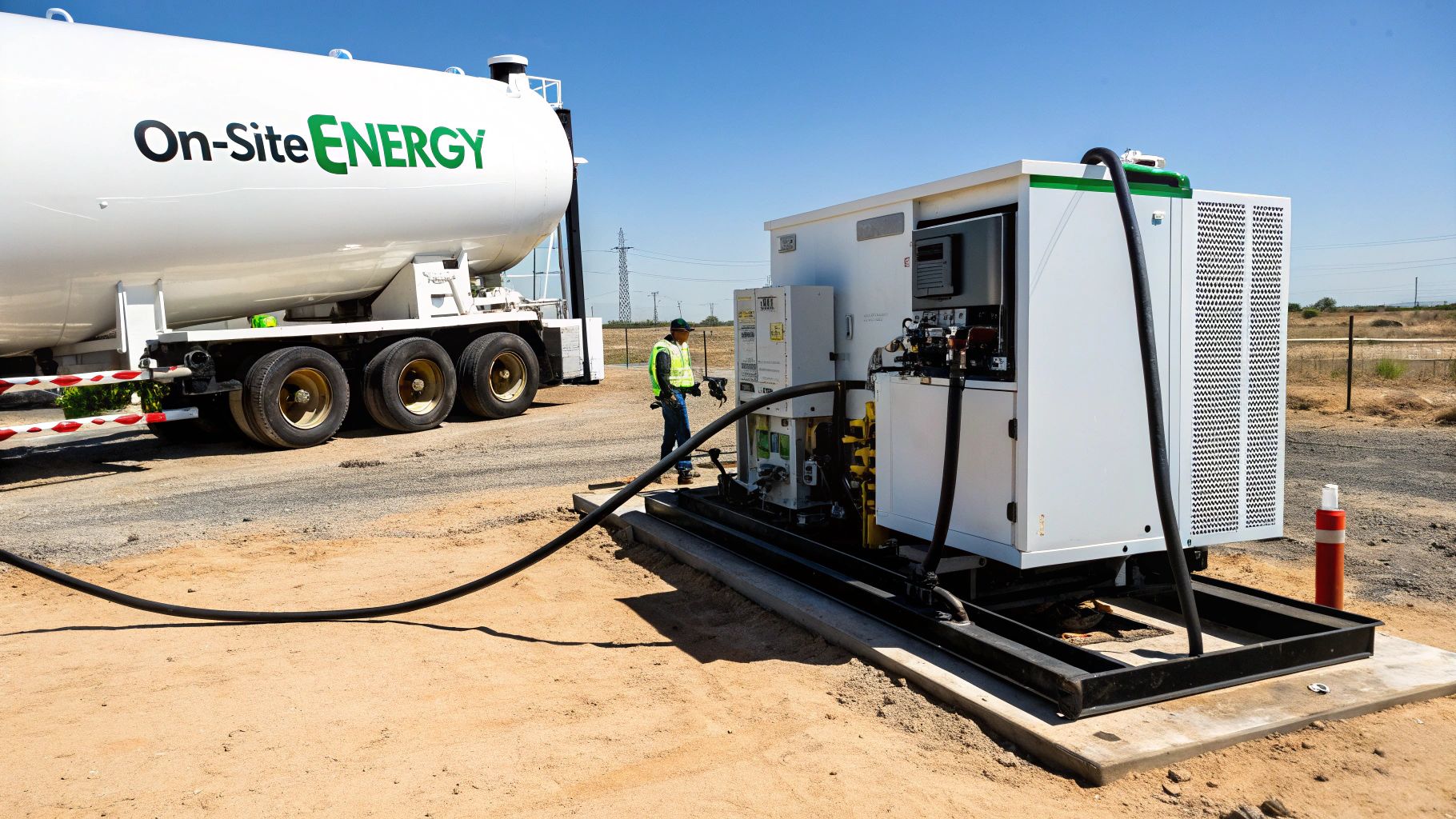
The technology behind compressed natural gas tankers is impressive, but their real value is proven on the ground, solving tough, practical problems every day. These units are much more than just trucks filled with gas; they're mobile lifelines that keep projects moving and essential services online when the traditional energy grid can't.
Think of a CNG tanker as an energy first responder. When a pipeline goes down for repairs or simply doesn't exist yet, these trucks are dispatched to bridge the gap. They prevent costly shutdowns and ensure businesses can keep the lights on, making them indispensable in a surprising number of situations.
Powering Construction and Development
Construction and real estate development is one of the biggest areas where CNG tankers make a huge impact. Picture this: a new residential subdivision is almost finished. The homes are built, but the permanent gas utility hookups are stuck in limbo for weeks—or even months—due to permitting delays.
Without natural gas, the builder is at a complete standstill. They can't test appliances, run the furnaces to keep pipes from freezing in the winter, or get that all-important certificate of occupancy. A single delay like this can bring sales to a screeching halt, creating a massive financial headache.
This is where a CNG tanker becomes the hero of the story. A mobile unit arrives on-site and sets up a temporary, self-contained gas network. Suddenly, the builder can:
- Complete critical inspections that require working gas appliances.
- Prevent expensive weather damage by running the heat.
- Secure occupancy permits and start closing on homes without waiting for the utility company.
By creating a "virtual pipeline," a provider like Blue Gas Express keeps the project on schedule and on budget, turning a potential disaster into a simple logistical step.
Ensuring Continuity for Utilities and Industry
CNG tankers have also become essential partners for gas utility companies themselves. Pipelines need maintenance, upgrades, and sometimes emergency repairs. In the past, taking a pipeline section offline meant cutting off service to everyone downstream.
Now, utilities can deploy a fleet of CNG tankers to ensure a totally seamless supply during planned work. The tankers simply inject gas back into the system just past the repair site, and customers never even know there was an outage. It's business as usual for homes and businesses.
Industrial plants located far from a main gas line also lean on CNG tankers for primary or backup fuel. This frees up companies to build new facilities in more remote, cost-effective areas without being chained to existing infrastructure.
By decoupling energy access from physical pipelines, compressed natural gas tankers empower businesses to operate where they need to, not just where the grid allows. They provide the flexibility needed to support infrastructure integrity without disrupting daily life.
This move toward mobile gas is part of a much bigger trend. The global push for cleaner, more flexible energy is undeniable, driven by both environmental concerns and economic realities. The overall compressed natural gas market was valued at USD 159.9 billion in 2023 and is expected to more than double to roughly USD 344.6 billion by 2030. You can discover more insights about this market growth to see how quickly demand is accelerating.
Critical Support in Emergencies
When disaster strikes, reliability is everything. After a hurricane or earthquake damages a pipeline, CNG tankers become a critical part of the response, rapidly restoring power to essential services.
Their role in emergencies often includes:
- Hospitals and Medical Centers: Keeping generators and heating systems running to ensure patient care continues without a hitch.
- Data Centers: Fueling backup generators to prevent catastrophic data loss during a power grid failure.
- Temporary Shelters: Providing heat and power for emergency shelters housing displaced families.
In these high-stakes scenarios, the ability to get a dependable energy source on-site fast can literally be a lifesaver. It’s the ultimate demonstration of a pipeline on wheels.
Navigating Safety Regulations and Standards
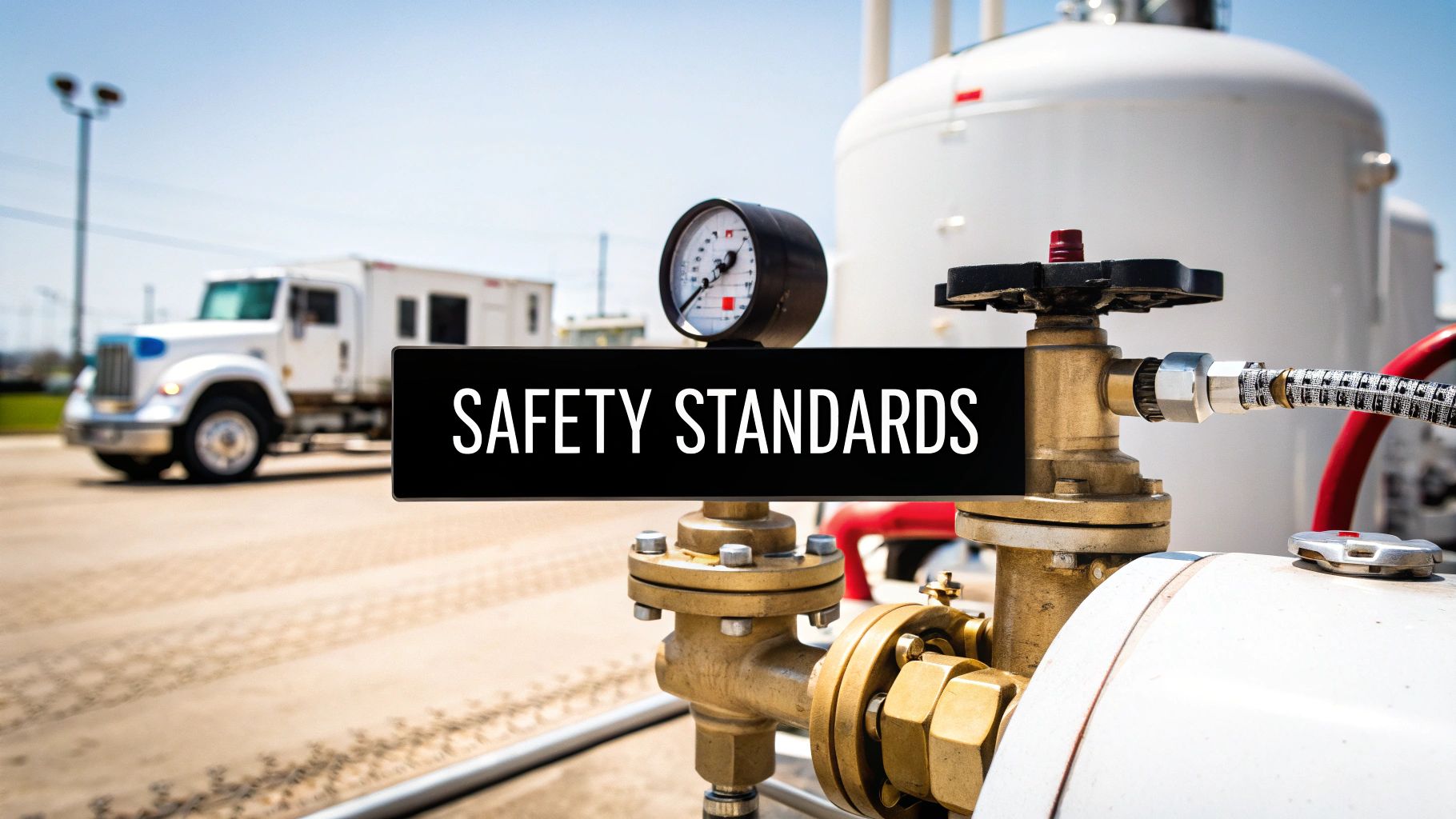
Let's be clear: moving natural gas at pressures often topping 3,000 psi is a serious business. It demands an absolute, unwavering commitment to safety. The entire mobile gas industry operates under a tough, multi-layered set of rules designed to protect everyone from the drivers on the highway to the communities they pass through.
These regulations aren't just bureaucratic hurdles. They're the very foundation that makes delivering mobile natural gas safely and reliably even possible.
For compressed natural gas tankers, this oversight covers every inch of their design, construction, and operation. It's a comprehensive safety blueprint that leaves nothing to chance. Every single component, from the truck's chassis to the smallest valve on a gas cylinder, has to meet precise standards set by government agencies.
Core Regulatory Frameworks
In North America, the two main players setting the rules are the Department of Transportation (DOT) in the United States and Transport Canada (TC) in Canada. Both organizations have established a rigorous list of requirements that all mobile gas providers must follow to the letter.
These regulations get incredibly specific, covering crucial details like:
- Vehicle Design and Materials: They spell out exactly what types of steel, carbon fiber composites, and other materials are tough enough for high-pressure cylinders.
- Pressure Testing: Every cylinder is put through intense hydrostatic testing to prove it can handle pressures far beyond what it will ever see in normal use.
- Regular Inspections: A strict schedule of visual and ultrasonic inspections is mandatory to catch any early signs of wear, corrosion, or damage.
This robust system ensures every compressed natural gas tanker hitting the road is built like a fortress, perfectly capable of managing its high-pressure cargo.
Safety isn't an afterthought; it's engineered into the very DNA of the equipment. These standards create a baseline of trust, assuring clients that the mobile energy solution arriving at their site is backed by proven engineering and stringent oversight.
Onboard Safety Systems: A Multi-Layered Defense
Beyond just building a tough truck, modern CNG tankers are packed with advanced safety systems. Think of it as a multi-layered defense against potential risks. These aren't just bells and whistles; they are integrated, automated features designed to stop an incident before it can ever escalate.
Key onboard safety technologies include:
- Pressure Relief Devices (PRDs): These are essentially automatic safety valves. In the extremely unlikely event of over-pressurization (like in a fire), they are designed to safely vent the gas.
- Emergency Shut-Off Valves (ESVs): Positioned at critical points, these valves can be triggered manually or automatically to cut the flow of gas instantly in an emergency.
- Real-Time Monitoring: Sophisticated telematics systems keep a constant watch on cylinder pressure, temperature, and GPS location, alerting the dispatch team immediately if anything looks out of the ordinary.
Putting these kinds of robust safety protocols in place involves a deep understanding of risk, often informed by established fire risk assessment methodologies. These frameworks help providers develop complete safety plans for every job.
The Human Element: Driver Certification and Training
The final—and arguably most important—layer of safety is the person behind the wheel. The drivers operating compressed natural gas tankers are far more than just truck drivers; they are highly trained specialists.
They must hold commercial driver's licenses with a special hazardous materials (HazMat) endorsement. But the training goes way beyond that. They are experts in the unique properties of natural gas, proper handling procedures for high-pressure systems, and emergency response protocols.
These professionals know exactly how to safely connect and disconnect from a customer's site, monitor equipment during delivery, and spot potential hazards. It’s this combination of human expertise, advanced technology, and strict regulations that creates a safety net you can depend on.
The Economic and Environmental Forces Driving Mobile Gas
The rising demand for compressed natural gas tankers isn't happening by chance. It's being pushed forward by powerful global trends that mix pressing environmental goals with real-world economic advantages. As the world shifts toward cleaner energy, natural gas has stepped up as a critical bridge fuel—it's cleaner than diesel or coal but just as reliable and plentiful.
This worldwide move toward sustainability is a huge factor. Governments are setting bold carbon reduction goals and creating incentives for companies to ditch heavier fossil fuels. Switching to CNG helps businesses meet these new rules, sidestep potential carbon taxes, and build a greener brand. It’s a smart move that lines up a company's daily operations with what the public and investors want to see.
Making the Financial Case for CNG
Beyond the green angle, the numbers just make sense. Wild swings in oil prices can throw a wrench in the budget for any company that depends on diesel for its generators or vehicle fleets. Natural gas prices, on the other hand, have historically been more stable and often lower, providing a predictable and cost-effective alternative.
For a business, that translates directly to the bottom line. Cheaper fuel means lower operating costs and higher profits. Plus, the flexibility of compressed natural gas tankers helps companies avoid the massive upfront investment of building permanent pipelines, making it a nimble and financially sound choice for temporary or remote energy needs.
The decision to use CNG is rarely just about logistics; it's a strategic calculation that balances environmental stewardship with smart financial management, positioning companies for success in a low-carbon economy.
A Market on the Rise
This blend of environmental responsibility and economic logic is fueling some serious market growth. Valued at roughly USD 2.78 billion in 2025, the global compressed natural gas (CNG) tank market is expected to jump to USD 6.4 billion by 2035. That’s a compound annual growth rate of about 8.7%, all driven by global investment in natural gas storage. You can read the full research on this growing market for a deeper dive.
The growth is especially strong in a few key areas:
- Asia Pacific: This region is poised to lead the pack, projected to grab nearly 49.5% of the global revenue share by 2035. This is thanks to rapid industrial growth and major clean energy investments from both government and private industry.
- North America: With plenty of natural gas reserves and a strong regulatory push for cleaner fuels, adoption continues to climb across industrial and transportation sectors here.
At the end of the day, these forces show that opting for a mobile energy solution from a provider like Blue Gas Express is more than just an operational decision—it's about aligning your business with the major economic and environmental currents shaping our world.
Got Questions About CNG Tankers? We've Got Answers.
Even after you've got the basics down, you're bound to have some practical questions when thinking about using compressed natural gas tankers for your project. Let's tackle some of the most common ones we hear from the field to help you figure out if this mobile energy solution is a good fit for you.
How Far Can You Realistically Haul a CNG Tanker?
Technically, a truck can go anywhere. But when it comes to CNG tankers, the real question is about economics. The sweet spot for delivery is usually within a 150-200 mile radius of the compression station.
Once you get much farther than that, the cost of transportation starts to eat into your fuel savings. CNG is fantastic, but it's less energy-dense than liquid fuels, which means you need more trips for big jobs far away. If your project is outside that 200-mile zone, it's often more practical to look at LNG trailers.
Is CNG as Safe as Propane or Diesel?
Compressed natural gas has a stellar safety record, and that comes down to two things: the nature of the gas itself and some seriously tough engineering.
The biggest difference is what happens in a leak. Propane (LPG) is heavier than air, so it can pool on the ground and create a dangerous situation. CNG, on the other hand, is lighter than air. In the unlikely event of a leak, it just rises and dissipates harmlessly into the atmosphere.
On top of that, the storage cylinders are built like tanks. They're designed to withstand major impacts and are tested at pressures way beyond what they'll ever see in normal use. When you combine CNG's natural properties with strict DOT safety rules, you get an incredibly safe fuel for transport and on-site use.
The entire operation is wrapped in layers of safety, from the way the tanker is built to the specialized training every driver receives. This comprehensive approach means risks are managed and minimized every step of the way.
What’s Involved in the On-Site Setup?
Getting temporary gas hooked up with a CNG tanker is a smooth, hands-off process for you. Your mobile gas provider handles everything from start to finish.
Here's how it usually goes:
- Scoping Out the Site: First, a technician will come out to find the safest and most efficient spot to park the equipment.
- Placing the Gear: Next, the provider brings in the CNG tanker (often called a "tube trailer") and a pressure reduction unit, or PRU. That PRU is the key—it safely takes the high-pressure gas from the trailer and steps it down to the lower pressure your equipment needs to run.
- Hookup and Safety Checks: The technician then connects the PRU to your system. They'll run a full battery of leak and pressure tests to make absolutely sure everything is secure and safe before turning it on.
- Keeping the Gas Flowing: Once you're up and running, the provider keeps an eye on your gas levels remotely. They’ll schedule tanker swaps well before you run low, so you get a seamless, uninterrupted supply.
For projects in the Carolinas, Tennessee, or Virginia, Blue Gas Express provides rapid, reliable mobile gas solutions to keep your operations running smoothly. Find out more about our temporary CNG services.