

A compressed natural gas (CNG) refuelling station is the vital link that brings natural gas to vehicles, equipment, and entire facilities, especially when there’s no pipeline in sight. These aren't just "gas stations" for CNG vehicles; they're specialized facilities that compress standard utility gas into a much smaller, portable volume. This unlocks its use for everything from heating massive construction sites to powering emergency generators.
How a CNG Refuelling Station Works
Think of a CNG station as a powerful compressor. It takes the low-pressure natural gas flowing through a standard utility pipeline and essentially squeezes it down, concentrating its energy into a fraction of the space. This simple but powerful process is what makes natural gas portable, breaking it free from the limitations of fixed pipelines.
While most people might picture city buses or garbage trucks when they think of CNG, its real game-changing applications are often behind the scenes in the industrial world. For contractors, project managers, and utility companies, mobile CNG is an essential energy lifeline. It's the go-to solution for fueling equipment on a remote job site, commissioning a new generator before the permanent gas line is hot, or keeping the heat on for customers during a pipeline outage.
More Than Just a Public Pump
The public CNG station you see on the side of the road is a permanent fixture, built to serve a steady flow of vehicles for years. But the industrial world moves a lot faster and often needs a more flexible, on-demand solution. That's where temporary, mobile CNG solutions come into their own.
A mobile cng refuelling station delivers the same high-pressure gas but on a platform designed to be set up quickly and used for a specific, short-term job. It allows projects to move forward without being held up by a lack of access to the main gas grid. These "virtual pipeline" systems are critical for:
- Construction: Powering large-scale heaters, ground-thawing equipment, and temporary generators.
- Utility Maintenance: Creating a temporary gas bypass to ensure customers have uninterrupted service during pipeline repairs or upgrades.
- Industrial Commissioning: Letting factories and power plants test and fire up new gas-powered equipment right on schedule.
By bringing the gas supply directly to where you need it, mobile CNG solutions smash through logistical roadblocks. They turn natural gas from a location-bound utility into a truly on-demand energy source, keeping projects on track and operations running smoothly.
This guide will dive into both permanent and mobile CNG systems, but we'll focus on the practical, real-world knowledge you need to figure out if this technology is the right call for your project. We'll break down how it all works, compare the different options, and walk you through what it really takes to get a mobile station up and running on your site.
How the Refuelling Process Actually Works
Ever wonder how you get high-pressure natural gas from a low-pressure utility line? Think of it like a fire department hooking up to a regular hydrant. The city's water pressure is fine for your kitchen sink, but to fight a fire, they need to boost it dramatically. A CNG station does the exact same thing, but for natural gas.
It takes the standard, low-pressure gas flowing through a pipeline and transforms it into a highly compressed, portable energy source, ready for demanding industrial jobs. This isn't a single step, but a carefully choreographed process designed for maximum efficiency and, above all, safety.
Step 1: Drying the Gas for Purity
Before the gas goes anywhere, it has to be cleaned up. The raw natural gas coming from a utility pipeline isn't pure; it contains water vapor and other trace elements. If left in, this moisture can wreak havoc on high-pressure equipment, causing corrosion or even freezing solid in cold weather and creating dangerous blockages.
So, the first stop is a gas dryer. This unit acts like a heavy-duty dehumidifier, stripping out all that moisture. It’s a non-negotiable first step that protects the entire system, ensuring the compressors and storage tanks have a long, reliable life. Clean, dry gas is key.
Step 2: Compressing the Gas to High Pressure
With the gas now dry, it moves to the heart of the operation: the compressor. This isn't your average garage air compressor. We're talking about industrial, multi-stage units that work in sequence to methodically squeeze the gas.
Each stage bumps the pressure up a notch, step-by-step, until it reaches its target—typically between 3,600 and 4,500 psi. This multi-stage method is crucial for managing the intense heat generated during compression, keeping the whole process safe and stable. It's the most power-hungry part of the job, but it’s where the gas becomes the dense energy source we need.
This infographic shows the entire journey, from pipeline to the final job site.
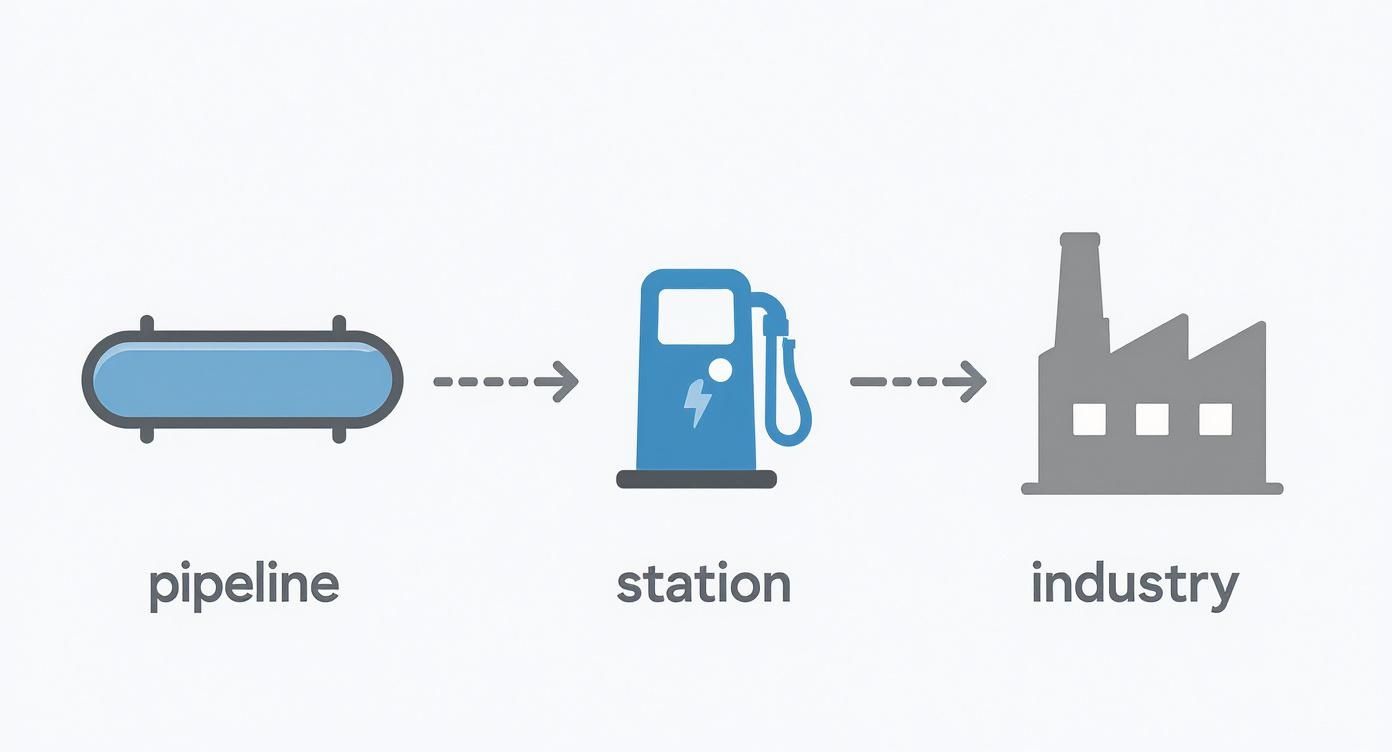
As you can see, the station is the critical link that makes pipeline gas usable for high-volume industrial applications.
Step 3: Storing and Dispensing the Final Product
Once the gas is fully pressurized, it’s piped into a high-pressure storage system called a "cascade." This is essentially a series of tough, interconnected steel tanks that hold the finished CNG, ready to be dispensed. The system is smartly designed to make refueling as fast and complete as possible.
The cascade is set up in banks, each held at a different pressure. When it's time to fuel up a trailer or piece of equipment, the system draws gas from the lowest pressure bank first, then moves to the next highest, and so on. This ensures a quick, smooth transfer without the risk of over-pressurizing anything.
Think of it like pouring water from three pitchers into a glass. You start with the one that's nearly empty (lowest pressure), then the half-full one, and finally the completely full one (highest pressure) to top it off quickly and efficiently.
The entire operation—from drying to dispensing—is automated and constantly monitored. The brains behind it all are sophisticated control systems. To really get into the weeds of how these automated systems manage flow and pressure, it's worth understanding the role of PLC process controls. These controllers are the nerve center, making constant adjustments to keep everything running perfectly and within strict safety limits.
Permanent vs. Mobile CNG Stations: Which is Right for Your Project?
Choosing the right CNG setup isn't just a technical decision; it's a strategic one that directly impacts your project's budget, timeline, and overall success. The central question is simple: Are you making a long-term capital investment, or do you need a flexible, short-term energy source? The answer will point you toward either a permanent or a mobile cng refuelling station.
Think of it this way: a permanent station is like building a house. It's a major, long-term commitment meant for a fixed location with steady, predictable demand. This makes it the go-to choice for fleet depots, city bus yards, or public fueling centers where a constant stream of vehicles will be refueling every day for years to come. It’s a capital expenditure, designed to last.
A mobile CNG station, on the other hand, is more like renting specialized industrial equipment. It’s an agile, operational expense brought in for a specific job over a set period. This is the perfect fit for temporary or emergency needs—like powering heaters on a construction site through the winter, commissioning a factory's new gas-fired equipment before the main utility line is active, or bypassing a damaged pipeline to keep a neighborhood's heat on.
The Core Decision Framework
The choice gets a lot clearer when you look at the fundamental purpose of each. Permanent stations are all about putting down roots and building long-term capacity. Mobile solutions, like those from Blue Gas Express, are about delivering immediate, flexible energy exactly when and where you need it, without the huge upfront cost or the long wait for construction.
Here's the bottom line: A permanent station is an infrastructure destination. A mobile station is an infrastructure solution. One is built to stay; the other is designed for rapid deployment to solve a specific problem.
Getting this distinction right is critical for any project manager or contractor. Tying up capital in a permanent station for a six-month construction project makes no financial sense. Likewise, trying to run a ten-year fleet operation on temporary mobile units would be a logistical nightmare. Your project’s timeline and demand are the two most important factors guiding this decision.
Comparing Permanent vs Mobile CNG Solutions
To really see the difference, let’s put the two options side-by-side. The table below breaks down the key factors you’ll need to consider, from cost and deployment speed to the regulatory hoops you'll have to jump through.
| Factor | Permanent CNG Station | Mobile CNG Station |
|---|---|---|
| Cost Structure | High Capital Expenditure (CAPEX) | Operational Expense (OPEX) |
| Deployment Speed | Months to over a year | Days to a few weeks |
| Site Requirements | Extensive: concrete pads, permanent electrical, pipeline access, large footprint | Minimal: level ground, standard electrical hookup, accessible for trailers |
| Regulatory Hurdles | Complex and lengthy: zoning, environmental impact studies, building permits | Streamlined: temporary use permits, standardized safety compliance checks |
| Ideal Use Case | Long-term fleet fueling, public refueling infrastructure | Temporary projects, emergency utility bypass, construction site services |
As you can see, the paths diverge significantly. A permanent cng refuelling station demands a serious investment of both time and money. The project timeline can easily stretch past a year from the initial planning stages to final commissioning, bogged down by complex local zoning laws and environmental reviews.
In stark contrast, a mobile solution is built for speed. Because it's a self-contained, temporary unit, the permitting process is far simpler and the site prep is next to nothing. This is how a provider like Blue Gas Express can get a site up and running in just a few days, turning a potential months-long delay into a solved problem.
The model of delivering energy on-demand is gaining traction everywhere. For a look at how this trend is playing out in other sectors, this guide to portable charging stations for electric cars offers some great insights into the power of mobile energy. Ultimately, your project's specific timeline, budget, and purpose will make the choice clear.
Deploying a Mobile CNG Solution On-Site
Putting a temporary mobile gas supply in place isn't a massive construction project. Think of it more as a swift, precise logistical operation. For any project manager, getting a handle on this process is crucial for keeping your timeline on track and sidestepping the kind of expensive downtime that can kill a budget.
A mobile CNG setup basically turns a potential energy headache into a fully managed, turnkey service.
The whole thing kicks off with a simple conversation with a specialized provider, like Blue Gas Express, who handles all the heavy lifting. We’d talk through your project's vitals: how much gas you need, at what pressure, and for how long. From that point, things move fast.

This ability to get up and running quickly is a game-changer, especially in areas where permanent pipelines are miles away. While millions of vehicles worldwide run on CNG, the refueling infrastructure can be patchy. Some regions are well-served, but others have big gaps. That’s where mobile solutions really shine. You can learn more about the global CNG landscape over at Rextag.
Site Selection and Preparation
The first real step on the ground is a site assessment. A technician will come out to your location to make sure it’s a good fit for safe and efficient operation. Unlike a permanent station that requires serious earthmoving and concrete work, the needs for a mobile unit are surprisingly simple.
So, what makes a good spot?
- Level Ground: The CNG trailers and pressure reduction unit need a stable, flat surface. A patch of gravel or compacted dirt is usually perfect—no concrete pad necessary.
- Plenty of Room: You’ll need enough space for a full-size tractor-trailer to pull in, drop off the CNG supply, and get out without a 10-point turn.
- Clear Access: The path for delivery trucks has to be clear. You don't want them getting blocked by other site activities when they come to swap out trailers.
- A Safety Buffer: The equipment needs to be set up away from busy areas, potential ignition sources, and other critical site infrastructure to meet standard safety setbacks.
Once we’ve picked the right spot, the "infrastructure" needs are minimal. The main thing is a standard electrical hookup to power the system’s heaters and controls. This is vital for keeping the gas flowing smoothly, especially when the temperature drops. That simplicity is what makes the whole process so fast.
Typical Deployment Timeline and Process
From your first call to having a live gas supply, the timeline is often just a handful of days—not weeks or months.
Here’s how it usually unfolds, step-by-step:
- Initial Chat & Site Walk: Your provider figures out your fuel demand and then inspects the proposed spot to make sure it ticks all the safety and logistical boxes.
- Getting Equipment on the Move: A specialized truck brings the pressure reduction unit and the first high-pressure CNG storage trailer right to your site.
- Installation & Hookup: Technicians get the equipment positioned correctly, connect it to your on-site piping, and plug in the electrical.
- System Commissioning: The whole setup gets purged, pressurized, and double-checked to make sure it's running perfectly and meeting every safety standard.
- Safety Handoff: Your crew gets a clear, straightforward walkthrough on how to operate the system and what to do if an issue pops up.
The entire process is designed to be as invisible as possible. The provider manages the logistics, compliance, and technical setup, which frees up your team to stay focused on their actual jobs.
This complete, hands-off approach is what defines a modern mobile gas solution. It isn't just about dropping off fuel; it’s about delivering a fully managed energy service that slots right into your project's workflow. It ensures you have the gas you need, right when you need it, and helps you avoid the kinds of delays that can derail even the most carefully planned projects.
Safety Isn't Just a Guideline—It's the Bedrock of CNG Operations
When you're working with natural gas compressed to several thousand pounds per square inch, safety is everything. A mobile cng refuelling station is a serious piece of industrial hardware, and it's the strict, overlapping safety standards that make it a reliable and secure tool for any job site.
These rules aren't just suggestions pulled from a manual. They are battle-tested codes that govern every single nut, bolt, and valve in the system. Think of it like the electrical code for a hospital—it’s there to ensure that under every conceivable condition, the system performs safely and predictably.
The Code That Matters Most: NFPA 52
In the world of natural gas vehicles and fueling, one standard stands above the rest: NFPA 52, the "Vehicular Natural Gas Fuel Systems Code." This is the primary rulebook for designing and installing any CNG station, whether it’s a permanent fixture at a fleet depot or a temporary unit brought to a construction site.
NFPA 52 sets the non-negotiable requirements for everything, from the materials used in the tubing to the minimum safe distance the equipment must be from buildings or power lines.
But it doesn't stand alone. Other crucial codes add layers of protection:
- ASME Boiler and Pressure Vessel Code: This is what ensures the high-pressure storage tanks are tough enough to handle the immense forces inside them.
- ANSI/CSA NGV Standards: These get into the nitty-gritty, covering specific parts like the hoses, nozzles, and breakaway couplings to ensure they are all certified for high-pressure gas service.
These codes all lock together, creating a system where safety isn't just a single feature but is woven into the very fabric of the equipment.
The Safety Features You Can Actually See and Touch
All those regulations translate into real-world hardware designed to prevent, detect, and control any potential issue. When you see a mobile CNG station on your site, you’re looking at a carefully integrated system of safety technology.
It's a common myth that CNG is more dangerous than diesel or gasoline. The opposite is often true. Natural gas is lighter than air, so if a leak ever occurs, it vents upward and dissipates harmlessly. Liquid fuels, on the other hand, pool on the ground, creating a lingering fire or slip hazard.
Here are the key safety systems you'll find on any professionally managed cng refuelling station:
- Emergency Shutdown Devices (ESDs): The big, red "uh-oh" buttons. Anyone on site can hit one to instantly stop all gas flow.
- Pressure Relief Devices (PRDs): Think of these as safety valves. Every tank and line has one. If pressure somehow builds beyond a safe limit, the PRD automatically and safely vents it.
- Methane Detectors: These are the electronic watchdogs. Placed in key areas, they continuously sniff the air for gas. The moment they detect a leak, they trigger alarms and can automatically shut the system down.
- Grounding and Bonding: Static electricity is the enemy of any fuel system. Every component, from the truck to the dispenser hose, is electrically bonded and grounded to prevent any chance of a spark.
Getting all of this approved by the local fire marshal and other authorities (often called the AHJ, or "Authority Having Jurisdiction") can be a complex job. That's where an experienced partner comes in. At Blue Gas Express, we don't just deliver the gas—we manage the entire permitting and compliance process. We ensure the setup on your site doesn't just meet the codes, but exceeds them, giving you a safe, compliant, and completely worry-free operation.
Mobile CNG Stations in Action

It’s one thing to understand the mechanics of a cng refuelling station, but it’s another to see it save a project from a costly delay. That's where the real value clicks. Mobile CNG solutions are problem-solvers, designed to bridge energy gaps and keep operations moving when a permanent gas line is delayed, damaged, or just not there yet.
Think about a major construction project in the dead of winter. The schedule hinges on pouring concrete, but the ground is frozen solid. You need ground-thawing equipment and massive temporary heaters running 24/7. Without a high-volume fuel source, everything stops. That’s a perfect job for a mobile CNG unit.
A provider like Blue Gas Express can roll a temporary fuel solution right onto the site. This "virtual pipeline" keeps the heaters fired up, the ground workable, and the project on schedule, no matter how far you are from a utility main.
Powering Up Before the Pipeline Is Live
Commissioning a new industrial facility—say, a manufacturing plant or a power generation station—presents another classic challenge. These sites have massive gas-fired turbines or generators that need to be tested and certified long before the facility opens. Waiting for the permanent utility pipeline to be installed can create a huge bottleneck, throwing the entire project timeline off by months.
This is where mobile CNG shines. A temporary station can supply all the natural gas needed to fire up and fully test the equipment, keeping everything on its original schedule.
Key Takeaway: Mobile CNG decouples critical project milestones from the utility construction timeline. It gives you the power to meet contractual obligations and start generating revenue sooner.
This on-demand energy model is catching on globally. The worldwide compressed natural gas market was valued at around USD 159.87 billion in 2023, and it's projected to keep growing. A major driver is the Asia Pacific region, which accounted for 48.3% of the market's revenue, thanks to industrial demand and supportive government policies. You can dig into more of the numbers on this expanding market from Grand View Research.
Keeping Communities Safe During Outages
Mobile CNG isn't just for industrial projects; it's also a critical tool for public utilities. When an existing pipeline needs to be taken offline for maintenance or gets damaged, thousands of homes and businesses can be left in the cold. A mobile CNG unit can be brought in to bypass the affected section of the line entirely.
By injecting natural gas back into the system downstream from the outage, the utility maintains service for everyone. This ensures public safety and comfort, and it also avoids the logistical headache of having to relight pilot lights for every single customer after the repair is done. In these moments, a mobile cng refuelling station becomes a vital piece of community infrastructure.
Common Questions About Mobile CNG Stations
When you're dealing with temporary energy needs, you want straight answers. Cost, speed, and what actually happens on-site are usually top of mind. To clear up any lingering questions, here are the direct answers we give contractors and utility managers when they're looking at a mobile CNG solution for a project.
How Quickly Can a Mobile CNG Station Be Deployed?
This is where mobile solutions really shine. Forget the months-long timeline of permanent construction. We can often have a complete mobile refuelling setup delivered, installed, and running in just a few days, depending on how ready your site is.
The whole process is pretty straightforward: a quick site check, trucking in the self-contained unit, hooking it up, and running final safety checks. That kind of speed is a game-changer for urgent situations like emergency pipeline repairs or construction jobs with razor-thin deadlines.
What Costs Are Involved with a Mobile CNG Solution?
Think of it as an operational expense, not a massive capital investment. This keeps your project budget clean and predictable. The costs break down into a few simple parts:
- A one-time fee for mobilization and demobilization (getting the gear to your site and taking it away).
- A recurring rental fee for the equipment while it's on-site.
- The cost of the natural gas you actually use.
This model makes budgeting a breeze for short-term projects. You know exactly what you're paying for, without tying up huge amounts of cash in permanent infrastructure you don't need long-term.
Key Insight: Treating your fuel supply as a manageable operational cost (OPEX) instead of a major capital investment (CAPEX) preserves project capital for core activities and simplifies financial planning, especially for temporary worksites.
Are Mobile Stations Powerful Enough for Industrial Use?
Absolutely. These aren't just for small jobs. A mobile CNG refuelling station is built from the ground up for heavy-duty industrial work. We regularly configure them to fuel large gas turbines, power multi-megawatt generator banks, or even act as the primary fuel source for a factory during a pipeline outage.
The system is completely scalable. We match the capacity to your exact needs by bringing in the right-sized compressor and adding as many CNG storage trailers as necessary. This ensures you get an uninterrupted, high-volume flow of gas that can keep up with even the most power-hungry equipment.
What On-Site Support Can I Expect?
You're not just getting a piece of equipment dropped off. Full, comprehensive support is a critical part of the package. This means our certified technicians handle the entire setup and commissioning process.
We also provide thorough safety training for your crew on proper refuelling procedures. From there, we offer 24/7 remote monitoring and have technicians on-call to handle anything that comes up. It's a full-service approach that lets our experts manage the fuel supply, so your team can stay focused on the job at hand.
Ready to eliminate energy delays on your next project? Blue Gas Express delivers reliable, on-demand mobile natural gas solutions to keep your operations running smoothly. Learn how we can provide a virtual pipeline directly to your site by visiting our website.