

Picture this: your multi-million dollar construction project is complete, ready for handover, but you're dead in the water. Why? The permanent natural gas line isn't connected yet. This single snag stops your HVAC commissioning cold, blocks crucial inspections, and makes that all-important certificate of occupancy impossible to get. It’s a frustratingly common and expensive headache, and it's exactly the problem C and E pipeline services were created to solve.
What Exactly Are C and E Pipeline Services?
In short, C and E (Construction and Engineering) pipeline services are all about delivering temporary mobile natural gas right to your job site. Using specialized trucks, we bring either Compressed Natural Gas (CNG) or Liquefied Natural Gas (LNG) to create what’s often called a 'virtual pipeline'. This completely bypasses delays with the local utility's infrastructure. It's like having a mobile power generator, but for natural gas, keeping your project's momentum going when it matters most.
This isn't just a matter of convenience; it’s a powerful risk management tool for any modern construction project. Delays tied to utility infrastructure are notoriously unpredictable and can be incredibly costly. A single stalled inspection can set off a domino effect, throwing off trade schedules, bloating labor costs, and even putting your financing timelines at risk.
The Problem They Solve at the Core
At its heart, this service is a bridge. It closes the gap between when your building is physically finished and when the utility is ready to connect you. Your structure might be perfect, but without a live gas feed, none of the essential systems can be tested or run. This creates a massive bottleneck right at the finish line.
- HVAC Commissioning: You can't properly test, balance, and get sign-off on modern heating, ventilation, and air conditioning systems without natural gas.
- Occupancy Permits: City inspectors simply won't issue a certificate of occupancy if you can't prove the heat and hot water are working. No gas, no permit.
- Project Handover: Developers can't hand the keys over to new owners or tenants until every system is proven to be safe and fully operational.
Think of a virtual pipeline as your on-demand energy lifeline. It untethers your project timeline from the utility's schedule and puts you, the project manager, back in control.
Keeping Your Project on the Move
The biggest advantage here is maintaining momentum. Instead of being forced to wait weeks—or sometimes even months—for the permanent gas line to go live, C and E pipeline services give you an immediate and dependable supply. This lets all those critical final-stage activities move forward without a hitch.
The table below really highlights the difference between the "wait and see" approach and deploying a temporary gas solution.
Permanent vs Temporary Gas Supply Scenarios
| Project Challenge | Impact of Permanent Pipeline Delay | How Temporary C and E Services Solve It |
|---|---|---|
| HVAC System Testing | All commissioning is halted, delaying subsequent inspections and trade work. | Provides immediate gas flow to test and balance all equipment on schedule. |
| Occupancy Permit Inspection | Fails inspection due to a lack of operational heating and hot water. | Ensures all systems are fully functional, meeting municipal requirements for occupancy. |
| Tenant Move-In Dates | Scheduled move-ins are postponed, leading to lost revenue and contractual penalties. | Keeps the project on its original timeline, allowing for a smooth handover to tenants. |
| Winter Construction | Risk of frozen pipes and interior damage without temporary heating solutions. | Delivers consistent heat to protect the building and allow interior work to continue. |
As you can see, waiting on a permanent line introduces significant risk and uncertainty, whereas a temporary mobile solution offers a clear path forward, keeping your project on time and on budget.
How a Virtual Pipeline Works on Your Job Site
The term "virtual pipeline" sounds a bit futuristic, but the concept is actually pretty simple. Think of it as a mobile power generator, but instead of electricity, it delivers a steady, reliable supply of natural gas right to your project. It’s the perfect bridge when the permanent underground utility line is delayed, keeping your entire schedule on track.
The process kicks off when natural gas, in a highly concentrated form, is delivered to your site. Depending on your project’s energy demands, the gas arrives in one of two ways: as Compressed Natural Gas (CNG) in specialized high-pressure tube trailers, or as Liquefied Natural Gas (LNG) in super-cooled cryogenic tankers. Both methods are just incredibly efficient ways to move a massive amount of energy over the road.
This diagram nails the basic idea: a project delay gets solved by a C&E truck, leading directly to project completion.

It’s a clear, three-step solution where the mobile gas service directly resolves a timeline issue, letting you finish the job.
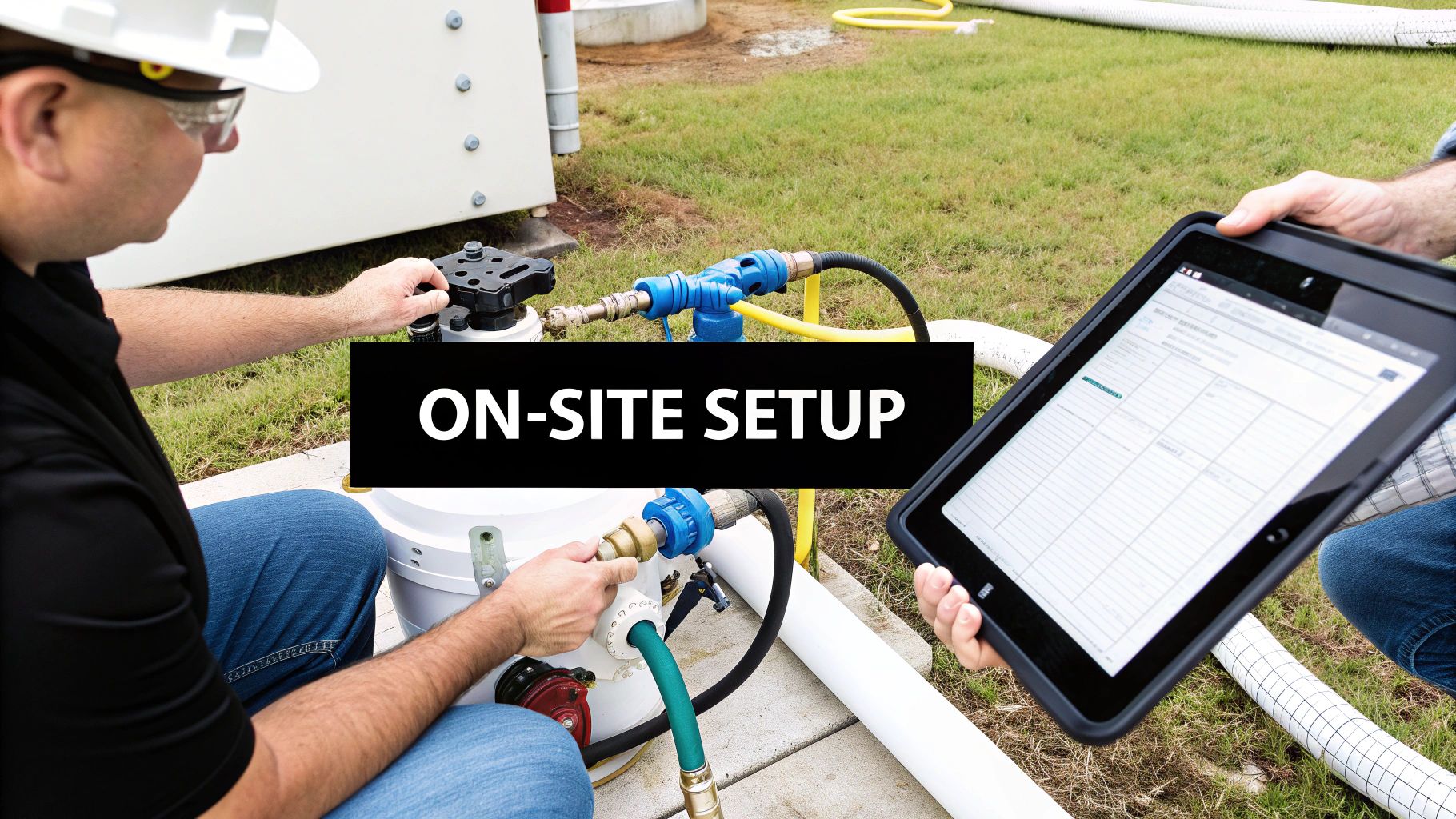
From Truck to Meter: The On-Site Setup
Once the transport truck is on-site, the heart of the operation is a specialized piece of equipment called a pressure regulation unit. This unit is the brain of the temporary system. Its main job is to safely and precisely step down the gas from its highly pressurized transport state to a usable pressure for your building's systems.
For CNG, this means carefully reducing the high pressure. For LNG, which is stored around a frigid -260°F, the unit has a vaporizer that warms the liquid, turning it back into a gas before regulating its pressure. From there, the unit connects right into your building’s gas meter or main connection point, essentially acting as the utility until the permanent pipeline is live.
This reliance on pipelines—both permanent and virtual—really shows how vital they are. In the United States, about 70% of crude oil and petroleum products travel via pipelines, which just highlights their critical role in our energy infrastructure. As production keeps climbing, the need for new pipeline construction is set to drive market growth of over 3.9% annually between 2025 and 2030. You can explore more pipeline market insights to get the full picture.
Choosing Between CNG and LNG
Picking between CNG and LNG isn't a toss-up; it's a strategic decision based on what your project actually needs. Each has its own strengths, and any good c and e pipeline service provider will walk you through the best option.
- Compressed Natural Gas (CNG): This is your go-to for projects with moderate gas needs or shorter timeframes. The on-site equipment is usually smaller, which is a huge plus on crowded construction sites.
- Liquefied Natural Gas (LNG): When you need massive volumes of gas over a long period—like for firing up industrial equipment or heating a large complex all winter—LNG is the clear winner. A single LNG tanker holds way more energy than a CNG trailer, meaning fewer truck swaps.
The bottom line is this: a virtual pipeline isn't a one-size-fits-all product. It’s a flexible system designed around your specific gas load, site logistics, and project timeline, so you get exactly the energy you need, right when you need it.
In the end, whether you go with CNG or LNG, the result is the same: you get an uninterrupted, utility-grade supply of natural gas. This allows you to commission HVAC systems, pass key inspections, and get your certificate of occupancy without being held hostage by infrastructure delays. That control is the real value c and e pipeline services bring to your job site.
When to Use Temporary Natural Gas Services
Knowing how a virtual pipeline works is one thing. But knowing precisely when to use one is what separates a good project manager from a great one, especially when you're up against the clock. Temporary natural gas isn't just a "Plan B"; it’s a strategic move to sidestep common, high-stakes project roadblocks.
Think of it as the essential bridge between a nearly finished building and a utility connection that's still weeks or months away.
Identifying the trigger points for bringing in a temporary solution can mean the difference between hitting your deadline and watching profits evaporate during weeks of downtime. The need often pops up unexpectedly, but it usually falls into one of four critical scenarios that can stop a project cold.
Let's break down the four key situations where c and e pipeline services become absolutely essential.

Overcoming New Construction Delays
This is, by far, the most frequent reason we get a call. Your crew has worked tirelessly, the structure is up, and you’re deep into the interior finishing. The only thing missing? The permanent natural gas line from the local utility, which is held up by scheduling conflicts, right-of-way snags, or some other unforeseen issue.
Without gas, your project is stuck on the 95-yard line. This is where a virtual pipeline becomes your MVP, supplying the energy to power through those final phases and cross the finish line without interruption.
Enabling Critical System Commissioning
Today's buildings have sophisticated HVAC systems that must be rigorously tested, balanced, and commissioned before you can hand over the keys. This is non-negotiable, and it requires a live, stable supply of natural gas to fire up boilers, rooftop units, and water heaters.
You can't exactly certify a high-performance heating system if you can't generate any heat. It's that simple. C and E pipeline services deliver the fuel needed to:
- Test and balance all gas-fired equipment according to the manufacturer's exact specs.
- Prove full functionality to the mechanical engineers and inspectors on site.
- Prevent a domino effect of delays for other trades who are waiting on the HVAC sign-off.
This ensures that when the final walkthrough happens, every system performs flawlessly, saving you from a long punch list and costly rework.
The ability to commission systems on your own timeline, independent of the utility's schedule, is a powerful advantage. It shifts control back to the project manager, turning a potential crisis into a manageable task.
Securing Final Occupancy Permits
Whether it’s a commercial high-rise, an apartment complex, or an industrial facility, the Certificate of Occupancy is the golden ticket. Local building authorities won't issue that permit until they can physically verify that all life-safety and essential systems—including heat and hot water—are fully operational.
An inspector showing up to a site with cold radiators and no hot water means an instant failed inspection. That failure resets the clock and throws your entire occupancy schedule into chaos. A temporary gas supply guarantees that when the inspector arrives, the heat is on, the water is hot, and your project gets the green light to open for business.
Maintaining Operations During Pipeline Outages
Temporary gas is also a lifeline for existing facilities facing an emergency. An unexpected pipeline shutdown, whether from a third-party digging accident or scheduled maintenance, can bring critical operations at a hospital, manufacturing plant, or large residential complex to a screeching halt.
In these moments, a rapid-deployment mobile gas solution is all about business continuity. It keeps the lights on and the heat running with minimal disruption, protecting revenue and ensuring safety. By providing an immediate, alternative energy source, these services ensure an infrastructure problem doesn't spiral into a catastrophic business crisis.
Staying Safe and Compliant: What You Need to Know
When you bring temporary natural gas onto a site, whether it's CNG or LNG, safety isn't just a line item—it's everything. Professional c and e pipeline services operate under a thick blanket of safety rules and regulations that protect your people, your project, and the public. Frankly, a provider’s commitment to safety is the single most important thing to look for.
Think of it like this: you wouldn't let an uncertified crew operate a crane on your site. The same principle applies here. A qualified temporary gas provider lives and breathes the standards set by major regulatory bodies. They ensure every valve, hose, and procedure is perfectly in line with requirements.
This isn’t about just ticking boxes. It’s about a deeply ingrained safety culture that covers every single phase of the job, from the first site walk to the day the equipment is hauled away.
The Bedrock of Safety Regulations
The entire framework for safe mobile gas operations rests on two key pillars: the Department of Transportation (DOT) and the National Fire Protection Association (NFPA). These organizations set the non-negotiable standards for how natural gas is transported, handled, and used on-site.
- DOT Regulations: The DOT’s rules are all about the journey. They govern the construction and maintenance of the high-pressure tube trailers (for CNG) and cryogenic tankers (for LNG) to make sure they can safely handle the rigors of the road.
- NFPA Standards: The NFPA steps in once the gas arrives at your site. Specifically, NFPA 52 (for CNG) and NFPA 59A (for LNG) lay out the ground rules for safe installation. This covers everything from where the equipment can be placed, how far it needs to be from buildings, and what emergency systems must be in place.
Following these standards isn't optional. It’s the first and clearest sign that you’re dealing with a professional, reliable provider.
On-Site Safety in Action
Beyond the rulebooks, a top-tier provider brings multiple layers of active safety technology and practical protocols to your job site. These systems work in concert to create a secure bubble around the gas supply, even on a hectic construction site.
Here are the key safety features you should absolutely expect:
- 24/7 Remote Monitoring: Technicians should be watching the system around the clock from a command center. They track pressure, flow rates, and overall system health, ready to respond instantly to the slightest issue.
- Automatic Shut-Off Valves: These are the system's reflexes. If there's a sudden pressure drop or any other red flag, these valves slam shut, immediately stopping the flow of gas and isolating the problem.
- Custom Site Safety Plans: Before a single piece of equipment shows up, a detailed safety plan is built for your specific site. This involves setting up a secure perimeter, briefing your on-site fire safety team, and training your crew on basic awareness.
Keeping personnel safe on any pipeline job is critical. It involves strict procedures and ensuring everyone has the right Personal Protective Equipment (PPE), including gear like essential FR bib overalls.
A true C and E pipeline service partner doesn't just deliver gas. They deliver a complete safety ecosystem to your project, actively managing risk so you can keep your focus on getting the job done.
Cutting Through the Red Tape
Navigating local permits can be a real headache. A good provider takes this completely off your plate. Their team works directly with local fire marshals and building officials to get all the necessary approvals for the temporary setup. This expertise is a huge time-saver, as they know exactly what paperwork and specs each jurisdiction requires, preventing bureaucratic snags from holding up your project.
This intense focus on safety and pipeline integrity is part of a much bigger picture. The global market for pipeline integrity management was valued at USD 2.31 billion and is projected to hit USD 3.64 billion by 2034. This growth is fueled by the need to safely maintain infrastructure and meet ever-stricter compliance rules. You can dive deeper into the pipeline integrity management trends to see where the industry is heading.
Executing a Seamless On-Site Deployment
So, you understand why you need a temporary natural gas solution. Now, let’s get into the how. A successful on-site deployment isn't about hoping for the best; it’s a well-defined process that transforms a potential logistical headache into a smooth, predictable operation. From the first call to the final equipment removal, a clear roadmap is what keeps your project on schedule and free of nasty surprises.
Think of it as moving from theory to practice. By breaking down each step, project managers can confidently steer the entire operation, avoiding common mistakes and ensuring the gas keeps flowing.
Step 1: Initial Assessment and Load Calculation
First things first: we need to know exactly how much gas your project requires. A professional c and e pipeline services provider will start with a detailed site assessment to calculate your specific energy load. This is much more than a back-of-the-napkin estimate. It's a deep dive into your building's gas-fired equipment, expected usage rates, and how long you'll need the service.
This data-driven approach is critical. It guarantees the temporary system is sized perfectly for your needs—no overspending on capacity you don't use, and more importantly, no risk of running dry at a critical moment. Precise planning is the bedrock of a successful deployment.
Step 2: Provider Vetting and Contract Review
With your project's needs clearly defined, the next step is finding the right partner. You'll want to look for a provider with a solid reputation, a stellar safety record, and direct experience in your industry. Once you've made your choice, it's time to dig into their proposal and service level agreement (SLA).
Pay close attention to the details. The contract should spell everything out, including:
- Scope of Work: What equipment will they provide? What specific services will they perform?
- Pricing Structure: A transparent breakdown of setup fees, equipment rental, and the cost of the gas itself.
- Service Guarantees: Firm commitments on system uptime, emergency response times, and the refueling schedule.
This is your chance to get everything in writing and make sure everyone is on the same page before a single truck rolls onto your site.
A well-structured deployment process is your project's insurance policy against further delays. It’s a proactive strategy that moves from detailed planning to meticulous on-site execution, ensuring every variable is accounted for.
Step 3: Site Preparation and Permitting
Before any equipment can arrive, your site needs to be ready. This means choosing a safe, secure, and easily accessible spot for the setup, well away from the hustle and bustle of heavy construction traffic. A good c and e pipeline service provider will take the lead here, working directly with your site superintendent to get it right.
At the same time, they should be handling the entire permitting process with the local fire marshal and building authorities. Their expertise in navigating these regulations is priceless, preventing bureaucratic red tape from slowing you down.
Step 4: Installation, Integration, and Service
With the site prepped and permits in hand, the real work begins. Certified technicians will install the pressure regulation unit, connect it to your building’s gas meter, and run through a comprehensive series of safety checks. For projects that are particularly complex or spread out, technologies like Augmented Reality Remote Assistance can be a game-changer, allowing off-site experts to guide field technicians in real time.
Once the system is live, the ongoing service kicks in. This typically includes:
- 24/7 Remote Monitoring: Technicians keep a constant watch on system performance to catch any issues before they become problems.
- Scheduled Refueling: Based on your actual consumption, CNG or LNG tankers are dispatched automatically to ensure a continuous supply.
- Final Commissioning: The provider makes sure the temporary system runs perfectly right up until the permanent utility connection is ready to take over.
- Safe Demobilization: After the permanent pipeline is active, the team safely disconnects and removes all their equipment, leaving your site exactly as they found it.
Costs, Timelines, and Working with Your Utility
When you get right down to it, every project decision boils down to money and time. Getting a clear, no-nonsense picture of the costs, lead times, and the critical dance of coordinating with the local utility is key to making a smart call on temporary natural gas. This isn't just about avoiding surprises; it's about budgeting with confidence and folding the solution right into your project plan.
The way these services are priced is usually pretty straightforward, broken down into three main buckets. This helps you see exactly where your money is going, from the first site visit to the last day of gas flow.
How the Pricing Breaks Down
The final number on the invoice will depend on your specific needs, but the pricing model itself is consistent. It's built to be flexible, scaling up or down with the size and length of your project.
- One-Time Setup Fee: Think of this as the cost to get the show on the road. It covers the initial site walk-through, engineering, pulling permits, and physically setting up and commissioning all the gear.
- Equipment Rental: This is a recurring charge—often daily or weekly—for the specialized pressure regulation unit and any other hardware that stays on your site.
- Gas Consumption: Just like your home gas bill, you pay for what you use. The price per unit can vary with the market and depends on whether you need CNG or LNG, as each has its own transportation and handling costs.
The big takeaway? Cost is a direct result of how much gas you burn and for how long. A sprawling factory needing a huge volume of gas for months will look very different from a small shop that just needs heat for a couple of weeks to get its occupancy permit.
A Realistic Look at Timelines
While a temporary gas setup is a whole lot faster than waiting for a permanent pipeline, it doesn't happen overnight. A little bit of forward-thinking goes a long way. From the day you first call to the day gas is flowing, you should plan on it taking anywhere from one to three weeks.
What happens in that time? A lot. There’s a detailed site safety review, the engineering plans get finalized, local permits have to be secured, and the equipment needs to be trucked in. For a true emergency outage, a good provider can often slam the accelerator on this process. But for planned construction projects, building that buffer into your schedule is just plain smart.
Why Utility Coordination is Everything
Here’s a piece of the puzzle that often gets missed: the seamless coordination with the local gas utility. A top-tier provider doesn't just show up and drop off a trailer. They act as the expert go-between, connecting your project team with the utility company. This partnership is absolutely essential for a smooth ride.
This kind of collaboration is becoming even more important as our energy infrastructure grows. For instance, the gathering pipeline market—the initial web of pipes that collect gas from the source—has expanded significantly, with onshore pipelines leading the charge because they're more economical. This is a global trend, and you can get more details about the global gathering pipeline market on gminsights.com to see the bigger picture.
Your provider handles all the technical talk with the utility engineers, making sure the temporary setup meets all their standards. More importantly, they manage the final cutover to the permanent pipeline so it's safe, quick, and doesn't interrupt your operations. Having an expert handle that communication takes a huge weight off your shoulders.
Got Questions About C and E Pipeline Services? We've Got Answers.
When you're facing a potential delay in your natural gas supply, it’s natural to have questions about bringing in a temporary fix. Let's tackle some of the most common things project managers, developers, and facility operators ask us.
Think of this as the practical cheat sheet you need to get the final details ironed out.
How Fast Can We Get a Temporary Gas Hookup?
While every project is a little different, we can typically get a standard setup running in one to three weeks once we have an agreement in place. If you're in an emergency situation, like a sudden utility outage, we can often move much, much faster.
The timeline really depends on a few key things: how easy it is to access your site, getting the safety assessment done, and working with local officials. The best advice? Give us a call the moment you think your permanent gas supply might be late.
Is This Stuff Safe on an Active Construction Site?
Absolutely. Safety is our top priority, and these systems are incredibly safe when handled by a qualified team that follows all DOT and NFPA regulations to the letter. All the equipment is built with layers of safety, like auto shut-off valves, pressure relief systems, and round-the-clock remote monitoring.
We always create a detailed, site-specific safety plan before a single piece of equipment arrives. This means setting up a secure zone around the gear and making sure every single person on site knows the safety rules. No compromises.
A professional provider will never cut corners on safety, making sure the temporary system fits right into even the most chaotic job site without a hitch.
Who Deals With the Gas Utility?
We do. A full-service c and e pipeline service provider handles all the back-and-forth with the local gas utility—it's a core part of what we do. This takes a huge weight off your shoulders.
We coordinate directly with the utility’s team to make sure:
- The temporary hookup is built to their exact technical standards.
- The final switchover to the permanent pipeline is smooth and safe.
- All the regulatory paperwork is filed correctly and on time.
This expert communication ensures everything goes off without a hitch.
What Else Is This Used For Besides Building Heat?
Great question. While keeping a building warm to get an occupancy permit is a huge part of our work, mobile natural gas is useful for so much more.
We see it used all the time to meet all sorts of commercial and industrial energy needs. For example:
- Industrial Processes: Firing up massive dryers, kilns, and ovens for manufacturing.
- Power Generation: Fueling natural gas generators to provide electricity in remote locations.
- Event Services: Powering huge temporary kitchens for festivals or disaster relief efforts.
- Agricultural Needs: Supplying steady heat for greenhouses or equipment that dries crops.
Essentially, if you need a reliable source of gas energy, we can tailor a solution for you.
Don't let a utility delay throw your entire project off schedule. At Blue Gas Express, we deliver dependable, quick-to-deploy mobile natural gas to keep your business moving forward. Contact us today to secure your energy supply.