

Think of gas analysis as the ultimate quality control check for your fuel supply. It’s the process of making absolutely sure the natural gas delivered to your site is safe, efficient, and perfectly matched to your equipment. Getting this step right is what prevents frustrating project delays, expensive equipment damage, and failed inspections.
Why Gas Analysis Is Non-Negotiable
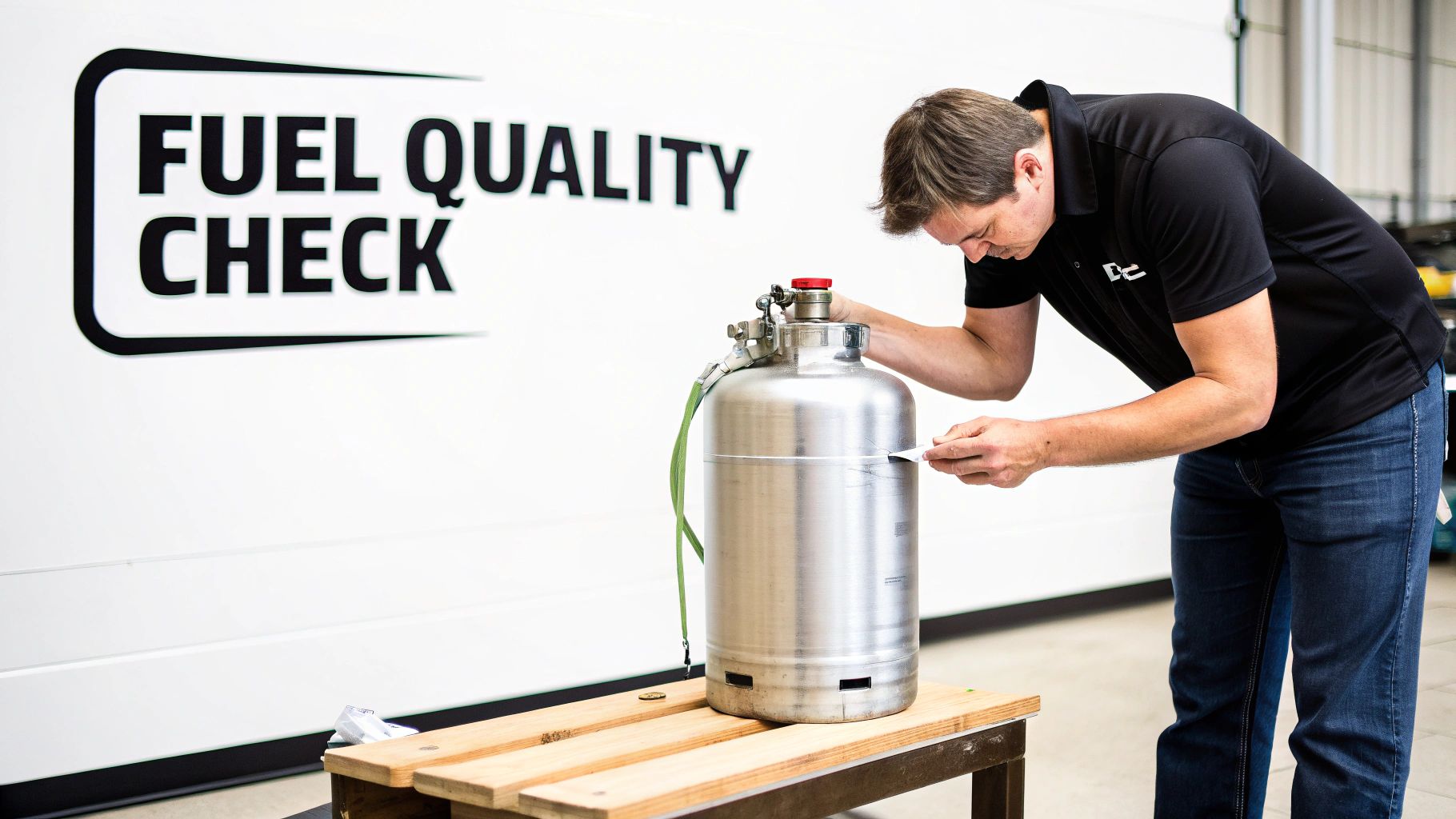
At its heart, gas analysis is about knowing exactly what you're feeding your system. It’s like a chef carefully tasting every single ingredient before a big dinner service—it’s not about just checking a box, but about proactively protecting your assets and keeping things running smoothly.
For a project manager on a new construction site, bad gas quality could mean failing a crucial inspection, which holds up occupancy permits and racks up huge costs. For a facility operator, it could lead to the slow, silent breakdown of expensive machinery, causing surprise downtime and even bigger repair bills down the road.
The Role in Project Success
Proper analysis confirms that the fuel's makeup meets the precise specs your equipment needs, whether you're using it for temporary heating, commissioning a generator, or running an industrial process. Without this check, you're rolling the dice on your operational integrity. This process verifies the gas has the right energy content and is clean from damaging contaminants.
Here’s what a thorough gas analysis brings to the table:
- Protects Your Equipment: It identifies harmful substances and confirms fuel compatibility, preventing issues like corrosion, engine knocking, and poor performance.
- Keeps People Safe: It detects dangerous components like Hydrogen Sulfide (H2S), which can be a serious risk to your team and infrastructure.
- Ensures Compliance: It guarantees the gas meets all the regulatory and industry standards needed to get your project commissioned and operational.
- Prevents Costly Delays: It helps you sidestep the expensive setbacks from equipment failures or failed inspections, keeping your project on track and on budget.
Navigating Supply Chain Volatility
The need for dependable fuel quality is more critical than ever. With global natural gas demand hitting a record 4,122 billion cubic meters (bcm), permanent pipeline availability can be unpredictable. This is especially true for businesses like construction firms and industrial facilities in the U.S. Southeast, making mobile CNG and LNG solutions essential for keeping operations going.
In states like North Carolina and Virginia, where 45% of U.S. homes rely on gas for heating, temporary mobile units from providers like Blue Gas Express are what allow projects to meet occupancy permits without grinding to a halt. You can read more about these market trends and their impact on the energy sector.
Ultimately, a detailed gas analysis provides peace of mind. It's the proof you need that the fuel arriving on-site is exactly what your operation needs to succeed.
What a Gas Quality Report Actually Tells You
Think of a gas analysis report as the spec sheet for your fuel. It's not just a bunch of numbers; it's a detailed breakdown that tells you everything you need to know about the fuel's performance, efficiency, and—most importantly—safety. This report shows you exactly what’s in your gas and predicts how it will behave in your equipment, helping you sidestep expensive damage and operational nightmares.
You wouldn’t put diesel in a gasoline engine, right? The same principle applies here. Feeding a boiler, generator, or industrial process with gas that has the wrong properties can lead to some serious headaches. Let’s look at the key quality indicators, which really fall into two buckets: performance metrics and harmful contaminants.
H3: Key Performance Indicators
These are the numbers that define the energy potential and compatibility of your fuel. Getting them right is the key to making sure your equipment runs at its best without putting unnecessary stress on the system.
Calorific Value (CV): This is the big one. Calorific value simply measures how much energy is packed into a certain volume of gas. A higher CV means you get more bang for your buck, while a lower CV means your equipment has to burn more fuel to do the same job, driving up costs.
Wobbe Index: You can think of this as a "compatibility score." The Wobbe Index is crucial for ensuring you can swap between different gas sources without messing up your equipment's performance. If two gases have the same Wobbe Index, they’ll deliver the same amount of energy, which keeps flames stable and your operations running smoothly.
Methane Number (MN): For anyone running natural gas engines, this is a non-negotiable metric. The Methane Number rates the fuel's resistance to "knocking"—that destructive rattling you hear when fuel ignites too early. A higher MN means better protection for your engine against damaging vibrations and long-term wear.
A low Methane Number is a direct threat to engine health. It’s like using low-octane fuel in a high-performance car; you risk significant mechanical damage that could have been easily prevented with a proper gas analysis.
H3: Tackling Harmful Contaminants
Just as important as what's in your gas is what isn't. Contaminants are the silent killers that can degrade equipment, create major safety hazards, and tank your overall efficiency. A good gas analysis is your first line of defense.
Hydrogen Sulfide (H2S): This is nasty stuff. H2S is a highly corrosive compound that smells like rotten eggs, and even tiny amounts can eat away at pipes, valves, and engine parts, leading to leaks and failures. It’s also a serious safety risk for your team.
Moisture (Water Vapor): Water in your gas lines is a huge problem, especially when it gets cold. It can freeze and form solid chunks called hydrates, creating blockages in pipelines that can bring your entire operation to a halt. Moisture also kicks corrosion into overdrive when mixed with H2S or CO2.
Oxygen (O2) and Carbon Dioxide (CO2): These are often called "inerts" because they don't combust. They essentially dilute your fuel, lowering its Calorific Value and making your system work harder for the same output. Oxygen also significantly increases the risk of corrosion inside your pipes and tanks.
To help you keep these straight, here’s a quick summary of the most important metrics we've covered.
Key Gas Quality Parameters at a Glance
| Parameter | What It Measures | Why It Matters for Your Project |
|---|---|---|
| Calorific Value (CV) | The energy content per volume of gas. | Determines fuel efficiency and operational cost. Higher is better. |
| Wobbe Index | The interchangeability of different fuel gases. | Ensures consistent performance and flame stability when switching gas sources. |
| Methane Number (MN) | The gas's resistance to engine knocking. | Prevents engine damage, reduces maintenance, and extends equipment life. |
| Hydrogen Sulfide (H2S) | The concentration of this corrosive contaminant. | Protects equipment from corrosion and ensures personnel safety. |
| Moisture (H2O) | The amount of water vapor in the gas. | Prevents pipeline blockages from freezing and reduces internal corrosion. |
| O2 / CO2 | The concentration of non-combustible "inert" gases. | A lower concentration means higher fuel quality and better efficiency. |
Having a solid grasp of these parameters is what separates a smooth-running project from one plagued by constant issues.
A deep understanding of gas composition is also essential for environmental compliance; for instance, detailed gas analysis is needed to support initiatives funded by the Greenhouse Gas Reduction Fund.
This kind of detailed knowledge becomes absolutely critical when supply chains are under pressure. U.S. natural gas consumption is projected to climb to a record 91.4 billion cubic feet per day (Bcf/d), with winter demand pushing existing infrastructure to its absolute limit. For industrial facilities and construction companies in Tennessee and South Carolina, these numbers really highlight the risk of relying only on permanent pipelines. When delays or interruptions happen, a mobile LNG or CNG delivery—with its quality verified upfront—becomes the lifeline that keeps your project on track. You can read more about how demand impacts energy supply chains.
By decoding these parameters, a gas analysis report goes from being a simple list of numbers to a powerful strategic tool. It gives you the power to verify your fuel quality, protect your most valuable assets, and make sure your operations run exactly as they should.
Essential Tools and Methods for Gas Analysis
To get a clear picture of what’s really inside your gas supply, you need the right tools and a rock-solid process. A proper gas analysis isn’t a one-size-fits-all job; the method you choose depends entirely on whether you need a quick spot-check in the field or a deep, detailed breakdown in a laboratory.
The goal, however, is always the same: get accurate, reliable data that you can actually act on.
Think of it like a mechanic's toolkit. Sometimes, all you need is a simple diagnostic tool to get a fast answer on the spot. Other times, you need to bring the engine into the shop and take it apart for a full inspection. Each approach has its place, and knowing which one to use is the secret to effective gas quality control.
This concept map breaks down gas quality into three essential pillars: Performance, Purity, and Safety.
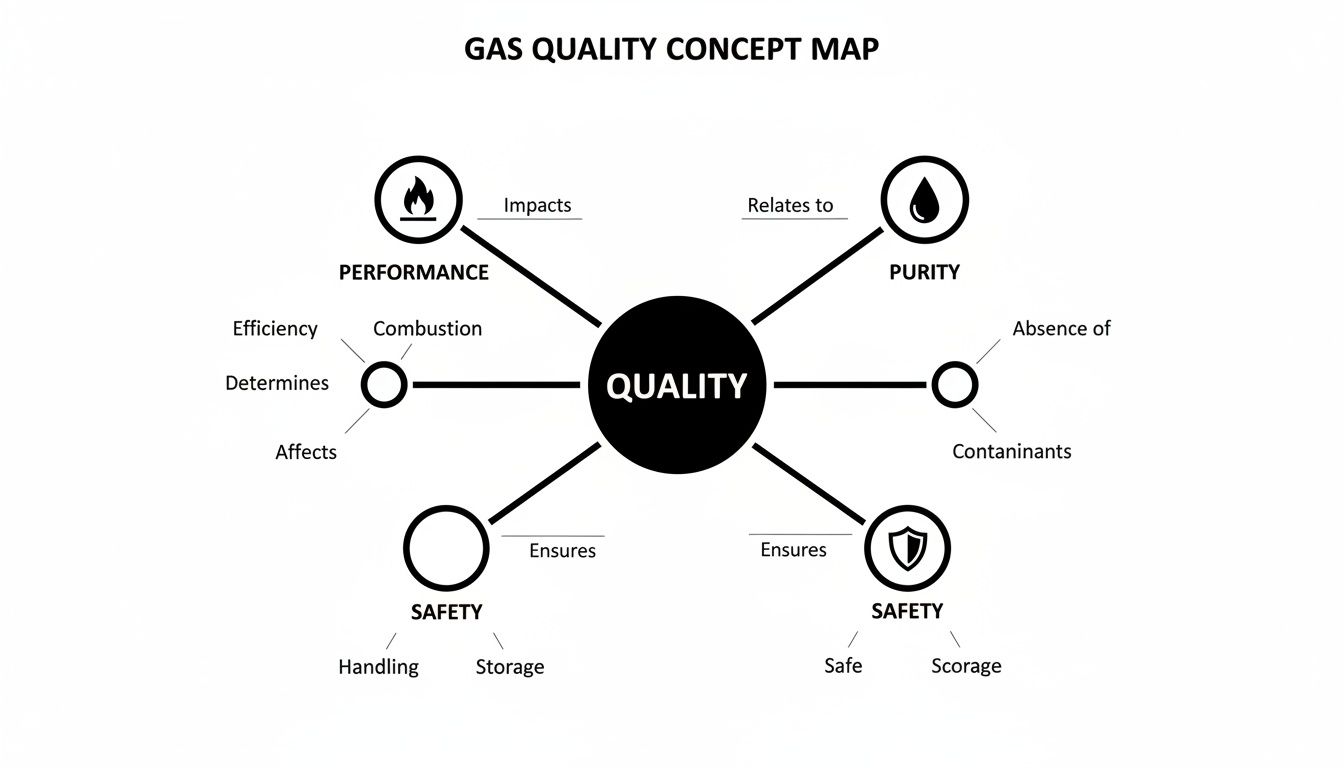
This visual shows how a truly complete gas analysis has to cover all three areas. From energy output and efficiency to contaminant removal, you need the full picture to run a reliable and safe operation.
Gas Chromatography: The Forensic Investigation
When you absolutely need the highest level of precision, Gas Chromatography (GC) is the undisputed gold standard. Think of it as a forensic investigation for your fuel source.
Inside a controlled lab, a GC instrument takes a small, precise sample of gas and meticulously separates it into its individual components—methane, ethane, propane, nitrogen, and any trace contaminants that might be hiding in the mix. The machine sends the gas through a long, thin tube (called a "column"), and since different gas molecules travel through it at different speeds, it can identify and measure the exact concentration of each one.
Gas Chromatography gives you the definitive data needed to calculate critical parameters like Calorific Value and Wobbe Index with pinpoint accuracy. It's the go-to method for contractual compliance and deep-dive troubleshooting.
Portable Gas Analyzers: Your On-Site Toolkit
While GC offers unmatched detail, it’s not exactly practical for quick, on-the-spot checks in the field. That’s where portable gas analyzers shine. These handheld devices are like a technician's multimeter, giving you real-time readings for specific components right at the worksite.
These analyzers are absolutely essential for:
- Safety Checks: Instantly detecting dangerous levels of contaminants like Hydrogen Sulfide (H2S) or dangerously low oxygen levels.
- Process Monitoring: Quickly verifying that gas composition is within operational limits during a commissioning job or routine maintenance.
- Initial Screening: Flagging potential issues that might signal the need for a more detailed lab analysis down the line.
They use a variety of sensor technologies to deliver results in seconds, making them an indispensable tool for any field operator who needs immediate answers to keep things safe and efficient.
The Critical Role of Proper Gas Sampling
Here’s the thing: the most advanced analyzer in the world is completely useless if the sample it’s testing is flawed. There’s an old saying in the industry that couldn't be more true: "the analysis is only as good as the sample."
A contaminated or unrepresentative sample guarantees a bad result, which can lead you to make incorrect decisions that damage expensive equipment or compromise safety. This is especially true when dealing with fuels like compressed natural gas, where methane content and impurities are under a microscope.
Proper sampling isn’t just about filling up a cylinder; it’s a careful, deliberate procedure designed to capture a sample that truly represents the gas flowing through the pipeline at that moment.
To make sure your sample is accurate, stick to these best practices:
- Purge the System: Always flush the sample cylinder and all connecting lines with the source gas. This gets rid of any lingering air, moisture, or old gas from a previous sample.
- Use the Right Cylinder: The sample cylinder should be made of a non-reactive material (stainless steel is common) and be perfectly clean and free of contaminants.
- Sample from the Right Location: Take your sample from a point where the gas is well-mixed. This usually means using a probe to pull from the middle third of the pipe's diameter, not from the wall.
- Control the Flow Rate: Fill the cylinder slowly and steadily. Rushing it can cause heavier hydrocarbons to condense into liquids, which would completely skew the results.
By mastering these fundamental methods and sticking to strict sampling protocols, you can be confident that your gas analysis provides a true, actionable reflection of your fuel quality.
How to Make Sense of Your Gas Analysis Report
Getting a gas analysis report back can be intimidating. It's often just a dense page of numbers, acronyms, and technical terms that looks more like a secret code than a useful document. But this report is your project’s health check-up, and learning to read it is one of the most powerful things you can do to protect your equipment, keep your team safe, and keep things running smoothly.
Think of it this way: the report tells the story of your fuel. It translates complex chemistry into practical insights, giving you a heads-up on potential problems long before they lead to expensive downtime or a full-blown shutdown. Understanding what those numbers really mean allows you to stop reacting to problems and start preventing them.
It's a critical shift in mindset. Instead of just filing the report away to prove you did your due diligence, you can use it to answer some very important questions about your project's health and efficiency.
Connecting the Data to Your Day-to-Day Operations
The real value of a gas analysis report is in connecting the numbers on the page to what’s actually happening out in the field. Let's walk through a couple of common scenarios to see how a single line item can signal a major risk or opportunity for your project.
Scenario 1: The Hydrogen Sulfide (H2S) Red Flag
Your report comes back showing H2S levels at 20 ppm (parts per million). That sounds like a tiny, insignificant number, right? Wrong. It’s a huge red flag. Hydrogen sulfide is incredibly corrosive, and even at these low concentrations, it’s silently eating away at your metal pipes, engine parts, and regulator seals. This one number is telling you that your equipment is on a fast track to premature failure and, even worse, potential leaks—a serious safety hazard.Scenario 2: The Wobbe Index Mismatch
Let’s say your boiler is spec'd for gas with a Wobbe Index of 1350, but the report for your latest delivery shows it's only 1280. This gap means the gas has less energy content than your equipment is expecting. The immediate effect? You'll likely see an unstable flame, inefficient heating, and a lot of soot buildup. Over the long haul, this forces your boiler to work harder than it should, driving up fuel costs and setting the stage for an expensive breakdown.
These examples show how a single data point can be a crystal ball, predicting future operational headaches. The report gives you the foresight to act before a small issue spirals into a crisis.
Turning Raw Numbers into Smart Decisions
A solid gas analysis does more than just tick a compliance box; it gives project managers the hard evidence they need to make crucial calls, especially when fuel supply can be a moving target.
For example, while North American natural gas production is booming, it also creates regional bottlenecks. We see this firsthand with our construction and industrial clients in Virginia and the Carolinas. When a cold snap hits, pipeline capacity gets strained, making mobile CNG/LNG a lifeline. When U.S. weekly demand suddenly jumps 7.3% and residential use spikes 24.4%, you can bet industrial users feel the squeeze. For a deeper dive, it's worth reading about how global gas markets are being reshaped.
A gas analysis report is your quality guarantee. It’s the definitive proof that the fuel being delivered—whether from a pipeline or a mobile unit—meets the exact specifications required to keep your project safe, compliant, and efficient.
By learning to interpret these reports, you turn a technical document into your project's early warning system. It helps you confirm you got what you paid for, ensures the fuel is compatible with your expensive equipment, and, most importantly, helps maintain a safe site for your team. It all comes down to making smarter, data-driven decisions that protect your timeline and your bottom line.
Troubleshooting Common Issues with Gas Analysis
A gas analysis report is far more than just a page of numbers. Think of it as a direct line to the health of your entire operation. When you can connect the data on that report to what's happening with your equipment, you shift from reacting to problems to actively preventing them.
This skill turns a routine compliance check into a powerful diagnostic tool. It helps you pinpoint the root cause of common issues, letting you take action before they escalate into costly downtime or equipment damage.
Linking Equipment Problems to Your Gas Report
Let’s walk through a few real-world scenarios. We'll connect common operational headaches directly to the data you'd find in a typical gas analysis.
Problem 1: An Unstable or Yellow Burner Flame
You walk by a boiler or temporary heater and notice the flame looks wrong. Instead of a strong, steady blue cone, it's sputtering, lifting off the burner, or burning a lazy, weak yellow. This isn't just inefficient; it's a clear sign of poor combustion.
- What Your Gas Report Might Show: A low Wobbe Index is the prime suspect. You might also see unusually high levels of inert gases like Carbon Dioxide (CO2).
- What to Do Next: Call your fuel provider immediately. This data tells you the gas doesn't have the energy content your equipment was built for. The fuel supply is "thin," and it needs to be corrected to match your system’s specifications before it causes further issues.
Problem 2: Poor Engine Performance or "Knocking"
Your natural gas engine or generator is running rough. Maybe it’s vibrating more than usual, or you hear that unmistakable "knocking" or "pinging" sound under load. This is a serious red flag that can lead to catastrophic mechanical damage.
- What Your Gas Report Might Show: The Methane Number (MN) is below the engine manufacturer's minimum requirement.
- What to Do Next: Shut the engine down if you can. You need to secure a new gas supply with a higher Methane Number. Pushing an engine with the wrong MN is like putting low-octane fuel in a high-performance car—you risk destroying pistons and cylinder heads, leading to an incredibly expensive overhaul.
Diagnosing Hidden Threats with Gas Data
Sometimes, the most dangerous problems are the ones you can't see or hear. This is where gas analysis really shines, uncovering silent threats that can destroy your infrastructure from the inside out.
Problem 3: Signs of Corrosion on Pipes and Components
You're doing a routine inspection and find unexpected rust or pitting on the inside of pipes, valves, or regulators. It's a clear signal that something is actively eating away at your system.
- What Your Gas Report Might Show: Elevated levels of Hydrogen Sulfide (H2S) or high Moisture (H2O) content. When you mix the two, you get a highly corrosive acidic environment.
- What to Do Next: You have to play detective and trace the contamination source. Is the H2S coming from the gas supply itself? You'll need a cleaner source. Is it moisture? Your system's dehydration units might be failing and need immediate attention.
Think of your gas analysis report as an X-ray for your fuel lines. It reveals hidden fractures and stressors—like corrosion from H2S—long before they become catastrophic failures, allowing you to perform preventative maintenance instead of emergency repairs.
To help you quickly connect the dots, we've put together a simple troubleshooting table.
This chart is a great starting point for translating a problem you see in the field to a potential cause you'll find in your gas quality report.
Common Issues and Their Gas Analysis Indicators
| Observed Problem | Potential Indicator in Gas Analysis | Next Steps to Investigate |
|---|---|---|
| Yellow, Unstable Flame | Low Wobbe Index, High Inert Gases (CO2, N2) | Verify fuel source meets equipment specs. |
| Engine Knocking/Vibration | Low Methane Number (MN) | Switch to a fuel with a higher MN rating. |
| Internal Pipe Corrosion | High Hydrogen Sulfide (H2S), High Moisture | Check gas source and inspect dehydration systems. |
| Pipeline Freezing/Blockages | High Moisture Content (H2O) | Improve gas drying process before it enters the system. |
By treating your gas analysis report as a practical troubleshooting roadmap, you can diagnose issues faster, protect your valuable assets, and keep your operations running safely and efficiently.
When to Bring in a Mobile Gas Supplier

Knowing your gas quality specs is crucial, but what happens when you can't get that gas to your site? While permanent pipelines are the go-to for long-term supply, there are plenty of times during a project when they’re simply not available. This is exactly where a mobile gas supplier proves its worth, becoming more than just a temporary fill-in.
Think of them as the logistical bridge between your project’s immediate energy needs and a permanent gas connection that’s not quite ready. For project managers, this service is a lifesaver, helping you navigate frustrating delays and planned shutdowns without grinding everything to a halt. It’s all about keeping control of your schedule, no matter what’s happening with the grid.
Common Triggers for a Mobile Gas Solution
So, when do you make the call? Knowing the right time to bring in a mobile provider can mean the difference between keeping a project on track and dealing with some very expensive downtime.
More often than not, it comes down to a critical need for fuel when the permanent infrastructure is delayed, taken offline for maintenance, or just hasn't been built yet.
Here are the most common scenarios we see:
Pipeline Construction Delays: This is a classic. Your building is finished, but the gas line hookup is weeks—or months—behind schedule. A mobile unit from a provider like Blue Gas Express can be brought in quickly, providing fuel for temporary heat so you can hit occupancy permit deadlines and stop pipes from freezing.
Planned Utility Shutdowns: The local utility has to take a section of the main pipeline offline for repairs or upgrades. Instead of shutting down your entire operation, a mobile supply acts as a seamless "fuel bridge," keeping you running without a hitch.
Commissioning New Equipment: You have brand-new gas-powered equipment—maybe a generator or an industrial boiler—that needs to be tested before the permanent gas lines are live. Mobile delivery gives you the fuel you need to run those critical startup procedures and sign off on the installation.
It’s Not Just Fuel, It’s Verified Quality
The real advantage of working with a professional mobile gas supplier goes way beyond just getting a truck to show up. It’s about getting a temporary supply that comes with a full analysis of gas, guaranteeing it’s the right stuff for your equipment. This is where all the technical details we’ve covered, from Calorific Value to contaminant levels, become critically important.
A mobile supplier doesn't just deliver gas; they deliver peace of mind. Their service includes a certified analysis confirming the fuel meets every performance and safety standard, ensuring a seamless transition and protecting your valuable equipment from the risks of unknown or off-spec fuel.
Ultimately, this partnership takes the guesswork out of the equation. You get a guaranteed supply of high-quality, compatible fuel exactly when you need it, letting you sidestep operational setbacks and keep your project moving forward safely.
Your Top Gas Analysis Questions, Answered
Even when you understand the 'what' and 'why' of gas analysis, practical questions always come up. Let's tackle some of the most common ones we hear from folks in the field, moving from theory to real-world application.
Think of this as your go-to reference for making smart, informed decisions that protect your equipment and keep your project on the right path.
How Often Should I Be Testing My Gas?
This is a great question, but there's no single, one-size-fits-all answer. The right testing frequency really hinges on your specific operation and what's at stake.
Here’s a good way to think about it:
- Critical Industrial Processes: If a shutdown means major financial losses, you'll want to lean towards continuous or at least daily monitoring. You simply can't afford any surprises.
- Commissioning New Equipment: Before you fire up that brand-new engine or turbine, a single, thorough analysis is essential. This is your chance to confirm the fuel meets the manufacturer's exact specs from day one.
- After Major Maintenance: Any time you've had the system apart or notice a change in how your equipment is running, it's smart to re-test. It’s a simple way to rule out fuel quality as the source of a new problem.
Keep in mind, a reliable mobile gas supplier will perform a rigorous analysis of gas on every single load. You should expect to receive a certificate of quality with each delivery, no exceptions.
What's the Real Difference Between Testing On-Site vs. Sending a Sample to a Lab?
Choosing between a field test and a full lab analysis is all about balancing speed with depth. Each has its place, and they often work together.
On-site analysis with a portable analyzer gives you immediate, real-time data on critical parameters like O2 and H2S. It's perfect for quick safety checks or verifying that a system is clear before starting work. Think of it as a quick, vital snapshot.
A laboratory analysis using a gas chromatograph (GC), on the other hand, is the deep dive. It meticulously separates and measures every component, giving you the precise data needed to calculate exact heating values and confirm you’re meeting strict contractual or warranty requirements. Many operations use both: a quick field test for immediate assurance, followed by a lab analysis for the official record.
Can "Bad" Gas Actually Damage My Equipment?
Yes, without a doubt. This isn't just a minor issue; ignoring gas quality is one of the fastest ways to destroy expensive, mission-critical assets.
Contaminants like Hydrogen Sulfide (H2S) and moisture are incredibly corrosive. Over time, they will eat away at pipes, regulators, and engine components, leading to expensive, premature failures. And if your gas has a low Methane Number, it can cause a destructive "knocking" in natural gas engines, which is just as damaging as it sounds.
It’s not just about corrosion, either. An incorrect heating value can throw off your entire combustion process, leading to inefficiency, soot buildup, and a drastically shorter lifespan for your burners. A proper gas analysis is one of the most powerful forms of preventative maintenance you can invest in.
When a pipeline interruption or scheduled maintenance puts your project on hold, don't gamble with your fuel quality. Blue Gas Express delivers verified, on-spec CNG and LNG to keep your operations running smoothly, safely, and efficiently. Visit https://bluegasexpress.com to secure a temporary fuel supply that you can count on.