

When you hear "natural gas," you might think of heating your home or cooking dinner. But what if that same reliable energy source could power a fleet of trucks or run heavy-duty industrial equipment? That's exactly what natural gas fueling is all about—using a cleaner, more affordable, and domestically sourced fuel as a powerful alternative to diesel and gasoline.
It's not some futuristic concept; it's a proven technology that's already cutting emissions and operational costs for businesses today.
The Foundation of Natural Gas Fueling
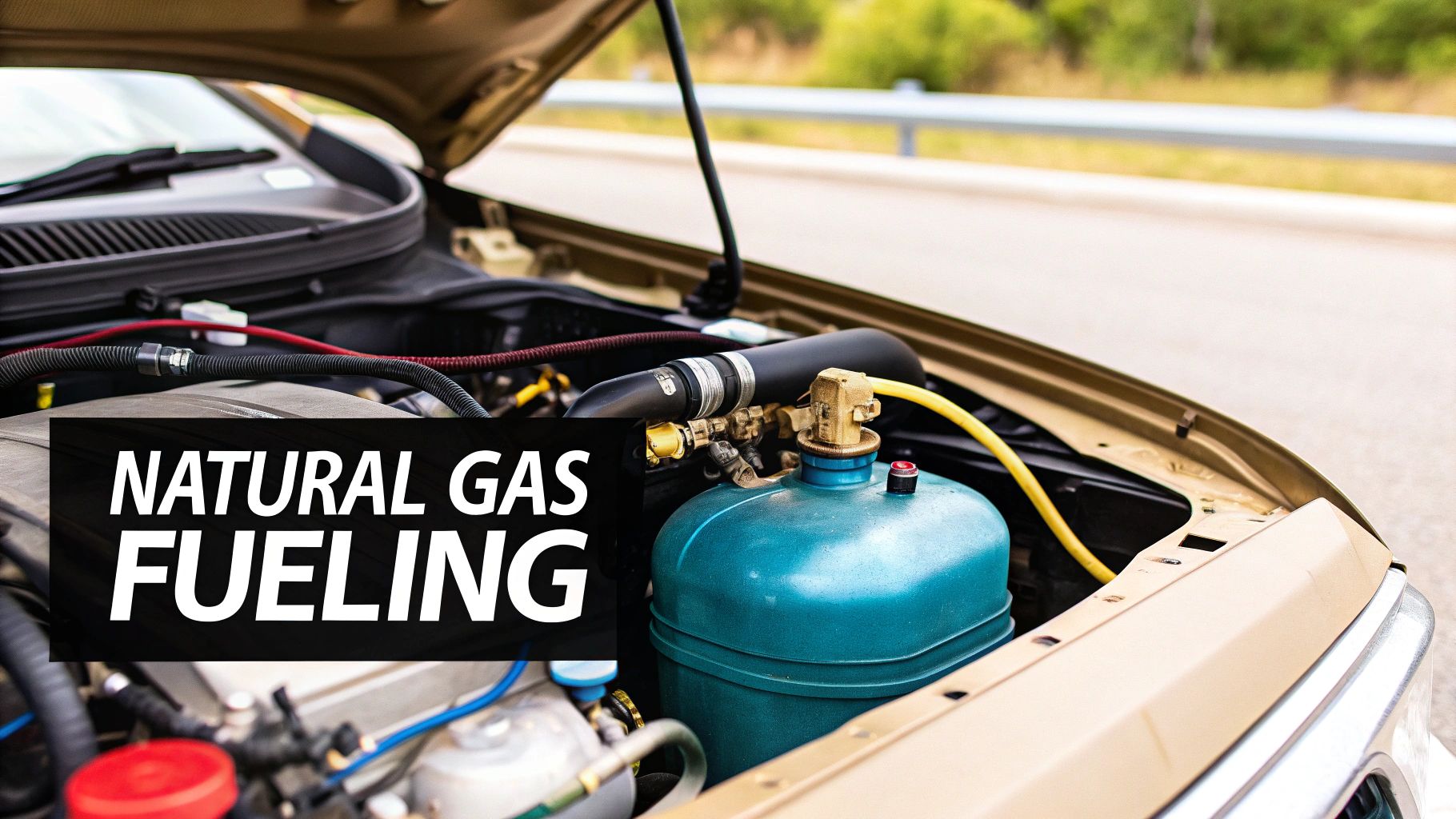
So, how does it work? At its heart, natural gas fueling is about adapting standard internal combustion engines to run on methane, which is the main ingredient in natural gas.
Picture a big-rig truck. Instead of a tank full of liquid diesel, it has a specialized fuel system designed to safely handle natural gas, either in a compressed or a super-chilled liquid state. The engine burns this gas just as efficiently as it would diesel, but the whole process is much cleaner.
Think of it like swapping out charcoal for propane on a barbecue grill. You're using a different fuel to do the same job, but the result is cleaner, more controlled, and often cheaper. This isn't just an idea on a drawing board; it's actively powering fleets and industries all over the world.
Why It Matters More Than Ever
The move toward natural gas isn't just a trend; it's a practical response to very real economic and environmental challenges. Fuel prices are a constant rollercoaster, and emissions regulations are only getting tighter. For millions of businesses, energy is a huge operating expense, and natural gas provides a stable and often much cheaper path forward.
Here’s what’s driving the shift:
- Cost Savings: Natural gas is consistently less expensive than diesel or gasoline. Over the last ten years, companies that switched have collectively saved hundreds of billions of dollars on fuel costs.
- Environmental Responsibility: It's simply a cleaner fuel. Natural gas engines produce far fewer harmful pollutants like nitrogen oxides and particulate matter (the soot you see from diesel trucks), not to mention fewer greenhouse gases.
- Energy Independence: Most natural gas is produced right here in North America. This reduces our dependence on foreign oil, leading to a more secure and stable energy supply chain for everyone.
- Operational Reliability: The infrastructure behind natural gas is incredibly robust. While the average electric customer sees an outage once a year, only about one in 650 natural gas customers experiences a service interruption.
By providing a cleaner, more affordable, and reliable energy source, natural gas fueling empowers businesses to meet sustainability goals without sacrificing performance or profitability.
A Practical Alternative for Modern Needs
The uses for natural gas fueling are incredibly broad and continue to expand. You'll find it in city buses running quieter routes, long-haul trucks crossing the country with a smaller carbon footprint, and even industrial sites that need uninterrupted power for manufacturing plants or data centers.
It’s the same logic that leads 87% of full-service restaurants to rely on natural gas for cooking—it delivers consistent, controllable heat at a low cost. When applied to transportation and industry, those same benefits of reliability and affordability really shine.
As we dive into the two main forms of natural gas fuel—Compressed (CNG) and Liquefied (LNG)—you’ll see just how this versatile resource can be adapted to fit very specific needs.
Choosing Between CNG and LNG Fueling
When you start looking into natural gas for fuel, one of the first big questions is: CNG or LNG? They both start as the same raw material, but how they’re processed and stored makes a world of difference. Each has its sweet spot, and picking the right one really boils down to what you need it to do.
Think of Compressed Natural Gas (CNG) like a scuba tank. The gas stays gas, but it's squeezed under intense pressure—around 3,600 psi—to pack as much as possible into a tough, heavy-duty tank. It's a proven, straightforward approach.
On the other hand, Liquefied Natural Gas (LNG) is more like turning a room full of steam back into a cup of water. The gas is chilled to a bone-deep cold of -260°F (-162°C), which transforms it into a super-dense liquid. This clever trick lets you store an incredible amount of energy in a much smaller, insulated tank.
Understanding CNG Fueling
CNG is the veteran of the two, especially for vehicles that stick to city or regional routes. The fueling infrastructure is more built out, and the technology itself is less complex. This makes it a really common first step for businesses moving away from diesel.
The "scuba tank" idea works well here. Because the gas is still a gas, it just takes up more physical space than LNG for the same amount of energy. That makes CNG a perfect fit for vehicles that run predictable, shorter routes and can head back to a central depot to refuel every night.
A few key things to know about CNG:
- Onboard Storage: Requires heavy, high-pressure cylindrical tanks.
- Fueling Time: It’s fast. Refueling usually takes just 5-10 minutes, which feels a lot like a normal trip to the gas pump.
- Best Use Cases: Ideal for city buses, garbage trucks, delivery vans, and other fleets that return to base.
The Power of LNG Fueling
LNG is all about energy density. It's the heavy hitter for demanding jobs that need serious range. By liquefying the gas, its volume shrinks by a factor of over 600. You're essentially concentrating a massive amount of power into a lighter, more compact tank.
This is why LNG is the undisputed champ for applications where range and weight are everything. A long-haul truck can cruise for 800 miles or more on a single tank of LNG—something a CNG truck just can't do. Its high energy density has also made it a top alternative fuel for powering massive cargo ships and ferries in the maritime industry.
LNG provides the energy density needed for demanding, long-distance operations, effectively bridging the performance gap between traditional diesel and cleaner natural gas fueling solutions.
This infographic breaks down the comparison visually, showing where each fuel shines.

As you can see, LNG packs more than double the punch for the same amount of space. It’s a clear trade-off: you get incredible range, but the fueling process takes a bit longer.
CNG vs LNG At a Glance
To lay it all out clearly, this table puts the two options head-to-head. Seeing the differences side-by-side helps pinpoint which fuel makes the most sense for different jobs.
| Feature | Compressed Natural Gas (CNG) | Liquefied Natural Gas (LNG) |
|---|---|---|
| Physical State | Gaseous, stored under high pressure | Liquid, stored at cryogenic temperatures |
| Energy Density | Lower (~9 MJ/L) | Higher (~22 MJ/L), about 2.4x more energy |
| Storage Tanks | Heavy, cylindrical, high-pressure steel or composite tanks | Lighter, insulated, thermos-like cryogenic tanks |
| Vehicle Range | Shorter; great for routes under 400 miles | Longer; built for routes of 600 miles or more |
| Fueling Time | Fast; typically 5-10 minutes | Slower; typically 10-15 minutes due to cryogenic transfer |
| Ideal Fleet | Urban & regional fleets (buses, refuse trucks, delivery) | Long-haul trucking, marine vessels, railroad, and mining |
| Infrastructure | More widely available and less complex to build | Requires specialized cryogenic equipment for production/storage |
In the end, the choice between CNG and LNG really comes down to your day-to-day reality. If your fleet sticks to predictable local routes and comes home every night, the speed and simplicity of CNG are tough to argue with. But if your business is built on long hauls and maximizing every pound of payload, the superior energy density of LNG is the only way to go.
The Real Benefits of Switching to Natural Gas

Moving to natural gas isn't just a small operational tweak; it's a smart business move with some serious upsides. The benefits show up everywhere—from your company's bottom line and environmental goals to the way you run your daily operations. It really builds a strong case for leaving traditional fuels like diesel and gasoline behind.
The most obvious win is the cost. Natural gas is almost always a more affordable fuel. It’s a bit like buying your energy wholesale instead of at retail prices—the cost per unit of energy is just lower, which adds up to huge savings over the long haul. For many businesses, this isn't just pocket change; it can completely reshape their operating budget.
Think about a logistics company with a fleet of long-haul trucks. Fuel is easily one of their biggest and most unpredictable expenses. Making the switch to LNG or CNG can dramatically cut that cost, turning a major headache into a real competitive advantage. Those savings can then be put back into the business, whether that means upgrading the fleet, giving out employee bonuses, or expanding into new markets.
A Cleaner Footprint and Healthier Communities
Beyond the numbers on a spreadsheet, the environmental perks of natural gas are substantial. It’s the cleanest-burning fossil fuel out there, which means it releases far fewer harmful emissions than diesel or gasoline when it's burned.
This has a direct, positive impact on air quality. A fleet of city buses running on CNG, for instance, pumps out significantly less particulate matter—that nasty soot that causes smog and respiratory problems.
- Greenhouse Gas Reduction: Natural gas engines can cut CO2 emissions by up to 25% compared to diesel engines.
- Cleaner Air: Nitrogen oxide (NOx) emissions, a primary cause of smog and acid rain, are slashed by as much as 90%.
- Less Soot: Particulate matter is practically eliminated, which is a massive win for public health in cities.
By dramatically lowering harmful emissions, natural gas fueling gives companies a clear path to meeting tougher environmental regulations and showing a genuine commitment to sustainability.
This goes beyond just checking a compliance box. It’s about being a better community member. Quieter engines and cleaner exhaust create a more pleasant environment for everyone, from people walking down a city street to employees working on an industrial site.
Enhancing Operational Performance
The benefits of natural gas also boost efficiency and reliability. One of the biggest advantages is the price stability that comes from using a fuel that’s abundant right here at home. The United States has massive reserves of natural gas, which helps shield users from the wild price swings and supply chain issues that often plague the global oil market.
This domestic supply is a major reason why more and more industries are adopting it. In fact, U.S. natural gas consumption hit a record 126.8 billion cubic feet per day in January 2025, driven by demand from homes and businesses alike. This just goes to show how robust the infrastructure and supply are. You can dig into more U.S. natural gas trends from the Energy Information Administration.
On top of that, natural gas engines often need less maintenance. Because the fuel burns so cleanly, it doesn’t leave as much carbon gunk on engine parts. This translates to less wear and tear on spark plugs, injectors, and exhaust systems, leading to longer times between service and less downtime for your essential equipment. A truck that’s on the road making money instead of sitting in the shop is always a better asset.
How Industries Are Putting Natural Gas to Work
The real power of natural gas fueling isn't just theory—it's what happens when the rubber meets the road. Across all sorts of industries, it’s being used to solve real, everyday problems, from powering fleets in crowded cities to running equipment at remote job sites. It’s more than just another fuel; it’s a flexible solution that helps businesses cut costs, run cleaner, and stay competitive.
Take long-haul trucking, for example. For companies shipping goods across the country, fuel is one of the biggest and most unpredictable expenses. This is where Liquefied Natural Gas (LNG) shines. Because it’s so energy-dense, a semi-truck running on LNG can travel 800 miles or more on a single tank, which is right up there with diesel. Fleets can keep their cross-country schedules without missing a beat, all while saving a bundle on fuel and cutting down on emissions.
In cities, it’s a different story, and that’s where Compressed Natural Gas (CNG) comes in. Public transit systems are swapping out their old diesel buses for cleaner CNG models to tackle urban pollution head-on. These buses are quieter and release far fewer pollutants, which means better air quality and less noise for everyone. Since city buses run predictable routes and head back to a central depot every night, the shorter range and quick refueling of CNG fit their operations perfectly.
Powering Operations on Land and Sea
The flexibility of natural gas doesn't stop with trucks and buses. The marine industry, for instance, is under massive pressure to clean up its act. LNG has become the fuel of choice for many modern cargo ships, ferries, and tankers. It helps these huge vessels meet tough international rules on sulfur and nitrogen oxide emissions, so they can navigate protected waters without facing steep penalties.
You'll also find natural gas at work in some pretty specialized fields. Think about remote mining and drilling sites, often miles from the nearest power line. They need a steady, reliable source of energy to run heavy machinery and keep the lights on. Mobile natural gas fueling units can be trucked directly to these locations, providing consistent power without the logistical headache of hauling in massive amounts of diesel.
Whether on the open ocean or at a rugged industrial site, natural gas delivers the clean, reliable, and affordable energy that modern businesses need to thrive.
Even the food service industry has to think about its fuel choices. The decision can really affect the bottom line and kitchen efficiency. To see how this plays out on a smaller scale, you can explore the differences in Natural Gas vs Propane for Commercial Griddles, which shows that picking the right fuel is a critical decision for any business.
A Global Shift Toward Natural Gas
This move toward natural gas isn't just happening here; it's a worldwide trend. Asia, in particular, is quickly becoming a major hub for natural gas use. Projections show the region's demand is set to climb by about 5% each year through 2030. This growth is fueled by rapid industrialization and the enormous energy needs of new technologies. With Asia expected to house more than a third of the world's AI data centers, the demand for reliable power is through the roof.
This global view really drives home just how big of an impact natural gas is having. Here are a few of the key industries where it’s making a difference:
- Long-Haul Trucking: Fleets are switching to LNG for its long range and lower operating costs on cross-country hauls.
- Public Transportation: Cities are converting bus fleets to CNG to cut down on air pollution and noise in urban areas.
- Marine Shipping: Cargo ships and ferries use LNG to meet strict international emissions regulations.
- Waste Management: Garbage trucks are perfect for CNG since they run the same routes every day and return to a central depot.
- Industrial Power: Remote operations like mines and factories rely on natural gas for dependable, off-grid electricity.
In every case, the story is the same: natural gas fueling offers a practical way for industries to operate more cleanly, efficiently, and economically. It’s a solution that’s delivering real results today and helping build a more sustainable energy future.
What Are Mobile Fueling Solutions, Anyway?
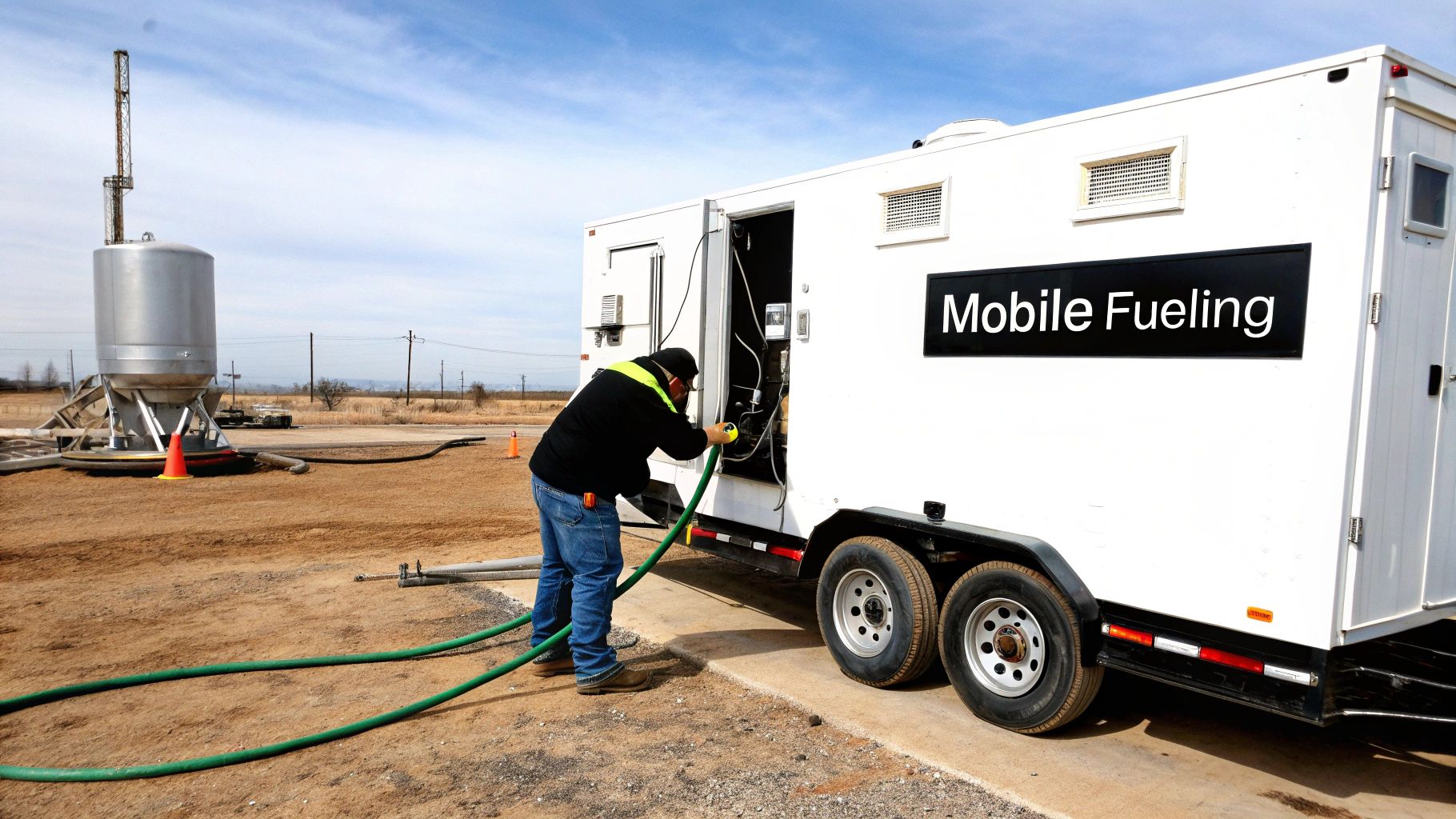
So, what happens when your project is ready to roll but the permanent natural gas pipeline isn't? Or what if a critical supply line needs maintenance, threatening to shut down your entire operation? This is precisely where mobile and temporary fueling solutions come in. They’re a powerful answer that ensures a lack of pipeline access doesn't bring your work to a screeching halt.
This approach creates what we in the industry call a "virtual pipeline." It’s a flexible, on-demand supply chain that uses specialized trucks and trailers to deliver either CNG or LNG directly to you. Think of it like having a gas station brought right to your doorstep, exactly when you need it most.
Frankly, it's more than just a backup plan; it’s a strategic tool that makes clean energy accessible anywhere, anytime.
How a Virtual Pipeline Actually Works
Let's use a real-world example. Imagine a construction site for a new housing development. The homes are built and the heating systems are installed, but the local utility's gas line won't be connected for another six weeks. Without heat, drywall can't be finished, inspections fail, and the whole project grinds to a halt.
Instead of just waiting and losing money, a mobile natural gas fueling provider can step in. They'll bring a specialized trailer filled with compressed natural gas right to the site and hook it up to the main gas meter. That one unit can supply the entire development with the energy it needs to keep everything on schedule.
A virtual pipeline is about much more than just dropping off fuel. It's about providing energy resilience and operational continuity, bridging the gap between available infrastructure and immediate energy demand.
This on-the-go approach is incredibly versatile and solves problems for a lot more than just construction sites.
Key Use Cases for Mobile Fueling
Mobile natural gas fueling offers a practical fix for all sorts of temporary energy challenges. It's become a vital service for industries that can't afford downtime and for fleets looking to test cleaner fuels without a huge upfront investment.
Here are some of the most common situations where it saves the day:
- Pipeline Integrity and Maintenance: When a section of a permanent pipeline needs repairs or inspection, a mobile unit can be brought in to bypass the outage. This keeps the gas flowing to homes and businesses without interruption.
- Remote Industrial Operations: Think about mines, manufacturing plants, or agricultural facilities located miles from the nearest pipeline. Mobile fueling delivers the steady power they need to run heavy machinery and keep production lines moving.
- Fleet Transition and Testing: A company thinking about switching its truck fleet to CNG or LNG can use a temporary fueling station to run a pilot program. This lets them test the real-world performance and efficiency of natural gas vehicles on their actual routes before committing to building a permanent station.
- Emergency and Disaster Response: After a hurricane or other natural disaster, mobile natural gas can be deployed quickly to power hospitals, emergency shelters, and other critical infrastructure when the traditional grid is down.
The Deployment Process, Step by Step
Bringing a mobile fueling solution to your site isn't random; it's a carefully structured process built for safety and efficiency. It usually follows a few clear stages to get you set up for a seamless, reliable supply.
- Initial Assessment and Sizing: First, the provider will work with you to figure out your exact energy needs—how much gas you need (volume), at what pressure, and at what flow rate. This ensures the equipment they bring is a perfect match for the job, whether you're powering a single piece of equipment or an entire facility.
- Logistics and Site Prep: Next, a detailed plan is drawn up for getting the mobile fueling unit to your location. Your site is prepped to make sure there's a safe and stable foundation for the equipment.
- Deployment and Connection: Highly trained technicians deliver the CNG or LNG trailer and connect it to your system. They run a whole battery of safety checks to make sure every connection is secure and operating exactly as it should.
- Supply Management and Monitoring: Once you're up and running, the fuel supply is monitored closely. The provider handles all the logistics of swapping empty trailers for full ones, guaranteeing you have an uninterrupted flow of natural gas for as long as you need it.
This reliable, on-demand service is what makes natural gas fueling a truly viable option, even in the most challenging or remote circumstances.
The Future of Natural Gas in a Changing World
The conversation around energy is always in motion, but natural gas is proving to be far more resilient and forward-thinking than many people realize. It's not just a temporary fix on the road to something else; it's a technology that is evolving, adapting, and weaving in new innovations that are securing its place in a sustainable energy future. It's a story of constant improvement, not just transition.
This evolution is really being pushed forward by some incredible advancements in how the fuel is produced and how engines use it. The biggest game-changer is Renewable Natural Gas (RNG).
RNG is made by capturing methane—a potent greenhouse gas—from organic waste sources like farms, landfills, and even wastewater treatment plants. Instead of just letting this gas escape and harm the atmosphere, we can capture it, clean it up, and turn it into a high-quality fuel.
This approach literally turns a major environmental headache into a powerful energy solution.
The Rise of Renewable Natural Gas
Think of RNG as the ultimate energy recycling program. It takes waste that would otherwise accelerate climate change and transforms it into a clean, dependable fuel. The results are pretty amazing. When used in vehicles, RNG can be carbon-neutral or, in some cases, even carbon-negative. That means it can actually remove more greenhouse gas emissions from the atmosphere than it produces.
- Source Material: It's created from everyday organic waste that we produce constantly.
- Environmental Impact: It directly tackles methane emissions, a greenhouse gas that's 25 times more potent than CO2.
- Compatibility: RNG is chemically the same as conventional natural gas, meaning it works perfectly in any existing CNG or LNG engine with zero changes needed.
By closing the carbon loop, Renewable Natural Gas transforms the entire natural gas fueling ecosystem, offering a clear and immediate path toward decarbonizing heavy-duty transportation and industry.
Technological Leaps and Long-Term Relevance
It’s not just the fuel that’s getting better—the engines are too. Modern natural gas engines are more efficient, powerful, and cleaner than ever before. They now rival diesel performance but with a tiny fraction of the emissions. On top of that, new developments in onboard storage are making CNG and LNG tanks lighter and more compact, which means vehicles can go farther and carry more.
This cycle of continuous improvement is what shores up the long-term role of natural gas. As the world explores different energy paths, it's smart to understand all the tools in the toolbox. For instance, it's helpful to compare the practicalities of natural gas with other alternatives, like the various electric vehicle charging options and their installation costs. Every technology has its sweet spot, and natural gas offers a powerful, scalable solution that's ready for heavy-duty work today.
Global demand backs this up, with consumption projected to reach a record 4,193 billion cubic meters in 2025. This growth is happening because it’s reliable and affordable, particularly in places like Europe and Asia, which are heavily investing in LNG infrastructure to power their industries and generate electricity.
At the end of the day, natural gas fueling isn’t just a bridge to a cleaner future—it’s becoming a core part of it. Through innovations like RNG and steady technological progress, it delivers a practical, powerful, and increasingly sustainable answer to the energy challenges we face right now.
Got Questions About Natural Gas Fueling? We’ve Got Answers.
Switching to a new fuel source always comes with a few questions. It’s only natural. Let's tackle some of the most common ones that pop up when people start looking into natural gas for their vehicles and equipment.
Is Natural Gas Actually a Safe Fuel?
Yes, it absolutely is. The systems used for natural gas vehicles have been around for decades and are built to withstand some seriously tough conditions.
The fuel tanks, whether for CNG or LNG, are engineered to be incredibly robust—often tougher than the gasoline or diesel tanks you see every day. They go through intense testing to make sure they can handle impacts, high pressure, and even fire.
Plus, natural gas has an interesting safety feature built right in: it's lighter than air. If a leak ever did happen, the gas would just float up and scatter into the atmosphere. It doesn't pool on the ground like gasoline or diesel, which dramatically lowers the fire risk.
How Far Can I Actually Go on a Tank of Natural Gas?
That's the million-dollar question, and the answer really comes down to which type of natural gas you're using and how big your tanks are.
- CNG (Compressed Natural Gas): Think of CNG for your local or regional workhorses. These vehicles typically get you 200 to 400 miles on a full tank, which is perfect for fleets like delivery vans or waste management trucks that head back to base every night.
- LNG (Liquefied Natural Gas): LNG is the long-distance champion. Trucks running on LNG can cover 600 to 800 miles—sometimes even more—before needing a fill-up. This puts them right in the ring with diesel for cross-country freight.
What’s the Real Story on Cost? Natural Gas vs. Diesel
This is where natural gas really shines. When you compare it to diesel on a gallon-equivalent basis, natural gas almost always comes out ahead. The price is more stable and consistently lower.
Fleets that make the switch often see their fuel bills drop by 30% to 50%.
For any business where fuel is a major operating cost—especially in trucking and transportation—those kinds of savings are a game-changer. It means a healthier bottom line and a much quicker payback on the investment in new equipment.
When a pipeline delay threatens to stop your project cold, you need a partner who can deliver. Blue Gas Express brings mobile CNG and LNG fueling right to your job site, ensuring you have uninterrupted power to stay on track. See how our temporary fueling solutions can keep your operations running smoothly by visiting https://bluegasexpress.com.