

You're standing next to a capped gas line on a Tuesday morning. The inspector's booked for Friday, the crew's already on site, and the utility just told you the meter set slipped again. Nothing on that job is broken. You're missing the one input that lets everything else move.
For gas-dependent sites, that's the outage. It doesn't need a storm or a pipeline failure. A delayed connection, a maintenance window, or a repair two streets over can idle a project just as effectively, and you need a practical way through the gap, not a binder.
What Operational Continuity Really Means for Gas-Dependent Sites
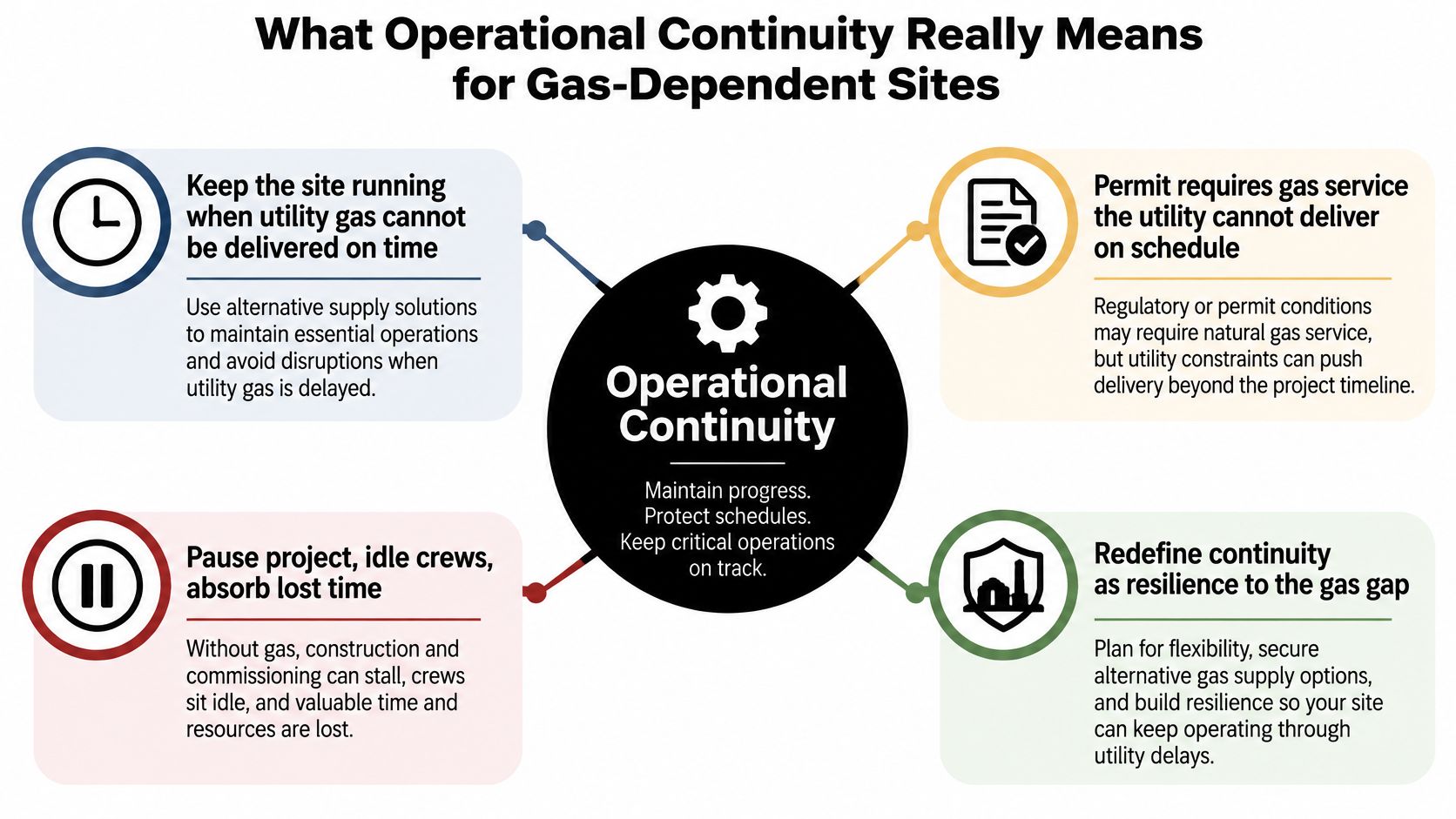
Operational continuity for a gas-dependent site means one thing: keeping critical work running when permanent utility gas isn't there. That's different from generic business continuity, which often stops at data backups, call trees, and office relocation. Your dependency is physical. You need heat, hot water, generator fuel, process heat, or gas service itself to pass an inspection and get occupancy.
Treat it as a service-level objective, not a sentiment. Name the load, name the duration you must protect, and name who decides when the backup starts. If you can't answer how long, what loads, and how fast fuel arrives, you don't have continuity. You have hope.
Why Gas Sites Are Exposed Differently
Electric loads can often be shed or shifted. Gas loads usually can't. A boiler either fires or the building loses freeze protection. A process heater either holds temperature or production stops. Lab and healthcare-adjacent spaces face the same hard dependency, which is why reviewing lab gas equipment from Labs USA helps teams see how tightly equipment, piping, and supply are linked in practice.
Federal guidance backs the seriousness of this planning. FEMA recommends maintaining an emergency disaster plan and a continuity-of-operations plan and reports that approximately 25% of businesses do not reopen after a major disaster. Your gas delay isn't a disaster, but the logic holds. The plan you write before the gap is the only one you'll have during it.
Critical Gas Loads and Continuity Risk
| Gas-Dependent Function | Typical Tolerance Window | Can Mobile CNG/LNG Bridge It? |
|---|---|---|
| Freeze protection heat | Short, weather-dependent | Yes, if sized to load |
| Generator commissioning | Tied to test schedule | Yes, with planned connection |
| Occupancy inspection | Fixed inspection date | Yes, if approved in advance |
| Industrial process heat | Very limited | Yes, with matched flow and pressure |
Practical rule: If a function blocks revenue, occupancy, or asset protection, it's a continuity load. Everything else is optional until permanent service returns.
The Real Cost of Downtime When Gas Is Missing
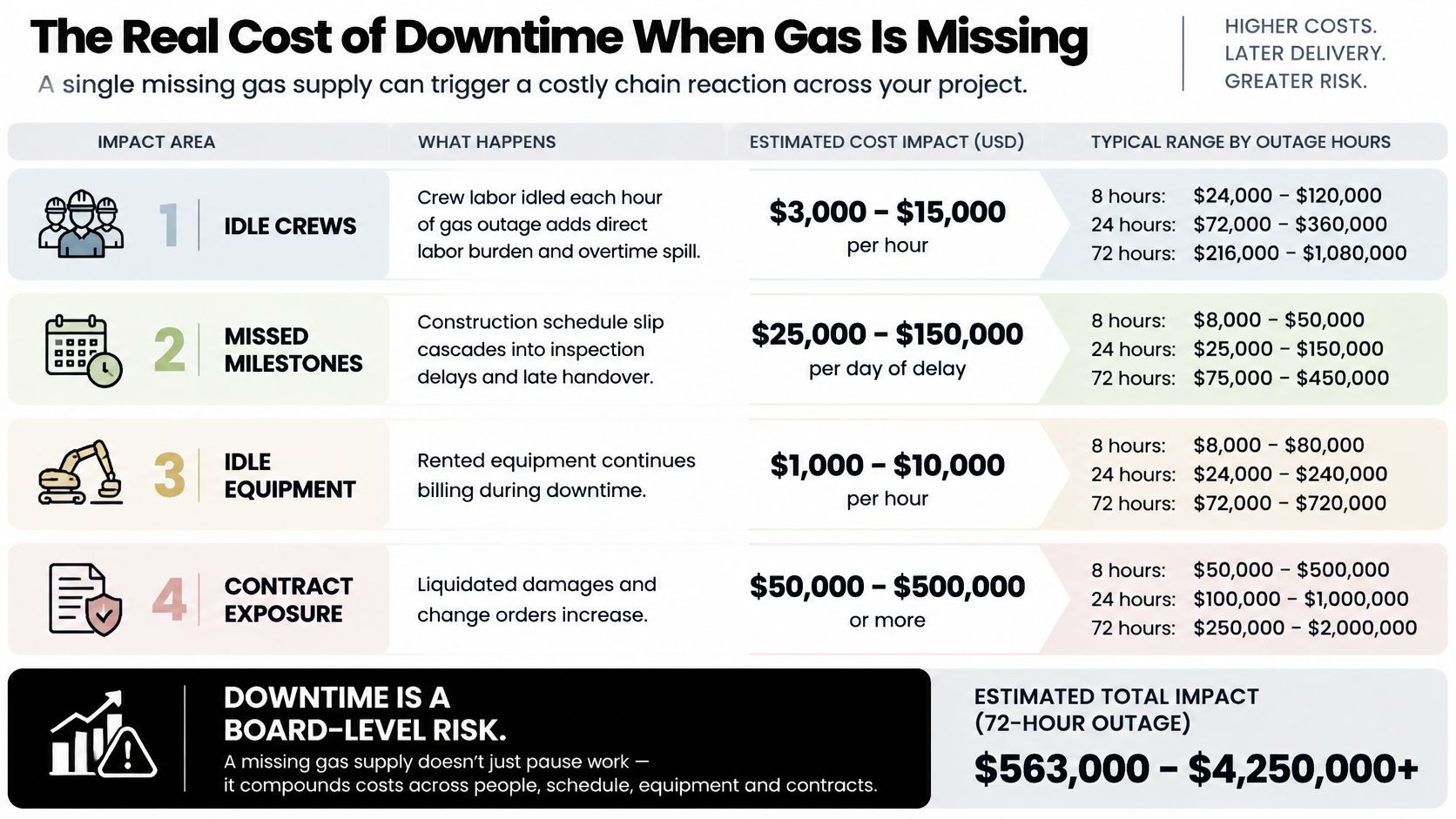
The first hour without gas looks manageable. Crews sweep, punch lists shrink, and someone calls the utility again. By the second day, you're paying people to wait, rented equipment is still billing, and the inspector's slot is gone. That's when a scheduling nuisance becomes a financial problem your CFO will notice.
Separate hard costs from soft costs when you make the case. Hard costs include liquidated damages, extended general conditions, equipment rental, remobilization, and freeze damage to piping or finishes. Soft costs include frustrated tenants, strained utility relationships, and crews who start questioning whether management saw this coming. Both categories cost you, but hard costs are what justify a continuity budget line.
How a Short Gap Cascades
A missed inspection doesn't just move one milestone. It pushes commissioning, which pushes occupancy, which pushes tenant move-in and payment. Idle labor is only the visible layer.
- Idle crews: You keep key trades on standby or lose them to other jobs and pay to remobilize.
- Missed inspections: A lost slot can mean waiting for the next available window while finished work sits exposed.
- Freeze and damage risk: Unheated piping and incomplete systems face harm that far exceeds the cost of temporary fuel.
- Contract exposure: Late handover triggers penalties, change orders, and disputes about who owned the delay.
The recovery data explains why speed matters more than expected. FEMA-linked guidance states that 80% of organizations unable to recover within one month are likely to fail, and companies unable to resume within ten days are unlikely to survive. Your project isn't facing business failure on day one, but the principle scales down cleanly. Every day you don't restore a critical function, the consequences stop being linear.
That's your argument to leadership. Don't ask for money for a plan. Ask for money to protect a specific milestone, a specific occupancy date, and a specific production commitment.
Three Strategic Approaches to Staying Online
Most sites lean on one strategy and assume they're covered. They're not. Redundancy, contingency planning, and temporary mobile gas supply do different jobs, and each fails in a predictable way when it's used alone.
Redundancy means duplicate paths, backup equipment, or isolated critical loads that keep running if one feed fails. It's the strongest protection and the most expensive to build. Contingency planning means the written sequence, vendor contacts, decision triggers, and load inventory that let your team act quickly. It costs little, but paper doesn't deliver fuel.
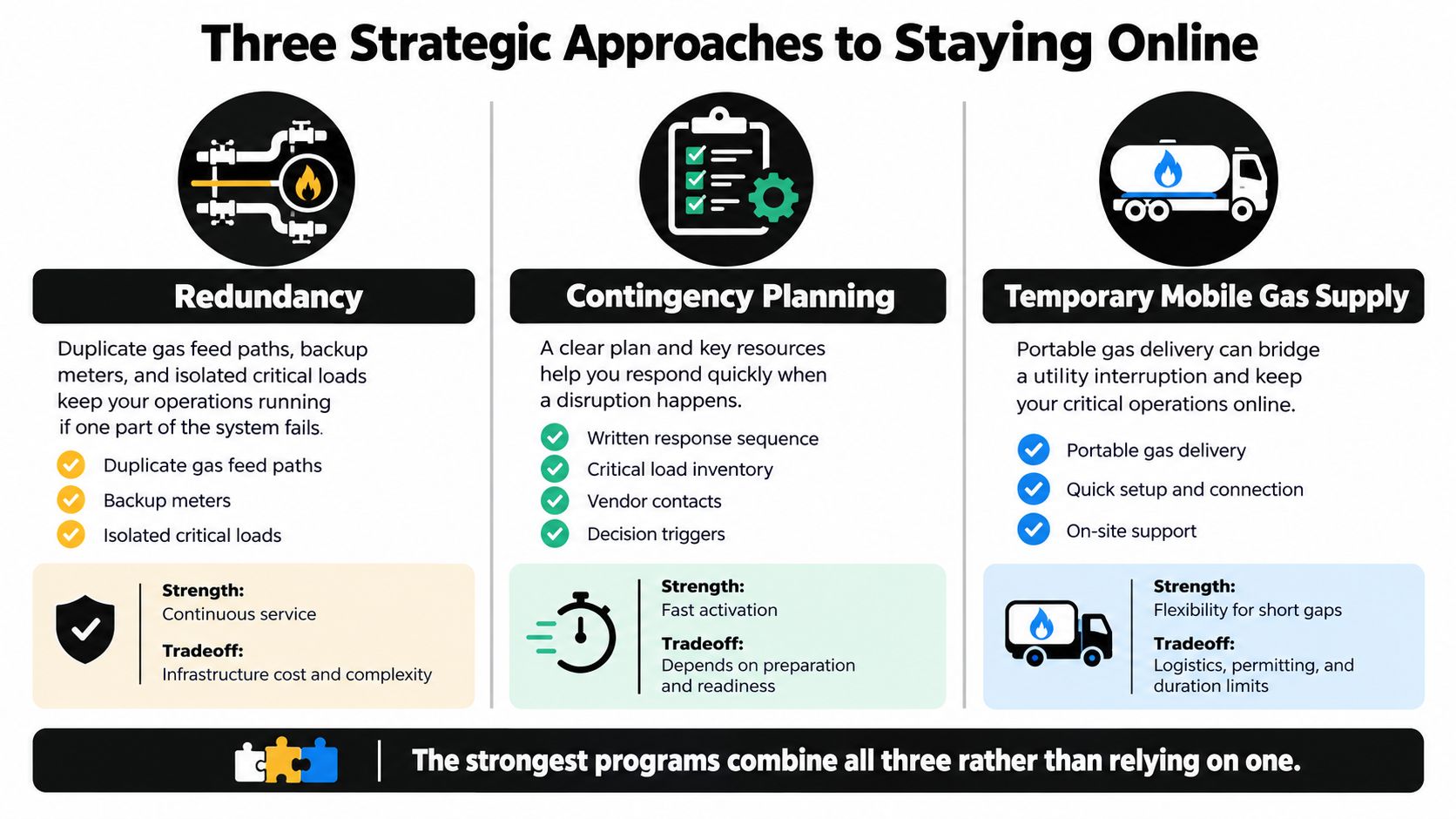
Temporary mobile gas supply bridges a defined gap with portable CNG or LNG connected to your existing system. It's flexible and doesn't require permanent infrastructure, but it depends on logistics, site access, permitting, and prequalification. If you first call a provider during the outage, you've already lost your best options.
The execution gap behind these strategies is measurable. Reporting on a 2025 resilience survey found 63% of companies had contingency plans but only 41% had built redundancy, while 89% of global executives reported an energy-related disruption and only 27% had advanced power-resilience capabilities. Plans are common. Tested capability isn't.
Comparing the Three Continuity Strategies
| Strategy | What It Protects | Common Failure Mode | Best Use Case |
|---|---|---|---|
| Redundancy | Continuous service | High cost, unused capacity | Permanent critical facilities |
| Contingency planning | Decision speed | Untested procedures | Every site, as the base layer |
| Mobile gas supply | Defined outage windows | Late activation, access issues | Delayed connections, maintenance |
Use All Three in the Right Order
Start with the plan, add redundancy where permanent criticality justifies it, and prequalify mobile supply for the gaps redundancy doesn't cover. Manufacturing teams take a similar layered view when they compare predictive maintenance outcomes against unplanned downtime, because prevention, detection, and response answer different questions. Your gas strategy should work the same way.
A backup generator without fuel logistics is a stranded asset. A written plan without a tested connection is a document, not a response.
Building Your Stepwise Response Checklist
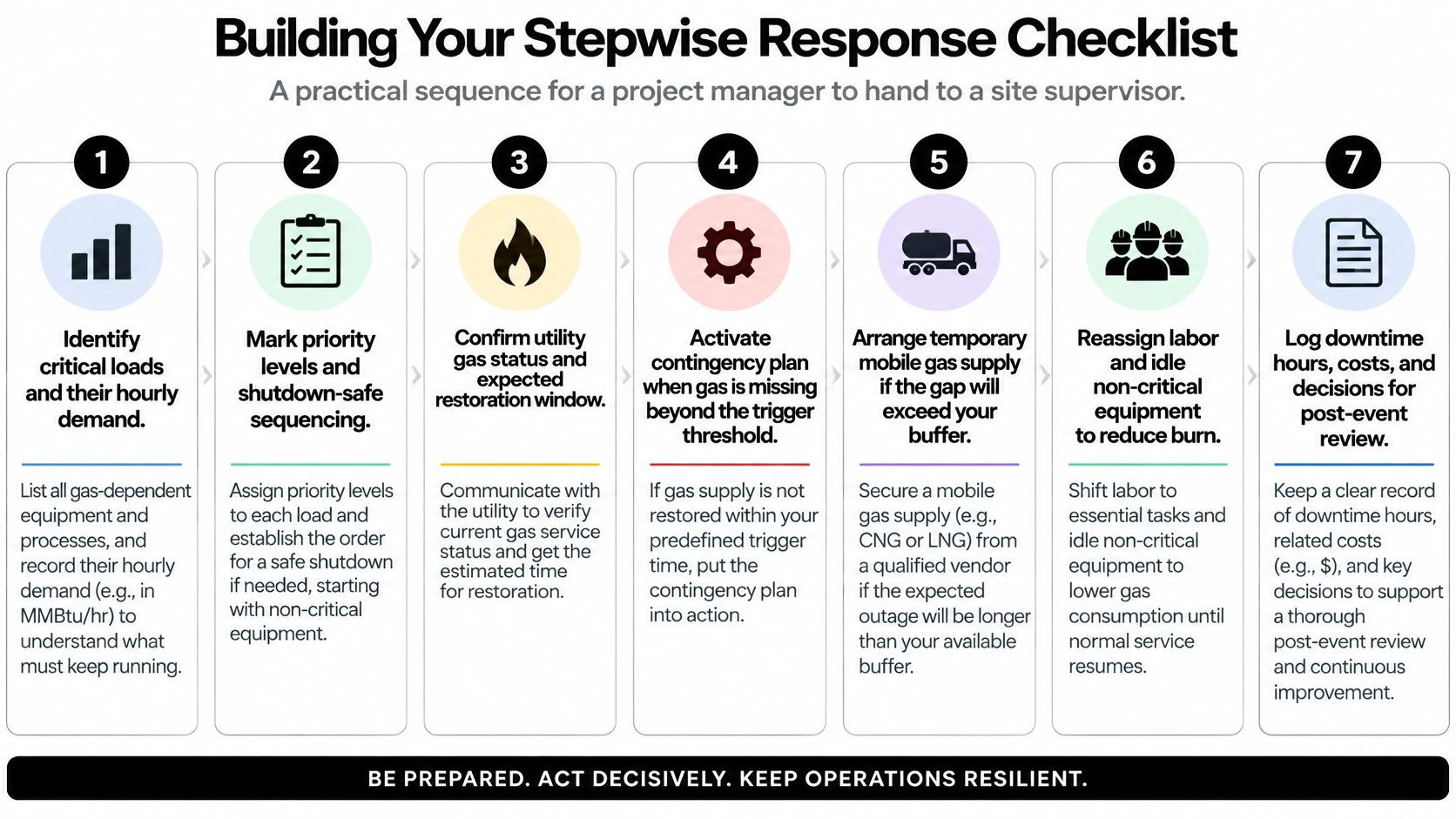
Build this checklist before you need it, and keep it where the site supervisor can reach it. A copy buried in a corporate drive won't help anyone standing at a gas meter at dawn. Each step below is an action you can finish this quarter.
Size the Requirement First
- Identify critical loads: List every gas appliance that blocks occupancy, safety, freeze protection, or production, and record its hourly consumption.
- Set priorities: Decide which loads run first, which can cycle, and which shut down safely if supply is constrained.
- Calculate the autonomy window: Multiply critical consumption by the hours or days you must protect. That's your fuel requirement, not the generator nameplate.
Fuel autonomy has established planning levels you can borrow. CISA's resilient-power framework defines approximately 3 days for Level 1, 7 days for Level 2, and about 30 days for Level 3, with higher levels requiring fuel diversification and documented emergency-delivery alternatives. Pick the level that matches your contracted milestones, then validate it against real delivery access.
Validate the Physical Connection
- Document pressure and flow: Record minimum operating pressure, regulator capacity, and connection points so a provider can match equipment without guesswork.
- Map site access: Confirm where a mobile unit sits, how delivery vehicles enter, and what traffic or permitting limits apply.
- Prequalify a provider: Share load data early, agree on changeover steps, and confirm who supplies hoses, regulators, and monitoring.
- Rehearse the decision: Set a trigger, such as a confirmed utility delay past your buffer, and name the person who activates the order.
If the checklist exposes a gap your current utility timeline can't close, act on that finding now. Closing it after the outage starts is the expensive version of the same decision.
Sector Scenarios That Bring It to Life
The framework stays constant across sectors. The critical load, tolerance window, and pressure behind it change. Read these three scenarios and find the one that looks like your site.
Residential Build Blocked at Final Inspection
A builder has homes complete, buyers scheduled, and a final inspection that can't pass without live gas to furnaces and water heaters. The meter set is delayed, and every unfinished closing ties up capital. The critical load is modest but the tolerance is effectively zero, because the inspection date drives revenue.
A temporary mobile supply changes the sequence. The builder can demonstrate functioning gas appliances, keep finished interiors conditioned, and protect closings while permanent service catches up. The continuity decision here isn't about comfort. It's about converting finished inventory into closed sales.
Industrial Plant During a Planned Outage
An industrial facility faces a scheduled utility outage while a process heater must hold temperature. Shutting down means losing product, cleaning equipment, and restarting under supervision. Restarting can take longer than the outage itself.
Here, flow and pressure matching matter most. The plant sizes mobile supply to the process load for the outage window, stages the connection before the shutdown, and treats changeover as part of the maintenance plan. Production continues at planned capacity instead of gambling on a restoration estimate.
Commercial Building Chasing Occupancy
A commercial property can't receive its certificate of occupancy without gas service for heat and hot water, and a tenant improvement schedule depends on that certificate. The contractual pressure comes from lease commitments, not equipment.
Mobile supply lets the owner commission systems, satisfy inspection requirements, and hand over space on schedule. In all three scenarios, the winning move is identical. Someone quantified the load and arranged the bridge before the deadline forced the decision.
Why Pipeline Reliability and Backup Power Are Not the Same as Continuity
It's tempting to point at a well-maintained pipeline or a new generator and call the site resilient. Each is necessary. Neither, on its own, keeps your operation running when fuel doesn't reach the burner.
Pipeline operators work under detailed federal corrosion-control rules. Under 49 CFR Part 192, Subpart I, buried or submerged pipelines installed after July 31, 1971 generally must have both an external protective coating and a cathodic-protection system placed into operation within one year after construction. Coating limits the steel's exposure to its surroundings, and cathodic protection uses electrical current to reduce external corrosion. That regulatory system supports long-term pipeline integrity, but it doesn't deliver gas to your site during a connection delay, repair, or localized outage.
The Chain Breaks at the Weakest Link
Think in systems. Gas production, pipeline transport, local distribution, your service line, regulators, and end equipment form one chain. Electricity runs through it too, since controls, compressors, and building systems depend on power while generators depend on fuel.
- Pipeline risk: Damage, maintenance, or capacity limits upstream of your meter.
- Equipment risk: A generator or boiler that's untested under real load.
- Fuel risk: Adequate equipment with inadequate runtime or no resupply route.
- Access risk: A delivery that physically can't reach the connection point.
Generator fuel choice illustrates the interdependence well. Reviewing whole-house generator fuel choices shows residential buyers weighing the same runtime and supply questions that commercial operators face at larger scale. The equipment decision and the fuel decision are never separate.
Sharp question to ask: If your primary gas feed and your backup generator depend on the same interrupted supply, what exactly is backing up what?
Ask that of your utility, your contractor, and yourself. Continuity is the framework that connects their answers into one tested sequence.
Choosing and Partnering With a Mobile Gas Provider
Choose your mobile gas partner in daylight, not at midnight. A provider you prequalify can review loads, inspect access, and stage the right equipment. A provider you find during an outage can only offer whatever is uncommitted and closest.
Judge candidates on operational specifics, not sales language. Ask about deployment time in hours, scalable CNG and LNG capacity, documented changeover procedures, and familiarity with permitting and inspection practices in your service region. Ask how they coordinate with the local utility, because temporary supply and permanent connection eventually have to meet cleanly.
Criteria That Separate a Partner From a Delivery
- Pre-outage site review: They've seen your connection point, regulator, and access route before dispatch.
- Load-matched equipment: Supply is sized to your documented flow and pressure, not estimated on arrival.
- Resupply discipline: Refill or unit-swap timing is agreed in advance, with a named dispatch contact.
- Utility coordination: They understand local requirements and communicate during changeover.
The supply-chain logic behind these criteria is well established. FEMA identifies energy as an interconnected system and states that fuel access, stockpiles, and resupply procedures are crucial to supply-chain recovery. Your provider is part of that supply chain, so treat selection as logistics planning.
Blue Gas Express, for example, provides temporary mobile CNG and LNG delivery for delayed connections and maintenance outages, with units that connect to residential, commercial, and industrial gas systems. Evaluate it and any competitor against the criteria above. My recommendation is direct: shortlist at least two providers, run a tabletop exercise with your first choice, and post the dispatch number next to the gas shutoff valve.
Your Operational Continuity Game Plan and Common Questions
Take four commitments into your next Monday meeting. First, set a quantified autonomy window for your critical gas loads. Second, prequalify a mobile gas partner with your actual load data. Third, document and rehearse the changeover procedure. Fourth, write the escalation chain with one named decision-maker and a clear activation trigger.
Common Questions
How fast can temporary supply be deployed? Deployment is fastest when load data, access, and connection details are already on file. Without prequalification, expect delays while equipment is sized and site conditions are confirmed.
What information does a provider need up front? Critical loads and hourly consumption, minimum pressure and flow, connection and regulator details, site access constraints, and the duration you need to cover. That information turns a quote into an executable plan.
How does temporary supply coordinate with permanent service? The provider and utility align on connection, inspection, and changeover so mobile supply bridges the gap and disconnects cleanly when permanent gas is live. Agree on that sequence before the unit arrives, not while it's idling on site.
If a delayed gas connection or a planned outage is threatening your inspection, occupancy, or production schedule, Blue Gas Express can deploy temporary mobile CNG and LNG supply to keep your critical systems running while permanent service catches up. Share your load requirements and site details before the gap hits, and a team serving construction, commercial, and industrial customers across the Southeast and Mid-Atlantic will help you build a bridge plan that is ready when you need it.