

You are looking at a generator sitting on a pad, a meter that has not been set yet, and a superintendent who wants gas ordered before the crew shows up. The nameplate says 100 kW. The overnight trailer load is nowhere near that. A fuel order built from the nameplate will miss the job, sometimes by a day of supply and sometimes by a regulator that cannot pass the peak.
Natural gas generator fuel consumption is an hourly volume times hours, read off a load curve. The rest of this walk-through is how to get that volume right before you call for supply.
Fuel Use Figures for Common Generator Sizes
Start with the size that shows up most often on construction, commissioning, and short outage jobs: 100 kW. Manufacturer standby data put that unit at 1,280 standard cubic feet per hour (scfh) at full load and 768 scfh at 50% load. The fuel bill is that hourly volume multiplied by run time. Rated kilowatts never become cubic feet by themselves.
| Generator size | Full load (scfh) | 50% load (scfh) |
|---|---|---|
| 50 kW | 640 | 384 |
| 100 kW | 1,280 | 768 |
Read the table left to right the way you would a quote sheet.
Size is the nameplate you are renting, not the average load you hope to see.
Full load is the flow the fuel system must be able to pass. Scale the 100 kW curve at about 12,800 Btu per kWh and a 50 kW unit lands near 640 scfh at full load. The same shortcut puts a 500 kW unit near 6,400 scfh. Those scaled rows are planning estimates, not a substitute for the model sheet.
Half load is where many sites sit. For the 100 kW row, half load is published data. For the other sizes, half-load figures are scaled estimates from that same curve, so treat them as a first pass.
The energy check is simple. Multiply scfh by 1,026 Btu per cubic foot. The 100 kW unit at full load uses about 1.31 million Btu every hour.
The one-line estimate is scfh times hours. Ten hours at 1,280 scfh is 12,800 standard cubic feet. Write down the size, the hourly rate for the load you expect, and the hours. Then replace these estimates with the manufacturer sheet for the exact model before you order supply. If the unit has been sitting, industrial generator condition monitoring from Forge Reliability is a practical place to see why a tired engine can drift off the published curve.
How Load Changes Gas Use More Than Size Does
A light load does not buy you a matching discount on gas. On a 100 kW standby curve, 25% load burns 497 scfh, which is about 39% of full-load gas, not a quarter of it. Friction, cooling, and the fuel the engine uses just to stay running stay roughly constant. Only the extra fuel tracks the kilowatts.
A Generac generator consumption sheet lists the rest of that standby curve: 768 scfh at 50%, 1,017 scfh at 75%, and 1,280 scfh at 100%. Prime-rated operation on the same unit is lower at every load level. The rating printed on the sheet changes the number before any arithmetic starts. Emergency backup and a long construction run are not the same curve.
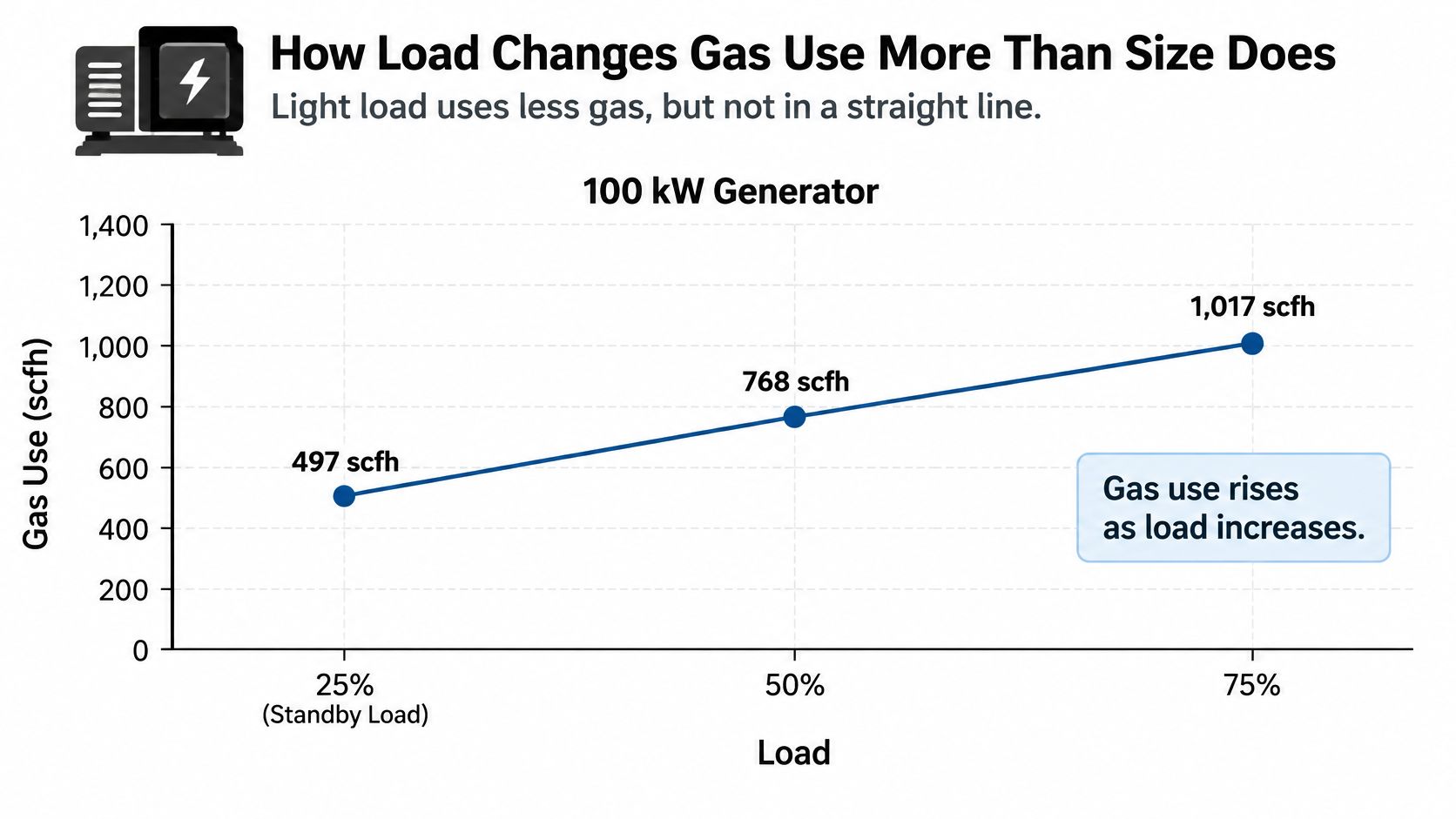
| Load level | Gas use (scfh) | Share of full-load gas |
|---|---|---|
| 25% standby | 497 | 39% |
| 50% standby | 768 | 60% |
| 75% standby | 1,017 | 79% |
| 100% | 1,280 | 100% |
A trailer night that a straight line gets wrong
Say the construction trailer holds about 25% load for 10 overnight hours, then the generator takes full load for two hours while the crew's tools peak.
497 × 10 + 1,280 × 2 = 7,530 standard cubic feet.
A straight line from full load treats 25% as 320 scfh. That path gives 320 × 10 + 1,280 × 2 = 5,760 scf and misses about 1,770 scf. On a multi-day outage that gap is a delivery you did not schedule.
Practical rule: Pull the load profile first, then read the curve at each level. Nameplate kilowatts are the ceiling, not the average.
Fuel piping still has to pass the manufacturer's 100% load flow, even when the average day sits far below it. Minimum stable loading, motor starts, power factor, and duty cycle all move the hourly number. Construction, temporary occupancy, commissioning, and outage work are exactly the jobs where average demand sits well under the badge on the enclosure.
How to Estimate Fuel Use From Heat Rate and Hours
When the size or the load is not in the table, build the estimate from energy. Heat rate is the fuel energy required to make one kilowatt-hour. The U.S. Energy Information Administration reported an average natural-gas fleet heat rate of 8,471 Btu/kWh in 2006. By 2015, wider use of combined-cycle plants had cut that fleet average by about 7%. In 2015, combined-cycle units averaged 7,340 Btu/kWh and simple-cycle units, including gas turbines, engines, and steam turbines, averaged 9,788 Btu/kWh. A 1,000 kW plant-style unit for one hour would need about 7.34 million Btu at the combined-cycle rate and 9.788 million Btu at the simple-cycle rate. Those are power-plant averages. A rental generator set runs hotter than either number. Combined-cycle plants also grew from 75% of U.S. natural-gas-fired generation in 2006 to 85% in 2015, which is why a plant average will understate a standby set.
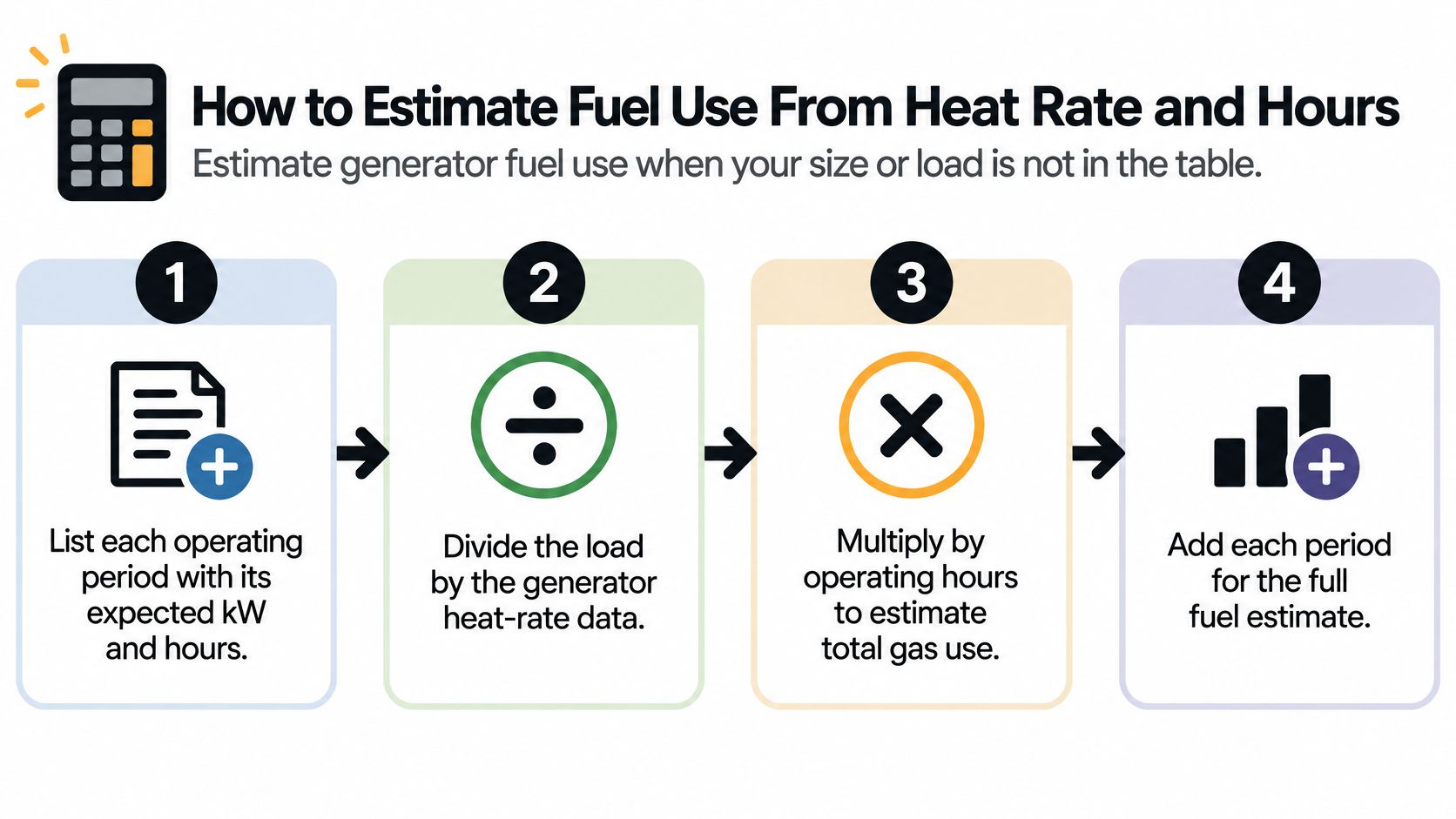
Seven steps when the sheet is thin
- List each period. Write expected kW and hours on its own line. A single "typical hour" hides the overnight lull and the tool peak.
- Get the load percentage. Divide expected kW by rated kW. If the manufacturer sheet has an scfh at that level, use it and skip the heat-rate math for that row.
- Pick a heat rate only if the sheet is missing. About 13,100 Btu per kWh lines up with 1,280 scfh at 100 kW and 1,026 Btu per cubic foot. The rounded 12,800 figure is only a shortcut. The EIA band of 7,340 to 9,788 Btu/kWh is a plant range, not a generator value, so do not drop a standby set into it.
- Turn kWh into Btu. Multiply kilowatt-hours by the heat rate. This is the energy the fuel has to deliver.
- Turn Btu into standard cubic feet. Divide by 1,026. That heating value is the planning constant for pipeline gas until the supplier's ticket says otherwise.
- Add 10 to 15% for cold starts and motor-starting surges. The steady-state curve does not include the first minutes after a start or a compressor kick.
- Sum the periods. The job total is the sum of the rows, not the worst hour times the whole day.
A run the two methods agree on
100 kW for 6 hours is 600 kWh. At 13,100 Btu per kWh that is 7.86 million Btu, or about 7,660 scf. The scfh table for the same full-load run is 1,280 × 6 = 7,680 scf. The two methods agree within a fraction of a percent.
Rated kW fails on its own because heat rate sets energy per kWh and the load profile sets the kWh. Put the seven steps in a spreadsheet with one row per load period, and keep the heat rate in a cell you can swap when the model sheet arrives.
Sample Calculations for Four Common Jobs
Each job below uses the same three moves. Standard cubic feet equals scfh times hours. Million Btu equals scf times 1,026, divided by one million. Carbon dioxide equals million Btu times 53.06 kg, the factor the U.S. Environmental Protection Agency assigns to pipeline natural gas, along with a higher heating value of 0.001026 million Btu per standard cubic foot. That pairing is about 0.05444 kg of CO2 per standard cubic foot. One million Btu produces about 53.06 kg of CO2. One hundred thousand standard cubic feet is about 102.6 million Btu and roughly 5.44 metric tons of CO2 at the EPA reference heating value.
| Scenario | Gas used (scf) | Energy (MMBtu) | CO2 (kg) |
|---|---|---|---|
| 100 kW at 75% for 8 hours, construction trailer power | 8,136 | 8.35 | 443 |
| 100 kW at 100% for 24 hours, continuous backup | 30,720 | 31.52 | 1,672 |
| 100 kW mixed overnight shift | 7,530 | 7.73 | 410 |
| 500 kW at 100% for 24 hours, scaled estimate | 153,600 | 157.6 | 8,362 |
Walk the first row, then swap your own hours
At 75% the 100 kW standby rate is 1,017 scfh. Eight hours is 1,017 × 8 = 8,136 scf. Times 1,026 and divided by one million, that is about 8.35 million Btu. Times 53.06 kg, that is roughly 443 kg of CO2.
Continuous full-load backup for a day is 1,280 × 24 = 30,720 scf, 31.52 MMBtu, and 1,672 kg. The mixed overnight shift already totaled 7,530 scf, which is 7.73 MMBtu and 410 kg. A 500 kW commercial unit, scaled at 6,400 scfh, runs 153,600 scf, 157.6 MMBtu, and about 8,362 kg in 24 hours. That last row is a scaled estimate. Confirm it on the manufacturer sheet before you buy gas against it.
What the CO2 column is for
The factor assumes the EPA reference heating value. Real gas composition, engine efficiency, load, and equipment condition move the result by a few percent. EIA's own point is that fuel per kilowatt-hour depends on heat rate and the fuel's heat content. Use these rows for budgeting and permit planning, not as a final compliance number.
Pick the row closest to your site and rerun it with your kW and your hours. The structure does not change. Only the inputs do.
Confirm Your Gas Supply and Avoid Common Estimating Errors
Order from the peak the pipe must pass, then from the volume the tank or the delivery must cover. Add the full-load scfh of every generator that could run at the same time, plus other gas appliances on that line. Our mobile systems plug into a commercial, industrial, or residential line of any size, and we match the unit to the capacity and flow speed of the equipment you need to gas up. The meter and regulator still have to be rated for that combined peak, not for the quiet hour.
Five numbers before you release a quote
- Peak scfh. Full-load flow of everything that can run together.
- Total scf for the planned run. Sum every load period, then add the 10 to 15% surge margin.
- Meter and regulator flow rating. If the badge is below peak scfh, the estimate is already wrong.
- Heating value from the delivery record. Do not freeze 1,026 Btu per cubic foot if the ticket shows something else.
- Days of supply the outage plan needs. A 24-hour total is not a three-day outage.
Errors that show up after the gas is on site
Nameplate instead of a metered profile. You pay for capacity the load never uses.
Wrong rating type. A prime curve on a standby job, or the reverse, shifts every hour before the hours are even multiplied.
One peak hour times the whole day. That ignores the long light-load stretch and still may miss a start surge.
One heating value for every delivery. Composition changes the cubic feet you need for the same Btu.
Cold weather lifts use in the first hours after a start, so keep the surge margin on cold-start days rather than trimming it.
A commercial site sized around a 500 kW nameplate that ran near 30% load most of the day paid for flow it never used. The one pump start that did spike was the hour nobody had written down.
An estimate is only as good as the load profile behind it.
If the service line is not ready, or the regulator work is still open, a licensed local fitter matters as much as the fuel math. Richmond gas installation and repairs from Encano Plumbing & Drainage Ltd. is the kind of site work that has to be finished before a temporary supply can land on a live meter set.
Send the supplier those five numbers, the generator model, and whether the curve is standby or prime. A quote built on nameplate kilowatts will not match the load you run.
Blue Gas Express supplies temporary CNG and LNG when a generator has to run before the permanent gas line is in, or while a line is down for maintenance. We size mobile gas units to the flow and the hours your load profile needs, from commissioning runs to multi-day outages. If you are ready to turn a fuel estimate into a delivery plan, visit Blue Gas Express.