

Your generator is scheduled for delivery, the concrete contractor wants a pad location, and the gas utility still won't commit to a connection date. Meanwhile, the owner wants to know when the building can open. That's where commercial generator installation becomes a coordination job, not just an equipment purchase.
The reliable approach is to plan backward from witnessed testing and handover. Set the acceptance criteria before ordering equipment, assign every approval to a named party, and treat fuel availability as part of the construction schedule.
Installation Sequence and Who Signs Off Each Phase
Use this sequence to identify what's complete, rather than measuring progress by whether the generator has arrived.
Installation phases, outputs and sign-offs
| Phase | Core actions | Document produced | Sign-off |
|---|---|---|---|
| Site assessment | Verify fault current, derating, space, ventilation and critical loads | Site record and assumptions sheet | Owner and engineer of record |
| Permits and emissions review | Submit equipment data, emissions tier, fuel and fire permit applications | Approved permit set | Building department, air district, fire authority |
| Pad and foundation | Pour and level the pad, set vibration isolators | Pad survey | General contractor |
| Fuel supply | Install tank or gas service and pressure regulator | Leak test record | Fire authority and gas utility |
| Mechanical and electrical install | Set generator, exhaust, feeders and transfer switch | Wiring and torque records | Electrical inspector |
| Commissioning and load testing | Cold start, transfer test, staged load | Test report with readings | Engineer, owner and authority having jurisdiction |
| Utility and authority handover | Confirm meter, inspections and as-built drawings | Signed handover package | Utility and owner |
These are project responsibility assignments, not a substitute for local approval rules. Confirm which inspections require separate signatures and whether the engineer must witness testing before construction starts.
A historical National Energy Technology Laboratory review, citing Carnegie Mellon's Electricity Industry Center, estimated approximately 12 million U.S. backup generators with more than 200 gigawatts of combined capacity. The same review estimated that roughly 75% of commercial businesses purchased backup generators, with an average unit size of approximately 18 kilowatts.
Commercial installations therefore aren't limited to hospitals and factories. They also protect refrigeration, communications, security and selected operating loads. The review also notes that building codes commonly require backup power for services such as elevators and fire-protection systems, so inspection milestones matter as much as crane availability.
Put responsibilities into the purchasing scope
Before requesting bids, write down who supplies the pad, fuel equipment, transfer controls, test equipment and final records. Procurement teams can use Procright's guide to draft sourcing requirements using AI to organize that scope, with the engineer checking the technical requirements before release.
Practical rule: No phase closes until its required document is signed. Reserve the load-test window at the start, not after every trade has demobilized.
Site Assessment Before You Size the Generator
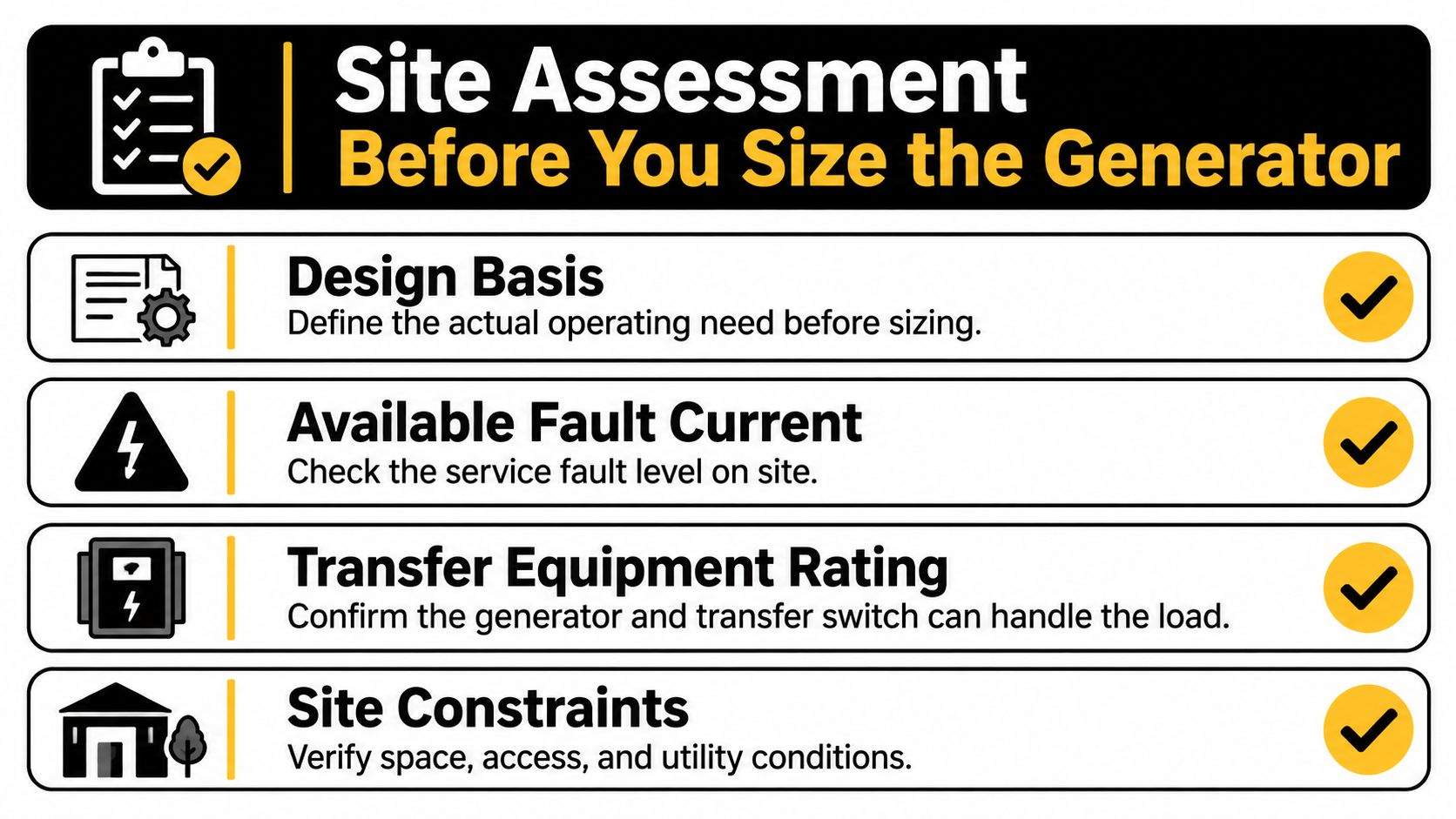
Start with the design basis, not the generator catalog. Define what the building must keep operating, how those loads start, and the conditions under which the system must deliver power.
Obtain the available fault current at the service from utility information and the electrical study. Check the transfer switch's withstand and closing rating against the available fault current and specified protective devices. Separately, verify generator-side protection and coordination, because generator fault behavior isn't identical to utility fault behavior.
Apply the manufacturer's altitude and ambient-temperature derating before accepting a usable output rating. A rooftop installation in summer or an enclosed mechanical space can have a different operating envelope from the conditions behind the catalog rating.
Walk the site in equipment-service order
Follow the path the installer and maintenance technician will use. Check the delivery route, pad location, enclosure doors, radiator discharge and access to filters, batteries and control panels.
The NFPA overview of NFPA 110 identifies vibration, noise, HVAC, cooling, fuel and exhaust as installation-performance considerations. Translate those considerations into items the drawings can resolve:
- Airflow and exhaust: Identify combustion-air and cooling-air paths. Keep exhaust termination away from building intakes and occupied areas, with the final arrangement checked against applicable requirements.
- Fuel and runtime: Establish the required operating duration and usable fuel capacity, or verify the gas supply's delivery conditions.
- Foundation and access: Check support, vibration isolation, working clearances and a practical load-bank connection location.
- Electrical routes: Map feeders, grounding paths, control wiring and the transfer-switch location before trenching or pouring concrete.
Rank loads before selecting capacity
Separate code-required loads, business-critical equipment and deferrable loads. Refrigeration compressors, elevators and pumps need starting information, not just running watts. Record voltage, phase, power factor and proposed starting order so the engineer can evaluate transient performance.
For example, a generator selected for a rooftop site may need a different rating once summer inlet-air temperature and elevation are considered. The correction belongs in equipment selection, not in a last-minute adjustment to the acceptance test.
Finish with a marked-up site drawing and an assumptions sheet. Record elevation, design ambient temperature, fuel-runtime basis, usable derated output, load priorities and unresolved utility conditions. Have the owner and engineer accept that record before the purchase order goes out.
Diesel, Natural Gas or Temporary Gas Supply Compared
Fuel choice affects generator operation, site logistics and the commissioning schedule. Match the supply to the planned duty, then confirm that its permits and connection arrangements fit the project timeline.
| Fuel option | Best fit | Main constraint | Permit and code note |
|---|---|---|---|
| Diesel standby | Emergency backup and short outages | On-site fuel storage and regular testing | Fire and air permits may apply; historical estimates were nearly 85% of commercial-building and critical-facility backup generators |
| Permanent natural gas | Extended runs at sites already using gas | Utility line capacity and regulator sizing | Gas piping permit and utility approval may apply; historical estimates were about 10% of commercial-building and critical-facility backup generators |
| Temporary CNG or LNG | Bridging a delayed utility connection or commissioning | Siting, storage limits and delivery access | Confirm requirements with the fire authority and check locally adopted codes |
The historical fuel shares come from DOE resilience guidance summarized in the DOE-supported CHP resource, which reported nearly 85% diesel and about 10% natural gas among backup generators serving commercial buildings and critical facilities.
Diesel provides on-site fuel, but the owner must plan replenishment, fuel condition and permitted storage. Permanent natural gas avoids routine liquid-fuel deliveries; an existing building connection alone does not establish that the utility can meet the generator's peak demand.
Confirm gas capacity and required pressure with the utility before selecting equipment. Also distinguish standby operation from routine on-site generation and combined-heat-and-power operation. Their operating purposes and approval requirements can differ.
Temporary gas needs its own site plan
Temporary CNG or LNG can bridge a delayed connection or support commissioning, but the trailer location is only one part of the plan. Confirm siting with the fire authority and check the locally adopted code. Document the storage location, delivery access, pressure regulation, ventilation, emergency shutoffs and responsibility for inspections.
Temporary fuel can protect a commissioning date only when the fuel arrangement is approved alongside the electrical installation.
Write the permanent-supply changeover procedure
Have the licensed gas contractor and utility approve the cutover method before scheduling the work:
- Schedule the window: Coordinate the utility connection and arrange any necessary backup coverage.
- Isolate the temporary supply: Shut down and secure the temporary source under the approved procedure.
- Test the permanent piping: Complete specified pressure or leak testing and controlled purging before admitting gas to the appliance.
- Retest operation: Run the generator on permanent service and add the results to the handover records.
Successful temporary operation does not prove that the permanent regulator and service can deliver the same performance. Confirm the permanent supply under the conditions required for commissioning.
Permits, Emissions Review and Inspections to Schedule
A generator can be mechanically ready and still be barred from operation because its emissions permit or inspection is incomplete. Set the approval path before selecting equipment: emissions limits, required controls, operating conditions and exhaust arrangements can affect both generator choice and the project schedule.
The Bay Area Air District's data-center guidance identifies requirements that may include Best Available Control Technology (BACT), Tier 4 diesel emissions performance, health-risk review, operating-hour limits and periodic source testing. These provisions are specific to the relevant data-center applications, not universal requirements for commercial generators.

Establish the operating category before purchase
Tell the permitting authority whether the generator will provide emergency standby power, construction power or routine generation. An emergency designation does not permit unrestricted operation. Routine use or operation outside the approved testing and maintenance conditions can change the unit's regulatory treatment.
Compare purchase cost with the likely approval requirements. Emissions controls, modeling or permit revisions can affect equipment selection and delay the schedule if addressed after procurement.
Schedule approvals around inspection access
Confirm the approval sequence with the local air agency, building department and fire authority. Codes and permit requirements vary by jurisdiction.
- Confirm jurisdiction: Explain the intended use, fuel, location and generator quantity.
- Submit before buying: Provide equipment data sheets, emissions certifications, exhaust information and an operating description.
- Resolve fuel approvals: Obtain applicable storage or gas-piping approvals before installing the fuel arrangement.
- Set inspection hold points: Identify work that must remain exposed, required witnesses and the conditions for controlled energization.
Keep a permit register with the responsible contractor, submission status, inspection prerequisites and approval documents. Schedule each inspection against the construction programme, allowing time to resolve findings before commissioning. For commercial premises in Ireland, review guidance on when businesses need electrical safety certificates; local requirements still govern the project.
How to Install the Generator and Connect Power
Installation belongs with licensed electrical and fuel contractors working from the approved design. Arrange the work so mechanical corrections happen before electrical testing, and establish isolation, lockout and controlled-energization procedures before touching existing distribution equipment.
Build and connect in a coordinated sequence
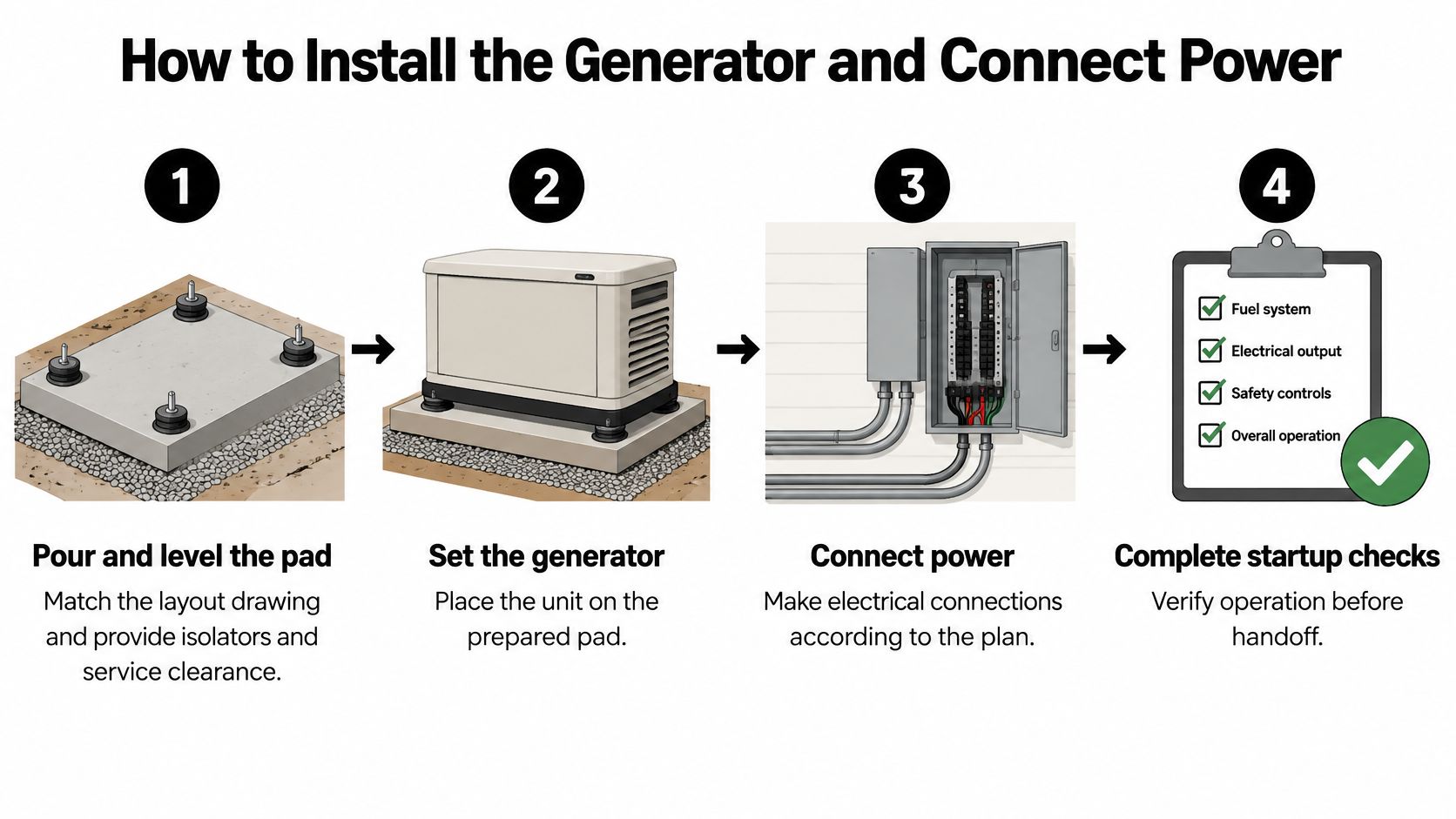
Pour and level the pad from the released drawing. Check conduit stub-ups, anchoring locations, drainage, isolator details and service clearance before placing concrete. Pouring from a preliminary equipment outline can leave the fuel connection or enclosure door blocked.
Set and anchor the generator. Use the manufacturer's lifting points and approved rigging plan, then check the base frame for level and distortion before tightening anchors. Don't pull a twisted frame flat with anchor bolts, because that can introduce alignment and vibration problems.
Install the exhaust system. Use the specified flexible connection, independent supports and a condensate-management arrangement that prevents drainage into the engine. Verify pipe sizing and allowable backpressure, because a convenient route with excessive restriction can compromise operation.
Complete the fuel connection. Install accessible shutoffs and perform the specified tests before introducing fuel; for gas, qualified personnel must verify regulator settings and complete controlled purging before light-off. Check pressure at the generator under demand, not only with the engine stopped.
Pull and terminate feeders. Select conductors from the engineered circuit rating, applicable ampacity rules, terminal ratings, protective devices and voltage-drop assessment, while confirming compatibility with site-derated generator output. Record lug torque using a calibrated torque tool and verify phase identification and rotation through the approved test procedure before connecting sensitive loads.
Wire the transfer equipment and auxiliaries. Connect start controls, remote annunciation, charger, block heater and the specified auxiliary supply, including a 120V circuit where the equipment design calls for it. Check control-terminal numbers against the actual shop drawings rather than assuming different manufacturers use interchangeable terminals.
Complete grounding and bonding. Follow the engineered neutral-switching and grounding arrangement, including whether the generator is treated as a separately derived system. Improvised neutral-to-ground connections can create unintended current paths and protection problems.
Label and document the installation. Identify breakers, disconnects, fuel shutoffs and equipment supplied from alternate sources, then update the as-built drawings. File wiring checks, torque records and inspection releases before the commissioning team starts functional testing.
Check the interfaces before calling for startup
The transfer switch deserves a dedicated coordination review. E & I Sales' resource on power transfer planning for industrial facilities provides useful context for discussing the transfer arrangement with the design team.
Check that the selected switch, source-sensing settings, generator controls and load-management signals match the approved sequence. Any transfer arrangement involving utility paralleling requires specific utility review, not an assumption that ordinary standby approval covers it.
Coordination check: The electrician shouldn't arrive for functional testing while the mechanical contractor is still correcting exhaust routing or the gas contractor is changing regulators.
Commissioning and Load Testing Before Handover
Load test stages and readings to record
The following practical staged sequence is described in Curtis Power Solutions' NFPA 110 acceptance-testing guidance. Use it to develop the project-specific procedure with the manufacturer, engineer and authority having jurisdiction, rather than treating it as a universal acceptance script.
| Test stage | Load level | Duration | What to record |
|---|---|---|---|
| Cold-start outage simulation | Utility failure simulated, initially no load | Start to full transfer | Start time, transfer time, voltage and frequency |
| Stage 1 | At least 30% of derated kW | 30 minutes | Phase voltage and current, kW, kVA, power factor, oil pressure, coolant and exhaust temperature |
| Stage 2 | 50% of derated kW | 30 minutes | Same readings plus alarms and fuel behavior |
| Stage 3 | 100% of derated kW | 60 minutes | Same readings plus response of high-inrush loads |
| Load shedding and retransfer | Priority loads, then utility restored | Per design and manufacturer | Shedding order, retransfer time and cooldown run |
Commissioning starts with accepted design assumptions and continues through installation checks, functional testing and owner training. Before simulating an outage, verify inspections, fuel readiness, control settings and the safety plan. Then place the system in its intended automatic operating state, including support equipment.
Test the assembled system, not just the engine
Run against the site-derated rating, with building demand supplemented by a load bank when necessary. Record frequency throughout loading, along with the table's electrical and engine readings. Include alarms and fuel behavior at every stage, even when the report records that no abnormal condition occurred.
An unloaded engine run proves very little about emergency-load performance. It won't adequately expose voltage drop through installed cables, restricted ventilation, insufficient fuel delivery or poor response to motor starting.
Full-load testing and motor-start testing answer different questions. Sustained loading checks thermal and fuel-delivery performance, while actual equipment starts reveal transient voltage and frequency behavior. A resistive load bank alone doesn't reproduce every compressor, pump or elevator starting event.
Close defects and establish the exercise routine
Witness load pickup, priority sequencing, shedding, retransfer and cooldown. Compare measured results with the approved acceptance criteria, then document defects, corrective work and successful retests before signing acceptance.
The cited guidance also recommends monthly exercise for at least 30 minutes and, for diesel systems, loading at or above 30% of standby nameplate capacity, unless the manufacturer specifies an alternative exhaust-temperature method. Put the applicable exercise procedure into the maintenance schedule, including who reviews readings and responds to alarms.
Don't hand the owner a report containing unexplained deviations. Acceptance means the responsible parties have reviewed the results and closed the outstanding items.
Confirm Utility Handover Before You Energize
Before authorizing normal service, confirm these items in writing:
- Inspection release: The authority has approved the installation for the intended energization.
- Fuel-service release: For permanent gas service, the utility has released the meter and regulator.
- Accepted test record: The load-test results match the site assumptions and approved acceptance criteria.
Utility ownership commonly includes the service and meter, with customer responsibility beginning at the designated delivery point. Confirm the actual boundary, especially around regulators, before assigning unfinished work.
Close the fuel and documentation gaps
If permanent service slips, an approved temporary supply can support commissioning, followed by testing on the permanent connection. Our mobile natural gas systems plug into commercial, industrial or residential natural gas lines of any size or quantity, and mobile units can be deployed within a few hours of a customer's request. Site approval and coordinated connection work still apply.
Our Sales team can prepare a custom quote. Have the site address, meter size, peak demand, generator model and required gas date ready.
Give the owner the signed test report, as-built drawings, fuel and permit approvals, operating instructions and maintenance schedule before closing the project.
Blue Gas Express provides temporary mobile CNG and LNG supply for commercial generator commissioning when permanent natural gas service is delayed. Visit Blue Gas Express to discuss your generator's fuel demand, site conditions and required commissioning date with our team.