

Russian piped gas exports to OECD Europe fell by an estimated 50% in 2022, according to the International Energy Agency. A natural gas outage doesn't always start with a broken pipe outside your building. Supply can fail upstream while local infrastructure remains intact.
For a builder or facility manager, the immediate questions are practical: Is the site safe? Which operations must stop? And when can equipment restart? Gas returning to a main isn't the same as service being restored at your building. Treat those as separate milestones when scheduling crews, inspections and temporary fuel.
Telling a Gas Leak From a Supply Cut
| Symptom | Likely situation | First action |
|---|---|---|
| Rotten-egg odor, hissing, dead vegetation | Possible gas leak | Leave the building, avoid switches and flames, call the utility from outside |
| No flame at appliances, neighbors also without gas, no odor | Supply interruption | Turn off appliances, call the utility to confirm, keep ignition sources off until service returns |
| Weak burner flame or low pressure at one meter only | Service line or regulator problem | Shut off affected appliances, report to the utility and keep others off |
| Power and gas both out, furnace will not ignite | Combined electric and gas outage | Check carbon monoxide alarms, use no unvented heaters, contact the utility |
The first decision is whether you're facing a suspected leak or an apparent supply interruption. The symptoms above guide your first action, but they aren't a diagnosis. Dead vegetation alone doesn't prove a leak, and a lack of odor doesn't prove the area is safe.
A gas smell or unexplained hissing overrides any assumption that the utility is doing maintenance. Leave without operating switches, using a phone inside or searching for the source. Make the call from a safe location away from the suspected release.
Confirm the outage without testing equipment
An apparent supply cut often affects neighboring properties at the same time, without a noticeable odor. Confirm it through the utility's outage line or published notices, rather than repeatedly trying to light burners. If only one appliance has failed, keep it off and arrange an equipment assessment.
Safety distinction: A neighborhood outage notice is not permission to ignore a gas odor at your property.
Record whether the problem affects one appliance, one meter, the whole property or neighboring buildings. That description helps the utility route the response appropriately.
If electricity is also out, verify that carbon monoxide alarms have working backup power before considering any approved alternate heating. Never use a gas range, outdoor heater or generator to heat an occupied building.
What Causes a Natural Gas Outage
Extreme cold can reduce supply just as heating demand rises. Wellheads, gathering lines, compressors and processing equipment can freeze, leaving downstream customers competing for reduced flow. During February 8–17, 2021, natural-gas production fell 28% across the Lower 48 states from the January average, while Texas production dropped 70.1%, according to the International Energy Agency's gas supply assessment.
Cold-weather equipment failures aren't the only explanation. A transmission segment, valve, compressor or meter station can restrict delivery even when regional gas supplies are adequate. Think of a kinked garden hose: water remains available at the tap, but everything beyond the restriction loses flow.
Match the cause to the site conditions
- Excavation damage: Digging near a main or service line can trigger an emergency isolation. Stop nearby excavation and keep equipment clear while responders assess the area.
- Planned work: Pipeline replacement and maintenance deliberately isolate sections. Check the notice for the affected meters and restoration arrangements, not just the work window.
- Flooding or ground movement: Erosion, displaced soil and damaged access routes can complicate both inspection and repair. Don't approach exposed or displaced piping.
- Electrical failure: Gas facilities may need electricity for controls and equipment. A power outage can therefore interrupt gas delivery as well as electrically operated heating.
An upstream restriction may affect a district; a service-line problem may affect only your meter. Ask the utility which boundary applies and whether your property requires an individual restoration visit.
Before calling, gather information you can obtain safely: utility notices, nearby construction activity, neighboring outages and which appliances stopped. Don't remove regulator covers or adjust pressure settings.
For multi-party sites, Doczen's resource on oil and gas operational communications is relevant to organizing incident updates. Use a shared log with a named utility contact, affected meters and the next update time, so subcontractors don't act on conflicting messages.
Emergency Steps to Take During an Outage
If a leak is suspected, getting people clear comes before troubleshooting or protecting equipment. Follow the utility's emergency directions and call emergency services if people are in immediate danger.
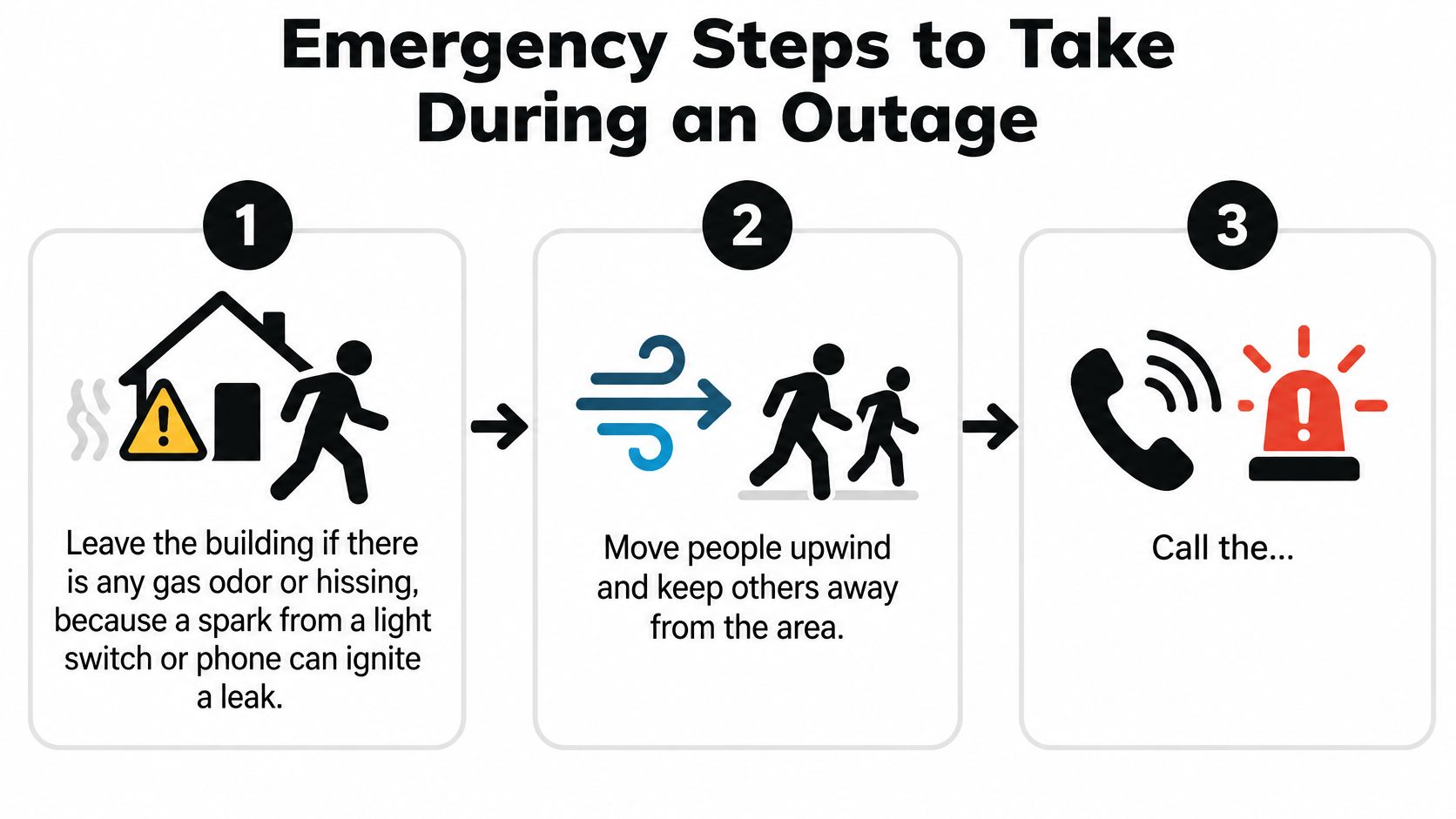
Leave if there's odor or hissing. Don't operate lights, electrical switches, phones or equipment in the suspected leak area. An electrical spark or flame could ignite escaping gas, so don't stay to investigate.
Move people away and upwind where practical. Keep clear of the suspected release and prevent others from entering. On commercial sites, notify the safety officer from a safe location, stop hot work through the site's emergency procedure and account for staff at the designated safe muster point.
Call from a safe distance. Give the utility the address, nearest access point and what you observed, including odor, sound, visible damage or excavation activity. Tell responders whether anyone is missing or needs assistance, and follow their exclusion-zone instructions.
Isolate appliances only when it's safe. During a confirmed supply interruption without leak indications, turn appliance controls off to prevent an unattended restart. Operate the building's main valve only if the utility directs you to and it's safely accessible; never approach a suspected leak to reach it, and never reopen a closed utility valve yourself.
Keep ignition sources off. Don't smoke, light pilots or use open flames around the affected area. Leave equipment off until responders authorize restoration, rather than assuming a returning flame means the system is ready.
Don't delay evacuation to ventilate. Leave doors or windows open only if doing so is immediately safe on your way out and consistent with emergency instructions. Don't walk through the building opening windows, operate fans or return inside to improve airflow.
Leave relighting to authorized personnel. Wait for the utility or a qualified technician acting under its restoration procedure. They must assess the affected equipment before returning it to operation.
Keep the exclusion in place
A common dangerous slip is re-entering for keys, drawings or a laptop. Assign someone to control access from outside the exclusion area, not from the doorway.
A safe restart means responders have released the area, affected appliances have been professionally checked and relit, and no gas odor remains. Absence of odor alone isn't clearance to enter.
Why Gas Service Takes Days to Return
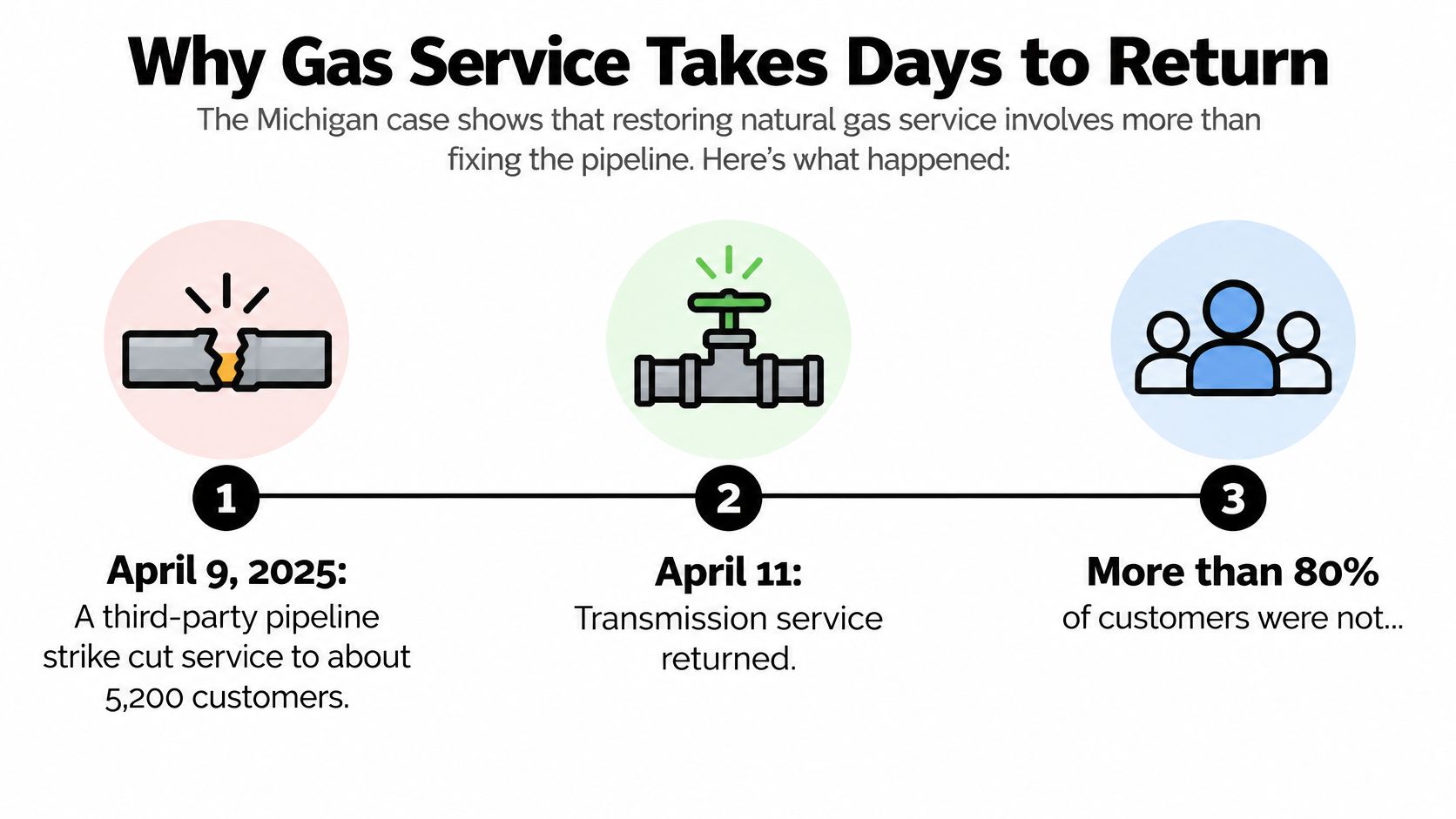
In Michigan, a third-party pipeline strike on April 9, 2025, interrupted service for about 5,200 customers; transmission service returned on April 11, and more than 80% of customers had been restored by April 14, according to the American Gas Association's Emergency Preparedness Handbook. The distinction matters: repairing the transmission line didn't automatically restore every customer.
Follow the customer-level restoration sequence
A depressurized district needs a controlled restoration program. The exact order depends on the utility's isolation plan, and meter shutoffs may begin before upstream repair is complete.
- Upstream flow becomes available. Transmission repair allows gas to reach the district again, but customer equipment remains subject to the restoration procedure.
- Affected meters are secured. The utility confirms required customer shutoffs before downstream repressurization.
- Mains are repressurized. Crews restore pressure in controlled stages and verify system conditions.
- Air is purged. Authorized personnel carry out the required purging procedure, not building occupants.
- Appliances are checked and relit. Technicians need access to the affected equipment and must resolve any faults before releasing it.
- Required approvals are completed. Where occupancy, commissioning or permitted work is involved, the authority having jurisdiction may need documentation before the project resumes.
Commercial relighting can take longer than residential work because crews may face multiple boilers, rooftop units, process burners and control interlocks. Locked mechanical rooms, unavailable equipment technicians and incomplete appliance lists can delay a visit even after a crew reaches the property.
Schedule against the authorized restart at your meter, not the announcement that pipeline repairs are complete.
Verify readiness before releasing crews
Use a written restart checklist rather than a verbal assurance that gas is back:
- Meter status: Obtain confirmation that service is restored at your meter and required shutoff and reopening steps are complete.
- Appliance status: Confirm a qualified technician checked and relit every affected appliance intended for use.
- Building safety: Confirm no odor remains, carbon monoxide alarms work and responders have cleared any restrictions.
- Project approval: Verify that documentation for occupancy, commissioning or freeze-protection arrangements has been accepted where required.
For an extended gap, our gas boxes provide quick backup for utility disruptions lasting more than an hour, and a Natural Gas Box is fully operational within minutes of connection to the building. Connection readiness and approvals still need to be established. We coordinate with gas utilities so the transition from temporary supply to permanent utility service is smooth.
Don't shut down temporary fuel until the permanent supply and required changeover checks are verified. Ask the utility: Is the repair complete? Is my meter still shut off? When is the relight visit scheduled? Use that last answer to book inspections and restart crews.
Which Loads to Protect First
| Load | Priority | Reason |
|---|---|---|
| Life-safety and alarm systems | 1 | People depend on them the moment power or fuel fails |
| Freeze protection for pipes, sprinklers and vessels | 2 | Freeze damage can outlast the outage itself |
| Process heat for active industrial operations | 3 | An uncontrolled shutdown can create equipment damage and difficult restart conditions |
| Backup generation for electrical loads | 4 | Keeps power running when gas and electricity fail together |
| Commissioning and occupancy inspections | 5 | Can be rescheduled, but delays permits and handover |
| Ordinary comfort heating | 6 | Important, but normally the first load to curtail |
This is a starting order for a confirmed supply interruption, not a reason to keep operating during a leak emergency. Evacuation and utility isolation take precedence over every production or schedule objective.
The WECC Extreme Cold Weather Report and Recommendations discusses serious interruptions affecting firm-contract customers while noting that large-volume customers weren't usually affected. A generally reliable system can still leave an individual site without usable supply.
Rank consequences, not equipment size
Inventory every gas-dependent load before winter or planned maintenance. Record its required pressure, peak demand, minimum operating demand, electrical dependencies and safe shutdown procedure. Identify the person authorized to shed it and the technician needed to restart it.
Adjust the table when a load serves a higher-priority function. A generator supporting life-safety equipment belongs with that function, not automatically below process heat. Likewise, comfort heating in an occupied care setting may protect people rather than merely provide convenience.
For each load, distinguish between continued operation and controlled shutdown. A process may need enough fuel to complete a safe shutdown rather than enough to sustain full production throughout the interruption. That distinction can reduce temporary capacity without accepting an uncontrolled stop.
Say a construction site loses gas during freezing weather. Protecting water lines and sprinkler piping takes precedence over heating a model home for a sales demonstration. Keep commissioning work paused if its fuel demand would jeopardize freeze protection, and coordinate any fire-system impairment through the site's established procedure.
Planning rule: Assign priority by the consequence of losing the load, not by which subcontractor asks first.
Write the final ranking into the outage plan. Include a named utility contact, a load-shedding decision-maker and a restart order that avoids bringing every burner online together.
Temporary Gas Options That Keep Work Running
| Option | Best for | Setup needs | Role during outage |
|---|---|---|---|
| Mobile CNG unit | Sites waiting for a permanent line or a short repair window | Compatible equipment, safe access, ventilation and approved procedure | Bridges the gap until service returns |
| LNG vaporization supply | Large loads or longer interruptions | Storage container, vaporizer, regulator and pipeline tie-in | Feeds the downstream section while the main is repaired |
| Pause non-critical work | Comfort heating, finishes and other loads that can wait | No temporary fuel equipment, but a revised schedule and safe shutdown | Avoids temporary-equipment and permitting risk until restoration |
Use temporary fuel for loads that can't safely stop, and pause the rest. Temporary supply is justified by the consequences avoided, not by the inconvenience of an outage.
A mobile compressed natural gas arrangement can suit an isolated building or a defined repair window. The practical constraints are usable fuel capacity, delivery access and the pressure and flow required at the connection. Nameplate burner demand alone won't establish whether the arrangement can support simultaneous starts.
Match capacity to the interruption
Liquefied natural gas vaporization can support larger demand or a longer interruption, including an approved downstream pipeline supply. It also requires more site coordination: storage placement, vaporization capacity, pressure regulation, odorization arrangements and a defined operating area. Don't choose it solely because the outage estimate sounds long.
Pausing work may be the better decision when loads are discretionary or restoration is sufficiently certain. Consider the whole delay, including approvals, connection, monitoring and removal. Temporary fuel doesn't eliminate the need for equipment checks or inspection acceptance.
Communication needs its own contingency arrangement. Yellow.ai's approach to business continuity is relevant when planning how customers and staff receive consistent updates. Keep fuel authorization with the utility and responsible site personnel, separate from general status messaging.
Before selecting an option, establish the protected load, expected duration, access route, electrical needs and replenishment arrangements. Obtain utility and fire-authority approval as applicable, and define who can stop the operation if conditions change.
Every temporary connection should have the utility's written agreement before it goes live, with isolation boundaries, operating responsibility and the permanent-service changeover procedure recorded.
Blue Gas Express provides temporary mobile natural gas for utility interruptions, maintenance outages and delayed permanent connections. Visit Blue Gas Express with your site location, critical loads and expected outage window to coordinate a temporary supply plan with your utility before committing to a restart date.