

Diesel's Producer Price Index jumped 34.6% in August 2023, its largest monthly increase since 1990, according to the Associated General Contractors of America, as reported by Construction Dive. That's a strong reason to watch fuel costs. It isn't a reason to fill every available tank.
For a superintendent, jobsite fuel delivery succeeds when the fuel can be received safely and lasts until the next usable delivery window. The posted price matters, but so do the receiving pad, truck access, equipment compatibility, and replenishment trigger. And when the schedule needs natural gas before the utility connection is ready, another diesel delivery won't solve the problem.
Diesel CNG and LNG on the Same Jobsite
Choose the fuel the equipment can use, then compare the delivery setup. Diesel serves liquid-fueled construction machinery. Compressed natural gas, or CNG, and liquefied natural gas, or LNG, supply compatible gas equipment through systems that control pressure and flow.
The common yardstick for comparing gas quantities is the gasoline-gallon equivalent, or GGE, which measures energy rather than container volume. The U.S. Department of Energy's fuel-properties comparison gives 5.66 pounds or 123.57 standard cubic feet of CNG per GGE, and 5.37 pounds of LNG per GGE; it also identifies CNG storage pressures up to 3,600 psi and LNG storage near minus 260°F.
Diesel, CNG, and LNG for jobsite delivery
| Fuel | Energy basis | How it is stored | Typical jobsite fit | Main constraint |
|---|---|---|---|---|
| Diesel | Liquid distillate for most construction machines | Tanks and approved portable containers | Excavation, lifting, paving, generators | Spill and fire rules, access, price swings |
| CNG | GGE measured by gas mass or standard volume | High-pressure compressed gas | Building gas, temporary heat, early commissioning | High-pressure gear and potentially more frequent refills |
| LNG | GGE measured by liquid mass | Cryogenic liquid in insulated vessels | High load or long run in limited trailer space | Cryogenic handling and temporary-facility rules |
Compare energy before comparing deliveries
A gallon of diesel and a gallon of LNG aren't interchangeable quantities of useful work. Neither can be compared directly with a CNG trailer's standard cubic feet without converting them to a common energy basis.
Start with the equipment schedule and manufacturer's fuel-input requirements. For a boiler, collect its rated input and expected firing pattern. For a generator, use consumption at the anticipated electrical load, not just its maximum nameplate output.
Then have the gas supply calculation account for the supplier's actual heating value. Gas composition and operating conditions affect the result, so a generic conversion is a screening tool, not a final delivery order.
The practical comparison should include:
- Required energy: The total demand over the operating window.
- Usable inventory: What the delivery system can supply at the required outlet conditions.
- Installed footprint: Storage, conditioning equipment, and clear working space.
- Delivery interval: How often the system must be replenished.
- Equipment compatibility: Fuel type, connection, pressure, and flow requirements.
Choose the constraint you can manage
CNG avoids cryogenic liquid handling, but its high-pressure storage can mean more trailer space or shorter replenishment intervals for a sustained load. LNG concentrates more energy into storage volume, which can help when space or delivery access is tight.
That compact storage comes with additional equipment and procedures. LNG must be transferred and vaporized safely, with pressure controlled throughout operation.
Fuel selection isn't an engine-conversion decision. A diesel excavator doesn't become gas-compatible because a mobile gas unit arrives. The useful question is whether the site needs fuel for diesel machines, gas for building systems, or separate delivery plans for both.
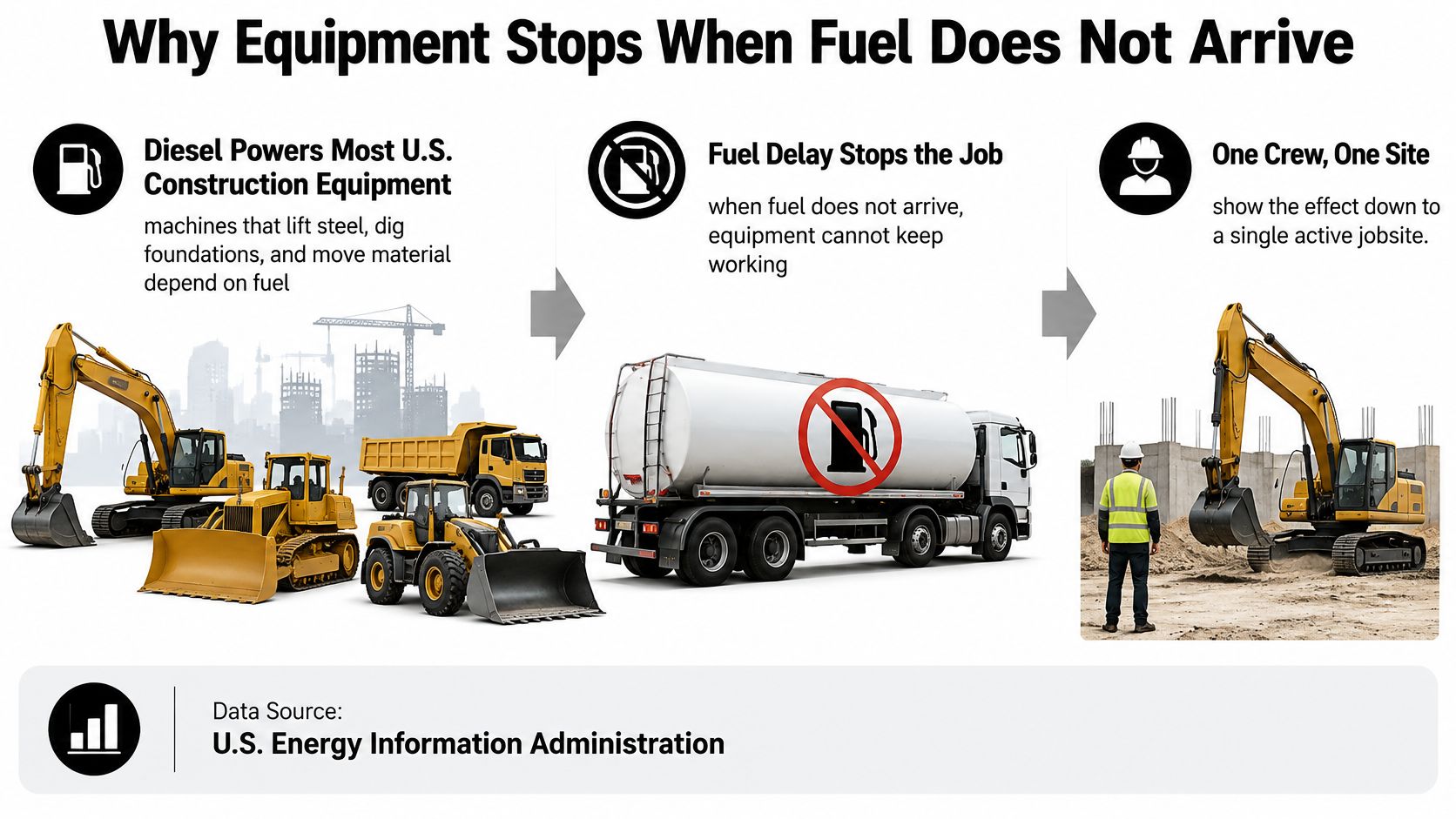
Why Equipment Stops When Fuel Does Not Arrive
The national scale helps explain why fuel logistics deserve a place on the construction schedule. The U.S. Energy Information Administration reports that diesel powers most U.S. construction equipment and that the transportation sector consumed approximately 2.98 million barrels of distillate daily in 2022, equivalent to about 125 million gallons.
That transportation total includes trucking and other activity. It isn't a construction-site consumption estimate, but it shows the broader dependence on dependable diesel supply.
At the jobsite level, the consequence is easier to see. Say an excavator, a lift, a paver, and a generator all depend on the same replenishment plan. If the delivery truck misses its access window, several separate activities can lose their fuel supply together.
Follow the effect through the crew
The excavator operator stops digging, but the effect doesn't end at the cab. Laborers waiting on the trench can't continue their planned work, and the crew installing material behind them loses its work front.
A lift without fuel can hold up overhead installation. A generator shutdown can interrupt tools or temporary services. A paver waiting for fuel can disrupt the coordination between equipment, material deliveries, and the crew placing the work.
Fuel is like the extension cord for the site. People rarely discuss it while everything runs, but disconnect it and the dependencies become obvious.
A delivery window belongs on the look-ahead schedule whenever missing it would stop a critical activity.
Keep the machines where the work is
Direct-to-equipment delivery can keep machines in their working areas instead of sending them away from a remote site for refueling. Bulk delivery can also work, provided the receiving location and on-site dispensing arrangement are ready.
The superintendent should distinguish those methods before ordering. A truck scheduled to fill a bulk tank isn't automatically scheduled to find and fuel equipment scattered across the project.
Record the receiving method, equipment locations, gate contact, and access restrictions on the delivery ticket. If an excavation or concrete placement will close the approach, move the delivery window before crews begin blocking it.
The replenishment trigger needs a level and a clock. Record how much usable fuel remains and when the supplier must arrive, rather than waiting until someone decides the gauge looks low.
Size Each Drop for the Site You Have
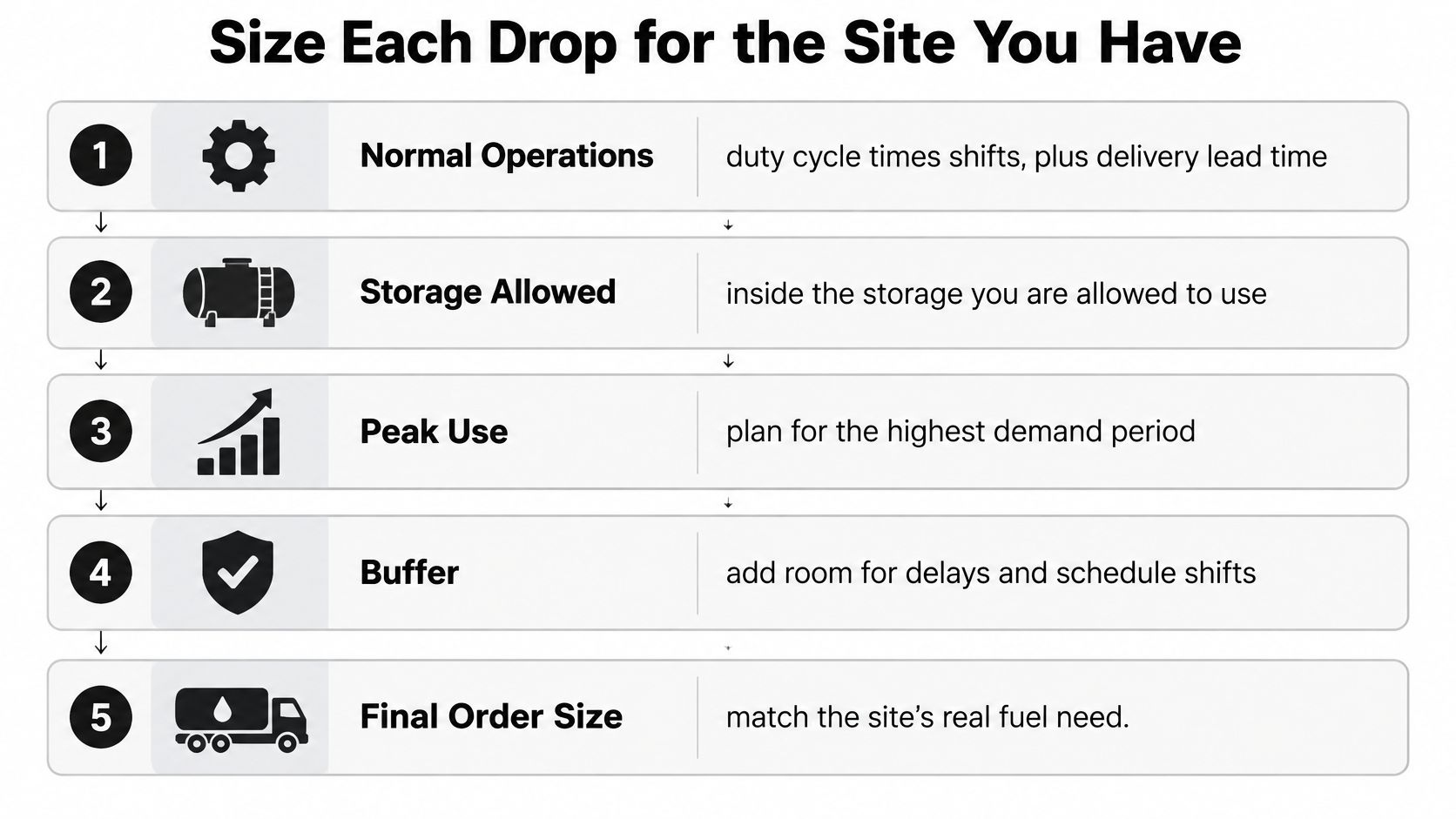
Average daily consumption is a starting point, not an order quantity. A machine working intermittently uses fuel differently from the same machine running through an extended shift, and temporary heating can change demand without adding anything to the equipment roster.
Build the order around the condition the site will face. Then fit that demand within the storage and access limits.
Delivery size and reorder trigger by site condition
| Condition | What to cover | Cadence | Reorder trigger |
|---|---|---|---|
| Normal operations | Duty cycle times shifts, plus delivery lead time, inside allowed storage | Scheduled drops | Level that still beats lead time and a missed access window |
| Peak winter demand | Added temporary heat and generator hours | Shorter interval than the fair-weather plan | Forecast cold plus rising daily burn |
| Emergency outage | Critical loads only, not a stockpile | On demand | Outage notice and remaining hours of cover |
| Delayed utility connection | Equipment being commissioned until permanent gas is live | Match remaining calendar days | Days of cover versus the utility date |
| Underground diesel | No more than the permitted equipment supply | Often daily | Shift-end inventory check before ordering |
Work through the operating conditions
For normal operations, multiply expected operating hours by consumption at the working load. Include every shift, then account for supplier lead time and periods when the delivery truck can't enter.
For peak winter demand, add temporary heaters and longer generator operation before setting the cadence. A fleet count that hasn't changed can still require more frequent deliveries.
An emergency outage calls for a critical-load list. Decide which systems must operate and which can remain off, rather than ordering enough fuel to run everything indefinitely.
A delayed utility connection needs a different calculation: the boilers, heaters, or generators being commissioned, their operating sequence, and the remaining temporary-service period. Annual gas bills won't describe that short-term load accurately.
For underground diesel, OSHA's underground-construction standard limits storage to a 24-hour equipment supply, including surface tanks feeding underground equipment, and requires tightly sealed containers, fire-resistant storage arrangements, and protection against spills escaping the storage area.
Check capacity against the delivery clock
Use this working check:
Planning check: Usable capacity minus the protected reserve, divided by expected daily consumption, must cover supplier lead time plus a missed access window.
Use consistent units. For gas, calculate days of cover from usable energy and the equipment's expected demand, not trailer volume alone.
If the check fails, shorten the delivery interval, protect another access opportunity, or revise the approved supply arrangement. Don't add inventory beyond the site's permitted capacity.
Price volatility belongs in the purchasing decision, not outside the storage rules. AGC reported that diesel had risen 77 cents over the preceding 10 weeks in August 2023, according to Construction Equipment. Buying ahead still has to fit the receiving setup.
When facilities staff take over replenishment from the construction team, Facility Management Insights' resource on supply chain optimization for facility teams provides useful context for organizing the handoff. Keep the consumption log, ordering authority, delivery restrictions, and inventory trigger together.
Rules That Make a Delivery Usable
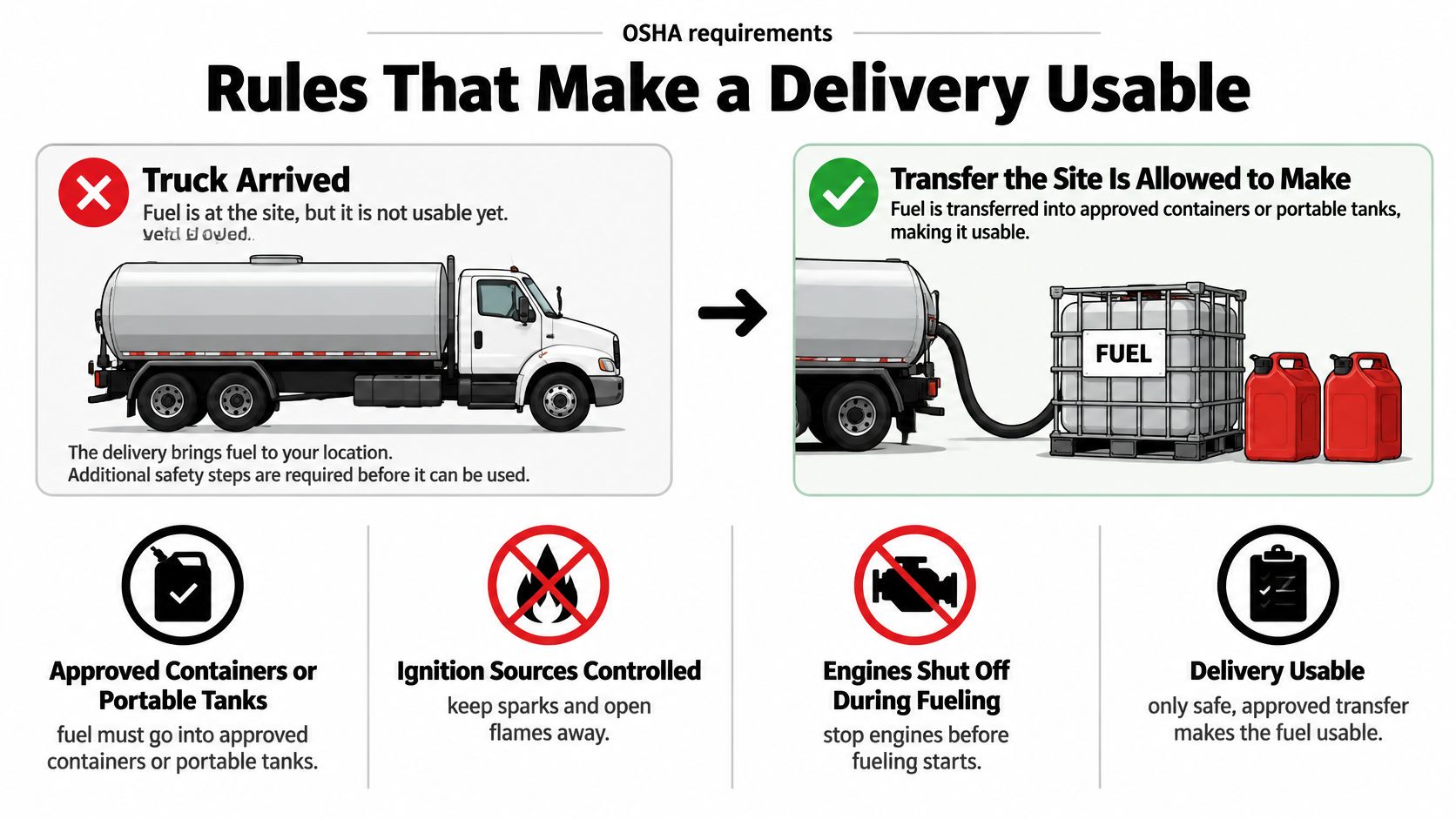
A fuel truck can arrive exactly on time and still leave the crew without usable fuel. If the receiving area is blocked, the container isn't approved, or the transfer can't be performed safely, arrival alone hasn't protected the schedule.
OSHA's construction fuel-handling requirements call for approved containers or portable tanks, ignition-source controls, engines shut off during fueling, a fire extinguisher within 75 feet of each pump, dispenser, fill pipe, or service area, and a 12-foot-wide access way within 200 feet of each portable tank for fire-control equipment.
These are construction-site requirements, not a universal approval for every fuel installation. Gasoline, diesel, LPG, CNG, and LNG don't share an interchangeable storage or transfer procedure.
Walk the receiving area that morning
Check the pad against the site as it exists today. A location that worked during excavation may no longer work after crews install scaffolding, park office trailers, or reroute haul traffic.
Confirm that the tank and transfer area are protected from vehicle strikes and separated appropriately from combustible materials. Walk the truck's approach and departure route, including turning room, overhead obstructions, ground condition, and any excavation beside the route.
Check bonding where the applicable transfer procedure calls for it. Put the extinguisher in its designated position, identify emergency shutoffs, and name the person who will supervise the transfer.
Confirm local fire-marshal approval when the jurisdiction requires it for the temporary fueling setup. An earlier approval shouldn't be treated as permission to relocate or expand the installation without review.
Assign each control to an owner
Use the project's responsibility sheet to make the division explicit:
- Fuel supplier: Bring compliant delivery equipment and a trained driver, and follow the agreed transfer procedure.
- General contractor: Prepare the receiving pad, manage traffic, and keep the approach available.
- Site safety manager: Verify the applicable separations, fire protection, and emergency arrangements.
- Facility operator: Apply plant-specific rules when construction takes place inside an operating facility.
Those assignments don't replace legal duties. They prevent the practical gap in which everyone assumes another person checked the same control.
The receiving contact should have authority to stop an unsafe transfer. That person also needs a way to reach the superintendent without leaving the transfer unattended.
The lowest delivered price isn't necessarily the lowest project cost. If an inspector requires the tank to be moved, the contractor may need another suitable pad, revised access, and a rescheduled delivery while the crew waits. A pre-delivery walk is easier to arrange than an emergency relocation.
Temporary LNG When the Calendar Slips
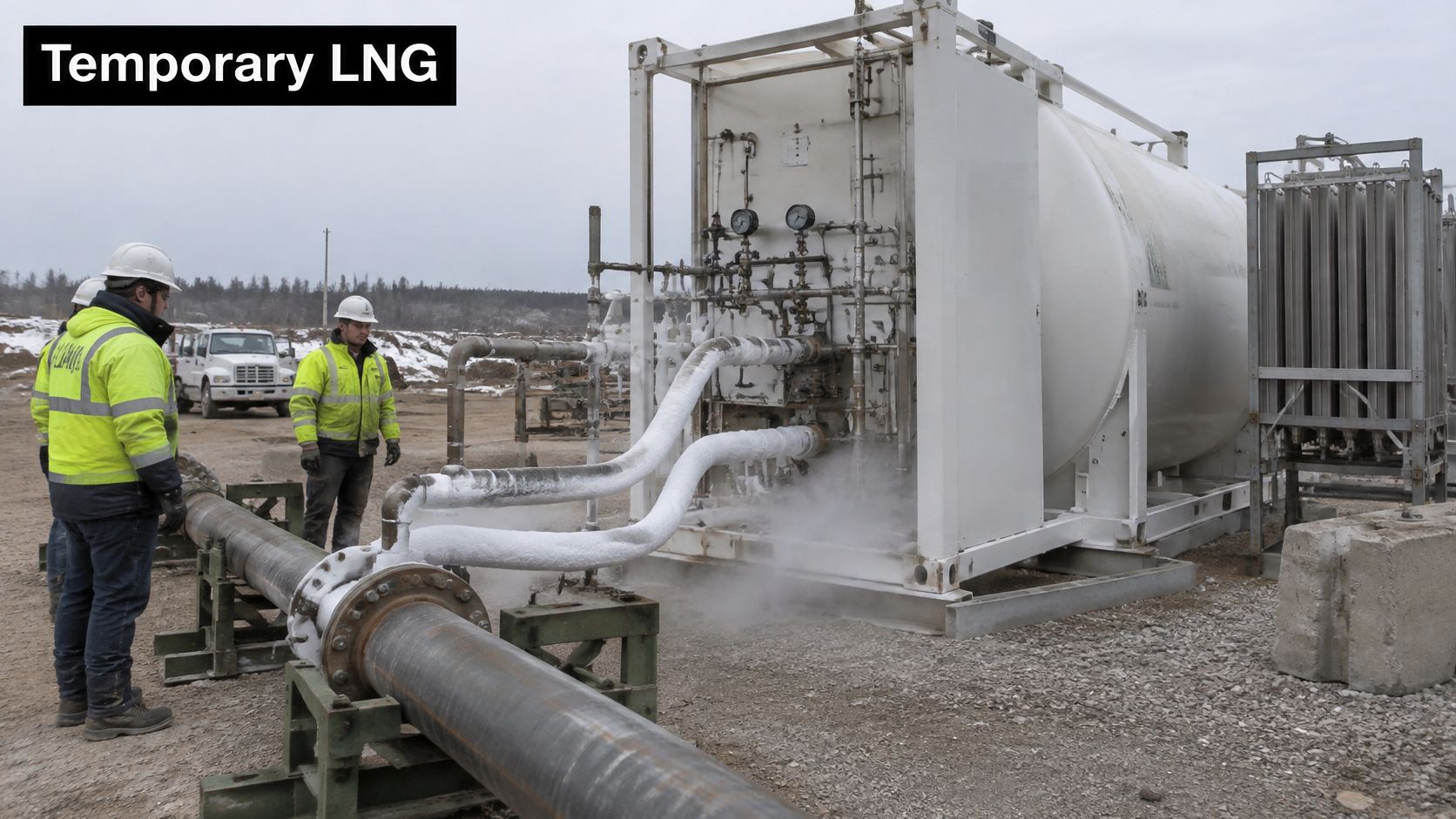
Temporary LNG combines pressurized equipment, flammable methane vapor, and cryogenic liquid. Treat it as a distinct installation, not a diesel tank with different contents.
Under 49 CFR Part 193, qualifying mobile and temporary LNG facilities used for short-term work may be excepted from portions of the federal framework when they comply with applicable NFPA 59A requirements; the temporary-installation framework includes a 180-day limit for certain installations before additional compliance conditions apply.
That isn't a blanket exemption for every construction project. The installation's purpose, governing requirements, and authority having jurisdiction need to be established before mobilization.
Treat an extension as a design change
Say a temporary unit is installed for a short maintenance outage. The repair expands, replacement parts arrive late, and the temporary gas supply remains through a longer operating period.
The project manager shouldn't extend the rental calendar without checking the installation's compliance basis. A longer duration can require revised siting, fire protection, documentation, inspections, or permits.
Set a review date before the applicable temporary-use threshold. Give the responsible engineer and permitting authority enough time to decide whether the setup can remain or must change.
A schedule extension can change the compliance plan even when the gas load stays the same.
Settle the release and shutdown plan
Before the first transfer, document the controls that apply to the actual pad:
- Separation and access: Establish boundaries and prevent unauthorized entry.
- Emergency shutdown: Identify shutdown points and who is trained to operate them.
- Electrical controls: Confirm grounding and bonding procedures.
- Vapor assessment: Provide methane detection where accumulation is possible.
- Personnel protection: Train handlers in transfer procedures and cryogenic protective equipment.
LNG vapor generally becomes lighter than air after warming. A cold release can behave differently depending on temperature, wind, ventilation, and nearby structures, so assess dispersion at the installation rather than relying on a slogan about methane rising.
CNG may be a non-cryogenic alternative for a shorter building tie-in, provided its supply arrangement meets the load. For LNG, put the installation date and the applicable temporary-use review milestone on the project calendar when the unit is set, not when the original completion date slips.
Mobile Gas That Keeps Milestones Moving
A subdivision is ready to show homes, but the permanent gas main isn't ready. Temporary gas supplied into the approved new lines can let the builder operate ranges, fireplaces, and heating while the utility completes its work.
The important date is the model-home opening. The builder needs an authorized gas connection and enough supply for demonstrations and building operation, not just a trailer parked nearby.
Match temporary service to the milestone
A commercial shell faces a different deadline: commissioning and the occupancy process. Gas at the building connection can let crews prove rooftop units and a compatible generator before permanent service becomes available.
Temporary gas doesn't guarantee an occupancy permit. It supplies the fuel needed for the relevant tests, while the contractor still has to satisfy the inspector, equipment startup procedures, and utility coordination requirements.
Then a cold snap threatens concrete curing and freeze protection. Gas-fired temporary heat may replace scattered propane-based area heaters where the load, distribution arrangement, and code path fit.
For that project, the target is a protected overnight condition or a curing window, not continuous service through an open-ended construction phase. The temporary supply should be sized around that defined task.
A mobile gas unit works somewhat like a temporary substitute for utility service: the equipment needs the specified gas pressure and flow at its connection. The contractor still needs an engineered, approved arrangement between the supply and the equipment.
Put performance commitments in writing
Our deployment process can put mobile gas units on the way within a few hours of a customer's request. Once our team arrives onsite, the mobile gas connection can be completed in 30 minutes or less.
Those capabilities don't eliminate site preparation. The delivery route, receiving location, connection readiness, and required approvals must align with the mobilization window.
The contractor's acceptance sheet should capture:
- Arrival window: When the delivery team is committed to reaching the site.
- Connection time: When gas service is expected to be available after arrival.
- Flow and pressure: The operating conditions the supply must maintain.
- Days of cover: Inventory expressed against the planned load.
- Refill continuity: How the load stays supplied during replenishment.
Our gas manifold allows a second mobile gas unit to connect while the main unit is taken to a CNG station for refilling. Identify that changeover arrangement before commissioning starts, rather than discovering during a test that replenishment requires an interruption.
Judge the supply plan by those written commitments. General statements about speed or geographic coverage won't tell the commissioning team whether the building will have gas at the required moment.
Lock the Fuel Plan Before Mobilization
Diesel machines: Schedule deliveries inside the site's storage and access limits. Don't stockpile just because extra inventory feels reassuring.
Gas needed before the utility is ready: Match the supply system to the energy load and expected service window, and calendar any required temporary-installation review.
Short cold snaps: Match temporary heat to the forecast operating period, then remove capacity when the need ends.
Build the quote from the work
Prepare a concise fuel brief before requesting prices. Include the equipment to be fueled or supplied with gas, required flow and pressure, expected operating duration, receiving-pad limits, and truck access restrictions.
Add the reorder trigger, the named owner of each safety control, and the expected end of temporary service. Include how the load changes as crews commission equipment or turn permanent systems over to the owner.
For estimating teams using digital takeoffs, Exayard construction estimating software can sit alongside this planning process. Keep the fuel brief with the estimate so temporary service, site preparation, and changing project phases aren't treated as disconnected allowances.
- Define the start: State when fuel or gas must be available for productive work.
- Describe the changes: Identify equipment additions, commissioning peaks, and planned shutdowns.
- Define the finish: State what confirms that temporary supply can leave.
Our Sales team at Blue Gas Express can use that brief to prepare a custom mobile-unit quote. We rent mobile natural gas for buildings and pipelines while customers wait for a permanent line or where no pipeline serves the site, and we can increase or decrease the number of units as project needs change.
Make the call before the inspection or first freeze. The plan is ready when the fuel, receiving location, replenishment trigger, and control owners are written down.
Blue Gas Express offers temporary mobile natural gas for jobsites, buildings, and pipelines when permanent service isn't available. Visit Blue Gas Express with your equipment list, gas requirements, site constraints, and schedule to request a custom quote and plan how supply will change through the project.