

The tenant build-out is finished, the equipment is on site, and the opening date is already on the calendar. Then the final inspection turns up a missing trade sign-off, an inaccessible room, or a utility system that isn't operating as approved. Until the authority clears the issue, a nearly complete building may still be legally unavailable for business.
That's why an occupancy permit for business should be treated as a project milestone, not a last-minute form. The process brings building safety, permitted use, trade work, agency approvals, and utility readiness together at the point when people are meant to occupy the premises.
What an Occupancy Permit for Business Actually Means
A commercial space may be finished, yet still be unavailable for lawful business use. A final inspection can hold approval until the building official receives a required trade sign-off or confirms that a life-safety system is ready. The coordination gap is often between completed construction and proof that every system and responsible trade is ready for occupancy.
An occupancy permit, often called a Certificate of Occupancy (CO), is the authority's approval to occupy a building or use it for its intended business purpose. The World Bank's description of occupancy permits explains that a certificate confirms compliance with applicable building codes, zoning rules, health and sanitation requirements, fire-safety standards, accessibility obligations, and other local laws.
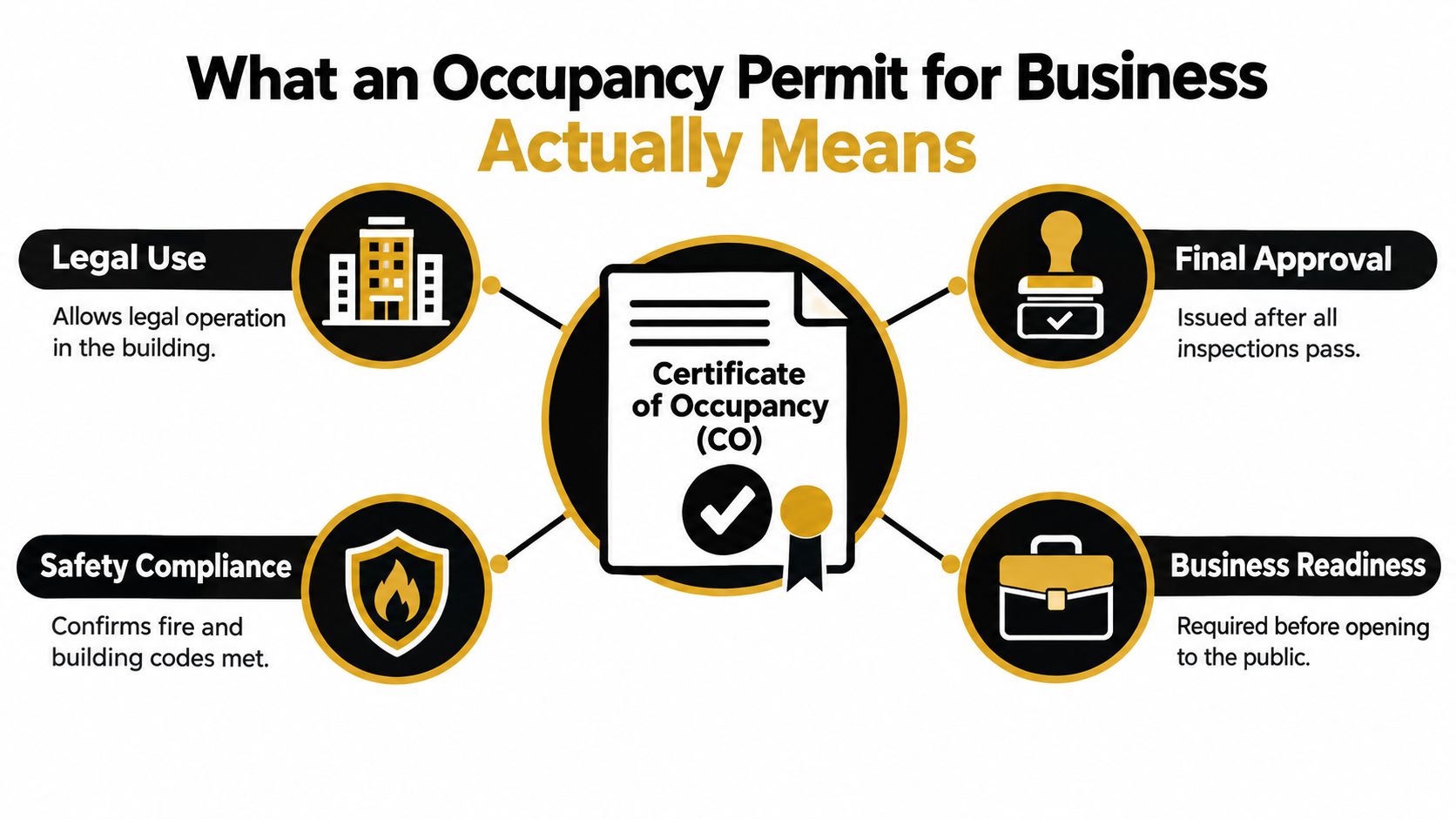
The permit documents that required safety and use checks are complete before employees, customers, tenants, or equipment move in. An unfinished inspection, an unready life-safety system, or an unavailable building service can delay operations even when the visible work is done. Utility readiness matters too: the final checkpoint brings service status, trade approvals, and any temporary gas arrangements into the same approval picture.
Local approval, not a universal form
Requirements vary by location. The owner or project team needs to confirm the rules with the city, county, or other authority responsible for the property. For a practical discussion of building regulations and compliance considerations, check Premier Builders guidance.
For construction companies, commercial owners, industrial facilities, and utilities, the CO belongs on the project schedule alongside commissioning and turnover. It is the point at which the authority checks that the proposed use, completed building, and required services are ready to align. The World Bank's research into construction regulation has documented authorities introducing information technology to improve building control and permitting, highlighting how permit administration is part of the approval process.
Eligibility and Required Documents
A building's history matters. So does the business that plans to occupy it. Before gathering paperwork, confirm that the proposed use and the building's existing approval status fit together. A space already approved for one kind of commercial use may require review before it can be used for another, even if the building itself hasn't changed.
Philadelphia's history illustrates how occupancy requirements developed through local building-safety milestones rather than one nationwide U.S. rule. The city reports enforcing building regulations since at least 1855; Pennsylvania's Fire and Panic Act established minimum commercial-building safety requirements in 1927; and Philadelphia began issuing Certificates of Occupancy in 1969. The city adopted the Pennsylvania Uniform Construction Code in 2004, then extended CO-related requirements to certain existing commercial buildings through the 2005 Uncertified Building Act. Los Angeles records a separate progression, from requirements affecting new apartments and regulated buildings in the 1940s to broader rules covering new buildings and changes in occupancy designation by the 1960s. These local histories show why a building's age and intended use can affect its review. Philadelphia's occupancy-certificate history provides useful context, while Material Handling USA facility design compliance offers another perspective on planning for code compliance.
Build a document set that matches the project
Use this checklist to get the closeout package in order:
- Approved plans and permits: Keep the approved drawings and permit records available, including revisions that reflect the work completed.
- Trade sign-offs: Track required structural, electrical, plumbing, mechanical, fire-alarm, sprinkler, elevator, and accessibility approvals where applicable.
- System certifications: Gather required certifications for life-safety and building systems, including fire alarms, sprinklers, and elevators.
- Use and occupancy details: Confirm that the intended business use and occupancy classification match the approved plans and the authority's records.
- Commissioning information: Coordinate building-system commissioning with final occupancy inspections. Temporary gas service or generators aren't separate from closeout if they affect approved plans, mechanical operation, or safety.
Renovations and additions can create their own approval obligations. Don't assume an existing CO automatically covers altered space or a changed business use. Ask the local authority what it expects before finalizing the turnover schedule.
The Inspection Process Step by Step
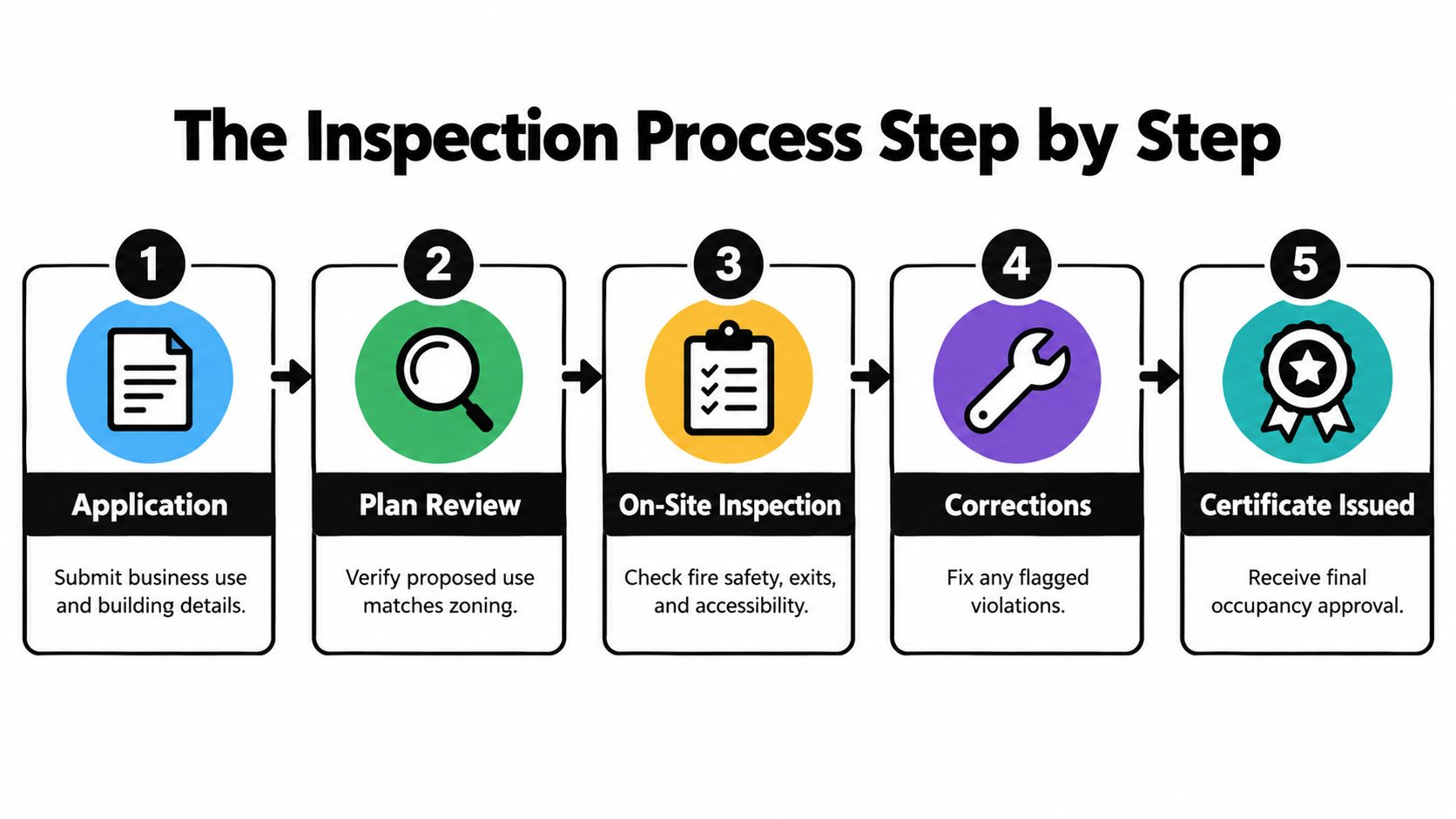
Treat the inspection process as a series of gates. Booking one final visit before the trade work and paperwork are ready usually creates a failed inspection or a return visit, not a faster certificate.
Clear the prerequisites before requesting final review
Start by confirming that the business use and occupancy classification match the approved plans. Then verify that each required trade inspection has passed. Depending on the project, that can include structural, electrical, plumbing, mechanical, fire-alarm, sprinkler, elevator, and accessibility work.
After trade reviews, close violations and submit required certifications. Only then should the team request the building-authority final inspection. Have the stamped plans, permit records, equipment access, and qualified trade representatives ready. Chicago requires applicants to schedule and pass required inspections, provide approved technical documents, ensure access to all spaces, and supply inspection equipment. New York City likewise requires construction and trade sign-offs, survey and occupancy-schedule information, and violation clearance before a CO can be issued. The Chicago Certificate of Occupancy requirements set out the practical inspection and document expectations.
Practical rule: Put every prerequisite on a permit-readiness matrix, with one named owner and one evidence field for each item.
The matrix prevents an easy-to-miss handoff from becoming the reason the official can't complete the inspection. It should show what's required, who is responsible, and where the signed record or certification can be found.
Include utilities and temporary systems in the inspection plan
Temporary fuel, generator, and utility arrangements aren't automatically outside the inspection scope. If they affect life safety, mechanical operation, fire protection, or approved plans, obtain the authority's written acceptance before inspection. A temporary system that's installed or operating differently from the approved documents can trigger questions the team could have resolved earlier.
Common failure points include incomplete trade sign-offs, inaccessible rooms, uncorrected violations, missing special-inspection certificates, and a use change that hasn't been reflected in the CO. Philadelphia also identifies approved permits and plans, filed sprinkler, standpipe, and fire-alarm certifications, completed trade inspections, cleared violations, and paid reinspection fees as closeout requirements. Check the authority's own list rather than relying on a generic checklist.
Timelines and What Causes Delays
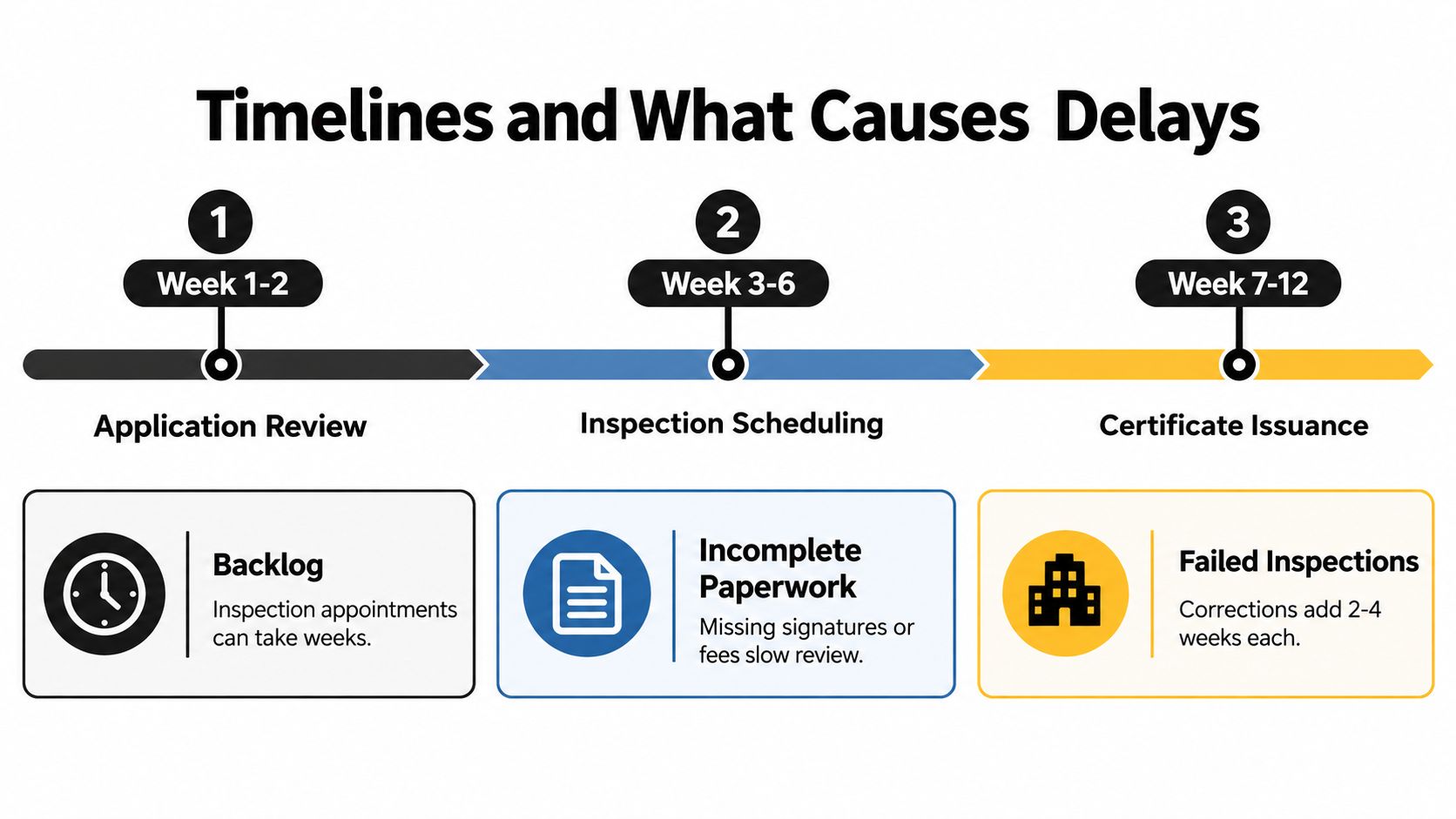
There isn't a dependable universal timeline for an occupancy permit. The schedule depends on the jurisdiction, the building's condition, the scope of work, the inspection queue, and whether all agency conditions are already satisfied. A team that treats the final inspection as the whole process often discovers too late that an earlier sign-off or an unavailable utility service is the actual constraint.
York County's reported inspection workload offers a local example of why scheduling deserves attention. The county reported 15,583 total inspections in FY2025, up from 15,404 in FY2024, while building inspections rose from 4,830 to 5,050. Those figures don't predict wait times in another jurisdiction, but they show that inspection departments handle substantial workloads. The figures are reported on the New York City Certificate of Occupancy guidance page.
Plan around dependencies, not optimistic dates
A standard CO is released after final inspection approval and all agency conditions are met. Larimer County provides a jurisdiction-specific example: after approval, its certificate or completion letter is automatically posted within 48 hours. That's a local process detail, not a deadline businesses should expect elsewhere.
Delays commonly come from unfinished prerequisites rather than the inspection visit itself:
- Trade approvals still open: One missing sign-off can hold up the final review.
- Rooms or equipment can't be accessed: Inspectors need to examine the required spaces and systems.
- Violations remain unresolved: The authority can't clear the job while required corrections remain open.
- Special-inspection records are missing: Work may be complete, but the supporting certificate isn't in the file.
- The approved use doesn't match the intended use: A change that isn't reflected in the CO can require further review.
Build the schedule backward from the intended occupancy date, allowing time to close each dependency before requesting final inspection. Confirm appointment availability directly with the authority, and update the plan when a trade or utility milestone slips. A realistic schedule gives the team time to resolve issues; a date built around unverified assumptions just moves the problem closer to opening day.
Temporary Certificates of Occupancy Explained
A project may be ready to occupy one area while work continues elsewhere. A Temporary Certificate of Occupancy (TCO) can permit that phased use, provided the issuing authority finds the designated space safe and sets clear conditions. It does not replace final life-safety work or the final CO. Treat it as time-limited permission with specific obligations and an end point.
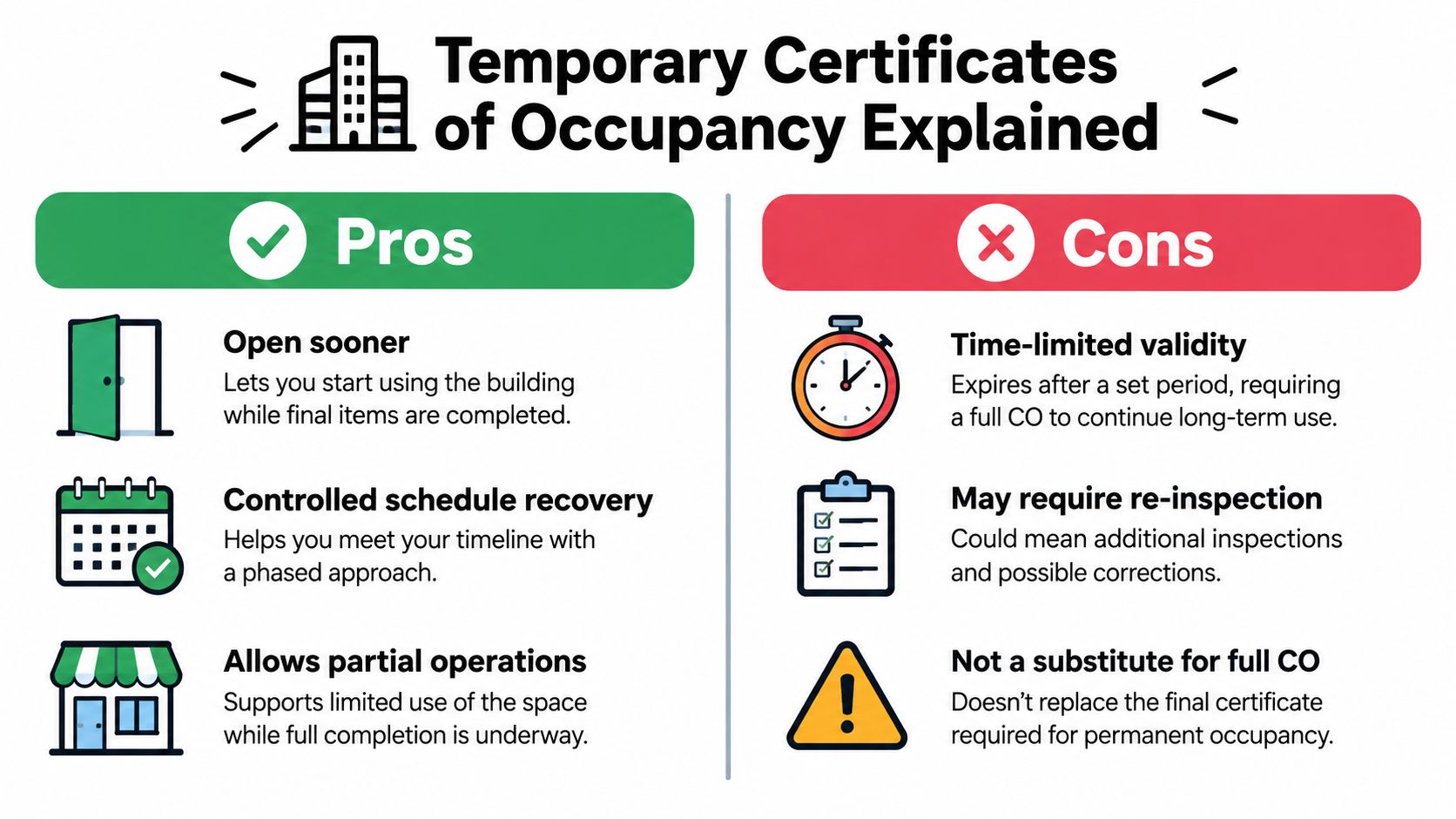
Before applying, define the exact area and business use. Keep occupied space separate from construction zones, document fire and egress controls, and secure the required temporary or final trade approvals. Assign an owner and deadline to each open item, then ask the authority to confirm the TCO's duration and conditions in writing. Utility readiness and trade sign-offs need to line up with the proposed occupancy, not just the building inspection.
Expiration rules shape the operating plan
TCO terms depend on the jurisdiction. New York City says a TCO may be issued when a building is safe to occupy despite unresolved issues. It typically expires after 90 days and may require renewal. A new TCO is also required if the space remains unoccupied for more than 30 days, according to the New York City TCO requirements. Confirm current requirements with the local authority before setting an opening date.
A TCO can support phased opening, equipment commissioning, or seasonal operations, but permission to occupy does not automatically authorize regulated equipment or every planned business activity. If operations pause, expiration and reoccupancy conditions may change the schedule. Put renewal dates, outstanding work, required inspections, and shutdown assumptions on the project calendar.
The certificate also marks a handoff between construction completion and operational readiness. Teams that are navigating the pre-opening construction gap should track outstanding approvals alongside the opening plan. A gas or generator system outside the approved scope can trigger reinspection or delay occupancy, even when the rest of the space is ready. Align the proposed TCO area, equipment approvals, and remaining work before requesting temporary occupancy.
How Temporary Natural Gas Solutions Support Permit Approval
The final occupancy risk is often a coordination problem across trades and utilities, not a single building-department form. A building can be nearly complete yet remain unavailable for lawful use because a supporting system, sign-off, or agency approval is missing. That's especially important when permanent gas service is delayed or an outage interrupts commissioning.
Temporary natural gas can help keep required building systems operating while permanent service is unavailable. Mobile compressed natural gas (CNG) and liquefied natural gas (LNG) units can support construction needs such as temporary heating or generator commissioning, subject to the project's approved plans and the relevant authority's requirements. They're not a substitute for permits or inspections. The team still needs to show that the arrangement is safe, suitable for the site, and accepted by the responsible authorities.
The useful question isn't simply whether temporary fuel is available. It's whether the equipment, approvals, and operating plan are ready for the authority to review.
Include the temporary system in the turnover dossier. Document its equipment location, ventilation, separation distances, fuel-system approvals, emergency shutoff details, commissioning records, and utility or fire-authority sign-offs. Coordinate the installation with the building official, contractor, utility, fire authority, and equipment provider before the final inspection. If the system affects fire protection, mechanical operation, or approved plans, get written acceptance rather than relying on an informal conversation.
Blue Gas Express provides mobile temporary CNG and LNG delivery across North Carolina, South Carolina, Tennessee, and Virginia for customers facing delayed gas-line installations or maintenance outages. Its mobile units can support construction, commercial, and industrial projects, including needs tied to occupancy approval and generator commissioning. The key is to bring the proposed setup into the approval conversation early, so a temporary utility solution supports the closeout plan instead of creating a late scope question.
Common Mistakes to Avoid and Final Checklist
The most expensive closeout mistakes often start with an assumption: that a CO is one inspection, that temporary utilities are separate from occupancy, or that a TCO stays valid until the final certificate arrives. Each assumption can leave the owner with a finished space but no clear path to open.
Use this checklist before requesting final or temporary occupancy:
- Verify the local rules: Confirm requirements with the city, county, or other authority responsible for the property.
- Match use to approval: Check that the proposed business activity and occupancy classification align with the approved plans and CO records.
- Close trade sign-offs: Confirm that all applicable inspections and required certifications are complete and filed.
- Keep the access and evidence ready: Make sure inspectors can enter all required spaces and review the relevant plans, permits, and equipment.
- Coordinate utilities early: Include temporary gas, generators, and other building services in the closeout plan when they affect approved systems or safety.
- Get written acceptance: Ask the building official to confirm how any outstanding item or temporary arrangement affects occupancy.
- Control TCO conditions: Record the occupied area, restrictions, remaining work, responsible parties, and renewal or expiration dates.
- Check the final documents: Make sure the issued certificate reflects the building's actual permitted use before employees, customers, or tenants move in.
A permit-readiness matrix is useful only if someone keeps it current. Assign owners, attach evidence, and revisit open items when scope or utility plans change. Don't request occupancy while a temporary system remains outside the approved scope, and don't treat a TCO as a permanent solution.
The practical goal is simple: bring the building, the paperwork, the utility systems, and the approved business use to the same finish line. If your project is waiting on natural gas service or needs temporary fuel for construction or commissioning, visit Blue Gas Express to discuss mobile CNG and LNG delivery for your site.