

When you need a supply of compressed natural gas, you’ve basically got two options: pull it from a permanent, fixed station or have it brought directly to you with a temporary mobile delivery service.
Mobile delivery is your lifeline for short-term projects, remote sites, or emergencies. Fixed stations, on the other hand, are built for the long haul, servicing consistent, daily demand like a fleet of CNG vehicles.
How to Source Compressed Natural Gas for Your Project
Securing a reliable CNG supply is more than just a purchase—it’s a critical logistical move that can make or break your project. For a construction manager, it might be the temporary heat needed to cure concrete and get that crucial occupancy permit. For a utility operator, it could be the emergency gas needed to keep customers online during an unexpected pipeline outage.
The stakes are always high. Delays aren't just an annoyance; they can trigger major financial penalties and derail entire project timelines.
This guide is designed to give commercial, industrial, and utility customers a clear, practical roadmap. We'll skip the jargon and get straight to the actionable steps you need to take to source CNG safely and efficiently.
Understanding Your Supply Options
Before you start hunting for suppliers, you need to understand the two fundamental ways CNG is delivered. Your choice here hinges entirely on your project's scope, timeline, and urgency.
Mobile CNG Delivery: This is exactly what it sounds like—CNG is brought directly to your site on specialized tube trailers. It’s the go-to solution for temporary or emergency needs where there’s no permanent infrastructure. Think of it as a "pipeline on wheels."
Fixed Refueling Stations: These are permanent facilities, similar to a typical gas station, built to handle ongoing demand. They are the backbone for commercial fleets that have made the switch to CNG-powered vehicles.
The real challenge for most people isn't just finding a CNG supplier, but figuring out which delivery method actually fits their project's unique demands. A construction site needing gas for a few weeks has completely different needs than a city bus fleet that has to refuel every single night.
This is the first and most important decision you'll make in the process. Getting it right from the start means you'll source your gas in the most cost-effective and logistically sound way, avoiding a world of headaches and unnecessary costs later on.
Mobile Delivery vs. Station Refueling: Choosing Your CNG Source
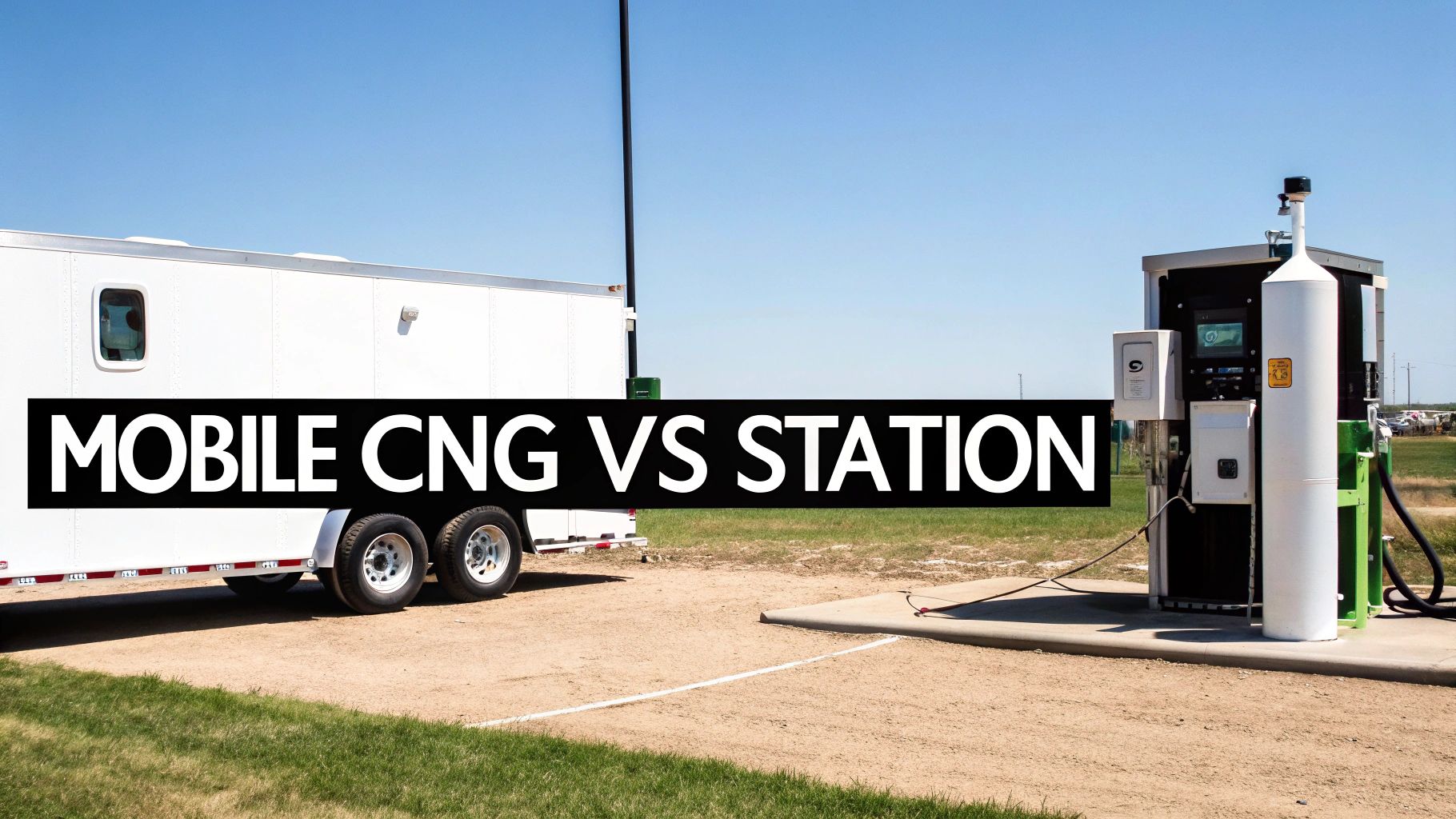
When you need to get compressed natural gas, the first big question you have to answer is how you're going to get it. Your choice boils down to two main paths: bringing the gas to your site with a temporary mobile supply or building a permanent, fixed refueling station.
This decision will shape your project's logistics, timeline, and budget. They each solve a very different kind of problem, and knowing the fundamental differences is the first step to making the right call for your operation.
Think of mobile CNG delivery as a "pipeline on wheels." It’s the go-to solution for any temporary, remote, or emergency need, bringing gas directly to you via large tube trailers when tying into a utility main just isn't an option.
On the other hand, fixed refueling stations are all about the long game. These permanent setups are the workhorses for businesses with steady, high-volume demand, like commercial fleets or factories that depend on CNG day in and day out.
When Mobile CNG Delivery Is the Right Choice
The biggest selling point for mobile CNG is its incredible adaptability. It truly excels in situations where infrastructure is missing, temporarily down, or just doesn't make financial sense for a short-term job.
Picture this real-world scenario: a construction manager is on the verge of getting a certificate of occupancy for a new commercial building. The problem? The gas utility’s final hookup is delayed by several weeks. Without gas, the permanent boilers and heating systems can't be commissioned, putting the entire project timeline and budget at risk. This is the exact moment mobile CNG becomes a project saver, deploying quickly to bridge that critical gap.
Mobile solutions are absolutely essential for:
- Emergency Utility Support: If a pipeline gets damaged, a mobile CNG unit can be dispatched almost immediately to keep gas flowing to homes and businesses, preventing a massive and costly outage.
- Pipeline Integrity Testing: Before a new gas pipeline can be brought online, it has to be rigorously pressure-tested. Mobile CNG provides the large, controlled volume of gas needed to perform this vital safety check.
- Remote or Off-Grid Operations: Need to power a generator at a remote drill site or a construction project miles from the nearest utility line? Mobile delivery makes it simple.
The real power of mobile CNG is its ability to eliminate delays. For our customers, waiting for a utility connection isn't just an inconvenience; it can mean thousands of dollars in lost revenue or project penalties every single day. A mobile solution turns that waiting time back into productive time.
The Case for Permanent Refueling Stations
Permanent stations are built for one reason: to establish a long-term, highly reliable fuel supply for consistent, everyday needs. Yes, the upfront investment is significant, but for the right operation, the long-term payoff in fuel cost savings over diesel or gasoline is massive.
A perfect example is a city transit authority running a fleet of 150 CNG buses. Trying to refuel that many vehicles daily with mobile trailers would be a logistical nightmare and financially impractical. Instead, they invest in a private, on-site fast-fill station that gets every bus topped off overnight, ensuring the entire fleet is ready to roll by morning.
These stations are the logical choice when you have:
- A large, centralized fleet of CNG-powered vehicles.
- A manufacturing process with a constant, predictable need for natural gas.
- A long-term corporate strategy focused on cutting fuel costs and emissions.
While the initial construction is a major undertaking, fixed stations deliver the lowest cost-per-gallon (or GGE) for natural gas over time. With the national average price for CNG often well below gasoline, the return on investment for high-mileage fleets becomes incredibly compelling. For sustained, predictable demand, permanent infrastructure is the undisputed winner.
Comparing Mobile CNG Delivery and On-Site Station Fills
To make the decision clearer, here’s a direct comparison to help you decide which CNG supply method best fits your operational needs and project timeline.
| Attribute | Mobile CNG Delivery (Tube Trailers) | On-Site Refueling Station |
|---|---|---|
| Best For | Temporary, emergency, or remote projects with no pipeline access | Long-term, high-volume, and consistent daily fueling needs |
| Deployment Speed | Fast. Can often be on-site within 24-48 hours | Slow. Construction can take 6-18 months or more |
| Upfront Cost | Low. Primarily service and delivery fees | High. Significant capital investment in infrastructure |
| Cost Per Unit | Higher due to transport and logistics | Lower over the long term, offering the best price per GGE |
| Flexibility | Extremely high. Can be moved to different sites as needed | None. It's a permanent, fixed asset |
| Ideal Use Cases | Pipeline outages, construction site power, utility bypasses | Fleet vehicle refueling, industrial process gas, transit authorities |
Ultimately, choosing a mobile solution buys you speed and flexibility, making it ideal for short-term or unpredictable needs. Opting for a permanent station is a strategic investment in long-term efficiency and cost savings for high-volume operations.
Nailing Down Your Project’s Exact CNG Needs
Before you even think about picking up the phone to order compressed natural gas, you need to have your numbers straight. Talking to a supplier without knowing your precise technical requirements is a surefire way to get a vague quote, or worse, the wrong setup for your job.
Think of it like ordering concrete for a foundation. You wouldn’t just ask for “a truck of concrete.” You’d specify the exact PSI, slump, and total cubic yards. CNG is no different. To get what you need quickly and cost-effectively, you have to be clear on three key things: volume, pressure, and duration.
Volume: How Much Gas Do You Actually Need?
First things first: what's the total volume of gas your project is going to burn through? In the CNG industry, this is measured in Standard Cubic Feet (SCF). Sometimes, for bigger jobs, you'll see it quoted in thousands of cubic feet (MCF).
For instance, a small construction site might just need 50,000 SCF to run temporary heaters for a couple of days to cure a concrete slab. On the other hand, a utility company doing integrity testing on a new pipeline could require a massive 5,000,000 SCF (or more) over the course of a week. Getting this number right is the starting point for everything else.
This isn't the time for guesswork. If you order too much, you're paying for gas you'll never use. But if you underestimate, you could be facing a complete project shutdown while you scramble for an emergency delivery. Do the math: calculate your equipment's consumption rate and multiply it by your total runtime.
Pressure and Flow Rate: The Nitty-Gritty Details
Next up are pressure and flow rate. Pressure, measured in Pounds per Square Inch (PSI), is all about the force the gas needs to be delivered at. The flow rate tells the supplier how fast your equipment will be using that gas.
These two numbers can vary wildly depending on the job.
A low-pressure application, like fueling some heaters on a job site, might only need 5-10 PSI. But a high-pressure scenario is a different beast entirely. Commissioning a new pipeline or fueling a fleet of CNG-powered trucks could demand pressures of 3,000 PSI or even higher.
When you talk to a supplier, be ready with these three specs:
- Pressure (PSI): What force does your equipment need to run properly?
- Flow Rate (SCF per hour): How quickly will your equipment consume the gas?
- Duration: How long will you need the supply? (e.g., 8 hours, 3 days, 2 weeks)
Having these figures ready is critical. It allows the supplier to spec out the right equipment for your site, from the regulators all the way to the vaporizers. A pressure mismatch can damage your gear or, just as bad, fail to power it at all.
As you define your project's exact CNG requirements, it’s also a good time to think about the bigger picture, like optimizing fuel economy across your entire fleet. Being precise with these details upfront turns a vague inquiry into a professional request, ensuring the supplier can give you a setup that works safely and efficiently from the moment it arrives. This kind of preparation is what separates a smooth project from a logistical headache.
Finding CNG Fueling Stations for Your Fleet
When you're running a vehicle fleet, switching to compressed natural gas is as much about logistics as it is about the trucks themselves. Unlike getting a mobile CNG delivery to a single job site, your vehicles are on the move. They need reliable, easy-to-access fueling points all along their routes.
The good news? The infrastructure to support CNG fleets has come a long way, especially in North America. It’s no longer a niche fuel source; it's a practical, scalable option for transport and logistics companies looking for a competitive edge. The ability to refuel efficiently is the linchpin, and today's network makes it a reality.
The U.S., in particular, has a robust and growing network. As of early 2026, there are 1,385 CNG stations and 81 LNG stations scattered across the country. This isn't just a random build-out; it's a direct response to the industry's demand for cleaner, more cost-effective transportation. You can dive deeper into the growth of NGV refueling infrastructure on 360iresearch.com.
Smart Tools for Planning Your Routes
Forget about paper maps and guesswork. Modern fleet managers have powerful software and mobile apps at their fingertips specifically designed to locate CNG stations and build the most efficient routes. These tools aren't just a convenience; they're essential for running a tight operation.
Most of these platforms give you exactly what you need to know:
- Real-Time Station Info: See if a station is online, check its current fuel prices, and know what payment methods they take before your driver ever gets there.
- Built-in Route Planning: You can map out a complex, multi-stop journey, and the software will automatically weave in the necessary CNG stops, cutting down on wasted miles and driver time.
- Advanced Search Filters: Need to find a public station with fast-fill capability? Or one that takes a specific fuel card? You can filter your search to find exactly the right fit.
Resources like the Alternative Fuels Data Center (AFDC) from the Department of Energy are invaluable for this kind of strategic planning. With tools like these, you can confidently map out routes across the state or even across the country without a second thought about fuel availability.
The real game-changer for fleet adoption has been the data. Knowing you can reliably refuel a truck traveling from North Carolina to Texas without a single major detour makes the transition to CNG a strategic advantage, not a logistical gamble.
How CNG Pricing Works: Understanding the GGE
When your driver pulls up to a CNG pump, they won't see a price per gallon. Instead, CNG is priced in Gasoline Gallon Equivalents (GGE). It's a simple concept: one GGE of natural gas contains the same amount of energy as one gallon of gasoline. This makes it incredibly easy to do an apples-to-apples cost comparison.
And the comparison almost always looks good. Historically, the price per GGE for CNG has been consistently and significantly lower than gasoline or diesel. Even with market fluctuations, it’s not uncommon for CNG to be $1.00 or more cheaper per GGE than traditional fuels.
For any fleet racking up serious miles, those savings add up fast. They can quickly offset the upfront cost of converting your vehicles and lead to a major long-term return on investment. This cost advantage is often the final push a company needs to make the switch.
How to Arrange for Mobile CNG Delivery
When a natural gas delay or an unexpected pipeline issue brings your project to a screeching halt, mobile CNG delivery is the fastest way to get back on track. Unlike the long haul of setting up permanent infrastructure, arranging for a temporary supply is a surprisingly quick process—if you know what you’re doing.
The whole thing comes down to having a good conversation with your supplier. Your job is to paint a crystal-clear picture of your needs and the site conditions so they can get the right gear on the road without any guesswork.
The Initial Call: What to Have Ready
That first phone call is where everything starts. To get the ball rolling fast, you need to show up with more than just an address. Have the technical details you’ve already figured out for your project right in front of you.
This isn’t just about getting a price; it’s about making sure the solution is safe and will actually work from the moment it arrives.
- Your Technical Specs: The first thing any good supplier will ask is about your required volume (SCF), pressure (PSI), and flow rate. Have those numbers ready.
- Site Contact Info: Who’s the point person on the ground? Give the supplier the name and number of someone who can answer technical questions and coordinate the delivery logistics.
- A Clear "Why": Give them the short version of what’s going on. Is this a planned hookup for a construction site? An emergency utility bypass? Pipeline testing? This context helps them understand the urgency and the specific equipment you'll need.
This is also when you'll talk timing. In a true emergency, the best providers can have a fully loaded CNG tube trailer heading your way within hours, aiming for a 24- to 48-hour arrival on-site. For planned projects, you can simply schedule the delivery to match your timeline.
“The single biggest delay we run into is a customer not having their pressure and volume needs nailed down. When you can tell us you need 50,000 SCF at 10 PSI, we can check equipment availability on the spot. If the request is vague, it kicks off a chain of back-and-forth emails that you just don't have time for in an emergency.”
The Site Safety Evaluation and Permitting
Safety is everything when you're dealing with natural gas. Before any trailer shows up, the supplier will run through a thorough site safety evaluation. A lot of the time, this can be done remotely using photos, satellite images, and your site plans, though a complex job might require a quick in-person visit.
The whole point is to find a safe, secure, and accessible spot for the CNG equipment. They’ll be looking for a few key things:
- A Level, Stable Surface: The tube trailer and all the regulation gear need to sit on solid, flat ground to operate safely.
- Clearance From Hazards: The setup has to be a safe distance from any ignition sources, overhead power lines, or areas with heavy vehicle traffic.
- Sufficient Access: Can a big rig get in, drop the trailer, and get out easily? They need a clear path.
Your supplier will also be your guide on any local permits. They’ve been through this hundreds of times and know how to navigate the local regulations. They’ll tell you exactly what paperwork, if any, you need to handle.
This simple diagram maps out the general process, whether you're looking for a temporary mobile supply or a permanent station.
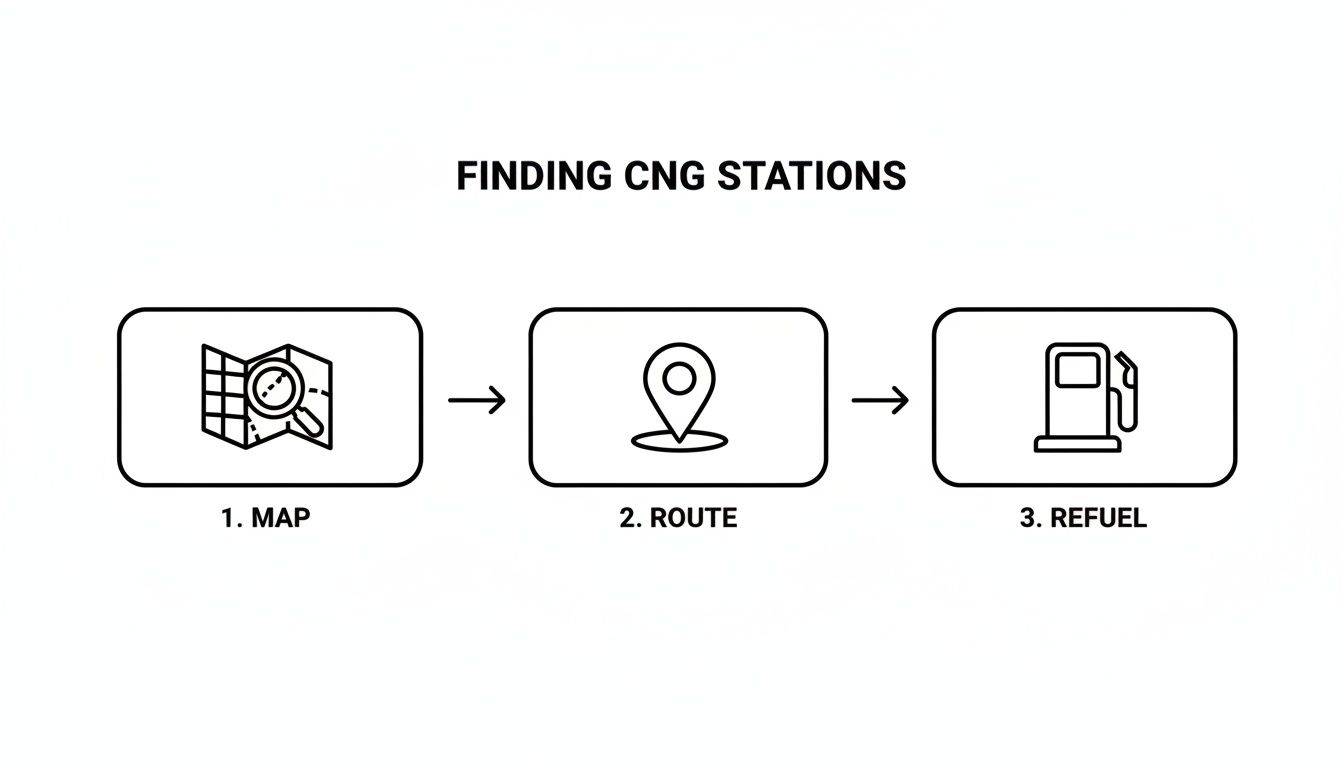
It’s a good visual reminder of the core stages, from first identifying your need all the way to the final hookup.
Delivery Day: From Hookup to Operation
When the truck arrives, the supplier’s technicians take over completely. They’ll handle positioning the tube trailer, connecting all the necessary hoses and regulators, and running meticulous leak checks on every single connection point.
Once they're securely hooked into your system, they'll pressurize the lines and get the gas flowing. Their job isn’t finished until your equipment is humming along and your on-site crew feels confident with the setup. It’s a hands-on service designed to get you back to work with minimal downtime.
Common Questions About Buying Compressed Natural Gas
Even with a solid plan, you're bound to have a few practical questions when it comes to sourcing compressed natural gas. Getting clear, no-nonsense answers is the best way to move forward without any second-guessing. Let’s tackle some of the most frequent things we hear from commercial and industrial customers.
How Quickly Can I Get An Emergency Mobile CNG Supply?
When a pipeline gets hit or a critical piece of equipment fails, every minute counts. This is exactly what reputable mobile CNG providers are built for. In a real emergency, it’s not uncommon to have a fully loaded CNG tube trailer pulling up to your site within 24 to 48 hours of your first call, provided your location is within a reasonable distance of their dispatch hub.
To help make that happen, there are a couple of things you can do on your end to speed things up:
- Have your specs ready: Be prepared to tell them the pressure you need (in PSI), your best guess on volume (SCF), and what kind of connection you have. This information cuts out the back-and-forth.
- Clear the way: Before the truck arrives, make sure there’s a clear and safe path for a large tractor-trailer to get to your hookup point.
The best suppliers run 24/7 emergency hotlines for a reason—so they can start rolling the moment you call.
What Are The Main Cost Factors for Mobile CNG?
When you get a quote for a mobile CNG delivery, you’ll quickly see it’s not just about the cost of the gas. The final price is a package deal covering the entire service, from logistics to hardware. Knowing what goes into that number helps you make a true apples-to-apples comparison between suppliers.
A typical quote is broken down into a few key parts:
- The Gas Itself: This is the commodity, usually priced per MCF (thousand cubic feet) or MMBtu (million British thermal units).
- Mobilization & Demobilization: Think of this as the round-trip transportation charge for getting the trailer and equipment to you and then taking it away.
- Equipment Rental: You'll see a daily, weekly, or monthly fee for the tube trailer and any pressure-regulating gear needed to make the connection.
- On-Site Labor: If your setup requires a technician to stay on-site for monitoring, that cost will be listed separately.
The biggest factors that will swing your final cost are the total volume of gas you’ll use, the duration the equipment needs to be on your site, and your distance from the supplier's depot.
What Safety Checks Are Required For a Mobile CNG Setup?
When you're bringing high-pressure natural gas onto your property, safety is non-negotiable. Before a single molecule of gas flows, the supplier will perform a thorough site assessment. This isn't just about checking boxes; it's a crucial process to ensure a completely safe operation.
The supplier’s technicians will be looking at several things. They’ll pinpoint a safe, level spot for the tube trailer—well away from traffic, potential ignition sources, and overhead obstructions like power lines. They will also give your connection point a detailed inspection to ensure it’s compatible and in good working order.
Once everything is hooked up, they perform meticulous leak checks on all fittings and connections before, during, and after the gas transfer begins. This whole process guarantees the setup meets all local and federal safety standards, letting you focus on your project with confidence.
When project delays are not an option, you need a reliable temporary gas supply. Blue Gas Express specializes in rapid deployment of mobile CNG and LNG solutions to keep your operations online. If you're facing a utility delay or an emergency outage, contact us today to get a mobile gas unit on its way.