

When you hear about natural gas, you probably think of the pipelines running underground. But what happens when you need to get that energy across an ocean? That's where Liquefied Natural Gas, or LNG, comes in.
At its heart, LNG is just natural gas that's been chilled to a frigid -260°F (-162°C). This extreme cold shrinks the gas to 1/600th of its original volume. Think of it like taking all the air in a giant hot air balloon and compressing it down to the size of a beach ball. That’s the magic of liquefaction.
This incredible transformation is what makes LNG a global commodity. It frees natural gas from the limits of pipelines, allowing it to be loaded onto massive, specialized ships and sent anywhere in the world. For countries with limited domestic energy resources, LNG imports are a lifeline, providing a much cleaner and more reliable alternative to coal or heavy fuel oil.
The Versatile Role of LNG in a Global Economy
Once an LNG tanker reaches its destination, the liquid is carefully warmed back into a gas—a process called regasification—and sent off to do its job. And its job description is impressively long.
A Fuel for a Modern World
Natural gas delivered as LNG is a true workhorse of the modern economy. Here’s a look at its primary roles:
Powering Nations: It’s a major fuel for generating electricity. Many modern power plants run on natural gas because they are efficient and can quickly ramp up or down, making them a perfect partner to stabilize the grid when renewable sources like wind and solar aren't available.
Driving Industry: From forging steel and shaping glass to producing chemicals and fertilizers, countless industrial processes rely on the intense, controllable heat that natural gas provides.
Heating Communities: LNG is a game-changer for regions and communities that aren't connected to a pipeline network, offering a clean and reliable source for heating homes, schools, and businesses.
Fueling Transportation: The shipping and trucking industries are increasingly turning to LNG as a cleaner-burning fuel to power massive container ships, long-haul trucks, and even trains, helping to cut down on emissions.
The global trade in LNG is massive and only getting bigger. In a recent year, the world traded 407 million tonnes of LNG. While growth hit a temporary snag, the future is incredibly bright. Experts predict that by 2030, another 170 million tonnes of LNG supply could hit the market, mostly to meet soaring demand in Asia. You can explore the future of the LNG market to get a better sense of this growth trajectory, which underscores just how critical LNG has become to global energy security.
The Journey of LNG From Gas Well to Your Business
How exactly does natural gas travel thousands of miles without a pipeline? The secret lies in a fascinating journey that transforms a bulky gas into a compact, easily transportable liquid. It's this process that allows us to get energy from remote production fields to businesses and communities anywhere in the world.
The whole thing starts at a liquefaction facility. Here, natural gas straight from the well gets a thorough cleaning. Impurities like water, carbon dioxide, helium, and heavier hydrocarbons are stripped out. This isn't just for purity's sake—it's crucial to prevent these substances from freezing solid and damaging expensive equipment in the next step.
Once it's purified, the gas is ready for its big transformation.
The Science of Shrinking Gas
The real magic happens when the purified natural gas is cooled down to a staggering -260°F (-162°C). At this incredibly cold temperature, the gas condenses into a clear, non-toxic liquid—what we know as LNG.
This change from gas to liquid is the key to its global mobility. As a liquid, natural gas takes up 600 times less space than it does as a gas. To put that in perspective, imagine shrinking the entire volume of a large concert hall down to something that could fit on a single shipping pallet. That’s the kind of compression we're talking about.
This extreme densification is what makes it economically feasible to ship LNG across oceans. Without it, moving natural gas to regions that aren't connected by pipelines would be practically impossible, limiting energy access for millions.
Now that the energy is densely packed, it's ready to hit the road (or the sea).
Global Transport and Local Delivery
The next leg of the journey requires some highly specialized equipment. For international shipping, LNG is pumped into massive, double-hulled vessels that are essentially giant thermoses on the water. These cryogenic carriers are engineered to keep the LNG at its frigid temperature for voyages that can last for weeks.
When a ship reaches its destination country, the LNG is offloaded at a receiving terminal. From there, it might be stored in large, insulated tanks or loaded onto smaller-scale transport. For regional and local deliveries, specialized cryogenic tanker trucks take over, bringing the LNG directly to industrial sites, power plants, or local distribution hubs.
This flexibility is one of LNG's greatest strengths. It can serve customers far from any major pipeline infrastructure.
The infographic below highlights the primary end-uses for LNG once it reaches its final destination.

As you can see, the journey ends with LNG powering industries, generating electricity, and heating homes—proving just how versatile it is across different sectors.
Back to Gas: The Final Step
Of course, before it can be used, LNG has to be turned back into a gas. This final step is called regasification.
The process itself is surprisingly simple. The liquid LNG is gently warmed by passing it through heat exchangers. These units often use something readily available, like seawater or even just ambient air, to raise the temperature.
As soon as its temperature climbs above -260°F, the LNG rapidly expands and reverts to its gaseous state. This regasified natural gas is chemically identical to the gas flowing through pipelines. It can be injected directly into a local utility’s network for homes and businesses or sent straight to an industrial facility for immediate use. This seamless transition makes it an ideal energy source for both permanent and temporary needs.
Powering Industries and Communities with LNG
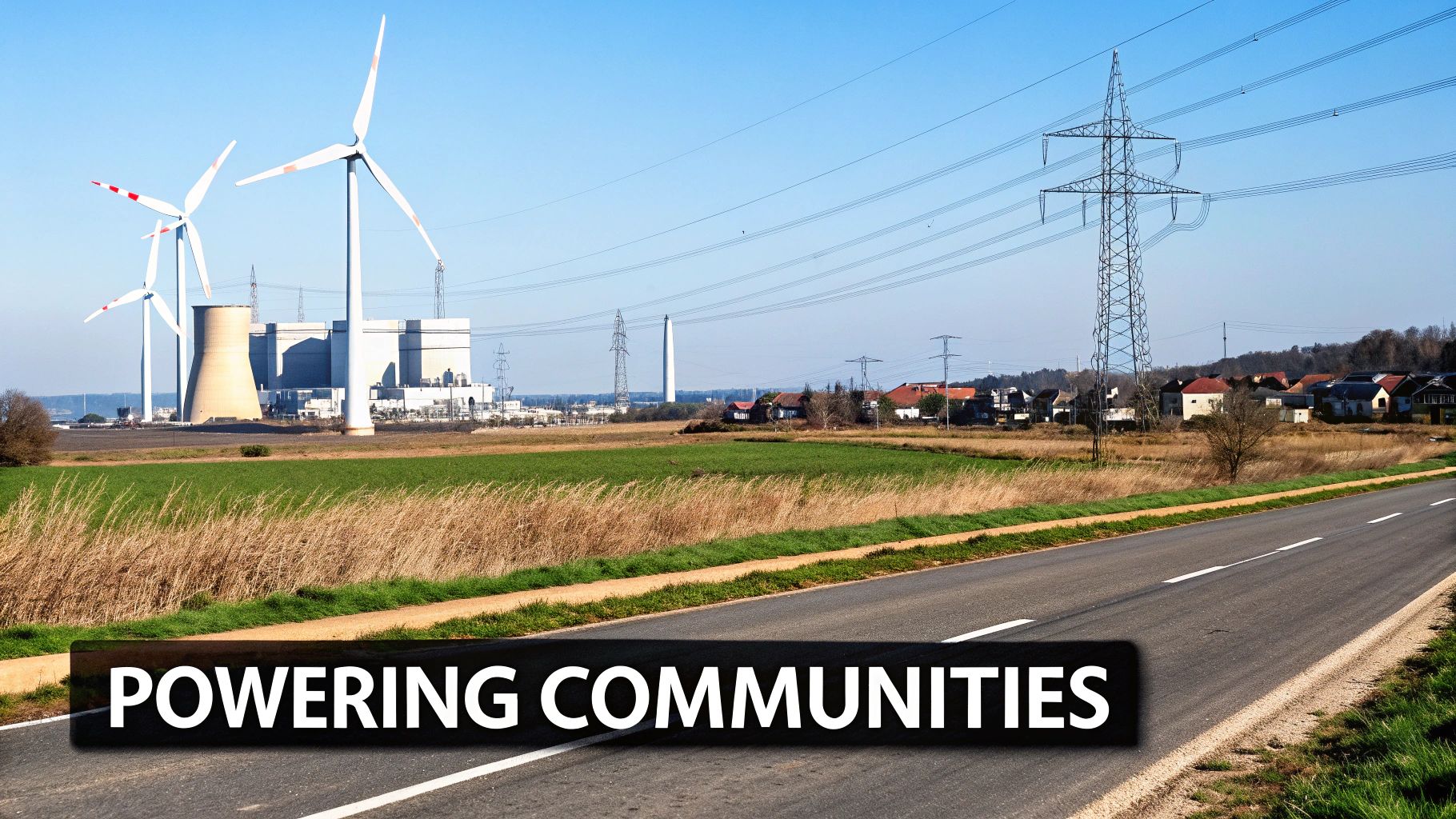
So, after its long journey across oceans and highways, what happens to all this liquefied natural gas? It gets put to work, delivering clean, reliable, and powerful energy. While LNG's applications are incredibly diverse, its primary role really shines in three core areas: powering our electrical grids, fueling our industries, and warming our homes and businesses.
These aren't just abstract concepts; they're the engines of our daily lives. From the electricity that keeps your lights on to the manufactured goods you use every day, LNG often plays a quiet but foundational role. Let's take a closer look at each of these workhorse applications to see how this super-cooled liquid becomes such an indispensable energy source.
Keeping the Lights On with LNG Power Generation
One of the most critical jobs for LNG is fueling electricity generation. Gas-fired power plants are the backbone of many modern energy grids, offering a dependable and cleaner-burning alternative to older coal-fired facilities.
Once it's regasified, LNG provides a consistent and controllable fuel source that can generate electricity 24/7. That reliability is crucial, but its real strength is its flexibility. Unlike a coal or nuclear plant that can take hours or even days to ramp up, gas turbine plants can fire up and get to full power in mere minutes.
This quick-response capability makes natural gas the perfect partner for renewable energy sources like wind and solar. When the sun goes down or the wind stops blowing, gas plants can instantly fill the energy gap. This keeps the grid stable and prevents blackouts.
Why is this so important? As the world shifts toward cleaner energy, keeping the power supply stable is a massive challenge. LNG-fueled power plants act as a crucial "energy bridge," providing the on-demand power needed to back up intermittent renewables and ensure a dependable flow of electricity to everyone.
The power sector remains a primary consumer of natural gas worldwide for precisely these reasons. Even with a temporary slowdown in global demand growth to just 0.5% recently due to market pressures, projections show a strong rebound. Experts anticipate a 2% rise in consumption, largely driven by economic recovery in the Asia Pacific region. You can dive deeper into these global natural gas consumption trends and see how different regions are shaping demand.
Fueling the Engines of Industry
Beyond the power grid, industries of all kinds depend on natural gas for both process heat and as a raw material. Many manufacturing processes demand immense, consistent, and precisely controlled heat that only gas can efficiently provide. For facilities located far from traditional pipeline infrastructure, LNG makes this possible.
Just think about how everyday products get made:
- Steel and Metal Forging: Shaping metal requires furnaces that reach scorching temperatures. Natural gas provides the high-intensity heat needed to melt and forge steel, aluminum, and other metals.
- Glass Manufacturing: Making everything from windows to bottles depends on melting sand and other materials in furnaces that have to maintain exact temperatures for long stretches.
- Cement and Ceramics Production: The massive kilns used to produce cement, bricks, and ceramic tiles are huge energy consumers. Natural gas is often the preferred fuel for its clean burn and consistent heat output.
But it’s not just a fuel. Natural gas is also a vital feedstock—a raw ingredient used to create other products. In the chemical industry, it’s a key component in producing ammonia, which is the foundation for virtually all nitrogen-based fertilizers that help grow the world's food supply. It's also used to make plastics, antifreeze, and fabrics.
Heating Homes and Businesses Beyond the Grid
The third major pillar of LNG use is heating homes and businesses, especially in places where pipeline access is limited or nonexistent. For remote communities, new housing developments, or commercial centers built beyond the reach of the existing gas grid, LNG offers a clean and efficient alternative to heating oil or propane.
Here’s how it works: a centralized LNG storage and regasification unit can serve an entire neighborhood or business park. The regasified natural gas is then fed into a small-scale local pipeline network, delivering gas for heating, hot water, and cooking just like a traditional utility service. This gives consumers all the benefits of natural gas—efficiency, lower cost, and convenience—without needing a connection to a major national pipeline.
This application truly highlights LNG's unique ability to democratize energy access. It ensures that even geographically isolated areas can tap into a modern, cleaner-burning fuel, improving local air quality and providing a reliable energy source for daily life and economic growth.
Exploring Specialized and Emerging LNG Applications
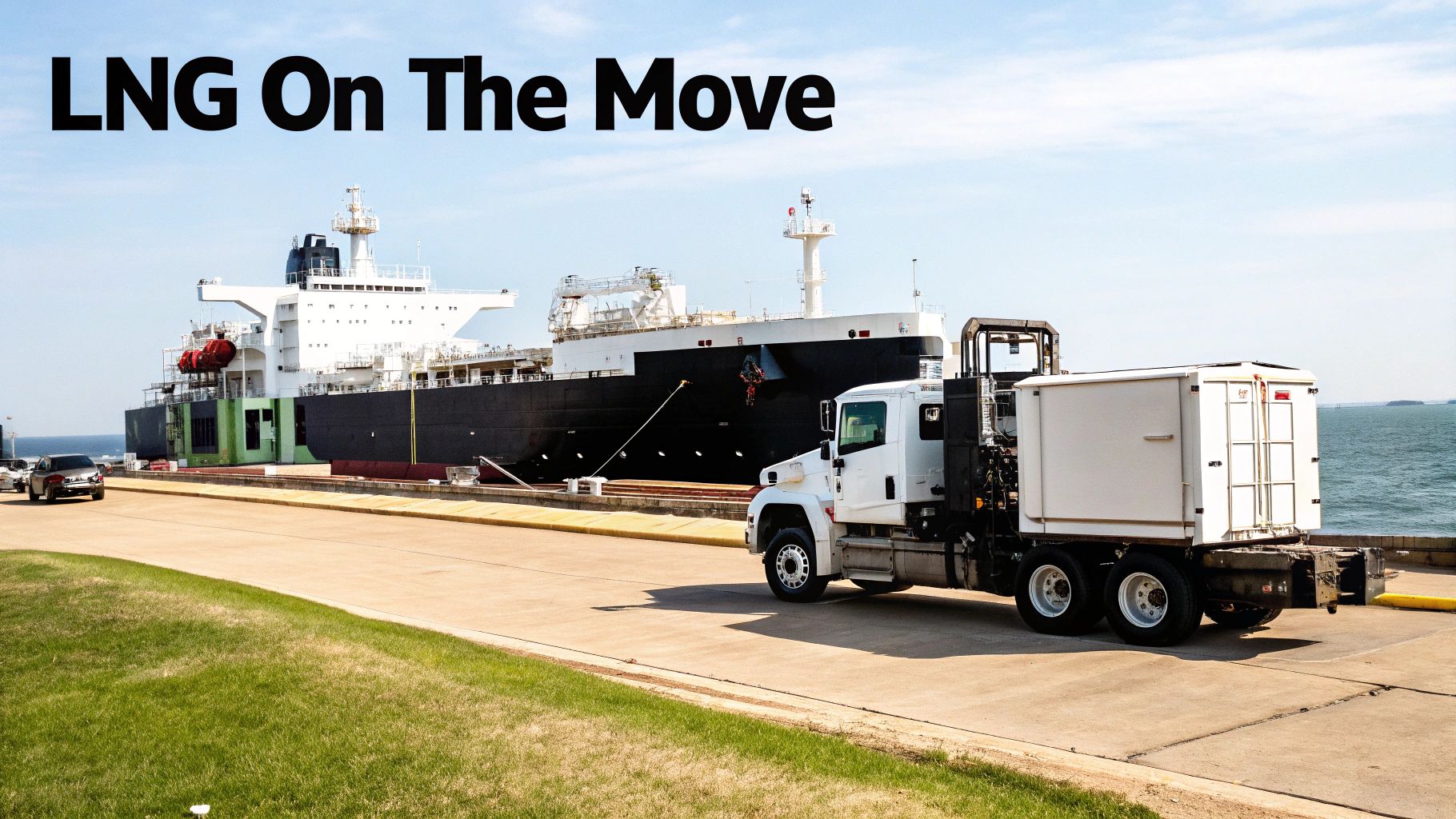
While LNG is a powerhouse for electricity grids and industrial furnaces, its story doesn't end there. Beyond these traditional roles, LNG is solving modern energy challenges in some really specialized and innovative ways, especially in transportation and as a flexible, on-demand energy source. Its unique properties are opening doors to cleaner, more efficient operations in sectors that have historically leaned on heavier, more polluting fuels.
These emerging applications are incredibly important. They show how LNG can do more than just generate large-scale power; it can also provide targeted solutions for specific industries and fill temporary energy gaps. From the high seas to remote construction sites, LNG is proving to be a remarkably adaptable fuel.
Fueling a Cleaner Transportation Sector
The transportation industry, a major source of global emissions, is in the middle of a massive shift, and LNG is right at the heart of it. Its high energy density and cleaner burn make it a seriously attractive alternative to diesel and heavy fuel oil for vehicles that need a lot of power over long hauls.
Two key areas are seeing rapid adoption:
Maritime Shipping (Bunkering): The international shipping industry is under immense pressure to clean up its act. Strict regulations now limit sulfur and nitrogen oxide emissions, forcing vessel operators to find cleaner fuels. LNG bunkering—the process of fueling a ship with LNG—has emerged as a leading solution. When used as a marine fuel, LNG virtually eliminates sulfur oxides and drastically cuts nitrogen oxides and particulate matter. This helps shipping companies meet tough environmental standards and improves air quality around busy ports and shipping lanes.
Heavy-Duty Trucking and Railways: For long-haul trucks and trains, fuel efficiency and range are everything. Here, LNG offers a compelling advantage over diesel. Because it's so dense, a truck can carry enough LNG to travel long distances without constant refueling stops. This makes it an ideal choice for fleet operators looking to cut both fuel costs and emissions without sacrificing performance. To give you a sense of scale, by 2023, over 18% of U.S. natural gas production was already being exported, highlighting the growing global infrastructure that supports these new uses.
Peak Shaving for Grid Stability
Electricity demand isn't a flat line. It spikes during heatwaves when air conditioners run full blast or on frigid winter mornings. These periods of high demand, known as "peaks," can strain the electrical grid to its breaking point. This is where a clever application called peak shaving comes into play.
Gas utility companies can store LNG during periods of low demand when prices are cheaper. When a peak event hits, they quickly regasify this stored LNG and inject it into the pipeline system to meet the sudden surge in demand. This strategy avoids the need to build expensive new "peaker" power plants that would sit idle most of the year.
Peak shaving is a perfect example of LNG's strategic value. It acts as an energy reserve, allowing utilities to manage supply and demand efficiently, ensure grid reliability during extreme weather, and ultimately keep energy costs stable for consumers.
Emergency and Temporary LNG Supply
What happens when a natural gas pipeline needs urgent repairs, or a new construction project needs gas before the permanent utility lines are even installed? In these scenarios, waiting for the grid simply isn't an option. This is where mobile LNG solutions, like those provided by Blue Gas Express, become absolutely essential.
Mobile LNG units are effectively a "pipeline on wheels." They deliver a continuous, reliable supply of natural gas exactly where it's needed, for however long it's needed. This temporary service is critical for all sorts of situations:
- Pipeline Interruptions: During planned maintenance or unexpected outages, a mobile LNG supply can keep hospitals, factories, and residential communities running without a hiccup.
- New Construction: A construction site can get the gas it needs for heating or equipment commissioning long before permanent infrastructure is active, preventing costly project delays.
- Disaster Recovery: After a natural disaster damages local infrastructure, mobile LNG can provide immediate energy for emergency shelters, critical facilities, and rebuilding efforts.
This flexibility is what makes LNG so valuable in today's energy landscape. It’s not just a bulk commodity but a precise tool for ensuring energy continuity, answering the question of "what is liquefied natural gas used for" in ways that solve immediate, real-world problems.
LNG vs. CNG: What's The Real Difference?
Natural gas comes in more than one package. While both Liquefied Natural Gas (LNG) and Compressed Natural Gas (CNG) start out as the same raw methane, the way we process and store them creates two completely different fuels with unique jobs. Getting a handle on these differences is crucial for figuring out which one fits a specific need.
Let’s try a simple analogy. Think of LNG as an energy ice cube—it’s incredibly dense, compact, and perfect for packing a massive amount of energy into a small, lightweight container. On the other hand, CNG is more like a scuba tank, storing the gas by cramming it into a heavy-duty cylinder under intense pressure. Both are useful, but they solve very different logistical problems.
It All Comes Down to State and Storage
The biggest divide between LNG and CNG is their physical state. To make LNG, we super-cool natural gas down to a frosty -260°F (-162°C), which turns it into a clear, non-toxic liquid. In contrast, CNG stays in its gaseous form but is compressed to pressures between 3,000 and 3,600 psi.
This single difference has massive implications. The liquefaction process shrinks natural gas to just 1/600th of its original volume. This incredible density means you can store far more energy in an LNG tank compared to a CNG tank of the same size. CNG, because it's just compressed gas, needs much larger and significantly heavier tanks to hold the same amount of fuel.
How Energy Density Shapes the Job
This density gap is why LNG and CNG have carved out their own distinct niches. LNG’s compact, lightweight nature makes it the go-to fuel when space is tight and long-distance travel is a must.
LNG is the fuel of choice for: Heavy-duty, long-haul trucks, massive container ships, and locomotives that need to cover hundreds of miles between fill-ups. It’s also a workhorse for large industrial plants that need a steady, high-volume fuel source delivered by truck.
CNG works best for: Vehicles on shorter, predictable routes. Think city buses, garbage trucks, and local delivery vans that can easily return to a central station each night to refuel. For them, the heavier tanks and shorter range just aren't a deal-breaker.
While we're focused on LNG and CNG, it's also helpful to see how natural gas stacks up against other common fuels. You can dig deeper into the key differences between natural gas and propane to get a broader perspective, especially for commercial use cases.
The bottom line is simple: LNG packs more punch. A gallon of LNG delivers about 2.4 times more energy than the equivalent volume of CNG. That's precisely why it dominates heavy-duty transportation and industries with a massive appetite for fuel.
LNG vs CNG: A Head-to-Head Comparison
To make it even clearer, this table breaks down the fundamental differences between LNG and CNG. It highlights their unique storage methods, energy densities, and the applications where each one shines, helping you see why one might be chosen over the other.
| Characteristic | Liquefied Natural Gas (LNG) | Compressed Natural Gas (CNG) |
|---|---|---|
| Physical State | Liquid (cryogenic) | Gas (highly compressed) |
| Storage Pressure | Low Pressure (Atmospheric) | High Pressure (3,000-3,600 psi) |
| Energy Density | High (600x gaseous volume) | Lower (200-250x gaseous volume) |
| Ideal Use Cases | Long-haul trucks, ships, industry | City buses, local fleets, passenger cars |
| Refueling Time | Faster, similar to diesel | Slower, requires more time to pressurize |
| Infrastructure | Complex (cryogenic storage) | Simpler (compressor stations) |
Ultimately, the choice between LNG and CNG isn't about which one is "better" overall, but which one is better suited for the task at hand. LNG’s high energy density makes it the clear winner for long-range and high-consumption scenarios, while CNG offers a simpler, effective solution for local fleets and smaller-scale needs.
To really understand LNG’s place in the world, you have to look at both sides of the coin. It’s a compelling energy source, no doubt, but bringing it to market isn’t without its challenges. Getting a handle on this trade-off gives you a realistic view of its role in the global energy mix.
On one hand, LNG has some serious advantages that have fueled its global growth. Its biggest selling point? You can ship it anywhere. By freeing natural gas from the fixed routes of pipelines, LNG gives countries the power to import fuel from all over the world. This diversification is huge for energy security, as it means nations aren't locked into a single supplier.
That flexibility goes hand-in-hand with a much better environmental track record compared to other fossil fuels.
The Clear Advantages of LNG
You can really see LNG’s benefits when you stack it up against old-school fuels like coal and heavy oil. The fact that it burns cleaner is a major reason why everyone from power plants to shipping companies is making the switch.
- Cleaner Air: When you burn natural gas, you get far fewer harmful emissions. It produces almost no sulfur dioxide or soot and cuts carbon dioxide emissions by up to 40% compared to coal.
- Energy Security: For countries that don't have their own gas reserves, LNG imports offer a steady and dependable energy source, protecting them from the political turmoil or supply cuts that can plague pipelines.
The ability to ship energy exactly where it's needed is a game-changer. It underpins economic stability and helps smooth the transition away from dirtier fuels by providing a reliable, lower-carbon alternative.
This one-two punch of environmental and strategic pluses is why LNG is catching on. But tapping into these benefits means tackling some pretty complex hurdles first.
Overcoming the Hurdles to Adoption
For all its advantages, switching to LNG isn't as simple as flipping a switch. The entire process, from the gas field to the final user, relies on some incredibly advanced technology and requires a massive amount of capital. These are serious barriers to entry.
The biggest hurdle is the price tag on infrastructure. Building liquefaction plants to super-cool the gas and constructing the specialized terminals to receive and "regasify" it can run into the billions. These aren't short-term projects; they're huge, long-term commitments that demand meticulous planning and solid financial backing.
Beyond the upfront cost, the process itself burns through a lot of energy. Getting natural gas down to -260°F takes a significant amount of power, which has to be factored into its overall efficiency. Then there’s the safety aspect. You're dealing with a cryogenic liquid, which calls for bulletproof safety protocols and deep expertise. Every single step—from transport in double-hulled ships to storage in heavily insulated tanks—is governed by strict standards. This is why it’s so important to work with experienced partners who know how to manage LNG safely and effectively.
Common Questions About Liquefied Natural Gas
You've seen what LNG can do, but how does it work in the real world? Let's dig into some of the most common questions people have about its safety, practical use, and why a business might need it on a temporary basis.
Is LNG a Safe Fuel to Transport and Use?
Absolutely. LNG has an outstanding safety record, backed by decades of refinement and strict international standards that cover every step of its journey, from production to delivery.
It’s transported in incredibly robust, double-walled cryogenic containers. Think of them as giant, high-tech thermoses—they keep the LNG at its frigid temperature without needing to be pressurized. This design alone eliminates many of the risks associated with other fuels.
What if there’s a leak? Unlike oil, which creates a messy and persistent hazard, LNG just wants to turn back into a gas. It warms up, vaporizes, and simply dissipates into the air, drastically reducing the risk of a ground-level fire and avoiding any long-term environmental damage.
Can I Use LNG Directly in My Home or Business?
Not in its liquid form. Before LNG can power a furnace, an industrial boiler, or a kitchen stove, it needs to be turned back into a gas. This is done through a straightforward process called regasification.
Specialized equipment carefully warms the liquid, allowing it to expand back to its gaseous state. The end result is natural gas that’s completely identical to what flows through a standard pipeline. It’s then fed into the local system, so for the person actually using the energy, the experience is seamless.
The key takeaway is that LNG is a transportation method. Once it arrives, it becomes the same reliable natural gas customers are used to, ready for heating, cooking, or powering industrial machinery.
Why Would a Business Need a Temporary LNG Supply?
This is where LNG really shines as a flexible solution. Businesses turn to temporary, or "mobile," LNG when their main natural gas supply is either down, not enough, or not even built yet. It's an energy bridge that keeps the lights on and the machines running.
Here are a few classic scenarios:
- New Construction Sites: A project can get the gas it needs for temporary heat or equipment testing long before the permanent utility pipeline is installed. This prevents costly delays.
- Planned Maintenance: When the local utility has to shut down a pipeline for scheduled work, a temporary LNG supply means a facility can operate without a single hiccup.
- Emergency Backup: A pipeline could be damaged by an accident or severe weather. Mobile LNG can be brought in quickly to provide a critical lifeline and prevent a complete shutdown.
This kind of flexibility is a game-changer for ensuring operational continuity.
For businesses facing these exact challenges, Blue Gas Express provides reliable, on-demand mobile LNG and CNG solutions to prevent project delays and operational shutdowns. Ensure your project stays on track by exploring our temporary natural gas services.