

Getting natural gas service set up in Houston isn't as simple as just making a phone call. It’s a coordinated effort between you, the main utility provider CenterPoint Energy, and the City of Houston. From filing the right paperwork to passing tough safety inspections, every step needs to be handled correctly to get your gas turned on without a hitch.
Understanding Houston's Gas Service Process
Whether you're a homeowner moving in, a business owner opening a new location, or a contractor on a new build, you need to know the ropes. Misunderstanding the process is the fastest way to run into frustrating delays, like having your permit application kicked back or failing a critical inspection.
This guide is designed to walk you through the entire journey, from submitting your initial request with CenterPoint to acing the final city inspection. I'll point out the common roadblocks I’ve seen trip people up and share some real-world advice to keep your project on track.
The Core Stages of Gas Service Setup
Think of the process in three big phases: application, inspection, and finally, connection. Each one has its own set of rules and timelines, and you can't move on to the next until the one before it is completely buttoned up. If you drop the ball on one step, the whole project grinds to a halt.
Here's a classic example I see all the time: a restaurant is racing to get its Certificate of Occupancy, but they need gas to test the kitchen equipment. The problem? The permanent meter is still weeks away from being installed. This is where planning ahead for temporary gas solutions can be a lifesaver, bridging the gap while you wait for the permanent connection.
This flow chart gives you a bird's-eye view of the entire process.
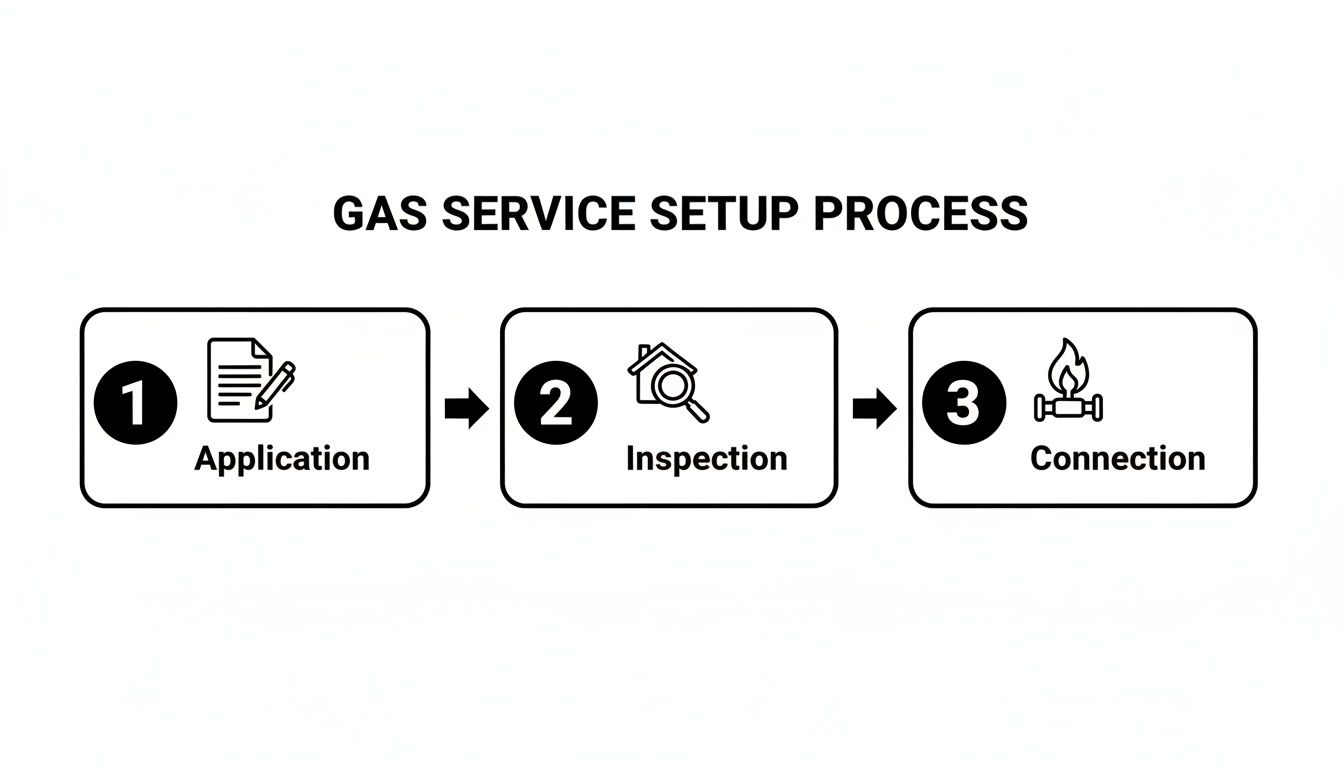
Seeing it laid out like this makes it clear how each stage builds on the last.
Safety and Compliance Are Non-Negotiable
When it comes to natural gas, there are no shortcuts. Safety is the top priority for both CenterPoint and the city inspectors. All gas line work has to be done by licensed plumbers who know Houston’s building codes inside and out. This guarantees every pipe, fitting, and appliance is installed correctly to prevent dangerous leaks.
The big one to watch out for is the pressure test. This is where a city inspector checks to see if your gas lines can hold pressure without any leaks. A failed pressure test is probably the single most common reason for project delays in Houston.
Getting familiar with safety documentation is a smart move. While specific requirements can differ, understanding concepts like what is a Gas Safe Certificate gives you a great sense of why these verifications are so important. At the end of the day, CenterPoint Energy won't turn on the gas until they are 100% certain your system is secure.
Your Pre-Application Checklist for Gas Service

Getting your gas service turned on in Houston smoothly really boils down to your prep work. Think of it like this: you wouldn't start baking without making sure you have all the ingredients first. The time you spend getting organized before you even fill out the first form is what separates a quick approval from weeks of frustrating back-and-forth.
This initial phase is your chance to get ahead of the game and sidestep the common hiccups that trip most people up.
The first, and most crucial, step is simply getting your paperwork in order. What a provider like CenterPoint Energy needs from you depends entirely on your situation. A homeowner just moving in has a much simpler checklist than a contractor breaking ground on a new commercial building.
For example, if you're a residential customer, you'll mainly need to prove your identity and your right to be at the property. But for a commercial account, they'll need business identifiers like your Employer Identification Number (EIN) and other official documents. Submitting the wrong paperwork for your specific scenario is the fastest way to get your application flagged and sent to the back of the line.
Gathering Your Essential Documentation
Before you start the application, do yourself a favor and pull together all the required documents. Having everything scanned and saved in a dedicated folder will make the online submission process a breeze. Don't be the person frantically searching for a permit number while the application form times out.
To avoid any guesswork, we've put together a table outlining exactly what you’ll need based on your applicant type.
Required Documents for Houston Gas Service Application
| Document/Information | Residential Applicant | Commercial Applicant | New Construction Project |
|---|---|---|---|
| Driver's License or State ID | ✓ | ✓ | ✓ |
| Social Security Number (SSN) | ✓ | ||
| Proof of Occupancy (Lease) | ✓ | ✓ | |
| Proof of Ownership (Deed/Tax Doc) | ✓ | ✓ | ✓ |
| Employer Identification Number (EIN) | ✓ | ✓ | |
| Business Legal Name | ✓ | ✓ | |
| Site Plans & Property Description | ✓ | ||
| City of Houston Building Permits | ✓ | ||
| Gas Load Letter (BTU Calculation) | ✓ | ✓ | ✓ |
Having these items ready to go before you begin will eliminate nearly all of the common submission errors we see. It’s a simple step that saves a ton of time.
Calculating Your Gas Load Accurately
Now for what is easily the most critical—and most often overlooked—part of your prep work: calculating your project's total gas load. This isn't just a technical detail; it’s the number that tells the utility company how big your gas meter and service line need to be. Get it wrong, and you're in for some major headaches.
Your gas load is measured in British Thermal Units (BTUs), which is the total energy required to run all of your gas appliances simultaneously. This includes everything from the furnace and water heater in a home to massive commercial ovens and industrial boilers.
If you underestimate your load, you’ll end up with a system that can't keep up, causing appliances to underperform or shut down. If you overestimate, you'll pay for oversized infrastructure you don't actually need.
The single biggest mistake I see clients make is guessing their BTU requirements. This is not the place for an estimate. An incorrect load letter is a primary cause for application rejection and can set a project back by a month or more.
So, how do you get this number right? Don't guess. Talk to the professionals installing your equipment.
- Your HVAC technician can give you the exact BTU rating for your furnace.
- Your plumber knows the specs for the water heater.
- If you're opening a restaurant, the kitchen equipment supplier will have the precise BTU requirements for every stove, oven, and fryer.
Your job is to list every single gas-powered appliance you plan to use. Once you have that list, a licensed plumber or mechanical engineer can add up the BTUs and create a formal "gas load letter." Submitting this professional document with your application proves you’ve done your homework and ensures the system they install is perfectly sized for your needs from day one.
Navigating the Application and Permitting Maze
Alright, you've got your paperwork in order and know your gas load. Now it's time to dive into the official process. This is where you'll formally connect with both the utility provider—which is almost always CenterPoint Energy in Houston—and the City of Houston's permitting department. Getting through this successfully isn't just about filling out forms; it's about understanding the specific, and sometimes quirky, local rules for gas line installations here.
Think of it like a two-lane highway. One lane is CenterPoint's application for service, which is all about getting a meter set on your property. The other lane is the city's permitting process, which focuses on the safety and code-compliance of the actual gas piping. Both have to move forward at the same time. If one gets held up, you've got a project-stalling traffic jam on your hands.
This is also where a good, licensed Houston plumber proves their worth ten times over. They aren't just there to wrench pipes together; they're your guide through this whole administrative jungle. They know the people, the process, and exactly where the common landmines are buried.
Getting Your Service Request in Motion
The first real move is to submit your service request to CenterPoint. You'll typically do this on their website, uploading all the documents you've gathered. It’s a pretty straightforward online form, but you have to be meticulous. A single typo in the service address or a name that doesn't perfectly match the permit can get your application kicked into a manual review queue, easily adding weeks to your wait.
Once you hit "submit," your request goes into the system. CenterPoint's engineers will review your gas load letter and site plans to figure out the right service line and meter set for your needs. This isn't an instant approval. Depending on how complex your project is—say, a simple swap for a new home versus running a new commercial line—this review can take anywhere from a few days to several weeks.
Here’s a tip from the trenches: As soon as CenterPoint gives you a project or work order number, write it down, save it in your phone, and guard it with your life. This number is your golden ticket for tracking progress and getting straight answers from customer service. Without it, you’re just another address in a vast database.
Making Sense of the City of Houston Permitting Process
While the utility is figuring out the meter, your plumber will be wrestling with the City of Houston for the permits. This is a hard-and-fast rule—any new gas line or modification requires a permit. No exceptions. The city’s main job here is to ensure public safety, and they do that by enforcing the building codes through permits and inspections.
Your plumber will submit the plans and pull the permits for the "yard line" (the pipe from the meter to the building) and all the gas piping inside. This is how the city verifies that the right materials are being used, the lines are buried at the proper depth, and all connections meet Houston's strict local codes. Trying to sneak in gas work without a permit is a bad idea. Not only is it illegal, but it's a surefire way to have CenterPoint refuse to set your meter, leaving you with no gas service at all.
This whole robust system exists for a reason. The Houston area is powered by an incredible amount of natural gas, with regional production figures averaging a massive 109.7 Bcf (billion cubic feet) per day in early 2026. This immense output from places like the Permian Basin and the Haynesville Shale makes gas a cheap and powerful energy source for us. You can see more about these U.S. natural gas production trends to understand the scale. All that available energy requires an incredibly safe delivery system, and that’s exactly what the permitting process is designed to protect.
How to Keep Tabs on Everything (and Stay Sane)
Once everything is submitted, the waiting game begins. But don't just sit on your hands. Being proactive can help you spot a problem before it blows up into a major delay.
- For the Utility Application: Use your work order number to check the status online or over the phone. If the initial review timeline they gave you has passed, don't be shy about calling for an update.
- For the City Permits: Keep in touch with your plumber. They're your eyes and ears on the ground and will be the first to know when the permit is officially issued and when they can get inspections on the schedule.
You absolutely have to set realistic expectations for your timeline. For a new construction project, it's pretty standard for the whole process—from the day you first apply to the day the meter is finally installed—to take 8-12 weeks, and sometimes longer. Things like the city inspector's backlog, a stretch of bad weather, or seasonal rushes can all throw a wrench in the works. Building this buffer into your project plan from day one is the key to a much smoother ride.
Juggling Timelines, Inspections, and the Bottom Line
Once your paperwork is filed, you enter what I call the "hurry up and wait" phase. This is where your project really hinges on managing three critical pieces: the schedule, the city inspection, and the final cost. Honestly, getting a grip on these is the difference between a smooth project and a chaotic, budget-busting nightmare.
Let's talk timelines, because they can be a real shock. For a simple residential hookup where the gas line is already at the curb, you're still probably looking at 3-5 weeks from approval to a working meter. It’s not an overnight thing.
But if you're dealing with new construction or a commercial property that needs a brand new line run from the main, you need to think much bigger. Realistically, that process can easily stretch to 8-12 weeks, sometimes even longer if there are complications. Trying to rush this is one of the biggest mistakes people make—it just leads to headaches and expensive delays later on.
The Make-or-Break City Inspection
The single biggest gatekeeper in this whole process is the City of Houston's gas inspection. Don't think of this as just checking a box. It's a serious safety review, and absolutely nothing moves forward until you get that green tag. CenterPoint won't even think about setting a meter until an inspector has signed off.
The main event is the gas pressure test, and it's all about ensuring your system is perfectly sealed.
Here’s what the inspector is laser-focused on:
- A Rock-Solid System: Your plumber will pump air into the entire gas line system and hook up a pressure gauge.
- A Steady Needle: The inspector watches that gauge like a hawk. If the pressure drops even a tiny bit over the required time, you fail. Instantly. A moving needle means there's a leak somewhere.
- Code-Compliant Work: They'll also do a visual check to make sure the right materials were used and that the installation—pipe sizing, supports, and routing—is all up to local code.
Failing an inspection is a major setback. Your plumber has to find and fix the problem, and then you have to get back in the queue for a re-inspection, which can easily add another week or more to your project.
Pro Tip from the Field: Insist that your plumber runs their own pressure test before you call the city. It's so much easier (and cheaper) to find and fix a small leak on your own schedule than it is to deal with a red tag from a city inspector.
Unpacking the Costs of Getting Gas Service
Your budget needs to account for more than just the future monthly bill. A handful of upfront costs will hit your wallet during the setup, and it’s best to know they're coming.
- Permit Fees: The City of Houston permit has a fee, which can change depending on the size and scope of your job. It's a required administrative cost.
- Plumber's Invoice: This is almost always the biggest-ticket item. It covers all the labor and materials for running the gas pipes from the meter to your appliances.
- Trenching Work: If the utility needs to dig to run a new service line to your property, that cost is on you. The price tag can swing wildly based on how far they have to dig and what they have to dig through.
- Meter Set Fee: Most providers charge a one-time fee to install the physical gas meter after you've passed all your inspections.
It's also smart to look at the long-term financial picture. While these setup fees are a one-time thing, your ongoing costs are tied to commodity prices. Right now, natural gas prices are relatively low, but the forecast shows a significant shift on the horizon. Some analysts project the annual average price could leap by as much as 33% by 2027, rising from under $3.50/MMBtu to nearly $4.60/MMBtu. You can dig into the data yourself by checking out the latest natural gas price projections on eia.gov. Knowing both the immediate and future costs helps you budget effectively.
What to Do When Utility Timelines Don't Align
You've done everything by the book. The permits are filed, your plumber is lined up, and the project is teetering on a knife's edge, just waiting for that final gas connection. Then, you get the call—the utility meter set is still four weeks out. This is where even the best-laid plans can completely unravel, triggering costly delays that cascade through your entire schedule.
When the official timeline to set up gas service in Houston just doesn't work with your critical path, it feels like hitting a brick wall. It’s a common, and frankly, infuriating scenario for contractors and business owners all over the city.
The good news? You don’t have to just sit there and watch your budget burn. There's a powerful, practical solution that can bridge the gap and keep your project moving. We call it temporary mobile gas service, and it’s an absolute game-changer when the utility’s schedule is holding you hostage.
Real-World Problems Need Practical Solutions
Let’s talk about a couple of real situations where this becomes non-negotiable.
Picture this: you’re opening a new restaurant in the Heights. The kitchen is installed, your staff is hired, and you’re just waiting on that final Certificate of Occupancy. But the city inspector can't sign off until they see every single oven, fryer, and water heater fire up and run properly. Without gas, you’re stuck, bleeding money on rent and payroll for a business that can't open its doors.
Or, think about a new multi-family build during a chilly Houston winter. You need consistent heat to cure the concrete properly. Waiting weeks for the permanent gas meter means blowing your schedule and, even worse, potentially compromising the building's structural integrity. In both cases, the delay isn't a minor inconvenience; it's a direct financial threat.
Temporary gas isn't just a backup plan; it's a strategic tool. It gives you back control over your timeline, letting you pass critical inspections and hit your milestones without being at the mercy of the utility's schedule.
How Mobile CNG Works as a Bridge Fuel
So, what’s the magic behind this? It’s usually a mobile Compressed Natural Gas (CNG) unit.
Think of it as your own personal, self-contained gas supply delivered right to the job site. A specialized provider brings out a trailer or a skid equipped with tanks of compressed natural gas. They also bring all the necessary regulators and gear to safely hook it up to your building's existing gas piping.
This setup perfectly mimics the permanent utility service—your appliances and equipment won't know the difference. The CNG unit delivers the exact same fuel at the right pressure, so you can run your systems just as if the permanent meter were already installed. It’s the perfect bridge, giving you the energy you need, right when you need it.
When utility timelines don't align with your project schedule, it often involves navigating various service departments. For broader insights into how customer service functions within the construction industry and how to improve these interactions, this guide on Rethinking Customer Service in the Construction Industry offers valuable perspectives.
The Deployment and Coordination Process
Getting a temporary gas unit on-site is a surprisingly fast and straightforward process built for rapid deployment. Here’s a quick rundown of how it usually works:
- Initial Call: You'll reach out to a mobile gas provider and explain your situation—what your BTU load requirements are and how long you'll need the service.
- Site Assessment: They’ll check out your site to find the best spot for the CNG unit and plan the hookup to your building’s gas inlet. Safety and accessibility are always the top priorities here.
- Deployment and Hookup: Trained technicians deliver the CNG unit and connect it to your system. This part is fast, often taking just a few hours.
- Service and Monitoring: While the unit is on-site, the provider keeps an eye on gas levels and schedules refills as needed. This ensures you have a continuous, uninterrupted supply.
- Seamless Transition: Once CenterPoint is finally ready to set your permanent meter, the temporary service is disconnected. This is carefully coordinated to make sure there's little to no downtime for your operations.
This coordinated, hands-on approach is what makes temporary gas so effective. It’s not just about getting fuel; it’s about plugging in a short-term solution that doesn't mess with your long-term goal of getting permanent service. Using this strategy, you can move forward with confidence, test your equipment, pass your inspections, and keep your entire project on track and on budget.
Answering Your Top Houston Gas Service Questions
If you're trying to get natural gas hooked up in Houston, you've probably got a few questions. I hear the same ones all the time from homeowners, builders, and restaurant owners. Let's get you some straight answers to help you plan better and dodge the usual headaches.
The biggest unknown for most people? The timeline. It's almost always longer than you think, and that can really mess up a construction schedule or a move-in date.
How Long Does It Really Take to Get a Gas Meter Set?
This is the million-dollar question, and the answer really depends on your situation.
For a simple residential setup—where the gas service line is already at the curb and you just need a meter—you're typically looking at 2 to 4 weeks. Keep in mind, that clock starts after you’ve submitted a complete application and passed all your city inspections.
Now, if you're dealing with new construction or a commercial property that needs a brand-new gas line run from the main, you need to plan for a much longer wait. These projects can easily stretch from 8 weeks to several months.
A word of caution: these timelines are estimates, not guarantees. City permit backlogs, a failed inspection, or even just a busy season for the utility crews can throw a wrench in the works. It’s smart to build some buffer time into your project plan.
What's the Number One Cause of Delays?
Nine times out of ten, delays boil down to two things: permits and inspections. A single mistake on your City of Houston permit application—even just a missing signature—can stop your project dead in its tracks. The same goes for a failed pressure test during inspection; everything grinds to a halt until you fix the leak and pass a re-inspection.
My best advice? Hire a licensed plumber who knows the ins and outs of Houston’s local codes. Their experience is your best defense against these common setbacks. Another classic mistake is simply not factoring in the utility provider's lead time for the final meter set. It's the last piece of the puzzle, but it can take weeks to get on their schedule.
Who's Responsible for Which Part of the Gas Line?
This is a common point of confusion, but it’s actually a shared responsibility. Here’s how it works:
- CenterPoint Energy (The Utility): They handle the service line running from the main gas line in the street right up to the gas meter on your property.
- You (The Property Owner): You're on the hook for everything after the meter. That means hiring a licensed plumber to install the "yard line" (from the meter to the building) and all the interior gas piping that feeds your appliances.
The critical thing to remember is that all your piping must be installed and pass a strict city inspection before CenterPoint will even consider setting the meter to turn your gas on.
Can I Get Temporary Gas to Avoid Waiting?
Absolutely. In fact, using a temporary gas solution can be a total project-saver when you’re in a bind. If the utility’s timeline just isn’t going to work for your grand opening or you need to keep construction moving, this is your best bet.
You can have mobile Compressed Natural Gas (CNG) units brought right to your job site. These are self-contained, reliable gas sources perfect for powering temporary heaters, testing commercial kitchen equipment, or getting through final inspections needed for a Certificate of Occupancy. It’s the perfect way to bridge the gap and keep things on track while you wait for the permanent hookup.
When utility delays threaten to derail your project, Blue Gas Express delivers fast, reliable mobile natural gas right where you need it. Don't let waiting for a meter dictate your timeline. Check out our temporary CNG services and see how we can keep your job moving and your business running.