

Imagine needing to perform surgery on a major artery while the heart is still pumping. That’s the best way to think about the piping hot tapping process. It’s a highly specialized technique for cutting into a live, pressurized pipeline without ever interrupting service, allowing for critical modifications or repairs without a costly and disruptive shutdown.
Understanding the Core Concept of Live Tapping
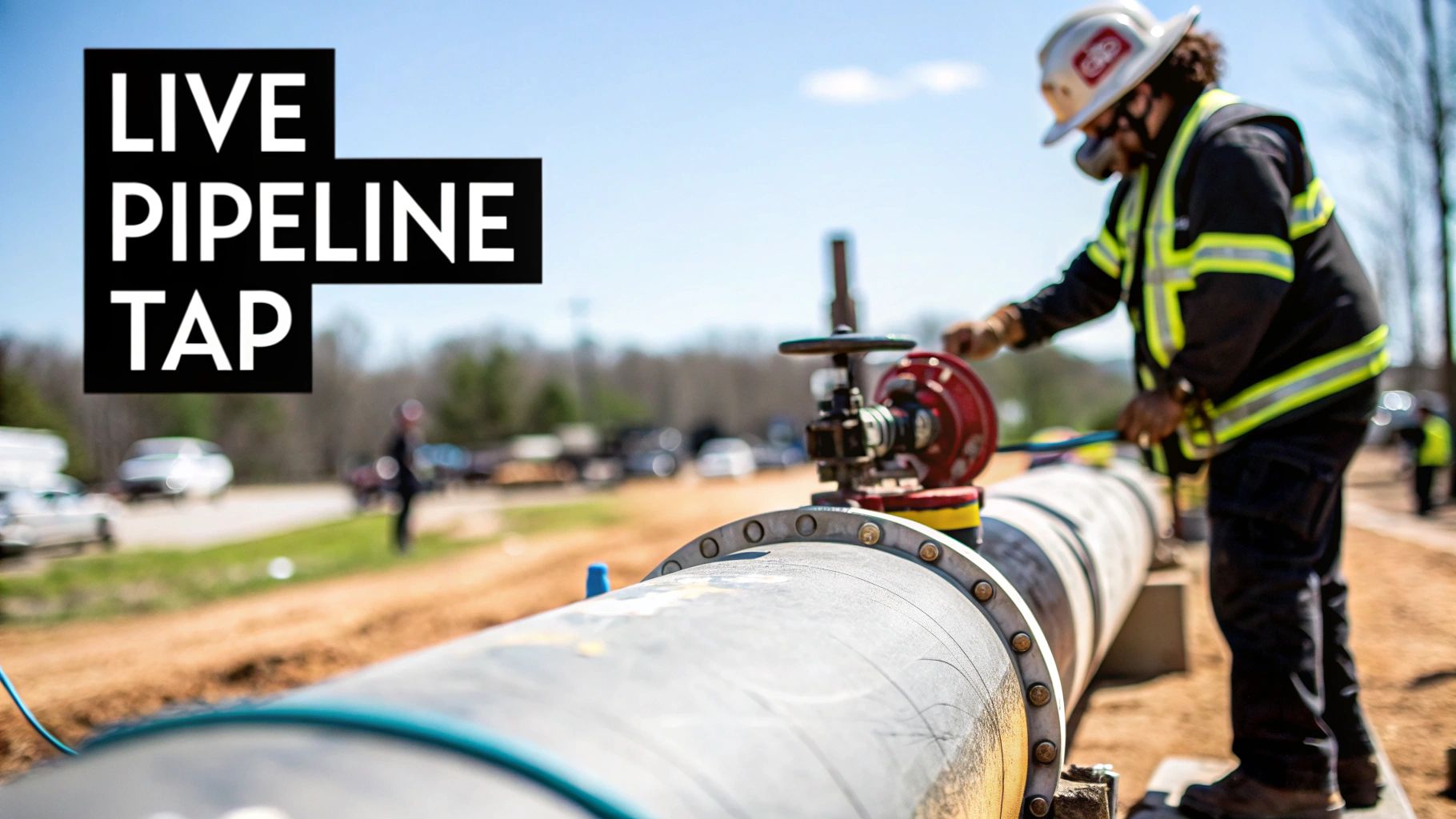
At its core, the piping hot tapping process is a brilliant engineering solution to a massive industrial challenge: how do you expand or maintain a pipeline system that absolutely cannot be turned off?
For sectors like natural gas distribution, chemical processing, or municipal water supplies, a shutdown isn't just a minor hassle. It can mean millions in lost production and significant disruptions to essential public services. Hot tapping lets technicians add new branch lines, install sensors, or create access points on pipes actively carrying materials under immense pressure.
Why This Process Is Indispensable
The real value of hot tapping is all about maintaining operational continuity. It's a method used worldwide to keep pipelines flowing, whether they're transporting hazardous liquids, natural gas, or hydrogen. By allowing for new connections without a full shutdown, this process also has a huge environmental benefit, avoiding the large-scale venting or lost product that comes with depressurizing a line. You can explore more on how this process ensures pipeline safety and efficiency to get a deeper dive.
This capability is essential for:
- System Expansions: Adding a new connection for a new factory or neighborhood without cutting off service to existing customers.
- Maintenance and Repairs: Installing a temporary bypass line to allow crews to replace a failing valve or a damaged section of pipe.
- Instrumentation Installation: Placing new sensors, gauges, or sampling ports directly onto a live line to improve system monitoring and control.
The entire operation is built on one simple principle: contain the pressure at every single step. A specialized fitting and valve are welded onto the pipe before any cut is made, ensuring the whole process remains a closed, fully controlled system from start to finish.
The Fundamental Components at Play
The entire procedure relies on three key pieces of equipment working together seamlessly.
First, a hot tap fitting, often a split-tee, is welded directly onto the main pipe. This creates a permanent, leak-proof branch connection. Next, a full-port isolation valve gets attached to that fitting. This valve acts as the gatekeeper, giving technicians control over access to the live pipeline.
Finally, the hot tapping machine is bolted onto the valve. This isn't just any drill; it's a powerful, precision tool that cuts through the pipe wall, captures the piece it removes (known as a "coupon"), and retracts safely. Once the machine is removed, the valve is closed, and the new connection is officially live and ready for use.
The Tools and the Team: What a Safe Hot Tap Really Takes
Pulling off a hot tap isn't just about having the right gear; it's about the seamless interplay between that specialized hardware and a crew that knows exactly what they're doing. It's a high-stakes operation where every component and every person has a critical job. Get one part wrong—the wrong tool, the wrong person—and what should be a controlled procedure can quickly turn into a serious incident.
Think of the hardware as a purpose-built system designed for zero-failure performance. The whole operation relies on a few key pieces working together perfectly to manage extreme pressures and create a new, permanent connection on a live line. This isn't just a collection of parts; it's an engineered solution for one of the most demanding jobs in the industry.
The Core Hardware: No Room for Error
It all starts with creating a solid, permanent branch on the active pipe. That’s why the fitting and the valve are so incredibly important.
The Split-Tee Fitting: This is your foundation. A split-tee is exactly what it sounds like: a tee-shaped connector made in two halves that clamp around the existing pipe. After being carefully positioned, it's welded directly onto the line, creating a permanent, leak-proof seal that becomes a new, integral part of the pipeline.
The Full-Port Valve: Bolted right onto the fitting, this valve acts as the gatekeeper. It has to be a "full-port" (or full-bore) valve, meaning its opening is the same diameter as the pipe. This is non-negotiable, as it allows the cutter to pass through cleanly. The valve stays open during the cut and is closed immediately after to isolate the new connection from the hot tapping machine.
The Hot Tapping Machine: This is the real star of the show. It's far more than a simple drill. This is a piece of precision machinery that bolts onto the valve. It consists of a long boring bar, a specially designed cutter, and a pilot drill. Critically, that pilot drill has a small retention wire or device to catch the piece of pipe being cut out—we call it the "coupon"—so it doesn't fall into the pipeline and cause major problems downstream.
A hot tap is only as strong as its weakest link. That’s why material selection is so vital. The fitting and valve must be a perfect match for the parent pipe's material specs and pressure ratings. Standards like ASME B31.3 demand this to ensure the new connection can handle the operational stress for years to come.
The table below breaks down these essential pieces of hardware and their specific roles.
Core Hot Tapping Equipment and Their Functions
| Equipment Component | Primary Function | Critical Considerations |
|---|---|---|
| Split-Tee Fitting | Creates a permanent, weldable branch on the existing pipeline. | Must match the parent pipe's material, diameter, and pressure rating. The quality of the weld is paramount. |
| Full-Port Valve | Provides isolation between the live pipe and the tapping machine. | Must have a "full-bore" opening to allow the cutter to pass through unobstructed. Pressure rating must exceed the line's maximum operating pressure. |
| Hot Tapping Machine | Houses the cutter and drills the hole into the pressurized pipe. | Must securely contain line pressure. The pilot drill must have a mechanism to retrieve the cut "coupon." |
Each component is engineered to work as part of a system, creating a sealed, pressurized containment from the pipe surface all the way to the machine's drive motor.
The Expert Crew Behind the Machine
The best equipment in the world is useless without the right people running it. The human element—the team with the right training, field experience, and flawless communication—is what truly guarantees a safe, successful outcome.
A professional hot tapping crew is a well-oiled machine in itself, with a clear chain of command and defined roles. This isn't a job for generalists; it requires specialists.
| Role | Primary Responsibility | Key Skills and Qualifications |
|---|---|---|
| Lead Technician | Manages the entire operation, from equipment setup to executing the cut. | Deep knowledge of machine operation, pressure control, and API standards. |
| Certified Welder | Welds the split-tee fitting onto the live, pressurized pipe. | Expertise in in-service pipeline welding, often certified to standards like API 1104. |
| Safety Supervisor | Oversees the worksite, enforces safety protocols, and manages the Job Safety Analysis. | OSHA certification, hazard recognition, and emergency response planning. |
This team structure creates essential checks and balances. The welder builds the foundation, the technician performs the precision cut, and the safety supervisor keeps a watchful eye over everything. It's this coordinated expertise that turns a potentially dangerous task into a routine, controlled, and highly effective procedure. That synergy is exactly how specialists like Blue Gas Express can confidently modify critical infrastructure while keeping essential services running without a hitch.
A Step-by-Step Look at the Hot Tapping Procedure
Executing a hot tap is all about precision, planning, and control. It’s an intricate process that turns a potentially risky job into a methodical, predictable sequence of events. From the initial inspection to removing the machine, every step is designed to protect the integrity of the pipe and keep the crew safe.
Think of the core equipment—the fitting, the valve, and the tapping machine—as a single, integrated system built to safely cut into a live line.
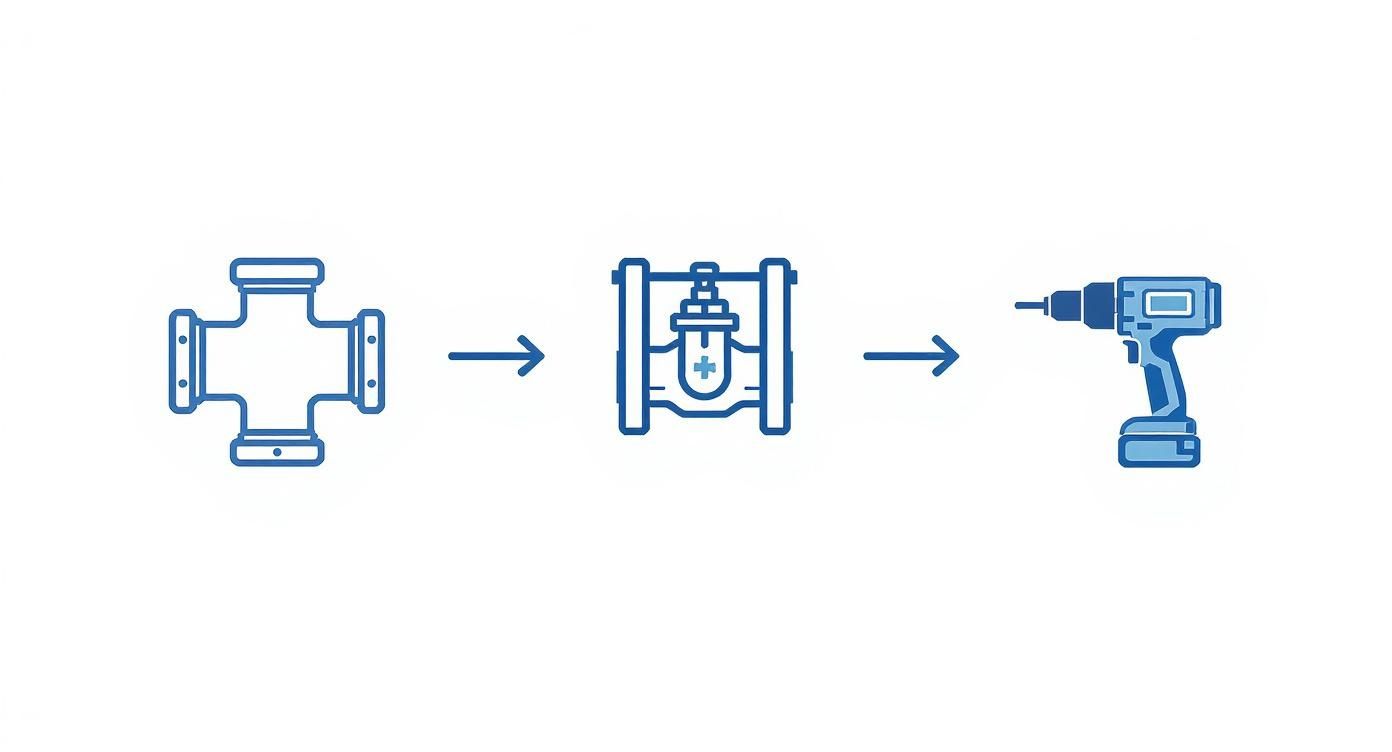
The infographic above shows how each piece is added in sequence, creating a sealed, pressurized containment system long before the pipe wall is ever breached.
Preparing the Stage for Success
Long before any heavy equipment shows up, the real work begins with preparation. This is more than just clearing the area; it's about making absolutely sure the pipe is healthy enough to handle the procedure.
Technicians start by inspecting the exact spot where the tap will be made. This means stripping off any paint, insulation, or coatings to get down to the bare metal. This clean surface is critical for what comes next: non-destructive testing (NDT). Using ultrasonic tools, the crew measures the pipe's wall thickness to ensure it meets the minimums laid out in standards like ASME B31.3.
A huge part of this inspection is finding what you can't see. We use techniques like the Dye Penetrant Test (DPT) to find microscopic surface cracks or porosity that could ruin a weld and cause a catastrophic failure. If the pipe wall is too thin or has any flaws, we have to find a new spot. No exceptions.
Building the Connection Point
Once a location gets the green light, the physical assembly can start. The split-tee fitting, which will become the new permanent branch, is carefully positioned and clamped onto the main pipe. Now, the certified welder steps in.
Welding on a live, pressurized pipe is not a job for just anyone. It's a highly specialized skill. The welder has to lay down a perfect, full-penetration weld that essentially makes the fitting a seamless part of the pipeline. Heat has to be carefully controlled to avoid weakening the pipe wall while still creating a strong, leak-proof bond.
After the welding is done, the full-port isolation valve is bolted onto the fitting’s flange. This valve is the gatekeeper for the whole operation. Its installation completes the permanent connection—and at this point, we still haven’t cut a hole in the main pipe.
Validating Integrity With a Pressure Test
With the fitting and valve locked down, it’s time for a critical safety check: a hydrostatic pressure test on the new assembly.
This involves pressurizing the space between the pipe wall and the closed valve to a level well above the pipeline’s normal operating pressure. This test accomplishes two things:
- It proves the weld is 100% free of leaks or defects.
- It confirms the valve and flange gaskets are sealed tight.
This test is non-negotiable. We only move forward after the assembly proves it can hold this higher pressure. It's the final go-ahead before we actually tap the pipe.
The Cut and the Final Steps
With the connection fully tested and validated, the hot tapping machine is mounted onto the open valve. The machine's boring bar, fitted with a cutter and pilot drill, is lowered through the valve until it makes contact with the pipe wall. Then, the machine is switched on, and the cutter slowly drills through the pipe.
This is a very controlled and precise cut. The pilot drill is cleverly designed with a retention wire that catches the piece of cut pipe—known as the coupon. As soon as the cut is finished, the cutter assembly is retracted back up through the valve, bringing the coupon with it.
The second the cutter is clear, the main valve is shut, completely isolating the new branch from the tapping machine. The pressure inside the machine is then safely bled off. Only then is it unbolted and taken away. The coupon comes with it, giving us physical proof that the cut was clean and complete.
With the machine gone and the valve closed, the new branch connection is officially ready for service—all accomplished without ever shutting down the flow inside the pipeline.
Navigating Critical Safety Protocols and Risks
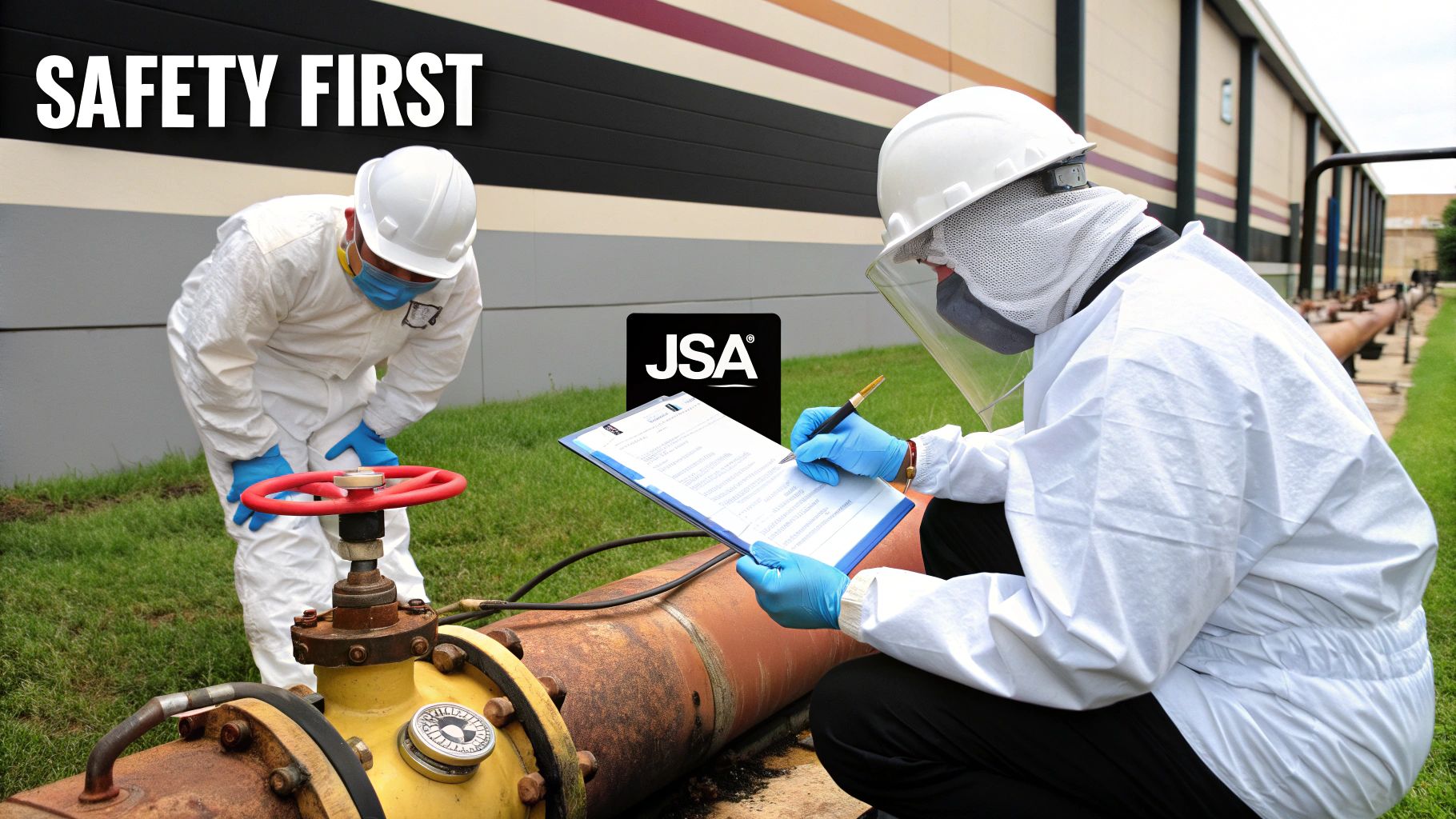
When it comes to the piping hot tapping process, there's zero room for error. A single mistake can have devastating consequences, which is why a deeply ingrained safety culture isn't just a talking point—it's the foundation of every single job. This goes way beyond a simple checklist. It's about an analytical mindset that sees and neutralizes hazards before they even have a chance to become a problem.
The entire procedure is dictated by an absolute commitment to safety. We're translating complex engineering principles into a series of controlled, repeatable actions. Every single step, from the first look at the site to the final removal of the tapping machine, is planned and carried out with safety as the number one priority.
Building a Foundation of Safety With JSA
Long before a single tool arrives on site, the whole operation gets mapped out in a Job Safety Analysis (JSA), sometimes called a Job Hazard Analysis (JHA). This isn't just paperwork; it's a critical thinking session. The crew gets together and breaks the job down into individual steps, identifying every conceivable hazard along the way.
For instance, a hot tap JSA gets very specific about the "what-ifs":
- Welding on a Live Line: What's the protocol if ultrasonic tests show the pipe wall is thinner than expected? What happens if the welder's heat input is too high, risking a burn-through?
- Pressure Containment Failure: If a flange gasket fails during the pressure test, what's our immediate emergency response? Who does what?
- Hazardous Material Exposure: Based on what's inside the line, what's the exact Personal Protective Equipment (PPE) required? Is it just a hard hat and gloves, or full-face respirators and chemical suits?
This process turns vague dangers into real-world problems with pre-planned solutions. It ensures every person on the team knows their job and, just as importantly, their role in keeping everyone safe.
True operational safety isn't about reacting to incidents; it's about engineering them out of the process from the very beginning. Compliance with standards like API Recommended Practice 2201 is the absolute minimum, serving as the blueprint for safe in-service welding and tapping procedures.
Managing Pressure and Thermal Stress
Two of the biggest inherent risks in hot tapping are the immense pressure inside the pipe and the thermal stress from the welding process. When you weld on a live pipeline, you're introducing an intense, focused heat source that has to be managed perfectly. The product flowing inside the pipe actually helps by acting as a natural coolant, pulling heat away from the weld zone.
But that flow rate is a delicate balancing act. Too slow, and heat builds up, which can weaken the pipe's metal structure. Too fast, and you can cool the weld too quickly, causing it to become brittle and crack. Technicians have to operate within a very precise "flow window" to get a strong, solid weld without hurting the pipe's integrity.
Pressure management is a constant, too. From the second the fitting is welded on, that entire assembly is designed to handle the line's full operating pressure. The hydrostatic test before the actual cut is a make-or-break moment—it's the final confirmation that every weld, bolt, and gasket is sealed tight.
Verifying Material Health and Compatibility
You can't just hot tap any pipe. A fundamental part of risk management is making sure the pipe is a good candidate in the first place. You wouldn't want to tap into a line that's brittle, like some older cast iron pipes, or one that's weakened by severe internal or external corrosion.
Before any project gets the green light, the pipe undergoes extensive non-destructive testing. Ultrasonic scanners are used to verify the wall thickness is sufficient, while methods like dye penetrant testing can reveal microscopic surface cracks you'd never see with the naked eye. This upfront work is non-negotiable and is what prevents catastrophic failures.
Since hot tapping often involves lines carrying potentially hazardous materials, a thorough chemical risk assessment is another essential layer of planning. This ensures the crew is fully prepared for the specific substances they're dealing with. In the end, a safe and successful hot tap all comes down to this kind of meticulous preparation and an unyielding commitment to industry best practices.
Where Hot Tapping Really Shines: Real-World Scenarios
The technical side of hot tapping is fascinating, but its real value hits home when you see it in action. This is where the theory prevents a costly shutdown or keeps the lights on for an entire community. It’s the go-to solution when you absolutely cannot stop the flow.
You'll find hot tapping being used everywhere, from upgrading municipal water systems to expanding massive industrial facilities. The demand for these kinds of non-disruptive solutions is only growing as industries push for greater efficiency and uptime.
In fact, the global market for hot tapping machines is sitting around $1.5 billion as of 2025 and is expected to grow by about 6% each year. That growth is a clear indicator of how vital this technology has become, especially in oil & gas, water management, and chemical processing. If you're interested in the market dynamics, you can dive deeper into this detailed hot tapping machine industry analysis.
Expanding a City Without Turning Off the Taps
Think about a suburb that's booming with new construction. All those new homes and businesses need water, but the main line feeding the area runs right under a busy highway and already serves thousands of people. Shutting that down would be a complete mess—traffic jams, public notices, and thousands of unhappy residents.
This is a textbook case for hot tapping. Instead of causing a massive disruption, a crew can come in and get the job done seamlessly.
- First, they excavate a small section to get to the existing water main.
- Next, they weld on a split-tee fitting and attach a new valve, all while the pipe is still pressurized.
- Then, the hot tapping machine drills right through the valve to create the new connection.
Just like that, you have a brand-new branch line ready to serve the entire development, and not a single person lost water pressure. It’s faster, cheaper, and saves everyone a major headache.
By enabling a new connection without interrupting flow, hot tapping directly supports urban development and infrastructure expansion. It allows cities to grow sustainably while maintaining reliable service for their communities.
Preventing a Million-Dollar Refinery Shutdown
Now, picture a huge oil refinery where a critical valve is on its last legs. This valve controls the crude oil flowing into a major processing unit. The old-school way to replace it? Shut down the entire unit. That could mean days of lost production and a financial hit running into the millions.
Hot tapping provides a much smarter way forward: creating a temporary bypass. Technicians perform two hot taps, one just before the failing valve and one just after it. They connect a new piece of pipe between these two points, creating a detour for the oil to flow through.
With the bypass up and running, the section with the bad valve is completely isolated and depressurized. Now the maintenance crew can work safely to replace it without impacting the rest of the refinery. Once the new valve is in, they just switch the flow back and remove the bypass. What could have been a financial disaster becomes a routine, manageable repair.
Boosting Pipeline Monitoring and Maintenance
Hot tapping isn't just for big expansions or emergency repairs. It’s also an essential tool for keeping systems optimized. For example, an operator might realize they need better data on a natural gas pipeline and decide to install new pressure or temperature sensors.
Or, maybe they need to add a chemical injection point to feed corrosion inhibitors into a line. With hot tapping, a small fitting and valve can be installed on the live pipe to create a permanent access point. This allows for the precise placement of sensor probes or injection quills, ultimately improving the safety and lifespan of the pipeline—all without ever taking it offline.
When to Call in the Hot Tapping Pros
The idea behind hot tapping sounds simple enough, but pulling it off in the real world is a whole different ballgame. This isn't a job for the general maintenance crew or even a skilled in-house team. We're talking about a high-stakes procedure where a single misstep can have catastrophic consequences.
So, when should you bring in the specialists? The short answer is: always. The complexity and the very real dangers mean that only certified technicians with thousands of hours of field experience should ever touch a hot tap job. Their value isn't just in running the machine; it's in their ability to see what can go wrong before it does.
Red Flags: When a Specialist is Non-Negotiable
Some situations crank up the risk factor from high to extreme. If your project has any of these elements, your first move should be calling a professional service.
High-Pressure Systems: Any line operating at serious pressures, often pushing past 1400 PSIG, requires equipment and expertise that you just don't find outside of a specialized team.
Hazardous or Flammable Materials: Tapping into a line carrying natural gas, volatile chemicals, or super-hot liquids? That’s where the pros earn their keep. They know the unique protocols needed to keep everyone safe.
Tricky or Aging Infrastructure: Working in tight quarters, on old pipes with questionable integrity, or with unusual pipe materials requires a level of problem-solving that only comes from years of hands-on experience.
Think of a professional hot tapping service as an investment in a sure thing. They live and breathe the ASME and API standards, and they show up with perfectly maintained, state-of-the-art equipment. It's about getting the job done right the first time, protecting your people and your assets.
Questions to Ask Before You Hire Anyone
You’re not just hiring a contractor; you’re entrusting a team with managing massive risk. Your questions need to reflect that.
- Certification and Training: Are your technicians specifically certified for in-service welding and hot tapping? Vague answers aren't good enough.
- Equipment and Maintenance: Can I see the maintenance and pressure test logs for your hot tapping machines? A top-tier outfit will have these ready to go.
- Safety Record: What's your company's safety record? Ask for their Total Recordable Incident Rate (TRIR). A low number speaks volumes.
- Relevant Experience: Show me case studies for jobs you've done under similar pressure, temperature, and material conditions. You want proof they’ve handled your exact scenario before.
Asking these questions is the best way to separate a truly qualified partner, like the seasoned experts at Blue Gas Express, from a crew that might be in over their heads.
Common Questions About the Hot Tapping Process
When you're dealing with a high-stakes procedure like hot tapping, it's natural for a lot of practical questions to come up, even if you understand the basic steps. Let's break down some of the most common things people ask to get a clearer picture of how this all works in the real world.
What Is the Main Difference Between Hot and Cold Tapping
The real difference boils down to one simple thing: is the pipeline running or not?
Hot tapping is done on a "live" system. That means the pipe is under pressure and product is flowing through it while we work. The massive advantage here is that you can make critical connections or modifications without shutting anything down, which can save a company from enormous downtime costs.
Cold tapping, on the other hand, is for pipelines that have been taken completely out of service. You have to depressurize the line, drain it, and purge it before you can even think about cutting. It's a more straightforward process, but it requires a full system outage—something that’s often just not an option for critical infrastructure.
Are All Types of Pipes Suitable for Hot Tapping
Absolutely not, and this is where expertise becomes non-negotiable. A pipe has to be in solid condition to handle the stresses of this procedure. There are a few hard limits.
- Material Integrity: If a pipe has heavy corrosion, existing cracks, or other structural flaws, it's an immediate no-go.
- Material Type: We generally stay away from brittle materials, like certain types of cast iron. They carry a risk of fracturing when you weld or cut into them.
- What's Inside: The fluid or gas being transported is a major factor. If a line is carrying something highly unstable or, say, pure oxygen, the risks are often too high to even consider hot tapping.
Before a single tool comes out, a deep engineering analysis is mandatory. This always includes non-destructive testing to confirm the pipe is structurally sound for the job.
The most critical work happens long before the first cut. A thorough inspection must confirm the pipe wall has enough thickness and is free from any defects that could compromise the weld or the tap itself.
What Happens to the Pipe Section That Is Cut Out
You might be picturing a loose piece of metal getting shot down the pipeline, causing all sorts of chaos. Thankfully, that's not how it works. That piece of pipe, which we call a coupon, is never left behind.
The hot tapping machine is engineered specifically to retrieve it. At the center of the cutting tool, the pilot drill has a small retention wire. The second the cut is complete, this wire latches onto the coupon. As we retract the cutter back through the valve, it pulls the coupon out with it. This is a critical safety measure, gives us physical proof of a clean cut, and prevents that loose piece from damaging pumps or valves downstream.
When the complexity of a live pipeline modification requires absolute certainty, you need a team with proven expertise. Blue Gas Express provides specialized mobile gas solutions, ensuring your operations continue seamlessly even during critical infrastructure work. Learn how we can support your project today.