

Natural gas vehicle stations are becoming a cornerstone for commercial fleets looking for a smarter, cleaner way to operate. These facilities, which provide either Compressed Natural Gas (CNG) or Liquefied Natural Gas (LNG), offer a powerful alternative to diesel, paving the way for more sustainable transportation and a stronger bottom line.
Why Invest in Natural Gas Vehicle Stations Now
The momentum behind natural gas fueling is undeniable, fueled by a combination of smart economics and mounting environmental pressure. If you run a fleet of any kind—logistics, construction, waste management, you name it—the case for building out this infrastructure is stronger than ever. It's a strategic play that hits both your financial targets and your corporate responsibility goals.
The dollars and cents are pretty clear. Natural gas has historically been a more stable and affordable fuel than diesel, often by a wide margin. For a fleet operator, that price difference translates directly into lower, more predictable operating costs. When you have dozens or even hundreds of heavy-duty trucks on the road, those savings add up fast and go straight to your bottom line.
Meeting Sustainability and Operational Goals
Beyond the cost benefits, the environmental upside is a huge piece of the puzzle. Emission regulations are only getting tighter, and switching your fleet to natural gas gives you a clear and immediate path to compliance. Compared to diesel engines, natural gas vehicles release far fewer greenhouse gases and harmful particulates.
Making this transition helps your company:
- Hit sustainability targets and build a reputation as an environmentally conscious brand.
- Stay ahead of government emission mandates, steering clear of potential penalties.
- Appeal to clients and partners who increasingly demand sustainable supply chains.
The market is already voting with its wallet. Valued at $15 billion in 2025, the global natural gas fueling station market is expected to explode to around $45 billion by 2033. That’s a compound annual growth rate of 12%, driven largely by tough emission standards across North America and Europe. Diving into the market trends and growth projections shows just how significant this shift is.
The Strategic Choice Between Permanent and Mobile Stations
One of the first big decisions you'll face is how to roll out your fueling infrastructure. A permanent, on-site station is often the long-term vision, but getting one built and permitted can take time. This is where agile, mobile solutions can be a total game-changer.
Mobile CNG and LNG solutions, like the units offered by Blue Gas Express, act as the perfect stopgap. They let your fleet start running on cheaper, cleaner fuel right away, so you're not stuck waiting for construction to finish. It’s all about maintaining operational momentum and starting your ROI clock sooner.
Think about it: a construction company can drop a mobile fueler right at a new job site, powering vehicles and equipment from the get-go. Or a logistics firm can use a temporary unit to keep trucks rolling while their main station undergoes maintenance. This kind of flexibility means you start reaping the rewards of natural gas from day one, not just when the concrete on your permanent station finally cures.
Choosing the Right Location for Your Fueling Station
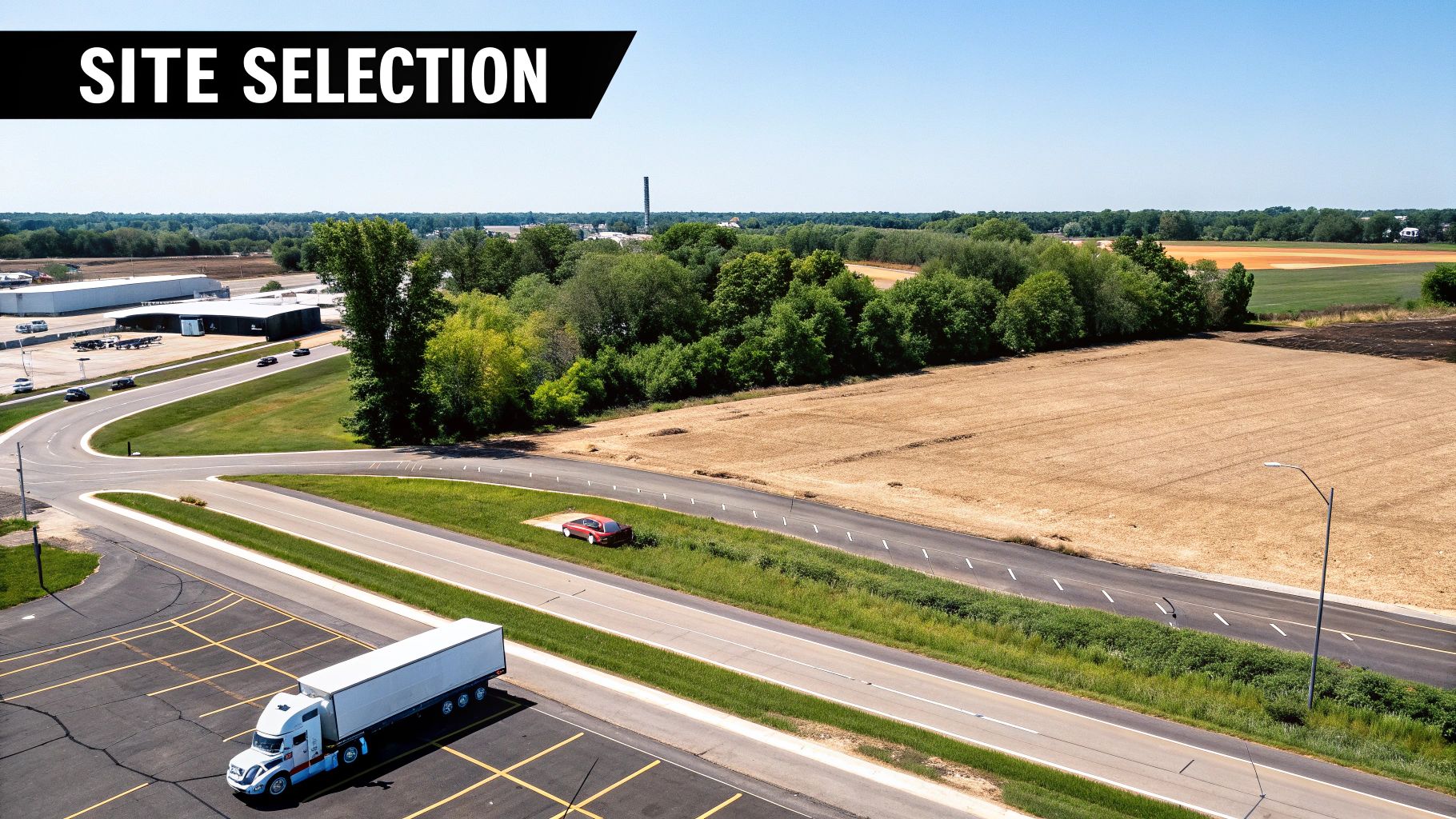
Let's be clear: picking the right spot for your natural gas vehicle station isn't just one step in the process—it's the foundation of your entire business. Get this wrong, and even the most advanced equipment won't save you. A great location is all about hitting that sweet spot of high demand and easy access.
The first question you have to ask is, "Who am I fueling?" Are you serving a dedicated private fleet, public transit buses, or over-the-road truckers? The answer immediately narrows your search. If you're building a public station, you have to think like a long-haul driver, and that means being right in the thick of the action near interstates, distribution centers, and busy industrial parks.
Analyzing Proximity and Accessibility
Your number one job is to make fueling an effortless part of a driver’s route. Put yourself in the cab of a Class 8 truck—any detour that adds more than a few minutes is a non-starter. You need a location that’s practically a straight shot off the highway. Easy on, easy off. It’s that simple.
When you're out scouting properties, keep these non-negotiables in mind:
- Major Transport Corridors: The site absolutely must be within a mile or two of a major interstate or freight highway. High traffic volume is your lifeblood.
- Ingress and Egress: Watch how traffic flows. Can a 53-foot trailer pull in and out without a complicated, multi-point turn? If a driver has to back up, you’ve already lost them.
- Turn Radius: This is a classic rookie mistake. The property has to accommodate the massive turning radius of heavy-duty trucks. Tight corners are a deal-breaker.
A prime piece of land might be at the junction of two major freight routes, right next to a new warehouse complex. On the flip side, a cheap parcel tucked away on a congested commercial street is a recipe for failure, no matter how good the price is.
A common mistake is just looking at raw traffic counts. You need to dig deeper. A professional traffic study can tell you the percentage of commercial truck traffic and where those trucks are actually going. That's the data that will make or break your demand forecast.
Verifying Utility and Infrastructure Availability
So you’ve found a promising lot. The next hurdle is infrastructure. Finding a great location is pointless if you can't get the juice to it. For a CNG station, the most critical utility is a high-pressure natural gas pipeline. Tapping into an existing main is one thing; paying to have a new line extended for miles is a budget-killer that can add hundreds of thousands to your project cost.
Before a dime is spent on a deposit, you have to get confirmation on these essentials.
Key Infrastructure Checklist
- Gas Pipeline Access: Get on the phone with the local gas utility. You need to know the exact location, size, and—most importantly—the pressure of their pipelines. Your compressors have minimum pressure requirements to work efficiently, making this a hard technical checkpoint.
- Three-Phase Electrical Power: Those compressors are absolute power hogs. You'll need access to a robust, three-phase electrical supply to keep everything running smoothly. Standard power won't cut it.
- Water and Sewer: These are essential for day-to-day operations, especially if you plan on including restrooms or vehicle washing services.
Navigating Zoning and Environmental Hurdles
Finally, you have to play by the local rules. Every town and county has its own zoning laws that dictate what can be built where. A fueling station isn't something you can just drop onto any commercial lot. A property zoned for "heavy industrial" is usually a safe bet, but "light commercial" might be a dead end.
Your first call should be to the local planning and zoning department. Ask for their zoning maps and the specific permit requirements for a fueling station. Be prepared for public hearings and reviews—getting to know the local officials early can save you a world of headaches and delays down the road.
An Environmental Site Assessment (ESA) is another crucial piece of due diligence. This investigation looks for any soil or groundwater contamination from the property's past life. Finding an environmental problem after you've already committed can stop a project in its tracks. It's an upfront investment that protects your capital and confirms your site is viable from every single angle.
How to Navigate Permits and Regulations
Let's be honest: the journey from a solid site plan to an operating fueling station is paved with paperwork. It's easy to look at the maze of permits and regulations and feel overwhelmed. But with the right approach, it’s a manageable process, not a project-killer. Getting this part right is absolutely critical if you want to keep your timeline and budget from spiraling.
You'll be dealing with approvals at the local, state, and sometimes even the federal level. I like to think of it as a series of gates you have to pass through, each with its own gatekeeper. The single best piece of advice I can give is to communicate with these agencies early and often. Don't see them as obstacles; they are your partners in making sure your station is safe and built to last.
Getting to Know the Key Players and Permits
Before you can even think about filling out an application, you need a clear picture of who you're talking to and what they care about. The specific permits you'll need will vary depending on where you are, but they almost always fall into a few core categories. One of the most valuable things you can do early on is build a regulatory matrix—a simple spreadsheet listing every permit, the agency in charge, and critical deadlines.
Your essential permit list will almost certainly include:
- Local Zoning and Building Permits: These come from your city or county planning department. They'll cover everything from land use and construction blueprints to the nitty-gritty of electrical and plumbing inspections.
- Environmental Permits: State environmental agencies will take a hard look at your project’s impact. This usually involves securing an air permit to operate, which governs any emissions from your compressors and venting systems.
- Safety Certifications: This is non-negotiable. You must comply with the National Fire Protection Association codes—specifically NFPA 52 for CNG and NFPA 59A for LNG. Your local fire marshal is the one who will be enforcing these life-or-death standards.
Insider Tip: Get in front of your local fire marshal before you finalize your engineering designs. Seriously. Bring them a preliminary site plan, walk them through your safety systems, and listen to their feedback. Getting their buy-in at this stage can save you from incredibly expensive redesigns down the road.
A Practical Playbook for the Application Process
Once you have your permit roadmap, the real work begins. Each application is a complex technical document, and it needs to be perfect. One missing signature or a single incorrect calculation can send your application right to the bottom of the pile, easily costing you weeks or even months.
Don't try to be a hero and do it all yourself. Putting together a team of experts—civil engineers, environmental consultants, and a legal advisor who knows local land-use law inside and out—is one of the smartest investments you can make. These pros speak the regulators' language. For instance, an experienced environmental consultant knows exactly how to conduct the required air dispersion modeling to prove your station meets clean air standards.
Getting Past the Common Regulatory Hurdles
Even with flawless applications, you're going to hit a few bumps in the road. It’s just part of the process for any major infrastructure project. Knowing what to expect means you can plan for them, both in your timeline and your budget.
Common Obstacles and How to Handle Them
| Hurdle | The Challenge | Proactive Strategy |
|---|---|---|
| Public Comment Periods | Local residents or community groups might raise concerns about safety, noise, or traffic during public hearings. | Don't wait for the official hearing. Host your own community info session beforehand. Be transparent, present your safety plans clearly, and answer every question. Building trust is key. |
| Air Quality Standards | Meeting tough state or federal emission limits for things like nitrogen oxides (NOx) can be a real challenge. | Spend the money on the best available control technology (BACT) for your equipment. The upfront cost often pays for itself by saving you a ton of time and headaches during the permitting phase. |
| Utility Interconnection | Getting the green light from the natural gas and electric utilities to connect to their grids can be a slow, bureaucratic slog. | The moment you have a confirmed site, start talking to the utility project managers. Their requirements can have a major impact on your site layout and equipment choices. |
For most projects, you should expect the permitting phase to take anywhere from 6 to 18 months. That huge range comes down to local complexity and how well-prepared you are. If you're building in a heavily regulated area with a ton of public oversight, you'll be on the longer end of that spectrum. This is where a temporary fueling solution from a provider like Blue Gas Express can be a lifesaver, giving you a way to keep your fleet running while the permanent station works its way through the regulatory process.
Designing Your Station and Selecting Equipment
With your location secured and the permitting process moving forward, it’s time to get into the nuts and bolts of your project: the station's design and hardware. This is where you map out how your station will actually work, choosing the core components that dictate its capacity, efficiency, and the experience you offer drivers. Getting this right is absolutely critical for a smooth operation and a healthy bottom line.
The first big fork in the road is deciding between Compressed Natural Gas (CNG) and Liquefied Natural Gas (LNG). This isn't just a minor technical choice; it's a decision that shapes your entire infrastructure, from the ground up.
CNG stations are what most people are familiar with. They tap directly into a utility pipeline, compress the gas to incredibly high pressures (usually 3,600 psi), and store it on-site for fueling. LNG is a different beast entirely. It’s delivered to your station as a super-chilled liquid and kept in specialized cryogenic tanks, which means a completely different set of equipment and handling procedures.
Key Components of a CNG Station
For a CNG setup, your design will center around a few key pieces of equipment working in concert. A logical, safe, and efficient layout is paramount to ensure a seamless flow from the pipeline right into a vehicle's tank.
- Compressor: Think of this as the heart of your station. It’s the muscle that pulls gas from the utility line and pressurizes it. The size of your compressor directly impacts your throughput—how many vehicles you can fuel in an hour.
- Storage Cascade: After compression, the high-pressure gas is channeled into a series of interconnected tanks, known as a cascade. This system acts as a buffer, ensuring fuel is ready to go for quick dispensing so drivers aren't stuck waiting for the compressor to play catch-up.
- Dryer: Pipeline gas naturally contains moisture, which is a big problem. It can cause corrosion or even freeze-ups in vehicle fuel systems, especially in colder climates. A dryer is an essential piece of the puzzle that strips this moisture out before the gas ever reaches the compressor.
- Dispenser: This is what your customers will interact with. It looks and feels much like a traditional gasoline pump, but it’s engineered to safely measure and transfer high-pressure gas.
Properly setting up your storage is a crucial step. For a general overview of best practices, you can find helpful information in this tank installation guide.
Fast-Fill Versus Time-Fill Setups
Inside the CNG world, you have another major choice to make: how you want to dispense the fuel. This decision really boils down to who you're serving.
Time-fill stations are the perfect fit for return-to-base fleets—think city buses, school buses, or waste management trucks that park overnight. These systems use smaller compressors to slowly fill the vehicles over several hours. It’s a lower-pressure, lower-stress process that cuts down on energy costs and equipment wear.
Fast-fill stations, on the other hand, are built for speed. They serve the public and high-turnover commercial fleets that need to get back on the road quickly. By relying on a large storage cascade, they can deliver a fill-up in just a few minutes, mimicking the experience everyone is used to. They cost more to build and run, but for a retail operation, they’re non-negotiable.
Your fueling strategy directly impacts your business model. A private fleet can optimize for the lowest possible operational cost with a time-fill system, while a public station must prioritize speed and convenience with a fast-fill setup to attract customers.
The viability of these stations is proven by the growing network across the country. As we head into 2026, the U.S. natural gas vehicle infrastructure is hitting some impressive numbers, with 1,385 compressed natural gas (CNG) stations and 81 liquefied natural gas (LNG) stations up and running. That represents a solid 2% year-over-year increase in CNG availability. California continues to lead the pack with 318 CNG stations, and with 53% of all stations now offering public access, the infrastructure is stronger than ever. You can dig deeper into the growth of the clean transport industry on TransportProject.org.
Comparing CNG and LNG Station Infrastructure
To make the right choice for your operation, it helps to see the core differences side-by-side. CNG and LNG infrastructure serve different needs and come with distinct hardware and operational models.
| Feature | CNG Stations | LNG Stations |
|---|---|---|
| Core Components | Compressor, Dryer, Storage Cascade (high-pressure vessels), Dispenser | Cryogenic Storage Tank, Cryogenic Pump, Vaporizer, Dispenser |
| Fuel Source | Connected directly to a natural gas utility pipeline | Fuel is delivered by cryogenic tanker trucks and stored on-site |
| Fueling Process | Dispenses gas at high pressure (3,600 psi). Fast-fill takes minutes; time-fill takes hours. | Dispenses a super-chilled liquid (-260°F). Fueling is fast, comparable to diesel, taking about 5-10 minutes. |
| Ideal Use Case | Return-to-base fleets (delivery vans, buses), light/medium-duty vehicles, regional haul trucks. | Long-haul heavy-duty trucks (Class 8), marine applications, and high-horsepower equipment. |
Ultimately, CNG is generally better suited for fleets operating within a specific region, while LNG is the go-to for heavy-duty, long-distance transportation where energy density and fast refueling are paramount.
Essential Support and Safety Systems
Beyond the main fueling hardware, a professional station needs a suite of integrated systems to ensure it runs safely, reliably, and smoothly. These aren't just nice-to-haves; they are foundational to a well-managed facility.
Your checklist has to include:
- Emergency Shutdown (ESD) Systems: These are the big red buttons and automated sensors placed strategically around the site that can kill the gas flow instantly in an emergency.
- Methane Detectors and Alarms: These sensors are your first line of defense against leaks. They constantly monitor the air and will trigger loud alarms and automatic shutdowns the moment they detect gas.
- Payment Processing Terminals: For any public-facing station, you'll need modern, secure payment systems that can handle everything from standard credit cards to fleet cards and mobile payments.
- Remote Monitoring Tools: This is a game-changer. These systems give you (or your service provider) a real-time view of the station’s performance, allowing you to spot issues, diagnose problems remotely, and track every cubic foot of fuel sold.
How to Manage Project Costs and Timelines
Getting a natural gas vehicle station off the ground is a major undertaking, and two things will make or break your project: a realistic budget and a well-managed schedule. It’s easy to get excited about the big-ticket equipment, but overlooking a single line item or underestimating the time it takes to get a permit can send your entire plan sideways.
Let’s be honest—the initial capital investment is significant. A clear-eyed view of the total cost is essential to avoid sticker shock and ensure you’re not scrambling for funds halfway through the build.
Breaking Down the Full Financial Picture
Your budget needs to be more than just a list of hardware. It has to cover everything from the dirt you build on to the fees you pay for stamps of approval. We can break these down into "hard costs" (the tangible stuff) and "soft costs" (the essential services and paperwork).
Here's a look at the major expenses you absolutely need to have on your radar:
- Land Acquisition and Site Prep: This isn't just the price of the property. Think grading, paving, and digging trenches for utilities. The cost here can swing wildly depending on your location and what the land looks like before you start.
- Equipment Costs: This is the heart of your station. You're looking at the compressor, storage cascade, dryers, dispensers, and, for LNG, the cryogenic tanks. A small, time-fill station might start around $500,000, but a large, public-facing fast-fill station can easily top $2 million.
- Installation and Labor: You need skilled technicians to put all this complex equipment together safely and correctly. Don't skimp here; this isn't a DIY project.
- Soft Costs: This is the bucket that often surprises people. It includes fees for architects, engineers, lawyers, consultants, and all those non-negotiable permits. Expect this to account for 15-20% of your total project cost.
This entire financial plan is built around a straightforward, three-step process: compress, store, and dispense.
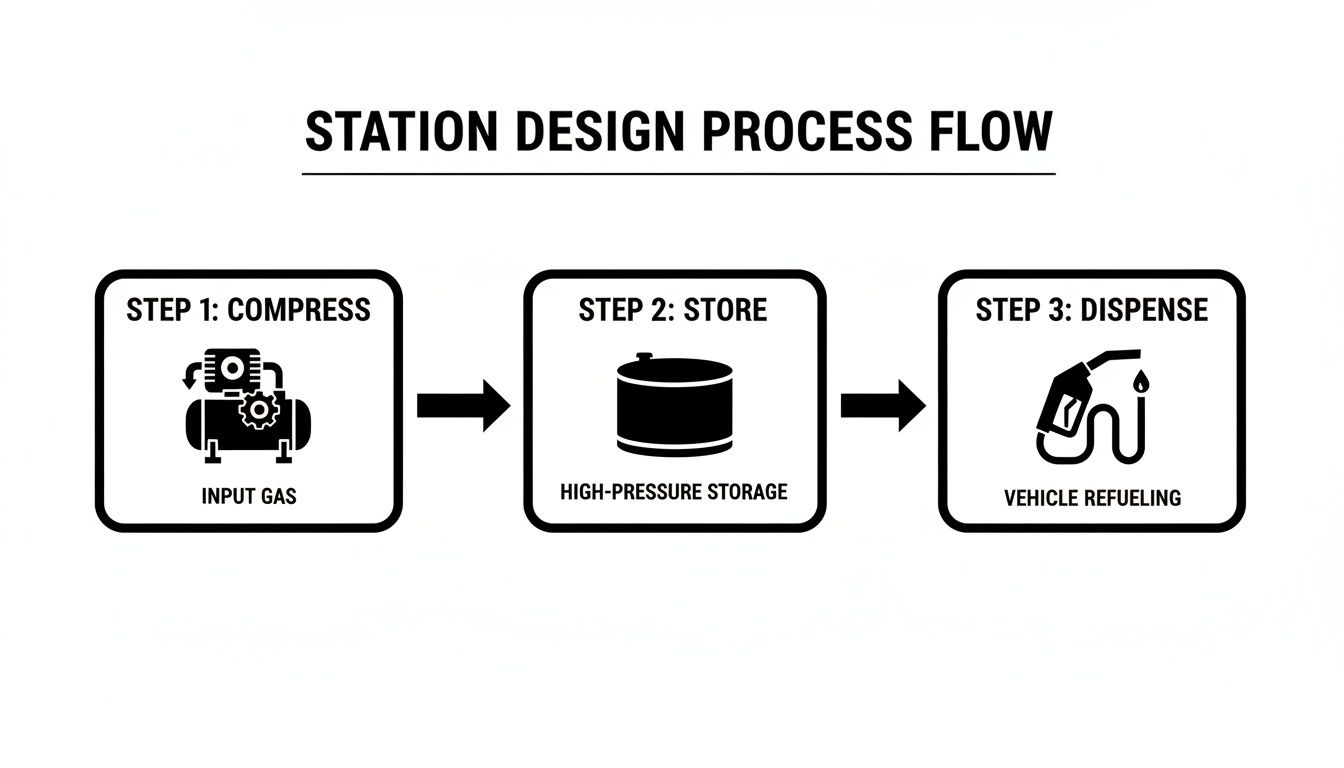
Each of these stages requires its own specialized equipment, which in turn demands careful financial planning to get right.
Mapping Out a Realistic Project Timeline
In construction, time truly is money. From the day you pick a site to the day the first truck fills up, you should plan for a timeline of 12 to 24 months. What’s the biggest wild card? Almost always, it's the permitting process.
I've seen it happen time and again: a company picks a site and assumes they can break ground next month. The reality is that the pre-construction phase—navigating permits, finalizing designs, and coordinating with utilities—frequently takes longer than the actual build. If you don't plan for this, you're setting yourself up for frustrating and expensive delays.
Here’s a general sequence of events you should expect:
- Site Selection & Due Diligence (1-3 months): Finding the perfect spot and making sure it’s a viable option.
- Engineering & Design (2-4 months): Turning the concept into detailed construction blueprints.
- Permitting & Approvals (6-18 months): This is the long haul. You'll be dealing with local, state, and utility authorities, and it’s the most unpredictable part of the schedule.
- Construction & Installation (4-6 months): The physical work of building the station.
- Commissioning & Opening (1 month): Final testing, training the team, and officially opening for business.
Handling Delays with a Strategic Bridge Solution
So what do you do with your fleet while the clock is ticking on that long, unpredictable timeline? This is where a mobile fueling solution becomes an incredibly valuable tool. Just waiting for the permanent station to be built means you're leaving money on the table every single day.
A temporary mobile CNG or LNG unit can be brought to your site in a matter of hours, not months. This completely changes the game.
It allows you to:
- Start Fueling Immediately: You can begin capturing the cost savings of natural gas from day one, even while your permanent site is still just a patch of dirt.
- Commission New Vehicles: Get your new CNG or LNG trucks on the road and your drivers trained without having to wait for the station.
- Prevent Revenue Loss: Keep your fleet running and avoid paying for expensive diesel while the construction and permitting processes crawl along.
By using a mobile solution from a provider like Blue Gas Express, you can effectively take the risk out of your project timeline. It turns a potential 18-month waiting game into an immediate operational win, ensuring your switch to natural gas is smooth and profitable right from the start.
Common Questions About Natural Gas Vehicle Stations
As you get closer to breaking ground on your own natural gas vehicle station, you're bound to have some practical questions. It's only natural. We're talking about everything from long-term profitability to the role of renewable fuels. Getting clear answers is key to solidifying your strategy and making sure you're moving forward with confidence.
Let's walk through some of the most common questions we hear from developers, fleet managers, and project partners. The goal here is to give you direct, real-world insights that tackle the concerns you're probably thinking about right now.
What’s the Typical Payback Period for a CNG or LNG Station?
This is almost always the first thing people ask, and the honest answer is: it all comes down to how much fuel you're pumping. The payback period for a station is a direct result of the initial investment, how consistently it’s used, and the price difference between natural gas and diesel.
For a private fleet station with a high, steady demand—think a municipal bus depot or a big logistics company—the payback can be surprisingly fast, often in the 3 to 5-year range. Every gallon of diesel you replace with cheaper natural gas is an immediate, hard-dollar saving.
Public retail stations are a different story. Their payback is usually longer, more in the 7 to 10-year ballpark, because building up a reliable customer base of independent truckers and smaller local fleets just takes time.
A crucial piece of the puzzle is government funding. Incentives, federal grants, and state tax credits can slash this timeline dramatically. These programs are specifically designed to soften the blow of the initial capital cost, making the financial case much stronger and getting you to profitability faster.
How Does Renewable Natural Gas Affect How a Station Operates?
This is the best part: Renewable Natural Gas (RNG) is a seamless, "drop-in" fuel. It’s the same molecule as conventional natural gas, meaning you can run it through any CNG or LNG station and into any natural gas vehicle with zero changes to your equipment. From a day-to-day operations standpoint, absolutely nothing is different.
The real impact is on your brand and your customers. By offering RNG, you can provide a carbon-negative or ultra-low-carbon fuel. For fleets with aggressive sustainability goals or clients who demand a green supply chain, this is a massive competitive advantage. While your supply contracts might look a little different, the actual dispensing, storage, and maintenance stay exactly the same. The switch is so straightforward that over 51% of U.S. CNG stations are already dispensing RNG.
What Are the Main Safety Considerations for a Natural Gas Station?
Safety isn't just a priority; it's the foundation of the entire design and operation. Everything is built around strict, well-established industry codes, primarily NFPA 52 for CNG and NFPA 59A for LNG.
Here’s what that looks like in practice:
- Smart Site Layout: It starts with the basics—designing for safe vehicle flow and making sure you have the required clearance from property lines and public roads.
- Methane Detection & Emergency Shutdown (ESD): We place sensors in critical spots to catch any potential leaks. If gas is detected, these systems automatically sound alarms and shut off the fuel flow instantly.
- Physical Safeguards: Things like breakaway hoses at the dispensers and robust fire suppression systems are standard, non-negotiable components.
- Certified Equipment: Every electrical component, from the lights to the card reader, has to be specifically rated for hazardous locations to eliminate any chance of ignition.
But hardware is only half the battle. A truly safe site depends on well-trained people. This means regular, documented staff training on emergency protocols, teaching drivers proper fueling techniques, and sticking to a routine inspection schedule.
Can a Temporary Mobile Fueler Replace a Permanent Station?
Think of a temporary mobile fueling solution as a strategic bridge, not a permanent destination. These units are expertly designed to solve short-term problems and keep you running when a fixed station isn't available.
They are the perfect solution for a few key scenarios:
- Commissioning new vehicles before your permanent station is built and operational.
- Providing backup fuel during planned maintenance or an unexpected shutdown at your main station.
- Supporting off-grid projects, like remote construction sites where you won't have infrastructure for years.
While these mobile units offer incredible flexibility and can be on-site in a matter of hours, their fuel capacity is smaller than a permanent station's. They are brilliant for helping your business avoid expensive downtime and letting you start or continue your move to natural gas while permanent infrastructure is being built or serviced.
Ready to bridge the gap in your natural gas supply and keep your project moving? Blue Gas Express provides reliable, rapid-deployment mobile CNG and LNG solutions to ensure you never have to pause operations.
Learn more about our temporary fueling services at Blue Gas Express