

A mobile gas service corporation is a specialized company that brings natural gas right where you need it, creating a temporary utility hookup on demand. Think of it as an energy lifeline for your project, delivering Compressed Natural Gas (CNG) or Liquefied Natural Gas (LNG) via mobile units to get you around the need for a permanent pipeline.
Understanding the Role of a Mobile Gas Service Corporation
Picture this: you're managing a huge construction project. The building is almost done, but the local utility’s permanent gas line is still six weeks out. Without gas, you can't test the HVAC, fire up the water heaters, or get the final occupancy permits. That kind of delay can cost a fortune. This is the exact problem a mobile gas service corporation solves.
These companies act as a critical bridge, delivering what's often called a "virtual pipeline" or "pipeline on wheels." They provide a seamless, temporary supply of natural gas, making sure your operations can continue without a single hiccup. In short, their service prevents costly downtime and keeps your entire project on schedule.
Core Mission and Key Functions
At its heart, a mobile gas service provider exists to close energy gaps. They do this with a few key functions that are much more than just simple fuel delivery.
- Temporary Utility Connection: They essentially create an on-demand gas main that connects directly to your building's existing plumbing and infrastructure.
- Emergency Energy Supply: If a pipeline shuts down for maintenance or there's an unexpected outage, they can deploy quickly to keep factories or essential services like hospitals up and running.
- Project Acceleration: For builders, they supply the gas needed to commission equipment—often the last step before getting that all-important Certificate of Occupancy.
The real value is simple: a mobile gas service corporation turns a potential shutdown or a months-long wait for the utility into a moment of seamless, uninterrupted operation.
A Portable Power Bank for Natural Gas
A great way to think about it is like a portable power bank, but for your project's natural gas needs. Instead of being stuck waiting for the grid (the pipeline network), you get a fully charged, independent energy source delivered right to your site. This "power bank" shows up on specialized trailers loaded with either CNG or LNG.
Once they arrive, certified technicians handle everything from safely hooking up the equipment to monitoring pressure and flow rates. This complete, hands-on service ensures the temporary supply is just as reliable and safe as a permanent utility connection, allowing you to power everything from a restaurant's kitchen to massive industrial boilers.
How Mobile CNG and LNG Delivery Actually Works
So, how does natural gas get from a permanent pipeline to your temporary project site without a single trench being dug? It's all about a finely tuned logistical process that’s built for speed, safety, and reliability.
It all starts with standard utility gas—the exact same stuff that flows into homes and businesses. A mobile gas service corporation taps into this supply and transforms it for transport. To make it portable, the gas is either squeezed under high pressure to create Compressed Natural Gas (CNG) or super-chilled to a frosty -260°F (-162°C), which turns it into Liquefied Natural Gas (LNG). This critical step packs a massive amount of energy into a surprisingly small volume.
The Virtual Pipeline on Wheels
What shows up at your site isn't just a simple tank on a truck. These mobile units, often called "virtual pipelines" or "tube trailers," are sophisticated, self-contained energy systems. Each one is a rolling marvel of engineering, designed to transport and deliver gas under precise conditions so it's ready to use the moment it arrives.
This diagram breaks down the journey from the main utility line right to your project.
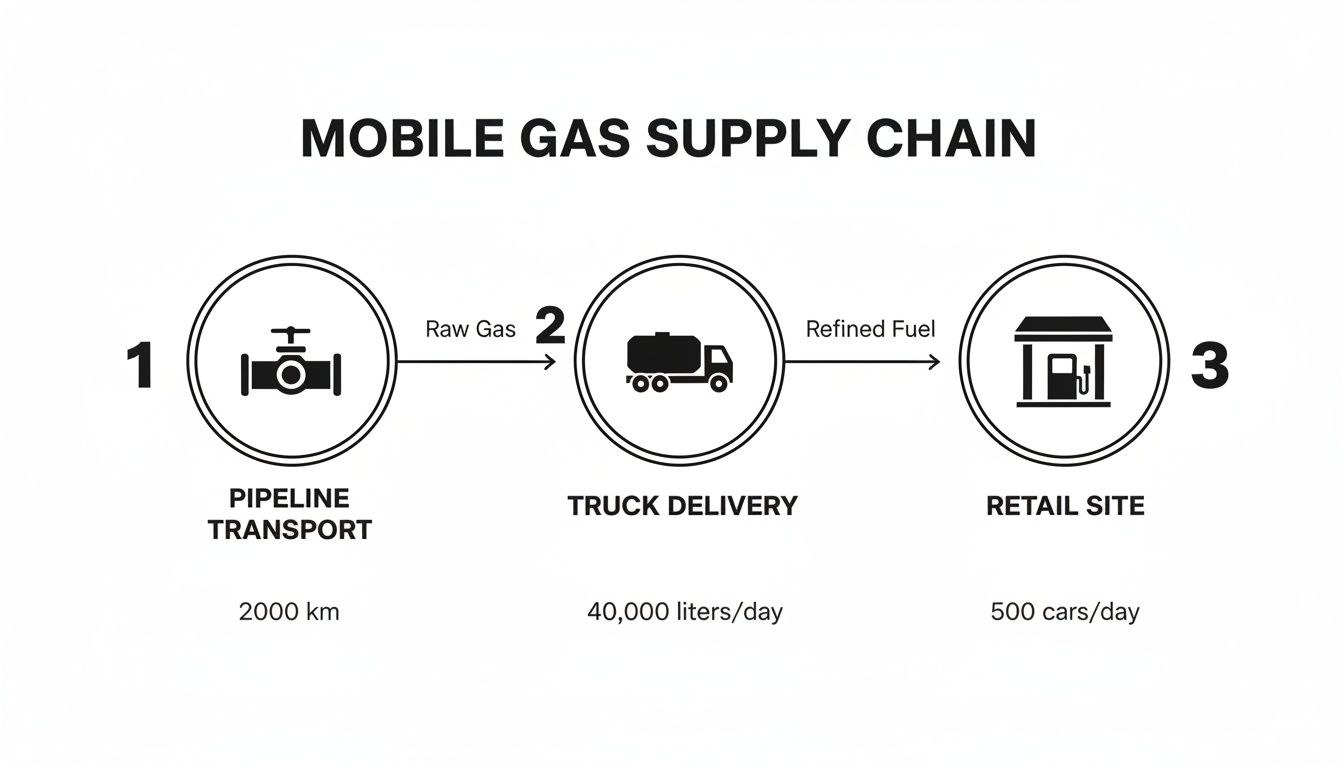
As you can see, a mobile gas provider literally bridges the physical gap between existing infrastructure and a project's immediate energy needs.
These systems are a collection of advanced components working in perfect concert:
- High-Pressure Containers: These aren't your backyard grill's propane tanks. We're talking specially designed cylinders for CNG or cryogenic tanks for LNG, all built to strict Department of Transportation (DOT) standards.
- Vaporization Equipment: For LNG to be usable, it needs to turn back into a gas. On-board vaporizers gently warm the liquid at a controlled rate, converting it back to its gaseous state.
- Regulators and Manifolds: This is the heart of the connection. This gear steps down the extremely high pressure of the stored gas to the exact level your on-site equipment needs, ensuring a smooth, seamless flow.
At its core, the delivery process turns a complex logistical challenge into a simple, on-demand utility connection. The goal is to make the temporary gas supply feel just as stable and reliable as a permanent underground pipeline.
On-Site Deployment and Management
When a mobile unit pulls up, the operation is handled from start to finish by highly trained, certified technicians. There’s no room for error—safety and precision are everything.
First, technicians perform a thorough site inspection and run through a battery of safety checks on both the mobile unit and your on-site gas infrastructure. Only when everything is confirmed to be secure do they connect the trailer to your system. From there, they manage the entire gas flow, constantly monitoring pressure and volume to match your project’s real-time energy demands.
This level of control is no accident. Safely managing CNG and LNG delivery hinges on sophisticated process control and instrumentation. This meticulous oversight is what allows a mobile provider to essentially create a temporary, above-ground gas main that integrates perfectly with your operations.
This ability to deliver reliable, on-demand energy is fueling some serious market growth. Recent analysis projects the global mobile fuel delivery system market will surge to USD 10.05 billion by 2035, a significant jump from USD 5.8 billion in 2026. North America is leading the charge with a commanding 40-45% market share, driven by heavy demand in states like North Carolina, South Carolina, Tennessee, and Virginia—all key service areas for regional experts like Blue Gas Express. This rapid expansion really highlights the essential role that a mobile gas service corporation plays in modern industry.
When Would You Need a Mobile Gas Service?
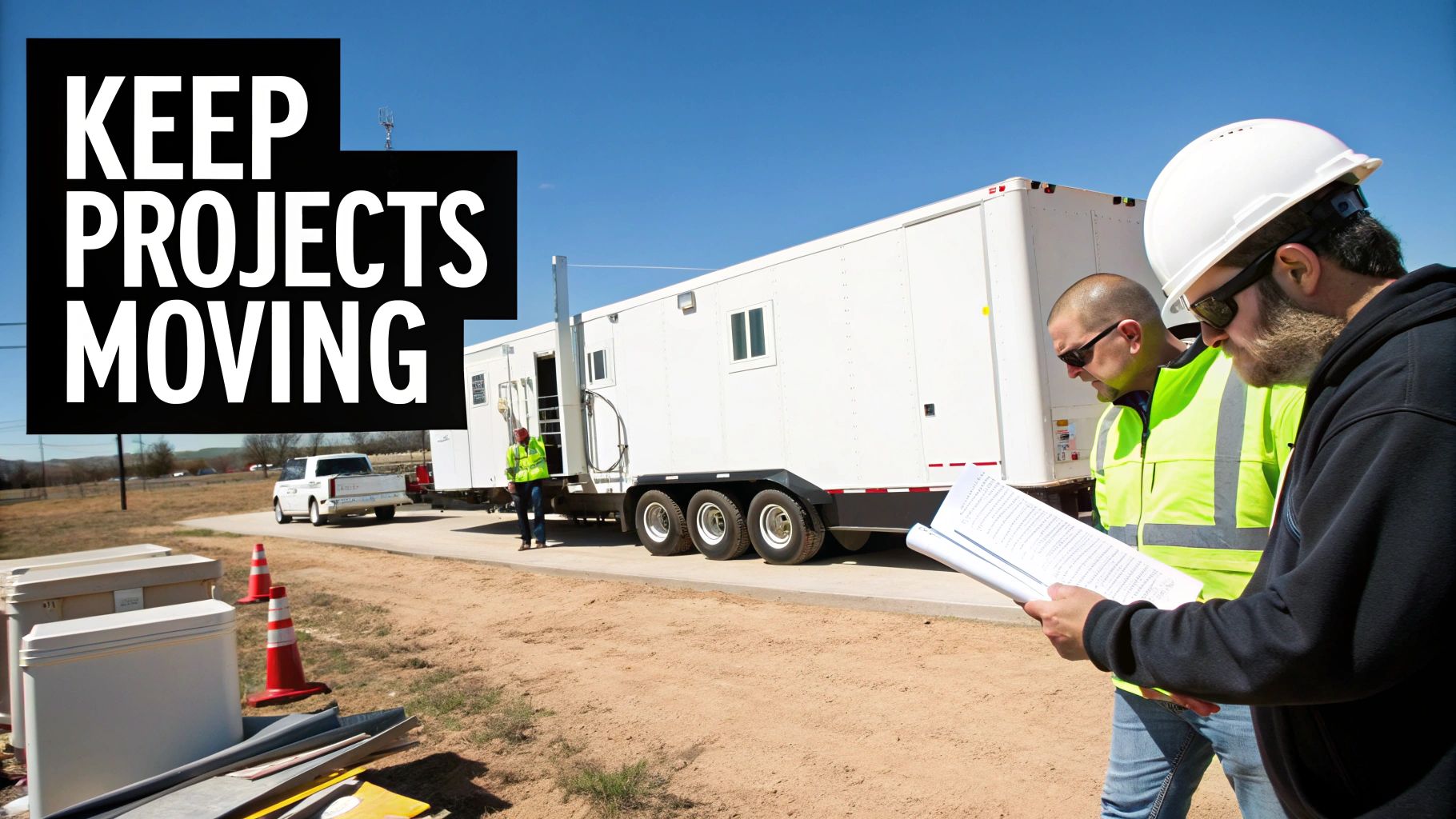
The real value of a mobile gas service corporation shines when the normal gas supply is delayed, cut off, or just isn't there yet. Think of it less as a convenience and more as a critical lifeline that prevents expensive shutdowns and keeps major projects on track.
For many businesses, waiting around for a permanent utility hookup simply isn't an option. Every day of delay means lost money, blown deadlines, and unhappy stakeholders. A mobile gas service neatly bridges that gap, delivering an immediate and reliable source of energy exactly where it's needed.
Let's look at a few real-world situations where these services are absolute game-changers.
Accelerating Construction and Development Projects
Talk to any construction manager, and they'll tell you about the race to get the Certificate of Occupancy (CO). This is the golden ticket, the final approval that says a building is safe and ready for people. The problem is, you can't get it until all the gas-powered systems—from the heat to the hot water—are tested and proven to work.
Imagine you've just finished a brand-new apartment building. The utility company tells you the permanent gas line won't be connected for another six weeks. That’s six weeks your building sits empty, unable to generate a dime of rent.
This is the classic "last-mile" problem that can sink a project's profitability. A mobile gas service corporation rolls a CNG or LNG unit right onto your site and hooks it into the building's main gas pipe. Instantly, the entire property has power.
This allows you to:
- Test HVAC Systems: Fire up the furnaces and air conditioners to prove they work, which is absolutely essential for passing inspections, especially in the middle of winter or a summer heatwave.
- Commission Appliances: Get all the gas stoves, water heaters, and dryers in every unit running to confirm they're installed correctly.
- Pass Final Inspections: With everything operational, inspectors can give their final sign-off. You get your CO and can start bringing in tenants or selling units immediately.
A mobile service can prevent project delays that cost developers an average of $10,000 per day in carrying costs and lost opportunity. It turns a potential month-long wait into a non-issue.
Ensuring Business Continuity for Factories and Facilities
For any large industrial or commercial operation, a steady energy supply is everything. Any interruption, whether it’s a planned shutdown or a surprise outage, can bring production to a screeching halt and cause massive financial damage. A mobile gas service is basically an insurance policy against that happening.
Picture an industrial bakery that depends on massive, gas-fired ovens to operate. The local utility calls to schedule a 48-hour pipeline maintenance project. Without a backup, that means two full days of no baking, no shipping, and unhappy customers.
Instead, the plant manager can schedule a mobile LNG unit to be on-site for those two days. It hooks right into their system, the ovens stay hot, and production continues without a single hiccup. It’s a proactive solution for several common scenarios:
- Planned Utility Maintenance: When the gas company needs to work on its lines, a mobile unit creates a seamless bridge, ensuring zero downtime.
- Unexpected Outages: If a pipeline fails, a mobile unit can be deployed fast to get critical operations back online while repairs are made.
- Peak Shaving: Some facilities bring in a temporary supply during cold snaps to avoid getting hit with sky-high "peak usage" charges from their utility provider.
What could have been an operational disaster becomes a simple, managed event.
Supporting Gas Utilities and New Developments
It might sound strange, but gas utilities themselves are some of the biggest customers for mobile gas. When they’re building out pipelines to a new subdivision or commercial park, there's often a gap. The homes are finished, but the main gas lines aren't "live" yet.
Instead of making new homeowners wait in the cold, a utility will often partner with a mobile gas service corporation like Blue Gas Express. A temporary station is set up to supply the entire development, letting families move in and businesses open right on schedule. This keeps their new customers happy and ensures they don't lose them to all-electric alternatives out of frustration.
To illustrate just how versatile this service is, here’s a breakdown of who uses temporary natural gas and why.
Mobile Gas Service Applications By Industry
This table shows the primary applications and benefits of temporary natural gas for different customer types, illustrating the service's versatility.
| Industry/Audience | Primary Use Case | Key Benefit |
|---|---|---|
| Construction & Developers | Energizing buildings for final CO inspections | Avoids costly project delays and starts revenue generation sooner. |
| Industrial Plants | Business continuity during planned or unplanned outages | Prevents production shutdowns and massive financial losses. |
| Commercial Buildings | Temporary heat during construction; backup power | Keeps projects on schedule and ensures operational uptime. |
| Gas Utilities | Supplying new developments before permanent lines are active | Improves customer satisfaction and secures new service accounts. |
| Event Venues | Powering temporary kitchens, heating, and generators | Provides clean, reliable energy for large-scale temporary events. |
As you can see, the ability to deliver natural gas on demand solves a wide range of logistical and financial challenges across many different sectors.
Breaking Down Project Timelines and Costs
For any project manager eyeing a mobile gas service, two questions always come first: "How fast can we get it?" and "What's the bottom line?" The answers to these questions really get to the heart of why a mobile gas service corporation can be such a powerful partner, helping you keep projects moving and budgets intact.
Let's talk about speed first. The whole operation is built for a quick turnaround because providers know that every minute of downtime costs you money. In most cases, especially for emergencies, you can have natural gas flowing to your site within hours—not days or weeks. This is a massive advantage when a surprise utility cut threatens to halt your production line or a last-minute gas connection is all that's standing between you and your Certificate of Occupancy.
The process itself is a surprisingly straightforward sequence, all designed for maximum efficiency.
Typical Deployment Timeline
- Initial Consultation and Needs Assessment: It all starts with a phone call. The provider will want to understand the specifics of your project, like what kind of equipment you're running and how much gas you expect to burn through each day.
- Site Review and Logistics Planning: Next, they'll check out your site. This is often done remotely using satellite maps and your own site plans to pinpoint the best spot for the mobile unit and figure out the safest route for the delivery truck.
- Equipment Mobilization and Deployment: With a solid plan in place, the team gets moving. A specialized truck towing a CNG tube trailer or carrying an LNG tanker heads straight to your location.
- On-Site Setup and Connection: Once they arrive, certified technicians take over. They secure the area, run through all the safety checks, and hook the mobile unit directly into your site’s gas plumbing. It's a seamless and secure connection.
This entire chain of events can unfold in an incredibly short amount of time, turning what could be a major crisis into a minor bump in the road.
Deconstructing the Cost Factors
Now for the money talk. It’s better to think of this as an investment in a comprehensive service rather than just a fuel purchase. You're really paying to avoid the much larger costs that come with project delays. The final price tag isn’t a one-size-fits-all number; it's calculated based on a few key factors.
Before you commit, it’s smart to understand the financial ins and outs, much like when conducting a financial feasibility study for a new building. When you know what goes into the cost, you can see the real value you're getting.
The main things that will shape your final quote are:
- Total Gas Volume: The biggest piece of the puzzle is how much natural gas you'll actually use. Bigger projects needing more fuel will, of course, have a higher cost.
- Rental Duration: How long do you need the unit on-site? You can arrange service for a single day, a few weeks, or even several months, and the price will be structured to match.
- Travel Distance and Logistics: The mileage from the provider’s hub to your site factors into the transportation costs. A remote location or a site that's tough to get to might need a bit more logistical planning.
- Specialized Equipment Needs: Sometimes a project needs special gear. LNG service, for example, requires an on-site vaporizer to turn the liquid back into a gas, and that equipment is part of the overall cost.
While there's an upfront cost, the true financial benefit lies in the losses you avoid. A mobile gas service can prevent thousands of dollars in daily penalties, lost production, or carrying costs associated with a stalled project.
When you understand these timeline and cost dynamics, it becomes clear that a mobile gas service corporation offers more than just fuel. It provides operational certainty, sidesteps expensive delays, and keeps your project moving forward.
Navigating Safety and Regulatory Standards
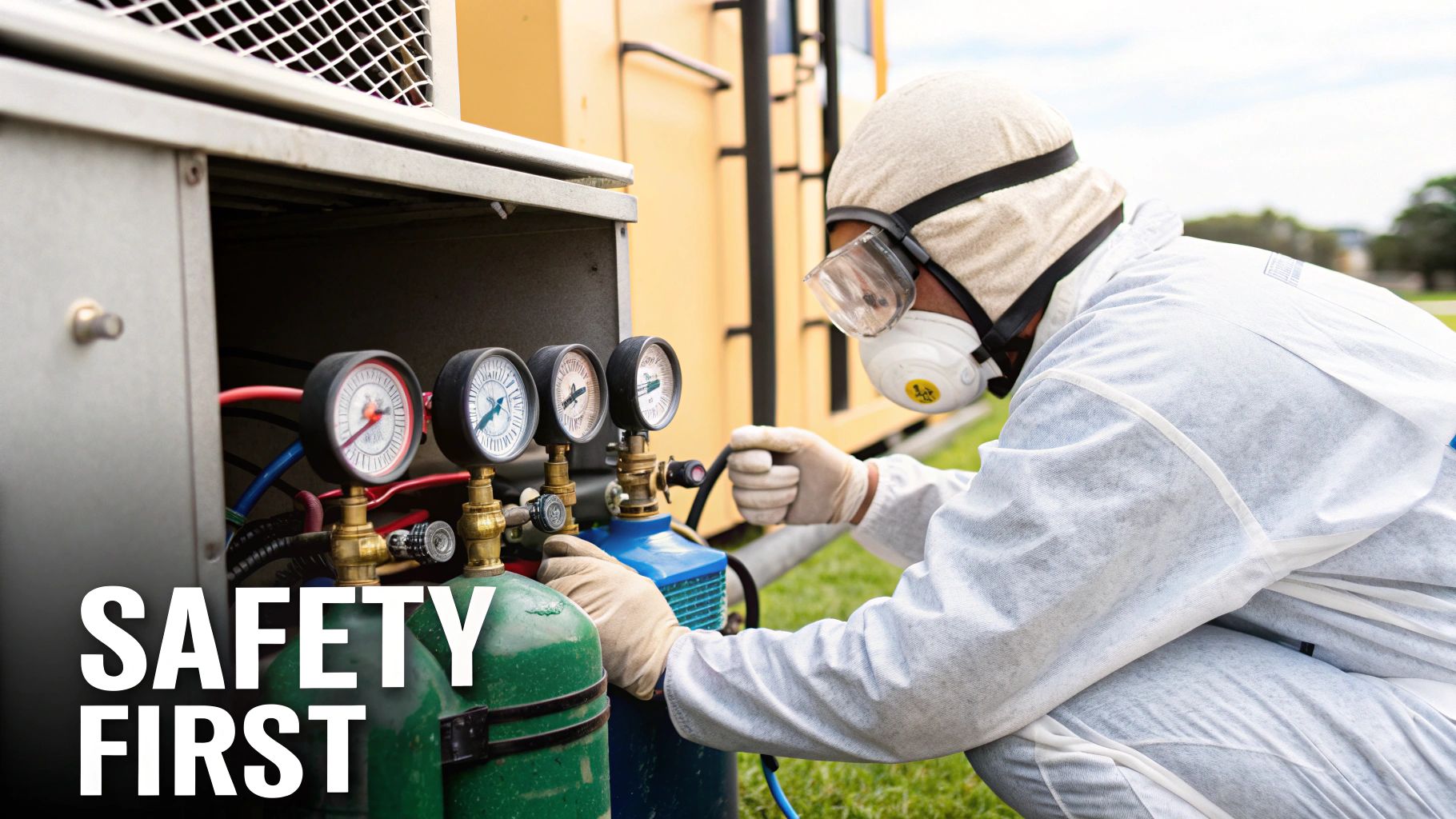
When you're working with natural gas, safety isn't just another box to check—it's the bedrock of the entire operation. Any professional mobile gas service corporation worth its salt operates within an ironclad framework of safety protocols and government regulations. This isn't just about compliance; it's about building trust and ensuring every project, big or small, goes off without a hitch.
The whole process is wrapped in a web of federal, state, and local rules that leave absolutely no room for error. It’s about more than just following the letter of the law. It’s about fostering a deep-rooted culture of safety that influences every decision, from the first site visit to the final disconnection.
The Pillars of Mobile Gas Safety
You can think of safety in this field as a structure built on three core pillars: strict regulatory compliance, advanced equipment engineering, and the hands-on expertise of certified professionals. Each piece is essential for creating a secure and dependable temporary gas supply.
A top-tier provider doesn't just meet these standards; they aim to exceed them. They take a comprehensive approach to risk, identifying and mitigating every potential hazard long before a single piece of equipment arrives on your property.
To see how this works in the real world, let's break down the key standards a reputable mobile gas service corporation lives and breathes.
- Department of Transportation (DOT) Regulations: These are the rules of the road for moving natural gas. They govern everything from the construction and integrity of the CNG or LNG tanks to the specific safety placards required on every truck. Adhering to these is non-negotiable and guarantees the gas gets to you safely.
- National Fire Protection Association (NFPA) Standards: Once the mobile unit is on-site, a different set of rules kicks in. The NFPA provides the playbook for safe handling and deployment. Codes like NFPA 52 (for CNG) and NFPA 59A (for LNG) offer detailed guidelines on equipment placement, proper connection procedures, and emergency response plans.
- Local and State Permitting: Every city and state has its own unique requirements. A seasoned provider will manage all the local permitting for you, ensuring the temporary setup fully complies with local fire codes and municipal ordinances. This means total peace of mind for you.
The bottom line is this: a temporary mobile gas service has to be every bit as safe—if not safer—than a permanent utility connection. This is accomplished through a layered defense that combines unwavering regulatory adherence with proactive, on-the-ground safety measures.
Engineered for Safety and Managed by Experts
The mobile units themselves are incredible feats of safety engineering. They are purpose-built to manage the immense pressures of CNG or the frigid, cryogenic temperatures of LNG, and they come loaded with multiple redundant safety systems.
These aren't just simple tanks on a trailer; they are highly sophisticated delivery systems. They’re equipped with automated shut-off valves that can instantly cut the flow of gas if they detect a pressure drop or spike. Pressure relief systems are also standard, acting as a fail-safe against over-pressurization, while continuous electronic monitoring feeds real-time data back to the technicians.
But the single most important safety component isn't a valve or a sensor—it's the expert managing the equipment. From hookup to monitoring to disconnection, every step is handled by certified technicians. These pros go through rigorous, ongoing training in natural gas handling, emergency procedures, and the latest regulatory updates. Their expertise is what truly ensures every installation is secure, efficient, and up to code.
How to Choose the Right Mobile Gas Provider
Choosing a mobile gas provider isn't just about hiring a fuel supplier; it's about bringing a critical partner onto your project. The right partner can make the difference between a smooth, on-schedule operation and a costly, delayed headache. Think of them as more than a vendor—they're your lifeline, delivering not just gas, but reliability, deep expertise, and the peace of mind that comes from knowing your operation won't miss a beat.
It’s tempting to just look at the price tag, but that rarely tells the whole story. You need to dig deeper into their operational muscle, safety culture, and real-world track record to find a partner who truly gets what you need. This checklist will walk you through what really matters.
Evaluate Operational Footprint and Response Time
Let's start with a simple, practical question: how fast can they get to you? A provider’s operational footprint and their guaranteed response time are non-negotiable, especially when you're in a pinch. A company with equipment and teams staged in the right places can turn a potential crisis into a minor hiccup.
Ask them point-blank for their typical deployment time to your exact job site. For instance, a provider like Blue Gas Express, which is laser-focused on the Carolinas, Tennessee, and Virginia, has a home-field advantage in that territory. A national company based a thousand miles away simply can't compete with that kind of local presence, which means faster mobilization and a team that already knows the regional logistics and rules.
Scrutinize Fleet Capacity and Scalability
Your project has unique demands, and your provider's fleet should be able to meet them. A one-size-fits-all approach just doesn't work here. You need a partner with a versatile fleet of CNG and LNG units, someone who can scale up for a massive industrial job or scale down for a smaller commercial need.
Here’s what to consider:
- For small commercial jobs: Can they supply a smaller, more economical CNG tube trailer for something short-term, like getting a new restaurant's kitchen up and running?
- For large industrial needs: Do they have the high-capacity LNG tankers and heavy-duty vaporization equipment needed to keep a manufacturing plant online during a major pipeline shutdown?
A flexible, scalable fleet is a sure sign that the company can tackle any job efficiently. They won't try to sell you more capacity than you need, and more importantly, they won't come up short when you need them most.
Vet Safety Records and Certifications
When you're working with natural gas, safety is everything. There are no second chances. A provider's safety record isn't just a statistic; it's a direct reflection of their professionalism, their processes, and their entire company culture. Don't just take their word for it—ask for proof.
Any provider worth their salt will be happy to show you their safety metrics, insurance certificates, and technician credentials. That kind of transparency is the hallmark of a company that puts safety first, giving you confidence that your site, your people, and your project are in good hands.
The market for this service is interesting. While major national players hold about 55% of the market, specialized regional companies and fleet-focused solutions make up a solid 30%. This space allows focused operators like Blue Gas Express to excel at serving builders and utilities in the Southeastern U.S., where a delay in getting an occupancy permit can easily cost $10,000 per day. You can discover more insights about mobile fuel delivery market analysis to understand the landscape better.
Finally, make sure their technicians are fully certified and trained to meet all DOT and NFPA standards. That hands-on, certified expertise is your best insurance policy for a secure and compliant setup.
Common Questions, Answered
When you're considering a mobile gas service corporation, a few practical questions always come to mind. Project managers and builders often want to know about the nuts and bolts of the service before bringing it on-site. Let’s clear up some of the most common ones.
How Much Gas Can One of These Units Actually Hold?
You’d be surprised by how much energy is packed into a single mobile unit. A standard compressed natural gas (CNG) trailer—often called a "tube trailer"—can carry anywhere from 50,000 to over 400,000 standard cubic feet (SCF) of natural gas.
The right size for your job really boils down to your daily consumption. A good provider will work with you to analyze your equipment's needs and daily usage patterns. This ensures they dispatch a unit that can handle your demand without needing constant change-outs, giving you a steady, uninterrupted energy supply.
Is This the Same Quality Gas I’d Get From a Pipeline?
Absolutely. The fuel delivered by a mobile gas service corporation is the exact same high-quality natural gas that flows through the utility pipelines powering homes and businesses. The only thing that changes is how it gets to you.
The gas is either compressed (CNG) or liquefied (LNG) to make it dense enough to transport efficiently. Once it’s on your site and hooked into your system, it behaves identically to pipeline gas. Your equipment—whether it's HVAC systems, generators, or commercial kitchen appliances—will run just as it was designed to.
The bottom line is that you're not trading quality for convenience. You get the same reliable, clean-burning natural gas, just delivered in a way that solves logistical problems and keeps your project moving forward.
What’s the Real Difference Between CNG and LNG?
The main distinction between CNG and LNG is all about energy density. Think of it like this: CNG is like neatly folding your clothes to pack a suitcase, while LNG is like vacuum-sealing them. You can fit a lot more into the same space with the second method.
- CNG (Compressed Natural Gas): This is natural gas stored under very high pressure. It’s perfect for most temporary construction and commercial projects because it's simpler and faster to get up and running.
- LNG (Liquefied Natural Gas): This is natural gas that has been cryogenically cooled into a liquid, making it incredibly dense. A single LNG tanker can haul significantly more energy than a CNG trailer of the same size, making it the go-to choice for massive industrial jobs or long-term projects with huge fuel demands.
Ready to keep your project on schedule and avoid costly delays? Blue Gas Express provides reliable, on-demand temporary natural gas solutions across the Southeast. Learn how our rapid deployment can power your success by visiting our website.