

Ever looked at your gas bill and wondered why it’s priced in kilowatt-hours (kWh) when your meter is clearly ticking over in cubic meters (m³)? It’s a common point of confusion, but the answer is simple: you’re paying for the energy you use, not just the volume of gas that flows through the pipes.
This one distinction is the key to understanding your bill and mastering the conversion from kWh back to m³.
Why You’re Billed for Energy, Not Volume
The whole system is designed for fairness. After all, not all natural gas is created equal.
Think of it like buying two bags of coffee beans that are the same size. One bag is full of rich, high-quality Arabica beans that make a strong, flavorful brew. The other is filled with lower-grade beans that produce a much weaker cup. You’re getting the same volume of beans, but the value and end result are completely different.
Gas is the same way. The amount of energy packed into a single cubic meter can vary depending on where it came from and its specific chemical makeup. This energy potential is quantified by a crucial metric called the Calorific Value (CV).
The Role of Calorific Value
Calorific Value is the bridge between the volume your meter clocks and the energy you actually get to use. It’s a measure of the heat produced when a set amount of gas is completely burned.
A higher CV means the gas is more energy-dense. You'll need less of it to heat your water or cook your dinner, so you're getting more bang for your buck.
Your gas supplier is constantly sampling and testing the gas flowing into the grid to get an average CV. This is what allows them to bill you and your neighbor accurately for the energy consumed, even if the gas delivered on Tuesday had a slightly different energy content than the gas from Friday.
This approach solves a big problem:
- Billing for Volume (m³): This would be inherently unfair. Some customers would end up getting more energy for their money than others, purely based on the luck of the draw of that day's gas quality.
- Billing for Energy (kWh): This standardizes everything. It ensures everyone pays for precisely what they receive—usable heat.
The shift from billing by volume to billing by energy means you only pay for the actual heat your appliances can generate. It’s a system designed to reflect the true value of what’s being delivered.
If you really want to connect the dots between your usage and your bill, learning how to read your smart meter is a fantastic next step. It lets you see the raw volume data before it gets converted, bridging the gap between the physical measurement on-site and the final number on your statement. That kind of transparency is the foundation of taking control of your energy costs.
The Conversion Formula and Calorific Value Explained
So, how do you actually get from a volume of gas to the energy you're billed for? It's not just a simple guess; there's a specific formula that translates the physical amount of gas used into the energy it contains. This is the key to understanding your gas bill and making accurate calculations for projects.
At its core, the formula is beautifully simple:
Energy (kWh) = Volume Used (m³) x Calorific Value (CV)
But don't let that simplicity fool you. To get an accurate result, two other critical elements come into play: the Calorific Value itself and a small but important adjustment called the Volume Correction Factor. Let's break down what these really mean.
What Is Calorific Value?
The Calorific Value (CV) is the most important part of this equation. In plain terms, it's a measure of the energy density of the gas. It tells you how much heat energy is released when a cubic meter of that specific gas is completely burned.
Think of it like this: some gas is just more potent than others. A higher CV means you get more bang for your buck—more heat from the same volume. Gas suppliers don't just guess this number; they constantly sample the gas entering the network to determine its quality. The CV on your bill is usually an average taken over the billing period, which keeps things fair and accurate.
A Quick Tip from the Field: Don't be surprised if the Calorific Value on your bill changes slightly from one month to the next. It's not a mistake! The natural composition of gas from different sources varies, causing these minor fluctuations.
Gross vs. Net Calorific Value
Dig a little deeper, and you'll run into two different types of CV:
- Gross Calorific Value (GCV): This is the big one. It measures all the heat produced when gas burns, including the latent energy that gets captured when the water vapor (a natural byproduct of combustion) condenses back into liquid.
- Net Calorific Value (NCV): This measures the heat produced without including that extra energy from the condensed water vapor. Since most standard boilers and appliances can't capture this latent heat, the NCV represents the more "practical" energy output.
For billing, however, suppliers almost always use the Gross Calorific Value. It’s the standard because it reflects the total potential energy in the gas you're supplied, providing a consistent benchmark for charging.
The Correction Factor: Why It Matters
The final piece of the puzzle is the Volume Correction Factor. Gas is a bit like a balloon—it expands when it's warm and contracts when it's cold. Its volume is also affected by atmospheric pressure. To make sure everyone is billed on a level playing field, the volume of gas measured by your meter needs to be adjusted to a standard set of conditions.
This standard is typically 15°C and 1013.25 mbar of pressure. The correction factor, most commonly 1.02264, does this job, converting the volume you used into what it would have been under these standard conditions.
This diagram neatly shows how these elements all work together to determine your final bill.
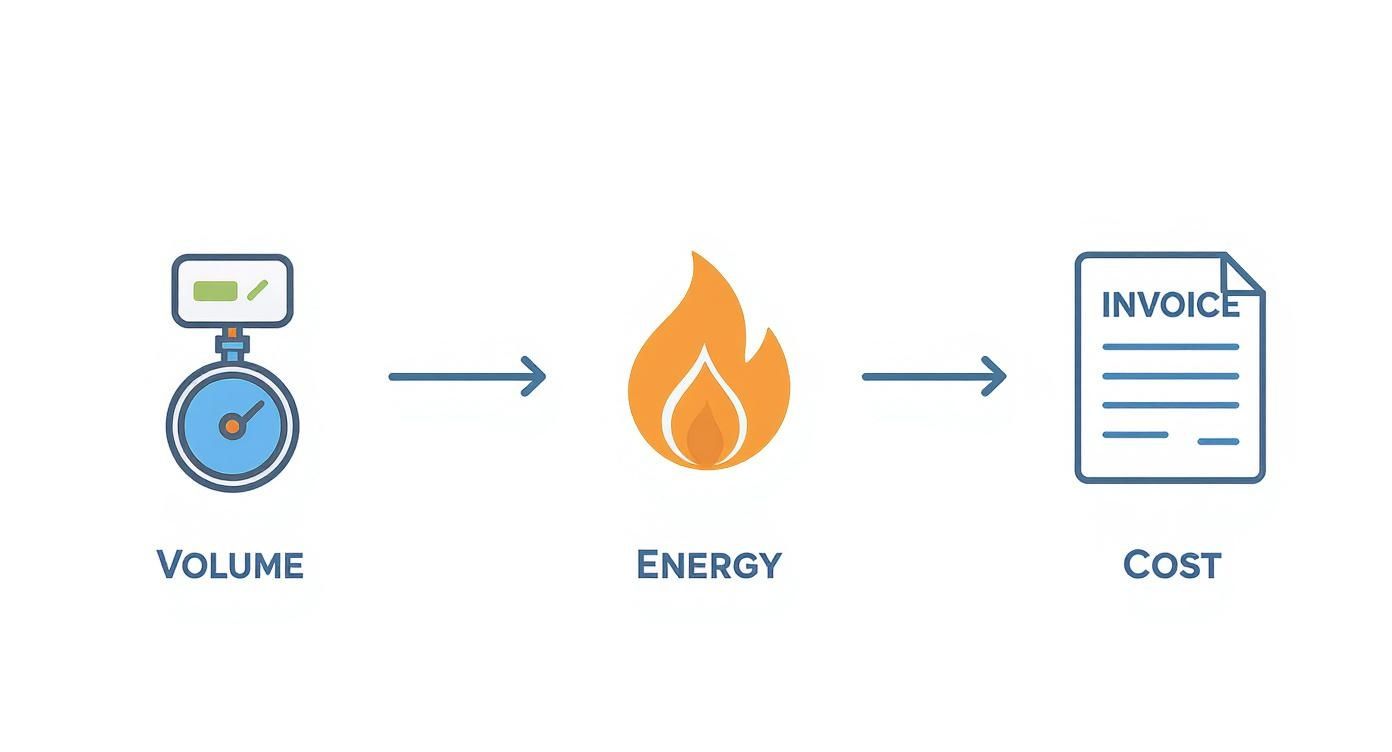
As you can see, the process starts with the raw volume your meter records. That number is then adjusted and converted into energy before the final cost is calculated. This method of converting kWh to cubic meters is fundamental to energy billing across Europe and North America.
In the UK, for example, the National Grid actively monitors gas quality at over 100 points across the country to keep billing precise. This results in average calorific values ranging anywhere from 10.4 kWh/m³ to 11.9 kWh/m³ depending on the source. You can find more detail on how these calculations work by reading up on how gas units are converted for billing.
Let's Walk Through a Real-World Gas Bill Calculation
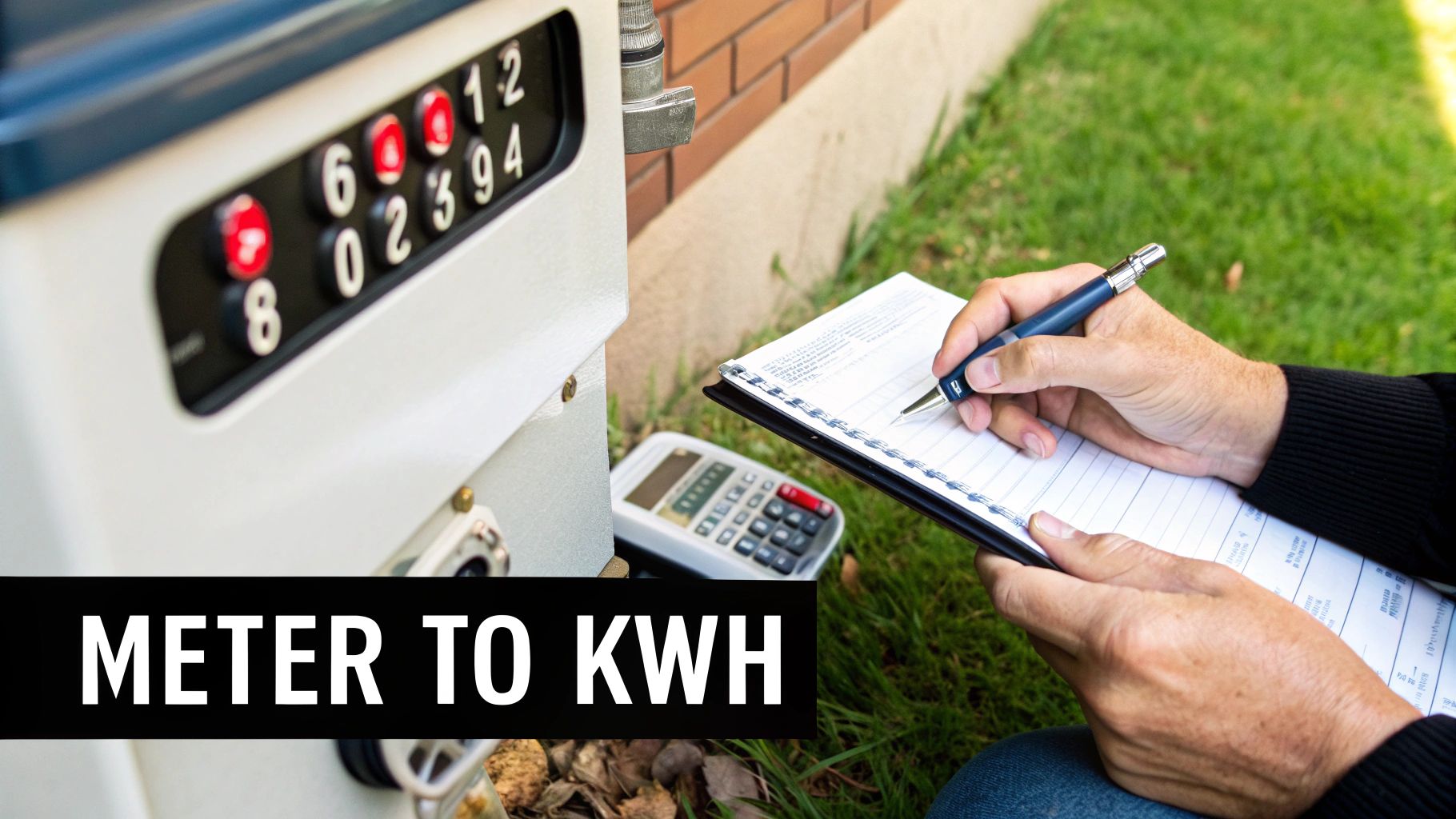
All the theory is great, but nothing beats seeing the numbers in action. Let's run through a practical example, from reading the meter to the final kilowatt-hour figure, to show you exactly how the kWh to cubic meters conversion happens on your bill.
Working through this will give you the confidence to check your own statements and understand precisely what you're being charged for.
Start with Your Meter Readings
First things first, you need to figure out how much gas you’ve actually used. This means taking two readings from your gas meter at the start and end of the period you're interested in.
Let's imagine you're tracking your usage for the month of January.
- Reading on January 1st: 12345 m³
- Reading on February 1st: 12455 m³
To find the volume consumed, just subtract the first reading from the second.
12455 m³ – 12345 m³ = 110 m³
Simple enough. Over the course of the month, your home used 110 cubic meters of gas. This is the raw, uncorrected volume straight from the meter on your wall.
Adjust for Standard Conditions
Now for the part that often confuses people. The volume of gas changes with temperature and pressure, so to keep billing fair and consistent, suppliers adjust your raw volume to a standard set of conditions.
This is done with a volume correction factor, which is typically 1.02264.
110 m³ (Your Volume) x 1.02264 (Correction Factor) = 112.49 m³ (Corrected Volume)
Your corrected volume is now 112.49 m³. It’s a bit higher than what your meter showed, but this is the standardized figure everyone works from for billing.
Convert to Energy with the Calorific Value
The final piece of the puzzle is converting that corrected gas volume into the energy you consumed, measured in kilowatt-hours (kWh). For this, you need the Calorific Value (CV) of the gas supplied to your area, which you can almost always find printed right on your gas bill.
Let's say your bill shows a Calorific Value of 11.1 kWh/m³.
All you have to do is multiply the corrected volume by this CV.
112.49 m³ (Corrected Volume) x 11.1 kWh/m³ (Calorific Value) = 1248.64 kWh
And that's it! The 110 cubic meters of gas that your meter clocked has been converted into 1248.64 kWh of energy. This final number is what your supplier will use to calculate how much you owe.
By breaking it down like this, you can completely demystify your gas bill. It's no longer just a random number you have to pay. Now you can see the exact process that links the physical gas flowing into your home to the energy units you're charged for. This quick kWh to cubic meters check gives you the power to verify your own usage and truly understand your consumption.
Sizing Commercial Gas Supplies with kWh to M³ Conversions
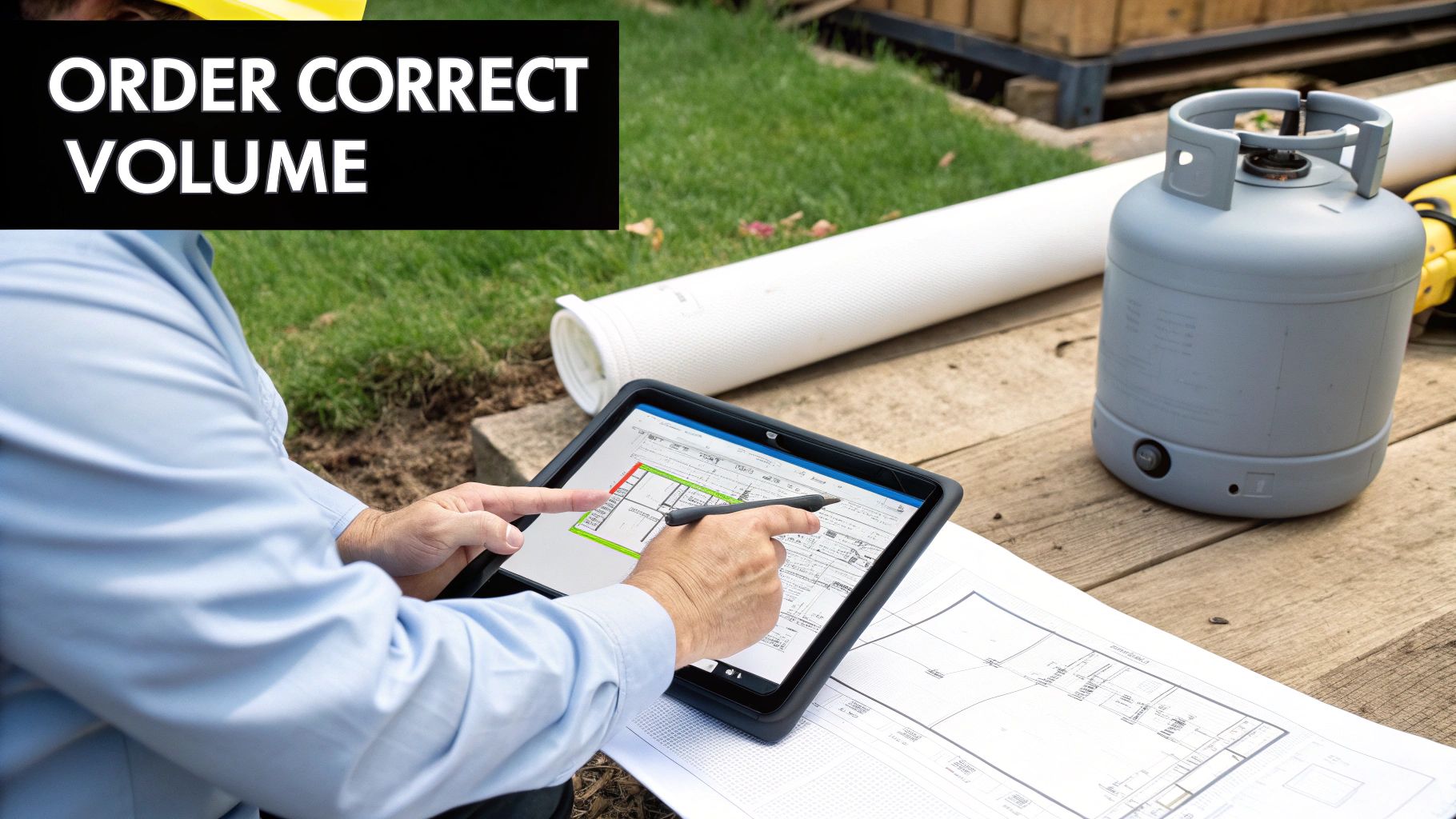
The conversion from kWh to cubic meters isn't just some academic exercise for double-checking your home energy bill. Out in the field—on construction sites, during plant commissioning, or when utility maintenance forces an outage—it's an essential tool for keeping projects on track. This is where the theory hits the pavement.
Imagine you’re the project manager on a new commercial build. It’s a cold winter, the permanent heating isn't online yet, and you've got a long weekend coming up. You absolutely cannot let the building freeze. Your first job is to figure out the heat load required to hold the temperature, which means calculating the total energy demand in kilowatt-hours (kWh) based on the building’s volume, insulation, and the weather forecast.
From Energy Demand to Gas Volume
Once you have that total energy number, the real work starts. You can't just call a supplier and say, "I need 15,000 kWh of gas." They deal in physical volumes. This is precisely where knowing how to convert kWh to cubic meters becomes a logistical lifeline.
You'll use the same principles we've covered—dividing your total kWh demand by the gas's calorific value—to figure out exactly how many cubic meters you need. That final number dictates your order for a temporary supply, which is often delivered as either Compressed Natural Gas (CNG) or Liquefied Natural Gas (LNG).
For a project manager, getting this conversion right is non-negotiable. Order too much, and you're wasting budget and dealing with the headache of returning unused fuel. But under-ordering? That's far worse. It can mean project delays, burst pipes, and expensive work stoppages.
A Practical Case Study
Let's walk through a scenario I’ve seen play out many times.
- The Job: You need to provide temporary heat for a 50,000-square-foot warehouse over a 72-hour period.
- The Heat Load: Your engineers have run the numbers and determined you need a total of 25,000 kWh to keep the site and materials from freezing.
- The Supplier's Spec: The temporary gas supplier confirms their natural gas has a calorific value of 10.8 kWh/m³.
To figure out your order volume, you just need to do some simple math:
Required Volume (m³) = Total Energy (kWh) ÷ Calorific Value (kWh/m³) = 25,000 kWh ÷ 10.8 kWh/m³ ≈ 2,315 m³
Now you know exactly what to order: roughly 2,315 cubic meters of natural gas. This kind of calculation is the absolute bedrock of temporary energy planning. This practice of tying volume to energy content became standard in the late 20th century, creating consistency across global markets. Today, a widely accepted average is that 1 cubic meter of natural gas holds about 9.94 kWh of energy—a critical figure for suppliers and regulators. You can dig deeper into the data behind these common North American energy conversion factors if you want to see the historical context.
A quick note on LNG deliveries: they add one more layer to consider. LNG is trucked in as a liquid and expands to about 600 times its volume when it’s vaporized back into a gas. While your supplier will handle that calculation, understanding it helps you plan the physical space you'll need for their vaporization equipment on your site.
Spotting Common Conversion Mistakes and How to Avoid Them
Even with the right formulas, it’s surprisingly easy to get tripped up when converting kWh to cubic meters. A few common slip-ups can throw your numbers way off. Knowing what to look for will save you a ton of headaches, whether you're just trying to make sense of your home energy bill or planning a major commercial project.
The Imperial vs. Metric Mix-Up
One of the most frequent errors I see is a simple mix-up between measurement systems. This is especially common in North America, where many older gas meters still measure volume in cubic feet (ft³), not the metric cubic meters (m³) we use in the formulas. If your calculation looks completely wrong, this is the very first thing you should check.
Before you even touch a calculator, look at your meter. If it’s logging cubic feet, you have to do a quick conversion first.
- 1 cubic meter = 35.315 cubic feet
To get your reading from ft³ into m³, just divide the number on your meter by 35.315. Skipping this step is a classic mistake that will make your final result wildly inaccurate. It’s a simple check that can save you from a lot of confusion down the line.
"Why Doesn't My Math Match My Bill?"
This is a question I get all the time. You’ve done the calculation, double-checked your work, and your final kWh figure still doesn’t match what’s on your utility bill. Don't panic—it's probably not your math that's wrong. The discrepancy usually comes from the billing process itself.
Several things can create that mismatch:
- Estimated Readings: Your supplier might have used an estimated read for that billing period. If you provided an actual reading later, the next bill will correct it, but the current one will be off.
- Billing Cycles: The dates you’re calculating for might not align perfectly with the utility's official billing cycle, which can throw off the total.
- Tiered Pricing & Standing Charges: Your simple conversion won't account for things like tiered rates (where the price per kWh changes) or daily standing charges that get added to the final amount.
The point of doing your own calculation isn't to perfectly replicate the final pound or dollar amount on your bill. It’s to verify the energy conversion itself—the crucial step from the volume of gas (m³) to the energy consumed (kWh). The final bill has other financial variables layered on top.
Physical vs. Corrected Volume: A Crucial Distinction
Finally, you have to get your head around the difference between the gas volume at your meter and the "corrected" volume used for billing. This is a technical point, but it's absolutely critical for accuracy.
The number you see on the meter's dial is the physical volume. It's the literal amount of gas that flowed through the pipe under whatever the real-world temperature and pressure conditions were at that exact moment.
But gas expands when it’s warm and contracts when it’s cold, so to bill everyone fairly, suppliers convert that physical volume to a standardized equivalent. This is the corrected volume. They apply a standard correction factor (usually 1.02264) to calculate what that volume would have been at a standard temperature (15°C) and pressure.
If you forget to apply this correction factor when converting kWh to cubic meters, your result will always be slightly lower than what the utility company calculates. To accurately follow their process, always multiply your raw meter reading by this factor before doing anything else.
Common Questions About Gas Conversion
Once you get the hang of the conversion process, a few specific questions tend to pop up again and again. Let's tackle some of the most common ones I hear from people trying to square their energy bills with their meter readings.
Why Does the Calorific Value on My Bill Fluctuate?
It's a great question. The calorific value (CV) isn't a fixed constant because natural gas itself isn't a manufactured product—it's a natural one. Its exact chemical composition can shift slightly depending on where it was sourced and the specific mix of gases flowing through the supply network at any given time.
Gas suppliers are constantly taking samples and measuring the CV of the gas as it enters the grid. The number you see on your bill is a recent average for your area, which is their way of making sure you're billed accurately for the actual energy you received. Those small changes simply reflect the real-time variations in the gas quality.
How Can I Convert kWh Back to M³ to Double-Check My Meter?
This is a smart thing to do if you suspect a billing error. To reverse the calculation and check your meter reading against your bill, you just need to work backward.
Simply take the total kWh figure from your bill and divide it by the calorific value your supplier used for that billing period.
The formula looks like this: Cubic Meters (m³) = Total kWh ÷ Calorific Value (kWh/m³)
A Quick Heads-Up: The number you get from this calculation is the 'corrected' volume used for billing. It won't perfectly match the raw reading on your physical meter because it doesn't account for the separate volume correction factor, which adjusts for temperature and pressure. It should be very close, though!
Is There a Single, Standard Conversion Factor I Can Use?
Unfortunately, no. There isn't a single, fixed international standard for converting kWh to cubic meters. Because the energy content of natural gas changes from place to place, a universal factor would be too inaccurate for precise billing or technical work.
For a rough, back-of-the-envelope estimate, many people use a general approximation of around 10.5 kWh per cubic meter. But remember, that's just a ballpark figure.
For anything official—like verifying a bill or creating technical specifications for a project—you absolutely must use the specific calorific value provided by the local gas supplier for that exact time frame. Getting this right is critical for billing and for environmental reporting, since burning one cubic meter of natural gas emits about 1.9 to 2 kilograms of CO2. The energy content is what directly links the gas volume to its environmental impact. If you want to dive deeper into these calculations, the EPA provides some great data on greenhouse gas equivalencies.
Facing a delay in your natural gas line installation or a planned maintenance outage? Blue Gas Express provides reliable, mobile CNG and LNG solutions to keep your construction project on schedule. Get in touch with us today!