

Ever thought about having a personal gas pump in your own garage? That's essentially what a home CNG fueling station is. It’s a compact appliance that connects to your home's natural gas line, compresses the gas, and lets you refuel your natural gas vehicle (NGV) right in your driveway.
Imagine plugging your car in overnight, just like your phone. You wake up every morning with a full tank, ready to go.
Imagine a Gas Station in Your Garage
Waking up to a fully fueled vehicle without ever having to leave your property isn't science fiction anymore. For NGV owners, it's a real-world solution that offers a new level of convenience and energy independence. You're no longer at the mercy of public station locations and hours.
This technology simply taps into the same natural gas line that already powers your furnace or water heater. It takes that everyday utility and turns it into clean, affordable fuel for your car. The whole idea is to have a small, dedicated compressor that does its job quietly while you sleep.
This guide will walk you through everything you need to know to decide if a personal fueling station is the right move for you.
Why Consider a Personal Fueling Station?
It really comes down to two things: convenience and the simple fact that there aren't many public CNG stations around. While the alternative fuel market is expanding, the public network for CNG is still pretty sparse.
To put it in perspective, in 2023, the entire United States had just over 700 public CNG stations. Compare that to the nearly 14,500 total alternative fuel sites, and you'll see that public CNG infrastructure makes up only about 4.8% of the pie. This scarcity is a huge reason why fleet operators and early NGV adopters invest in their own private fueling setups. It gets rid of the constant worry about where the next fill-up is coming from.
You can get a better sense of the current landscape from this overview of U.S. natural gas fueling infrastructure.
A home CNG unit fundamentally changes how you think about refueling. It’s no longer an errand you have to run. It becomes an automatic, background task—something that just happens while you’re asleep, like charging your smartphone.
What This Guide Will Cover
We’re going to break down the entire process, turning complicated topics into straightforward, practical advice. Here’s what we’ll get into:
- How the Technology Works: We’ll trace the path from your utility line to your vehicle’s tank, explaining the compression process in plain English.
- Installation Requirements: A simple checklist covering the gas, electrical, and space requirements you'll need to meet.
- Safety and Regulations: A look at the essential codes and professional standards that ensure a safe and secure installation.
- Costs and ROI: We'll dive into the real numbers—what it costs to install and how you can calculate your long-term savings on fuel.
How Your Home Becomes a Refueling Hub
Turning your garage into a personal gas station might sound like something out of a sci-fi movie, but the reality is surprisingly practical. A home CNG fueling station works a lot like a super-powered air compressor. It simply connects to the same natural gas line that already runs your furnace or water heater, takes that low-pressure gas, and converts it into high-pressure fuel ready for your vehicle.
The system sips a small, steady amount of gas from your utility line, which is typically at a very low pressure—often less than 1 psi. From there, a multi-stage compressor gets to work, methodically building up the pressure to get the gas ready for your vehicle's tank.
The whole process is designed to be safe, quiet, and efficient. You can literally refuel your car while you sleep.
This flowchart breaks down the simple journey of natural gas from your home's supply line right into your vehicle's tank.
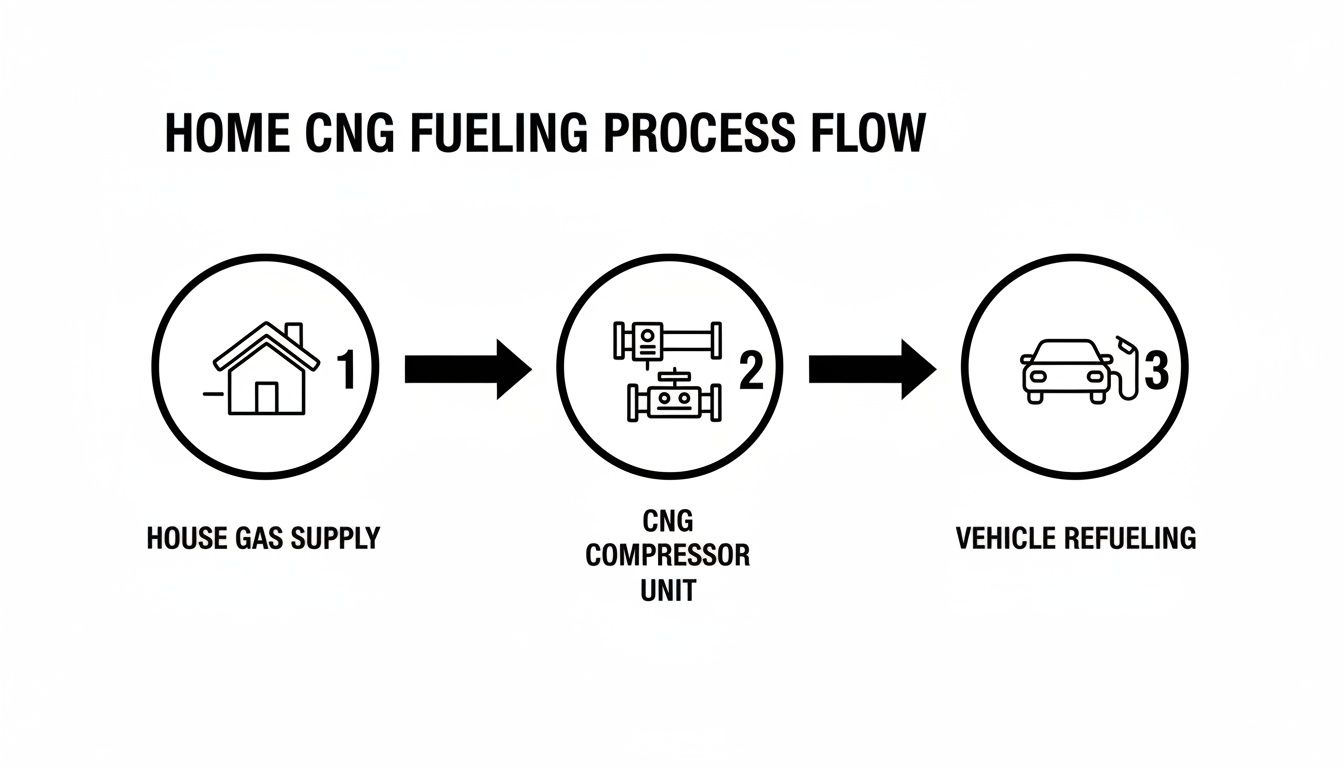
As you can see, it's a three-step dance: tap into the existing gas line, compress the gas on-site, and then dispense it directly into your vehicle. All done right there on your property.
The Compression and Filling Process
So, what's happening inside that box? The gas is carefully squeezed through several compression stages. Each stage packs the gas molecules tighter, raising the pressure a bit more. This gradual approach is the key to managing heat and keeping the whole operation safe and reliable.
As the pressure climbs, the gas is also pushed through a series of high-tech filters and dryers. This is a critical step for protecting your engine. These components scrub out any moisture, oils, or tiny impurities from the utility gas line, making sure only pure, dry methane makes it into your vehicle.
The target pressure for most CNG vehicle tanks is around 3,600 psi (pounds per square inch). To give you some perspective, that's more than 100 times the pressure in a typical car tire. Once it hits that mark, the gas is ready to be delivered through a specialized high-pressure hose and nozzle.
The core function of a home CNG fueling station is to take a large volume of low-pressure gas and concentrate its energy into a much smaller, high-pressure volume. It’s essentially packing hours of driving energy into your vehicle's tank overnight.
Slow-Fill Versus Fast-Fill Systems
When you start looking into home CNG fueling stations, you'll quickly run into two terms: "slow-fill" and "fast-fill." Knowing the difference is crucial, because it sets the right expectations for how a home unit actually works.
Fast-Fill Systems: Think of the big, commercial pumps you see at public CNG stations. These behemoths use massive storage tanks to hold a large reserve of pre-compressed gas, letting them fill a truck or bus in just a few minutes. Because of their sheer size, cost, and power demands, they are completely impractical for a residential setting.
Slow-Fill Systems: This is the category for virtually all home units. Instead of storing compressed gas, they compress it on the fly and feed it directly into your vehicle's tank over several hours. This method is far more energy-efficient and doesn't put a huge strain on your home's electrical panel or gas line.
A standard slow-fill home station will top off an average natural gas vehicle in about 6 to 10 hours. This timeframe makes it a perfect match for an overnight routine. Just plug the nozzle into your car when you get home from work, and you'll wake up to a full tank, ready to go. It completely eliminates that extra stop at the gas station from your daily life.
Your Home CNG Installation Checklist
Before you can start fueling up your vehicle in your own driveway, you need to make sure your property is ready for the job. Installing a home CNG fueling station is a bit more involved than just plugging in a new appliance. It’s a serious piece of equipment that needs the right utility connections and a proper space to live.
Think of it like laying the foundation for a small outbuilding—if you get the prep work right, the final installation will be safe, smooth, and efficient. Let's walk through the three big things you need to check: your natural gas line, your electrical panel, and the physical spot where the unit will go.
Verifying Your Natural Gas Supply
First things first: you have to confirm your home's natural gas service can handle the extra demand. The compressor for your CNG station taps right into your existing gas line, but it's a thirsty machine that needs a specific amount of gas at a steady, reliable pressure.
Your local gas utility is the only one who can give you the green light here. You'll need to get on the phone with them and ask two very specific questions:
- Is my gas pressure high enough? Home compressors need a minimum inlet pressure to work correctly. It's usually measured in inches of water column (W.C.), and while most homes have enough, you absolutely must verify it.
- Can my line deliver the required flow rate? The compressor needs to pull a certain volume of gas—measured in standard cubic feet per hour (SCFH)—to fill your vehicle's tank in a reasonable time. Your utility needs to confirm that your meter and service line can supply this volume without starving your furnace or water heater.
Don't even think about guessing on this one. Your utility company has all the data and can tell you with certainty if your current service is up to snuff.
A lot of people assume that if they have a gas line, they're good to go. The reality is that the compressor acts like another major appliance, and you need to be sure there’s enough gas to go around. This is a non-negotiable first step.
Assessing Your Electrical System
A home CNG compressor is a powerful piece of equipment, and it needs a lot of juice. You won't be plugging this into a standard 120V wall outlet. Almost every unit on the market requires a dedicated 240V circuit, the same kind of heavy-duty connection an electric stove or clothes dryer needs.
This means you'll almost certainly need to hire a licensed electrician. They’ll have to run a brand-new, dedicated circuit from your main electrical panel directly to where the compressor will be installed. This circuit needs its own breaker and must be rated for the specific amperage of your unit to prevent overloads and operate safely.
Making sure your electrical system is ready is a huge part of the project. In some cases, it might even require a significant upgrade. For a closer look at what's involved, you can learn more about a home electrical panel upgrade to see if your current setup can handle the load.
Choosing the Right Physical Location
Finally, you need to find the perfect home for the unit itself. The compressor needs to be sheltered from the weather and have plenty of ventilation to run safely.
Here are the most common and practical spots:
- A Well-Ventilated Garage: This is the go-to for most people. It protects the unit from the elements and is right where your vehicle is. The key here is good airflow to make sure any potential gas vapors can dissipate easily.
- A Sheltered Outdoor Area: No garage? No problem. A covered spot like a carport or a small, purpose-built shelter works great. Just make sure it’s protected from direct rain, snow, and harsh sun.
- A Dedicated Utility Shed: For a completely separate setup, a small, well-ventilated shed is an excellent choice. It keeps the equipment out of your main living space entirely.
No matter where you put it, the compressor needs to sit on a solid, level surface. A concrete slab is the standard for good reason—it provides a stable base that can support the machine's weight and absorb vibrations while it's running. Your installer will be your best guide here, helping you pick a location that meets all local building and fire codes for a home CNG fueling station that’s as safe as it is convenient.
Before getting too far into the process, it helps to have a clear checklist of what you need to confirm. The table below breaks down the essential site preparations you'll need to address.
Home CNG Station Site Preparation Checklist
| Requirement Category | Key Consideration | Typical Specification |
|---|---|---|
| Natural Gas Supply | Inlet Pressure | Must meet the compressor's minimum (e.g., 7" W.C.) |
| Natural Gas Supply | Flow Rate (Volume) | Sufficient SCFH to not impact other home appliances |
| Natural Gas Supply | Utility Confirmation | Official verification from your gas utility is required |
| Electrical System | Voltage & Circuit | Dedicated 240V circuit with its own breaker |
| Electrical System | Amperage Rating | Circuit rated for the specific compressor model (e.g., 30A) |
| Electrical System | Professional Install | Installation by a licensed electrician is mandatory |
| Physical Location | Foundation | Solid, level surface, typically a concrete slab |
| Physical Location | Weather Protection | Must be sheltered from rain, snow, and direct sun |
| Physical Location | Ventilation | Adequate airflow to prevent gas buildup (especially in garages) |
| Regulatory | Permits & Codes | Installation must comply with all local building and fire codes |
Running through this checklist early on will save you a world of headaches later. It ensures you know exactly what's needed to make your property ready for a safe and successful installation.
Understanding the Safety and Permit Process
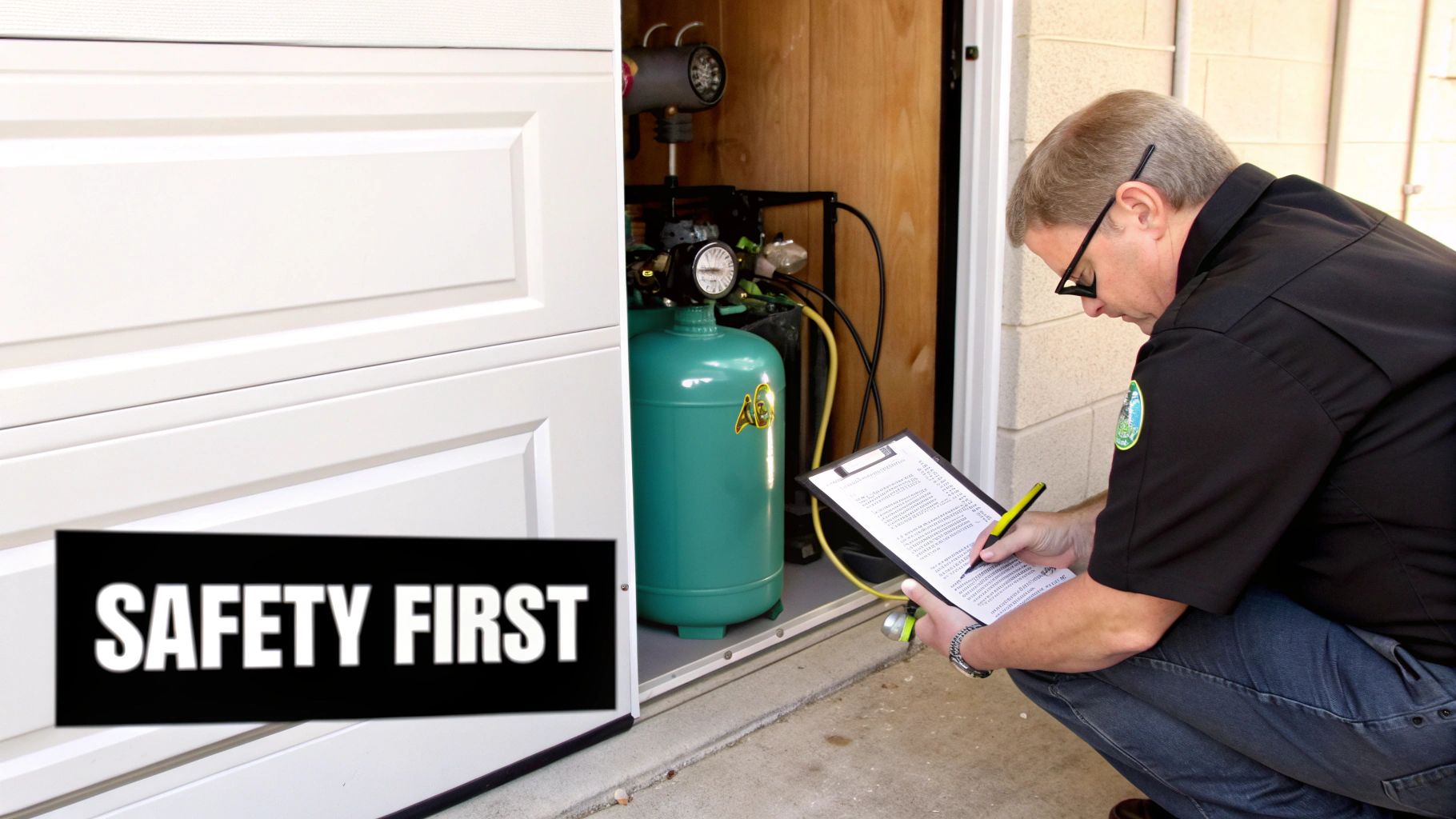
Let's be crystal clear: when you're dealing with high-pressure natural gas, safety isn't just a suggestion—it’s the absolute, non-negotiable top priority. Installing a home cng fueling station brings together high-pressure gas lines and high-voltage electricity, a combination that makes this a job strictly for certified professionals. This is not a weekend DIY project.
Think of it this way: you wouldn't try to rewire your home's main electrical panel or run a new gas line to your furnace yourself. The same logic applies here, but with even higher stakes. A professional installation ensures every connection is torqued correctly, every component is calibrated, and the entire system runs exactly as designed. It's about getting the job done right for total peace of mind.
Built-In Safeguards of Modern Compressors
The good news is that modern home CNG compressors are incredibly well-engineered systems with multiple, overlapping safety features. They are designed to constantly monitor their own operation and shut down at the first hint of an issue, long before it could ever become a real danger.
These built-in protections work in tandem to create a secure fueling environment right in your garage.
- Automatic Shut-Off Sensors: These are the brains of the operation, constantly monitoring gas pressure, temperature, and electrical draw. If any of these metrics drift outside the normal range, the system immediately shuts itself down.
- Pressure Relief Valves: This is a purely mechanical failsafe, and it’s a critical one. If for some reason the internal pressure ever exceeds a safe limit, these valves automatically open to vent the excess gas safely.
- Methane Detectors: Many setups include integrated methane (natural gas) sensors. If this device detects even a tiny amount of gas in the surrounding air, it can trigger an alarm and instantly cut off the gas supply.
Think of these features as your silent guardians, working 24/7 to keep the system operating within its strict safety limits.
Navigating Codes and Securing Permits
Before a single wrench is turned, you'll need to work through the local regulations and permitting process. This isn't just bureaucratic red tape; it's a crucial step that confirms your installation plan is fully compliant with all legally required safety standards. While your certified installer will handle the paperwork, it’s helpful to understand what’s involved.
The installation has to meet several layers of codes that govern everything from where the unit can be placed to how the electrical connections are made.
The permit process is a critical checkpoint. It ensures a third party—your local building authority—reviews and approves the installation plan, verifying it meets established safety protocols before any work actually begins.
Here are the key regulations you'll come across:
- Local Building Codes: These rules dictate things like structural and placement requirements. For example, they often require the unit to sit on a non-combustible surface like a concrete pad and mandate specific ventilation criteria.
- Fire Codes (NFPA 52): The National Fire Protection Association's "Vehicular Gaseous Fuel Systems Code" is the industry bible for CNG installations. It lays out detailed rules for component placement, ventilation, and emergency shut-off systems.
- Electrical Codes: Because these stations have significant electrical components, it’s vital to adhere to essential electrical safety standards like NFPA 70E. Your electrician must follow these codes to the letter.
- Utility Company Requirements: Your local gas provider will have its own set of rules for connecting new equipment to their supply lines. These must be followed to ensure your service remains active and safe.
Getting a handle on these requirements from the start allows you and your installer to design a plan for a fully compliant and secure home cng fueling station.
Breaking Down the Costs and Fuel Savings
Let's talk numbers. Installing a home CNG fueling station is a serious investment, no doubt about it. But it's an investment that can absolutely pay for itself over time, thanks to some pretty dramatic fuel savings. To get the full picture, we need to look at what you’ll spend upfront and what you can expect for a long-term return on investment (ROI).
This isn't just about buying a box; it's about setting up a complete, safe, and efficient fueling system right in your garage or on your property. The real value comes from ditching those volatile, high prices at the pump for the steady, low cost of the natural gas you already use to heat your home.
Unpacking the Initial Investment
Getting a home CNG system installed and running will typically set you back anywhere from $5,000 to over $10,000. The final price tag really depends on the equipment you choose and how much prep work your site needs. The cost boils down to three main components:
- The Compressor: This is the heart of the system and the biggest chunk of your budget. Costs vary quite a bit based on the brand, its refueling speed (capacity), and any extra features. A more powerful unit that fills your tank faster will naturally be at the higher end of that price range.
- Professional Installation: This is not a weekend DIY project. You absolutely need to hire certified technicians to handle the natural gas line connections, the high-voltage electrical wiring, and the final system check. Labor costs alone can run from $1,500 to $4,000, sometimes more.
- Site Upgrades: Your property might need some work before the compressor can even be installed. This could involve running a new 240V electrical circuit to the garage, pouring a small concrete pad for the unit, or even getting your utility company to upgrade your natural gas meter.
The good news? As the market for compressed natural gas continues to expand, equipment is likely to become more affordable. Major industry analyses point to significant CNG market growth on grandviewresearch.com, which pushes manufacturers to scale up production. That usually leads to lower prices for consumers.
Calculating Your Return on Investment
Now for the fun part: the savings. The whole point of a home CNG fueling station is to swap expensive gasoline for cheap, abundant natural gas. Natural gas is priced in "gasoline gallon equivalents" (GGE), which makes it super easy to compare costs directly.
When gasoline is $3.50 per gallon at the pump, the cost of a GGE of natural gas from your home utility line might be less than $1.50. That’s a massive difference.
To show you how this plays out, we've put together a sample calculation.
Estimated Cost and ROI Breakdown for Home CNG Stations
This table illustrates how a typical investment in a home CNG station can be offset by fuel savings over time, especially for a high-mileage driver.
| Expense/Saving Category | Estimated Cost / Value | Notes |
|---|---|---|
| Compressor Equipment | $5,500 | Mid-range unit with moderate refueling speed. |
| Professional Installation | $2,500 | Includes labor for gas and electrical hookups. |
| Site Prep & Permits | $1,000 | Pouring a concrete pad and local permitting fees. |
| Total Initial Investment | $9,000 | The all-in, one-time cost to get started. |
| Annual Mileage | 20,000 miles | A common figure for commuters or small businesses. |
| Vehicle Fuel Economy | 20 MPG / 20 MPGe | Assumed efficiency for both gasoline and CNG. |
| Annual Gasoline Cost | $3,500 | (1,000 gallons @ $3.50/gallon) |
| Annual CNG Cost | $1,500 | (1,000 GGE @ $1.50/GGE) |
| Annual Fuel Savings | $2,000 | The key number for calculating your payback period. |
| Payback Period | 4.5 Years | ($9,000 initial cost / $2,000 annual savings) |
Based on these numbers, the $9,000 system pays for itself in just four and a half years. After that point, you're pocketing a pure $2,000 in savings every year you drive that vehicle.
The ROI becomes even more attractive if you have multiple natural gas vehicles (NGVs) in your household or if you’re running a small business with a local fleet. The more you drive, the faster you get your money back.
Is a Home CNG Station Right for You?
So, you're intrigued by the idea of a personal fuel pump in your garage. It's a big decision, both financially and logistically. While a home CNG fueling station can be a fantastic source of convenience and long-term savings, it’s definitely not a one-size-fits-all solution. The real question is whether your specific situation and driving habits are a good match for the technology.
Let's dig into who these systems are really built for and explore some practical alternatives if a permanent setup isn't in the cards for you.
The Ideal Home User Profile
The strongest argument for a home CNG station comes down to one thing: mileage. If you're constantly on the road, the fuel savings start to pile up quickly. The more you drive, the faster that initial investment starts paying you back.
Here’s a snapshot of who stands to gain the most:
- The High-Mileage Commuter: Anyone putting 15,000 to 20,000+ miles on their vehicle each year is a prime candidate. When you're paying $1.50 per GGE for natural gas instead of $3.50 per gallon for gasoline, the savings become impossible to ignore.
- The Multi-NGV Household: If your family has more than one natural gas vehicle, the math gets even better. You can refuel both cars overnight from a single compressor, effectively doubling your savings without doubling your equipment costs.
- The "Prepper" or Self-Reliant Homeowner: For those who prioritize being independent, having your own fuel source provides a unique sense of security. You’re no longer tied to the fluctuating prices and availability of public gas stations.
Small Businesses and Light Commercial Use
It's not just homeowners who can benefit. These smaller-scale CNG stations can be a complete game-changer for certain small businesses. Think about companies running a handful of local service vehicles—plumbers, electricians, HVAC technicians, or local delivery services. A private station can slash their operating costs.
Instead of sending drivers to pay retail at a public station, a business can fill up its entire fleet overnight right at the shop, using its existing low-cost utility gas. This move doesn't just cut the fuel bill; it boosts productivity. No more wasted time making fuel stops during the workday. Every vehicle is full and ready to go first thing in the morning.
For a small fleet, the ROI isn't just about fuel savings—it's about recovered time. Eliminating daily refueling stops can add up to dozens of productive hours saved each month, directly boosting the bottom line.
Practical Alternatives to a Permanent Station
But what if a permanent installation just doesn't make sense for you? Maybe you're renting, you might move soon, or you simply don't drive enough to justify the upfront cost. Thankfully, there are other ways to get the benefits of CNG without the commitment.
One of the most useful options is a mobile refueling service. Companies like Blue Gas Express can bring CNG directly to you, either on a temporary or on-demand basis. This is a perfect fit for a construction site that needs temporary fuel for heaters or for a business with a short-term need for CNG-powered equipment. They deliver the fuel right where you need it, giving you a flexible way to use natural gas when a full-blown home cng fueling station is just overkill.
Got Questions About Home CNG Fueling? Let's Clear Things Up.
So, you've got the basics down, but you're probably still wondering about the practical, day-to-day stuff. That's completely normal. Investing in a home CNG station is a big decision, and you need to know exactly what you’re getting into before you take the plunge.
Let's tackle some of the most common questions we hear from people who are considering their own personal refueling setup.
How Long Will It Take to Fill My Tank?
This is probably the biggest mental shift from using a public station. Most home CNG fueling stations are what we call "slow-fill" systems. Don't expect a five-minute fill-up like you get at a commercial pump; these units are designed to work overnight.
For a standard passenger car, you're typically looking at 6 to 10 hours to go from empty to full. The exact time hinges on your vehicle's tank size and the specific compressor you have. It's a slow and steady process that’s actually more energy-efficient. You just get into the habit of plugging it in when you park for the evening, and by morning, you have a full tank ready to go.
It's a lot like charging your phone. You plug it in before bed without a second thought, and it’s at 100% when your alarm goes off. Same principle here.
Can I Install This Myself?
Let me be crystal clear on this one: absolutely not. Installing a home CNG station is a job that must be handled by a certified professional, no exceptions. You're dealing with a combination of high-pressure natural gas and high-voltage electricity, and that's a dangerous mix for anyone without specialized training.
A certified installer is essential for a few key reasons:
- Following the Rules: They know how to ensure the installation complies with all local building codes and fire safety standards, like NFPA 52.
- Working with Utilities: Your local gas utility has its own set of rules for connecting this kind of equipment. An expert knows how to navigate that.
- Safety First: A pro performs detailed leak checks and system tests to make absolutely certain everything is working safely and correctly before the job is done.
Trying to DIY this project is incredibly risky, and it will also void your warranties and likely get you in trouble with local authorities. It's just not worth it.
What's the Maintenance Like?
Home CNG compressors are built to be tough, but just like your furnace or air conditioner, they need a little bit of TLC to stay in top shape. The good news is that the maintenance is pretty straightforward and your owner's manual will lay out the exact schedule.
You'll mostly be doing periodic checks on things like filters and oil levels (for lubricated models) and giving the hoses a quick inspection for any signs of wear and tear. Beyond that, most manufacturers recommend having a professional service technician come out once a year. They'll run a full diagnostic to make sure all the safety systems are working perfectly and that the unit is running as efficiently as possible.
For situations where a permanent installation isn't the right fit, Blue Gas Express offers flexible mobile CNG and LNG delivery solutions to keep your project running. Learn more about our temporary natural gas services.