

Think of a gas management system as the central nervous system for your entire operation. It's the intelligent, automated network that's constantly sensing, thinking, and acting to keep everything running safely and at peak efficiency. The whole point is to precisely monitor, control, and optimize gas flow, pressure, and purity from start to finish.
What Exactly Is a Gas Management System?
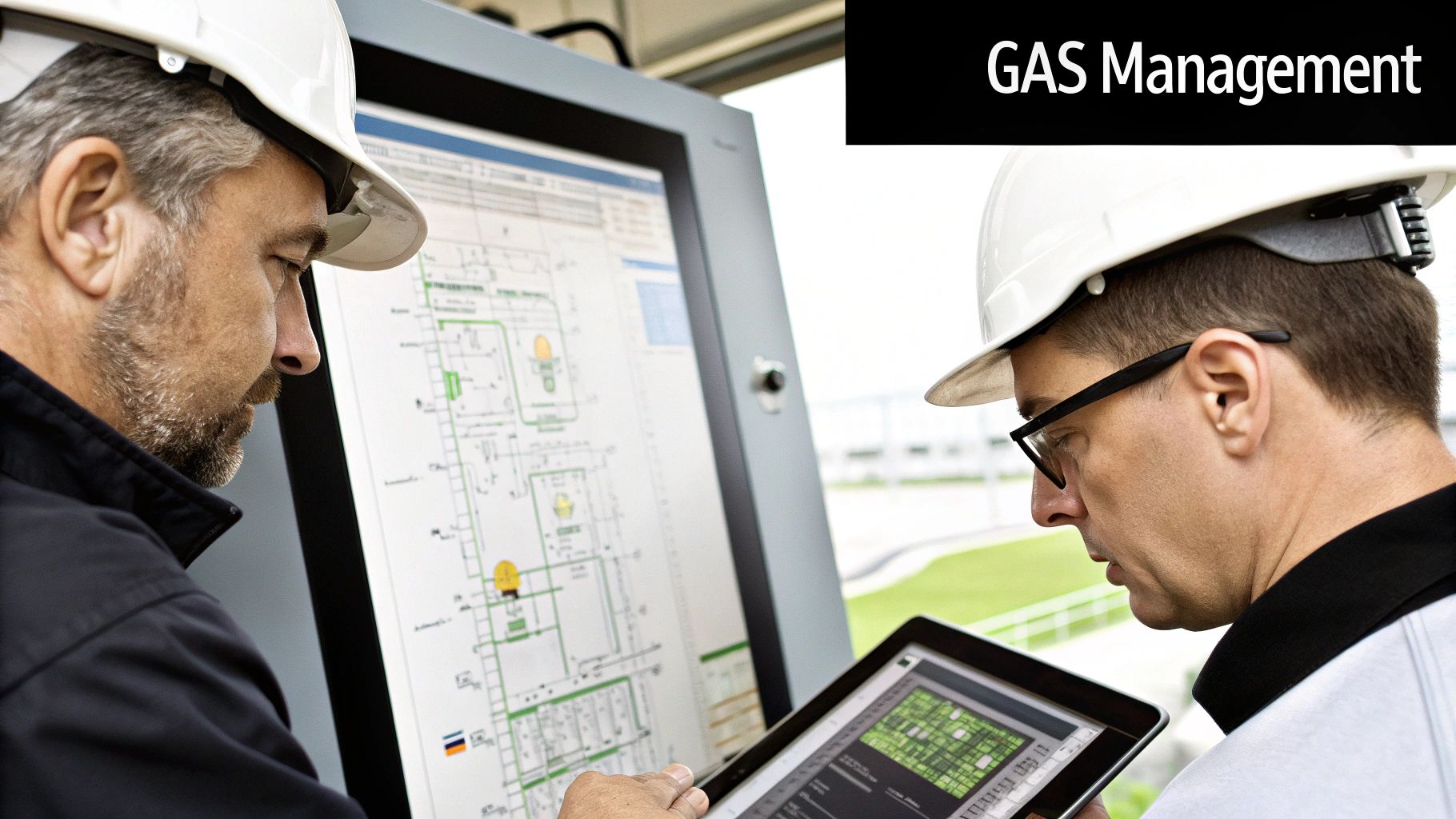
At its core, a gas management system is much more than a simple alarm or a passive detector. It's an active, fully integrated solution that gives you real-time oversight and automated control over your entire gas inventory and distribution network. This kind of technology is absolutely critical in places where gases are a key part of the job—think construction sites, manufacturing plants, and utility infrastructure.
Let's make it real. Imagine a big construction project that needs temporary natural gas for heating. A standalone gas tank is just a container. But once you connect it to a management system, that tank becomes a smart asset. The system keeps tabs on consumption, spots potential leaks before they become a problem, and makes sure the supply is steady, preventing expensive project delays.
The Real Purpose of Gas Management
The fundamental goal here is to create an operational environment that's seamless, responsive, and, above all, safe. These systems aren't a luxury; for modern industrial work, they're a necessity that tackles several critical jobs at once. By giving you precise control, they help you stick to strict regulatory standards and your own internal safety rules.
A gas management system is the critical link between your gas supply and your team's safety. It’s like having a vigilant guardian on duty 24/7, constantly processing data to prevent accidents, cut down on waste, and ensure you're always in compliance.
This proactive approach is what really sets a true gas management system apart from basic monitoring. For instance, a simple gas detector might beep if there's a leak. A complete management system, on the other hand, can automatically shut off the supply line, alert emergency crews, and log the entire incident for analysis later. That's a whole different level of capability.
Why These Systems Are Non-Negotiable Today
In today's fast-moving industrial world, you can't compromise on efficiency or safety. A well-designed gas management system directly boosts your bottom line while protecting your people and property. Its primary functions boil down to a few key areas:
- Preventing Accidents: By constantly watching for leaks, pressure changes, and equipment issues, these systems seriously reduce the risk of fires, explosions, or exposure to hazardous gases.
- Cutting Waste: When you have precise control over gas flow, you waste less product. For companies that rely on expensive specialty gases, this adds up to major cost savings.
- Ensuring Compliance: Many industries have to follow tough regulations for gas storage and use. These systems provide the detailed data logging and control you need to meet—and often exceed—those standards.
Getting a handle on this foundation is the first step. From here, we can start to see how each individual component works together to protect your assets and push performance higher.
Breaking Down the Core Components
To really get a handle on how a gas management system works, it helps to think of it like a living organism. It has senses to detect what's happening, a brain to make decisions, and muscles to take action. Each part has its own job, but they're all constantly communicating to keep the entire operation safe and efficient.
Let's pull back the curtain and look at the essential hardware and software that make these systems tick.
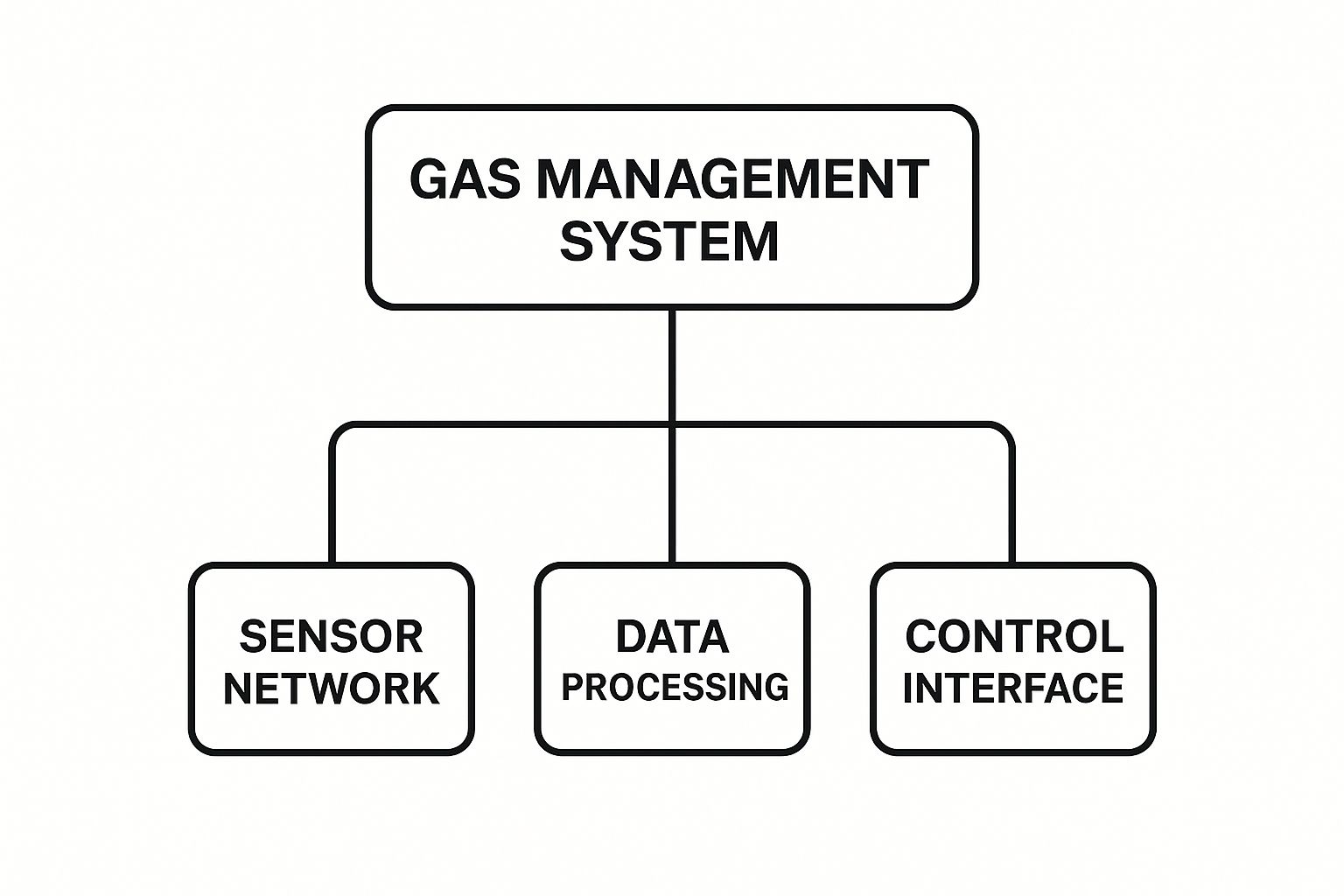
As you can see, everything starts with sensors gathering information from the field. That data flows to a central processing unit, which then tells the control interfaces what to do.
The "Senses": The Sensor Network
The sensor network is the eyes, ears, and nose of the whole operation. These are the devices out in the field, constantly gathering raw data about the gas environment. Think of them like the smoke detectors in your home, always on alert, sniffing the air for the first sign of trouble.
This isn't just one type of sensor, either. It’s a whole suite of specialized tools designed to measure different things with incredible accuracy.
- Pressure Transducers: These keep a close watch on the force of the gas inside pipelines and tanks. A sudden drop could mean a leak, while a spike might point to a dangerous blockage.
- Flow Meters: You can't manage what you don't measure. Flow meters track the volume of gas moving through a line, which is crucial for everything from operational efficiency to accurate billing.
- Gas Detectors: These are the specialized "noses" calibrated to sniff out specific gases, like methane (CH₄) or the highly toxic hydrogen sulfide (H₂S). Catching a methane leak is critical, especially since it has a Global Warming Potential (GWP) nearly 30 times that of CO₂ over 100 years.
- Temperature Sensors: Gas behaves differently at different temperatures. These sensors provide vital context, helping to interpret pressure readings and prevent equipment from failing under extreme heat or cold.
Without this constant, reliable stream of information, the rest of the system would be flying blind.
The "Brain": The Control Unit
If sensors are the senses, the control unit is the brain. This is where all that raw data gets crunched, analyzed, and interpreted in the blink of an eye. Modern systems use powerful controllers—often Programmable Logic Controllers (PLCs) or dedicated microprocessors—to make sense of the nonstop flood of information.
The control unit is constantly comparing what's happening in real-time to the safe operating limits you’ve programmed into it. It’s trained to spot anomalies—a pressure reading that’s a little too low, a flow rate that’s creeping too high, or the faintest whiff of a hazardous gas. It doesn't just see the numbers; it understands what they mean.
The control unit is the decision-making heart of the system. It processes thousands of data points every second, distinguishing normal operational fluctuations from genuine threats, and initiates an immediate, calculated response to keep the site secure.
This processing power also allows the system to be proactive. By analyzing historical data, the "brain" can spot trends that might predict an equipment failure down the road, giving you a chance to schedule maintenance before a small issue becomes a catastrophic one.
The "Muscles": Actuators and Valves
Once the brain makes a decision, it sends a command to the system's "muscles"—the actuators and control valves. These are the heavy-lifters, the physical components that carry out orders to directly manage the gas flow. They’re the hands that turn the wrench, but with digital speed and perfect precision.
The key players here are:
- Automated Valves: These can be emergency shut-off valves that slam the door on gas flow in a crisis, or they can be throttling valves that make tiny, precise adjustments to maintain perfect pressure.
- Actuators: These are the devices that provide the physical force to open or close the valves. They receive their marching orders directly from the control unit and can be powered by electricity, compressed air (pneumatic), or fluid (hydraulic).
- Alarms and Notifications: Action isn't just about controlling gas. It's also about alerting people. When a problem is detected, the system immediately triggers alarms like sirens and flashing lights while sending automated alerts straight to the phones of key personnel.
Together, these three elements—sensing, processing, and acting—create a closed-loop system that never sleeps. It’s a powerful fusion of digital intelligence and rugged mechanical hardware, all working in concert to give you total control and unwavering safety.
How These Systems Operate in Real Time
A gas management system is like a vigilant, 24/7 partner, constantly running through a seamless cycle of monitoring, analysis, and action. This isn't just a box of electronics waiting for something to go wrong; it’s an active, dynamic process that gets ahead of problems and fine-tunes performance on the fly.
To really get a feel for how it works, let's trace a single piece of data from a sensor on the ground all the way to the control room and back out to the field. This whole loop happens in the blink of an eye, turning a simple measurement into a decisive, protective action. It’s a closed-loop system where data doesn’t just inform—it drives an immediate and intelligent response.
The Sense-Think-Act Sequence
Picture a temporary natural gas pipeline feeding a heating unit on a sprawling construction site. The system’s sensors are your eyes and ears on the ground, constantly sampling the environment. The very moment a pressure sensor flags an unexpected drop, the operational sequence kicks into high gear.
Sensing the Anomaly: The pressure transducer registers a reading that falls outside its programmed safe limits. At the same time, a nearby methane detector might sniff out trace amounts of gas in the air, adding a second layer of confirmation.
Transmitting the Data: Both sensors instantly translate their findings into digital signals. This critical information is then securely beamed to the central control unit—the system’s brain.
Analyzing the Situation: The control unit receives the data. It immediately cross-references the pressure drop with the methane reading, recognizing that the two signals together point to a high probability of a pipeline breach.
Executing a Response: Within milliseconds, the controller fires off a command to an automated shut-off valve located just upstream from the potential leak. The valve’s actuator snaps shut, instantly stopping the flow of gas and isolating the compromised section.
Notifying Personnel: Simultaneously, the system blasts audible and visual alarms on-site to alert anyone nearby. It also shoots out automated text messages and email alerts to the site supervisor and safety officer, pinpointing the exact location and nature of the incident.
This entire chain of events, from initial detection to complete shutdown, happens far faster than any human could possibly react. It's this high-speed, automated response that turns a potential catastrophe into a managed, contained event.
Beyond Just Emergency Response
While emergency shutdowns are absolutely vital, the real strength of modern gas management systems is what they do when everything is running smoothly. They aren't just reacting to failures; they are constantly working to prevent them and to optimize every cubic foot of gas you use.
How? Through continuous data logging and smart analytics. The system never forgets. Every pressure reading, flow rate, and temperature change is recorded and stored, building a rich, detailed history of your operation's performance.
A gas management system is more than a safety net; it's an operational intelligence tool. By analyzing historical data, it identifies subtle patterns that predict equipment wear, optimize gas usage, and ensure you remain in unwavering compliance with safety regulations.
This proactive approach is why these systems are being adopted so widely. The global market, valued at around $4.29 billion in 2022, is on track to hit about $7.5 billion by 2030. This growth isn't just a trend; it's a clear signal of the industry-wide shift toward smarter, data-driven safety and efficiency. You can discover more about these market trends and see what they mean for your own operations.
Turning Data Into Actionable Insights
All that logged data is where the long-term value really comes from. By digging into this information, facility managers and safety officers can fine-tune their operations for peak efficiency and rock-solid security.
Predictive Maintenance: The system might notice a valve is taking a fraction of a second longer to close than it did last month. This tiny trend, completely invisible to a human observer, can signal mechanical wear and trigger a maintenance check long before the component actually fails.
Consumption Optimization: By analyzing flow rate data over time, you can spot periods of inefficient gas use. For a manufacturer relying on expensive specialty gases, this kind of insight can lead to process tweaks that save thousands of dollars every year.
Compliance and Reporting: When the regulators come knocking, the system has you covered. It provides a complete, timestamped log of every event, alarm, and system status. This detailed record makes proving your commitment to safety straightforward and stress-free.
Ultimately, the real-time operation of a gas management system is a continuous conversation between your equipment and your team. It gives you the clarity to make smarter decisions, the speed to act when it matters most, and the foresight to stop problems before they even start.
Where Gas Management Systems Really Make a Difference
Putting an advanced gas management system in place delivers real, measurable value. But what that value looks like changes dramatically from a muddy construction site to a sterile manufacturing cleanroom or a sprawling utility network. The benefits aren't one-size-fits-all; they’re shaped by the specific pressures and risks of each industry.
When you connect the dots between system features and day-to-day business outcomes, the return on investment isn't just a number on a spreadsheet—it's safer workers, smarter operations, and serious cost savings.
It's no surprise, then, that the market is booming. Valued at USD 22.7 Billion in 2025, the gas delivery systems market is on track to hit USD 50.5 Billion by 2035. This growth is fueled by a push toward smart manufacturing and the ever-growing demand for high-purity gases in critical fields. You can discover more about the future of gas delivery systems and see how these integrated solutions are becoming standard practice.
On the Construction Site: All About Safety
For a construction manager, the number one win is simple: worksite safety. A construction site is a constantly changing environment, often with temporary gas lines strung up for heaters or power equipment. That creates a unique set of risks. A gas management system is the vigilant watchdog you need, constantly sniffing for leaks or pressure drops that could spell disaster.
This automated oversight also takes a huge headache out of complying with strict OSHA regulations. Instead of just relying on manual spot-checks, the system gives you a continuous, logged record of safe operations. That doesn’t just protect your crew; it shields the company from the hefty fines and legal troubles that follow a safety incident.
Think of an integrated gas management system on a construction project as a dedicated safety officer for your gas supply. It’s not just passively detecting problems—it’s actively preventing them by shutting down risks in milliseconds, keeping your people safe and your project on schedule.
In the Factory: Driving Efficiency and Quality
Shift gears to an industrial setting, and the conversation turns to precision, quality control, and the bottom line. Manufacturers often work with incredibly expensive specialty gases, where even a little waste adds up fast. Gas management systems give you the tight, granular control needed to dial in consumption, making sure every last molecule does its job.
That precision has a direct impact on product quality. In sensitive processes like welding or semiconductor fabrication, the slightest hiccup in gas purity or flow can ruin an entire batch. By locking in the exact parameters, these systems ensure production standards are hit every single time, which means fewer defects and less rework.
Here's where manufacturers see the biggest gains:
- Slash Waste: Stop bleeding money on expensive gases like argon or nitrogen through tiny, unseen leaks.
- Lock in Quality: Guarantee that gas mixtures and flow rates are flawless, protecting the integrity of your product.
- Get Ahead of Breakdowns: The system monitors equipment performance, flagging potential failures before they shut down your whole line.
For the Utilities: Protecting the Public
When you're a utility company managing a massive natural gas network, the stakes couldn't be higher. Here, the benefits are all about public safety and keeping critical infrastructure running. A modern gas management system provides a complete, top-down view of the entire grid, from the big transmission pipelines down to the service lines feeding a neighborhood.
This wall-to-wall monitoring lets utilities find and fix leaks with incredible speed and accuracy—often before anyone in the area even smells gas. They can remotely isolate a section of pipe, dispatch a crew to the exact spot, and prevent a small issue from becoming a major outage. It’s this proactive stance that builds public trust and ensures the safe, reliable flow of energy to homes and businesses.
Exploring Real-World Applications

It’s one thing to understand the theory behind gas management systems, but seeing them in action is where it all clicks. These aren’t just abstract concepts; they’re the unseen workhorses operating 24/7 in some of our most critical industries.
Let's look at a few real-world stories. They show how a well-designed system goes from being a line item on a budget to an absolutely essential asset. These examples highlight the tough challenges companies face and how the right gas management setup provides the solution, locking in safety, precision, and uninterrupted operations.
Protecting Public Trust in Utility Networks
Think about a major utility provider. They're responsible for a natural gas network that snakes for thousands of miles under our cities and neighborhoods. The challenge is staggering: how do you keep an eye on all of it to prevent a leak that could lead to a disaster, shut down service, and destroy public trust? This is exactly where a networked gas management system acts as the central nervous system for the entire grid.
Instead of just relying on scheduled manual checks, the utility blankets its network with advanced methane sensors and pressure transducers at critical points like pipeline junctions and compressor stations.
- Real-Time Monitoring: All these sensors feed a nonstop flow of data back to a central control room.
- Automated Alerts: The moment a pressure drop or methane reading spikes past a set limit, the system instantly flags the exact location of the problem.
- Swift Isolation: It can even trigger emergency shut-off valves automatically, isolating the compromised pipeline section and containing the potential leak in minutes, not hours.
This shifts leak detection from a reactive, and often frantic, search to a precise, data-driven response that protects communities and keeps the energy flowing.
Ensuring Flawless Precision in High-Tech Manufacturing
Now, let’s go inside a semiconductor fabrication plant, or "fab." In here, the environment has to be controlled with almost unbelievable precision. Making microchips involves hundreds of steps that depend on a cocktail of high-purity specialty gases—argon, nitrogen, and silane, to name a few. The smallest impurity or the slightest waver in gas flow can ruin an entire batch of microchips, a mistake that easily costs millions.
A specialized high-purity gas management system is what makes these exacting standards possible. It oversees every single part of the gas delivery process, from the huge storage tanks outside all the way to the point of use in the cleanroom. The system ensures gas purity stays at 99.999% or better and that flow rates are rock-solid, leading to consistent products and maximum output.
In a semiconductor fab, the gas management system isn't just a safety precaution—it's a fundamental part of quality control. It guarantees the pristine conditions needed to make flawless microchips, which has a direct impact on the company’s profitability.
Delivering Energy Safely on the Move
Finally, picture the logistical puzzle of a mobile fueling operation. Companies like Blue Gas Express provide temporary CNG (Compressed Natural Gas) solutions for construction sites or industrial plants that aren't hooked up to a pipeline. They bring in a "virtual pipeline" on mobile trailers. The core challenge is transferring high-pressure gas safely, accurately, and efficiently.
The integrated gas management system on these mobile rigs is absolutely critical. It monitors tank pressure and temperature, controls the dispensing flow rate, and has an immediate emergency shutdown function. This makes sure every cubic foot of gas is delivered safely and accounted for, preventing dangerous over-pressurization and ensuring billing is spot-on. For these mobile setups, the system is the all-in-one brain that makes temporary energy delivery both feasible and secure.
These kinds of innovative solutions are part of a massive shift toward cleaner energy. In fact, the gas generating systems market, valued at USD 10.2 billion in 2025, is projected to hit USD 25.7 billion by 2035. This growth points to the rising demand for flexible, hybrid energy solutions. Discover more insights on the gas generating systems market to see where the industry is headed.
Choosing the Right Gas Management System
Picking the right gas management system is one of those big decisions that directly shapes your safety, efficiency, and ultimately, your bottom line. This isn't about finding a one-size-fits-all box; it’s about finding the perfect match for the real-world demands of your job site or facility.
Think of it like choosing the right work vehicle. A general contractor needs a rugged pickup truck, a logistics company needs a fleet of delivery vans, and a utility provider needs specialized service trucks. They all move things, but how they do it is completely different. The same goes for managing gas—the ideal system for a temporary construction site will be fundamentally different from one running in a permanent manufacturing plant.
Defining Your Core Operational Needs
Before you even look at a single piece of hardware, you need to take a hard look at your own operation. Getting clear on your requirements first creates a blueprint that will guide your decision, making sure the system you end up with actually fits how you work.
Start by asking the right questions:
- What specific gases are we handling? The system absolutely must be designed for the gases you use, whether that’s flammable natural gas, inert argon, or something more hazardous.
- What’s the scale of our operation? A small, single-point monitor for a temporary heater is worlds away from a networked system watching over miles of pipeline.
- What are our regulatory requirements? Meeting standards from OSHA, the EPA, or other agencies is non-negotiable. Your system must be able to monitor, log data, and trigger safety functions exactly as required.
Answering these questions first will immediately narrow down your options, steering you away from generic solutions and toward something truly built for your world.
Choosing a gas management system is a strategic investment in operational resilience. The right choice is one that not only solves today's safety and efficiency challenges but is also flexible enough to adapt to your company's growth and evolving technological landscape.
Planning for the Future
A system that’s perfect for you today could become a major headache if it can't grow with your business. Scalability is key. You need to know that as you expand—by adding new production lines, extending a pipeline, or taking on bigger projects—your management system can grow right along with you without forcing a complete, and costly, replacement.
Equally important is integration. Your gas management system can't be an island. It needs to talk to your other platforms, whether that’s your plant management software, a SCADA system, or a building automation network. This creates a single, unified view of your entire operation, giving you a much clearer picture of both safety and performance.
And don't forget about the people behind the product. Strong vendor support—including regular maintenance, solid training, and responsive troubleshooting—is what will protect your investment and keep your system running reliably for years to come.
System Selection Criteria by Industry
The best system always depends on the job. A construction site has different priorities than a high-purity manufacturing facility or a sprawling utility network. The key is to weigh different factors based on the unique risks and goals of your industry.
The table below breaks down the primary focus for each of these core sectors.
| Selection Factor | Construction Focus | Industrial Manufacturing Focus | Utility Focus |
|---|---|---|---|
| Durability | High Priority: Must withstand harsh weather, dust, and physical impact. Portability and ruggedness are key. | Moderate Priority: Needs to be robust for a plant floor environment but is generally in a controlled setting. | High Priority: Requires extreme durability for outdoor, remote, and often underground installations. |
| Scalability | Low Priority: Systems are often temporary and project-based. Easy deployment and removal are more important. | High Priority: Must be able to expand with new production lines or facility additions without a full replacement. | Very High Priority: Essential for expanding service areas and integrating new segments of the grid seamlessly. |
| Integration | Low Priority: Typically operates as a standalone safety system. | Very High Priority: Needs to integrate with SCADA, DCS, and plant automation for process control. | High Priority: Must connect with central control rooms, billing systems, and enterprise asset management software. |
| Regulatory Compliance | High Priority: Focused on OSHA safety standards for worker protection and temporary site safety. | High Priority: Adherence to EPA, OSHA, and industry-specific standards for emissions and process safety is critical. | Very High Priority: Must meet strict federal, state, and local utility commission regulations for public safety. |
Looking at this, it becomes clear that there's no single "best" system. The right choice is always the one that aligns with your industry's specific challenges and operational goals, ensuring you get a tool that's not just compliant, but genuinely effective.
Common Questions About Gas Management
As you start looking into gas management systems, a few practical questions always seem to pop up. Getting straight answers is the best way to see how these systems go from a concept on paper to a real-world asset. Let's dig into some of the most common ones.
Gas Detection Versus Gas Management
So, what's the actual difference between gas detection and gas management? It’s a bit like a smoke alarm versus a full-on fire suppression system.
A gas detector is a standalone sensor. Its one and only job is to scream when it sniffs a specific gas. That’s a critical first alert, no doubt, but it’s completely dependent on a person to hear it and do something about it.
A true gas management system, on the other hand, is an active, intelligent network. It doesn't just tell you there's a problem—it starts solving it. If it detects a leak, it can automatically slam a valve shut to stop the flow, kick on emergency ventilation fans, and shoot detailed alerts straight to a control room or a mobile device. It’s the difference between passive awareness and active, automated control, which is a massive step up for both safety and operations.
System Maintenance Requirements
How much babysitting do these systems need? While every setup is a little different, modern gas management solutions are built to be tough and require minimal hands-on time. The core hardware, like the controllers and valves, is designed to take a beating in harsh industrial environments.
That said, you can't just set it and forget it. Routine maintenance is non-negotiable for keeping everything running safely and accurately. This usually involves:
- Sensor Calibration: This is the most common task. Sensors can drift over time, so they need to be periodically checked and recalibrated to make sure their readings are dead-on accurate.
- Component Inspection: A regular walk-around to visually check valves, wiring, and control boxes for any signs of corrosion, damage, or wear and tear.
- Software Updates: Just like your phone, the system's software needs to be kept current. This patches security holes and gives you access to the newest features and improvements.
A well-maintained system isn't just an expense; it's an investment in safety and uptime. Taking care of it proactively ensures it's ready to do its job perfectly the moment you need it most.
Retrofitting Older Facilities
Can you install a modern gas management system in an older building or plant? Absolutely. In fact, retrofitting is one of the most common ways to bring existing facilities up to today's safety and efficiency standards.
The process involves weaving new sensors, automated valves, and a central controller into the facility’s existing gas lines and infrastructure. The rise of wireless sensor technology has made this a whole lot easier and less disruptive than it used to be, often eliminating the need to run miles of new conduit and wiring. A good provider can engineer a system that plays nicely with your current setup, giving you advanced control without forcing a complete, and costly, overhaul.
For construction projects, industrial facilities, or utilities needing reliable, temporary natural gas, Blue Gas Express delivers mobile CNG and LNG solutions directly to your site. Our systems ensure your operations continue without interruption, providing the safe and efficient gas management you need to stay on schedule. Learn more about our mobile gas solutions and keep your project moving forward.