

It’s a common question, but you can't directly convert cubic meters (m³) to kilowatts (kW). They measure two completely different things: volume and power.
Think of it like this: a cubic meter of gas is like a tank of petrol, while a kilowatt is the power your car’s engine produces. You can’t ask how many horsepower is in a gallon of petrol—it doesn't make sense. To connect the two, you need to know how fast you're using that fuel.
The Real Link Between Gas Volume And Power
To get from a volume of gas to a power output, we have to talk about how that gas is being used over time. A cubic meter of natural gas just sitting there isn't doing anything. It’s pure potential. It's only when you start burning that gas in a generator or a heater that you can measure the power it's producing in kilowatts.
This is where two crucial pieces of the puzzle come in:
- Flow Rate (m³/h): This is the speed of consumption. It tells you how many cubic meters of gas your equipment is burning every hour.
- Calorific Value (kWh/m³ or MJ/m³): This is the energy density, or the "punch," packed into the gas. It tells you exactly how much energy is released from every cubic meter you burn.
Put those two together, and you've built the bridge from gas volume to real-world power.
Defining The Key Terms
Before we jump into the formulas, let's quickly get these core concepts straight. Getting a firm grip on what each term means is the key to getting your calculations right every time.
Here's a quick reference guide to keep the fundamental concepts clear.
Key Terms in Gas to Energy Conversion
| Term | Unit | What It Measures |
|---|---|---|
| Volume | Cubic Meter (m³) | The physical space the natural gas occupies. |
| Power | Kilowatt (kW) | The rate at which energy is used or produced at any given moment. |
| Flow Rate | Cubic Meter per Hour (m³/h) | The volume of gas consumed over a one-hour period. |
| Calorific Value | kWh/m³ or MJ/m³ | The amount of heat energy contained within one cubic meter of gas. |
| Energy | Kilowatt-hour (kWh) | The total amount of energy consumed over a period of time. |
This table helps clarify why we can't do a simple m³ to kW swap.
This distinction is absolutely vital in the real world, especially for energy billing. In the UK and Europe, utility companies use a standard formula: they multiply the gas volume used (in m³) by its calorific value and a correction factor. They then divide that number by 3.6 to get the final energy figure in kWh, because one kWh is equivalent to 3.6 Megajoules (MJ). If you're interested, you can learn more about how utility companies convert gas units to kWh for billing.
Why Calorific Value Is Your Most Important Number
Think of natural gas like coffee. You can get a standard drip coffee or a potent, high-caffeine espresso. A cup is still a cup, but the energy you get from each is completely different.
The calorific value of natural gas works the same way. It's the measure of how much energy is packed into each cubic meter of gas. It’s the secret ingredient that links volume to power, making it the most critical piece of the puzzle for any cubic meters to kilowatts conversion. Without it, you’re just flying blind.
This energy content is usually measured in one of two ways:
- Megajoules per cubic meter (MJ/m³): This is the standard unit you'll find on technical documents and utility bills.
- Kilowatt-hours per cubic meter (kWh/m³): A more direct unit for power calculations, which can make the math a little tidier.
The Myth of a One-Size-Fits-All Number
It’s tempting to look for a single, magic number to convert gas volume into energy, but it simply doesn't exist. The calorific value isn't a universal constant; it’s a variable that changes based on the unique chemical fingerprint of the gas.
The exact mix of methane, ethane, and other hydrocarbons in natural gas depends on where it was pulled from the ground. Gas from a North Sea field won't have the same energy profile as gas from a shale basin in Texas. This means a cubic meter of gas in one region can produce a different amount of power than the same cubic meter elsewhere.
The calorific value often fluctuates within a range of 38 to 41 MJ/m³, which is about 10.6 to 11.4 kWh/m³. If you use a generic average when your supply is actually at the high or low end of this spectrum, your power calculations could be way off.
This variability is exactly why you need to know the specific calorific value of your gas supply. Whether you're sizing a generator for a construction site or calculating the output for an industrial boiler, starting with the right energy value is absolutely essential for getting accurate results.
So, where do you find this number? Your best bet is your gas utility provider. It's often printed right on your monthly bill or available on their website. For mobile gas solutions, like the temporary pipelines from Blue Gas Express, this data is always included in the technical specs to ensure every piece of equipment runs safely and efficiently. For any important calculation, always use the figure provided by your direct supplier.
The Simple Formula For Gas Flow To Power
Now that we've got a handle on flow rate and calorific value, we can bring them together in one straightforward formula. This is the heart of converting cubic meters to kilowatts—it translates a gas consumption rate directly into thermal power.
Think of it like a recipe. The gas flow rate and its energy content are your ingredients. The formula is the method you follow to get your final dish: a power output measured in kilowatts.
Power (kW) = Gas Flow Rate (m³/h) × Calorific Value (kWh/m³)
This is your go-to formula for quick calculations, especially when the calorific value is already conveniently listed in kilowatt-hours per cubic meter. It cuts right to the chase and gives you the thermal power being generated.
The process is pretty simple: you take the volume of gas, figure out its energy punch, and that tells you the power it can deliver.
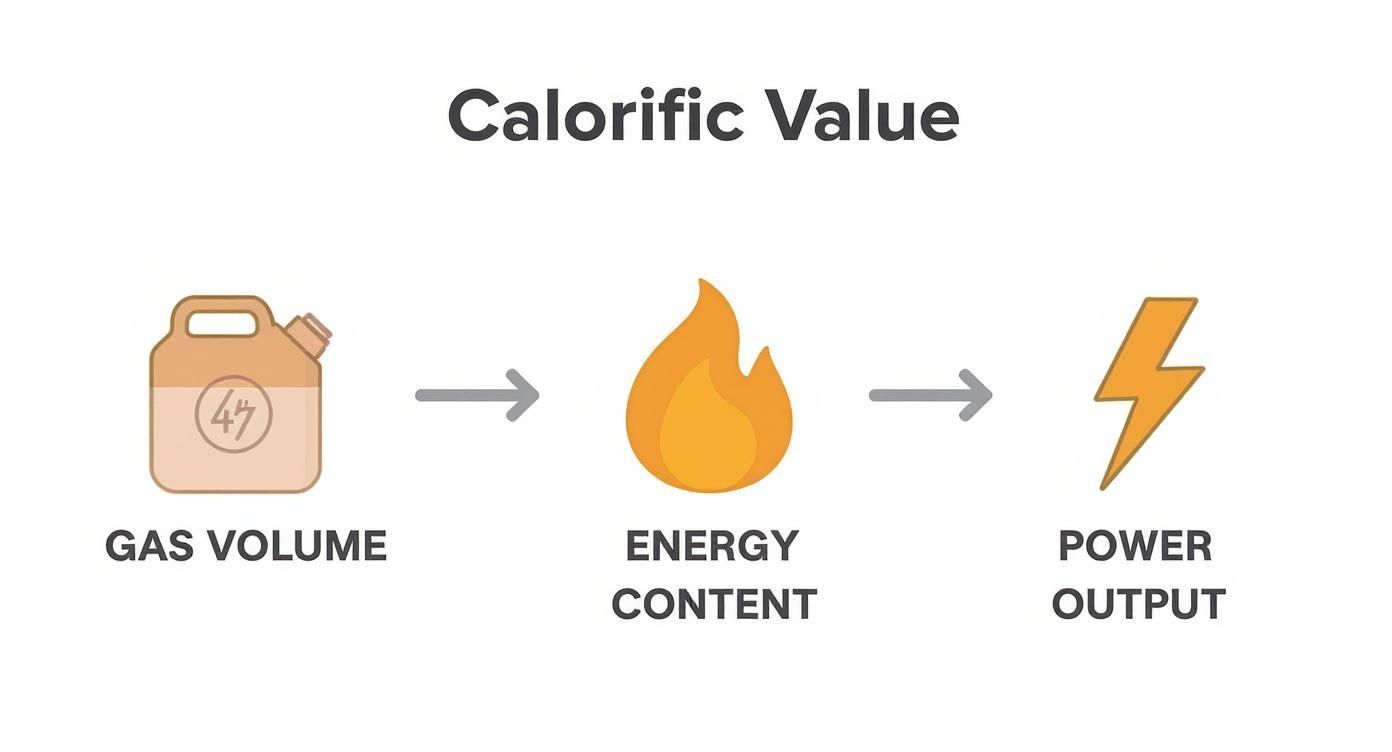
As you can see, the calorific value is the critical bridge connecting the physical volume of the gas to its real-world power potential.
Working With Megajoules
Out in the field, you'll often find calorific value listed in megajoules per cubic meter (MJ/m³), especially on utility bills or technical spec sheets. When you run into this, you just need to tweak the formula slightly to account for the different units.
The key is knowing the conversion: 1 kWh is equal to 3.6 MJ. With that in mind, we just add one small step.
- Step 1: Multiply your gas flow rate (m³/h) by the calorific value (MJ/m³). This will give you the power in megajoules per hour (MJ/h).
- Step 2: Divide that number by 3.6 to convert the result into kilowatts (kW).
This two-step approach lets you confidently work with the numbers your gas supplier provides, ensuring your calculations are always accurate.
A Practical Example Step-By-Step
Let's walk through a real-world scenario. Imagine you're sizing equipment for a commercial boiler that uses 15 m³/h of natural gas. You check the supplier's data sheet, and it says the calorific value is 39 MJ/m³.
Here's how you'd figure out the power:
Calculate the Energy Flow Rate:
15 m³/h × 39 MJ/m³ = 585 MJ/hConvert Megajoules to Kilowatts:
585 MJ/h ÷ 3.6 = 162.5 kW
And there you have it. The boiler has a thermal power output of 162.5 kW. By following these simple steps, you can accurately determine the power of any gas-burning appliance, from a temporary heater on a construction site to heavy-duty industrial machinery.
Putting The Conversion To Work In The Real World
Theory is one thing, but making it work on the ground is where the real value lies. Getting your head around the conversion from cubic meters to kilowatts isn't just a mental workout—it's a critical skill for any engineer, project manager, or facility operator making big decisions every day.
Let's move past the formulas and see how this all plays out with a couple of practical examples. These scenarios show exactly how these calculations influence everything from sizing equipment to planning operations.

Sizing A Generator For Continuous Operation
Picture this: you're tasked with powering a 500 kW industrial generator for a remote site. The spec sheet says it has an electrical efficiency of 40%. You've checked with your gas supplier, and they’ve confirmed the local calorific value is 39.5 MJ/m³.
The big question is: how much natural gas flow, in cubic meters per hour (m³/h), do you need to keep it running?
First off, we need to factor in that 40% efficiency. The 500 kW is the electrical output, not the total energy the generator is chewing through.
Step 1: Calculate the Real Thermal Input
To get 500 kW of electricity out, the generator needs a much larger thermal input from the gas. The calculation is500 kW ÷ 0.40 = 1,250 kW. This is the heat energy we need to generate every hour.Step 2: Convert Thermal Power to MJ/h
Our gas energy is in megajoules (MJ), so let's get our power requirement into the same unit. We simply multiply by our conversion factor:1,250 kW × 3.6 = 4,500 MJ/h.Step 3: Figure Out the Gas Flow Rate
Now, we just divide the total energy we need by the energy in each cubic meter of gas:4,500 MJ/h ÷ 39.5 MJ/m³ = 113.9 m³/h.
There's your answer. You need to ensure a steady gas supply of at least 113.9 cubic meters per hour to keep that 500 kW generator running without a hitch.
Calculating A Commercial Heater's Output
Let's flip the problem around. You're monitoring a large commercial heater that's running at a steady 25 m³/h. Looking at the gas bill, you see the calorific value for the last period was 10.8 kWh/m³. So, what's the heater's actual thermal output in kilowatts?
This one is much more straightforward because the units (kWh/m³) already align perfectly with what we need.
Power (kW) = Gas Flow Rate (m³/h) × Calorific Value (kWh/m³)
Plugging in the numbers gives us:
25 m³/h × 10.8 kWh/m³ = 270 kW
That heater is kicking out a maximum of 270 kW of thermal power. This is a vital piece of information for checking if the unit is performing as it should and for understanding its heating capacity.
These kinds of calculations are becoming more important every day, especially as energy policies evolve. For example, with the recent Scottish New homes ban direct emission gas heating systems, being able to accurately calculate energy needs for different fuels is essential for staying compliant and designing for the future.
How Global Gas Quality Affects Your Calculations
It’s a common mistake to think that a cubic meter of natural gas is the same everywhere. It's not. The gas pulled from a well in Texas can have a surprisingly different energy punch than gas flowing through a pipeline in Germany.
This difference is the single most important factor in getting your cubic meters to kilowatts conversion right. There’s simply no universal number that works for everyone, and anyone who tells you otherwise is oversimplifying things.
The real driver here is the gas's origin, which dictates its energy density—what we call its calorific value. Natural gas from American shale fields, for instance, has a unique blend of methane, ethane, and other hydrocarbons. That mix is different from the gas coming out of Russia, and those subtle chemical variations determine exactly how much energy you get when you burn it.
Why Regional Values Matter
This isn't just some technicality for engineers to worry about; it has real-world consequences. If you size a generator for a project in Virginia using a European calorific value, you could end up with a machine that's either struggling to keep up or running inefficiently. For any calculation that needs to be right, you absolutely have to use the local data from your gas supplier.
Getting this data right is a serious business. The precise analysis of gas composition often happens in specialized labs, using equipment like lab furniture for oil gas research to ensure every measurement is spot-on.
The numbers involved at a global scale are staggering. These conversions are the foundation of the entire energy market. Just to give you a sense of the scale, one billion cubic meters (bcm) of natural gas is equivalent to roughly 38.735 petajoules (PJ) of energy. When you consider that countries like the United States and Russia deal in hundreds of bcm each year, you're talking about thousands of petajoules. You can dive deeper into these large-scale energy unit conversions and their global impact.
Your calculation for a single generator might seem small, but it’s a tiny piece of the same puzzle that energy traders solve every day.
Key Takeaway: Where your natural gas comes from determines its energy content. For accurate and safe power calculations, always, always use the specific calorific value provided for your region.
To give you an idea of how much these values can vary, here's a quick look at some typical averages from around the world.
Typical Natural Gas Calorific Values by Region
The table below offers an illustrative comparison of the average energy content you can expect from natural gas sourced from different parts of the world. Notice how even neighboring regions can have meaningful differences.
| Region | Average Calorific Value (kWh/m³) | Average Calorific Value (MJ/m³) |
|---|---|---|
| United Kingdom | 11.0 kWh/m³ | 39.6 MJ/m³ |
| Continental Europe | 10.5 kWh/m³ | 37.8 MJ/m³ |
| North America | 10.7 kWh/m³ | 38.5 MJ/m³ |
| Russia (Export) | 10.6 kWh/m³ | 38.2 MJ/m³ |
Remember, these are just averages. Always refer to your local utility's specifications for the most precise figures for your application.
The Real World vs. The Formula: Factors That Affect Accuracy
The formulas we've walked through are fantastic for getting a clear, reliable baseline. But they exist in a perfect world of spreadsheets and standard conditions. Out in the field, things get a little more complicated.
Think of it like the official fuel economy rating on a new car. That number is a great starting point, but your actual mileage will change based on how you drive, the weather, and whether the road is hilly or flat. The same principle applies to natural gas conversions.
Several real-world variables can nudge your final numbers, turning a precise calculation into a ballpark estimate if you're not careful.
Why Your On-Site Numbers Might Differ
Gas Pressure and Temperature: Natural gas is sensitive to its environment. It expands when it's warm and contracts when it's cold. All our standard calculations assume a specific "standard" temperature and pressure. If your on-site conditions are drastically different—say, on a freezing winter morning or a scorching summer afternoon—the actual energy packed into each cubic meter will change, affecting your true power output.
Appliance Efficiency: This is a big one. The kilowatt value we calculate is the raw thermal power locked inside the gas. No machine is 100% efficient at converting that energy into useful work. A generator, for instance, loses a significant amount of energy to heat and friction. Its final electrical output in kW will always be less than the thermal input from the gas.
Connecting Energy Use to Environmental Impact
Getting a handle on the m³ to kW conversion isn't just an operational task—it's a critical step in understanding your environmental footprint. Once you know the kilowatt-hour (kWh) equivalent of your gas consumption, you can directly calculate your carbon emissions.
This simple bit of math turns a technical figure into a powerful tool for sustainability. It allows you to accurately track greenhouse gas emissions, giving you the hard data needed to meet environmental targets and operate more responsibly.
At its core, this conversion is a cornerstone of environmental accounting. On average, burning natural gas to generate electricity produces about 0.055 kg of CO2 per kWh.
Let's put that into perspective. Burning 100 m³ of natural gas (which we know is roughly 1,079 kWh) would release approximately 59.3 kg of CO2. For those interested in the deeper data, it's worth exploring the official greenhouse gas equivalencies to see how these figures are determined.
Ultimately, mastering this conversion helps you see the entire chain of events—from a simple volume of gas in a pipe, to the kilowatts powering your site, and finally, to the impact it has on the world around us.
Frequently Asked Questions
Even after running the numbers, a few common questions always seem to surface when converting cubic meters to kilowatts. Let’s tackle them head-on with some straightforward answers to help you get the calculation right every time.
Can I Use A Single Conversion Factor For All Natural Gas?
That’s a definite no. The energy packed into natural gas, its calorific value, isn't universal. It varies quite a bit depending on where the gas comes from and its specific chemical blend.
If you grab a generic number off the internet, your power calculations will be off—sometimes significantly. For an accurate conversion, you absolutely have to use the specific calorific value from your local gas supplier. That’s the only number that reflects the actual energy density of the gas flowing through your pipes.
Where Do I Find The Calorific Value Of My Gas Supply?
The best place to look is right on your gas utility bill. It's usually listed there, often in megajoules per cubic meter (MJ/m³).
If it's not on your bill, your next move should be to check the supplier's website or just give their customer service a call. For bigger commercial or industrial jobs, this info is almost always found on the technical data sheets that come with the gas supply agreement.
Does Appliance Efficiency Affect The Final Kilowatt Output?
Yes, and this is a big one that people often forget. The formulas we've discussed calculate the total thermal power available in the gas. But here's the catch: no machine is 100% efficient at turning that thermal energy into useful work.
For instance, a natural gas generator with 40% electrical efficiency can only convert 40% of the gas's thermal energy into electricity. The other 60% is lost, mostly as waste heat.
To get the real-world electrical output, you have to multiply the thermal power you calculated (in kW) by your appliance's efficiency rating. Always check the manufacturer's specs for the correct efficiency percentage—it’s the key to making sure your numbers match reality.
When your project can't wait for a permanent gas line, Blue Gas Express delivers reliable, mobile natural gas solutions to keep you operational. For temporary CNG and LNG in North Carolina, South Carolina, Tennessee, and Virginia, visit our website to get your project powered.