

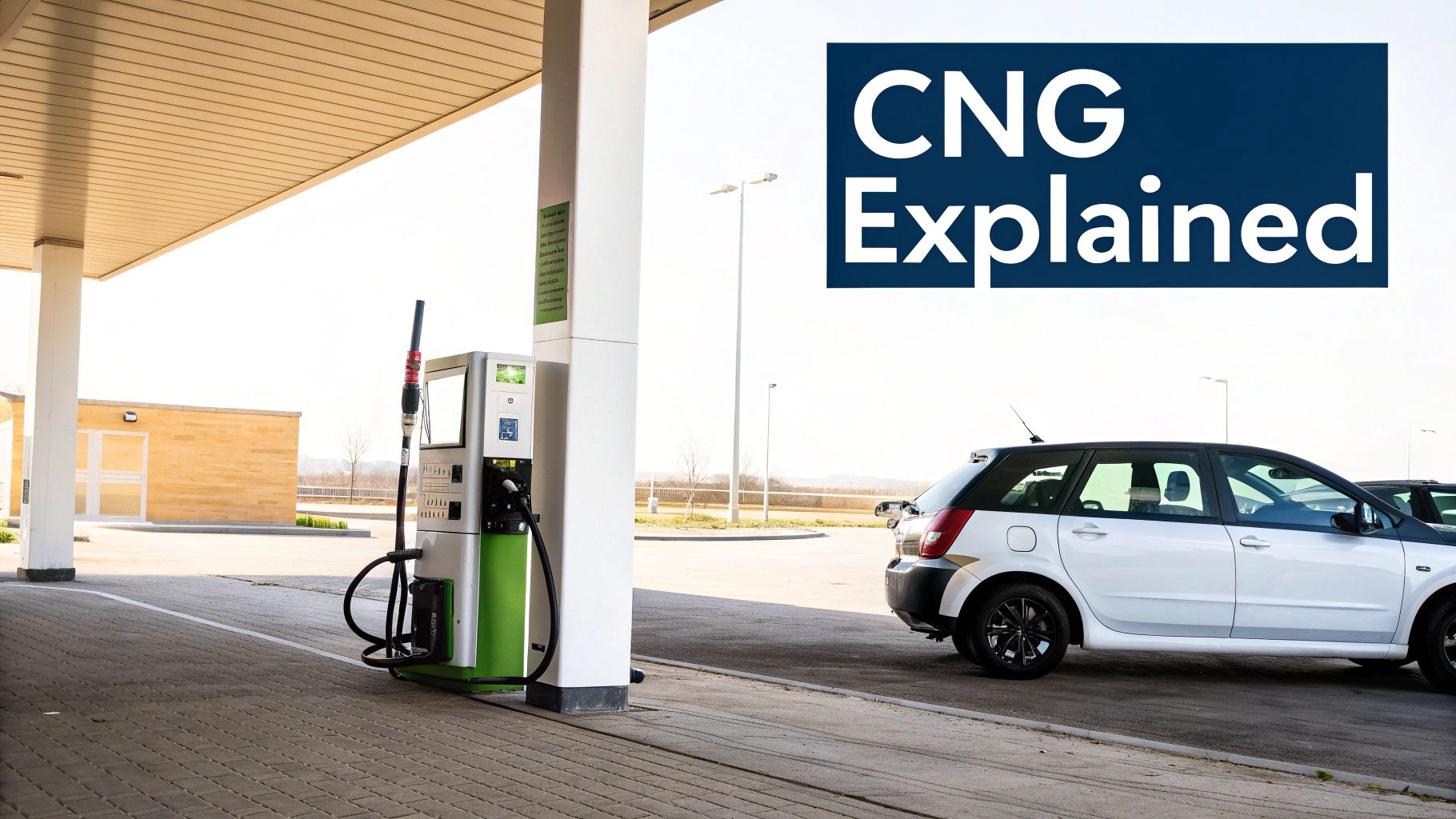
Imagine a super-powered air pump, the kind you'd find at a gas station, but instead of filling tires with air, it's filling vehicles with clean-burning natural gas. That's the simplest way to think about a compressed natural gas filling station. These facilities are the critical piece of the puzzle that makes CNG a real-world, cost-effective, and greener alternative to gasoline and diesel.
What Is a CNG Filling Station and Why Is It Important?
A compressed natural gas (CNG) filling station is the backbone of the entire natural gas vehicle network. Its main job is to pull natural gas from a standard utility pipeline, crank up the pressure to a powerful 3,600 pounds per square inch (psi), and then safely dispense it into vehicles or mobile storage tanks. Think of them less as a simple fuel stop and more as a gateway to cleaner energy.
Unlike a typical gas station that just pumps liquid fuel from a big underground tank, a CNG station is a bit more complex—almost like a mini processing plant. It takes low-pressure gas from the pipeline and transforms it into a dense, energy-packed fuel. This compression step is non-negotiable; it’s what allows enough gas to be stored in a vehicle’s tank to give it a decent driving range.
The Growing Role in Modern Energy
The importance of these stations goes way beyond just offering another option at the pump. They are the enablers of a large-scale shift away from petroleum, especially for commercial fleets and industrial operations. By making CNG readily available, these stations unlock some serious benefits:
- Significant Cost Savings: On a gallon-to-gallon equivalent basis, natural gas is often dramatically cheaper than gasoline or diesel. For a government fleet, the numbers speak for themselves: CNG can average around $1.10 per gallon when gasoline is sitting at $1.91.
- Environmental Benefits: Natural gas is one of the cleanest fossil fuels out there. Vehicles powered by CNG can slash greenhouse gas emissions by 20-30% and cut smog-forming nitrogen oxides by as much as 95% compared to their diesel counterparts.
- Energy Independence: The vast majority of natural gas used in the U.S. is produced right here at home. Building out the CNG station network directly reduces our dependence on foreign oil and makes our national energy supply more secure.
A single CNG station can be a multi-million dollar investment. A municipality might spend over $1.6 million on the facility and vehicle conversions. While that's a hefty price tag, the long-term fuel savings and environmental upsides create a powerful return, especially for vehicles that are always on the road.
More Than Just Stations
When it comes down to it, these facilities are much more than just concrete and compressors. They represent a tangible, practical step toward a more sustainable energy future.
Whether it’s a permanent public station refueling a fleet of city buses or a temporary mobile unit powering a generator at a remote construction site, CNG stations are what make cleaner, more affordable energy accessible right now. They effectively bridge the gap between the immense natural gas resources beneath our feet and the engines that keep our economy moving.
What Are the Different Kinds of CNG Stations?
When you hear "CNG station," you probably picture a pump at a public station, much like a regular gas station. That's certainly part of the picture, but it's not the whole story. The world of compressed natural gas is surprisingly flexible, with different types of stations built to handle everything from fueling a national trucking fleet to powering a single, remote construction site.
At a high level, CNG stations fall into two main camps: permanent, fixed-in-place installations and nimble, mobile solutions. Each one is designed for a very different job.
Permanent CNG Stations: The Long-Term Backbone
Permanent stations are the bedrock of the CNG network. These are physical, long-term installations tied directly into a utility's natural gas pipeline, built for constant, high-volume fueling. Think of them as the established highways of the natural gas world.
They typically show up in two forms:
- Public Retail Stations: You’ll spot these along major trucking corridors and in bigger cities, open to anyone with a CNG vehicle. They work just like the gas station you're used to, offering fuel to the general public. These are absolutely essential for making CNG passenger cars, light-duty trucks, and regional delivery fleets practical.
- Private Fleet Depots: These are custom-built for a specific company or government agency that brings its vehicles back to a central hub every night—what we call "return-to-base" operations. A city might build one for its fleet of transit buses, or a waste management company might install one to refuel its garbage trucks. Going private gives an organization total control over its fuel costs and ensures its vehicles are always ready to go.
A private CNG station is a serious commitment. For example, a local government might spend $1.4 million on the station itself, plus another $233,950 to convert its vehicles. The long-term payoff, however, comes from dramatically lower fuel costs—sometimes nearly half the price of diesel—and a much smaller carbon footprint.
Mobile and Temporary CNG Solutions: The "Virtual Pipeline"
Permanent stations are great for established routes, but what about when your energy needs are temporary, remote, or just plain urgent? This is where mobile and temporary CNG solutions completely change the game. Instead of digging trenches and building permanent infrastructure, specialized trailers deliver compressed natural gas right to your location.
We call this a "virtual pipeline on wheels." It’s an incredibly flexible, on-demand energy source that brings the fuel to you, exactly when and where you need it. This whole approach sidesteps the massive costs and long timelines that come with building a permanent station.
You'll see these temporary solutions pop up in all sorts of real-world situations:
- Remote Construction Sites: Firing up heaters and generators on a project site that's miles away from the nearest gas line.
- Emergency Outage Response: Keeping the lights on by supplying fuel to a hospital's or data center's backup generators during a natural gas outage.
- Generator Commissioning: Running tests on massive new natural gas generators at a power plant before its permanent pipeline is officially up and running.
This method provides energy security and keeps projects moving without the multi-year wait and multi-million dollar price tag of a permanent station. For companies like Blue Gas Express, the mission is to deliver this mobile energy source quickly and safely, making sure critical work stays on schedule.
Comparing Permanent vs. Mobile CNG Fueling Solutions
To really get a feel for which solution is right for a given job, it helps to put them side-by-side. The choice between building something permanent or calling in a temporary service really boils down to the project's scope, timeline, and urgency.
This table breaks down the key differences:
| Attribute | Permanent CNG Stations | Mobile & Temporary CNG Solutions |
|---|---|---|
| Infrastructure | Requires a fixed, permanent connection to a gas pipeline. | Self-contained mobile units; no permanent connection needed. |
| Primary Use Cases | Public retail fueling, large return-to-base private fleets. | Remote power, pipeline outages, equipment commissioning. |
| Capital Cost | Very high upfront investment, often millions of dollars. | No capital investment; operates as a service or rental model. |
| Deployment Time | Extremely long, typically 12-24 months for permits and construction. | Very fast, can be deployed in a matter of hours or days. |
| Flexibility | Completely inflexible; fixed to a single geographic location. | Highly flexible; can be moved to any accessible site as needed. |
In the end, both permanent and mobile stations play a critical role. The permanent stations form the foundational network, while mobile solutions provide the agility and on-demand access that modern projects and emergency situations demand.
How a CNG Filling Station Actually Works
Ever wondered what's happening behind the scenes at a compressed natural gas (CNG) station? It might seem complex, but the whole process boils down to a logical, four-step journey: cleaning the gas, pressurizing it, storing it, and finally, getting it into a vehicle.
Let's use a simple analogy. Think of it like making soda at home with a machine. The natural gas from the utility pipeline is just like your plain tap water. The station’s compressor is the carbonator, injecting all the fizz and pressure. The high-pressure storage tanks are the reinforced bottles that hold the bubbly water, and the dispenser is the nozzle you use to fill your glass. It’s all about taking something low-pressure and making it high-pressure and ready to use.
Step 1: Gas Inlet and Pre-Treatment
It all starts at the connection to a local natural gas utility line. The gas that arrives is at a very low pressure—typically less than 60 psi. At this stage, it's not nearly potent enough to power a vehicle.
Before we can even think about pressurizing it, the gas needs a good cleaning. It's first routed through a filtration and drying system. This is a critical step that strips out any moisture, oils, or tiny particles. Why? Because clean, dry gas prevents damage to the sensitive, high-precision parts of the compressor and, just as importantly, the vehicle’s fuel system.
Step 2: The Compression Stage
With the gas cleaned up, it’s sent to the heart of the operation: the compressor. This is where the "compressed" in compressed natural gas happens. In a multi-stage process, this powerful machine squeezes the gas, cranking its pressure up from less than 60 psi to an incredible 4,500 psi or even higher.
This massive increase in pressure generates a lot of heat. To keep things stable and efficient, the gas is cooled down between each stage of compression. You can think of the compressor as the workhorse of the station; it’s the most energy-intensive and expensive piece of equipment, doing the heavy lifting of packing those gas molecules tightly together.
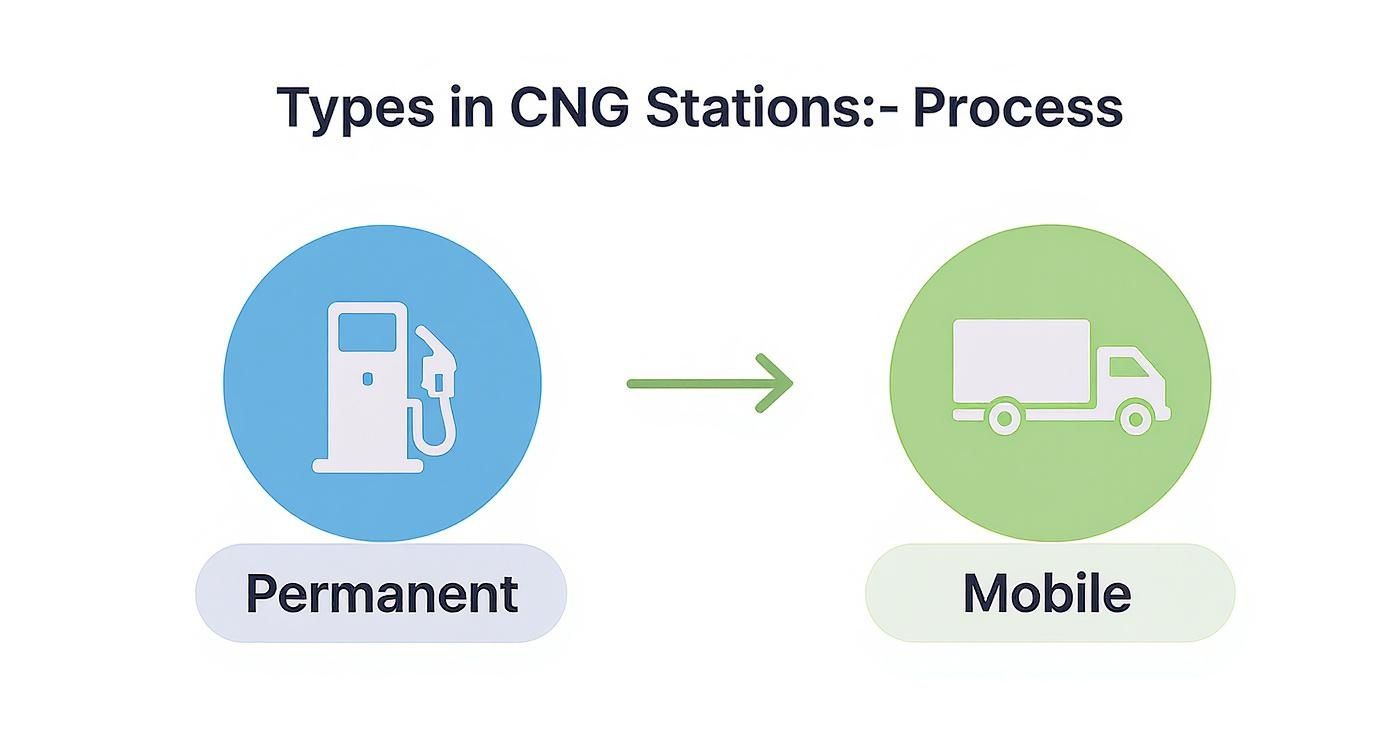
Whether it's a permanent station or a mobile fueling truck, this core process of compression and storage is fundamental to getting CNG into vehicles.
Step 3: High-Pressure Storage
Once compressed, the gas doesn't go straight to the pump. Instead, it's directed into a series of large, robust storage tanks, often configured in what’s known as a cascade system. These tanks act as a ready-to-go reserve, ensuring there’s always a supply of high-pressure gas for vehicles pulling in to refuel.
The cascade system is pretty smart. It uses three banks of tanks set at low, medium, and high pressures. When you start fueling, the system first pulls gas from the low-pressure bank. As the pressure between your vehicle's tank and the storage bank starts to even out, it automatically switches to the medium-pressure bank, and then finally to the high-pressure bank to top things off.
This tiered approach makes sure the vehicle's tank gets as full as possible, all while making the compressor's job easier. It's a clever energy-saving strategy that allows for consistently fast fill-ups.
Step 4: Dispensing the Fuel
The final stop is the dispenser itself. It looks a lot like a standard gasoline pump, but it’s equipped with a special nozzle and hose built to safely handle the extreme pressure. When you connect the nozzle to the vehicle, it creates a tight, secure seal.
Inside the dispenser, sophisticated electronics control a series of valves that manage the gas flowing from the cascade storage system. This carefully controlled process fills the vehicle's tank to a standard pressure of 3,600 psi. Built-in safety features prevent overfilling and ensure gas won't flow until the connection is locked in place. The precise management of this flow relies on components like a three-way control valve, which is key to directing the high-pressure gas safely. The whole setup is designed for a quick, safe, and efficient refueling experience.
Getting a Handle on CNG Safety Standards and Permitting
When you're dealing with a fuel pressurized to a hefty 3,600 psi, safety isn't just a bullet point on a checklist—it's the bedrock of the entire operation. The impressive safety record of CNG filling stations didn't happen by accident. It's the direct result of stringent, overlapping regulations and smart, robust engineering. These aren't just guidelines; they're mandatory codes that dictate every single component and procedure.
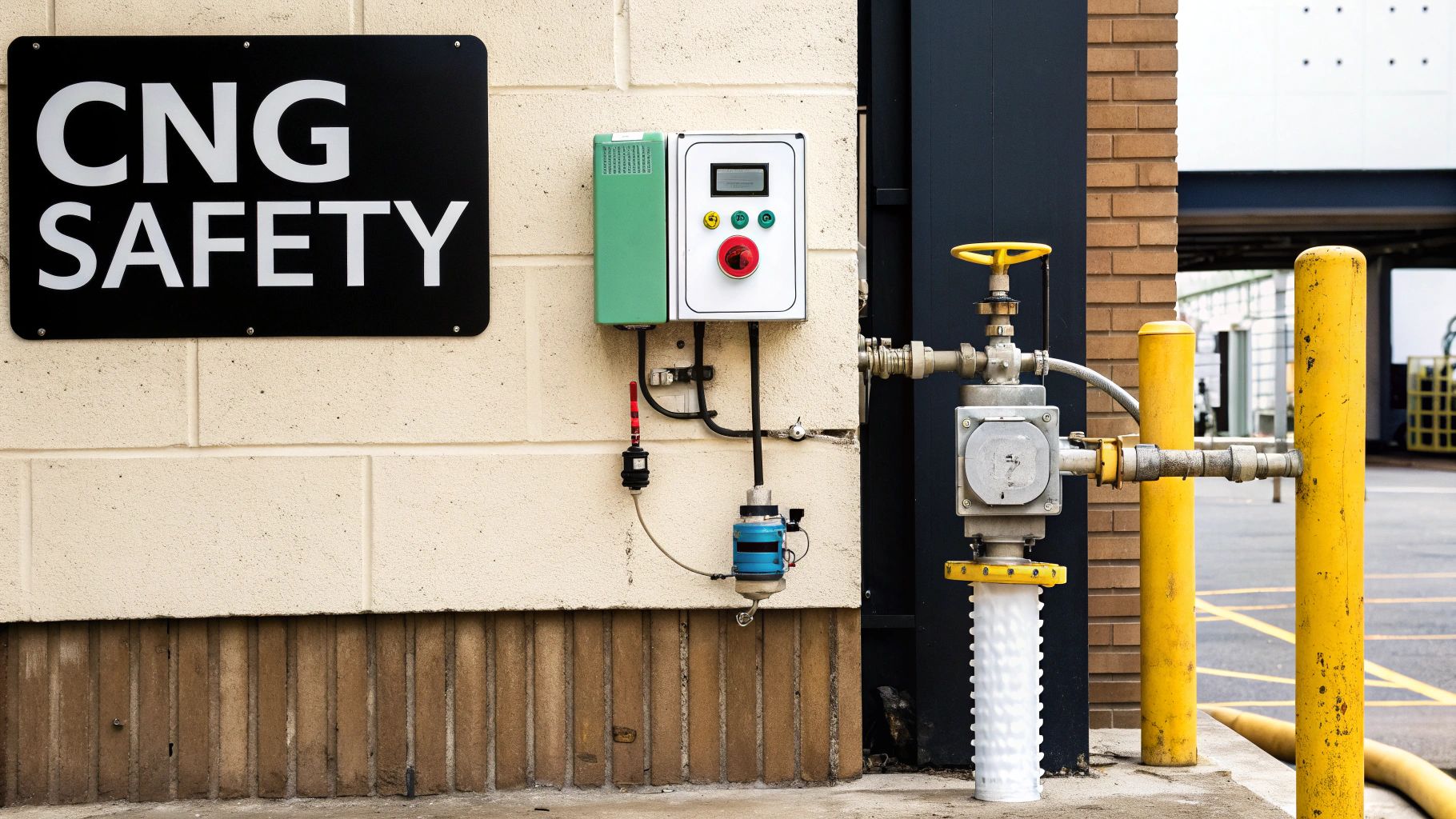
This entire framework is designed to stop incidents before they can even start, ensuring both permanent stations and temporary setups run with the highest level of reliability. Think of it as a comprehensive safety playbook that leaves nothing to chance.
Core Safety Codes and Regulations
The go-to rulebook for CNG infrastructure in North America is NFPA 52, also known as the Vehicular Natural Gas Fuel Systems Code. This document is the gold standard, spelling out the non-negotiable requirements for designing, building, installing, and operating CNG fuel systems and stations.
NFPA 52 covers all the bases, including:
- Station Layout and Siting: It dictates safe distances from buildings, property lines, and public roads to create a protective buffer.
- Equipment Standards: All components—from compressors and storage tanks to dispensers and piping—must be certified for high-pressure natural gas service. No exceptions.
- Ventilation and Electrical Systems: The code demands specialized, explosion-proof electrical gear and proper ventilation to make sure gas can never build up in enclosed spaces.
On top of this cornerstone code, stations also have to comply with a whole slew of local, state, and federal rules. It's a web of safety protocols, with each layer reinforcing the others.
Essential Built-In Safety Features
Modern CNG filling stations are marvels of preventative engineering, packed with multiple, redundant safety systems that react automatically. These aren't just optional add-ons; they're baked into the station's core design, working quietly in the background to keep everything running smoothly.
The goal of these systems is simple: detect any potential issue the second it happens and neutralize it safely. This proactive approach is exactly why CNG has maintained such a strong safety profile over decades.
Here are some of the key safety mechanisms you'll find:
- Emergency Shutdown Devices (ESDs): You've probably seen them—the big red buttons placed strategically around the station. One push can instantly stop the flow of gas and shut down the entire system.
- Pressure Relief Devices (PRDs): Every high-pressure tank and vessel has these built-in safety valves. If the pressure ever climbs beyond a safe limit, the PRD automatically opens to vent the excess gas harmlessly into the atmosphere.
- Methane Detectors: Think of these as sensitive electronic "noses" installed where gas could potentially collect. If they sniff out even a tiny amount of methane, they can trigger alarms and initiate an automatic shutdown.
- Breakaway Hoses and Nozzles: The fueling hoses are cleverly designed to detach safely from the dispenser if a driver accidentally pulls away while still connected. The moment it breaks, it instantly seals both ends to prevent any gas from escaping.
Navigating the Permitting Journey
Getting the official green light to build a CNG station is a meticulous process, and for good reason. The permitting journey involves multiple agencies that scrutinize every detail to ensure the project meets strict public safety and environmental standards. It all starts with choosing a site and drawing up a detailed engineering plan.
That plan is then submitted to the local Authority Having Jurisdiction (AHJ)—this could be a city planning department, the fire marshal, or a county commission. They comb through everything, from zoning laws and environmental impact to the station’s design and its safety features. As part of this wider approval process, you'll also need to meet specific sign permit requirements.
This multi-stage review ensures every "i" is dotted and every "t" is crossed long before the first shovel hits the ground. It all wraps up with final inspections and the official approval to begin operation.
What Does It Really Cost and How Long Does It Take to Get a CNG Station?
When you’re looking at a major infrastructure project, it always boils down to two simple questions: "What’s the price tag?" and "How long until it’s running?" For compressed natural gas (CNG) filling stations, the answers couldn't be more different depending on one key factor: are you building something permanent or bringing in a temporary fix?
The financial and logistical gap between these two options isn't just a small step—it's a massive leap.
A permanent CNG station is a serious capital investment. Think of it like building a brand-new commercial facility from scratch. You're dealing with buying land, major construction, and tying into complex utility grids. This path really only makes sense for organizations that have a steady, high-volume need for fuel in one fixed spot.
Mobile CNG services, on the other hand, play by a completely different set of rules. They sidestep the enormous upfront costs and drawn-out construction schedules, giving you a flexible, on-demand energy source. This is the perfect solution for temporary projects, emergency responses, or any site that’s miles away from a gas pipeline.
The Investment for a Permanent CNG Station
Putting in a permanent CNG station is a multi-million dollar affair. The final bill will vary depending on the station's size and location, but the core expenses are pretty universal. For perspective, a county government might spend $1.4 million just to install a quick-fill station for its vehicle fleet.
So, where does all that money go? It breaks down into a few key areas:
- The Heavy-Duty Equipment: The compressor is the heart of the station and, by far, the most expensive piece of the puzzle. It can easily eat up a huge chunk of the budget. High-pressure storage tanks, dryers, and dispensers add to the tab.
- Engineering and Construction: This bucket covers everything from site prep and pouring concrete pads to running electrical and fabricating the intricate piping needed to connect everything safely.
- Permitting and Red Tape: Getting through the maze of local, state, and federal regulations is no small feat. It requires hiring specialized consultants and paying significant fees for environmental reviews and inspections.
- Tying into the Utility: Hooking up to a high-capacity natural gas pipeline is more complicated than you’d think. It often involves expensive upgrades and a lot of back-and-forth with the local utility company.
Unpacking the Timeline
The timeline for building a permanent station can be just as intimidating as the cost. From the initial idea to fueling the first vehicle, you're typically looking at a 12 to 24-month process. This long runway is because of all the sequential steps involved, and any one of them can cause delays.
The long lead time for a permanent station is a deal-breaker for many. If you need fuel now—not in two years—building from the ground up just isn't an option. This is exactly where the speed of a mobile solution becomes its biggest strength.
Here’s a rough sketch of the project lifecycle:
- Site Selection and Design (2-4 months): Finding the right spot and drawing up detailed engineering plans.
- Permitting and Approvals (6-12 months): This is often the longest and most unpredictable part of the journey, as you wait for multiple agencies to sign off.
- Equipment Procurement (4-6 months): Specialized compressors and tanks aren't sitting on a shelf; they have long lead times.
- Construction and Installation (3-5 months): The actual physical work of building the station.
- Commissioning and Testing (1 month): The final safety checks and operational tests before you can flip the "on" switch.
The Smart Economics of Mobile CNG
Mobile and temporary CNG services, like what we offer at Blue Gas Express, completely change the conversation around cost and time. Instead of a massive upfront capital investment, you’re essentially buying energy as a service. You pay for the fuel you need, delivered right where you need it, without spending a dime on construction.
This model is a lifesaver in countless situations. A construction project waiting for a permanent gas line can get a mobile unit on-site in days, which keeps the project moving and helps secure occupancy permits on time. For a power plant testing a new generator, it provides the fuel needed for commissioning without having to wait months for the pipeline to go live.
The financial trade-off is crystal clear. While the per-unit cost of gas from a mobile service might be higher than from a permanent station you own, it completely wipes out that $1.4 million+ initial investment and the two-year wait. For any short-term or urgent need, the value is simply undeniable.
Your Checklist for Finding a Mobile CNG Provider
When your project's success hangs on a temporary fuel supply, there’s no room for error. Finding the right mobile compressed natural gas (CNG) service isn't just about getting a quote; it's about finding a reliable partner. This checklist is for project managers and engineers who need to get it right the first time, avoiding the common hangups that can derail a project.
Think of it like hiring a specialized crew for a critical part of the job. You wouldn't just go with the first name in a search result. You'd check their qualifications, look into their safety record, and make sure they have the right equipment. The same goes for bringing a high-pressure virtual pipeline onto your site.
Step 1: Pinpoint Your Exact Fuel Needs
Before you even think about picking up the phone, you need to get crystal clear on your project's energy appetite. A vague request like "we need some natural gas" will only get you a ballpark quote and could lead to major problems down the line. A good supplier needs hard numbers to build the right solution.
Be ready with answers to these questions:
- Total Volume: How much gas do you actually need? Figure out your daily and total project needs in SCF (Standard Cubic Feet) or Dekatherms.
- Required Pressure: What’s the specific delivery pressure (psi) your equipment needs to run smoothly? This isn't a "nice-to-have," it's a must-know.
- Flow Rate: What’s the maximum and average flow rate (SCFM or SCFH) you'll need when your equipment is running at full tilt?
Step 2: Take a Hard Look at Your Site Logistics
Next up, walk your site and look at it through the eyes of a logistics pro. A mobile CNG setup involves heavy tractor-trailers and specialized gear, and it all needs a safe and accessible home. A quick site assessment now can save you from huge headaches on delivery day.
Here’s what to check off your list:
- Access and Maneuverability: Is there a clear, safe path for a big rig to get in and out of the setup area without any trouble?
- Safe Operating Zone: Have you marked out a level, stable spot for the equipment? Make sure it's a safe distance from buildings, potential ignition sources, and busy areas.
- On-Site Connection Point: Where exactly will the CNG gear hook into your system? Make sure the connection point is easy to get to and configured correctly.
Step 3: Vet Your Supplier's Credentials
Let's be clear: not all mobile CNG providers are the same. The company you choose becomes a critical part of your worksite's safety and productivity. It's on you to dig into their experience, safety record, and technical skills before you sign anything.
A reputable provider will be an open book about their safety protocols and track record. Don't be shy about asking for proof—your project's integrity hinges on their professionalism and commitment to doing things the right way.
When you're talking to potential suppliers, ask for:
- Safety Records: Get a look at their OSHA logs and safety incident rates.
- Operator Qualifications: Make sure their technicians are properly trained and certified to handle high-pressure gas.
- References: Ask to speak with a few past clients who had projects similar to yours.
Step 4: Go Through the Service Agreement with a Fine-Tooth Comb
The service agreement isn't just paperwork; it’s the rulebook for your partnership. Read every line to understand the full scope of services, who is responsible for what, and all the costs involved. A solid, detailed agreement protects everyone and prevents surprise fees or misunderstandings later on.
Step 5: Plan the On-Site Integration
Finally, work with your chosen provider to map out a smooth integration. A pre-deployment meeting to hash out the final details—from hookup procedures to communication plans—is a smart move. This way, when the CNG trailer rolls up, everyone knows their job, and you can get the system online safely and efficiently, keeping your project moving forward without any costly delays.
Common Questions About CNG Filling Stations
Diving into compressed natural gas for the first time? It's natural to have a few questions. From safety to practical applications, people often wonder about the same key things. Let's clear up some of the most common queries we hear from project managers and fleet operators.
Getting straight answers is the first step to understanding how CNG can solve real-world energy challenges, whether you're converting a fleet or firing up a new power plant.
Is CNG Really a Safe Fuel for Vehicles?
Absolutely. In fact, many experts consider it safer than gasoline or diesel. The safety of CNG comes down to its physical properties and the seriously tough equipment used to handle it.
Natural gas is lighter than air. If a leak ever happens, the gas doesn't pool on the ground creating a flammable puddle like liquid fuels do. Instead, it rises and dissipates harmlessly into the atmosphere.
The storage tanks themselves are built like a fortress. These thick-walled cylinders undergo extreme testing—we're talking high-pressure, fire, and even gunfire tests—to ensure they can withstand incredible force. They are far more robust than a typical car's gas tank. Plus, the whole system is layered with safety features:
- Automatic Shut-Off Valves: These are designed to instantly cut the flow of gas if a problem is detected.
- Pressure Relief Devices: Think of these as safety valves that will safely vent gas if the tank's pressure ever gets too high.
- Strict Codes: Everything from the nozzle to the tank is regulated by strict safety standards, like NFPA 52, which governs natural gas vehicle systems.
What’s the Main Difference Between CNG and LNG?
This is a big one. Both are natural gas, but the key difference is how they’re stored. It really comes down to pressure versus temperature.
CNG (Compressed Natural Gas): We keep it in its gaseous state but compress it to a high pressure, typically around 3,600 psi.
LNG (Liquefied Natural Gas): We chill natural gas down to a frosty -260°F (-162°C), which turns it into a super-dense liquid.
Because LNG is so much denser, you can store a lot more energy in the same amount of space. This gives vehicles a longer range, which is why it's the go-to choice for long-haul semi-trucks. CNG, on the other hand, is perfect for "return-to-base" fleets like city buses, delivery vans, and garbage trucks that come back to the same depot every night to refuel. The fueling stations are also simpler and generally less expensive to build.
Can I Use a Temporary CNG Supply for an Industrial Project?
You certainly can. This is one of the most powerful applications for mobile CNG technology, often called a "virtual pipeline." We use specialized trailers to bring a steady supply of high-pressure natural gas directly to your job site, no pipeline connection needed.
It's a game-changer for a ton of situations:
- Commissioning brand-new gas-fired turbines at a power plant before the permanent pipeline is active.
- Providing an emergency fuel source to keep a factory running during a pipeline repair or a utility outage.
- Powering remote construction or industrial sites that are miles away from the nearest gas main.
This approach gives you a flexible, scalable, and rapidly deployable energy source, ensuring critical projects don't get held up waiting for a utility hookup.
When your project demands a reliable, on-demand natural gas supply without the delays of permanent infrastructure, Blue Gas Express delivers. We provide temporary CNG and LNG solutions to keep your operations running smoothly. Find out how we can support your project at https://bluegasexpress.com.