

Mobile CNG oil and gas solutions are the ultimate problem-solver when a project’s energy needs are immediate, but the permanent utility hookup isn't. Think of it as a plug-and-play power source, delivered right to your site, that keeps the lights on and the project moving. It's become the go-to answer for some of the biggest headaches in modern construction and industry.
Why Mobile CNG Is Your Energy Bridge During Pipeline Gaps
Let's walk through a scenario that’s all too common. Your multi-million dollar construction project is right on the finish line. The one thing holding you back from getting that all-important occupancy permit is the final HVAC system test. The problem? The permanent natural gas line is weeks behind schedule.
Every single day you wait, the costs stack up. You're paying idle crews, staring down the barrel of potential late penalties, and watching revenue opportunities slip away.
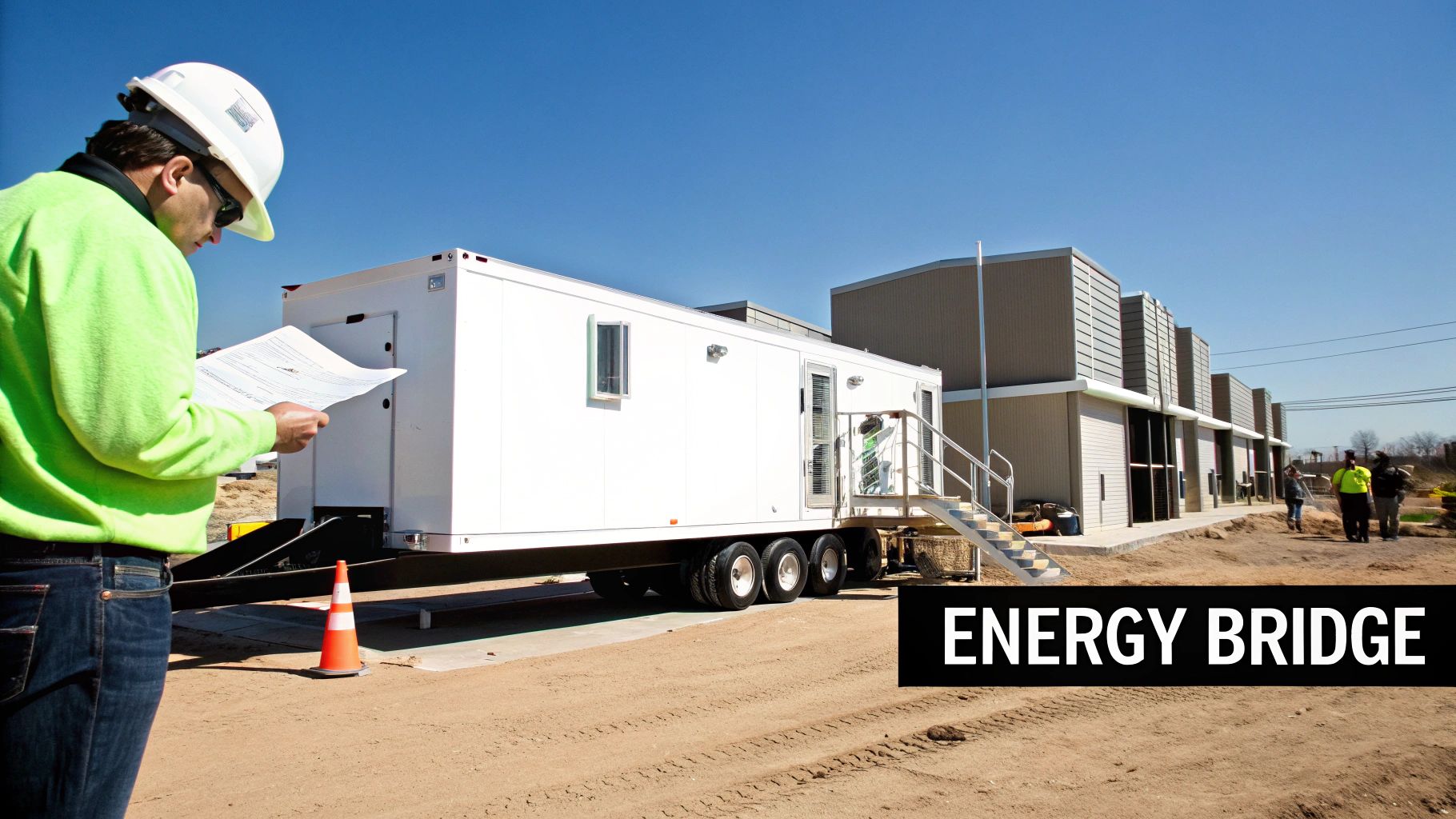
This kind of delay can bring a perfectly executed project to a screeching halt. That gap—the one between when you need the gas and when the utility can provide it—is precisely where mobile CNG proves its worth.
A Strategic Tool for Project Continuity
Viewing mobile CNG as just a temporary fuel source really misses the bigger picture. It's a strategic tool that buys you project continuity and protects your budget. By delivering a steady supply of natural gas right when you need it, you're no longer at the mercy of the utility company’s schedule.
Think back to that developer trying to get their permits. Without gas to test the HVAC systems, they can't get the sign-off needed to start leasing out commercial space or closing on condos. The financial hit is direct and substantial.
This is where a mobile CNG provider like Blue Gas Express steps in, deploying a unit to the site in a matter of hours to create a seamless "energy bridge." This temporary connection makes a world of difference.
- Timely System Commissioning: You can fire up boilers, generators, and HVAC units to complete all necessary tests and inspections on your own timeline.
- Permit Acquisition: It allows you to meet every requirement to secure occupancy permits without those agonizing, expensive delays.
- Financial Security: You sidestep the crippling costs of downtime, avoid penalties, and keep the revenue flowing by sticking to your schedule.
By bridging this energy gap, mobile CNG turns a potential financial crisis into a simple logistical task. It’s like an insurance policy against delays you can't control, protecting both your bottom line and your project's momentum.
In the end, this service keeps your investment moving forward, turning what could have been a disaster into just another box to check. In the high-stakes world of cng oil and gas, where every day on the calendar counts, that kind of proactive solution is essential.
What Exactly Is Compressed Natural Gas?
To get a real handle on how mobile cng oil and gas solutions work, you first need to understand the fuel itself. At its heart, Compressed Natural Gas (CNG) is the exact same natural gas that runs furnaces in our homes and powers factories nationwide. The big difference isn't what it is, but how it's packaged to be moved around.
Here's a simple way to think about it. Imagine you needed to move a giant, room-sized puff of cotton. It would be a logistical nightmare. But what if you could squeeze that entire cloud down into a small, dense box? Suddenly, you could take it anywhere. That’s the core idea behind CNG.
We take natural gas straight from a utility pipeline and put it under some serious pressure—usually between 3,000 and 3,600 pounds per square inch (psi). This process shrinks its volume down to less than 1% of what it would be at normal atmospheric pressure. From there, this compressed gas is loaded into incredibly strong, specialized cylinders on mobile trailers, all set to hit the road.
The Journey from Pipeline to Your Project
The entire system is built for speed. Once the gas is compressed, getting it from our hub to your site is as simple as driving a truck. These mobile CNG trailers are essentially a "pipeline on wheels." When a trailer arrives, our technicians connect it directly to your equipment or existing gas lines with specialized hoses and regulators. What was once a complex energy gap becomes a simple, on-demand delivery.
This setup ensures your project gets a steady, reliable flow of natural gas, giving you the same performance you'd expect from a permanent utility connection.
CNG vs. LNG: What’s the Difference?
When talking about mobile natural gas, you’ll constantly hear two terms: CNG and LNG (Liquefied Natural Gas). They both start as the same raw material, but how they’re prepared for transport makes all the difference. Nailing this distinction is crucial for picking the right solution for your job.
Let's break it down with an analogy:
- CNG is like the air in a scuba tank. It stays in its gaseous state but is squeezed into a much smaller container under high pressure. It’s ready to use the moment you regulate that pressure back down.
- LNG is like turning water into ice. The natural gas is cryogenically cooled to a bone-chilling -260°F (-162°C), which turns it into a liquid. This shrinks its volume by over 600 times, making it incredibly dense for shipping.
While LNG is fantastic for shipping massive quantities over long distances (think ocean tankers), the whole process of liquefying it and then turning it back into a gas (regasification) is a lot more involved. For most temporary project needs, CNG’s straightforward compression and quick setup make it the faster and more practical choice.
The push for cleaner, more reliable energy has fueled huge growth in this space. The global compressed natural gas market was recently valued around USD 91.11 billion and is expected to climb to USD 132.32 billion by 2035, growing at a rate of 3.45% each year. You can dig into more of the data on global CNG market trends to see just how important it's becoming.
Why CNG Is the Go-To for Temporary Needs
The very nature of CNG makes it a perfect fit for the fast-paced, unpredictable environment of a job site or a facility waiting on a utility connection. Its advantages are baked right into its physical properties.
Here’s why it works so well in practice:
- Speed is everything: Compressing gas is a faster process with simpler equipment compared to liquefaction. This lets providers like us get fuel to your site quickly when you're in a pinch.
- It has a solid safety profile: CNG is lighter than air. In the unlikely event of a leak, it just rises and dissipates into the atmosphere. This is a key difference from heavier fuels like propane, which can pool on the ground and create a serious ignition risk.
- There's no expiration date: Once the gas is in those cylinders, it can stay there indefinitely. There’s no fuel loss or degradation, so you have a stable, reliable energy source for as long as your project takes.
These factors make CNG more than just a fuel; it's a powerful logistical tool that keeps your operations running when a permanent gas line is out of the picture. It hits that sweet spot of energy density, safety, and rapid deployment that temporary projects demand.
How Mobile CNG Solves Critical Project Delays
It’s one thing to talk about technology in theory, but where mobile cng oil and gas solutions truly prove their worth is on the ground, in the middle of a high-stakes project. In these moments, a temporary natural gas hookup isn't just a "nice-to-have"—it's the one thing standing between you and a financial disaster.
Picture a large residential development, just weeks from its grand opening. Everything is set, but there's a hitch: the utility has pushed back the final gas line commissioning. Without natural gas, the HVAC systems can't be tested. No HVAC test means no occupancy permits, and no permits mean the developer can't start closing on homes. The entire project grinds to a halt.
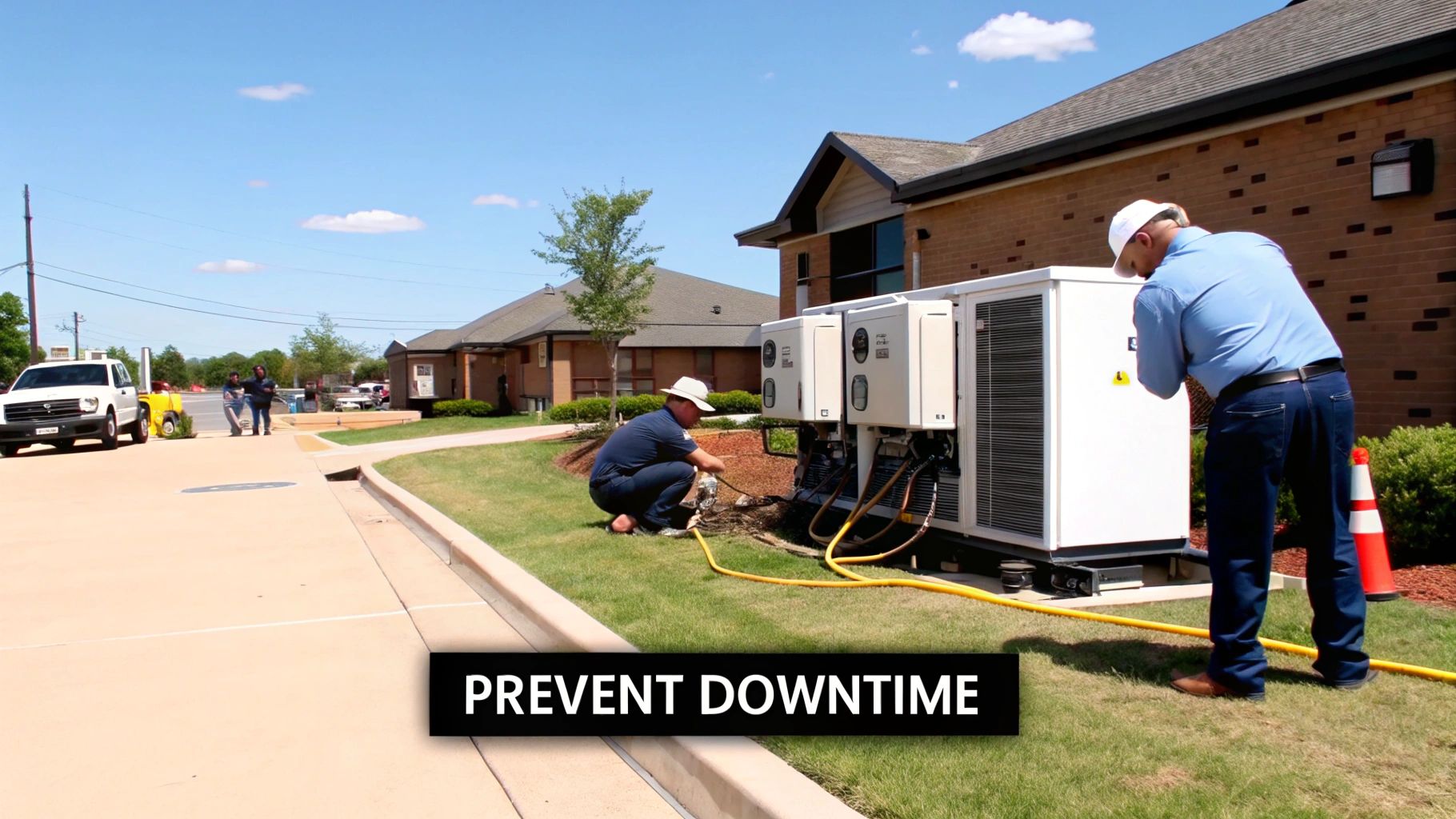
This is the exact scenario where a rapid-deployment CNG unit saves the day. A mobile trailer arrives on-site, connects directly to the building's existing gas infrastructure, and starts supplying the steady fuel needed to run every system. What could have been a weeks-long, costly delay is solved in a matter of hours.
Keeping Industrial Operations Online
Now, let's look at it from an industrial perspective. A manufacturing plant depends on a constant flow of natural gas for its core processes. The local utility gives notice of a planned 48-hour pipeline shutdown for critical maintenance. For this facility, every hour of downtime means thousands of dollars in lost production, not to mention idle labor costs.
Simply shutting down isn't a viable option. So, instead of taking a massive financial hit, the plant manager brings in a temporary CNG solution.
- Proactive Planning: A mobile CNG unit is scheduled to arrive just before the outage begins, ready to go.
- Seamless Transition: Technicians integrate the temporary supply into the plant's system, ensuring a smooth, instant switchover with zero interruption to the gas flow.
- Continuous Production: The facility runs at full steam throughout the utility's maintenance window, completely sidestepping the shutdown.
In this case, the cost of the temporary CNG is a drop in the bucket compared to the hundreds of thousands of dollars in revenue that would have otherwise vanished. A potential crisis becomes just another scheduled event on the calendar.
Comparing Temporary CNG to Other Interruption Solutions
When a gas interruption hits, you have to weigh your options. But when you stack them up, mobile CNG almost always comes out on top as the most efficient and reliable choice.
Here's a quick breakdown of how a mobile CNG solution compares to the usual alternatives.
| Factor | Mobile CNG Solution | Alternative (e.g., Propane, Project Halt) |
|---|---|---|
| Speed | Can be deployed and operational within hours, offering a rapid response to urgent needs. | Halting a project causes indefinite, costly delays. Switching to propane requires significant equipment conversions. |
| Compatibility | Delivers natural gas that is identical to the utility supply, requiring no modifications to existing equipment. | Propane has different properties and requires orifice and pressure adjustments on all appliances, adding complexity and cost. |
| Safety | Lighter than air, so it dissipates safely into the atmosphere in the unlikely event of a leak. | Propane is heavier than air and can pool in low-lying areas, creating a significant ignition risk if a leak occurs. |
| Operational Impact | Provides a seamless, uninterrupted energy flow, allowing business to continue as usual. | Shutting down operations leads directly to lost revenue, missed deadlines, and severe financial penalties. |
As you can see, the choice becomes pretty clear. Each alternative comes with its own set of headaches, from safety concerns to added costs and operational chaos.
The bottom line is clear: mobile CNG is not just a fuel substitute; it is a direct solution for operational continuity. It allows businesses to maintain control over their timelines and finances, independent of external utility schedules.
This is what turns temporary CNG from a reactive fix into a genuine strategic asset. Whether it's about getting those permits for a new construction project or making sure an industrial facility hits its production quotas, a mobile "pipeline on wheels" delivers the reliability you need to keep things moving forward. Having a complete energy solution ready to deploy on demand is a powerful tool for any project manager.
Getting into the Technical and Safety Details
Bringing a mobile energy source onto your site can sound complex, but today's mobile CNG services are built to be incredibly straightforward and, most importantly, safe. The entire operation is handled by specialists who manage every technical aspect, so your team gets the power it needs without getting bogged down in the details.
At the core of any mobile cng oil and gas setup is a vital piece of equipment: the Pressure Reduction Unit (PRU). You can think of it as a sophisticated control valve or even a "translator." The natural gas stored in the mobile cylinders is under very high pressure, but your on-site equipment—like a boiler, heater, or generator—is designed to run on gas at a much lower, standard utility pressure.
The PRU’s entire job is to precisely "step down" this high pressure. It ensures the gas flowing into your equipment is at the exact level needed for it to operate safely and efficiently. This makes the switch to a temporary mobile source completely seamless for your existing systems.
What a Safe and Professional Setup Really Looks Like
In the natural gas world, safety isn't just a priority—it's the foundation of everything. A quality provider doesn't just drop off fuel; they deliver a fully managed, secure energy solution from beginning to end. You can see this commitment in every part of the process.
Properly managing mobile CNG systems requires strict safety protocols. This is true for any gas system, where knowing when to call for an expert gas leak response is key to keeping everyone safe. The same level of professional oversight is essential for temporary setups, which is why certified technicians are always part of the equation.
Here’s a glimpse at the checklist your provider will handle for you:
- Initial Site Assessment: First, experts survey your location. They identify the safest and most practical spot for the mobile unit, taking all site logistics and environmental factors into account.
- Permitting and Compliance: The provider takes care of all the paperwork, securing the necessary local and state permits to make sure the installation meets all regulations.
- Multi-Point Equipment Inspections: Before a single cubic foot of gas flows, every component is thoroughly checked—the storage cylinders, the PRU, the hoses, and all connections.
- Professional Connection and Commissioning: Certified technicians manage the entire hookup to your system. They then test every connection and make sure it’s all running perfectly before the system goes live.
- 24/7 Remote Monitoring: Once up and running, the system is typically monitored around the clock. This allows the provider to keep an eye on pressure, flow rates, and overall system health, making proactive adjustments as needed.
This hands-on, expert-led approach means you’re not just renting equipment. You’re bringing on a partner dedicated to providing a reliable utility service that keeps your project moving and your site safe.
Global Demand and a Focus on Standards
The shift toward CNG as a cleaner-burning fossil fuel isn't just a local trend; it's happening all over the world. This widespread adoption fuels constant improvements in safety technology and operating procedures.
The market numbers back this up, with projections showing the industry growing from USD 92.21 billion to USD 121.42 billion by 2032. The Asia-Pacific region has been a huge part of this, recently accounting for a 45.3% revenue share thanks to strong government backing. You can learn more about the global CNG market's consistent expansion.
This global trust is built on the strict safety protocols and advanced engineering that have come to define the industry. For your project, that translates into a proven, dependable, and secure temporary energy solution you can count on.
Calculating the Real ROI of a Temporary Gas Solution
When you're looking at a temporary natural gas solution, it's easy to get fixated on the initial price tag. But that's missing the point entirely. The real calculation isn't about the cost of the service; it's about the staggering cost of doing nothing. For any project manager or financial decision-maker, the key is to understand the massive financial hit you'll take from inaction. Once you see that, the powerful ROI of a mobile cng oil and gas solution becomes crystal clear.
A project delay because you're waiting on a gas hookup isn't just a minor hiccup—it's a financial bleed-out. The first and most obvious expense is paying idle crews. Your construction teams and subcontractors are on the clock whether they're working or just waiting around, and those costs pile up incredibly fast, often reaching thousands of dollars a day.
Then there are the contractual penalties. Most project agreements have stiff fines for missing deadlines. A delay of just a few days could trigger clauses that wipe out your entire profit margin. And for commercial properties, every day you're delayed is another day you're not collecting rent, pushing your entire revenue forecast back.
Framing Your Potential Losses
To really get a handle on the ROI, you have to add up the total cost of a potential delay. It's about quantifying what's really at stake while you wait for the utility company to show up.
Start by asking a few hard questions:
- Daily Burn Rate: What’s the total daily cost of your idle workforce, including every single contractor on site?
- Penalty Clauses: What are the exact financial penalties in your contracts for missing key milestones or the completion date?
- Lost Revenue: How much rental income, sales, or production revenue do you lose for every week the project is stalled?
- Financing Costs: Are you racking up extra interest or carrying costs on construction loans while everything is at a standstill?
When you answer these, the financial picture gets very real, very fast. You'll likely find that the investment in a temporary CNG setup is just a small fraction of the losses you’d face from even one week of downtime.
Case Study: A Manufacturing Plant's High-Return Insurance Policy
Imagine a manufacturing facility that absolutely needs natural gas to run its production line. They were facing a five-day planned pipeline shutdown for maintenance. The plant manager had two options: shut everything down or find a temporary fix.
Halting operations would have cost them over $100,000 in lost production revenue alone, and that’s not even counting the cost of paying a skilled workforce to do nothing. Instead, they brought in a temporary CNG provider and kept the plant running at full capacity. The cost of the mobile gas service was a drop in the bucket compared to the financial disaster of a shutdown. The ROI was massive and immediate.
This whole process is designed to be quick and efficient, as you can see from this simple breakdown.
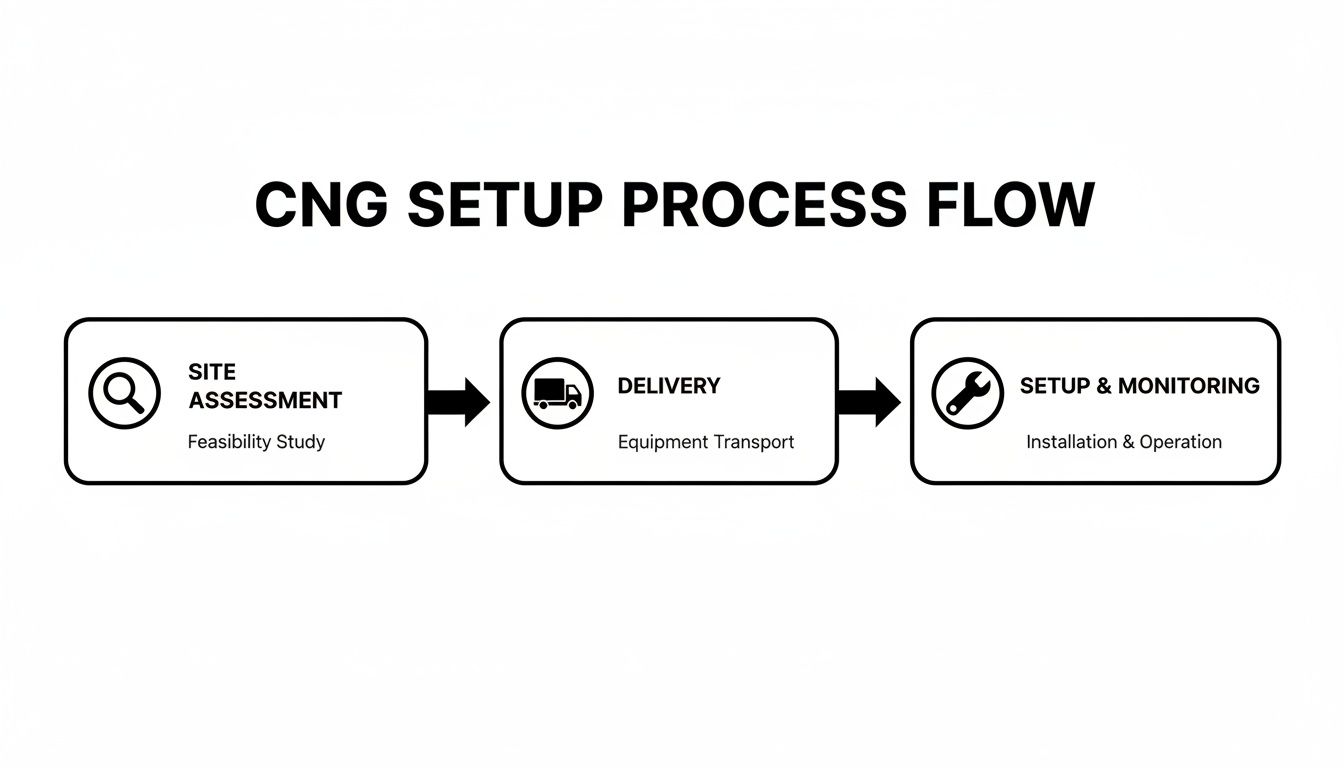
As the chart shows, every step—from the first site check to the final monitored setup—is built for speed. The goal is to get your operation online without missing a beat.
In the end, it’s best to think of temporary CNG as a high-return insurance policy for your project's bottom line. It's a strategic spend that directly shields you from much larger financial losses, keeping your timeline and your budget right where they need to be.
How to Choose the Right Mobile Gas Provider
Picking a temporary energy partner is a big deal. Your project's timeline and budget are on the line, and let's be honest, not all providers are built the same. The gap between a top-tier partner and an unreliable one can create a world of difference—one keeps your operation running smoothly, the other brings costly chaos. You have to look past the price tag and dig into what really matters: safety, reliability, and genuine expertise.
Think of it like calling in a specialized emergency crew. When things go sideways, you don't want just anyone showing up. You need a team with the right gear, a proven playbook, and a history of getting the job done right under pressure. That’s exactly the mindset you need when choosing a mobile cng oil and gas provider.
Evaluating Technical Expertise and Safety Records
The first thing you should put under a microscope is a provider's safety record. Don't be shy about it—ask for their safety stats, certifications, and any incident reports. A company that takes safety seriously will have this data ready and will be proud to show you how they protect their people and your site.
Next, you need to size up their technical know-how. The best providers have certified technicians who live and breathe the details of pressure regulation, system hookups, and 24/7 monitoring. They should be able to walk you through the specifics of their equipment, like their Pressure Reduction Unit (PRU), and explain exactly how they'll guarantee a steady, uninterrupted flow of gas to your machinery.
Assessing Fleet Quality and Response Time
A provider's promises mean nothing without the fleet to back them up. When vetting a company, it's smart to ask about their fleet management best practices, as this gives you a window into their commitment to reliability. Modern, well-maintained equipment is simply less likely to fail, and that’s a huge factor when downtime isn't an option.
Then, you need to talk about speed. How fast can they get to you? The real pros can deploy in a matter of hours, not days. This is a game-changer, especially in the fast-paced North American CNG market where new projects are popping up constantly. If you’re hit with a sudden pipeline delay, a provider who can get a unit on-site in hours can literally save your project from losing permits and revenue.
The right partner doesn’t just sell you gas; they sell you operational continuity. Their entire service model should be built around speed, reliability, and the technical skill to solve your energy gap with precision and urgency.
Key Questions for Your Potential Provider
To cut through the sales pitches, use this checklist when you're talking to potential partners. How they answer these questions will tell you everything you need to know about their professionalism and whether they're truly ready to support you.
- Safety and Compliance: Can you show me your company’s safety record and the certifications your technicians hold?
- Deployment Speed: What’s your guaranteed response time? How long from my first call until you are fully up and running on my site?
- Technical Support: Do you provide 24/7 remote monitoring and have technicians on call for the entire time you're here?
- Equipment Condition: How old are your mobile CNG trailers and pressure reduction skids, and what does your maintenance schedule look like?
- Scalability: Our volume needs are specific. Can you meet them? And more importantly, can you scale up or down if our project demands change?
By focusing on these core areas, you’ll be able to spot a premier provider who understands what's at stake and will act like a true partner in your success.
Your Questions About Mobile CNG, Answered
Jumping into any new operational solution is going to come with questions. It’s only natural. Let's tackle some of the most common ones we hear about temporary CNG, so you can get a clearer picture and feel confident about your decision.
How Fast Can I Get a Temporary CNG Unit to My Site?
One of the biggest selling points of mobile CNG is its speed. We're talking hours, not days or weeks. In a typical scenario, a professional provider can get a unit delivered, have certified technicians make the connections, and have you fully up and running in a remarkably short time after your initial call. The entire system is built for rapid response because we know downtime is expensive.
This makes it an absolute lifesaver for those urgent, "we need it yesterday" situations. Whether you're facing a last-minute building inspection or dealing with an unexpected utility cut-off that’s threatening your entire production schedule, mobile CNG can bridge that gap almost immediately.
Is CNG Safe to Use on an Active Job Site?
Absolutely. Safety is the foundation of any professional mobile CNG operation. Compressed natural gas itself has a fantastic safety record, mainly because it's lighter than air. In the very rare event of a leak, the gas simply rises and disperses into the atmosphere.
This is a huge advantage over heavier fuels like propane, which can pool near the ground and create a dangerous ignition hazard. On top of that, any reputable provider follows strict federal safety regulations, uses equipment that has been tested to extremes, and has trained experts overseeing the entire process from hook-up to disconnect.
When you bring in a professional mobile CNG service, you’re not just ordering fuel. You're getting a fully managed energy solution where safety is the top priority. The whole operation is handled by specialists who know how to maintain a secure environment on a busy site.
When Should I Choose CNG Instead of Temporary LNG?
Great question. The decision between CNG and LNG really boils down to two things: how much gas you need and for how long.
- CNG (Compressed Natural Gas) is your go-to for most temporary energy needs. Its quick, flexible setup is perfect for powering an HVAC system for a few weeks, running industrial equipment during a planned shutdown, or keeping a business online during a short-term pipeline issue.
- LNG (Liquefied Natural Gas) is the heavy-hitter, usually brought in for massive, long-term industrial projects. Think situations that demand a huge, continuous fuel supply where the logistical complexities of LNG storage and regasification are justified by the sheer volume required.
A good provider won’t just sell you a service; they’ll walk you through your specific needs to figure out which option is the most practical and budget-friendly for your project.
Will Temporary CNG Work with My Existing Equipment?
Yes, it’s designed to be a seamless plug-and-play solution. Think of a mobile CNG setup as a "utility on wheels." The key piece of technology is the pressure reduction unit (PRU). This device takes the highly compressed gas from the transport trailer and steps it down to the exact pressure your on-site equipment is built to handle.
From your team's perspective, it’s as if your boilers, dryers, or generators are still hooked up to the main utility line. There’s no need to modify your gear and no hiccups in operation. You just get a smooth, uninterrupted flow of energy.
Don't let a utility delay derail your project's timeline and budget. Blue Gas Express delivers fast, reliable, and safe mobile natural gas solutions to keep your operations moving forward. Contact us today to secure your energy bridge.