

Picture this: your own personal fuel station, right in your garage. That's essentially what a home CNG filling station is. It’s a compact appliance that hooks directly into your home's natural gas line, letting you refuel your natural gas vehicle (NGV) while you sleep. It’s the ultimate setup for convenience and serious long-term savings on fuel.
How Your Home CNG Station Actually Works
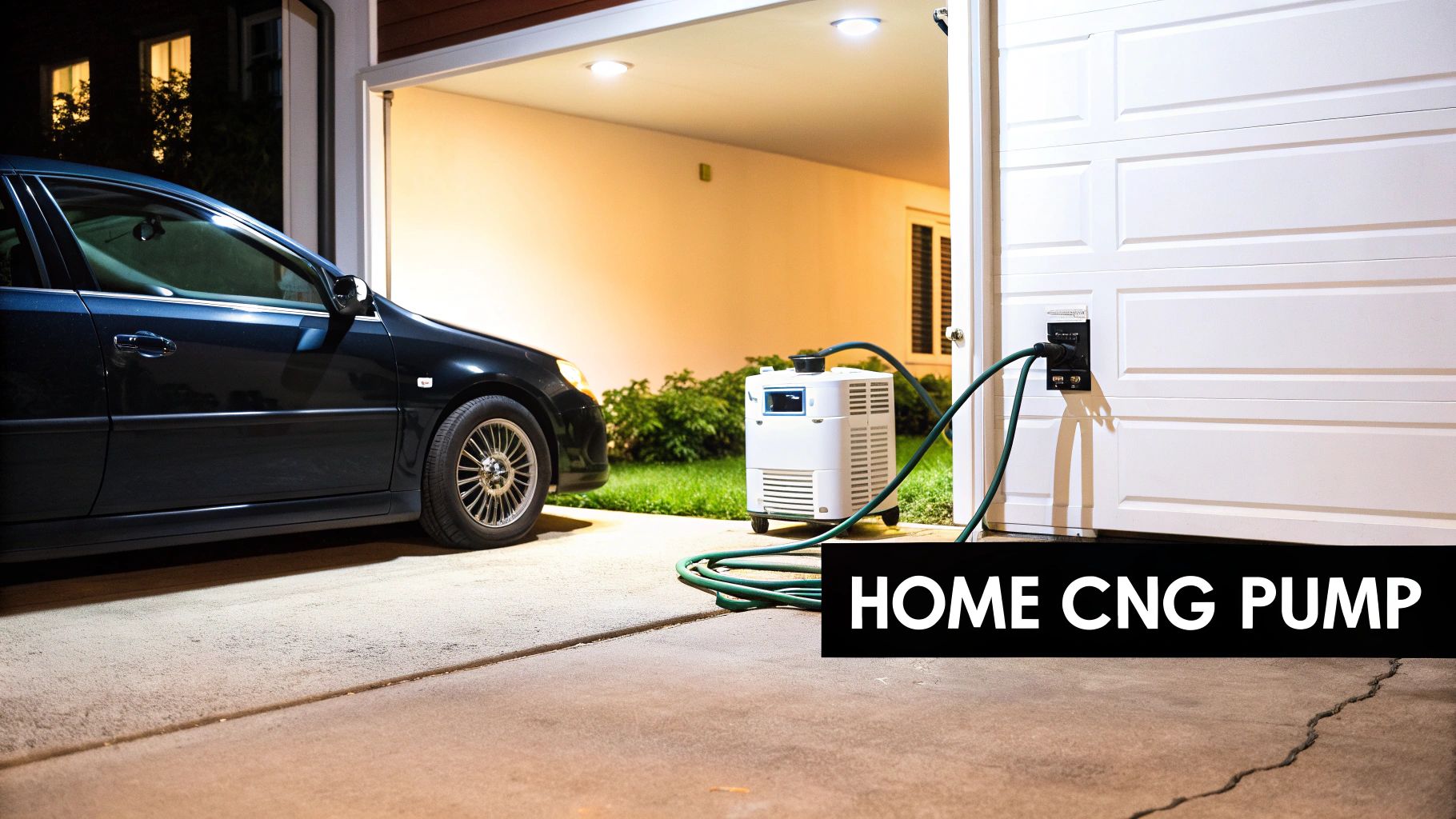
The idea of a home filling station might sound intimidating, but the process itself is surprisingly simple. Don't think of it as a complex refinery. A better analogy is a heavy-duty air compressor, but one designed specifically for natural gas. It takes the same low-pressure gas that runs your furnace and water heater and safely brings it up to vehicle-grade pressure.
The system pulls gas from your utility line, where it's typically at a very low pressure—less than 0.5 pounds per square inch (psi). The appliance then works methodically to compress that gas all the way up to 3,600 psi, the standard for NGVs. Once pressurized, the gas is ready to be transferred into your vehicle’s high-strength fuel tank. The whole operation is quiet, automated, and designed to run overnight.
The Slow-Fill Advantage
Unlike the "fill-and-go" speed of a public station, home units rely on a "slow-fill" method. This deliberate process, which can take several hours, is much gentler on the equipment and ensures the vehicle's tank is filled completely and safely every time.
This approach makes refueling just another part of your nightly routine. You pull into the garage, connect the nozzle, and wake up to a full tank. It completely removes the need for last-minute trips to the gas station, turning a recurring chore into a hands-off, automated task.
From Utility Line to Vehicle Tank
The journey of the natural gas from your home's main line to your car's fuel tank involves a few critical, automated steps. Each stage is designed to ensure the gas is clean, dry, and pressurized correctly for peak vehicle performance.
- Gas Inlet: The unit starts by drawing a slow, consistent stream of natural gas directly from your residential supply line.
- Drying and Filtration: Before anything else happens, the gas is passed through a dryer. This is a crucial step that strips out water vapor and other impurities, kind of like a powerful dehumidifier. This protects both the compressor and your vehicle's fuel system from corrosion and ice formation.
- Multi-Stage Compression: This is where the magic happens. The compressor is the heart of the unit, taking the purified gas and squeezing it through several stages. With each stage, the pressure increases until it finally hits the target of 3,600 psi.
- Dispensing: The highly pressurized gas is then sent through a durable, high-pressure hose and nozzle that connects securely to your vehicle's fueling port, where it begins the slow-fill cycle.
This straightforward yet highly effective process is what makes home CNG filling so practical. But how does it stack up against just using a public station? The table below gives a quick overview.
Home CNG Filling vs Public CNG Station At a Glance
Here’s a quick comparison highlighting the key differences between refueling at home and using a commercial public station.
| Feature | Home CNG Filling Station | Public CNG Station |
|---|---|---|
| Refueling Speed | Slow-fill (8-12 hours) | Fast-fill (3-5 minutes) |
| Convenience | Unbeatable. Refuel overnight at home. | Requires traveling to a specific location. |
| Fuel Cost | Very low (based on residential utility rates). | Higher (retail prices with commercial markups). |
| Upfront Investment | High (for equipment and professional installation). | None. |
| Best For | Daily commuters, return-to-base local fleets. | Long-distance trips, commercial fleets, occasional use. |
Ultimately, the choice comes down to your driving habits and priorities. For daily predictability and the lowest possible fuel costs, a home station is a game-changer. For spontaneity and long-haul travel, the public network remains essential.
The Gear You'll Need for an At-Home CNG Setup
So, what does it take to turn your garage into your own personal gas station? A home CNG system isn't just one magic box; it’s a team of specialized components working together to safely compress and deliver natural gas to your vehicle. Let's break down the essential pieces of the puzzle.
At the heart of the whole operation is the compressor. You can think of it as the muscle of the system. Its job is to take the low-pressure natural gas flowing into your home—the same gas that runs your furnace or stove—and squeeze it down until it reaches the high pressure needed to fill your car's tank.
This isn’t a quick crush. The compressor works in stages, methodically raising the pressure from less than 1 psi from your utility line all the way up to the 3,600 psi standard for vehicles. It's designed to do this quietly and automatically overnight, which is the whole idea behind the convenience of a home station.
The Compressor: Your System's Engine
Home compressors are known as "time-fill" or "slow-fill" units. This name tells you exactly what they're built for: a slow, steady, overnight fill, not the lightning-fast refueling you'd find at a public station. This gentler pace is actually a good thing—it's easier on the equipment, extending its life and ensuring a safe, complete fill every single time.
These units are built tough, with safety as the top priority. They’re packed with sensors and automatic shut-offs, so once you hook up your vehicle, the compressor handles the entire process on its own without you needing to babysit it.
The Dryer and Filter: Keeping Things Clean
Before the gas can even get to the compressor, it needs to be cleaned up. The natural gas from your utility line contains tiny amounts of water vapor and other impurities. At low pressure, they’re no big deal, but under extreme compression, they can cause some serious damage to both the filling station and your vehicle.
That's where the dryer and filter system steps in. It acts like a bouncer at a club, grabbing moisture and other gunk before it can get any further. This is a critical step that prevents corrosion and stops ice crystals from forming inside the high-pressure components, which is a real risk in colder climates.
A clean, dry gas supply is non-negotiable for the health of your CNG system. Skipping proper filtration is like running your car with dirty oil—it’s only a matter of time before something expensive breaks.
Clean gas ensures your cng home filling station runs efficiently and protects the intricate fuel system in your vehicle. It might be a small component, but it plays a massive role in the long-term reliability of your setup.
The Dispenser: Making the Final Connection
The last step is getting that highly pressurized gas safely into your vehicle. This is handled by a set of incredibly robust components built to manage extreme pressure without breaking a sweat.
While specialized fuel tanks are a critical part of a vehicle's CNG system, the home station has its own key dispensing hardware to connect to them.
The core equipment includes:
- The Dispensing Hose: This is no garden hose. It’s a heavy-duty, reinforced line specifically built to handle the constant stress of 3,600 psi pressure without failing.
- The Refueling Nozzle: This connector is precision-engineered to create a perfectly sealed, leak-proof link to your vehicle. It clicks securely into place and has a safety mechanism that prevents it from being removed until the pressure is released.
- Breakaway Valves: This is a genius safety feature. If someone were to forget the car was hooked up and drive off, this valve would instantly snap apart and seal both the hose and the vehicle side, preventing a dangerous gas leak.
These three systems—the compressor, the dryer, and the dispenser—all work in concert. Each one plays a vital part in transforming the ordinary natural gas in your home into a clean, cheap, and convenient fuel, ready and waiting for you every morning.
Navigating Installation and Safety Requirements
Let's be clear: installing a cng home filling station isn't a weekend DIY project. It’s a serious undertaking that requires professional expertise and a strict adherence to safety codes. Think of it less like assembling furniture and more like having a central air conditioning unit or a whole-house generator installed. You need certified experts to make sure every connection is tight, every wire is right, and the entire system is safe.
The journey from an empty spot in your garage to your first overnight fill-up always starts with a professional site assessment. A certified installer will come to your home to see if your property is a good fit. They’ll check your existing natural gas supply, take a look at your electrical panel, and find the best and safest spot for the unit, making sure it has proper ventilation and clearance.
This initial check is crucial. The installer needs to confirm your residential gas line can handle the pressure and flow without affecting your furnace or water heater. They also have to verify you have a dedicated 240-volt circuit—the same kind an electric dryer uses—or that one can be installed to power the compressor.
The Professional Installation Process
Once the site assessment gives you the green light, the real work begins. This is a multi-step job for licensed technicians who know their way around both natural gas and electrical systems. It's a coordinated effort to integrate every piece of your home station safely so it works without a hitch.
The core steps usually look like this:
- Gas Line Connection: A licensed plumber taps into your home's natural gas line, running a dedicated pipe to where the CNG unit will be. This includes installing shut-off valves and checking every connection for leaks.
- Electrical Work: A certified electrician installs the required 240-volt circuit and wires it to the compressor. This is non-negotiable for providing the stable power the unit needs to run reliably.
- Unit Mounting and Setup: The technicians will securely mount the compressor, dryer, and dispensing gear according to the manufacturer's exact specs and local codes.
- System Commissioning: After everything is installed, the entire system gets a thorough test. Technicians perform pressure tests, double-check for leaks, and run the unit through a full cycle to make sure it's operating perfectly before they hand it over.
This simple chart shows how the natural gas flows through the main components once your system is professionally installed.
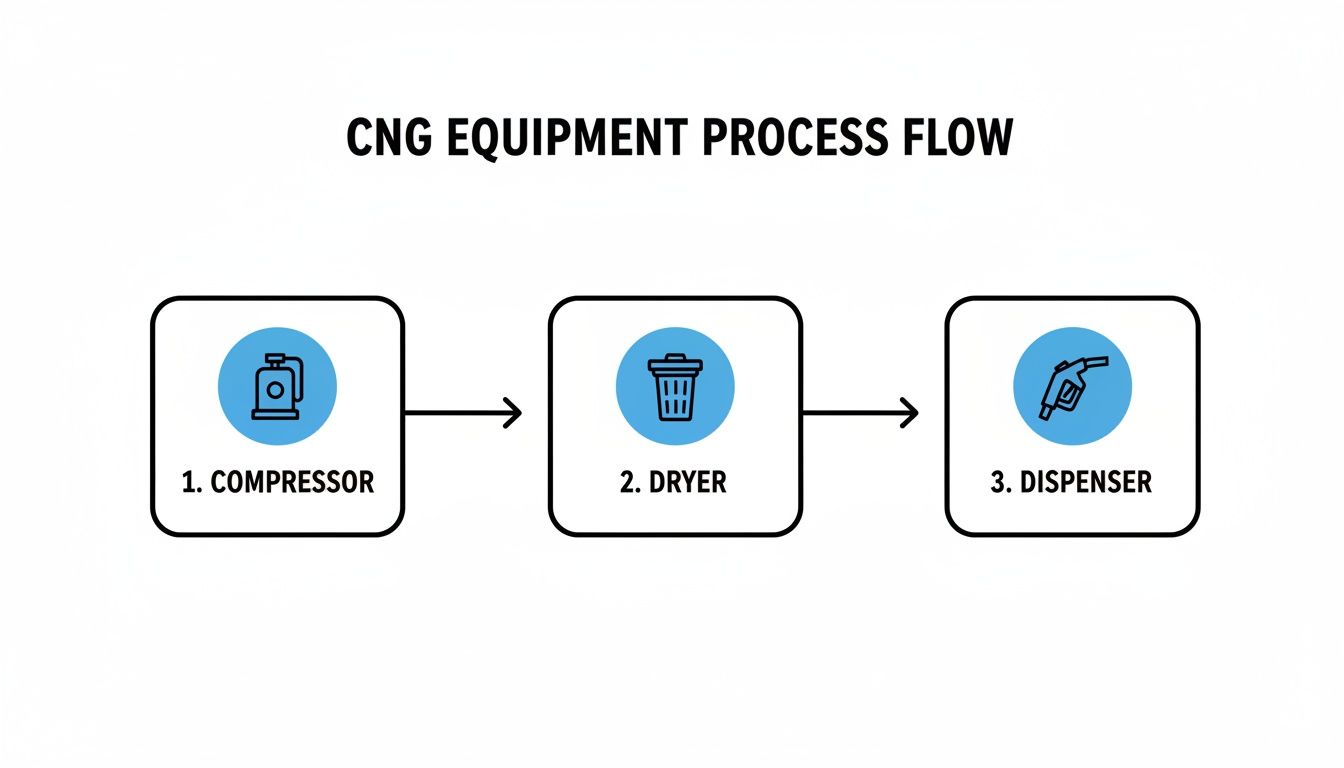
As you can see, the gas moves from the compressor, through the dryer to remove moisture, and finally to the dispenser hose that fills your vehicle.
Understanding Permits and Safety Codes
Before a single wrench is turned, your installer has to deal with local permits and regulations. This paperwork isn't optional—it's there to protect you, your property, and your neighbors. Any reputable installer will handle this entire process for you.
They’ll submit detailed plans to your local municipality to get the necessary approvals, which usually include electrical, plumbing, and a general building permit.
Safety standards from organizations like the National Fire Protection Association (NFPA) are the blueprint for a safe installation. Following these rules isn't just about ticking boxes; it’s about making sure your system works safely and reliably for years.
After the work is done, a city inspector will pay a visit for a final review. They'll confirm that the installation matches the approved plans and meets every safety code. You can only start using your new refueling station after this official sign-off. This rigorous process gives you total peace of mind, knowing your system is both legal and secure.
These strict safety protocols are the foundation of the growing global market for these stations, which was valued at USD 2.22 billion in 2024 and is helping to drive wider adoption.
Breaking Down the Costs and Long-Term Savings
Let's get down to brass tacks: what does a home CNG filling station actually cost, and when does it start paying you back? It's a serious investment, no doubt, but the math behind the long-term savings is surprisingly straightforward. To really get a handle on it, we need to look at both what you'll spend upfront and how producing your own fuel generates a powerful return over time.
The biggest ticket item is, of course, the refueling appliance itself. This isn't just any gadget; it's a highly specialized piece of equipment engineered for years of safe, reliable service. The price tag reflects the complex technology needed to compress natural gas safely right in your garage.
But the hardware is only one piece of the puzzle. Professional installation isn't just a good idea—it's mandatory for safety and to meet local codes. This means bringing in a certified technician for the natural gas plumbing and a licensed electrician to handle the wiring. You want every connection to be perfect.
Unpacking the Upfront Investment
So, what should you really budget for a complete setup? The final number can shift depending on the model you pick and the layout of your home's utilities, but the total investment usually lands in a pretty predictable ballpark.
For a residential CNG appliance that can pump out four to six Gasoline Gallon Equivalents (GGE) in an overnight fill, you're typically looking at $4,000 to $10,000. This is the core unit that unlocks all those fuel savings.
Here’s a more detailed look at how the total costs shake out:
- Refueling Unit: The main appliance will run you $4,000 to $10,000.
- Professional Installation: Expect to pay $1,500 to $3,000 for the skilled labor to hook up the gas and electrical systems.
- Permitting Fees: This varies by city, but it's usually between $200 and $500.
- Potential Electrical Upgrades: If your garage needs a new 240V circuit, plan on an extra $500 to $1,500.
When you add it all up, a complete, professionally installed system will generally set you back somewhere between $6,200 and $15,000.
Calculating Your Return on Investment
Now for the fun part: figuring out when this investment pays for itself. The entire ROI calculation boils down to one simple comparison: the price you pay for natural gas from your utility company versus the price of gasoline at the local pump.
To get a fair comparison, we convert the cost of natural gas into a Gasoline Gallon Equivalent (GGE). This gives us a true apples-to-apples number. And here's the kicker: a GGE from your home's natural gas line is drastically cheaper than a gallon of gasoline. For example, if gas is $3.50 per gallon and your natural gas works out to $1.50 per GGE, you’re pocketing a cool $2.00 in savings for every "gallon" you use.
The heart of your ROI is fuel cost displacement. Every mile you drive on home-compressed natural gas is a mile you aren't paying retail gasoline prices for. That price difference is what pays back your initial investment.
This isn't some niche idea, either. The global market for CNG filling stations was valued at around $8 billion in 2023 and is only getting bigger. The push for cleaner fuels and growing demand for fueling infrastructure across North America are driving this trend. You can learn more about the industry's growth and discover insights about the CNG filling station market.
Want to run the numbers for yourself? It's easy.
- Figure Your Annual Mileage: How many miles do you drive in a year?
- Check Your Vehicle's Fuel Economy: What’s your car’s miles per gallon (MPG) on both CNG and gasoline?
- Calculate Annual Fuel Use: Divide your yearly mileage by your MPG to see how many GGEs you'll use.
- Find Your Annual Savings: Multiply your annual fuel use by the price difference between a gallon of gas and a GGE.
- Calculate Your Payback Period: Divide the total upfront cost of the system by your annual savings.
For a lot of drivers who are on the road frequently, the payback period often works out to just two to four years. Don't forget to look into potential federal and state tax credits for clean energy projects, too. Those incentives can shorten your payback period even more, making the financial case for a home CNG station incredibly strong.
When a Mobile CNG Solution Makes More Sense
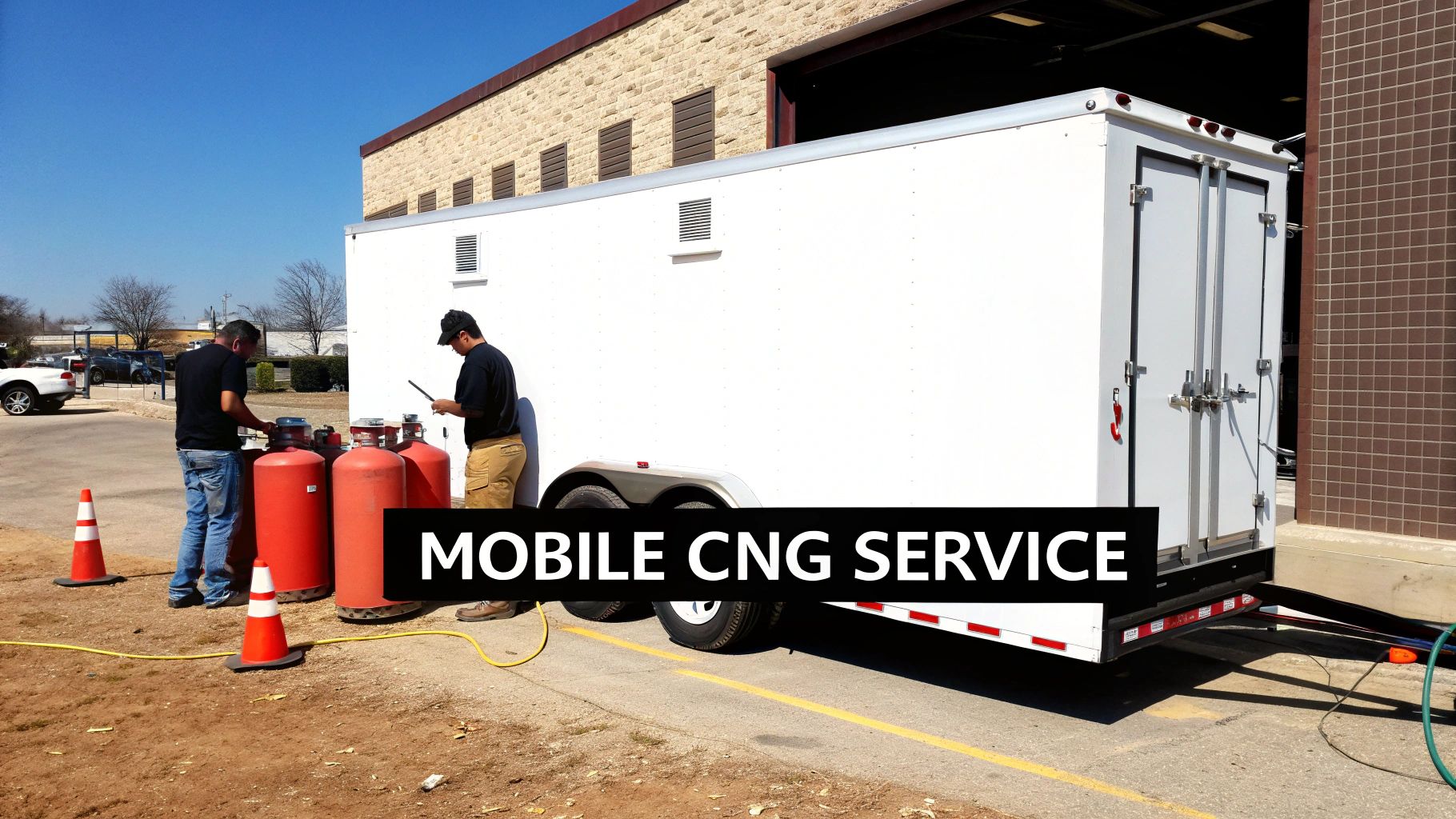
While a permanent cng home filling station is a fantastic long-term investment for many, it's not always the right tool for the job. Sometimes, you need something more flexible, immediate, or temporary. This is exactly where mobile CNG delivery services, like our team at Blue Gas Express, come into play as a smart, strategic alternative.
Think of mobile CNG as natural gas on demand, brought right to your site precisely when you need it. It’s the perfect tactical fix for logistical headaches where a permanent hookup is impossible, impractical, or just not ready yet. For projects with tight deadlines or unexpected interruptions, this approach is a total game-changer.
The real beauty of it is the agility. A mobile unit can be dispatched and set up in a matter of hours, creating a critical energy bridge without you having to invest a dime in permanent infrastructure.
Navigating Temporary Energy Gaps
Mobile CNG really proves its worth in situations where you need natural gas urgently, but only for a short time. Construction and development projects are a perfect example. We see it all the time: a new building is basically finished, but the permanent gas utility lines are still weeks, or even months, away from being turned on.
That kind of delay can bring a project to a dead stop. Without gas, you can't run heaters to keep pipes from freezing in the winter, you can't cure drywall properly, and you can't perform essential tests on the building's systems. Most importantly, you can't pass the final inspections needed for a certificate of occupancy.
For a builder or developer, a stalled project isn't just a minor hassle—it’s a direct hit to the budget. Mobile CNG delivery acts as a vital stopgap, making sure timelines stay on track and occupancy permits get signed without costly delays.
This temporary supply keeps the work moving, the project on schedule, and the budget intact. It turns a potential crisis into just another manageable step in the process.
Key Scenarios for Mobile CNG Deployment
The uses for on-demand natural gas are incredibly varied, solving problems for all sorts of industries. It’s a versatile tool that ensures you can keep the lights on when the unexpected happens or when permanent infrastructure simply isn't an option.
Here are a few of the most common situations where we get the call:
- Construction Site Power: Bringing in temporary heat keeps crews working and protects materials, allowing projects to power through cold weather long before permanent utilities are live.
- Securing Occupancy Permits: We supply the gas needed for final inspections of HVAC systems and appliances—a critical last step before a builder can hand over the keys.
- Emergency Gas Outages: When a main gas line is down for maintenance or emergency repairs, we act as a crucial backup for businesses, preventing a complete operational shutdown.
- Generator Commissioning: We can fuel new natural gas generators for all their initial testing and commissioning before they’re hooked up to a permanent supply.
This kind of flexibility is becoming more critical as the North American compressed natural gas market, which hit USD 92.21 billion in 2024, keeps growing. As demand rises, temporary solutions help fill the gaps left by the limited number of public stations. You can explore the full research on the growing CNG market to see just how important these mobile solutions are becoming.
For any business facing these kinds of challenges, mobile CNG isn't just a backup plan. It's a strategic asset that guarantees energy is there when you need it, protecting your investment and keeping your projects moving forward.
Got Questions? Here's What You Should Know About Home CNG Stations
If you're thinking about installing a CNG home filling station, you probably have some very practical questions about what it’s like to own one day-to-day. Let's tackle some of the most common things people ask before they decide to make the switch.
How Long Does It Take to Fill Up?
Forget what you know about filling up at a public station. Home units are designed for "slow-fill" convenience, meaning they top off your tank overnight while you sleep.
Most vehicles take between 8 to 12 hours for a complete fill, depending on the size of your tank and the output of your specific unit. The idea is to plug it in when you get home from work and wake up to a full tank every single morning. It’s a true set-it-and-forget-it system that lets you say goodbye to weekly trips to the pump.
What’s Involved with Maintenance?
Home CNG stations are built to be tough and reliable, requiring about as much attention as your home's furnace or air conditioner. The routine upkeep is simple and doesn't ask for much.
- Annual Filter Swap: You'll need to change out the dryer filter once a year to keep the natural gas pure and your system running clean.
- Occasional Professional Check-Up: Every few years, it's a good idea to have a certified technician give it a once-over to inspect the seals and connections, just to be safe.
The main compressor is a sealed unit, built to last for years without you ever having to touch it.
Can I Put a CNG Station in Any Garage?
Not exactly. A professional needs to come out and do a site assessment to make sure your space is a good fit. Safety and building codes are very specific here, so this step is non-negotiable.
A safe and compliant installation absolutely requires three things: proper ventilation, clear access to your natural gas line, and the right kind of electrical service. This isn't just a best practice—it's a requirement.
The installer's job is to confirm your gas line can handle the load and that you either have—or can get—a dedicated 240-volt electrical circuit. This professional sign-off is what ensures your home is ready for a CNG station.
If you're dealing with a project that has temporary natural gas needs or you're facing delays getting a permanent line installed, a mobile solution is often the best path forward. Blue Gas Express delivers CNG and LNG right to your site, keeping your operation fueled without interruption. Find out how we can help.