

At its core, a CNG fueling system is simply a way to take natural gas, compress it, store it safely, and then pump it into an engine or piece of equipment. Think of it as the natural gas equivalent of a traditional gas station, but built to handle a cleaner, more affordable fuel.
Understanding a CNG Fueling System
So, what actually happens inside one of these systems? It’s a three-step dance: compression, storage, and dispensing. The whole setup is designed to safely pressurize natural gas so it can be stored in tanks and used on demand. Getting a handle on this basic workflow is the first step to seeing how CNG can be a practical energy solution.
- Compression: This is where it all starts. Powerful compressors take natural gas from a pipeline and squeeze it down, raising its pressure significantly.
- Storage: The compressed gas is then moved into a series of high-pressure cylinders or vessels, where it’s held securely until it's needed.
- Dispensing: Finally, a dispenser with a metered nozzle transfers the gas from the storage tanks into the vehicle or equipment’s fuel tank.
By switching from diesel or gasoline, users often see a dramatic drop in emissions like carbon monoxide and nitrogen oxide. For fleet managers, the benefits are tangible: engines run quieter, and maintenance costs tend to go down. It all adds up to smoother operations and a smaller environmental footprint.
Benefits of CNG Solutions
The advantages go beyond just being green. Many operators find they can cut their fuel costs by up to 30% compared to gasoline. It also makes it easier to stay ahead of increasingly tough emissions regulations. CNG isn't just for one type of vehicle either—it's incredibly versatile, powering everything from city buses to critical backup generators.
The market is taking notice. The global CNG fueling system market was recently valued at around $5 billion and is expected to grow at an 8% compound annual growth rate between 2025 and 2033. This growth is a clear signal of strong support from both environmental policy and industry adoption. You can dig deeper into these numbers by reading the full report on MarketReportAnalytics.
Key Takeaway: One of the biggest strengths of CNG fueling systems is their modular design. This allows them to be scaled for anything from a massive highway refueling station to a temporary mobile unit that can be brought right to a job site.
This flexibility means CNG systems are showing up everywhere. They’re a natural fit for public transit depots looking to clean up urban air, but they’re also becoming essential for industrial operations.
Primary Applications
You'll find CNG fueling systems in a surprisingly wide range of places:
- Transit Fleets: Helping cities reduce emissions and noise pollution.
- Emergency Backup: Keeping hospitals and data centers running during power outages.
- Mobile Fueling: Bringing fuel directly to construction sites, remote work zones, and special events.
Whether you're thinking about building a permanent station or need a temporary mobile setup from a provider like Blue Gas Express, it’s crucial to understand the design, safety, and regulatory side of things. In the next few sections, we'll get into the nitty-gritty of how these systems work, what components to look for, and the rules you need to follow.
What You Will Learn
This guide is designed to give you a complete picture. We'll cover:
- The fundamental principles of gas compression and high-pressure storage.
- The key differences between "fast-fill" and "time-fill" stations.
- Essential safety features, from leak detection to emergency shutdown systems.
- How to estimate costs and choose the right provider, whether it's a permanent installation or a mobile service like Blue Gas Express.
We’ll build on these core concepts step-by-step, giving you the practical knowledge needed to confidently move your project from an idea to a fully commissioned system. You’ll walk away with checklists, real-world examples, and the best practices needed to make the switch to cleaner, more cost-effective CNG.
Let’s get started.
How a CNG Fueling System Works Step By Step
Breaking down a CNG fueling installation into stages makes the process easy to follow. At its core, the system handles four critical functions: receiving, purifying, compressing, and dispensing natural gas. Each stage transforms low-pressure pipeline gas into a high-pressure fuel ready for vehicles.
Think of it like filling a scuba tank. You draw in a huge volume of air, squeeze it down with a compressor, and store it in a compact cylinder. A CNG station does the same—only with natural gas and at pressures high enough to power engines.
Stage 1: Gas Reception And Purification
The journey starts when natural gas arrives from a utility pipeline at around 60 psi, far too low for vehicle fueling. This incoming gas carries moisture, oil droplets, and dust that must be removed before compression.
To protect sensitive equipment and ensure engine reliability, the gas flows through a series of high-efficiency filters and a dedicated dryer. A spotless gas supply is non-negotiable for safe, long-term operation.
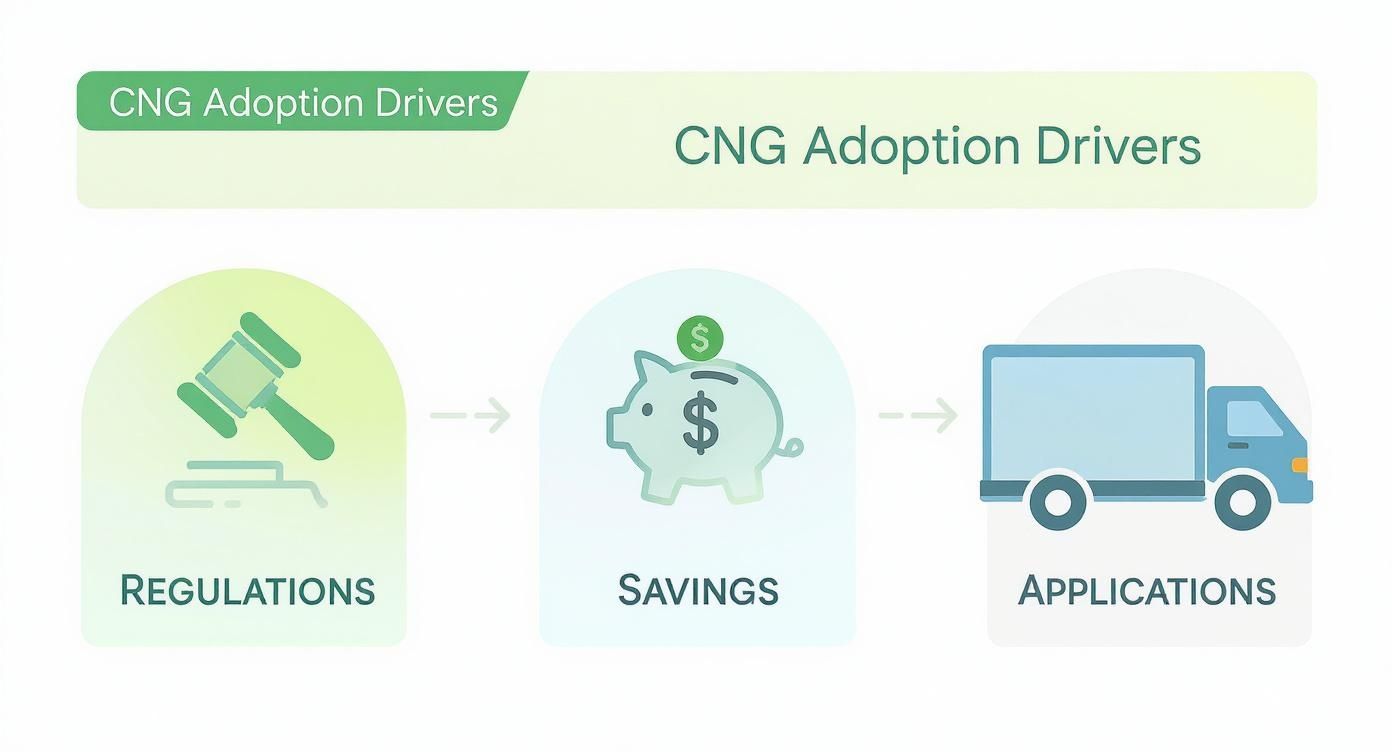
This visual lays out why companies are adopting CNG: to meet regulations, cut fuel costs, and tap into a versatile energy source.
Stage 2: Compression And High-Pressure Storage
Once purified, the gas enters the compressor. In multiple steps, pressure climbs from pipeline levels up to 3,600 to 4,500 psi.
After compression, the gas moves into a “cascade” of storage vessels. Banks are arranged as low, medium, and high pressure so the fill process happens in stages:
- Draw from the low-pressure bank first
- Switch to medium once pressures even out
- Finish with the high-pressure bank to top off
This sequence speeds up fills and reduces the load on the compressor during peak demand.
Stage 3: Dispensing The CNG Fuel
Fueling a vehicle involves a dispenser that resembles a standard gas pump but is built for high pressure. Its main parts include:
- A Meter: Tracks volume in Gasoline Gallon Equivalents (GGE) or cubic feet
- Hoses and Nozzles: Rated for 4,500 psi and designed for a leak-proof seal
- Breakaway Couplings: Separate cleanly if a driver pulls away too soon
Behind the scenes, a control system constantly monitors flow rates, pressures, and safety interlocks. The result? A fast, accurate, and secure fill every time.
A Look Inside CNG Fueling Systems: Components and How They Work
To really get a feel for how a CNG fueling system works, you have to look under the hood at its core hardware. These aren't just simple pipes and valves; they're a symphony of precisely engineered components, all designed to work together and handle natural gas under incredible pressure. Every single part has a critical job to do in getting that fuel where it needs to go, safely and efficiently.
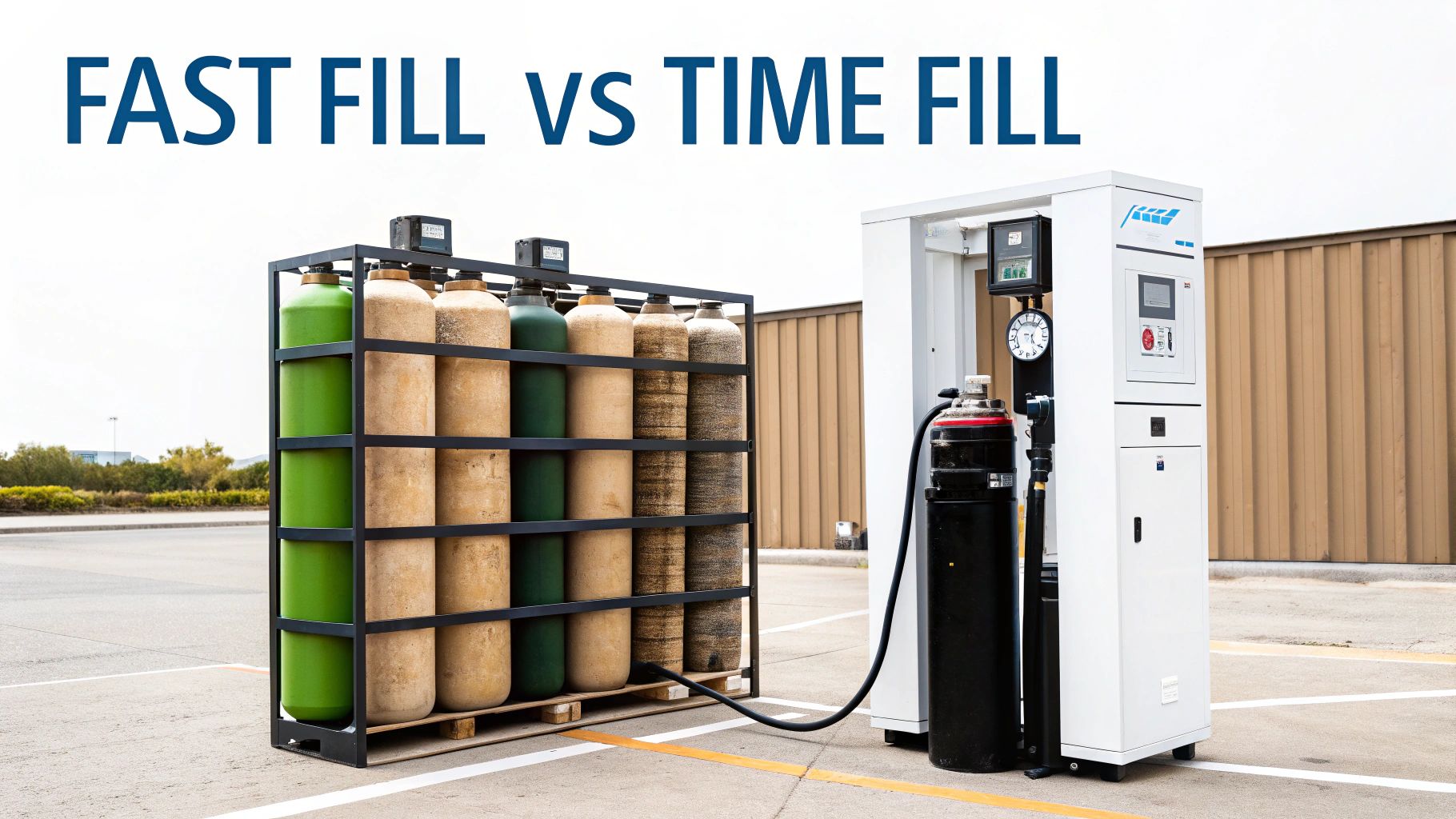
This interconnected machinery is the true backbone of the CNG industry. And it's a rapidly growing one. The global market for compressed natural gas is expected to jump by USD 32.28 billion between 2025 and 2029, climbing at a steady 9% CAGR. This boom is largely thanks to the rising popularity of CNG vehicles, especially in places like the Asia Pacific region. If you're interested in the market trends, Technavio offers some great insights into this expansion.
The Compressor: The Heart of the System
The compressor is the real workhorse of any CNG setup. Its job is to grab low-pressure natural gas straight from a utility line and squeeze it down, boosting its pressure up to a whopping 4,500 psi. This doesn't happen all at once. The gas goes through multiple stages of compression, with cooling periods in between to manage the intense heat and keep the process efficient.
Think of the compressor as the system's heart. It's constantly pumping high-pressure gas—the lifeblood of the operation—through the entire network. A tough, reliable compressor is absolutely essential for consistent performance, especially for demanding applications like a public bus depot or a large commercial fleet yard.
High-Pressure Vessels: Secure Storage
Once the gas is compressed, it needs a safe place to hang out until it's needed. That's where high-pressure storage vessels come in. These are incredibly durable, thick-walled cylinders, often set up in what’s known as a "cascade" system.
This cascade setup usually has three groups, or banks, of cylinders: one for low, one for medium, and one for high pressure. When a vehicle starts to fuel up, it pulls gas from the low-pressure bank first. As the pressure between the vehicle's tank and the storage bank starts to even out, the system smartly switches over to the medium bank, and then finally to the high-pressure bank to finish the job. This clever sequence makes for a much faster and more complete fill, all while putting less strain on the compressor.
Dispensing and Safety: The Final Touches
The last pieces of the puzzle are the ones you actually see and interact with, along with the safety gear that keeps everything in check.
- The Dispenser: It might look a lot like a regular gasoline pump, but it's built to handle high-pressure gas. It has a meter to track how much fuel is dispensed (typically measured in Gasoline Gallon Equivalents, or GGEs), heavy-duty hoses, and a special nozzle that clamps on to create a perfect, leak-proof seal with the vehicle.
- Priority and Sequencing Panels: These are the brains of the cascade system. They direct the gas flow from the right storage bank to the dispenser at the right time, making the whole filling process as fast as possible.
- Emergency Shutdown Devices (ESDs): You'll find these big red buttons or levers in key spots. In an emergency, a single push can instantly shut off the gas flow, isolating the system to prevent any accidents.
- Breakaway Couplings: A simple but brilliant safety feature on the dispenser hoses. If a driver ever pulls away without unhooking the nozzle, this coupling is designed to snap apart cleanly, automatically sealing both the hose and the nozzle to stop a gas leak in its tracks.
System Analogy: The easiest way to think about the two main types of stations is this: A fast-fill station is like your typical gas station. You pull up, fill your tank in a few minutes, and you're on your way. A time-fill system, on the other hand, is more like plugging in an electric car overnight. Vehicles are hooked up to fueling posts and refuel slowly over many hours, which is perfect for fleets that all return to the same base every night.
When you understand how these individual parts work together, you start to see the ingenuity that goes into a modern CNG fueling system. Each piece is carefully chosen to strike the perfect balance between performance, safety, and cost, creating a reliable foundation for cleaner energy.
Stationary vs Mobile CNG Systems: Which Is Right For You
Choosing a CNG fueling solution isn’t just about picking pumps and compressors. It’s about aligning your fuel delivery model with your operational needs. A stationary system sits permanently on your site, hooked up to a pipeline for steady, high-volume use. A mobile CNG system brings fuel directly to you—no pipeline required. Deciding between the two can save time, money, and headaches down the road.
Understanding Stationary Systems
Stationary CNG setups shine when demand is consistent and predictable. Once you’ve covered the initial investment, your per-gallon cost plummets.
Building one, however, takes time:
- Long Lead Times: Permits, site prep, and construction often stretch for months—or even a year.
- High Upfront Costs: Land acquisition, specialized equipment, and installation add up.
- Inflexibility: You’re locked into the site. Moving the station isn’t an option.
In short, if you manage a large fleet from a fixed location—think municipal transit or major distribution centers—a stationary station can be a strong, long-term play.
The Agility Of Mobile CNG Fueling
When speed and adaptability matter most, mobile CNG units answer the call. Instead of waiting on pipelines, you get fuel delivered on trailers—fast.
Imagine a construction site that needs to fire up its generator to meet an occupancy deadline but hasn’t yet tied into the utility gas line. A mobile unit can roll in within hours, keeping your schedule on track without a single delay.
A mobile CNG fueling system effectively decouples your operation from the constraints of physical pipelines. It lets you tap into clean, reliable natural gas power wherever you need it, turning logistical hurdles into routine fueling appointments.
Globally, the CNG market stood at USD 91.11 billion and is expected to climb to USD 132.32 billion by 2035, growing at a 3.45% CAGR. For a deeper dive, check out this global CNG market analysis by Spherical Insights.
Here is an image of a public CNG fueling dispenser, which is a common sight at stationary facilities.
This dispenser highlights the user-facing part of a permanent installation, showing how familiar the fueling process can be for drivers accustomed to traditional fuels. Mobile systems often use a similar dispensing setup, just connected to a mobile storage trailer instead of fixed tanks.
Below is a side-by-side look at the two approaches.
Comparison of Stationary and Mobile CNG Systems
| Feature | Stationary System | Mobile System |
|---|---|---|
| Installation Time | Months to over a year for permitting, site prep, and build | Hours to days for drop-off and setup |
| Capital Expenditure | High initial outlay (land, pipeline, equipment) | Lower upfront cost; pay-as-you-go model |
| Operating Cost (Per Gallon) | Lowest long-term cost once operational | Slightly higher per-gallon price but no infrastructure fee |
| Flexibility | Fixed location | Deployable to remote or temporary sites |
| Scalability | Scalable on-site with additional dispensers or compressors | Add trailers or swap units for extra capacity |
| Ideal Use-Cases | Centralized fleets, transit depots, large distribution centers | Construction projects, generator commissioning, emergencies |
Whether you lean toward a permanent station or a mobile unit, weigh factors like budget, timeline, and operational footprint. Both solutions deliver clean energy—but your choice will shape how quickly and cost-effectively you tap into CNG.
Navigating Safety Standards and Regulations
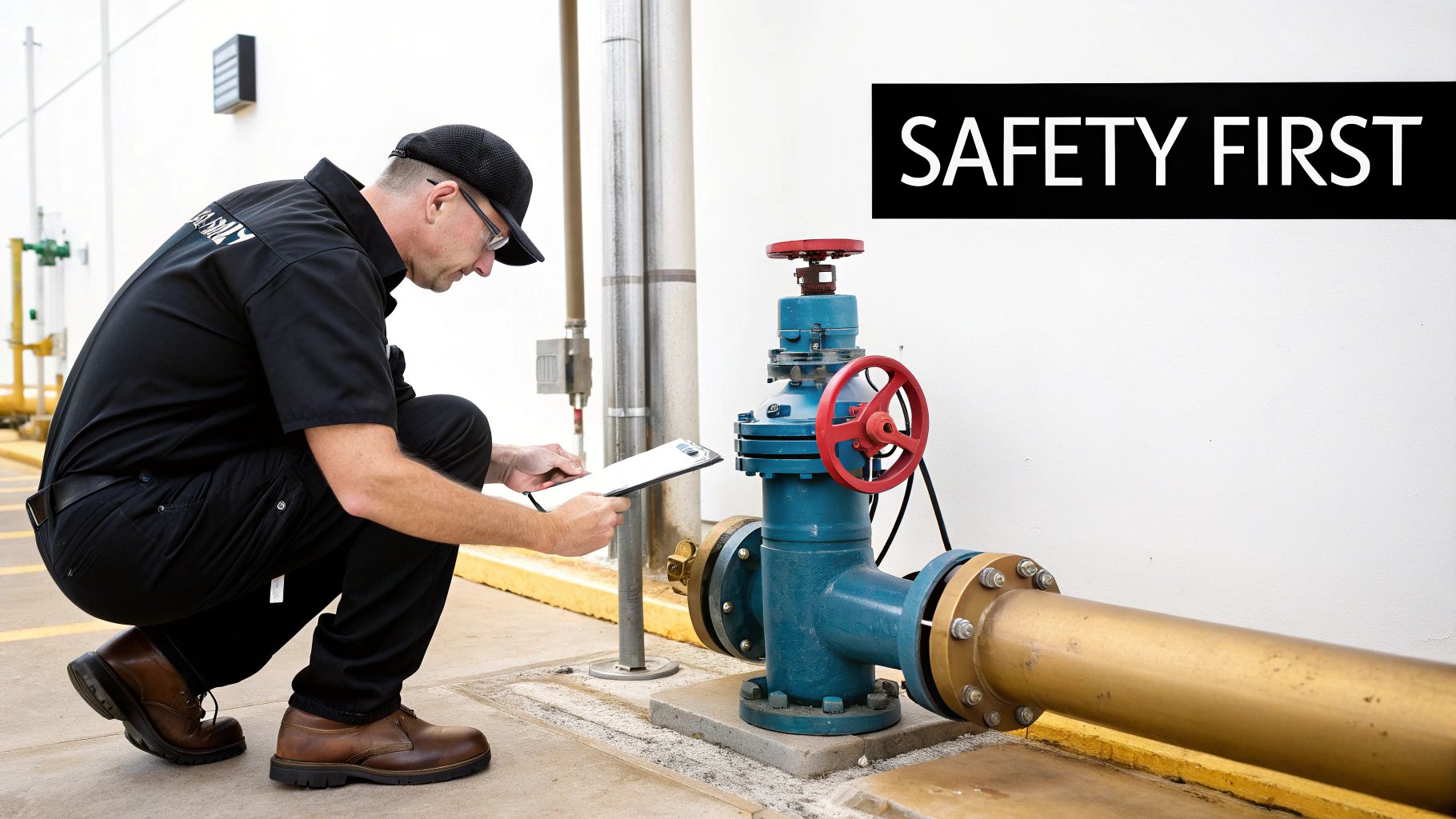
When you're dealing with high-pressure natural gas, there’s absolutely no room for error. A rock-solid commitment to safety protocols and regulatory compliance isn’t just a good idea—it's essential.
You can think of a CNG fueling system as a complex machine where every single part has to work perfectly to keep things safe. One small failure can cascade, which is why the rules are so strict.
I remember a project commissioning a remote generator out in Virginia. The built-in gas detectors went off, alerting our technicians to a tiny leak. Because they were there, we caught it and fixed it before it could become a real problem. That’s a perfect example of why these systems—leak detection, emergency shutdowns, regular inspections—are non-negotiable lifesavers.
Key Safety Standards
Codes like NFPA 52 are the bible for CNG station design, installation, and daily operations. They literally provide the blueprint for doing things the right way.
NFPA 52 gets into the nitty-gritty, covering everything from gas detection and ventilation needs to emergency response plans.
- NFPA 52 dictates the precise location and spacing for dispensers to prevent gas from building up in a confined space.
- ANSI/AGA guidelines focus on compressor safety and the exact specifications for pressure relief valves.
- Local fire codes are the final gatekeeper, requiring permit reviews and on-site inspections before any fuel line can be activated.
While these codes are specific to CNG, they fit within a larger framework of industrial safety. For anyone new to this space, looking at some general industrial safety guidelines is a great starting point.
Leak Detection and Monitoring
You can't see or smell natural gas in its pure form, so continuous monitoring is your first and best line of defense.
- Fixed gas detectors are installed around storage vessels and dispensers, acting as a constant watchdog.
- Technicians use portable "sniffer" devices during their routine checks to find issues the fixed sensors might miss.
- Everything is tied into a SCADA system that logs sensor data and can trigger automatic alarms.
This layered approach is all about deliberate redundancy. If one sensor fails, others are there to back it up, so a single point of failure doesn't become a disaster. Our teams on the ground run hourly patrols, and any alarm initiates an immediate, formal shutdown procedure.
Emergency Shutdown Systems
Think of an emergency shutdown system (ESD) as a giant circuit breaker. The moment it detects an overload or a dangerous condition, it cuts everything off.
- Manual ESD buttons are placed in easy-to-reach spots, like near the dispensers.
- The system can trigger an automatic shutdown if it detects dangerously high pressure.
- Control room operators can also activate the remote ESD if they spot a problem on their monitors.
“A swift shutdown can mean the difference between a minor incident and a catastrophic event,” notes a CNG safety inspector.
You have to know these systems will work when you need them. That's why we test our ESDs regularly—ideally on a monthly basis—to ensure they perform flawlessly under real-world conditions.
Routine Inspections and Maintenance
Constant vigilance is key. Routine inspections are designed to spot normal wear and tear before it evolves into a genuine hazard.
- Visual inspection of all valves, hoses, and fittings.
- Pressure testing on storage vessels is done annually.
- Calibration of flow meters and detectors happens biannually.
Every inspection is documented in a detailed compliance log. This not only keeps auditors happy but, more importantly, it creates a paper trail that helps prevent accidents. This process builds accountability and fosters a true culture of safety where it's everyone's top priority.
| Component | Inspection Frequency | Purpose |
|---|---|---|
| Gas Detectors | Monthly | Verify alarm thresholds |
| Valves and Fittings | Quarterly | Check for leaks |
| Storage Vessels | Annually | Pressure integrity test |
A clear, documented schedule keeps the whole team aligned and ensures nothing gets missed.
Regulatory Engagement And Permits
The permitting process can be a headache, but talking to the authorities early and often makes it much smoother.
- Start by submitting detailed site plans showing all equipment placement and safety zones.
- Keep an open line of communication with utility providers and the local fire marshal to get their approvals.
Being proactive like this helps avoid frustrating delays and builds a good working relationship with the inspectors. You also have to track your permit timelines carefully to make sure nothing expires mid-project.
Ultimately, staying ahead of regulations is about smart planning and transparent communication. Combine that with regular training so your team knows not just the "why" but the "how" of responding under pressure. A strong safety culture is what turns a regulatory checklist into a living, breathing system that protects people, property, and your entire operation.
Evaluating Costs And Making The Right Choice
Choosing a CNG fueling solution starts with a clear view of upfront outlays and long-term operating costs. You’re not just buying compressors or storage vessels; you’re investing in site prep, permits, and years of upkeep.
Think of it like deciding between buying a house and renting an apartment. A permanent station is your home purchase—large upfront costs for land, construction, and equipment, but the lowest per-gallon fuel cost over time. A mobile service, such as those offered by Blue Gas Express, is more like renting—you skip the big capital expense and pay only for what you use, getting fuel delivered in days or even hours.
Breaking Down The Costs
When you tally up expenses for a stationary CNG station, equipment is just the beginning. Initial outlays for a full build can range from $500,000 to over $2 million, depending on size and complexity.
Key cost components include:
- Equipment: Compressors, storage cascades, dryers, and dispensers form the core investment.
- Site Preparation: Concrete pads, electrical hookups, safety barriers and landscaping add both time and money.
- Permitting And Engineering: Meeting local codes and securing approvals often involves hiring specialists.
Mobile CNG solutions shift that spending into a predictable operational expense. You avoid large capital costs and instead pay based on your fuel usage and the length of service—perfect for temporary needs like short-term generator testing or bridging a pipeline outage.
Cost And Deployment Timeline For CNG Options
Below is an overview of estimated capital costs and deployment timelines for different CNG fueling configurations. Use these figures as a starting point when weighing your options.
| Option | Typical Cost Range | Deployment Timeline |
|---|---|---|
| Stationary System | $500,000 – $2+ million | 12–18 months |
| Mobile Fueling Unit | Operational expenses only | Days to a few weeks |
This table highlights rough ranges—you’ll refine your budget once you define capacity, location, and local permitting requirements.
A Practical Buyer Checklist
Before you reach out to providers, work through these questions. They’ll help you match your needs to the right CNG fueling approach.
What Is Your Daily Fuel Demand?
Estimate your total Gasoline Gallon Equivalents (GGE) per day. Oversizing wastes money; undersizing creates delays.What Is Your Project Timeline?
Do you need fuel next month, or next year? Stationary builds often take 12–18 months from start to finish. Mobile setups can be on-site in a matter of days.
Choosing a provider isn’t just about price—it’s about reliability and field experience. The right partner anticipates logistics challenges and prevents costly downtime.
What Are Your Site Constraints?
Is there enough space for tanks and compressors? Do you have access to a natural gas line? If space or utility connections are tight—or if you’re on a short-term project—a mobile solution usually makes more sense.How Important Is Scalability?
Will your needs grow? You can expand a stationary station, but it often means more capital. Mobile services scale up simply by adding extra trailers or deliveries.
By walking through these points, you’ll develop a clear profile of the CNG fueling system that fits your budget and your operations—today and down the road.
Common Questions About CNG Fueling Systems
When you're thinking about switching to a cleaner fuel like CNG, the big-picture benefits are clear. But it’s the practical, day-to-day questions that really matter for the fleet managers and engineers making the call. Let's break down some of the most common things people ask when they're getting into the nitty-gritty of CNG.
These questions usually boil down to things like system size, how long it takes to fill up, and what it takes to keep everything running smoothly. Getting these details right from the start is the key to making sure your new fueling setup actually works for your operation.
How Do We Figure Out the Right System Capacity?
Sizing a CNG fueling system isn't a shot in the dark; it's all about your data. The first thing you need to do is figure out how much fuel your fleet actually uses in a day. We measure this in Gasoline Gallon Equivalents (GGE).
Let's say you run a fleet of 50 trucks, and each one burns through about 20 GGE a day. That's a total daily demand of 1,000 GGE. You’d want to size your compressor and storage cascade to easily handle that, probably adding a buffer of 15-20% to account for busy days or future growth. Sizing it right means no one is ever waiting in line for fuel.
What Really Affects Refueling Times?
How quickly you can fill a CNG tank depends on a few moving parts. It’s a bit of a dance between what the station can deliver and what the vehicle's tanks can take.
Here are the main variables that come into play:
- Outside Temperature: Gas is denser when it's cold, so you can actually get a more complete fill. On a hot day, the gas expands, which can make refueling take a little longer.
- Station Pressure: A station with a fully-pressurized, high-pressure storage bank is going to fill vehicles a lot faster. If the station's storage is low, the fill will be slower.
- Vehicle Tank Size: This one's pretty straightforward—bigger tanks take more time to fill. A city bus will be at the dispenser longer than a light-duty pickup.
A well-designed fast-fill station can get a typical truck back on the road in just 5 to 10 minutes, which feels a lot like a normal stop at a diesel pump.
What Does a Typical Maintenance Schedule Look Like?
With any high-pressure system, staying on top of maintenance is non-negotiable for both reliability and safety. CNG systems are built tough, but they need regular check-ups to stay in peak condition.
A consistent maintenance program does more than just prevent breakdowns; it ensures the system operates safely and efficiently, protecting both your assets and your team.
A good preventative maintenance plan has a few different layers, from daily checks to annual deep dives.
Common Maintenance Tasks and Frequencies
| Task | Frequency | Purpose |
|---|---|---|
| Daily Visual Inspections | Daily | A quick walk-around to spot obvious leaks, damage, or weird noises. |
| Filter Changes | Quarterly | Swapping out coalescing and particulate filters to keep the gas pure. |
| Compressor Oil Analysis | Semiannually | A "blood test" for your compressor to check the health of its core parts. |
| Safety Valve Testing | Annually | Making sure all the emergency shutdown and pressure relief systems work perfectly. |
Sticking to a schedule like this is how you minimize downtime and get the most life out of your equipment. It turns maintenance from a reactive headache into a strategic asset, ensuring your CNG station is a reliable workhorse for years.
For projects with immediate fuel needs that can't wait for a permanent station, Blue Gas Express provides temporary mobile CNG solutions that can be deployed in hours. Learn how we can keep your operation running without interruption.